Showing posts with label Matins. Show all posts

Wednesday, January 21, 2015

The Joy of the Psalms

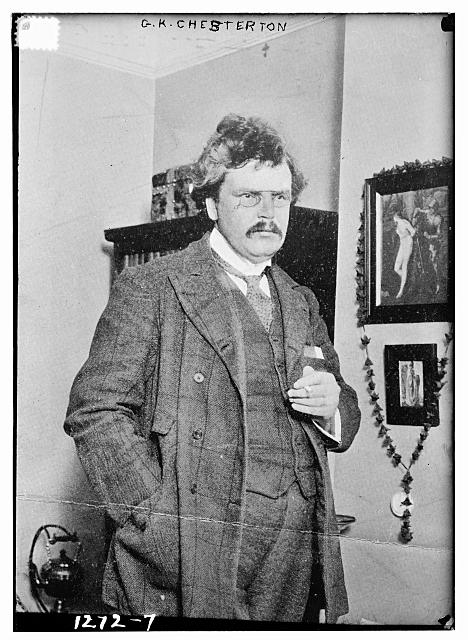
Deo gratias, I have been putting into practice, in some small way – I hope – the advice tendered by this blog's title, Psallite sapienter; for as Chesterton once said, if something's worth doing, it's worth doing badly. In other words, ever since Sunday the 28th of December, I have resumed reciting the Day Hours from the Roman Breviary of 1962.

I find that the nine psalms of Matins "occasions psychological difficulties", but, since the Feast of the Holy Family (EF) I have adopted an expedient, whereby I say a shortened Matins, including but three psalms out of the nine, omitting the other six: it's not the Office as it should be, but it's better than nothing.

UPDATE: For any who may be interested, I have determined to choose three out of the nine Matins psalms according to the following cycle, so that every three weeks I read over all of them.


Selection of Psalms for Shortened Matins

1st Sunday of Advent & week following 3 Pss of Noct. 1
2nd Sunday of Advent & week following 3 Pss of Noct. 2
3rd Sunday of Advent & week following 3 Pss of Noct. 3
4th Sunday of Advent & week following 3 Pss of Noct. 1
Christmas      9 Pss as given
Sunday in Christmas Octave & week following 3 Pss of Noct. 2
H. Name (Sun. aft. Xmas Oct.*) & week following 3 Pss of Noct. 3
[* if it occur]
Epiphany 9 Pss as given
1st Sunday after Epiphany & week following 3 Pss of Noct. 1
2nd Sunday after Epiphany & week following 3 Pss of Noct. 2
3rd Sunday after Epiphany & week following 3 Pss of Noct. 3
4th Sunday after Epiphany & week following 3 Pss of Noct. 1
5th Sunday after Epiphany & week following 3 Pss of Noct. 2
6th Sunday after Epiphany & week following 3 Pss of Noct. 3
Unused Sundays after Epiphany used before the Last after Pentecost
Septuagesima & week following 3 Pss of Noct. 1
Sexagesima & week following  3 Pss of Noct. 2
Quinquagesima & week following  3 Pss of Noct. 3
1st Sunday in Lent & week following  3 Pss of Noct. 1
2nd Sunday in Lent & week following  3 Pss of Noct. 2
3rd Sunday in Lent & week following  3 Pss of Noct. 3
4th Sunday in Lent & week following  3 Pss of Noct. 1
1st Sunday of the Passion & week following 3 Pss of Noct. 2
Palm Sunday & week following 3 Pss of Noct. 3
Last 3 Days of Holy Week 9 Pss as given
_________________________________________________
Traditional Dominican Practice:
Easter Octave 3 Pss as given
1st Sunday & Week after the Easter Octave 3 Pss of Noct. 1
2nd Sunday & Week after the Easter Octave 3 Pss of Noct. 2
3rd Sunday & Week after the Easter Octave 3 Pss of Noct. 3
4th Sunday & Week after the Easter Octave 3 Pss of Noct. 1
5th Sunday & Week after the Easter Octave 3 Pss of Noct. 2
Sunday & following Ferias after the Ascension 3 Pss of Noct. 3
Pentecost Octave (Whitsuntide) 3 Pss as given
________________________________________________

Trinity Sunday (1st after Pent.) & week following 3 Pss of Noct. 1
2nd Sunday after Pentecost & week following 3 Pss of Noct. 2
3rd Sunday after Pentecost & week following 3 Pss of Noct. 3
4th Sunday after Pentecost & week following 3 Pss of Noct. 1
5th Sunday after Pentecost & week following 3 Pss of Noct. 2
6th Sunday after Pentecost & week following 3 Pss of Noct. 3
7th Sunday after Pentecost & week following 3 Pss of Noct. 1
8th Sunday after Pentecost & week following 3 Pss of Noct. 2
9th Sunday after Pentecost & week following 3 Pss of Noct. 3
10th Sunday after Pentecost & week following 3 Pss of Noct. 1
11th Sunday after Pentecost & week following 3 Pss of Noct. 2
12th Sunday after Pentecost & week following 3 Pss of Noct. 3
13th Sunday after Pentecost & week following 3 Pss of Noct. 1
14th Sunday after Pentecost & week following 3 Pss of Noct. 2
15th Sunday after Pentecost & week following 3 Pss of Noct. 3
16th Sunday after Pentecost & week following 3 Pss of Noct. 1
17th Sunday after Pentecost & week following 3 Pss of Noct. 2
18th Sunday after Pentecost & week following 3 Pss of Noct. 3
19th Sunday after Pentecost & week following 3 Pss of Noct. 1
20th Sunday after Pentecost & week following 3 Pss of Noct. 2
21st Sunday after Pentecost & week following 3 Pss of Noct. 3
22nd Sunday after Pentecost & week following 3 Pss of Noct. 1
23rd Sunday after Pentecost & week following 3 Pss of Noct. 2
Any unused weeks after Epiphany inserted here
24th Sunday after Pentecost & week following 3 Pss of Noct. 3


This method is based on that of the Dominican Breviary, which employs only three psalms at Matins for the whole of Eastertide (as indicated above) – in addition to the practice in the Roman Breviary, whereby only three psalms are said at Matins during Easter Week and Whitsuntide.

In addition, it is well-known that Matins of the Little Office of Our Lady contains only three psalms, while in the Office of the Dead one may read either one Nocturn, or all three.

As there are a maximum of 53 Sundays in the year, and Matins during the Octaves of Easter and Pentecost already have their assigned psalmody of three psalms, this scheme spreads the recitation of the psalms at Matins over a three-week cycle that, ideally, repeats 17 times a year. (In reality, of course, this neat pattern is likely to be broken…)

In any case, it has really helped me, this return to prayer, even if not to the full Hours, as I love the psalms and the cycles of the liturgy; so to God be the glory.

Wednesday, December 5, 2012

Monastic Responsory for Advent

The Breviarium Monasticum contains 61 Matins Responsories for use during Advent (not counting two  that differ merely in their versicle); of these, the Roman Breviary contains 57, that is, all but four (and the two that appear in the former twice, with differing versicles, it contains but once).

Here is one of the "missing Responsories" enjoyed only by select Benedictines; it doesn't appear in the Office for a little while yet, as it is the fourth Matins Responsory for the 3rd Sunday of Advent, but I like the words, with their strongly eschatological flavour, and have englished the Latin as follows:


R/. Ecce veniet Dñs princeps regum terræ: * Beati, qui parati sunt occurrere illi, habebunt partem in civitate Jerusalem. V/. Veniens veniet Dñs, et non tardabit. * Beati, qui parati sunt occurrere illi, habebunt partem in civitate Jerusalem. Gloria Patri et Filio et Spiritui Sancto. * Beati, qui parati sunt occurrere illi, habebunt partem in civitate Jerusalem. 
R/. Behold, He shall come, the Lord, the Prince of the kings of the earth: * Blessed are they that are prepared to meet him, they shall have a place in the city Jerusalem. V/. Coming He shall come, the Lord, and shall not tarry. * Blessed are they that are prepared to meet him, they shall have a place in the city Jerusalem. Glory be to the Father, and to the Son, and to the Holy Ghost. * Blessed are they that are prepared to meet him, they shall have a place in the city Jerusalem.

Wednesday, February 22, 2012

Matins in Bed

One should pray in secret, lest any merit thereof be lost; then again, to share a little of my simple, eccentric joys is the purpose of this blog, as I seek to "psalm wisely", and to speak of matters that may edify, all self-congratulation being excluded, is surely permissible; especially when the matter speaks more of human weakness, and a hesitant step, than of any amazing ascetical feat.

To confess, then: I read Matins and Lauds in bed ere I arose this morning; and the half-hour I spent on this from six o'clock onwards (the sky still dark outside at the start, lightening as I ended) was a most pleasing blessing, a grace more than any self-merited benefit.  In this practice, I followed the good example of an old friend of mine, Bernard, whom I met with in Melbourne last month: he told me long ago that that was his rule, in order to begin the day with prayer in the only time available.  In considering this, let not the perfect be the enemy of the good!  Of course, to arise and pray is better than to lie in bed to do so; but to do so at all is better than not to do so at all.

Nocte surgentes [well, sort of] vigilemus omnes, 
Semper in psalmis meditemur, atque
Viribus totis Domino canamus 
Dulciter hymnos.

Of the various Matins psalms, I particularly like those read on Wednesday, so it was a pleasure to pray Pss 44, 45, 47, 48 and 49.

Then, of course, off I went to Mass at Carmel, to be marked with the blessed ashes and so begin the Christian warfare of Lent, strengthened by the Sacrifice offered and Sacrament received.  So many sins to expiate, so many vices to conquer, so many virtues to gain...

Saturday, November 20, 2010

St Felix of Valois – Matins with the Company of Heaven


Having found online the Vitæ SS. Joannis de Mattha, et Felicis de Valois, &c., by that learnèd Franciscan Francis a S. Augustino Macedo,  published at Rome in 1660, I give both his splendid Latin description of the celestial Matins celebrated by Our Lady and all the company of heaven together with St Felix, and my poor rendering of what turned out to be a very difficult piece of prose:
Ædificato jam in Cervo frigido amplo Cœnobio, & frequenter habitato à fratribus, & noctes matutinis psalmis resonante, accidit, ut pulsantis negligentia æra Campanæ ea ipsa sacratiori nocte natalium Deiparæ anniversario pervigilio, penitus silerent.  Quamquàm hoc non negligentiæ, sed providentiæ assignandum videretur.  Qùi enim possent ea nocte fratres vigiliis assueti, tam profundè sopiri, quam Religio, vel insuetis reddit insomnem?  Vigilabat de more Felix, & quòd horas prævenire solitus, in chorum prior venerat.  Meliores ibi psaltes socios habuit.  Deipara Virgo è cœlo lapsa secum adduxerat cælites; ac ut habitus loco responderet, & ne concentus vocum à conspectu oculorum discreparet, cùm Virgo ipsa, tùm сomitatus solemnem Familiæ Crucem gestabat.  Eminebat Deipara, & nitida luce perfusa vincebat tenebras.  Et quasi expectasset, dum veniret Felix siluit, ubi is adfuit, voce suavissima præcìnuit Antiphonas.  Secuti sunt Angeli Sanctis intermixti.  Divisi in choros alternis canentes Matutinum cum Felice officium persolverunt.  Fuit hoc futuræ mortis præsagium; cantus ille Cygnæum quiddam præseferebat.   
([Pars II.] "Vita S. Felicis de Valois", Cap. VIII., p. 104f.) 
An ample monastery having been built at Cerfroid, both oft dwelt in by the brethren, and by nights having resounded with matins psalms, it happened, that by forgetfulness of the ringers the brass bell thereof, on that more sacred night vigil on the anniversary of the birth of the Mother of God, was wholly silent.  Although it may be seen that this was not out of negligence, but assigned by providence.  For wherefrom were the brethren, accustomed to vigils, able that night both deeply to be lulled to sleep, and by Religion, especially as they were accustomed to offer up sleeplessness?  Felix by custom kept vigil, and because he was wont to anticipate the hours, in choir first he worshipped.  There he had sweeter companion psalmists.  The Virgin Mother of God from heaven descended, with her she brought citizens of heaven; and that she correspond to the habit of the place, and lest the harmony of voices be different from what the eyes consider, as with the Virgin herself, so the solemn company wore the Cross of the Order.  The Mother of God became visible, and pouring forth brilliant light conquered the darkness.  And as if expected, when having come Felix was silent, where she was present, with a most sweet voice she sang the antiphons.  Angels intermixed with saints followed.  Singing, divided into alternate choirs, with Felix they discharged the office of Matins.  This was for him a presage of his impending death; it was as it were his swansong.
As mentioned below, this visitation, a foretaste of that perpetual canticle of praise sung before God and the Lamb, was vouchsafed St Felix of Valois within two months of his death: it was indeed his earthly swansong, but only as it were a clearing of his throat ere he joined for ever the choirs above.

May this consoling tale inspire us in our prayers, particularly when joining in the Prayer of the Church in her sacred round of liturgy, that, as Tertullian said, we may fit ourselves now for what we hope will be our endless employ hereafter.

St Felix of Valois

A charming tale told of St Felix (from the third lesson of his history, formerly read in the second nocturn of his feast):
Illústrem… a beáta Vírgine Matre favórem accépit ; dormiéntibus síquidem cunctis frátribus et ad matutínas preces in pervigílio Nativitátis Deíparæ média nocte recitándas, Deo sic disponénte, non surgéntibus, Felix, de more vígilans et horas prævéniens, chorum ingréssus, réperit beátam Vírginem in médio chori, hábitu cruce órdinis insigníto indútam, ac Cælítibus simíliter indútis sociátam.  Quibus permíxtus Felix, præcinénte Deípara, laudes divínas concínuit ríteque persólvit.  Et, quasi jam a terréstri ad cæléstem chorum evocarétur, instántis mortis ab Angelo cértior factus...
…he received an extraordinary favour from the Blessed Virgin Mary.  During the night watch on the Feast of the Nativity of the Mother of God, while the brethren slept, and in the providence of God did not wake for midnight office, Felix who had been watching, as was his habit, in anticipation of reciting the Office, entered the choir.  There he found the Blessed Virgin in the middle of the choir, robed in the habit and cross of the Order.  Around her was a company of heavenly beings, clothed in similar attire.  Felix took his place among them, and as the Mother of God intoned the Office, sang with them and duly rendered praises unto God.  Then, as if already he was being summoned from an earthly choir to an heavenly one, an Angel informed him that death was at hand...
Having thus sung with Our Lady and the angels on the 8th of September, he passed to heaven, there to sing God's praises with them for evermore, on the 4th of November 1212.

I recall a like, if even more extraordinary story told of St Catherine of Siena: Our Lord was wont to appear to her, and would walk with her up and down her room while reciting the Breviary with her after the manner of a pair of religious – except that when it came to the doxology, she would bow to Him while He proclaimed, Glory be to the Father and to Me and to the Holy Ghost.

Sunday, November 14, 2010

St Jerome on This Sunday's Gospel

This Sunday is the Sixth after Epiphany – unused earlier in the year, because Easter was early, and slotted in now to fill up the number of Sundays after Pentecost.  The 1962 Breviary (both the Roman and the Dominican) supplies only one short Patristic passage, formerly the seventh Lesson at Matins and now the third, as a commentary on this Sunday's Gospel; so, having located a translation, I here append the opening of that pericope, and what St Jerome wrote of this, as given for the three last lessons of Matins prior to the late pre-conciliar reforms:
A Reading of the Holy Gospel according to Matthew (13, 31-35)
At that time: Jesus spake this parable unto the multitudes: The kingdom of heaven is like to a grain of mustard seed, which a man took, and sowed in his field.  And the rest.
A Homily of St. Jerome the Priest (Liber 2 Comment. in cap. 13 Matth.)
The kingdom of heaven is the proclamation of the Gospel, and that knowledge of the Scriptures, which leadeth unto life, and whereof it is said to the Jews, The kingdom of God shall be taken from you, and given to a nation bringing forth the fruits thereof.  Therefore is this kingdom like to a grain of mustard seed, which a man took and sowed it in his field.  By the man that sowed it in his field, many understand to be meant the Saviour, because he is the Sower that soweth in the souls of believers; others understand every man that soweth good seed in his own field, that is, in himself and in his own heart. — But thou, O Lord, have mercy upon us.  R/.  Thanks be to God.
Who is he that soweth, but our own mind and soul, which take the grain from preaching, and by nourishing it in the soil, cause it to sprout in the field of our own breast?  The preaching of the Gospel is the least of all doctrines.  He that preacheth, for his first lesson, God made man, Christ dead, and the stumbling-block of the Cross, receiveth at first but little credit.  Compare such teaching as this with the doctrines of the Philosophers, with their books, their magnificent eloquence, and their rounded sentences, and thou shalt see how the grain of the Gospel, when it is sown, is the humblest of all seeds. — But thou, O Lord, have mercy upon us.  R/.  Thanks be to God.
But when the doctrines of men grow up, there is therein nothing piercing, nothing healthy, nothing life-giving.  The plant is drooping, and delicate, and soft.  There are herbs and grass whereof it may truly be said that the grass withereth and the flower fadeth.  But the grain of Gospel seed, though, when it was sown, it seemed to be the least of all seeds, when once it is rooted in the soul of man, or in the whole world, groweth not into an herb, but becometh a tree: so that the birds of the air (whereby we may understand, either the souls of believers, or the angelic powers bound to the service of God,) come and lodge in the branches thereof.  I consider that the branches of the Gospel tree, which groweth from the grain of mustard seed, are the divers developments of doctrine, on which the birds above mentioned find resting-places. — But thou, O Lord, have mercy upon us.  R/.  Thanks be to God.
What St Jerome says is most wise: the Gospel message is the least of seeds, scandal to Jews, nonsense to Greeks, and yet the wisdom and the power of God: in Bl John Henry's words, "the stately tree rears itself aloft", and whereas the doctrines of men prove but low growths and feeble, the doctrine of Christianity is strong and magnificent in its reach.

Saturday, November 6, 2010

Breviary Homily for 4th Sunday after Epiphany

Talk about the Breviary being, as its name implies, an abbreviated Office... while its prayers, hymns and psalms may not be, the Matins readings certainly are.  The dangerous practice of clipping away at the lessons used of old has had bad effects over the ages; how far the liturgy has fallen from the great lengthy extracts used during Advent at Cluny, where all of Isaias was read through within a week or so.  It was particularly foolish of the last pre-Conciliar liturgical reform to slice away the remaining Patristic texts almost to nothing on Sundays – no wonder the Council Fathers called for longer readings (and less psalms) at Matins!

Herewith, the third lesson for the 4th Sunday after Epiphany in the 1962 Roman and Dominican Breviaries:

Homily of St Jerome the Priest
The fifth sign He wrought, when going up into the boat from Capharnaum, He commanded the wind and sea.  The sixth, when in the region of the Gerasenes he gave power to the demons in the pigs.  The seventh, when entering into His city, he cured the second paralytic on a bed.  For the first paralytic is the son of the centurion.

And that's it.

For somewhat more than this barest of outlines, I turn to a 1953 Monastic Breviary and translate the rest of the extract from St Jerome's commentary:

For He Himself had slept: and they approached unto Him, and woke Him, saying: Lord, save us.  A type of this sign we read in Jonas, when amongst other perils, he himself was secure, and slept, and was awoken; and by the authority (imperio) and sacrament of His passion He freed those awaking Him.
Then arising He commanded the wind and sea.  From this place we understand, that all creatures know the Creator.  For what he rebuked, and what He commanded, knew the Commander: not according to the error of heretics, who believe that all things are ensouled, but according to the majesty of the Maker, of which amongst us we are insensible, of which they were aware.
Moreover, the men were amazed, saying: Of what sort is this man, for the wind and sea obey Him?  It was not the disciples, but the sailors, and others, who were in the boat, who marvelled.  If however some contentious man should wish that those, who were surprised, to have been the disciples: we will respond, rightly they are yclept men, who as yet knew not the power of the Saviour.

Now, this at least supplies some meat.

How stupid of the revisers not to take up the second passage as the most pregnant with meaning...

Saturday, April 17, 2010

Tres Psalmi ad Matutinum Dicuntur, Alleluia

Taking up the Dominican Breviary, I thought it interesting for those liturgically inclined to note how the Black Friars of old marked Eastertide: above all, by shortening Matins.  Of course, there are the usual abundant Alleluia's; but - and I say my own Alleluia to this - the most marked feature of the Dominican Office is that, from Easter Sunday to Whit Saturday, only three psalms are appointed for Matins each day.  

As a consequence, all days, even the greatest feasts, have only three lessons and three responsories also.  (Bear in mind that, unlike the Roman Rite, but like the Benedictine, the Dominicans do not let the last responsory be replaced by the Te Deum, but rather the responsory is read, then the Te Deum, as throughout this festal season.)

During the Easter Octave, the psalms for Matins were as follows: on Sunday, Pss 1, 2, 3; on Monday, Pss 4, 5, 6; on Tuesday, Pss 7, 8, 10; on Wednesday, Pss 11, 12, 13; on Thursday, Pss 14, 15, 16; on Friday, Pss 18, 19, 20; on Saturday, Pss 22, 23, 25; and on Low Sunday, the three psalms of Easter Sunday Matins were repeated.

(Whence come these particular psalms?  They seem to be roughly those used, until St Pius X's reforms of the distribution of the psalms in the Office, implemented by the Dominicans in 1922 or thereabouts, at Sunday Matins: Pss 1, 2, 3, 6, 7, 8, 9, 10, 11, 12, 13, 14, 15, 16, 17, 18, 19, 20 – but omitting the two longest of these (marked in bold) – plus several psalms used prior to St Pius X's reforms at Prime in the Dominican Rite on Sundays from Septuagesima to Palm Sunday: Pss 21, 22, 23, 24, 25 – again omitting the two longest.  Pss 4 and 5, otherwise used at daily Compline and once a week at Lauds respectively, must be made use of as both apposite and fitting the sequence of the psalms.)

In similar manner, the three Matins psalms for the Sundays after Easter are in all cases the first three of the usual nine, that is, Pss 1, 2, 3, which are those of Easter Sunday, and bear the typic imprint of the Lord's Resurrection.

We are now in the first week after the Octave of Easter; the three psalms to be read or sung at Matins on all the weekdays are the first three of the usual nine.  Come next week, the second after the Octave, the three psalms to use will be the middle three of the usual nine; and in the third week after the Octave, the last three of the usual nine psalms will be those to recite.  Then, as is sensible, the cycle repeats: in the fourth week after the Octave, the first three psalms; in the fifth, the middle three; and in the week after the Sunday after Ascension, the last three.  (For Ascension Thursday, Pss 8, 10 and 18 are appointed.)

Pentecost Octave is even simpler: the three Matins psalms of the feast are repeated all week: Pss 47, 67 and 103.

As for any feast days occurring in Paschal Time that have proper psalms at Matins, only three are used – those of the first Nocturn of the relevant Common, as all the rubrical notes in the Proper of Saints puts it (whether for the Annunciation when transferred to after Easter, or for the feast of St Peter Martyr), although, when the Commons are consulted, in the absence of any direction in the Proper, the particular psalms to be chosen are to be selected secundum ordinem Nocturnorum: that is, on Sundays, Mondays and Thursdays from the first Nocturn; on Tuesdays and Fridays, from the second; and on Wednesdays and Saturdays, from the third.  This rule would be used for feasts of Apostles during Eastertide, since there is no direction to the contrary in the Proper.

Since I've always found the nine psalms of Matins a real chore to work through, I'm delighted (as Abp Hart would say) to find the Dominicans agreed to the extent that, for 56 days of the year, they make the task so much sweetly shorter.  Alleluia!

******

P.S.  In private use, lest the Office feel too much of a burden for a layman (e.g. me!) who prays it pro pia devotione, seeking to join in the liturgical life of the Church to the extent possible, but yet to keep a rule of prayer that is doable rather than too onerous given one's circumstances, it could be advisable to adapt this rule of three psalms at Matins for the whole year...

Wednesday, December 2, 2009

Spare A Thought

Spare a thought for the nuns at the Carmel here in Launceston: come December the 1st, they move to their summer timetable, and arise half an hour earlier, at 4.55 am. Deo gratias!

It certainly makes my coming to weekday Mass for Advent at Carmel pale in comparison - especially since I've now missed the start of Mass (at 7.30 am) for three days running, and have shamefully to sneak in late - the first day during the sung Gloria, yester-day during the first reading, and to-day during the sermon! At this rate I'll soon never get to Mass at all, quod Deus avertat.

I must say, I find it a real discipline to take up the Breviary again as part of my Advent preparation: all these Psalms... I was quite pleased to be almost over with Matins before Mass. It must be said, Matins is the real kicker: the Day Hours are doable, though one has to be consistent about observing the veritas horarum lest they all get left to be said at night.

Writing this put me in mind of something to consider, for I keep a small notebook recording Masses heard, Confessions made, and Hours prayed (obviously I turn my mind to God on other occasions also, but liturgical prayer makes up the bulk of my devotional practices).

I find that this year so far, out of just over 11 months, I've read the full Breviary Office on 131 days, the Day Hours only on 70, and some part of the Hours on 14; while I used the Little Office instead for 76 days, plus 15 when I attempted only part of it; up until Advent, for a change, I prayed Mattins and Evensong from my copy of the Book of Divine Worship for 20 days straight; shamefully, 8 days here and there went by without much prayer at all.

To think that for years and years - well over a decade - I was absolutely punctilious about saying the Divine Office; now see how much of a chopper and a changer I've become...

Friday, September 4, 2009

The Greater Part of Our Penance

My Scottish correspondent commented some posts below, in regard to the Breviary: "Humbert of Romans said that the 'greater part of our Penance consists in the daily recitation of the Office'. Notice he says part, so it alone is not all our penance; besides, it is not only penance - it can also be a joy."

Of ourselves as sinful men (and I speak first of myself), all we deserve is penance; but the Lord deigns to console us also, such is His mercy.

I fully agree with Humbert's opinion: that's why, despite its sometimes fatiguing length, I do make it a rule to say some form of the Divine Office every day: for well over a decade, it was the modern Liturgy of the Hours; then more recently I've more and more used the 1962 Breviary; and for the past seven weeks, I have been reciting the Little Office of Our Lady (whose relative brevity turns out to fit more easily with my work commitments), to the point that much of it is becoming second nature to me.

Why the Office? Well, fundamentally it is singing the praise of God in His own words: and since this shall be our entire occupation hereafter (if we avoid hell), it is fitting to make some preparation for this in the present. Prayer is not about changing God's will, but about conforming our will to His: praying the Scriptures is of signal use in this. Add to this the holy prayers of the Church, and the remembrance of notable saints as models for us, yes, and intercessors...

Being sick at home and away from work, these last three days I've managed the full Office again, and it has been both a penance, and a joy. While I have a great and even-deeper love for the Office of the Blessed Virgin, which is hard to tear myself away from, the sombre majesty of the ferial Office in particular is important, part of the innate genius of the Roman Rite.

Matins of Fridays - with the very long Psalm 77 (in six parts), then Psalms 78, 80 and the enjoyable 82 (confounding Israel's enemies) - is penance indeed! So, too, is Friday None, as I've blogged about before: Psalm 88 is prodigiously long. Lauds is, also, with a particularly long canticle from Isaias xlv, 15-26, Vere tu es Deus absconditus, to be prayed: an important text, but fatiguing.

But there are joys, too - the Passion Psalm, Psalm 21, at Prime; several familiar Psalms at Lauds (98 and 142, both splendid, plus 84 and 147, used at Prime and Vespers of Our Lady); and the blessedly short Terce and Sext (Psalms 79, 81, 83 and 86, all beaut psalms, the last used at Matins of the Virgin) to make up for the length of the rest of the Hours.

(Wednesday, Thursday, and to-day I've prayed the Hours from Matins to None en bloc in the mid-afternoon, after 3 pm, the hour of Christ's Death on Calvary. Penance, penance...)

Thursday, September 3, 2009

Ecclesiasticus Chapter XIV

Holy Church appoints to-day her book, the Church's wisdom, that is, Ecclesiasticus, to be read at Matins; and it is the fourteenth chapter thereof with which the lessons are concerned, beginning with verses 1 to 5:

Blessed is the man that hath not slipped by a word out of his mouth and is not pricked with the remorse of sin. Happy is he that hath had no sadness of his mind, and who is not fallen from his hope. ... He that is evil to himself, to whom will he be good? ... (Ecclus xiv, 1-2, 5a)

The second lesson (verses 6 to 10) concerns the self-hatred of the envious and covetous; to-day, by reason of the occurrence of the feast of St Pius X, it is combined with the third lesson (verses 11 t0 17):

My son, if thou have any thing, do good to thyself, and offer to God worthy offerings. Remember that death is not slow, and that the covenant of hell hath been shewn to thee: for the covenant of this world shall surely die [that is, the decree that dying we shall die binds all men]. Do good to thy friend before thou die: and according to thy ability, stretching out thy hand, give to the poor. Defraud not thyself of the good day: and let not the part of a good gift overpass thee. Shalt thou leave to others to divide by lot thy sorrows and labours? Give and take, and justify thy soul. Before thy death work justice: for in hell there is no finding food.

In other words, all too soon we shall die, and whatsoever we have not done, never shall we do. Now is the time to act, and do good while it is yet day, for the night comes when none can work. Death is certain; when we are weighed in the balance, "Every work that is corruptible shall fail in the end: and the worker thereof shall go with it [to corruption]. And every good work shall be justified: and the worker thereof shall be honoured therein." (Ecclus xiv, 20f)

Here we have expressed already in the Old Testament the doctrine of the Apostle:

For other foundation no man can lay, which is laid: which is Christ Jesus. Now, if any man build upon this foundation, gold, silver, precious stones, wood, hay, stubble: every man's work shall be manifest. For the day of the Lord shall declare it, because it shall be revealed in fire. And the fire shall try every man's work, of what sort it is. If any man's work abide, which he hath built thereupon , he shall receive a reward. If any man's work burn, he shall suffer loss: but he himself shall be saved, yet so as by fire. (I Cor. iii, 11-15)

Whatsoever good we do, if it is truly founded upon Christ, and built conformably upon Him, it will be good; but unless the Lord builds the house, the builders labour in vain (Ps 126:1). Thus saith the Spirit: "Blessed are the dead who die in the Lord... for their works follow them." (Apoc. xiv, 13b & d)

Redeem the time!

Wednesday, September 2, 2009

My God, My Mercy

I have a little prayer book entituled My God, My Mercy (quoting Psalm 68:18b - Deus meus, misericordia mea); this line one strikes each Wednesday at None in the Breviary, and to-day (being sick at home) I had the sudden inspiration (after a very spiritually dismal time) of reading the full Office again, which has at least restored my spirits while being insufficient penance for my sins, double-mindedness and backslidings.


(By special grant of the Holy See,
St Stephen and all his successors down to
Bl Charles, last Emperor of Austria and King of Hungary,
had the right to have the Cross carried before them.)

St Stephen the Confessor, King and Apostle of Hungary! What a figure, the flower of Magyar piety and chivalry, the Duke who led his nation to Christ, promoted the Church everywhere for the salvation of his people, received the crown of Hungary from the Pope himself, and, ever-devoted to the Holy Mother of God, whom he had declared Patroness of Hungary, was taken up to heaven at her intercession on the very day of her Assumption, called in Hungary the Day of the Great Lady. As his collect prays, may the Almighty grant St Stephen to be a potent fighter for the Church from heaven, who on earth was her zealous propagator.

(Note that his feast is kept some days earlier, on the 20th of August, in the new Calendar, and is a public holiday in Hungary - it is the anniversay of the translation of his relics to Buda.)


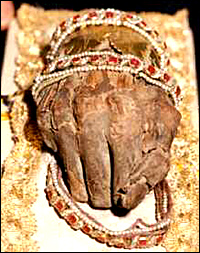
(The Holy Right Hand, principal relic of St Stephen:
with this hand he ministered to the sick and poor,
and it was preserved as a signal sign of his charity
while the rest of his body crumbled into dust.)

I liked, too, reading and praying the Wednesday psalms, some of them especially familiar to me nowadays by their continual reappearance in the Little Office, but some of them old friends not seen for some time: Pss 44, 45, 47, 48, 49 and 50 at Matins (a very happy sequence on which I've blogged before); Pss 96, 64, 100, 145 and the Canticle of Judith (xvi, 15-21) at Lauds; at Prime and the Little Hours, Pss 25, 51, 52, 53, 54, 55, 56, 57, 58, 59. (Vespers will be from the second half of the Gradual Psalms, including the beautiful Ps 131, Memento Domine David, and Compline uses Pss 33 and 60.) There's nothing quite like a Psalm.

I took the time also to read the Martyrology: such saints! What am I in comparison; what am I called to be...

As always, one reads the Martyrology for the next day, as a kind of holy advance notification: to-morrow brings (for Traddies) Pope St Pius X (may he pray for the Church, to drive away all Modernism, to redouble worthy reception of the Eucharist, and to restore peace and good order between the Society of his name and the Holy See, for the salvation of souls - to the glory of God).

But also commemorated are St Phœbe, known to St Paul; many holy martyrs and virgin-martyrs (many tortured and put to the sword, one plunged into molten lead, another cast into a fiery furnace, many monks of Lerins and their Abbot St Aigulf who were slain by the Saracens, and one, St Basilissa, a nine year old girl, who by her stedfast witness converted the Roman magistrate who ordered her put to torment and death); holy bishops and confessors; a hermit (St Simeon Stylites the younger); and the ordination of St Gregory the Great to the Supreme Pontificate, that his rays of sanctity might the more surely irradiate the Globe from the City - in the Novus Ordo, this is his feast day.

Wednesday, July 8, 2009

Eructavit cor meum verbum bonum

Spiritual aerobics: walking up and down and up and down and up and down the stairs here at home, reading Matins.  Told you I was crazy.

Because of time constraints, I usually say Matins (if at all) out of due order: before work, I say Lauds and Prime (asking for a blessing the day and my actions), perhaps fit in Terce and/or Sext at breaks, but in any case get them and None done by mid- to late-afternoon (I hope)... Vespers is said in the evening, then Compline to complete the day.  Or at least that is my general aim...

I must note that to me, Wednesday Matins are very beautiful because of their sublime (and not overly long) psalmody: Psalms 44 (Eructavit cor meum verbum bonum - a royal epithalamium, the song of David's love for his wife the queen, of God's love for Israel, of Jesus' love for His Mother, for His Church, for the Christian soul), 45 ("God is for us a refuge and strength"), 47 ("Great is the Lord and exceedingly to be praised"), 48 ("Hear this, all ye nations"), 49 ("The God of gods, the Lord, has spoken and summoned the earth") and 50 - the incomparable Miserere.  (Psalm 46, which would fit in the midst of these, is read at Lauds on Mondays - "All nations, clap your hands... psallite sapienter...")  Since to-day is the feast of a canonized queen who, widowed, took the habit as a holy religious, how fitting to sing Psalm 44 at the opening of her Office!

While my Latin is by no means perfect, I know these psalms well, having prayed them for many years in English in the modern Divine Office (let us say that some psalms aren't quite so well-recalled)...

Friends, such as Terra, prefer to pray the Benedictine Breviary, wherein Psalm 44 is instead the last of the twelve psalms at Monday Matins (or "Vigils"), while on Tuesdays at Matins the following psalms are prayed: the six Psalms 45, 46, 47, 48, 49, 51 in the First Nocturn, and another six, Psalms 52, 53, 54, 55, 57, 58 in the Second Nocturn.  Phew!  (And Psalm 50 makes its appearance as the second psalm daily at Lauds.)  

It is considered that St Benedict based his arrangement of the weekly cursus of psalms on that then current at Rome, making various changes here and there, while the Roman arrangement endured until the minor reform of St Pius V (who removed Psalms 21, 22, 23, 24, and 25 from Sunday Prime, and redistributed them among the other weekdays - until his day, Sunday Prime had nine psalms!) and the major reform of St Pius X (who decreed that each psalm - with the exception of the Venite, Psalm 94, and at penitential times the Miserere, Psalm 50 - was to be assigned but one Hour at week at which it was to be said, thus cutting back substantially on the length of the Office). 

Before 1912, the Roman Breviary, too, had twelve psalms at Matins - this number allegedly goes back to the Egyptian Fathers of the Desert, who received a response from an angel to their question of the proper number of psalms for the night office.  To this day, their lineal descendants, the Copts, pray in their Office an astonishing number of psalms every day, but they have a cheeky way of speeding up their devotions: one monk says the first of the psalms appointed, another the second, and so on - all together saying their respective psalms at once!

Whatever of this, the psalms for Wednesday Matins in the 1962 Breviary were previously included in the twelve said at Tuesday Matins until 1912: Psalms 38, 39, 40, 41, 43, 44, 45, 46, 47, 48, 49, and 51 - for Psalm 50 was instead said every day at ferial Lauds (and when this happens in the 1962 Breviary on Wednesdays, as in Lent, Psalm 50 is dropped from that day's Matins).

Sunday, June 28, 2009

David and Goliath

To-day (and to-morrow and the next day, were it not for supervening feasts), Holy Church presents us at Matins with the sacred history of David and Goliath, in chapter seventeen of the first Book of Kings (or I Samuel, in modern Bibles).  Why?

It seems to me that there is more to this story than an encouragement to the underdog!  True, the secular world likes any tale of the puny weakling overcoming the big bad bully, but the world would rather play down any embarrassingly religious angle.  So, what angle?

David explicitly places all his trust in God and then, like a good pupil of St Ignatius in later ages, strives with all his cunning skill to achieve victory for the Lord.  "Thou comest to me with sword and spear and shield, I however come to thee in the name of the Lord of hosts, of the God of the armies of Israel..."  And a sly slingshot to the forehead felled the Philistine, and grabbing Goliath's own sword, David struck it off.  Good riddance to bad rubbish.


David's achievement in single combat, moreover, was not for his benefit only; for the rival armies of the Philistines and the Israelites hung upon the outcome, the Israelites, indeed, King Saul included, were hanging back in fear, since no one had dared stand up to Goliath - he personified the helplessness the Israelites felt before their oppressors, against whom they had taken arms, yet without much hope of success.  It was David's unexpected vanquishing of big bad Goliath that gave his fellows hope and heart to take to the fight themselves, and defeat their fearsome foes, throwing off their cruel yoke.  David's victory was not for himself only. 

Now David, as all men ought know, is a type of Christ; and as Christ Himself insinuates in His parables, He it is Who despoils the "strong man armed", that is, the Devil, who held us all in thrall as once his minions the Philistines oppressed the Israelites; Satan rejoiced to mock the Saviour as He was dragged to Calvary by demonic inspiration, but it was otherwise when the Lord, conquering by His sacrificial death, descended to Hades not as victim but Victor, destroying the false kingdom of Lucifer, casting out the Prince of this world, smashing the doors and breaking down the gates of Hell, which had held men captive in death these many many thousand years since Adam's fall had enslaved our sorry race to the malign deceiving Serpent.  

With Christ as our triumphant King, rising again, returning to us as our victorious Champion, we have in reality what David, returning victorious over the Philistine, was in figure: the One Who has won: the field of battle is won, and we can go forth to our own small wars confident that He will triumph in us, who are His, as He has once and for all conquered through His Own Self-Sacrifice.  He must reign until all His enemies are crushed beneath His feet: therefore we as behooves Christians must tread down Satan under our feet, as Our Lady and Her Son ever trample the Serpent.  As Newman noted, Those who are on the side of the Apostles [and therefore of their Master, Christ] are on the winning side.

The Greeks retain, as a curious apocryphon, the so-called Psalm 151, not used in the Liturgy, which relates, first, God's choice of David and His anointing of Him via His instrument, the prophet Samuel (which the Breviary Lessons proclaimed yesterday), and second, David's besting of Goliath:

I was the smallest among my brethren, and the youngest in the house of my father; I did shepherd the sheep of my father.
My hands made an instrument, and my fingers fashioned a psaltery.
And who shall tell my Lord?  The Lord Himself, He Himself shall hearken.
He sent forth His angel and took me from the flocks of my father, and anointed me with the oil of His anointing.
My brethren were big and good, yet the Lord took not pleasure in them.
I went forth to meet the alien, and he cursed me by his idols.
But I drew his own sword and beheaded him, and took away the reproach from the sons of Israel.

Glory be...

Monday, June 8, 2009

Monday Pilgrimage to Colebrook

To-day, being The Queen's Birthday holiday here in Tasmania (N.Z. and W.A. had it last week), there was the leisure to spend the day in devotion: young Tristan having been baptized last evening, his parents wished to dedicate him to Our Lady, and so events had been set in train that led to a pilgrimage being held...

How appropriate indeed!  The lessons at Matins this morning (I Kings, or I Samuel, i, 1-11) - the first ferial day after the great seasons of Septuagesimatide, Lent, Eastertide and Whitsuntide, as I noticed so forcibly while reading Matins and Lauds this morn before arising (wot, no Alleluia?) - were about Anna promising her hoped-for child to the Lord, since to-day the Church begins to read the four Books of Kings (or I & II Samuel and I&II Kings if you prefer), from the origins of Samuel, devoted to the Lord and the one to anoint first Saul, then David as King, to the destruction of faithless Jerusalem after her kings failed to keep fidelity with God.  (All this is to be understood as signifying Christ, the Promised One, the True King of Salem, the True Priest in the line of Melchisedech King of Salem, the Faithful and True, the One Israel longed for in the knowledge that mere man has no power of himself to save himself or to keep faith with God: only the Mediator between God and man can bridge the gap and establish the True Faith, to keep which by His grace is our salvation, to enter into which is by Baptism into His death, to consecrate ourselves to Him is the goal of this life and of eternal life.)

It had been decided that to begin with all would assemble by 10.30 am at Richmond, about 25 km from Hobart, and progress to St John's church there, the oldest extant church in the Commonwealth, praying the Rosary in honour of Our Lady Help of Christians, Patroness of Australia, begging her aid for all the pressing needs of our Nation and State, of the Catholic Church in Australia and in this archdiocese.  Despite the weather being cloudy and showery, twenty of us arrived and processed - singing the Rosary in Latin and the vernacular after the custom of the Christus Rex and Chartres pilgrimages - up to St John's, wherein Fr Tattersall and Steven led us in singing the prayer for our Pope Benedict, and then the Litanies of Loreto.  It was I suspect the first time since the Council that the Litanies were sung there in Latin... though back in 1995 I and others sang Vespers of the Ascension according to the Monastic Rite there.  We concluded after processing back to our cars about 11.15 am, and drove on the remaining 20 km or so to the tiny historic settlement of Colebrook...

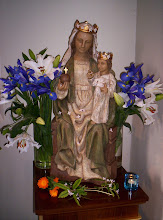
At Colebrook, the beautiful and historic church of St Patrick, designed by Pugin, and built under Bishop Willson, has been restored (in an ongoing programme) by the Pugin Foundation; the latest addition is a devout shrine and statue of Our Lady of Colebrook, carved by French contemplative nuns and blessed by the local parish priest in 2008.  To Our Lady of Colebrook our pilgrimage had made its way...


First, at the heavenly call of the Angelus bell we knelt at Our Lady's feet and prayed that prayer in union with the whole Church Militant; and there we then concluded our Rosary, singing through to the final Salve Regina and prayer.


Next, the new Puginesque freestanding altar carefully moved to one side, and a portable organ brought into the chancel - separated from the nave by the restored rood screen, the only one of seven rood screens still preserved in a Pugin church - the old carven high altar was dressed for the Mass of the Ages, Mass as not celebrated there for forty years - and it was to be a Missa cantata, which records shew not to have been celebrated at Colebrook for more like seventy years.  How long, Lord, how long, cry the saints beneath the altar...


Just after twelve thirty Mass began.  Several of the choir were paratus, and in the chancel; it was great to be able to assist them by singing the Proper and Ordinary together with several others in the front pews, as I was kindly lent a Liber as I had been yesterday.  The Liturgy was a Votive of Our Lady, using the Common Salve sancta parens, with Mass IX (Cum jubilo) - Our Lady's Mass - and Offertory hymn Virgo Dei Genetrix, the Communion antiphon extended with the Magnificat, Our Lady's own song of humble worship, and after Mass that marching song of the Australian Church Militant, "Help of Christians, guard this land".  In consonance with the last item, the orations of the Mass were those of Our Lady Help of Christians.  (Piously, it transpired, on the few occasions the local priest is able to come and say Mass in this village, he chooses feasts of Our Lady: there had last been Mass here on the 24th of May, Our Lady Help of Christians, and before that perhaps for St Patrick, or else back in December for the Immaculate Conception.)

There were about twenty-five at Mass all told, including some who had travelled far to reach this church, this shrine and this Mass.  Fr Tattersall preached with reference to the Gospel, Blessed those who hear the Word of God and keep it, pointing out how supremely this was fulfilled by the Blessed Virgin herself, conceiving the Word in her heart by faith ere she conceived Him in her womb by the Holy Ghost (as Augustine saith), and remaining constant in her faith and Fiat through the events of Christ's childhood, passion and resurrection, until she prayed perseveringly in the Cenacle with the apostles and disciples for the promised Paraclete Who would energise the nascent Church.  How appropriate it was that Colebrook was formerly named Jerusalem!  Rightly could we triple name Our Lady as Help of Christians, Our Lady of Colebrook, yea, Our Lady of Jerusalem.  

Faith is the key, he continued: the church of St Patrick, Colebrook, is not merely an example of technical proficiency, but a testimony to faith, the faith of Pugin, the faith of Bishop Willson, the faith of our fathers (and, one may add, in its restoration this church witnesses to the faith still smouldering beneath the ashes).  In the face of the great needs of our time, we turn as Pope Pius VII did to Our Lady Help of Christians; as he returned to Rome in triumph after the defeat of his captor, the terrible Napoleon, whenas in men's eyes the Church and Papacy had seemed overthrown and finally doomed, he ascribed such unexpected deliverance to the maternal intercession of the Mother of God; thus likewise did the first bishops of Australasia, shepherding a poor convict flock in the face of oppression and bigotry, turn to the Blessed Virgin for aid under this hope-filled title.  By entrusting all our cares and affairs to her, we do but renew and bring to mind the consequences of Christ's committal of all men, in the person of the Beloved Disciple, to His Mother at Calvary; by dedicating ourselves to her, who is the First Disciple, Model of all believers, we find a sure path to rededicate ourselves and all ours to God, to Whom and by Whom we were forever consecrated at our Baptism.  Pray for us, O Holy Mother of God: that we may be made worthy of the promises of Christ.

The Holy Sacrifice completed, soon afterward the final ceremonies of the day transpired: Tristan's mother was churched - there's a beaut service, the churching of women, their thanksgiving after childbirth - and Tristan dedicated to Our Lady at her shrine, whereupon we sang Sub tuum præsidium, that oldest extant prayer to the Mother of God: "We fly to thy patronage, O Holy Mother of God: despise not our petitions in our necessities, but ever deliver us from all dangers,  O glorious and blessed Virgin."

We concluded the festivities with picnic lunch in the park at Colebrook - did I mention that before Mass the clouds had rolled back and the sun shone bright, though it remained cold, our breath visible as we sang? - and a good time was had by all.  (After reading None in the church, I left for home about 3.45 pm, and reached Launceston at 5.30.)

Athanasian Creed

It's been good to begin using my new '62 Breviary from Nova et Vetera; and to celebrate, I've gone back to reading the full Office, Matins included (which Hour I find I can pray very pleasantly in bed before arising).  Yesterday being Trinity Sunday, Prime included - as once it did on every green Sunday - the great confession of Trinitarian faith known as the Athanasian Creed; here it is.

Imagine a certain clergyman of my acquaintance, who as a young Anglican choirboy would have sung this on sundry feasts as the BCP directs; I guess very few Anglicans would stomach it now.

(I am sorry to report a glaring misprint in this Nova et Vetera edition, by the way; on page 17 of volume II, it reads Aqualis Patri, instead of Æqualis Patri.)

Saturday, April 11, 2009

Misericordiæ Domini

The first Lesson of Matins for Holy Saturday (from Lamentations iii, 22-30) shews us what hope the Just Man - Christ - had in God His Father, even in the midst of His Passion, for He knew as God, and also as Man, the Divine plan for man's salvation asked of Him to be a willing victim, that God's justice be vindicated before the face of all the earth, and thus His unimaginable mercy revealed; the whole chapter bears meditation, but here is the Douay of the passage set down for Tenebræ this day:

Heth. The mercies of the Lord that we are not consumed: because his commiserations have not failed.
Heth. They are new every morning, great is thy faithfulness.
Heth. The Lord is my portion, said my soul: therefore will I wait for him.
Teth. The Lord is good to them that hope in him, to the soul that seeketh him.
Teth. It is good to wait with silence for the salvation of God.
Teth. It is good for a man, when he hath borne the yoke from his youth.
Jod. He shall sit solitary, and hold his peace: because he hath taken it up upon himself.
Jod. He shall put his mouth in the dust, if so be there may be hope.
Jod. He shall give his cheek to him that striketh him, he shall be filled with reproaches.

Jerusalem, Jerusalem, return to the Lord, thy God.

Sunday, March 29, 2009

The Vocation of Jeremias

Holy Mother Church bids us read at Matins on this Passion Sunday the opening chapter of the book of Jeremias the Prophet: he is to be taken, therefore, as a type and foreshadowing of Christ, Who supremely prophesied to the Jews both God's promised blessings, and also His threatened disasters conditional upon whether or not they heeded His Voice - whether or not they hearkened unto His Word, the very Word Incarnate pleading with them.  It is the same for us: If today ye hear His voice, harden not your hearts (the Invitatory antiphon of Passiontide).

The beginning of the book of Jeremias the Prophet.

The words of Jeremias the son of Helcias, of the priests that were in Anathoth, in the land of Benjamin. The word of the Lord which came to him in the days of Josias the son of Amon king of Juda, in the thirteenth year of his reign. And which came to him in the days of Joakim the son of Josias king of Juda, unto the end of the eleventh year of Sedecias the son of Josias king of Juda, even unto the carrying away of Jerusalem captive, in the fifth month. And the word of the Lord came to me, saying: Before I formed thee in the bowels of thy mother, I knew thee: and before thou camest forth out of the womb, I sanctified thee, and made thee a prophet unto the nations. And I said: Ah, ah, ah, Lord God: behold, I cannot speak, for I am a child. And the Lord said to me: Say not: I am a child: for thou shalt go to all that I shall send thee: and whatsoever I shall command thee, thou shalt speak. Be not afraid at their presence: for I am with thee to deliver thee, saith the Lord. And the Lord put forth his hand, and touched my mouth: and the Lord said to me: Behold I have given my words in thy mouth: Lo, I have set thee this day over the nations, and over kingdoms, to root up, and to pull down, and to waste, and to destroy, and to build, and to plant. And the word of the Lord came to me, saying: What seest thou, Jeremias? And I said: I see a rod watching. And the Lord said to me: Thou hast seen well: for I will watch over my word to perform it. And the word of the Lord came to me a second time saying: What seest thou? And I said: I see a boiling caldron, and the face thereof from the face of the north. And the Lord said to me: From the north shall an evil break forth upon all the inhabitants of the land. For behold I will call together all the families of the kingdoms of the north, saith the Lord: and they shall come, and shall set every one his throne in the entrance of the gates of Jerusalem, and upon all the walls thereof round about, and upon all the cities of Juda. And I will pronounce my judgments against them, touching all their wickedness, who have forsaken me, and have sacrificed to strange gods, and have adored the work of their own hands. Thou therefore gird up thy loins, and arise, and speak to them all that I command thee. Be not afraid at their presence: for I will make thee not to fear their countenance. For behold I have made thee this day a fortified city, and a pillar of iron, and a wall of brass, over all the land, to the kings of Juda, to the princes thereof, and to the priests, and to the people of the land. And they shall fight against them, and shall not prevail: for I am with thee, saith the Lord, to deliver thee.

But thou, Lord, have mercy upon us.  R/.  Thanks be to God.

Monday, March 23, 2009

The Burning Bush

Yesterday, being Sunday, I was at the early Mass at Carmel (it was still quite dark when I got up; autumn is here, winter is coming...), and, partly beforehand, partly during and after, I prayed Matins and Lauds.  (A good day, Sunday: plenty of time for Office, and for having a nap later in the day, and a good walk around the Gorge.)

Now, Matins struck me for its Scripture readings - for these (taken from Exodus iii, 1-15) concerned Moses happening upon the Burning Bush, that mysterious theophany, the Lord speaking to him therefrom, and receiving God's commission to go set His people free from the yoke of Pharaoh; God even revealed His Divine Name, Ego sum qui sum - I Am Who Am.  God the terrible and great, the All-Holy, the Apart, the One Necessary Being, suffers Himself to concern Himself with the concerns of mortal men, to choose to Himself a people, and by great and mighty acts to bring them forth out of Egypt, the house of slavery, into a land where milk and honey flow.  


It ought go without saying that what He once did for Israel, to free them from Pharaoh, is an image and foreshadowing of the greater liberation and redemption wrought in later time by Christ the Incarnate Word, delivering us from our slavery, from our spiritual Egypt, from sin, Satan, death and hell, by His Cross, that, set free for freedom in Christ, in grace, we may in due time pass to our eternal homeland of heaven; and that it is for us, inspired by and faithful to grace, to appropriate to ourselves this salvation - and how better to so do than to join in the sublime mysteries of the Mass.

Monday, March 2, 2009

More on the Proper Chants of the First Sunday of Lent

The chants of the Proper of the first Sunday of Lent are all taken from Psalm 90 - above all, the day's great Tract uses all but three verses of it (why they're omitted, I'm unsure).  I mentioned in an earlier post that two supplements to the Proper are available for optional use: the Offertory Scapulis suis may have its ancient melismatic verses sung with it (the first of these for the first Sunday of Lent being Dicet Domino: susceptor meus es, non timebo a timore nocturno, a sagitta volante per diem. * Scuto..., where the last word indicates the last part of the Offertory antiphon which is thereupon to be repeated), while the Communion Scapulis suis may be repeated after every one or two verses from Psalm 90 (verses 1-3 and 11-16, to be precise).

However, there is another fine item worthy of chanting at Mass if time permit: the last Responsory of Matins, also taken from Psalm 90:

R/. Angelis suis Deus mandávit de te, ut custódiant te in ómnibus viis tuis: * In mánibus portábunt te, ne umquam offéndas ad lápidem pedem tuum.
V/. Super áspidem et basilíscum ambulábis, et conculcábis leónem et dracónem. * In mánibus portábunt te, ne umquam offéndas ad lápidem pedem tuum.
Glória Patri, et Fílio, et Spirítui Sancto. * In mánibus portábunt te, ne umquam offéndas ad lápidem pedem tuum.