Showing posts with label Colebrook. Show all posts

Sunday, January 14, 2018

Second Sunday after Epiphany Mass and Picnic

Today the Latin Mass community, North and South, gathered at Colebrook to attend the monks’ Mass for the Second Sunday after Epiphany, reflecting on the mystery of the Wedding feast at Cana and Our Lady’s intercession thereat, and afterwards to have a pleasant picnic at their property at Rhyndaston. Mass was glorious and moving, the elevation barely visible through clouds of incense – “and the glory of God filled the sanctuary” – and put me in mind of what Dom Anscar Vonier wrote about “The Doctrinal Power of the Liturgy of the Catholic Church” in his Sketches and Studies in Theology:

One of the great advantages of the liturgical presentment of Catholic dogma is found in this, that it sets forth revealed truth in a non-combative and non-controversial way. It is truly the divine bread prepared for the use of the children. We forget the unbeliever, the heretic, the schismatic, when we are gathered together for the Feasts of the Lord; instead, we are made to remember the Angelic Choirs and the Saints of heaven. If evil and Satan are at all alluded to in the liturgy, such remembrances are songs of triumph, because in the Liturgy the powers of darkness are mentioned only in connexion with Christ's victory over all sin. It is indeed a supreme satisfaction to the Catholic soul to be thus left to enjoy the Faith for its own sake; it creates in the Church a spirit of confidence far more potent than any controversy, however well conducted, can do.

(I quoted quite a lot more of this back in 2008.) 

Sunday, March 5, 2017

Colebrook Again

As I live closer to Colebrook than Hobart, I drove to St Patrick's Church again this Sunday, though earlier in the day, as the monks (I mean, Fr Prior and the pre-postulants) planned to sing Terce at 9:45 am, followed by their sung Mass at 10 am, and, as it transpired, the office of Sext a little before noon. 

Being able to join in their solemn, public worship by attending both those Little Hours was a great privilege, as was participating in the supernatural joy of the Missa cantata for the First Sunday of Lent, most fitly adorned by their singing of its magnificent Gregorian propers, all taken from Psalm 90 (the only concession to their small numbers being the psalm-toning of the even verses of the Tract, which even so lasted about six minutes), not to mention the chanting of Mass XVII and Credo I. I was able to join confidently in the Ordinary, all the responses and also the Introit, which shares its melody with that of Trinity Sunday, whose chant I learnt long years ago.

Please do join in prayer that the monastic community of Notre Dame Priory finds its permanent home soon. St Joseph, pray for us.

Sunday, February 26, 2017

Quinquagesima at Colebrook

I had a meeting to attend in Colebrook this afternoon, and, having found out that Fr Pius hoped to celebrate Mass at the church there, decided to shave 50 km off my usual drive to the Latin Mass in Hobart, plus make my meeting in good time, by going to the Priory Mass at 11 am at St Patrick's. It was nice to have a later start in the morning and an easier drive…

Because the beautifully restored Pugin-designed church has an intact rood screen, and the front pews have been placed antiphonally with the choir lectern in the midst for the monastic Office, taking my place in the first of the pews placed lengthwise across the church I had a view as it were into the gem-studded casket that is the sanctuary, within which space, and most especially before the altar, the holy of holies at its upper end, the sacred liturgy unfolded before me and the others in the congregation.


The Prior was the celebrant, and his first five candidates the servers, of the Missa cantata, preceded by the Asperges as usual. I was moved by the engaging detail that Fr Pius led the singing of the Gregorian Propers and Ordinary (Mass XI & Credo I), with the rest of the servers forming the choir – he himself sang the Gradual alone, and psalm-toned the Tract (the only concession to their small numbers). 

Father preached – as one would expect – a detailed, focussed and liturgically-illuminated homily, reminding us that the Lord in today's Gospel foretells his Passion and Resurrection, while the Apostle emphasises in the Epistle, given our Lenten penance about to begin, that all our doings without charity are worthless. 

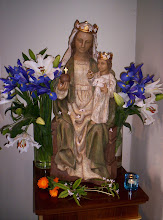
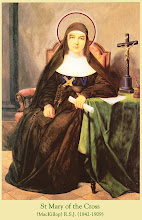
After Mass, the altar party moved to the Lady Altar, where before Our Lady of Colebrook they sang Sub tuum, before invoking Our Lady of Cana, praying the following prayer to St Joseph for the success of their just-established monastic foundation, and finally invoking St Mary of the Cross, before returning to the sacristy.
Prayer to St Joseph attributed to St Francis de Sales 
Glorious Saint Joseph, Spouse of Mary, grant us, we beseech thee, thy paternal protection, through the Heart of Jesus Christ. O thou whose infinite power reaches out to all our needs, rendering possible for us that which is impossible, look upon the concerns of thy children with thy fatherly countenance. In the troubles and sorrows that afflict us, we have confident recourse to thee. Deign to take under thy loving protection this important and difficult endeavour, the cause of our worries, and dispose its success to the glory of God and to the benefit of His faithful servants. Amen.

Wednesday, February 22, 2017

Foundation Day

I headed off bright and early this morning to drive the 150 km south to Colebrook, arriving at 9:45 am. Gradually more and more familiar faces arrived. For we were all assembled with our Archbishop, well over a hundred laity and clergy together, to celebrate the foundation today of Notre Dame Priory at St Patrick’s, a beautiful Pugin-designed church that has waited 160 years for this great day, when, as we all remarked afterward, it was finally used for what it was built for: the full traditional liturgy of Solemn High Mass coram archiepiscopo in the late morning and Solemn Vespers mid-afternoon. The servers were the five young men who are the first candidates for the monastic life to arrive and begin the foundation, for the present in temporary accommodation in Lindisfarne; more will arrive in due course. 

The Mass Propers of the Chair of St Peter were expertly sung by Ronan and friends, as was the Ordinary of the Mass (Mass IV and the little-used Credo V), all sensitively accompanied by Stephen Smith on the church’s recently-installed organ. His Grace preached, and, the sacred mysteries consummated and received, Fr Prior gave a speech of thanks after the Last Gospel, before a final Sub tuum at the Lady Altar together with prayer to St Joseph and invocations of St Mary of the Cross, secondary patroness of the new monastery, and of St Patrick, titular of the church. The morning liturgy lasted an hour and forty minutes all told.

We decamped to the Colebrook Hall for luncheon, where all and sundry had a great time catching up, toasting the foundation and delighting in such a joyful day. Afterwards, I had time to stroll around the little township before returning to church for Solemn Vespers (again expertly sung, lasting about 35 minutes) followed by Benediction (at exposition, Jesu dulcis memoria, then silent adoration, the usual Tantum ergo &c. before the blessing, the Divine Praises afterward, and at reposition the Benedictine Te decet laus), concluding at 5:30 pm.

After final farewells, I set off for home at six o’clock, and got back by eight. A wonderful day!

Thursday, March 12, 2015

Tasmanian Pilgrimage

A small group of friends and I spent the weekend on a Lenten pilgrimage: on Saturday, we walked from St Joseph's Church in Hobart to St John's Church in Richmond (25 km); and on Sunday, another 28 km to St Patrick's Church, Colebrook. The three churches mentioned are all historic: St Joseph's, built 1841, was Hobart's original pro-cathedral; St John the Evangelist's, built 1837, is the oldest extant Catholic church in Australia; and St Patrick's, Colebrook, built 1857, is a perfect Pugin design.

Shelstone Saddle (our Saturday lunch stop) with Hobart in the distance

His Grace condescended to join us for the last hour of the walk into Richmond, and proceeded to celebrate Mass for us in the Ordinary Form; Hugh and Tony sang the Gregorian propers, just as they did the next day at Colebrook, where Fr Suresh sang a Missa cantata. En route, from time to time we said the Rosary (ten decades each day), sang hymns, conversed and enjoyed the pleasant weather and  scenery.

Simon and Lyle took turns in driving our support vehicle, which kept us supplied with water, plus food and drink for lunch, morning and afternoon tea. The pilgrimage could not have happened without the kind permission of the local parish priest, nor the support of other friends of mine who assisted us. David, who joined our band on the Sunday, lives locally, and helped plan the route.

A little before lunch on Sunday, with Gravelly Ridge to climb afterwards

It was a pity that a few others were unable to attend in the event, but c'est la vie. I must say that such a generous dose of unaccustomed fresh air, sunshine and exercise all agreed with me, and I cannot wait to strike out cross-country again. Being a Catholic affair, we quenched our hard-earned thirst and enjoyed a pleasant dinner together in a local pub each evening.

Colebrook was originally named Jerusalem, and so our little venture bore a somewhat grandiose title: a Lenten Pilgrimage to Tasmania's Jerusalem. All pilgrimages, large and small, are images of the progress of each Christian, and of the whole Church, through the desert of this world to the supernal City of God. As St Louis IX said as he lay dying, "We will go to Jerusalem".

St Patrick's Church, Colebrook

Monday, June 8, 2009

Monday Pilgrimage to Colebrook

To-day, being The Queen's Birthday holiday here in Tasmania (N.Z. and W.A. had it last week), there was the leisure to spend the day in devotion: young Tristan having been baptized last evening, his parents wished to dedicate him to Our Lady, and so events had been set in train that led to a pilgrimage being held...

How appropriate indeed!  The lessons at Matins this morning (I Kings, or I Samuel, i, 1-11) - the first ferial day after the great seasons of Septuagesimatide, Lent, Eastertide and Whitsuntide, as I noticed so forcibly while reading Matins and Lauds this morn before arising (wot, no Alleluia?) - were about Anna promising her hoped-for child to the Lord, since to-day the Church begins to read the four Books of Kings (or I & II Samuel and I&II Kings if you prefer), from the origins of Samuel, devoted to the Lord and the one to anoint first Saul, then David as King, to the destruction of faithless Jerusalem after her kings failed to keep fidelity with God.  (All this is to be understood as signifying Christ, the Promised One, the True King of Salem, the True Priest in the line of Melchisedech King of Salem, the Faithful and True, the One Israel longed for in the knowledge that mere man has no power of himself to save himself or to keep faith with God: only the Mediator between God and man can bridge the gap and establish the True Faith, to keep which by His grace is our salvation, to enter into which is by Baptism into His death, to consecrate ourselves to Him is the goal of this life and of eternal life.)

It had been decided that to begin with all would assemble by 10.30 am at Richmond, about 25 km from Hobart, and progress to St John's church there, the oldest extant church in the Commonwealth, praying the Rosary in honour of Our Lady Help of Christians, Patroness of Australia, begging her aid for all the pressing needs of our Nation and State, of the Catholic Church in Australia and in this archdiocese.  Despite the weather being cloudy and showery, twenty of us arrived and processed - singing the Rosary in Latin and the vernacular after the custom of the Christus Rex and Chartres pilgrimages - up to St John's, wherein Fr Tattersall and Steven led us in singing the prayer for our Pope Benedict, and then the Litanies of Loreto.  It was I suspect the first time since the Council that the Litanies were sung there in Latin... though back in 1995 I and others sang Vespers of the Ascension according to the Monastic Rite there.  We concluded after processing back to our cars about 11.15 am, and drove on the remaining 20 km or so to the tiny historic settlement of Colebrook...

At Colebrook, the beautiful and historic church of St Patrick, designed by Pugin, and built under Bishop Willson, has been restored (in an ongoing programme) by the Pugin Foundation; the latest addition is a devout shrine and statue of Our Lady of Colebrook, carved by French contemplative nuns and blessed by the local parish priest in 2008.  To Our Lady of Colebrook our pilgrimage had made its way...


First, at the heavenly call of the Angelus bell we knelt at Our Lady's feet and prayed that prayer in union with the whole Church Militant; and there we then concluded our Rosary, singing through to the final Salve Regina and prayer.


Next, the new Puginesque freestanding altar carefully moved to one side, and a portable organ brought into the chancel - separated from the nave by the restored rood screen, the only one of seven rood screens still preserved in a Pugin church - the old carven high altar was dressed for the Mass of the Ages, Mass as not celebrated there for forty years - and it was to be a Missa cantata, which records shew not to have been celebrated at Colebrook for more like seventy years.  How long, Lord, how long, cry the saints beneath the altar...


Just after twelve thirty Mass began.  Several of the choir were paratus, and in the chancel; it was great to be able to assist them by singing the Proper and Ordinary together with several others in the front pews, as I was kindly lent a Liber as I had been yesterday.  The Liturgy was a Votive of Our Lady, using the Common Salve sancta parens, with Mass IX (Cum jubilo) - Our Lady's Mass - and Offertory hymn Virgo Dei Genetrix, the Communion antiphon extended with the Magnificat, Our Lady's own song of humble worship, and after Mass that marching song of the Australian Church Militant, "Help of Christians, guard this land".  In consonance with the last item, the orations of the Mass were those of Our Lady Help of Christians.  (Piously, it transpired, on the few occasions the local priest is able to come and say Mass in this village, he chooses feasts of Our Lady: there had last been Mass here on the 24th of May, Our Lady Help of Christians, and before that perhaps for St Patrick, or else back in December for the Immaculate Conception.)

There were about twenty-five at Mass all told, including some who had travelled far to reach this church, this shrine and this Mass.  Fr Tattersall preached with reference to the Gospel, Blessed those who hear the Word of God and keep it, pointing out how supremely this was fulfilled by the Blessed Virgin herself, conceiving the Word in her heart by faith ere she conceived Him in her womb by the Holy Ghost (as Augustine saith), and remaining constant in her faith and Fiat through the events of Christ's childhood, passion and resurrection, until she prayed perseveringly in the Cenacle with the apostles and disciples for the promised Paraclete Who would energise the nascent Church.  How appropriate it was that Colebrook was formerly named Jerusalem!  Rightly could we triple name Our Lady as Help of Christians, Our Lady of Colebrook, yea, Our Lady of Jerusalem.  

Faith is the key, he continued: the church of St Patrick, Colebrook, is not merely an example of technical proficiency, but a testimony to faith, the faith of Pugin, the faith of Bishop Willson, the faith of our fathers (and, one may add, in its restoration this church witnesses to the faith still smouldering beneath the ashes).  In the face of the great needs of our time, we turn as Pope Pius VII did to Our Lady Help of Christians; as he returned to Rome in triumph after the defeat of his captor, the terrible Napoleon, whenas in men's eyes the Church and Papacy had seemed overthrown and finally doomed, he ascribed such unexpected deliverance to the maternal intercession of the Mother of God; thus likewise did the first bishops of Australasia, shepherding a poor convict flock in the face of oppression and bigotry, turn to the Blessed Virgin for aid under this hope-filled title.  By entrusting all our cares and affairs to her, we do but renew and bring to mind the consequences of Christ's committal of all men, in the person of the Beloved Disciple, to His Mother at Calvary; by dedicating ourselves to her, who is the First Disciple, Model of all believers, we find a sure path to rededicate ourselves and all ours to God, to Whom and by Whom we were forever consecrated at our Baptism.  Pray for us, O Holy Mother of God: that we may be made worthy of the promises of Christ.

The Holy Sacrifice completed, soon afterward the final ceremonies of the day transpired: Tristan's mother was churched - there's a beaut service, the churching of women, their thanksgiving after childbirth - and Tristan dedicated to Our Lady at her shrine, whereupon we sang Sub tuum præsidium, that oldest extant prayer to the Mother of God: "We fly to thy patronage, O Holy Mother of God: despise not our petitions in our necessities, but ever deliver us from all dangers,  O glorious and blessed Virgin."

We concluded the festivities with picnic lunch in the park at Colebrook - did I mention that before Mass the clouds had rolled back and the sun shone bright, though it remained cold, our breath visible as we sang? - and a good time was had by all.  (After reading None in the church, I left for home about 3.45 pm, and reached Launceston at 5.30.)