Showing posts with label Our Lady Help of Christians. Show all posts

Thursday, August 22, 2013

Support the Brisbane Oratory in Formation

Earlier this year, the great and good project of establishing an Oratory in Brisbane – first mooted for Australia, we learn, in 2011 – was made public with the blessing of Archbishop Mark Coleridge. Fr Paul Chandler, a priest of that archdiocese, together with two other priests (who wish to remain anonymous for the time being, at the request of their respective bishops), and a seminarian, Shawn Murphy, who has just begun his studies for the priesthood with the Oratorians in Toronto, are working toward establishing this new Oratorian community in 2015 or 2016. God bless their endeavours!

Now these nascent Oratorians have a website for the Brisbane Oratory in Formation: on their behalf, I ask you to above all pray for them, but also please consider donating funds for their many needs, particularly the education of their seminarian (further details may be accessed via the relevant section of their website).

As readers may realize, I am (all unworthy) a devotee of St Philip Neri, Founder of the Congregation of the Oratory, and third Apostle of Rome. Indeed, a reproduction painting of him looks down on me as I type... would that I would heed his advice to the same extent as I beseech his prayers. It was a special pleasure to me to visit his glorious relics at the Chiesa Nuova on my various visits to the Eternal City; may he intercede by his merits and suffrages for the Brisbane Oratory in Formation: "Look down from heaven and see, and visit this new vineyard: and perfect the same, which thy right hand hath planted" (Ps 79:15b-16a).

I am minded to repeat one of Newman's hymns in his honour:
St. Philip in his School (A Song.) 
This is the Saint of gentleness and kindness, 
Cheerful in penance, and in precept winning; 
Patiently healing of their pride and blindness, 
Souls that are sinning.  
This is the Saint, who, when the world allures us, 
Cries her false wares, and opes her magic coffers, 
Points to a better city, and secures us 
With richer offers.  
Love is his bond, he knows no other fetter, 
Asks not our all, but takes whate’er we spare him, 
Willing to draw us on from good to better, 
As we can bear him.  
When he comes near to teach us and to bless us, 
Prayer is so sweet, that hours are but a minute; 
Mirth is so pure, though freely it possess us, 
Sin is not in it. 
Thus he conducts by holy paths and pleasant, 
Innocent souls, and sinful souls forgiven, 
Towards the bright palace where our God is present, 
Throned in high heaven. 
******

These future Oratorians of course seek the patronage of Our Lady Help of Christians above all under God. And may Bl John Henry Newman and Bl Pier Giorgio Frassati, the other well-chosen patrons of the future Brisbane Oratory, add their prayers to those of St Philip, that in God's time things now hoped for may come to be.

Monday, May 24, 2010

Our Lady Help of Christians, pray for us!

To-day, which in the Traditional Calendar is Whit Monday, in the modern Roman Rite's local Australian Calendar is the Solemnity of Our Lady Help of Christians.  Given the importance of the feast, and the need to pray for a relative undergoing a medical procedure, I went to Mass...

I do wish the celebrant would recall that the Creed ought be read, it being a solemnity!  It is of far greater importance to join the Church in confessing our Holy Faith than to indulge in what was the great time-wasting session that ensued instead: while all sat (meditating on their latter end, as the saying goes), we had tiresomely longwinded extempore prayers of the faithful, one of which, from an over-pious middle-aged female, as well as being inaudible, was longer than the sermon.  I resent turning the Mass into a pathetic prayer-group.

Alas!  I had come to "Lazy Mass", an unfortunately common variant of the Ordinary Form, especially when Mass is celebrated for a small coterie, middle-aged and up, on weekdays.  (The virulent form is such a Mass dominated by foul religious sisters or fouler layfolk of the dissenting variety.)  Note that I write not of Mass for the very aged or frail, since they of course can hardly be expected to sit, stand and kneel in due order: I write of those perfectly able to kneel at Mass on Sunday, but who manifest an aversion to the same on weekdays.

Sitting – apparently this is the acceptable posture in which to worship God.  Or so one not conversant with the actual directions of the Roman Rite might conclude, given the lazy way all but two rested in their chairs during the Preface, when they should have stood (as had done at the start of Mass, and as they did for the Lord's Prayer later on), and, most scandalously, during the entire Eucharistic Prayer (the amply-carpeted floor being too uninviting for most knees).  The rationale seemed to be that if one sat dumbly during the very Consecration, why bother standing for the Preface?  The well-known and reinforced requirement that one must now stand up at the Orate fratres seems not to apply to such Lazy Masses.

I expect that if I had asked why, there would have been horror at the question even being posed: apparently at a weekday Mass this sort of thing reigns in some places.  There is an entire blindness to the scandal of such material irreverence and disobedience to the clear directions given for the Mass, which allow no exceptions for such pretended exceptions.

It is wrong to sit at such times unless one is incapacitated.  If kneeling is not possible, it has been pointed out in Notitiæ, official organ of the Congregation for Divine Worship, that standing is the next best.  But no, ignorance triumphs again.

It particularly offends and upsets me that such a bad custom perverts the proper understanding of what liturgy and due reverence require, and turns the dread mysteries of the Mass into a safe little sit-down.  People even get the wicked idea (Luther I think first gave voice to it) that somehow such an "intimate" little affair is more "authentic" than the norm, when it is in fact a corruption inimical to a true perception of religious respect.

How typical that in backward Tasmania, the notorious coffee-table Masses of the sixties and seventies are still alive and well!  At least those who destroyed the liturgy back then largely drew the logical conclusion and either reformed themselves (as one hopes) or left altogether (as one fears), their innovating irreverence slipping away into indifference and atheism...

Despite the priest (personally devout), who has I know improved matters in the parish to some extent, I discovered anew that I cannot bear the way weekday Mass is arranged, not on his part, but on that of the congregation.  It drives me away every time, and has for years, whenever for any reason have I steeled myself to go again.  But I suppose this would be considered evidence of my having a problem, not those folks in their unthinking laxity, no...

Monday, June 8, 2009

Monday Pilgrimage to Colebrook

To-day, being The Queen's Birthday holiday here in Tasmania (N.Z. and W.A. had it last week), there was the leisure to spend the day in devotion: young Tristan having been baptized last evening, his parents wished to dedicate him to Our Lady, and so events had been set in train that led to a pilgrimage being held...

How appropriate indeed!  The lessons at Matins this morning (I Kings, or I Samuel, i, 1-11) - the first ferial day after the great seasons of Septuagesimatide, Lent, Eastertide and Whitsuntide, as I noticed so forcibly while reading Matins and Lauds this morn before arising (wot, no Alleluia?) - were about Anna promising her hoped-for child to the Lord, since to-day the Church begins to read the four Books of Kings (or I & II Samuel and I&II Kings if you prefer), from the origins of Samuel, devoted to the Lord and the one to anoint first Saul, then David as King, to the destruction of faithless Jerusalem after her kings failed to keep fidelity with God.  (All this is to be understood as signifying Christ, the Promised One, the True King of Salem, the True Priest in the line of Melchisedech King of Salem, the Faithful and True, the One Israel longed for in the knowledge that mere man has no power of himself to save himself or to keep faith with God: only the Mediator between God and man can bridge the gap and establish the True Faith, to keep which by His grace is our salvation, to enter into which is by Baptism into His death, to consecrate ourselves to Him is the goal of this life and of eternal life.)

It had been decided that to begin with all would assemble by 10.30 am at Richmond, about 25 km from Hobart, and progress to St John's church there, the oldest extant church in the Commonwealth, praying the Rosary in honour of Our Lady Help of Christians, Patroness of Australia, begging her aid for all the pressing needs of our Nation and State, of the Catholic Church in Australia and in this archdiocese.  Despite the weather being cloudy and showery, twenty of us arrived and processed - singing the Rosary in Latin and the vernacular after the custom of the Christus Rex and Chartres pilgrimages - up to St John's, wherein Fr Tattersall and Steven led us in singing the prayer for our Pope Benedict, and then the Litanies of Loreto.  It was I suspect the first time since the Council that the Litanies were sung there in Latin... though back in 1995 I and others sang Vespers of the Ascension according to the Monastic Rite there.  We concluded after processing back to our cars about 11.15 am, and drove on the remaining 20 km or so to the tiny historic settlement of Colebrook...

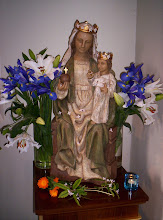
At Colebrook, the beautiful and historic church of St Patrick, designed by Pugin, and built under Bishop Willson, has been restored (in an ongoing programme) by the Pugin Foundation; the latest addition is a devout shrine and statue of Our Lady of Colebrook, carved by French contemplative nuns and blessed by the local parish priest in 2008.  To Our Lady of Colebrook our pilgrimage had made its way...


First, at the heavenly call of the Angelus bell we knelt at Our Lady's feet and prayed that prayer in union with the whole Church Militant; and there we then concluded our Rosary, singing through to the final Salve Regina and prayer.


Next, the new Puginesque freestanding altar carefully moved to one side, and a portable organ brought into the chancel - separated from the nave by the restored rood screen, the only one of seven rood screens still preserved in a Pugin church - the old carven high altar was dressed for the Mass of the Ages, Mass as not celebrated there for forty years - and it was to be a Missa cantata, which records shew not to have been celebrated at Colebrook for more like seventy years.  How long, Lord, how long, cry the saints beneath the altar...


Just after twelve thirty Mass began.  Several of the choir were paratus, and in the chancel; it was great to be able to assist them by singing the Proper and Ordinary together with several others in the front pews, as I was kindly lent a Liber as I had been yesterday.  The Liturgy was a Votive of Our Lady, using the Common Salve sancta parens, with Mass IX (Cum jubilo) - Our Lady's Mass - and Offertory hymn Virgo Dei Genetrix, the Communion antiphon extended with the Magnificat, Our Lady's own song of humble worship, and after Mass that marching song of the Australian Church Militant, "Help of Christians, guard this land".  In consonance with the last item, the orations of the Mass were those of Our Lady Help of Christians.  (Piously, it transpired, on the few occasions the local priest is able to come and say Mass in this village, he chooses feasts of Our Lady: there had last been Mass here on the 24th of May, Our Lady Help of Christians, and before that perhaps for St Patrick, or else back in December for the Immaculate Conception.)

There were about twenty-five at Mass all told, including some who had travelled far to reach this church, this shrine and this Mass.  Fr Tattersall preached with reference to the Gospel, Blessed those who hear the Word of God and keep it, pointing out how supremely this was fulfilled by the Blessed Virgin herself, conceiving the Word in her heart by faith ere she conceived Him in her womb by the Holy Ghost (as Augustine saith), and remaining constant in her faith and Fiat through the events of Christ's childhood, passion and resurrection, until she prayed perseveringly in the Cenacle with the apostles and disciples for the promised Paraclete Who would energise the nascent Church.  How appropriate it was that Colebrook was formerly named Jerusalem!  Rightly could we triple name Our Lady as Help of Christians, Our Lady of Colebrook, yea, Our Lady of Jerusalem.  

Faith is the key, he continued: the church of St Patrick, Colebrook, is not merely an example of technical proficiency, but a testimony to faith, the faith of Pugin, the faith of Bishop Willson, the faith of our fathers (and, one may add, in its restoration this church witnesses to the faith still smouldering beneath the ashes).  In the face of the great needs of our time, we turn as Pope Pius VII did to Our Lady Help of Christians; as he returned to Rome in triumph after the defeat of his captor, the terrible Napoleon, whenas in men's eyes the Church and Papacy had seemed overthrown and finally doomed, he ascribed such unexpected deliverance to the maternal intercession of the Mother of God; thus likewise did the first bishops of Australasia, shepherding a poor convict flock in the face of oppression and bigotry, turn to the Blessed Virgin for aid under this hope-filled title.  By entrusting all our cares and affairs to her, we do but renew and bring to mind the consequences of Christ's committal of all men, in the person of the Beloved Disciple, to His Mother at Calvary; by dedicating ourselves to her, who is the First Disciple, Model of all believers, we find a sure path to rededicate ourselves and all ours to God, to Whom and by Whom we were forever consecrated at our Baptism.  Pray for us, O Holy Mother of God: that we may be made worthy of the promises of Christ.

The Holy Sacrifice completed, soon afterward the final ceremonies of the day transpired: Tristan's mother was churched - there's a beaut service, the churching of women, their thanksgiving after childbirth - and Tristan dedicated to Our Lady at her shrine, whereupon we sang Sub tuum præsidium, that oldest extant prayer to the Mother of God: "We fly to thy patronage, O Holy Mother of God: despise not our petitions in our necessities, but ever deliver us from all dangers,  O glorious and blessed Virgin."

We concluded the festivities with picnic lunch in the park at Colebrook - did I mention that before Mass the clouds had rolled back and the sun shone bright, though it remained cold, our breath visible as we sang? - and a good time was had by all.  (After reading None in the church, I left for home about 3.45 pm, and reached Launceston at 5.30.)

Sunday, July 13, 2008

Totus Tuus, Maria

Pilgrims are encouraged to visit St Mary's Cathedral, and there consecrate themselves to Our Blessed Lady, a devotion that I once undertook, but need to rekindle in my soul, as by again taking up my daily Rosary (as I have just done after many false starts) and above all by striving to live as a true child of Mary, and thus to be docile, that I may be formed by the Holy Ghost, to so behave as befits a coheir of Christ, to adhere to grace so as to be a son of God; here is a prayer that may be used:

A Prayer of Consecration
to
Our Lady of the Southern Cross,
Help of Christians


Mary, you are the Mother of Jesus, our Lord. He gave you, while on the Cross, to be our Mother. You are Our Lady of the Southern Cross, Help of Christians. You were created full of grace by God, our loving Father. The Holy Spirit has made you the greatest of Saints.

Your “yes” to God’s Word teaches us how to receive the power of His Spirit. Your presence in the upper room inspired the first disciples to trust completely in the promise of the risen Christ: “You will receive power when the Holy Spirit has come upon you; and you will be my witnesses.” (Acts 1:8)

I now consecrate myself entirely to your Immaculate Heart and through it to to the Sacred Heart of Jesus your Son so that I might be a witness to Jesus in the power of His Spirit.

Come Holy Spirit! Renew in us the graces of our Baptism. Pour out in abundance your gifts given in Confirmation, when the voice of the Father reaffirmed our original vocation “You are my beloved son.” Provide a new outpouring of the Holy Spirit in us that we might be completely seized by God, who is love. Mary, teach us to be attentive to the voice of God in silence, and to live lives of service in truth, joy and peace. Totus Tuus. I am all yours. Amen.

Saturday, May 24, 2008

Our Lady Help of Christians

A grand day off: a feast, a feast of Our Lady. A day to spend at Mass and in prayer, a day to spend with friends, a rainy day, a day for lounging in a bookshop...

Since the Proper for Australia's 1st class Feast of Our Lady Help of Christians doesn't seem to be online, I will append it below.

Note that all is from the Common of the Blessed Virgin Mary (beware - this link gives the wrong short lesson at Prime; it should be that of the season, according to the '62), except for -

(a) the Collect (Omnipotens et misericors Deus, qui ad defensionem);

(b) the Hymns, of which there are two (Sæpe dum Christi populus cruentis at Vespers and Matins, and Te Redemptoris Dominique nostri at Lauds);

(c) the Magnificat and Benedictus Antiphons (Ecce, Maria erat spes nostra at first Vespers, Ad te, o sancta Dei Genetrix at Lauds, and Sancta Maria, succurre miseris... tuum sanctum implorant auxilium at second Vespers, though, rather confusingly, this is, apart from its proper ending, the same as the Common Magnificat antiphon for first Vespers);

(d) the Proper Lessons for Nocturns II and III (from St Bernard's sermons, numbers 69 and 70, except for Lesson vi, which is "from public records");

(e) the Proper ending of Responsory vii at Matins (tuum sanctum implorant auxilium - this of course being, in its versicle, the same as the second half of the second Magnificat antiphon).

******

Die 24 Maji
Beatæ Mariæ Virginis sub titulo Auxilium Christianorum
Patronæ principalis Australiæ


Omnia de Commune Festorum B.M.V., præter ea quæ hic habentur propriæ.

In I Vesperis

Hymnus

Sæpe dum Christi populus cruentis
Hostis infensi premeretur armis,
Venit adjutrix pia Virgo cælo
Lapsa sereno.

Prisca sic patrum monumenta narrant,
Templa testantur spoliis opimis
Clara, votivo repetita cultu
Festa quotannis.

En novi grates liceat Mariæ
Cantici lætis modulis referre
Pro novis donis, resonante plausu
Urbis et Orbis.

Oh dies felix, memoranda fastis,
Qua Petri Sedes fidei magistrum
Triste post lustrum reducem beata
Sorte recepit!

Virgines castæ, puerique puri
Gestiens clerus, populusque grato
Corde Reginæ celebrare cæli
Munera certent.

Virginum Virgo, benedicta Jesu
Mater, hæc auge bona: fac, precamur,
Ut gregem Pastor Pius ad salutis
Pascua ducat.

Te per æternos veneremur annos,
Trinitas, summo celebranda plausu;
Te fides mentes, resonoque linguæ
Carmine laudent.

Amen.


Ad Magn. Aña. Ecce, Maria erat spes nostra, ad quam confugimus in auxilium, ut liberaret nos, et venit in adjutorium nobis.

Oratio

Omnipotens et misericors Deus, qui ad defensionem populi christiani in beatissima Virgine Maria perpetuum auxilium mirabiliter constituisti: concede propitius; ut, tali præsidio muniti certantes in vita, victoriam de hoste maligno consequi valeamus in morte. Per Dñm.

Ad Matutinum

Hymnus Sæpe dum Christi populi cruentis, ut supra

In II Nocturno

Sermo sancti Bernardi Abbatis
(Ex Serm. de 12 stellis [Dom. infra Oct. Assumptionis B.M.V., 1, 2])

Lectio iv

Vehementer quidem nobis, dilectissimi, vir unus et mulier una nocuere: sed gratias Deo, per unum nihilominus virum, et mulierem unam omnia restaurantur, nec sine magno faenore gratiarum. Et quidem sufficere poterat Christus: siquidem et nunc omnis sufficientia nostra ex eo est: sed nobis bonum non erat esse hominem solum. Congruum magis ut adesset nostrae reparationi sexus uterque. Jam itaque nec ipsa mulier benedicta in mulieribus videbitur otiosa: invenietur equidem locus ejus in hac reconciliatione. Opus est enim mediatore ad mediatorem Christum: nec alter nobis utilior quam Maria. Crudelis nimium mediatrix Heva, per quam serpens antiquus pestiferum etiam ipsi viro virus infudit: sed fidelis Maria, quae salutis antidotum et viris et mulieribus propinavit. Illa enim ministra seductionis, haec propitiationis; illa suggessit praevaricationem, haec ingessit redemptionem. Quid ad Mariam accedere trepidet humana fragilitas? Nihil austerum in ea, nihil terribile; tota suavis est, omnibus offerens lac et lanam. Revolve diligentius evangelicae historiae seriem universam: et si quid forte increpatorium, si quid durum, si quod denique signum vel tenuis indignationis occurrerit in Maria, de caetero suspectam habeas, et accedere verearis.

Lectio v
[2, 3, 4, 5]

Quod si, ut vere sunt, plena magis omnia pietatis et gratiae, plena mansuetudinis et misericordiae, quae ad eam pertinent, inveneris, age gratias ei, qui talem tibi mediatricem benignissima miseratione providit, in qua nihil possit esse suspectum. Denique omnibus omnia facta est; sapientibus et insipientibus copiosissima charitate debitricem se fecit. Omnibus misericordiae sinum aperit, ut de plenitudine ejus accipiant universi, captivus redemptionem, aeger curationem, tristis consolationem, peccator veniam, justus gratiam, Angelus laetitiam. Ipsa praeterita non discutit merita; sed omnibus sese exorabilem, omnibus clementissimam praebet, omnium denique necessitates amplissimo quodam miseratur affectu. Ipsa est quondam a Deo promissa mulier serpentis antiqui caput virtutis pede contritura; cujus plane calcaneo in multis versutiis insidiatus est, sed sine causa. Sola enim contrivit universam haereticam pravitatem. Contriti sunt insidiatores, conculcati supplantatores, confutati derogatores, et beatam eam dicunt omnes generationes. Jam si Ecclesia lunae intelligenda videtur vocabulo, habes mediatricem evidenter expressam: Mulier, inquit, amicta sole, et luna sub pedibus ejus. Amplectamur Mariae vestigia, et devotissima supplicatione beatis illius pedibus provolvamur. Teneamus eam, nec dimittamus, donec benedixerit nobis: potens est enim.

Lectio vi
(Ex publicis monumentis)

Præsentissimum Deiparæ auxilium ad religionis hostes profligandos, sæpe populus christianus mirum in modum expertus est: ex quo factum, ut sanctissimus Pontifex Pius quintus post insignem victoriam, intercedente beatissima Virgine, a Christianis de Turcarum tyranno apud Echinadas insulas reportatam, in Litaniis Lauretanis eandem Reginam cælorum inter alia præconia Auxilium Christianorum appellari constituerit. Sed illud in primis memorabile est, atque explorati miraculi loco habendum, quod cum Romanus Pontifex Pius septimus impiorum consiliis et armis ex apostolica Petri Sede exturbatus, et arcta custodia, præsertim Savonæ per annos quinque, eoque amplius fuisset detentus, viis omnibus penitus interclusis, ne Dei Ecclesiam regere posset, nullo similis persecutionis in priscis annalibus exemplo, inopinato et præter omnium expectationem contigit, ut ingenti plausu, ac velut universi orbis manibus pontificio solio restitueretur. Quod et secundo accidit, dum iterum commoto turbine, ab Urbe discedens sacro comitante Cardinalium collegio, Liguriam contendit. Verum præsentissimo Dei beneficio, cessante procella, quæ grave minabatur excidium, Romam, plaudentibus præ novo gaudio populis, reversus est. Antea tamen, quod in votis habuerat, et captivitate detentus exsequi insignem Savonæ imaginem Deiparæ Virginis sub titulo Matris Misericordiæ solemni ritu propriisque manibus decoravit. Quam mirabilem rerum vicissitudinem idem Pontifex Maximus Pius septimus totius eventus intime conscius, cum intercessione sanctissimæ Dei Genetricis, cujus potentem opem, et ipse impense imploraverat, acceptam merito referret in ejusdem Virginis Matris honorem sub appellatione Auxilii Christianorum, sollemne festum indixit perpetuo celebrandum die mensis Maji vigesimo quarto, faustissimi sui in Urbem reditus anniversario, approbato etiam Officio proprio, ut tanti beneficii distincta et perennis exstet memoria, et gratiarum actio.

In III Nocturno

Lectio sancti Evangelii secundum Lucam
Lectio vii (Cap. 11,27-28)

In illo tempore: Loquente Jesu ad turbas, extollens vocem quædam mulier de turba, dixit illi: Beatus venter qui te portavit. Et reliqua.

Sermo sancti Bernardi Abbatis

(In Nativitate B.M.V. [De aquæductu 6, 7])

Intuere, o homo, consilium Dei, agnosce consilium sapientiae, consilium pietatis. Caelesti rore aream rigaturus, totum vellus prius infudit; redempturus humanum genus, pretium universum contulit in Mariam. Altius ergo intuemini, quanto devotionis affectu a nobis eam voluerit honorari, qui totius boni plenitudinem posuit in Maria: ut proinde si quid spei in nobis est, si quid gratiae, si quid salutis, ab ea noverimus redundare, quae ascendit deliciis affluens. Totis ergo medullis cordium, totis praecordiorum affectibus, et votis omnibus Mariam hanc veneremur; quia sic est voluntas ejus, qui totum nos habere voluit per Mariam. Haec, inquam, voluntas ejus est, sed pro nobis.

R/. vii Felix namque es, sacra Virgo Maria, et omni laude dignissima: * Quia ex te ortus est sol justitiæ, Christus, Deus noster. V/. Ora pro populo, interveni pro clero, intercede pro devoto femineo sexu: sentiant omnes tuum juvamen, quicumque tuum sanctum implorant auxilium. * Quia.

Lectio viii
[7]

In omnibus siquidem, et per omnia providens miseris, trepidationem nostram solatur, fidem excitat, spem roborat, diffidentiam abigit, erigit pusillanimitatem. Ad Patrem verebaris accedere, solo auditu territus, ad folia fugiebas: Jesum tibi dedit mediatorem. Quid non apud talem Patrem Filius talis obtineat? Exaudietur utique pro reverentia sua: Pater enim diligit Filium. Sed forsitan et in ipso majestatem vereare divinam, quod licet factus sit homo, manserit tamen Deus. Advocatum habere vis et ad ipsum? Ad Mariam recurre. Pura siquidem humanitas in Maria, non modo pura ab omni contaminatione, sed et pura singularitate naturae. Nec dubius dixerim, exaudietur et ipsa pro reverentia sua. Exaudiet utique Matrem Filius, et exaudiet Filium Pater.

Lectio ix
[7, 8]

Filioli, haec peccatorum scala, haec mea maxima fiducia est, haec tota ratio spei meae. Quid enim? Potestne Filius aut repellere, aut sustinere repulsam? Non audire, aut non audiri Filius potest? Neutrum plane. Invenisti, ait Angelus, gratiam apud Deum: feliciter. Semper haec inveniet gratiam, et sola est gratia qua egemus; nimirum sola est gratia, qua salvamur. Quid nos alia concupiscimus, fratres? Quaeramus gratiam, et per Mariam quaeramus, quia quod quaerit, invenit, et frustrari non potest. Quaeramus gratiam, sed gratiam apud Deum: nam apud homines gratia fallax. Quaerant alii meritum, nos invenire gratiam studeamus. Quid enim? Non gratiae est quod hic sumus? Profecto misericordiae Domini est, quod non sumus consumpti nos.

Ad Laudes

Hymnus

Te Redemptoris Dominique nostri
Dicimus Matrem, speciosa Virgo,
Christianorum decus, et levamen
Rebus in arctis.

Sæviant portæ licet inferorum,
Hostis antiquis fremat, et minaces,
Ut Deo sacrum populetur agmen,
Suscitet iras.

Nil truces possunt furiæ nocere
Mentibus castis, prece quas vocata
Annuens Virgo fovet, et superno
Robore firmat.

Tanta si nobis faveat Patrona,
Bellici cessat sceleris tumultus,
Mille sternuntur, fugiuntve turmæ,
Mille cohortes.

Tollit ut sancta caput in Sione
Turris, arx firmo fabricata muro,
Civitas David,clypeis et acri
Milite tuta.

Virgo sic fortis Domini potenti
Dextera, cæli cumulata donis,
A piis longe famulis repellit
Dæmonis ictus.

Te per æternos veneremur annos,
Trinitas, summo celebranda plausu:
Te fides mentes, resonoque linguæ
Carmine laudent.

Amen.


Ad Bened. Aña. Ad te, o sancta Dei Genetrix, clamavimus, et per te venit Domini auxilium nobis.

In II Vesperis

Hymnus Sæpe dum Christi populi cruentis, ut supra

Ad Magn. Aña. Sancta Maria, succurre miseris, juva pusillanimes, refove flebiles, ora pro populo, interveni pro clero, intercede pro devoto femineo sexu: sentiant omnes tuum juvamen, quicumque tuum sanctum implorant auxilium.


I did delight in the Office today, though Matins of three Nocturns is long, and was all the Office I got though after the 9am Low Mass; I returned to the Pro. late in the morning for Lauds, Prime, Terce and Sext. None came later in the day; and now for Vespers...