Showing posts with label Divine Office. Show all posts

Wednesday, October 30, 2013

So slack and lazy

Mea culpa: having, finally, taken the beam out of my eye, I see clearly how slack and lazy I've been about my spiritual life. For, while the Holy Mass and Divine Office are my two great devotions, I have been remiss about going to the former (except on Sundays of course!) and about reciting the latter.

Ever since moving back to Tasmania, I have found it difficult to get to daily Mass – firstly, because I'd become so used to going to the Extraordinary Form (my definite and settled preference, for so many clear and cogent reasons) that I found return to the Novus Ordo very trying; but, secondly, since the only daily Mass that fits my work schedule is the early Mass at Carmel, and I prefer sleeping in, quite frankly.

Now Mass is Mass, the same Christ our God is offered and received as our all-prevailing Sacrifice and lasting Peace; and the presence of the holy nuns at Carmel puts priests on their best behaviour (so one who slumps in a chair and confects the Eucharist on a coffee table in his own parish tries to celebrate properly, not sloppily, in the nuns' chapel), so, while ideally I'd prefer Introibo ad altare Dei, I can cope, and fondly imagine an ad orientem liturgy; and the new translation renders the Latin well, so I don't need to bring along Fr Z's translations any more, nor read along in the Latin of the Ordinary.

But how slumber makes one forgetful of one's higher calling! Yet, as an Old Believer Canon of Preparation for Holy Communion sings (in Ode 3, troparion 3), "The preacher crieth out and commandeth us always to come to the House of God; let us not be lazy, but let us hasten now, for the time is at hand." Yes, in the words of that golden book, The Imitation of Christ, I will confess myself "So wakeful for tales, so drowsy at the sacred vigils" (Book IV, chapter 7): over the past years, I have in the main risen for work at seven or later, too late to get to Mass; and thus I've become disengaged from what ought be my priority.

As I wrote in my missal in a first flush of piety when at University, "I will always be thankful for the Mass, and put the Mass first in my life". What a shame to repeat these words and consider how I have neglected them! From being a daily or near-daily Mass-goer, for the past five years I've rarely gone to daily Mass, except while on holiday, strangely enough, and for a period last year, I think, when I got back into the habit - and then gave it away.

Now I am fearful that, having just resumed getting up at six and going to daily Mass, I will soon slacken off and reject the offer of grace again. As St Philip Neri taught his followers to say, "Do not trust me, Lord, for this day I will betray thee". Judas has more followers.

How did I manage to make a sudden, and, I beg and pray, a lasting change (as time will tell)? - by going on the Christus Rex Pilgrimage, and returning to my senses. On pilgrimage, I got up at five thirty every morning, in order to be ready for our early start each day: and the mornings are beautiful. I resolved – God grant I keep it – to get up with the dawn and go to Mass. Nowadays, when I open my curtains just after six, the sky is bright and soon the sun rises to the south-east, casting a beautiful glow over all things.

The second item so needful to me and yet so neglected has been the Breviary. Again, I must accept the rebuke of Thomas à Kempis, upbraiding me from beyond the grave with being "So negligent in saying thy office" (Im. Christi, IV, 7). I said the modern Divine Office for years; when in Perth, I switched to the Breviary – and since moving back to godless Tasmania, I've slipped further and further away from both. At one stage, I used the Little Office; but even that I gave up.

Any more slackness and I wouldn't have remembered God at all. As it was, I have become disengaged from the liturgical year, the true Year of the Lord, the year of salvation, with feasts even of apostles and evangelists slipping by unnoticed, seeing a reference to sundry celebrations even of the Lord and His Mother only by reference to reading blogs online after they had passed, and the words of the Venite being proven all too true: "if to-day you should hear His voice, harden not your hearts".

Oh, so the Divine Office is too long? I said it daily for years, and it takes less than half an hour. Oh, so the Breviary is a burden insuperable? Yet I said the Hours thereof while working full-time when in Perth, I said it while on pilgrimage this weekend past, and now am again fitting it into my schedule (I said Matins and Lauds before Mass this morning and the morning before quite easily).

I am angry at myself for listening to the siren voice of laziness and slackness, which is really the flesh, not to mention the world and the Devil, luring one down to Hell: a most beguiling journey. And it is entirely unsurprising that, daily Mass and Breviary gone, even the Angelus unsaid, and my other prayers neglected, or haphazardly said sometimes but less and less frequently, I find myself more sinful, judgemental, selfish, slack, nastier, coarser, and worse off. The Devil laughs to lead us astray, promising nothing in return.

As St Augustine taught, if we do not make continual progress in the spiritual life, then we begin to go backwards. My backsliding has been most wretched. At least I have kept going to confession, else God knows how practically atheistic I would have become. But frankly my love of what is holy is so caught up with receiving our Divine Lord in the Blessed Sacrament, and singing God's praises in the psalms, that if I but weekly (yes, weakly) partake of the one, and less and less (indeed, hardly ever) of the other, then I turn from the Divinity towards the wretchedness of secularity.

A wise Dominican, Fr Gregory, told me that the last thing to do if one loses one's faith is to stop praying and stop going to Mass, since that is when one needs most of all to say one's prayers and go to Mass! But all unawares I have been praying less and less, and going to Mass less and less – tempting me to live a less and less Catholic life, tempting God, in fact, by spurning the great helps He provides by prayer and the sacraments, rejecting His graces, and preparing my soul to lose the little it has.

Now, thanks be to God that I have always had a strong Faith, ever since I received the grace of a real conversion of heart while a young man at University, and I cannot but believe (though, Christ absolve me, sometimes I have dared wish I didn't) – but I tremble when I think of how throughout my adolescence I hardly went to church, never went to confession, and held many erroneous notions, issuing in despairing thoughts. It was God's grace that delivered me then, lead me into the goodness and truth of orthodoxy, and spurred me on; but the old man is not dead, and my spiritual life has not been in a good way for a long time.

Dear readers, please pray for me, a sinner, that these good resolutions I have made, and the baby steps I have taken, may please God form again the good habits I have lost, to my enduring benefit. I hope this public rebuke of myself may remain fresh in my mind, and force me not to shame myself by going back on my word.

Saturday, July 10, 2010

Corbon on the Divine Office

Meanwhile, however, there is one final sign that reveals to us the meaning of time made new: the prayer of the Hours.

Through this prayer the mystery of the liturgy that is celebrated on the Sunday permeates and transfigures the time of daily life.  But whereas everything is given to us in the liturgy of the Lord’s Day, here we give everything back.  There everything is grace; here everything becomes praise of the glory of his grace [Eph 1:6,12,14].  The “office”, the service, of the Bride, is then “divine”: her sole occupation is loving.  In this office our entire being takes part in praising the Father through his Son in his Holy Spirit.  Our “person”—body, soul, spirit, and heart—becomes in its every fiber a prayer, but so does our being “in relation to God”, since it is the community that prays, and, finally, our being “in time”, since this ongoing mortal time of ours is transformed into an offering by the dew of the Spirit [cf. Eucharistic Prayer II, modern Roman Rite].  The office is our incarnate participation in the prayer of Jesus himself.  The prayer that the Word makes to the Father expands and, in the form of praise, takes flesh in us who are in synergy with the Holy Spirit.  The office is a prism allowing the pure light of the Son’s own praise to be channeled through the adopted sons of God.

Understandably, then, the prayer of the Hours consists chiefly of the prayer that Jesus himself used in his mortal condition: the psalms.  In this single book of the Old Testament the entire economy of salvation became prayer, and now this love-inspired plan has been fulfilled in Jesus.  When the Church prays, the liturgy that “fulfills” this love-inspired plan is expressed through these same psalms.  In them the Spirit repeats with the Bride the wonderful deeds of her Lord.  The texts that we call the “hymns” of the prayer of the Hours are the blossoming of the psalms as prayed by Christ; they are, as it were, the psalms of the New Covenant.  In its litanic prayers the Church voices for “today” the intercession that first found expression in the psalms.

[By “hymns” and “litanic prayers”, Corbon, a priest of the Greek-Catholic eparchy of Beirut, may be referring to the poetic compositions and to the litanies used in the Byzantine Office.]

The biblical readings that are at the heart of the office complete the promise of the psalms.  We no longer go to meet the Word solely through the prayer of expectation; rather, when we hear the word of God, we encounter the Word in the silence of pure faith: there is nothing to say; we can only receive him in a spirit of utter poverty.  At this point, the encounter is not mediated by the prayer of those who were our fathers in the faith; our faith clings directly to him who is its source and goal.  When the wind reaches us, it has crossed mountains and valleys, seas and cities; so too the Breath of the Spirit reaches us laden with the redemptive drama of generations past.  But when it finally touches us, it causes us to be born directly into the life of the Son and to “see the kingdom of God”.

[I think that Corbon is speaking of the readings in the Hours and treating them as lectio divina.]

For the office is indeed divine: it is the divine occupation par excellence, the occupation of those who dwell in the kingdom of love.  It is relaxation in the spirit, as contrasted with the tensions and “preoccupations” of the world.  It transfigures us because it makes “this world as we know it… pass away” (1 Cor 7:31) and reveal its true nature as a gift.  It truly re-creates us by reminding us of the life to which we are called and making us live that life here and now: “Eternal life is this: to know you, the only true God, and Jesus Christ whom you have sent” (Jn 17:3).

Even though the prayer of the heart, which is absolutely indispensable, opens to us all the dimensions of love in human history, the office goes further in one direction: it transcends individuals, taking them out of themselves and making them one in the community.  It is then that the Church prays as the Church, the Bride of the Lord of history, moved by the Spirit and surrendered to the Father: “Look, I and the children whom God has given me” (Heb 2:13).  The office is the office of a people who are priests in the one Priest, the “compassionate and trustworthy high priest” (Heb 2:17).  “He… made us a kingdom of priests to serve his God and Father: to him, then, be glory and power for ever and ever.  Amen” (Rev 1:6).


—Jean Corbon, O.P. (1924-2001) The Wellspring of Worship (trans. Matthew J. O’Connell; 2nd ed., San Francisco: Ignatius Press, 2005) 186-188.  [Original title: Liturgie de Source, Paris: Les Editions Du Cerf, 1980.]

Thursday, December 24, 2009

The Royal Hours

Of old time the Eastern Emperor assisted at the Hours of Prime, Terce, Sext and None on certain great days, and among them, on the Vigil of Christmas; hence they were styled Royal Hours, which name they retain in the Byzantine Rite.

On this day, then, special extra-long services are held - or rather, just one super-long service, by concatenation - during which, not only are three proper psalms read at each of Prime, Terce, Sext and None, but at each are read a Prokeimenon (answering to a Gradual), then a Lesson, Epistle and Gospel. These amplifications of the normal Hours are celebrated with solemnity.

Those wishing to consult the texts, follow this link to the Royal Hours of Christmas.

There is also a Catechesis of St Theodore the Studite for the Nativity of Christ that is read at Byzantine Rite Prime this day: a beautiful patristic passage.

Wednesday, December 2, 2009

Spare A Thought

Spare a thought for the nuns at the Carmel here in Launceston: come December the 1st, they move to their summer timetable, and arise half an hour earlier, at 4.55 am. Deo gratias!

It certainly makes my coming to weekday Mass for Advent at Carmel pale in comparison - especially since I've now missed the start of Mass (at 7.30 am) for three days running, and have shamefully to sneak in late - the first day during the sung Gloria, yester-day during the first reading, and to-day during the sermon! At this rate I'll soon never get to Mass at all, quod Deus avertat.

I must say, I find it a real discipline to take up the Breviary again as part of my Advent preparation: all these Psalms... I was quite pleased to be almost over with Matins before Mass. It must be said, Matins is the real kicker: the Day Hours are doable, though one has to be consistent about observing the veritas horarum lest they all get left to be said at night.

Writing this put me in mind of something to consider, for I keep a small notebook recording Masses heard, Confessions made, and Hours prayed (obviously I turn my mind to God on other occasions also, but liturgical prayer makes up the bulk of my devotional practices).

I find that this year so far, out of just over 11 months, I've read the full Breviary Office on 131 days, the Day Hours only on 70, and some part of the Hours on 14; while I used the Little Office instead for 76 days, plus 15 when I attempted only part of it; up until Advent, for a change, I prayed Mattins and Evensong from my copy of the Book of Divine Worship for 20 days straight; shamefully, 8 days here and there went by without much prayer at all.

To think that for years and years - well over a decade - I was absolutely punctilious about saying the Divine Office; now see how much of a chopper and a changer I've become...

Wednesday, September 9, 2009

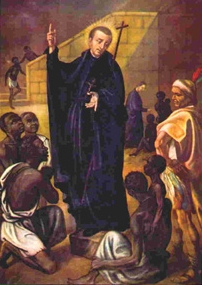
St Peter Claver & St Gorgonius

In the modern Roman Rite, to-day is the optional memorial of St Peter Claver, Jesuit Apostle of the Slaves, while in the older Form, it is a feria with commemoration of the martyr St Gorgonius: in both cases, either the ferial Mass may be said (with commemoration in the Extraordinary, without it in the Ordinary), or Mass of the saint; the difference is that in the modern Divine Office, St Peter Claver's full Office may be read ad lib., whereas in the Breviary, only a commemoration is made of St Gorgonius at Lauds.

All that is known of this Gorgonius (there is another more famous Martyr of this name who died at Nicomedia at the outset of the Great Persecution of Diocletian) is that he died for the Faith sometime in the 3rd century, and was buried at the spot named "the two laurels" on the Labican Way; by Pope Gregory IV, his relics were transferred to St Peter's (where I hope to venerate them).

St Peter Claver (1580-1654), meanwhile, is a most amazing saint, a saviour of men after the model of Our Lord, whose indefatigable care for the bodies and souls of the poor African slaves brought into Cartagena (now in Colombia) caused him to so preach Christ and baptize in His Name that 300,000 - yes! even the modern Martyrology with its severe critical spirit attests to this! - received the laver of regeneration at his hands.

All this was summarized in his famous vow: Æthiopum semper servus (Ever the slave of the Ethiopians, or the African slaves).

Meanwhile, back in his religious community, he was the innocent victim of persecution from his fellow Jesuits, which only added to the severe penances with which he macerated his flesh - such as wearing a fearsome crown of thorns while studying in his cell, and also each morning before the rest awoke, when, shouldering a life-sized Cross, he lived out the last steps of Christ to Calvary by dragging this painful burden from his cell to the chapel (no wonder the other Jesuits complained!).

He died on Our Lady's birthday, hence, most appropriately, his feast is appointed for the day after pro aliquibus locis (and presumably for the Society of Jesus). There would be no reason why a Traditional Mass could not be said in his honour on the 9th (so long as St Gorgonius was commemorated if it were a Low Mass, juxta rubricas). Indeed, if the liturgical reform had not occurred, it would seem probable that his feast would eventually have been extended to the whole world, with St Gorgonius as his companion. Here is his collect from the Traditional Missal, and - modified - from the Novus Ordo:

TRADITIONAL

Deus, qui abreptos in servitutem nigritas ad agnitionem tui nominis vocaturus, beatum Petrum mira in eis juvandis caritate et patientia roborasti, ejus nobis intercessione concede, ut, quæ Jesu Christi sunt* quærentes, proximos opere et veritate diligamus. Per eumdem...

(God, Who intending to call the negroes abducted into slavery to the knowledge of Thy Name, didst strengthen blessed Peter with wonderful love and patience in aiding them: grant to us by his intercession that, seeking what things are Jesus Christ's*, in work and truth we may love our neighbours. Through the same...)

NOVUS ORDO

Deus, qui beatum Petrum servorum servum effecisti eumque mira in eis juvandis caritate et patientia roborasti, ejus nobis intercessione concede, ut, quæ Jesu Christi sunt*, quærentes, proximos opere et veritate diligamus. Per [eumdem]...

(God, Who didst make blessed Peter the slave of the slaves, and didst strengthen him with wonderful love and patience in aiding them, grant to us by his intercession that, seeking what things are Jesus Christ's*, in work and truth we may love our neighbours. Through...)
* Cf. Philippians ii, 21: "For all seek the things that are their own:
not the things that are Jesus Christ's".


Note that the Novus Ordo is a little shy of referring to the trapped and enslaved negroes, and prefers a play on words (servant of servants, slave of slaves), which unfortunately loses the great focus of the Traditional prayer on the signal work of St Peter, not just in patiently and charitably serving them, but above all in baptizing so many to be made sons of God and co-heirs with Christ, that they might inherit life eternal. There are too many instances of such a this-worldly focus in modern prayers...

(If it were desired to read the Breviary, keeping his feast, all would be from the Common of Conf's-non-Pont's, but for his proper prayer.)

Friday, September 4, 2009

The Greater Part of Our Penance

My Scottish correspondent commented some posts below, in regard to the Breviary: "Humbert of Romans said that the 'greater part of our Penance consists in the daily recitation of the Office'. Notice he says part, so it alone is not all our penance; besides, it is not only penance - it can also be a joy."

Of ourselves as sinful men (and I speak first of myself), all we deserve is penance; but the Lord deigns to console us also, such is His mercy.

I fully agree with Humbert's opinion: that's why, despite its sometimes fatiguing length, I do make it a rule to say some form of the Divine Office every day: for well over a decade, it was the modern Liturgy of the Hours; then more recently I've more and more used the 1962 Breviary; and for the past seven weeks, I have been reciting the Little Office of Our Lady (whose relative brevity turns out to fit more easily with my work commitments), to the point that much of it is becoming second nature to me.

Why the Office? Well, fundamentally it is singing the praise of God in His own words: and since this shall be our entire occupation hereafter (if we avoid hell), it is fitting to make some preparation for this in the present. Prayer is not about changing God's will, but about conforming our will to His: praying the Scriptures is of signal use in this. Add to this the holy prayers of the Church, and the remembrance of notable saints as models for us, yes, and intercessors...

Being sick at home and away from work, these last three days I've managed the full Office again, and it has been both a penance, and a joy. While I have a great and even-deeper love for the Office of the Blessed Virgin, which is hard to tear myself away from, the sombre majesty of the ferial Office in particular is important, part of the innate genius of the Roman Rite.

Matins of Fridays - with the very long Psalm 77 (in six parts), then Psalms 78, 80 and the enjoyable 82 (confounding Israel's enemies) - is penance indeed! So, too, is Friday None, as I've blogged about before: Psalm 88 is prodigiously long. Lauds is, also, with a particularly long canticle from Isaias xlv, 15-26, Vere tu es Deus absconditus, to be prayed: an important text, but fatiguing.

But there are joys, too - the Passion Psalm, Psalm 21, at Prime; several familiar Psalms at Lauds (98 and 142, both splendid, plus 84 and 147, used at Prime and Vespers of Our Lady); and the blessedly short Terce and Sext (Psalms 79, 81, 83 and 86, all beaut psalms, the last used at Matins of the Virgin) to make up for the length of the rest of the Hours.

(Wednesday, Thursday, and to-day I've prayed the Hours from Matins to None en bloc in the mid-afternoon, after 3 pm, the hour of Christ's Death on Calvary. Penance, penance...)

Friday, July 24, 2009

Baumstark's Laws of Liturgy

Anton Baumstark was a liturgical scholar of the old school, who did not believe that tinkering with the sacred cult was the proper concern of liturgists, but that on the contrary one ought be not master but student of the liturgy. (One may note in passing that Our Lord Jesus Christ is the One Liturgist - Λειτουργὸς - as Hebrews viii, 2 attests.)

Famously, he formulated two laws describing the organic evolution of the liturgy over time: first, that on the most solemn days the most ancient and sober rituals tend to be retained; second, that over time, newer liturgical developments can tend to replace by degrees older features of the divine cult. For instance, until the post-Conciliar reforms, the Divine Office of the last three days of Holy Week, and of the whole of Easter Week, was marked by a simplicity of form unchanged for many ages - no hymns were sung, no short chapters read at the Day Hours, and so forth - this being an example of his first law. Contrariwise, the ancient Roman ferial Office has over time gradually been replaced by a multiplicity of saint's days, so that the weekly cycle of ferial Vesper hymns focussing on the Six Days of Creation are hardly ever sung through in one week, being replaced by hymns for the various occurring saints from their respective Common or Proper.

Baumstark's second law was well-explained by Jungmann, when considering the place of the Lord's Prayer, preces and Collect in the Divine Office. (I write here not of Matins, which was not generally read apart from Lauds - its union with the latter being the ideal, as even its name suggests.) According to mediæval testimony, at the Lateran Basilica the Lord's Prayer was said at the end of each Hour of the Office, with no collect at all appended. It is conjectured that this was the case especially if no priest were present (note here that monks, such as those who sang the Office at the Lateran, were originally unordained), and that in the remote past the Lord's Prayer was the normal conclusion of each Hour - a Collect proper to the day or time being added, at first to give greater solemnity, and then more and more often, so the Lord's Prayer became in the nature of a preface to it. (As the priest first said Dominus vobiscum before the Collect, the Collect itself savoured of things sacerdotal, and was only by degrees, it is argued, accepted as right for a layperson to say: and then it is prefixed with Domine exaudi instead.) The Benedictine and Dominican Breviaries still retain this characteristic pattern of Pater before Collect at the Day Hours.

However, in these, and in the Roman Breviary when the Lord's Prayer still rarely makes an appearance, the Pater noster is always preceded by a threefold Kyrie eleison, Christe eleison, Kyrie eleison. It is thought that this - like the Kyrie at Mass - was once a full litany (as in the Byzantine Rite), but over time was abbreviated to this simple form (St Benedict in his Rule terms it a litany). This litany before the Pater noster disappeared, only to be replaced, apparently under Celtic influence, with suffrages or preces recited after it - originally, these were a series of petitions, each followed by a versicle and response (usually from the psalms), but over time were reduced to a dialogic pattern of versicles and responses.

The Carthusian Breviary retained these long preces at all Hours; but outside that austere Order, it was felt increasingly that preces were not so appropriate to feast days, and so were restricted to ferias in various Breviaries, then were cut down in length (especially at the Little Hours), then were restricted to penitential days, and acquired a penitential sense - since one knelt to pray them, days when they were said were termed "kneeling days". By the mid-twentieth century, the Roman Breviary was being shortened by "simplification of the rubrics" - and the preces at the Little Hours, including the longer and more specialized ones at Prime and Compline, were finally abolished, while Lauds and Vespers only kept their preces on most Ember Days, plus ferial Wednesdays and Fridays of Advent and Lent. In the Roman Breviary, moreover, the Lord's Prayer, from being the original concluding prayer of prayers, had become considered as but part of these preces - and so was in essence discarded altogether from its ancient place.

In the Little Office of Our Lady (itself a pious addition to the daily Office, that became as it were a separate spin-off more suited to lay use because of its relative brevity, simplicity and devotional quality), until the last pre-Conciliar reforms what survived before the Collect of each Hour was not the Lord's Prayer at all, but rather the threefold Kyrie that itself had been a later preface to the Pater noster.

In a separate development, for long centuries (until the last changes under John XXIII before the Council) a Pater and later an Ave had been said as a preparation before each Hour (also a Credo at some Hours), and a Pater with versicle after it... and this, from being a pious custom lifting up the mind to God (as St Ignatius analogously directs before meditation) beforehand, and prolonging the official liturgical prayer, became a fixed devotion, part of the Office. The Lord's Prayer having disappeared from its first place in the Hours, it reappeared elsewhere, finally almost being removed entirely. (In the modern Divine Office, which in many ways represents a decided break with the traditional, organic development of the liturgy, the Lord's Prayer is said aloud, after some intercessions, and before the Collect, but at Lauds and Vespers only, for somewhat artificial reasons.)

As Jungmann summarizes Baumstark's second law, A becomes Ab, Ab becomes AB, this becomes (A)B and finally B alone remains - A being the original liturgical prayer, first b then B being the addition to it that gradually expands in importance until it takes its place entirely.

Another example of this law is the way that, while the more conservative Roman Rite Divine Office still largely consists of the recitation of the psalms, in the Byzantine Rite, the various Canons and divers troparia, kontakia and whatnot - liturgical hymns, of great dogmatic value - have so multiplied that it is they, not the psalms, that are the chief feature of the Hours: indeed, usually the kathisma(ta) or portion(s) of the psalms appointed are very hurriedly recited in monotone by a reader even in monasteries, so that the massed choirs can then break forth in magnificent chanting of the ecclesiastical compositions that now have pride of place; and in parish celebrations, very often the psalms to be recited are drastically pruned and abbreviated, being overshadowed by the more recent and popular elements of the services.

Wednesday, April 22, 2009

SS Soter and Caius

It was a delight to read Matins, Lauds and Prime this morning - beginning the day properly.  And after work and a coffee, the Little Hours, once around the Gorge (about 50 minutes) and Vespers.  Compline awaits my retiring to-night...

Why the obsession?  Because I seriously do believe one should live the liturgy of the Church.  The Office (new and old) has been the nourishment of my prayer life (apart from Holy Mass of course) for 15 years or more, since my early university days, and I hope it may be for many others a joy and a link to the truths of our Holy Faith, to the worship of Almighty God, to the cult of his saints, to the piety of our forefathers and to the Holy Scriptures, particularly the Psalms.

To-day we feast SS Soter and Caius, two early Martyr Popes.  Amusingly, the Breviary (following, I guess, the Liber Pontificalis) credits the former (who reigned c.166-c.174) with forbidding sacred virgins from touching the sacred vessels, and likewise prohibited them from exercising the office of thurifer!  A bloody good idea, and one that should be vigorously reënforced...
  
St Caius (r. 283-296) was a Dalmatian, of noble parents related to the family of the wicked Diocletian - that arch-enemy of Christ, whose name appears on every page of the Martyrology, yet was no martyr but their ravening persecutor and very dupe of Satan, whom he followed down to hell.  By the infamous cruelty of his distant relative Pope Caius too was crowned with martyrdom, along with his brother Gabinus - and both were buried in the same catacomb as St Soter, in the cemetery of Callixtus.

Celebrating the feast of martyrs during Paschaltide is a happy joy: the Martyrs stand in close company with the Lamb once slain Who lives now for ever and ever, and Alleluias of triumph resound as the Church lauds their sharing in the Easter Victory of her Divine Spouse.  The sacred Liturgy takes up a text even from the apocryphal Fourth Book of Esdras (ii, 35) to sing their blessedness, echoing in a different key both the traditional prayer for the dead and the texts of the Requiem Mass:

V. Lux perpétua lucébit Sanctis tuis, Dómine, allelúja.
R. Et ætérnitas témporum, allelúja.


(V. Light perpetual shall shine upon thy Saints, O Lord, alleluia.
(R. And an ageless eternity, alleluia.)

[Cf. Parati estote ad praemia regni, quia lux perpetua lucebit vobis per aeternitatem temporis. (IV Esdras ii, 35)]

May SS Soter and Caius pray with us and for us, that our part, too, may be among the saints in light.

Tuesday, February 3, 2009

Ferial Matins

I left Matins to-day till the afternoon, when I paid a visit to the Church of the Apostles after work to pray.  The Lessons were from Colossians i, 1-18 - which put me in mind of the use in the modern Office of Colossians i, 12-20 (with the opening gratias agentes changed to gratias agamus, so as to provide a principal verb) as a New Testament Canticle at Vespers on Wednesdays:
[Let us give] thanks to God the Father, 
Who hath made us worthy to be partakers of the lot of the saints in light: 
Who hath delivered us from the power of darkness, 
and hath translated us into the kingdom of the Son of His love, 
In Whom we have redemption *through his blood*', 
the remission of sins; 
Who is the image of the invisible God, 
the firstborn of every creature:
For in Him were all things created 
in heaven and on earth, 
visible and invisible, 
†whether thrones, or dominations, 
or principalities, or powers:†' 
all things were created by Him and in Him, 
and He is before all, 
and by Him all things consist. 
And He is the Head of the body, the Church, 
Who is the beginning, the firstborn from the dead; 
that in all things He may hold the primacy: 
because in Him, it hath well pleased the Father, that all fullness should dwell; 
and through Him to reconcile all things unto Himself, 
making peace through the Blood of His Cross, 
both as to the things that are on earth, and the things that are in heaven.
(I have given here the Douay version, as closely faithful to the Vulgate; the Neo-Vulgate of the modern Office is not notably different, excepting only that the section *-*' above, in Latin per sanguinem ejus, is not in the Neo-Vulgate.  Stupidly, the English version of the modern Divine Office is bowdlerized for the tender sensibilities of liberals and modernists, by omitting from verse 16 the words marked †-†', in the modern Latin sive throni sive dominationes sive principatus sive potestates, lest they suggest to the skeptical and misbelieving some of the names of the choirs of the Angels!)

Again, as I've noted previously, the use of canticles from the Old Testament is immemorial at Lauds (and at Vigils in the Monastic Rite), and of course the three Gospel canticles are the highlights of Lauds, Vespers and Compline; if St Pius X added extra canticles to Lauds, as he did, then it seems reasonable to allow Paul VI to add New Testament canticles to Vespers.  I certainly used the modern Office with profit and devotion for well over a decade, and do miss a number of its refinements even though I've gone over to the 1962 Breviary.  It would be a good thing to dwell on these words of St Paul in the passage given above, and often to recite and pray them.

Friday, January 9, 2009

Statistics

I keep note of what Masses I attend, when I go to confess, and so forth; here are the results, such as they are, for the Year of Our Lord 2008:
  • Masses in the Extraordinary Form: 175, plus 7 which I only attended part of, and the Good Friday Solemn Liturgy;
  • Masses in the Ordinary Form: 44, plus 2 which I only attended part of, and a Communion Service (!) led by a Deacon;
  • Byzantine Rite Divine Liturgy: 1;
Total Masses: 220, plus 9 partially attended.

I thus heard Mass about 60% of the time, or on average about 4 days a week - but of course sometimes I heard more than one a day, as while attending WYD with Juventutem...

While I have been for many years an almost daily Mass-goer, I have been a bit slack for three reasons: pressures of work, making it difficult to get to Mass or making me feel tired and disinclined to go; increasing dislike of the Novus Ordo, having become so used to the Traditional Mass to the extent that I didn't wish to attend the former if I couldn't make it to the latter; and sin, which makes one foolishly pretend to hide oneself from God, as Adam and Eve did in paradise after the Fall (Genesis iii, 8-10).
  • Confessions: 60, or slightly more than once a week.
I am an habitué of the confessional, I must admit, and would wish that I spent longer away from it!  While it is excellent that Fr Rowe (and other priests) hear daily confessions in Perth, looking back I think I overindulged in the Sacrament of Penance; here in Tasmania priests hear confessions on Saturday only, which will present a useful discipline, especially as "frequent" confession is advised to consist in being shriven fortnightly or at the most weekly.  What I require is to be less of a lazy backslider and more a disciplined soul living ongoing growth in virtue, however...  Orate pro me.

Finally, my rule of prayer continues to principally consist in reciting the Divine Office, either in its modern or increasingly in its traditional form, from the Roman Breviary - occasionally earlier in the year, then daily from mid-May to the end of July, and from September onwards, tho' until Advent I very frequently substituted the modern Office of Readings for the older Matins, as being shorter.  (I also have the habit of saying the Angelus, and using some short morning prayers, etc.)

Now, for making some belated resolutions for the Year of Our Lord 2009...

Thursday, December 11, 2008

Lunar Hermitage

I will behold thy heavens, the works of thy fingers:
the moon and the stars which thou hast founded.

(Ps 8:4)


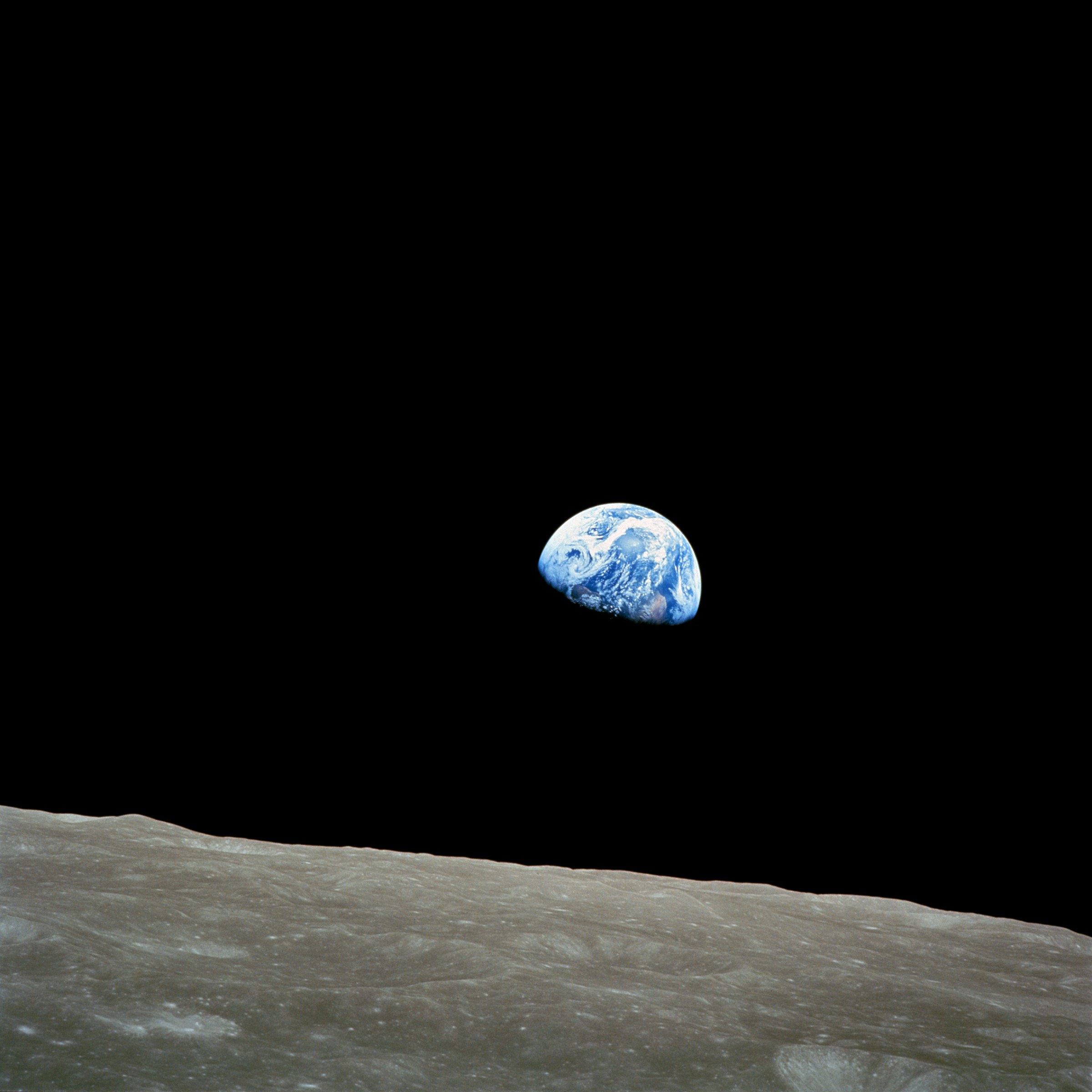
(Note the lunar lander just left of centre.)

I have been pondering for some time retiring to a hermitage somewhere - down the South West of W.A.? down past Huonville in Tasmania? - but have just now decided that the Moon is the best place whereto withdraw.

There are no people there, after all - "Far from the madding crowd" indeed!

Of course, I will have to start saving the pennies and soliciting donations via one of those blog-sidebar gizmos, as even a slingshot round the Moon and back - without landing! - costs about U.S. $100 million (I will have to resist the temptation to convert to Russian Orthodoxy to gain Mr Putin's assistance in subsidizing the expense, although I'd be happy enough to take out Russian citizenship as a gesture toward my transporters; maybe if I agree to produce evidence that he wasn't born a Georgian?)...

I figure that, locating myself at one of the peaks of eternal light at the North or South Pole of Luna, with solar power, greenhouse, modest lifepod buried under a layer of regolith, and an occasional incoming rocket to supply non-recyclables, all would be most cosy.

What a Christian joy, to live alone, hidden with Christ - the true Sun, That knoweth no setting - on a very pic de lumière éternelle!


It would be fine indeed to be away from all and sundry - for as oft as I have been among men, I have returned less a man (so à Kempis, quoting Seneca) - while ensconced in my better-than-eagle-eyrie, casing an eye upon the busy globe, with all its transient pomps and vanities, seen in its true quality as a vanishingly small blot in the centre of boundless immensities, from my seat on the edge of cislunar space, scarce below the eternal heavens - for we should only view terrene things with the left eye, reserving the nobler right for the contemplation of things above; and in any case I would still have Internet access.

Apart from the obvious astronomical pursuits, and perforce checking on the continued smooth running of the hydroponic pumps, and urine purifier, while partaking of spartan meals of algae supplemented by vegetables grown in watered moon dust (beware: moon dust is probably a health hazard, being made of extremely fine and very jagged particles, depressingly like asbestos), I would be able to devote myself to prayer and ascesis.

Praise ye him, O sun and moon: 
praise him, all ye stars and light.
(Ps 148:3)

I think the larger time available would enable me to embark on a truly medieval round of prayers, rather like that day I read the Divine Office, the Little Office, the Office of the Dead, the Gradual and Penitential Psalms and the Litanies of the Saints, just for starters!  And of course I could always attempt lectio divina and meditation if I really wanted to.

O ye sun and moon, bless the Lord: 
praise and exalt him above all for ever.
(Dan. iii, 62)

The only real drawback would be the lack of a chaplain (I think it would be prideful to ask for emergency ordination prior to departure from Baikonur cosmodrome, although I know at least one Aussie priest who obtained his orders under lawful if mysterious circumstances while visiting the Middle East).  I would plan to console myself by watching streaming video of sumptuous liturgies over the Net, from the New Liturgical Movement et al., and listening to Podcazts; given weight limitations, bringing too many CD's and DVD's could prove difficult - my personal library alone will require a separate rocket launch...

Of course, within the Oratory of my lifepod I should have room for some reproduction icons and a shelf-cum-altar, and like a Carthusian I could at least read a dry Mass; incense, let alone real candles, will, alas, prove too dangerous given the limited oxygen supply despite the presence of plants to scrub out CO₂.  No doubt I could have horrible fake Italian electric candles instead, to punish my vanity.  (I'll bring two blest candles in case the Three Days' Darkness occur during my lonely sojourn.)

Doubtless I should have in my Oratory a beautiful statue of Our Lady, Queen of Luna: for is she not fair as the Moon (Cant. vi, 9)? and does she not reign in heaven as Queen with the Moon under her feet (Apoc. xii, 1)?

Perhaps an indult could be got from the Vatican for long-life hosts, which I could bring (pre-consecrated), like a new Tarcisius, on my one-way voyage?  All men know that in the early church even laymen travelled with the Sacrament upon their person (e.g. St Satyrus, brother of St Ambrose), and there is a lunar precedent: Buzz Aldrin brought with him some Eucharistic elements (albeit from his Presbyterian church), which he consumed in the Eagle ere Armstrong, then he, stepped forth after their historic landing.  If I were instituted as an acolyte, I could even mount Exposition.  No doubt self-communion would be permitted, under such peculiar constraints...

Yes, something to do with eagles would make for a nice allusion: I think that Eyrie Oratory would be a fitting moniker for my lunar hermitage.

******

And just to shew my ecumenical streak, here is the proposed "Common for Space Exploration" of the Episcopalians in the U.S.A.:


Collect (traditional language)

Creator of the universe, whose dominion extends through the immensity of space: guide and guard those who seek to fathom its mysteries [especially N.N.].  Save us from arrogance lest we forget that our achievements are grounded in thee, and, by the grace of thy Holy Spirit, protect our travels beyond the reaches of earth, that we may glory ever more in the wonder of thy creation: through Jesus Christ, thy Word, by whom all things came to be, who with thee and the Holy Spirit liveth and reigneth, one God, for ever and ever. Amen.

Psalm 19 [18]:1-6 (Cæli enarrant)
or 
Canticle 12 (the Benedicite): from Daniel 3: 57-87 plus doxology

Lessons
Job 38: 4-12, 16-18 ("Where wast thou when I laid up the foundations of the earth... when the morning stars praised Me together...")
Revelation 1:7-8, 12-16 ("Behold He cometh with the clouds... I saw... One like to the Son of Man...")

Gospel
John 15:5-9 ("I Am the Vine, you are the branches...")

Preface of God the Father or the Epiphany*

Of these suggested texts, obviously Psalm 18 and the Benedicite are good proposals, being filled with Divine praises for the cosmic order; as readers will note, I've also quoted above from Psalms 8 and 148, for utterly the same reason.  One could add also Psalms 103 and 135...

Job xxxviii is another happy choice, since it aptly describes the mysteries of the universe.

However, bizarrely enough, the second Lesson, from the Apocalypse, seems to have been chosen because it can be read as describing Christ as as ancient astronaut, à la Erich von Däniken!  This is most inappropriate, and I'd junk it.

Similarly, I cannot really see why the passage from St John xv is applicable in any but the most generic sense.

Finally, I think the suggested Prefaces* aren't the best - while certainly, though in common with all other Episcopalian Prefaces, in their contemporary language versions, God the Father is named "Creator of heaven and earth", surely, a still better and more apposite choice would be that of the Ascension:


It is very meet, right, and our bounden duty, that we should at all times, and in all places, give thanks unto thee, O Lord, holy Father, almighty, everlasting God, through thy dearly beloved Son Jesus Christ our Lord; who after his glorious resurrection manifestly appeared to his disciples; and in their sight ascended into heaven, to prepare a place for us; that where he is, there we might also be, and reign with him in glory.  Therefore with Angels and Archangels, and with all the company of heaven, we laud and magnify thy glorious Name, evermore praising thee, and saying:


Holy, holy, holy...


Some of these texts, mutatis mutandis, could be used at my eremitical consecration prior to blast-off...

Saturday, November 8, 2008

Late at Night Early Morning Musings

I must say I find fitting in Matins a trial.  The rest of the Breviary - the day Hours, that is - I love, but finding the time for Matins remains an ongoing challenge.  Chugging through the nine psalms of the nocturn is penitential for me, requiring an ongoing exercise of the will, despite their individual excellences.  I have on and off 'cheated' by instead using the Office of Readings from the modern Office, and have speculated on the appeal of saying only say three psalms at Matins, omitting the rest, but I remain convinced that chopping and changing is not the answer, since one major feature of the Breviary is the commitment to reciting all 150 Psalms of David each week (insofar as no feasts of I or II Class supervene) and observing the one Calendar and keeping to the lectio continua at Matins.

My compromise is to omit praying Matins first each day, and instead to say Lauds and Prime before work, the rest of the Little Hours either at breaks or after work, Vespers in the evening (ideally after evening Mass, in thanksgiving) and Compline at bedtime, reserving Matins for some time in the afternoon or evening or night when I can knuckle down to it.

This evening, I came to the Pro. at about a quarter to six o'clock, after the Holy Hour had started (it being a First Friday), and made my humble confession (my penance: to say a decade of the Rosary to intercede for the propagation of devotion to the Sacred Heart), before praying Matins (Lauds to None already having been done), attending Benediction, and then serving Mass for Fr Rowe, which was a Votive of the Sacred Heart.  After Mass, Vespers...

We repaired to Fr Rowe's place for fish and chips, with beer (rather good, home-made by a parishioner) and some spirits (Drambuie and Arak), cake for dessert and copious cups of tea.  Besides the usual suspects, we were joined by some new acquaintances, one visiting from Geraldton, and two visiting from Sydney.  After having dinner, our visitors accompanied us to St Anne's, Belmont, to see how the work of fitting out that church is getting along; then I gave Justin a lift home, and finally got back here just before 1 am.

Justin has been telling me how he has found the Little Office of Our Lady to be an excellent rule of prayer, as (and I know the feeling) he is too busy to pray the Breviary.  I have in the past used it, and like it, but by the time I've said some short morning prayers, tried to keep to the daily threefold Angelus, and got through the Office of the day, I can really not fit much more in.  

What a grace it is to have time to pray!

Wednesday, August 13, 2008

Sickness and Lovecraft

Unfortunately, feeling unwell, I missed Holy Hour and Mass for St Philomena; Fr Rowe was a bit disappointed (he told us yestereven) by the absence of many, particularly as he preached a long sermon on aids to chastity after the example of the virginal martyress. Yesterday I got through work, and got to Confession, which is always a boon. The Redemptorist behind the grille reminded me that occasions of sin are like a firey cauldron: advice sobering and true, which I have tried to take to heart and act upon. I said the Rosary afterward before the altar and image of Perpetual Succour, with a degree more fervour than usual!

Last night, despite being offcolour, I made it to Fr Rowe's farewell dinner for one of the FSSP seminarians, who's departing for the States shortly, to begin his studies in Nebraska. Aaron and two of my housemates also came, and we were certainly well-fed!

However, ever since returning from WYD I've not been back to complete good health I think, and today I again woke sick and unwell, and called in sick, which my doctor confirmed later. Having not had as much energy lately, since the end of July I've been reduced to the modern Office again, fearing to tire myself out on that work of supererogation the Breviary when I must needs put my duties at work first. The Office is familiar to me, having used it for so long, but getting through it each day has been difficult and fitful, and I feel I haven't really prayed.

While prayer has not been as I would like it to be, on the natural level it has been nice to do some secular, fictional reading. Fr Bernard, a Dominican sometime stationed in Providence, Rhode Island, some years back introduced me to the wierd work of H.P. Lovecraft. and I've been enjoying reading his eldritch stories. For some odd reason, while in the past I disliked and but rarely enjoyed horror (excepting only a few of the classic vampire tales), I find Lovecraft congenial, despite his atheism and (worse?!) 'cosmicism', that nightmare vision of man in a cosmos uncaring, where his cherished morality and beliefs are meaningless, and sinister inhuman forces are real and strong, stronger than he.

(I wonder idly if existentialism would have been Lovecraft's cup of tea? or would de Beauvoir, Sartre and Camus have seen themselves in his tales? No; as another Frenchman said archly, "Whatever would the devil do in Paris? He would find men as diabolical as he, and himself dismissed as a naïve provincial." But I digress; I detest existentialism.)

Months ago I recorded buying two volumes of Lovecraft's stories: these I've finally finished reading, and now have acquired two more volumes in the Penguin Modern Classics edition (The Call of Cthulhu and Other Wierd Stories and The Dreams in the Witch House and Other Wierd Stories), which I have just started into. There are some duplicated stories, but these latest additions are annotated, which I like. So thanks, Fr Bernard, for your introduction to Lovecraft, via that screening of an adaptation of "The Call of Cthulhu" - a DVD I'm now ordering...

Sunday, January 13, 2008

The Lamest Canticle

I have no objection to the use in the modern Office of New Testament Canticles at Vespers in an analogous manner to the immemorial use of Old Testament Canticles at Lauds (and Monastic Vigils), in addition to the traditional three Gospel Canticles (Benedictus, Magnificat and Nunc dimittis) used at Lauds, Vespers and Compline.  Scholarly research revealed good suggestions that certain passages in the epistles of St Paul were hymnic in structure, after all.


However, the excuse for a Canticle slotted into 1st Vespers of the Epiphany and the Lord's Baptism is just dreadful, because it is a failed pastiche: it interlards the sublime concision of I Timothy iii, 16 with a response (yuk! deliver me from the Responsorial Psalm, too-aptly defined as "an exercise in short-term memory"), worked in poorly, from Ps 116:1a.  It would have been better far to either use I Tim. iii, 16 as a short reading at one of the Hours of these feasts (for which it is manifestly appropriate, excuse pun), or have it as a super-short canticle (longer at least than Psalm 116, and only a bit shorter than Psalm 132 or the Canticle from Apoc. xv, 3-4).

Saturday, January 12, 2008

Today He is Reborn in the Sacraments

My dirty little secret: I've gone back to using the modern Divine Office for the last week or so (but did Epiphany according to the Breviary).  It's the shape of things to come – I'll be joining friends of mine for Lauds and Compline according to the modern Liturgy of the Hours on a regular basis once I get back to Perth from holidays.  When I can, I mix and match the parts in Latin and English, since I have both the Latin original and the English version of the Office.


Anyhow, frankly it's nice to return to what I've been used to (and a great reduction in time and effort, which sounds bad!), despite the great appeal and attraction of the '62 Breviary, which I've treasured over the past three months.  I always knew this would happen, because there was no way with full time work I'd be able to keep it up anyhow.


One joy has been getting back to the Patristic gems in the Office: Friday's passage taken from Sermon 100, on the Epiphany, by St Maximus of Turin, contained the pregnant phrase [Dominus] hodie renatus est sacramentis ("today he [the Lord] is reborn in the sacraments"): this is said in reference to the Theophany, the Baptism of Christ in the Jordan, whereby He, the Holy One, sanctified the waters and made them fit for the later administration of baptism to all who shall come to believe; but in a deeper sense Christ is reborn in all the sacraments – for the purpose, the final cause of them all is the engendering of Christ in those who receive them in faith, that the Christus totus, Christ, Head and members, be built up, that Christ may be all in all and the Divine Image restored in man, that the last Adam may bear the likeness of the first Adam, that man may be Christified and made sharer in the Divine Nature.  For only if Christ be born in us and live in us and depart not from us are we redeemed and saved.

Sunday, December 30, 2007

What about Matins lessons and the Little Hours?

Summorum Pontificum cura – the third word is the key to the intent of Benedict XVI's Motu Proprio, since the phrase is then complete: "The care of the Supreme Pontiffs [for the sacred liturgy]" – has of course allowed (Art. 9, § 3) that all the clergy may use the 1962 Breviary when fulfilling their mandate of praying the Hours of the Divine Office.


(I assume that if the clergy may use it, certainly a mere layman may; it would be perverse to think otherwise.)


Certain questions arise.


Fairly obviously, Matins is the equivalent of the modern Office of Readings.  Now, apparently the clergy under Bishop Rifan in Campos still use (at least the readings from) the pre-1962 Breviary, the main difference being that Pope John XXIII's revision cut down the readings at Matins from nine on all feasts to only three, except for the most important days, and amazingly enough cut out most of the Sunday lessons from the Fathers (thus prioritizing action over contemplation, since the clergy are always busiest on Sunday; a cynic might suggest transferring Sunday's Office to Monday, when most observe their peculiar day of rest...) – this abbreviation is well-critiqued elsewhere.  


As mentioned in comments at WDTPRS, presumably this action of the Campos clerics fulfils their obligation, since the greater (all nine readings) includes the lesser (the three remaining after the 1962 abbreviation).  But a clarification on this point is needed.


Lauds, Vespers, Compline: old rite or new rite, they're basically the same, just reordered and chopped about (the post-Conciliar edition famously having less psalms per Hour).  But what of the Little Hours?  Prime has no post-Conciliar equivalent, and of Terce, Sext, and None, tho'all three are still prayable using the options in the new books, only one need be said, hence its name of the Middle Hour (singular).  Now, here is the question: One can fulfil one's obligation by praying either Office, and so one can mix-and-match (especially if one prays part of the Office with others, who may use the modern version, while one uses the older in private for the rest of the Office): but how to count the Little Hours?  


It would seem, bizarrely enough, that one bound to the Office should either say: Prime, Terce, Sext, and None (1962); or, just one Hour, the Middle Hour (1971).  To say only Prime, or Terce, or Sext, or None, or even two or three out of the four, instead of the Middle Hour, would not suffice!  Yet, having said Middle Hour, there would be no need to say any of Prime, Terce, Sext, or None!  This seems to reverse the principle of the greater including the lesser.


The reason behind this is simple.  In either Office, the basic principle is to pray the Psalter over a determinate period of time, disregarding interruptions due to feasts having proper Psalms.  In the case of the modern Liturgy of the Hours, the Psalter (omitting about 5% as occasioning psychological difficulties in vernacular recitation – cf. GILH, n. 131) is spread over four weeks, whereas (in line with the counsel of St Benedict and the Fathers) the Roman Breviary spreads the Psalter over one week only.  Hence, to fit in all the Psalms, the Breviary must needs have allotted psalms for each of Prime, Terce, Sext, and None, whereas in the Divine Office only one set of psalms is provided for the Middle Hour (those desirous of saying three Hours have to use various of the Gradual Psalms repeatedly, and these are already used at other Hours). 


I will be interested to see how this issue is interpreted.


Personally, as a layman I recite the Office out of devotion, realizing that by doing so I am truly taking part in a noble liturgical act, the worship of Christ and His Church, and knowing that liturgical prayer is of its nature higher than non-liturgical, tho' of course many charwomen at their beads please God much more highly than my sinful self distractedly racing through Sext on Sunday.  


I used the modern Divine Office for over twelve years, and have just recently switched to the 1962 Breviary; and in both cases I have said the Office complete, not omitting any Hours, but in the case of the modern Office only saying one Middle Hour for the most part (tho' one Lent at least I did say all three of modern Terce, Sext and None, thus becoming very familiar with the Gradual Psalms!).  My motive for this is simple: to pray the Office is fundamentally about praising God in His own words, the Psalms (all else is ancillary, tho' very important and holy), and to run through the whole Psalter is the aim; to omit any Hours is to fail in this.  So when using the old Breviary, I have said every one of the Little Hours.  


It would seem to me wrong to derogate from the discipline and arrangement of the old Breviary to allow the clergy to say only one of the Little Hours from it in fulfilment of their duty; Pope St Pius X intended the cursus to run through all the psalms in the course of each week, and only by saying all the Little Hours can this be achieved; if they esteem it so little, let them pray the "Little Office of Vatican II" as a friend unkindly names the modern Divine Office (which I continue to praise highly, it seems the best of the modern liturgical books), abbreviated precisely for their benefit.