Showing posts with label Martyrology. Show all posts

Tuesday, January 20, 2015

A Saint - Just Not in Either Martyrology


St John the Hermit, Priest of Ortega (so named after the nettles there, urtica in Latin), or, as he is called in Spanish, San Juan de Ortega – amusingly rendered into English as St John of the Nettle(s), or even, of the Thistle! – is a curious example of an undoubted saint, who nonetheless appears neither in the EF nor the OF Martyrology.

His feast, as found in many Spanish Breviaries, was and still is celebrated (by a fiesta, procession and Mass in his resting place) on the 2nd of June, the day of his death in 1163. The relevant volume of the Acta Sanctorum, published in 1695, details this and other accounts of his holy life, spent in the service of pilgrims to Santiago de Compostela; the tiny hamlet of San Juan de Ortega, named after him, is one of the stops along the Camino Francés, and his relics are still venerated there.

According to the Bollandists, Neque per Romani Breviarii susceptionem abolitum est festum, sed mutatum Officium – "And neither by the taking up of the Roman Breviary [in place of the old Diocesan Breviaries of Spain] was [his] feast abolished, but the Office was changed"; that said, I cannot find a copy thereof. At least, from the A.S., I have uncovered the Collect of his feast:

Omnipotens sempiterne Deus, qui beatum Joannem, Confessorem tuum atque Presbyterum, Sanctorum tuorum collegio sociasti; concede nobis, adhuc in valle lacrymarum laborantibus, ut ejus preces et merita, ad impetrandam gratiam tuam tuta præstent auxilia. Per. 
(Almighty, everlasting God, who hast joined blessed John, thy Confessor and Priest, to the college of thy Saints, concede to us, still labouring in this vale of tears, that by his prayers and merits, his secure assistance may be provided for obtaining thy grace. Through…)

It ought be noted that in 1971 the Vatican, at the request of the Spanish Episcopal Conference, appointed him Patron Saint of Surveyors, which is not an honour conceded to mythical persons or those whose claim to sanctity is dubious. Furthermore, the particular calendar of the Archdiocese of Burgos  lists him on the 2nd of June.

How annoying an oversight, then, that even in the most recent edition of the Roman Martyrology, his name does not appear! I spent quite a bit of time searching in my copy through all the many Saints named John, to no avail.

Now for rubricians, a question: according to the letter of the law, in both the modern and 1962 Missals, a Votive Mass may be celebrated of any Saint listed in the relevant edition of the Roman Martyrology; thus, according to the letter of the law, it would seem that it is impossible to offer a Votive Mass in honour of St John of the Nettle – however, as his cultus is ancient and undoubted (it was good enough for the Servant of God Queen Isabella the Catholic, who visited in 1477), could the spirit rather than the letter be applied, and such a Votive be offered, for the intention of the many pilgrims traipsing across Spain to the tomb of St James?

Thursday, December 24, 2009

From the Christmas Martyrology

To-day, at Prime for the 24th of December in the Year of Our Lord Two Thousand and Nine, was read the Martyrology for to-morrow, the 25th of December (I imitate the seventeenth Century style):

...since the Creation of the World, when (in the Beginning) GOD created the Heaven and the Earth; and from the Flood, the Two Thousand Nine Hundred and Fiftieth Year; from the Birth of Abraham, the Two Thousand and Fifteenth; from Moses, and the Exodus of the people of Israel from Egypt, the One Thousand, Five Hundred and Tenth; from the anointment of David as King, the One Thousand, Three Hundred and Second; in the Sixty-Fifth Week, according to the Prophecy of Daniel; in the One Hundred and Ninety-Fourth Olympiad; in the Seven Hundred and Fifty-Second Year from the Building of the City of Rome; in the Forty-Second Year of the Emperor Octavian Augustus, all the World composed at Peace, in the Sixth Age of the World, JESUS CHRIST, Eternal GOD and eternal SON of the FATHER, desiring to consecrate the World by His most devout Advent, and nine months having pass'd since His Conception, 
(All kneel)

in Bethlehem of Judæa was born of the Virgin Mary, being made Man.


The Nativity of Our Lord JESUS CHRIST according to the Flesh.


This holy day is marked by four commemorations of Christ's beloved servants, His saints: St Anastasia, Virgin and Martyr, who together with two hundred men and seventy women suffered many and varied torments under the Emperor Diocletian; St Peter Nolasco, Confessor, Founder of the Order of Our Lady of Mercy for the Redemption of Christians held captive by the Moors and Saracens; St Eugenia, Virgin and Martyr, who was put to death by the sword at Rome in the reign of the Emperor Gallienus; and most notable of all, a great company of the shining army of martyrs praising God:

At Nicomedia, the Passion of many thousands of Martyrs, who, when they were come together for Mass upon the Nativity of CHRIST, Diocletian the Emperor ordered the doors of the Church closed, and a Fire prepared all about, and a tripod with Incense set before the doors, and with a great voice to cry a Proclamation that whosoever would wish to flee the Conflagration, should come out the doors and offer Incense to Jove; and when all with one voice replied that they most willingly would die for CHRIST, as Incense were they consumed with Fire, and thus on that very Day they deserv'd to be born in Heaven, upon which CHRIST once deigned to be born for the salvation of the World.

Tuesday, December 15, 2009

Valerian, Confessor under the Vandals

One of the greatest tragedies to befall Christendom is the entire loss of the Church of North Africa, or of the Maghreb - "the Occident" - to use the Arabic term (the Copts and the other Christians of Egypt still hang on by a thread, despite cruelties daily perpetrated against them, as just last year - to attack the livelihood of the poorest - the slaughter of their pigs on the pretext of swine flu; or, far worse, the rapes of young women thereupon carried off into forced marriages and forced conformity to Islam).

It is true to say that the North African Church arose in martyrdom, flourished for a time despite all heresies - its native Donatists, addicted to martyrdom, active and passive! notwithstanding - suffered Arian persecution, came to a second lesser flowering - not without struggles - under the Byzantines, and then was worn down to nothing in a third age of dhimmitude.

One of the great glories of these churches, ere their slow agony of extirpation under the Muslim yoke (having been overrun by 700, some eight hundred years later, when the Spanish briefly reoccupied Tunis, only a few Christian families were found, and Arab writers refer to a few Christian villages remaining till that age), was their Second Age of Martyrdom under the Vandals (c. 430 - c. 530).

For the Vandal period, I make reference to Victor of Vita's History of the Vandal Persecution, written largely in about 484, while yet it raged. I refer to it, because - upon consulting the '62 Martyrology for to-day, an Advent feria, I found listed Bishop Valerian of Abensa (c. 380 - post 460), whose praise I render thus:

In the same area [(Proconsular) Africa (now Tunisia)], of St Valerian, Bishop, who, when being more than eighty years of age, in the Vandalic persecution, under King Genseric the Arian, called upon (conventus) by him that he should hand over the appurtenances of the Church, and constantly refusing the same, he was commanded to be banished beyond the city in a singular manner [or by himself (singularis)]; and since command was made that no one should permit him to dwell either in house or field, for a long time he lay in the public street naked under the sky, and, in confession and defence of Catholic truth, he completed the course of his blessed life.

(The modern Martyrology says the same, making some verbal alterations.)

It must be remembered that to be a traditor, literally a betrayer and traitor, to be one who would hand over to the ungodly the sacred vessels, the books of Scripture, and the like necessities of the Church, was the very worst sort of apostasy, especially in the eyes of North African Christians. It was death to refuse to be a traditor under the Romans; but those who gave in merited their own damnation.

Victor of Vita adds his eyewitness testimony to this: "I was privileged despite my unworthiness to be able to pay my respects to him while he was undergoing such an exile" (Book I, 40). It appears he is styled Confessor, rather than Martyr, because he was not directly put to death, albeit condemned to expire alone and unsheltered due to exposure - much as, through harsh and evil usage, St John Chrysostom died while being hurried into exile, but is not accounted a martyr thereby.

In such sufferings, one may add, the holy Bishop imitated the example of our Blessed Saviour, Who said of Himself, "The foxes have holes, and the birds of the air nests; but the Son of man hath not where to lay his head" (St Matthew viii, 20; & St Luke ix, 58), when "it came to pass, as they walked in the way, that a certain man said to him: I will follow thee whithersoever thou goest" (St Luke ix, 57): brave because strengthened by God is he who could bear to keep his word in such a case!

As the Apostle wrote of himself (I Cor. iv, 13 & 9), Valerian was treated as the utter scum of the earth, and made a public spectacle - but with an outcome far from that intended by that Herod of a king: for thereby the saint was proved as silver is tried.

Indeed, St Valerian was as those "being in want, distress, afflicted: of whom the world was not worthy" (Hebrews xi, 37b-38a). Truly with blessed Job he could say: "Naked came I out of my mother's womb, and naked shall I return thither: the Lord gave, and the Lord hath taken away: as it hath pleased the Lord so is it done: blessed be the name of the Lord" (i, 21).

As for his Arian oppressors, deniers of Christ and enemies of God's saints, of suchlike false religionists and evildoers it was well written: "They send men away naked, taking away their clothes who have no covering in the cold: who are wet, with the showers of the mountains, and having no covering embrace the stones" (Job xxiv, 7-8). The death of such sinners is the worst, because being but the entrance to everlasting hell!

Of course, Our Lord was stript of all things when at length He offered the Propitiatory Sacrifice upon the Cross, setting the supreme standard for all, to take up the Cross and follow Him. For the servant is not greater than his Master, but follows in His steps.

I am minded to subjoin in extenso the following pericope from the Epistle to the Hebrews (xii, 1-14), as fit for meditation given this saint's trials as set before us, and as a passage of Scripture whose tenor and conclusion is especially appropriate in this season of Advent as we make paths straight for the coming Lord:

And therefore we also having so great a cloud of witnesses over our head, laying aside every weight and sin which surrounds us, let us run by patience to the fight proposed to us: looking on Jesus, the author and finisher of faith, who having joy set before him, endured the cross, despising the shame, and now sitteth on the right hand of the throne of God. For think diligently upon him that endured such opposition from sinners against himself; that you be not wearied, fainting in your minds. For you have not yet resisted unto blood, striving against sin: and you have forgotten the consolation, which speaketh to you, as unto children, saying: My son, neglect not the discipline of the Lord; neither be thou wearied whilst thou art rebuked by him.
For whom the Lord loveth, he chastiseth; and he scourgeth every son whom he receiveth. Persevere under discipline. God dealeth with you as with his sons; for what son is there, whom the father doth not correct? But if you be without chastisement, whereof all are made partakers, then are you bastards, and not sons. Moreover we have had fathers of our flesh, for instructors, and we reverenced them: shall we not much more obey the Father of spirits, and live? And they indeed for a few days, according to their own pleasure, instructed us: but he, for our profit, that we might receive his sanctification.
Now all chastisement for the present indeed seemeth not to bring with it joy, but sorrow: but afterwards it will yield, to them that are exercised by it, the most peaceable fruit of justice. Wherefore lift up the hands which hang down, and the feeble knees, and make straight steps with your feet: that no one, halting, may go out of the way; but rather be healed. Follow peace with all men, and holiness: without which no man shall see God.

Friday, September 4, 2009

The Mutterology

Some Dominicans told me that of old time, the custom in their Melbourne priory was to have the Martyrology read out in the refectory during the meal; the clerical students deputed to this task termed it the Mutterology, as their Latin was perhaps faced by many a tonguetwister! They still joke about the saint(s) who died at "Too dirty in Umbria" [Tuderti, locative of Tuder, now Todi].

While in the old rite the 4th of September is a feria, there are a slew of saints whose anniversaries occur. From to-day's (1962) Martyrology (which I didn't get around to reading at Prime yester-day, hence my interest):

  • St Moses the Prophet and Lawgiver of Israel;
  • St Candida, said to have been first-fruits of Naples for Christ (and baptized by St Peter)*;
  • St Marcellus, bishop of Treves and martyr*;
  • SS Rufinus, Silvanus and Vitalicus, child-martyrs of Ancyra in Galatia*;
  • SS Magnus, Castus and Maximus, martyrs*;
  • St Marcellus, martyred at Chalons in the reign of the Emperor Antoninus by being buried up to his waist and left to die;
  • St Thamel (previously a pagan priest) and companions, martyrs*;
  • SS Theodore, Oceanus, Ammian and Julian, martyred by having their feet chopped off and their bodies thrown into a fire;
  • Pope St Boniface I, Confessor (died 422);
  • St Marinus, anchorite and deacon at Rimini, who converted many to the Faith of Christ (4th or 5th century);
  • St Rosalia, Virgin, a 12th century native of Palermo, and of royal descent, who abandoned the pomps and comforts of court and fled rather to the mountains to live as a hermitess;
  • St Rose of Viterbo, Virgin, whose relics were translated this day.

The modern Martyrology, observing many of these saints on different days, and omitting some so far as I can see (the ones marked with asterisks *), adds these other saints and beati, of local cultus only:

  • St Caletrix, 6th century bishop of Carnuti in Neustria (where?);
  • St Ida, widow of Duke Egbert, at Heresfeld in Saxony (died 825);
  • St Fredald, bishop and martyr, at Mimatus in Aquitaine (9th century);
  • St Irmgard, Countess of Süchteln, at Cologne (died circa 1089);
  • Bl Catherine Mattei, Virgin and Dominican sister of penitence (died 1547);
  • Bl Scipio Jerome Brigéat de Lambert, priest and martyr, starved to death in a prison hulk during the French Revolution in 1794;
  • Bl Marie of St Cecilia Bélanger, Virgin, religious sister of the Congregation of Jesus and Mary (died 1929);
  • BB Jose Paschal Carda Saporta and Francis Sendra Ivars, priests, and Bernard Bieda Grau, Capuchin, martyred in various parts of Spain during the Spanish Civil War.

Sancta Maria et omnes Sancti intercedant pro nobis ad Dominum...

(May Holy Mary and all the Saints intercede for us with the Lord....)

...ut nos mereamur ab eo adjuvari et salvari, qui vivit et regnat in sæcula sæculorum. Amen.

(...that we may deserve to be helped and saved by Him, Who liveth and reigneth world without end. Amen.)

Wednesday, September 2, 2009

My God, My Mercy

I have a little prayer book entituled My God, My Mercy (quoting Psalm 68:18b - Deus meus, misericordia mea); this line one strikes each Wednesday at None in the Breviary, and to-day (being sick at home) I had the sudden inspiration (after a very spiritually dismal time) of reading the full Office again, which has at least restored my spirits while being insufficient penance for my sins, double-mindedness and backslidings.


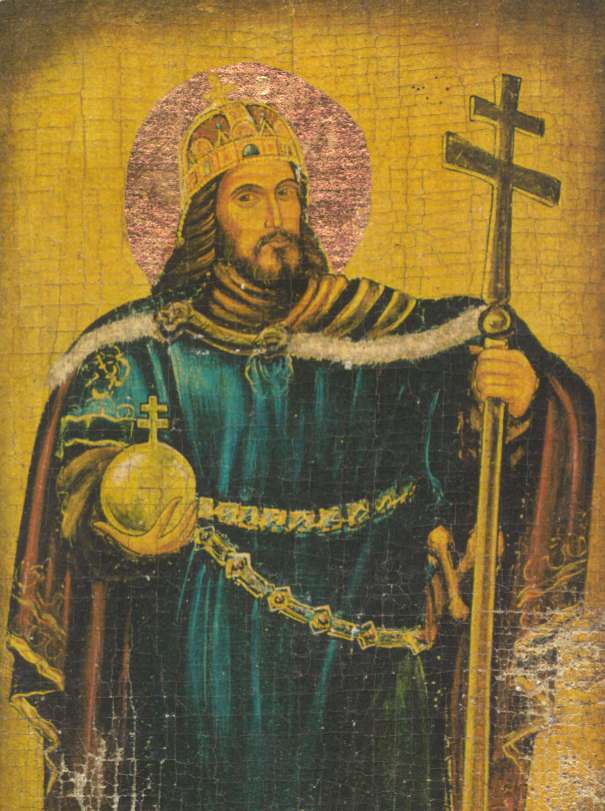
(By special grant of the Holy See,
St Stephen and all his successors down to
Bl Charles, last Emperor of Austria and King of Hungary,
had the right to have the Cross carried before them.)

St Stephen the Confessor, King and Apostle of Hungary! What a figure, the flower of Magyar piety and chivalry, the Duke who led his nation to Christ, promoted the Church everywhere for the salvation of his people, received the crown of Hungary from the Pope himself, and, ever-devoted to the Holy Mother of God, whom he had declared Patroness of Hungary, was taken up to heaven at her intercession on the very day of her Assumption, called in Hungary the Day of the Great Lady. As his collect prays, may the Almighty grant St Stephen to be a potent fighter for the Church from heaven, who on earth was her zealous propagator.

(Note that his feast is kept some days earlier, on the 20th of August, in the new Calendar, and is a public holiday in Hungary - it is the anniversay of the translation of his relics to Buda.)


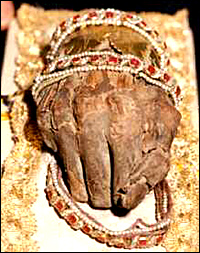
(The Holy Right Hand, principal relic of St Stephen:
with this hand he ministered to the sick and poor,
and it was preserved as a signal sign of his charity
while the rest of his body crumbled into dust.)

I liked, too, reading and praying the Wednesday psalms, some of them especially familiar to me nowadays by their continual reappearance in the Little Office, but some of them old friends not seen for some time: Pss 44, 45, 47, 48, 49 and 50 at Matins (a very happy sequence on which I've blogged before); Pss 96, 64, 100, 145 and the Canticle of Judith (xvi, 15-21) at Lauds; at Prime and the Little Hours, Pss 25, 51, 52, 53, 54, 55, 56, 57, 58, 59. (Vespers will be from the second half of the Gradual Psalms, including the beautiful Ps 131, Memento Domine David, and Compline uses Pss 33 and 60.) There's nothing quite like a Psalm.

I took the time also to read the Martyrology: such saints! What am I in comparison; what am I called to be...

As always, one reads the Martyrology for the next day, as a kind of holy advance notification: to-morrow brings (for Traddies) Pope St Pius X (may he pray for the Church, to drive away all Modernism, to redouble worthy reception of the Eucharist, and to restore peace and good order between the Society of his name and the Holy See, for the salvation of souls - to the glory of God).

But also commemorated are St Phœbe, known to St Paul; many holy martyrs and virgin-martyrs (many tortured and put to the sword, one plunged into molten lead, another cast into a fiery furnace, many monks of Lerins and their Abbot St Aigulf who were slain by the Saracens, and one, St Basilissa, a nine year old girl, who by her stedfast witness converted the Roman magistrate who ordered her put to torment and death); holy bishops and confessors; a hermit (St Simeon Stylites the younger); and the ordination of St Gregory the Great to the Supreme Pontificate, that his rays of sanctity might the more surely irradiate the Globe from the City - in the Novus Ordo, this is his feast day.

Tuesday, August 11, 2009

Supper for St Clare

Our nascent schola had sung through most of the music for Sunday Compline (according to the modern Office) in Gregorian chant at our practice this evening, when our leader Fr Allan very unexpectedly and graciously invited us to join him at the friary for a little eat and drink in honour of St Clare, whose feast day falls to-day in the Ordinary Form, on the anniversary of her death (it is kept to-morrow in the Extraordinary Form). He was most hospitable: a decent few glasses of merlot from the Clare Valley in South Australia, some cheeses with crackers, some cake and lamingtons, and a drop of port to finish off - a good time was had by all. How appropriate that it was in the Clare Valley (not the Lutheran Barossa) that Catholics settled, and good German Jesuits among them: Seven Hills, still owned by the Society of Jesus, still makes Australia's altar wine.

We were reminded that St Clare is patroness of television (one hopes she can redouble her prayers!) and, together with St Lucy, of the blind: St Clare having once been vouchsafed a vision of Mass when she was laid up in bed by illness, and having a name meaning clearness and clarity, just as Lucy means light. At the end of the soiree, Fr kindly shewed us a large landscape photograph of Assisi, pointing out the sites - I hope to visit there come September.

According to the modern Martyrology, to-day is also the feast of the martyr St Rufinus, first bishop of Assisi, and of a famous Irish abbess, St Attracta, who received the virgin's veil from St Patrick himself. Martyrs died this day under the Romans (such as SS Tiburtius and Susanna), under Elizabeth I, during the French Revolution, and in the midst of the Spanish Civil War. Most recently, in 1949, Bl Maurice Tornay was martyred on the borders of Tibet (to which land he had brought the Gospel) out of hatred for the name of Christ. May all the saints intercede for us!

Monday, July 27, 2009

Saints o' the Day

Is it true, gentle readers all, that ye are displeased seeing I have posted less concerning the saints of late? The lessening of your visits here would seem to teach me this.

Well, this evening I've opened up my martyrologies, and behold!

To-day is the commemoration of the Seven Sleepers (secondary patrons of the Dormitionists), and of St Symeon Stylites (the Elder - referred to here), doyen of pillar-dwelling ascetics, to name but some of the hallowed men who fell asleep in the Lord on this great day.

Likewise, to-day died St Celestine I, he who defeated proud Nestorius the archheretic by the agency of the Council of Ephesus, declaring Mary Most Holy the true Mother of God (Dignare me laudare te, Virgo sacrata: da mihi virtutem contra hostes tuos; Gaude, Maria Virgo, cunctas hæreses sola interemisti). To-day also reposed in the Lord St Clement of Ochrid, Apostle of the Bulgarians.

To-day died many holy martyrs, such as five slain at Cordoba by the Moors during their fanatical rule in Spain; and five martyrs slain in Spain by the Communists during their fanatical rule in Spain: how times change... I also note a passionbearing nun, St Anthusa, whipped and exiled for her stedfastness in the cult of icons by Constantine Copronymous (aptly so-named: at his baptism, he crapped in the font, foretelling his later treatment of holy things), and two priests martyred (one in England, one in Wales) under wicked Elizabeth I (she who died, paranoid and alone, lying amongst her own ordure: departing thence to the stench of hell).

The white-robed army of martyrs praise thee, O God!

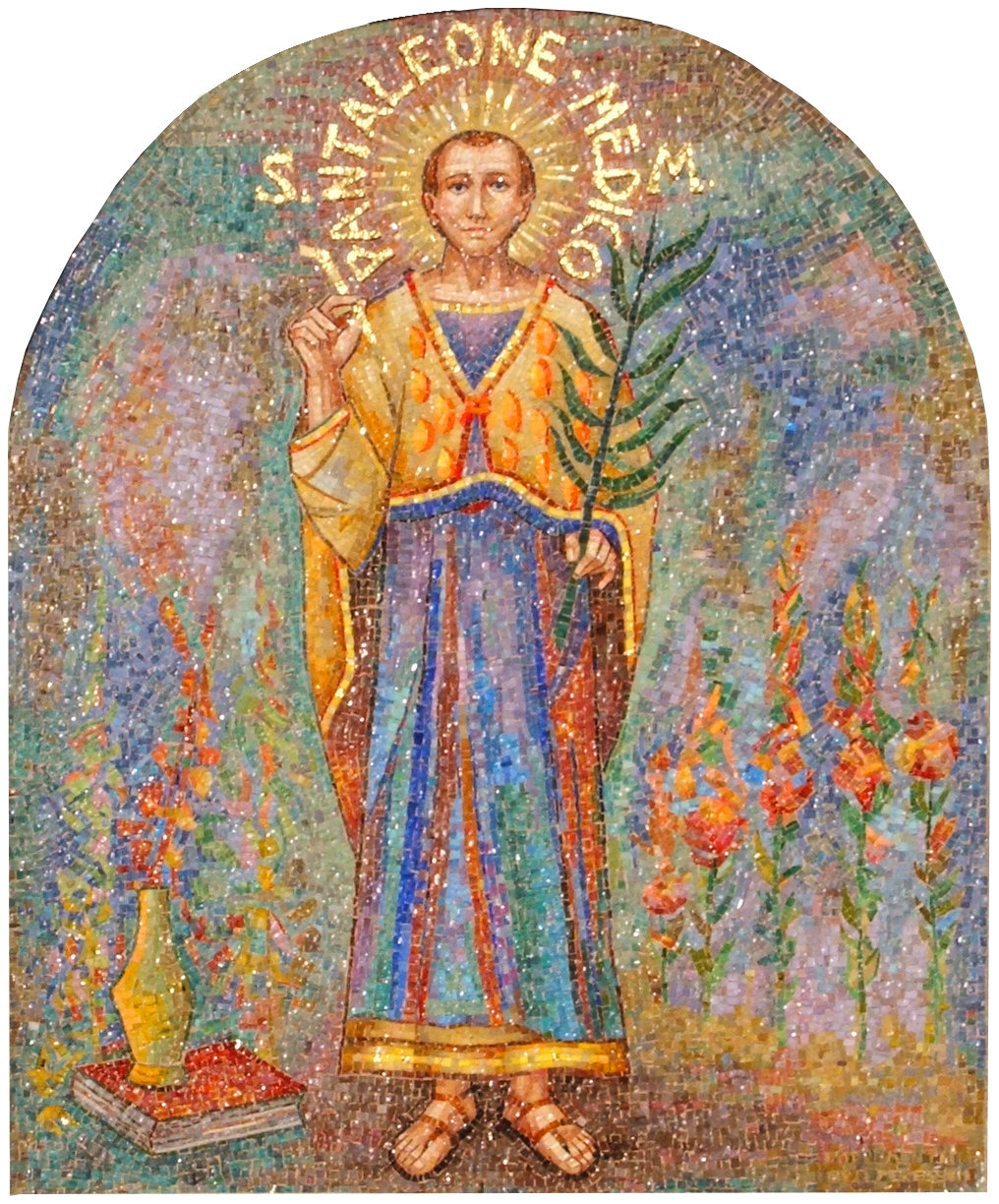
Last but first, comes St Pantaleon, martyr at Nicomedia in Bythinia, one of the holy unmercenaries, who has a commemoration at Lauds in the Breviary to-day:

Grant, prithee, God almighty: that, blessed Pantaleon Thy Martyr interceding, both from all adversities we may be delivered in body, and from depraved thoughts be cleansed in mind. Through our Lord Jesus Christ...

Tuesday, June 9, 2009

SS Primus and Felician

It's quite hard to get used to the season after Pentecost, given the great length of time the Church has had us celebrate feasts and holy seasons (wot, no Alleluia?)...

This morning at Lauds occurs the commemoration of two early Martyrs, SS Primus and Felician; according to my St Andrew's Missal's notes, they were brothers, and their relics are preserved at the church of St Stephen on the Cælian Hill; my Juergens edition of the Missal further details that after severe torment they were beheaded for the Faith in 286, at Rome.

The modern Martyrology records them on this day as follows: "On the Nomentine Way at Arcas by the fifteenth milestone from the City of Rome, of the holy Primus and Felician, martyrs."  (In the index to the Martyrology, there is a note that the century of their death is now considered uncertain; presumably they suffered during one of the Roman persecutions.)  Nomentum, whither led the Nomentine Way, was a town fourteen miles north-east of Rome, so they appear to have been put to death outside the town limits.  This must be in the Sabine Hills (as the old Martyrology relates); a further detail given in the pre-Conciliar Martyrology is that they were executed by order of Promotus, who was the official in charge at Nomentum.  Furthermore, but perhaps in a melodramatic manner, the older edition had them living long in Christ's service, yet enduring sundry tortures both together and separately.

Primus, "the first, the best", and Felician, whose name derives from felicitas, "fertility, happiness, good fortune, success" - how well their names become them.  Though in the eyes of a scoffing world they perished for nought, the faithful recognize in them men who knew the true estimation of things, and rather died for Christ that they might live with Him evermore: far from vanquished, they are conquerors with Christus Victor, having by His power trodden down the devil, overcome all evil, kept faithful unto death; and thus obtained the palm, won the crown of life (cf. Apoc. ii, 10), and merited - imagine! - to sit victorious with Christ Himself upon His throne (Apoc. iii, 21).  

May they pray for us who devoutly revere their triumphant sufferings in the cause of Christ our God, that they obtain for us who still strive to stand and fight the Divine gifts that alone will protect us and give us the victory:

Fac nos, quæsumus, Domine, sanctorum Martyrum tuorum Primi et Feliciani semper festa sectari: quorum suffragiis protectionis tuæ dona sentiamus.  Per...

(Make us, we beg, Lord, ever eagerly to attend upon the feast of Thy holy Martyrs Primus and Felician: by whose suffrages may we feel the gifts of Thy protection.  Through...)

[Sector is the intensified form of the verb sequor, to follow.]

Friday, January 30, 2009

Bl Columba Marmion's Feast

From the Roman Martyrology, 2004 edition, for today the 30th of January:
16*.  In the monastery of St Benedict of Maredsous also in Belgium, of the blessed Columba (Joseph) Marmion, who, born in Ireland, made a priest and then made Abbot in the Order of St Benedict, that as father of cenobites and leader of souls to holiness of life, shone with spiritual doctrine and eloquence.
Bl Columba Marmion, pray for us, that we may be made worthy of the promises of Christ.

Thursday, December 4, 2008

St Barbara

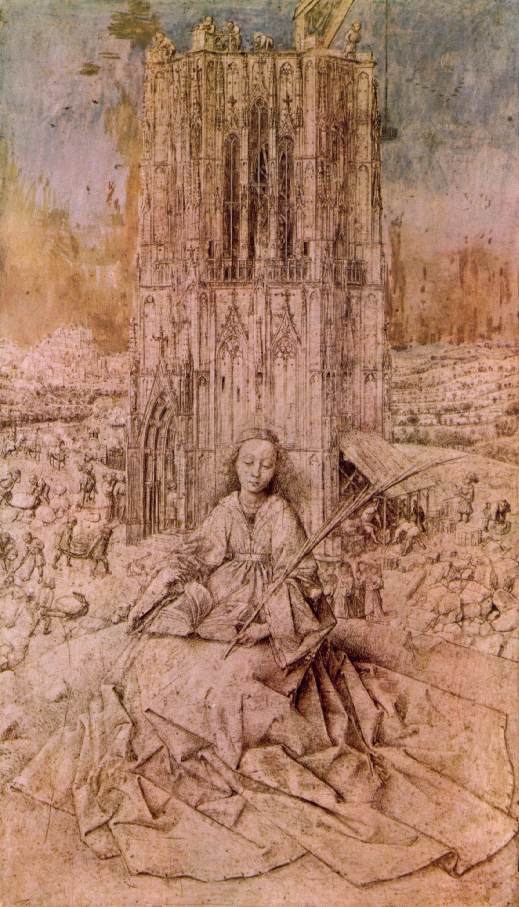
I caught the end of Mass to-day (after my doctor's appointment), arriving at the Supplices te rogamus; and was moved to check, once I returned home after lunch - having very unexpectedly met up with a dear religious I hadn't seen in years - on the status, shall we say, of St Barbara, who was commemorated (after the feria) on this, the feast of St Peter Chrysologus.

To my delight, St Barbara is included even in the modern Martyrology, as one said to have been a virgin and martyr at Nicomedia - and this recognition of her especially pleases me as Barbara is my Mum's name, and I'm glad she has such a celestial namesake and patron.

Saturday, November 29, 2008

Cool November; Another Year Over; St Saturnine

After my earlier fears of unpleasantly hot weather returning, for in the last part of October we had a heatwave with temperatures in the thirties five days running, November here in Perth has been pleasantly cool, with the hottest day so far - my birthday - a shade under 30°C, but quite comfortable as I recall, and the average for the month (23.5°C) several degrees cooler than usual.  This pleasant enough weather seems still to endure a while longer; while in Australia we generally count summer as starting on the 1st of December, I think that it may still be a little while till the really hot weather starts toward the second half of December - by which time I'll have moved back to Tasmania...

And in ecclesiastical news, to-day, the feast of St Saturnine, is the last day of the Church's Year of Grace, which segues into the first with Vespers of Advent Sunday to-night, which by God's grace I hope to sing.  My Advent plan this new year is to attend daily Mass (this will reaccustom me to the Novus Ordo, BTW).

Here is his short, straightforward and simple collect:

Deus, qui nos beati Saturnini Martyris tui concedis natalitio perfrui; ejus nos tribue meritis adjuvari.  Per...

(God, Who dost permit us to rejoice on the natal day of blessed Saturnine Thy Martyr, grant that we be aided by his merits.  Through...)

May we indeed rejoice at the triumph of this stedfast witness to Christ over the world, the flesh and the devil, and may his merits truly obtain for us assistance from the Lord, Who delights to work through secondary causes so as to work His works in us: for St Saturnine's "just deserts", far from being unspeakable torments as his evil tormentors thought and wrought, are those things he has deserved of God Himself for what he accomplished not of himself but of Him who strengthened him - supernatural rewards and benefits, not merely for himself, who won the everlasting crown of victory and rejoices and reigns evermore with God and His saints in heaven, but also for the whole Church militant, that we may not only profit by his example, but in the communion of saints all share in the graces won by this preëminent member of the Mystical Body.

But what of St Saturnine?  There are several of this name, such as the martyr-bishop of Toulouse (whose memory is also kept this day), or again the companion of SS Perpetua and Felicity; but the one commemorated in the Roman Mass is he that was a martyr at Rome, as the Golden Legend tells:

There was another Saturnine whom the provost of Rome held long in prison, and after, he raised him in the torment named Eculee [eculeus, the rack], and did do beat him with sinews, rods, and scorpions, and after, did do burn his sides, and then took him down and smote off his head, about the year of our Lord two hundred and ninety under Maximian.

The 2004 Martyrologium Romanum gives the following details about our saint:

Romæ in cœmeterio Trasonis via Salaria Nova, sancti Saturnini Carthaginensis, martyris, qui, ut sanctus Damasus papa refert, sub Decio imperatore pro Christo in patria in eculeo impositus est et Romam extorris missus, ubi, aliis atrocibus tormentis superatis, Gratianum tyrannum ad fidem convertit et capite obtruncato coronam martyrii adeptus est.

(At Rome, in the cemetery of Traso on the New Salarian  Way, [commemoration] of St Saturnine of Carthage, martyr, who, as Pope St Damasus tells, under the Emperor Decius for Christ in his fatherland [Carthage] was laid upon the rack and was sent, exiled, to Rome, where, triumphing over other atrocious torments, converted the tyrant Gratian to the Faith and by the chopping off his head won the martyr's crown. [c.250])

It also tells us of Saint-Saturnin, or Saint-Sernin, noble episcopal martyr of Toulouse:

Tolosæ in Gallia Narbonensi, commemoratio sancti Saturnini, episcopi et martyris, qui, ut fertur, ejusdem Decii temporibus, in Capitolio hujus urbis a paganis tentus est et de summa arce per gradus præcipitatus, ut, capite colliso et toto corpore dilaniato, Christo animam redderet.

(At Toulouse in Narbonensine Gaul, the commemoration of St Saturnine, bishop and martyr, who, 'tis said, in the times of the same Decius, was tried by the pagans at the Capitol [temple of idols] of this city and was thrown down the steps from the high gate [?], that, his head crushed and whole body rent, unto Christ he rendered up his soul.  [c. 250])

The Golden Legend supplies a rather forceful account of his sufferings: "And they took Saturnine which would not do sacrifice... and drew him unto the highest place of the capitol and cast him down the degrees and steps to the ground, so that his head was all to-broken and the brain sprang out, and so he accomplished his martyrdom."  

The 1738 Paris Missal provides the following Collect in stead of that of St Saturnine the Roman Martyr, both containing several references to Scripture in typical eighteenth century Gallican style, and finely alluding to the unshakeable faith of the Tolosan bishop's soul, despite the outrages committed upon his body, cast down and destroyed:

Deus, qui per beatum Saturninum Martyrem tuum atque Pontificem, infideles populos de tenebris ad lucem veritatis venire tribuisti; da nobis ejus intercessione, in fide stabiles, et a spe Evangelii quod prædicavit, immobiles permanere.  Per...

(God, Who through blessed Saturnine Thy Martyr and Pontiff, *didst grant unbelieving peoples to come from darkness to the light of truth*': †grant unto us at his intercession, to remain stedfast in faith, and immovable in the hope of the Gospel which he preached†'.  Through...)

*–*'   Cf. many passages in the New Testament, such as Acts xxvi, 17b-18: "...the nations, unto which now I send thee: to open their eyes, that they may be converted from darkness to light, and from the power of Satan to God, that they may receive forgiveness of sins, and a lot among the saints...".

†–†'  Cf. Col. i, 23: "...continue in the faith, grounded and settled, and immoveable from the hope of the gospel which you have heard, which is preached in all the creation that is under heaven, whereof I Paul am made a minister".

The other saints of the 29th of November are:

  1. St Philomenus, martyr at Ancyra in Galatia during the persecution of Aurelian under Felix the governor, who was thrown into the fire, then had his hands, feet and finally head pierced with nails, in the 3rd century [not to be confused with Philomenus, saintly martyr of Lyons, nor with the famous Philomena, whose cult remains somewhat uncertain].
  2. At Todi in Umbria [famously, Tuderti is misread as "Too dirty in Umbria"], St Illuminata the virgin, in the 4th Century [not to be confused with the unsaintly Illuminati of course!].
  3. St James (or Jacob), Bishop of Sarug, at Batnan in Osrhoene, whose sermons, homilies and letters illustrated the pure faith of the Church and is revered among the Syrians, together with St Ephræm, as a doctor and pillar of the Church, in 521.
  4. At Daventry in Frisia, the translation of St Radbod, bishop of Utrecht [Ultrajectum - more or less literally, "Thrown Out"?!], who, a teacher and pious pastor, died whilst visiting rustics, in 917.
  5. At York in England, Bl Edward Burden, priest and martyr, alumnus of the English College at Rheims, who dared to return as a priest to the dominion of wicked Queen Elizabeth I, and consummated his sufferings on the gibbet before a furious crowd, in 1588.
  6. In the same place, eight years later, BB George Errington, William Gibson and William Knight, who, when they but defended those proscribed as priests, by various torments were given over to martyrdom, in 1596.
  7. In Aceh in the island of Sumatra, the blessed martyrs Denis of the Nativity (Peter) Berthelot, priest, and Redemptus of the Cross (Thomas) Rodriguez, religious, both of the Discalced Carmelites, who were first enslaved by Mahometans and then slain with arrows by the sea shore, in 1638.
  8. At Luceria in Apulia, St Francis Antony Fasani, a priest of the Conventual Franciscans, who, a man by exquisite doctrine, preaching and penitential practice greatly supported, so consoled the poor and needy that he never stopped even to give away his habit, and to offer Christian aid to everyone, in 1742.
  9. At the place called El Saler near Valencia in Spain, Bl Alaphrid Simon Colomina, Jesuit priest and martyr, who in the persecution of the Church confirmed his fidelity to the Lord by his blood, in 1936.

Sancti Dei omnes, intercedere dignemini pro nostra omniumque salute!

Thursday, November 20, 2008

St Felix of Valois

I have previously blogged on St Felix, one of the cofounders of the Trinitarians.

Interestingly, it transpires that the history of St Felix is quite obscure, and he was never officially canonized - instead, his cult was allowed by Rome in 1666...

In the current 2005 Martyrology, he is commemorated on the 4th of November in tenth place, and moreover his entry is marked with an asterisk, signifying that it is only to be read in places and religious houses where he is venerated (as is done with those equipollently canonized and the merely beatified).  This is what is written:

Apud Cervum Frigidum* territorii Meldensis in Gallia, sancti Felicis de Valois, qui, postquam solitariam vitam diu egit, socius sancti Joannis de Matha in Ordine Sanctissimæ Trinitatis Redemptione Captivorum instituendo fuisse habetur.

(At Cerfroi* in the territory of Meaux in France, St Felix of Valois, who, after having long practised the solitary life, is held to have been the companion of St John of Matha in establishing the Order of the Most Holy Trinity for the Redemption of Captives.)

[*Literally, "Cold Stag" - which sounds more like a town in Arizona than in France!]

Saturday, November 8, 2008

The Four Crowned Martyrs

From the 2004 edition of the Roman Martyrology for the 8th of November:

Commemoratio sanctorum Simproniani, Claudii, Nicostrati, Castorii et Simplicii, martyrum, qui, ut traditur, fabri marmorarii apud Sirmium in Pannonia, cum simulacrum dei Æsculapii propter nomen Iesu Christi fingere renuissent, a Diocletiano imperatore in fluvium præcipites dari jussi sunt et a Deo martyrii gratia coronati; quorum Romæ sub titulo Quattuor Coronatorum in basilica Cælimontana veneratio ab antiquitus floruit.

(The commemoration of SS Simpronianus, Claudius, Nicostratus, Castorius and Simplicius, martyrs, who, as has been handed down, were sculptors in marble near Sirmium in Pannonia [now Sremska Mitrovitsa in Serbia]; when they refused to make an idol of the god Æsculapius on account of the name of Jesus Christ, by the Emperor Diocletian they were commanded to be taken and thrown into the river [Sava] and by God were crowned with the grace of martyrdom; whose veneration at Rome under the title of the Four* Crowned ones in the basilica on the Cælian hill has flourished from of old time.)

[* There was some confusion even in the earliest ages as to their exact names and number; in recent centuries their true history has been uncovered and vindicated against the jibes of Holy Church's enemies, who made much of the cult given to saints whose very names were at one time lost and unknown - forgetting what St Paul had said (Acts xvii, 23) about the wisdom of those Athenians who had reared an altar "To the Unknown God", and thus unwittingly served the cause of Truth.]

According to the Index of the Martyrology, they were martyred in 306.  Here is their proper Collect, taken from their commemoration to-day at Lauds:

Præsta, quæsumus, omnipotens Deus: ut, qui gloriosos Martyres fortes in sua confessione cognovimus, pios apud te in nostra intercessione sentiamus.  Per...

(Grant, we beseech, almighty God, that we, who have known the glorious Martyrs strong in their confession, may feel their pious intercession with thee in our behalf.  Through...)

Woe to Diocletian!  He is mentioned on well nigh every page of the Martyrology - but he is not a saint.  Mors peccatorum pessima: The death of sinners is the worst.

Also to-day:
  • St Clarus, priest at Tours, disciple of St Martin (c. 396);
  • Pope St Deusdedit I (618);
  • St Willehad, first bishop of Bremen, a friend of Alcuin, an Anglo-Saxon from Northumbria who came to the Continent to preach the Gospel in the footsteps of St Boniface to the Frisians and Saxons (789);
  • St Geoffrey (Godefridus), bishop of Amiens (1115);
  • Bl John Duns Scotus, the Subtle Doctor, far-famed Franciscan friar and professor at Canterbury, Oxford, Paris and latterly Cologne where he died in 1308;
  • Bl Mary Crucified, Abbess (1745);
  • The holy Vietnamese Martyrs SS Joseph Nguyen Dinh Nghi, Paul Nguyen Ngan, Martin Ta Duc Thinh (priests), alongside Martin Tho and John Baptist Con, farmers, who were beheaded in Tonkin for the Faith of Christ under Emperor Thieu Tri in 1840.
Look at this list!  Bishops and sculptors, priests, friars and farmers, even an abbess: in every age God is pleased to raise up friends worthy of Himself; pray that He may number us among them (Æterna fac cum Sanctis tuis in gloria numerari).

As we would go on to pray at Prime, after the Martyrology is read:

And elsewhere many other holy Martyrs and Confessors, and also holy Virgins.  Thanks be to God.

Precious in the sight of the Lord: is the death of His Saints.

May Holy Mary and all the Saints intercede for us with the Lord, that we may deserve to be aided and saved by Him, Who liveth and reigneth evermore.  Amen.

This portion of prayer from the Anglican tradition - which with the Book of Divine Worship is licitly given its true home in the Roman fold - is I think very apposite to add as well:

And we yield unto thee most high praise and hearty thanks, for the wonderful grace and virtue declared in all thy Saints, who have been the choice vessels of thy grace, and the lights of the world in their several generations: and chiefly in the blessed Virgin Mary, Mother of thy Son Jesus Christ our Lord and God, and in the Holy Patriarchs, Prophets, Apostles, and Martyrs, beseeching thee to give us grace to follow the example of their stedfastness in thy faith, and obedience to thy holy commandments, that at the day of the general resurrection, we, and all they who are of the mystical body of thy Son, may be set on his right hand, and hear his most joyful voice, Come ye blessed of my Father, inherit the kingdom prepared for you from the foundation of the world. Grant this, O Father, for Jesus Christ’s sake, our only Mediator and Advocate. Amen.

Thursday, December 13, 2007

Santa Lucia, Santa Lucia!

Traditional, beautiful and dangerous: Scandinavian maidens wear wreathes with lighted candles on St Lucy's day, impersonating the saint.  Surely OH&S would never allow this in Australia!   (Don't believe me, believe Wikipedia: see entry referring to all this.  And yes, there is an allusion here to her name, referring to light.)

According to the Breviary, the wicked (they always are) Prefect Paschasius (odd name for a pagan) first tried to have the virginal Lucy dragged off to a whorehouse (the Lesson is very explicit as to why), but the Holy Ghost made her immobile as a column, whereupon nasty Paschasius (cunningly inventive, these Romans) ordered a fire lit around her (hence the surely dangerous custom of presumably Lutheran maidens wearing candles in their hair): but when this didn't work, at last after many torments – the worst, her eyes were plucked out (yet still she could see! hence she's patroness of the blind) –  her throat was cut.

Advice to tormentors of martyrs: whipping, branding, throwing to beasts, cutting out tongues and cutting off hands (St Maximus Confessor), ripping off breasts (St Agatha), plucking out eyes (see above!), burning, raking with iron claws, shooting with arrows (St Sebastian), tying to a revolving wheel set afire (St Catherine of Alexandria), etc. may or may not work, but chopping off the head or at least slitting the throat does.  The saint may walk off with his head (St Denis et al.) or it may bounce thrice in honour of the Trinity, producing three miraculous fountains (St Paul), or, it not being properly chopped off, the saint may spend three days in prayer, consecrating her house as a church (St Cecilia), but eventually they go to reign forever with Christ; whereas (unless converted by their very victim) the persecutor ends up in hell with the devil.

Don't get me wrong: the Kingdom of heaven suffers violence, and those who win through to it must endure much.  Hence the expression "to storm heaven".  As St John the Baptist did, so did St Lucy, and the other martyrs who suffered this day.  (I am alluding to the readings as I heard them at Mass today in the ordinary form, for Thursday in the second week of Advent.)  To be so devoted to the Lord as to offer oneself a victim, to die as a faithful and true witness to Him, is perhaps the greatest grace given to men.  Would that one be graced with such constancy as to persevere to the end and be saved, as the holy martyrs.

The new Martyrology very finely says of St Lucy (excuse my translation):

The Ides of December, the fourth day of the moon [in 2008].

Of the memory of holy Lucy, virgin and martyr, who guarded, whilst she lived, her lighted lamp for the coming of her Spouse, and, dragged to death for Christ at Syracuse in Sicily, with Him she merited to enter into the wedding feast and to possess undying light.

I append the lovely Office hymn, Jesu corona Virginum; it has several tunes, but this is a favourite; the translation is also a favourite, even tho' it omits the second verse (see below):

O Jesu, Thou the Virgins' Crown, 
Thy gracious ear to us bow down, 
Born of that Virgin whom alone 
Both Mother and a Maid we own.

*

In Thee, their Bridegroom and their Lord, 
The virgins find their bright reward, 
And wheresoe'er Thy footsteps wend 
With hymns and praises Thee attend.

O gracious Lord, we Thee implore 
Thy grace into our minds to pour; 
From all defilement keep us free, 
And make us pure in heart for thee.  

All praise to God the Father be, 
All praise, Eternal Son, to Thee, 
Whom we the Spirit we adore, 
For ever and for evermore.  Amen.

(*Verse 2: Amongst the lilies Thou dost feed, / And thither choirs of Virgins lead; / Adorning all Thy chosen brides / With glorious gifts Thy love provides.)