Showing posts with label Tenebræ. Show all posts

Thursday, April 28, 2011

Good Friday in Melbourne at St Aloysius

By the time I reached the apartment where I was staying, and had a very late dinner, it was almost midnight on Thursday; so I awoke fairly late on Good Friday morning.  I had intended to read Matins and Lauds, but in the event I only had time for the Little Hours – for, after attending Stations of the Cross back at St Aloysius at 10:30am, which took half an hour, and then getting coffee and a hot cross bun for breakfast, I ended up joining the ad hoc schola for Easter Sunday's coming services, and we practiced the Mass and Vesper music for a good two hours and more.  I had barely enough time to go back to my quarters and change into a suit for the afternoon's solemn service.  So much for my intention of reading over Dix's masterful sermons for the Three Hours' Devotion...

The Commemoration of the Passion lasted two and a half hours: it is always a long, sombre service; the sung Gospel (the crowd parts in polyphony), a short sermon, the solemn prayers, the Reproaches whilst we crept to the Cross, the Communion, all was rightfully lengthy and fatiguing – for there was One Who hung on the Rood three hours, long ago.

After the liturgy, hot soup and hot cross buns were available for the weary faithful; after a rest at my apartment, I returned for Tenebræ (8:00-9:50pm).  I must say, I always find Tenebræ a very difficult service to appreciate intellectually, especially as one must concentrate so hard on properly chanting the psalms, without the time to savour them, and especially as the particular choice of Lessons from Lamentations and St Augustine I find difficult to appreciate, as to the meaning of the words selected; but the emotional impact of this worship is great: the chanting of the Lamentations, Victoria's settings of the Responsories in particular, and the ever-deepening darkness, till the final candle is hidden, the strepitus terrifies, and then the light returns.

Saturday, April 11, 2009

St Augustine on the Passion

Yesterday and to-day, the Church bids us read at Matins the commentary of St Augustine on verses of Psalm 63, which he rightly interprets in the context of the Lord's Passion, the suffering of the Saint of saints and the true and faithful Witness, the Prince of Martyrs: for "the New the Old reveals, the Old the New conceals".  Here are the extracts used on Good Friday and Holy Saturday (although I haven't been able to fill up a missing part of Lesson vi):

Good Friday

Lesson iv

You have protected me from the gathering together of malignants, and from the multitude of men working iniquity (Psalm 63:2). Now upon Himself our Head let us look. Like things many Martyrs have suffered: but nothing does shine out so brightly as the Head of Martyrs; in Him rather let us behold what they have gone through. Protected He was from the multitude of malignants, God protecting Himself, the Son Himself and the Manhood which He was carrying protecting His flesh: because Son of Man He is, and Son of God He is; Son of God because of the form of God, Son of Man because of the form of a servant: having in His power to lay down His life: and to take it again. (John 10:18) To Him what could enemies do? They killed body, soul they killed not. Observe. Too little therefore it were for the Lord to exhort the Martyrs with word, unless He had enforced it by example. 

Lesson v

You know what a gathering together there was of malignant Jews, and what a multitude there was of men working iniquity. What iniquity? That wherewith they willed to kill the Lord Jesus Christ. So many good works, He says, I have shown to you, for which of these will you to kill Me? (John 10:32) He endured all their infirm, He healed all their sick, He preached the Kingdom of Heaven, He held not His peace at their vices, so that these same should have been displeasing to them, rather than the Physician by whom they were being made whole: for all these His remedies being ungrateful, like men delirious in high fever raving at the physician, they devised the plan of destroying Him that had come to heal them; as though therein they would prove whether He were indeed a man, that could die, or were somewhat above men, and would not suffer Himself to die. The word of these same men we perceive in the wisdom of Solomon: with death most vile, say they, let us condemn Him; let us question Him, for there will be regard in the discourses of Him; for if truly Son of God He is, let Him deliver Him. (Cf. Wisdom 2:20,18.)

Lesson vi

For they have whet like a sword their tongues (Psalm 63:3). Which says another Psalm also, Sons of men; their teeth are arms and arrows, and their tongue is a sharp sword. Let not the Jews say, we have not killed Christ. For to this end they gave Him to Pilate the judge, in order that they themselves might seem as it were guiltless of His death. For when Pilate said to them: You put him to death, they responded: It is not lawful for us to put any man to death. [...] But if he is guilty because he did it though unwillingly, are they innocent who compelled him to do it? By no means. But he gave sentence against Him, and commanded Him to be crucified: and in a manner himself killed Him; ye also, O you Jews, killed Him. Whence did ye kill Him? With the sword of the tongue: for you did whet your tongues. And when did ye smite, except when you cried out, Crucify, Crucify? (Luke 23:21)

Holy Saturday

Lesson iv

There shall draw near a man to a deep heart, and God shall be exalted (Psalm 63:7). They said, Who shall see us? They failed in searching searchings (Psalm 63:6), evil counsels. There drew near a man to those same counsels, He suffered Himself to be held as a man. For He would not have been held except He were man, or have been seen except He were man, or have been smitten except He were man, or have been crucified or have died except He were man. There drew near a man therefore to all those sufferings, which in Him would have been of no avail except He were Man. But if He were not Man, there would not have been deliverance for man. There has drawn near a Man and a deep heart, that is, a secret heart: presenting before human faces Man, keeping within God: concealing the form of God, wherein He is equal with the Father, (Philippians 2:6) and offering the form of a servant, wherein He is less than the Father.

Lesson v

To what did they bring those their searchings, in which searchings they failed, so that even, when the Lord was dead and buried, they set guards at the tomb? For they said to Pilate, That deceiver; by this name the Lord Jesus Christ was called, for the comfort of His servants when they are called deceivers; they say therefore to Pilate, That deceiver said when yet living, After three days I will rise again: (Matthew 27:63-66) Command therefore the sepulchre to be guarded until the third day: lest perhaps his disciples come and steal him away and say to the people: He is risen from the dead: and the last error shall be worse than the first. Pilate saith to them: You have a guard.  Go, guard it as you know.  And they departing, made the sepulchre secure, sealing the stone and setting guards.

Lesson vi

They set for guards soldiers at the sepulchre. At the earth quaking, the Lord rose again: such miracles were done about the sepulchre, that even the very soldiers that had come for guards were made witnesses, if they chose to tell the truth: but the same covetousness which had led captive a disciple, the companion of Christ, led captive also the soldier that was guard of the sepulchre. We give you, they say, money; (Matthew 28:12-13) and say ye, while yourselves were sleeping there came His disciples, and took Him away. Truly they failed searching searchings. What is this that thou sayest, O unhappy astuteness? To what extent hast thou not abandoned the light of the counsel of piety, and have immersed thyself in the depths of cunning, that this thou sayest: Say, that is, you sleepers, his disciples came, and stole him away? Sleeping witnesses ye adduce: truly you yourself hast fallen asleep, that in searching such devices hast failed.

Misericordiæ Domini

The first Lesson of Matins for Holy Saturday (from Lamentations iii, 22-30) shews us what hope the Just Man - Christ - had in God His Father, even in the midst of His Passion, for He knew as God, and also as Man, the Divine plan for man's salvation asked of Him to be a willing victim, that God's justice be vindicated before the face of all the earth, and thus His unimaginable mercy revealed; the whole chapter bears meditation, but here is the Douay of the passage set down for Tenebræ this day:

Heth. The mercies of the Lord that we are not consumed: because his commiserations have not failed.
Heth. They are new every morning, great is thy faithfulness.
Heth. The Lord is my portion, said my soul: therefore will I wait for him.
Teth. The Lord is good to them that hope in him, to the soul that seeketh him.
Teth. It is good to wait with silence for the salvation of God.
Teth. It is good for a man, when he hath borne the yoke from his youth.
Jod. He shall sit solitary, and hold his peace: because he hath taken it up upon himself.
Jod. He shall put his mouth in the dust, if so be there may be hope.
Jod. He shall give his cheek to him that striketh him, he shall be filled with reproaches.

Jerusalem, Jerusalem, return to the Lord, thy God.

A Look Back at Tenebræ

I have blogged a little on my own experience of praying Tenebræ from the Breviary; one thing I hadn't consciously grasped was the great length of the first two days' Matins: Holy Thursday Matins' psalms have 189 verses, and Good Friday's, 176 - in both cases, the length of the psalmody is over 50% longer than usual, and even longer than the noticeably lengthy Christmas Matins.  However, on Holy Saturday, the psalms of Matins have only 111 verses, which is very close to the post-Pius X average length of Matins psalmody (115 verses).

I had best now tackle Tenebræ for Holy Saturday, and commemorate Christ's harrowing of hell...


(As I suspected, it took but half an hour.  The tone of the Office is noticeably lighter and suffused with quiet hope and faith in the resurrection.)

Friday, April 10, 2009

Good Friday

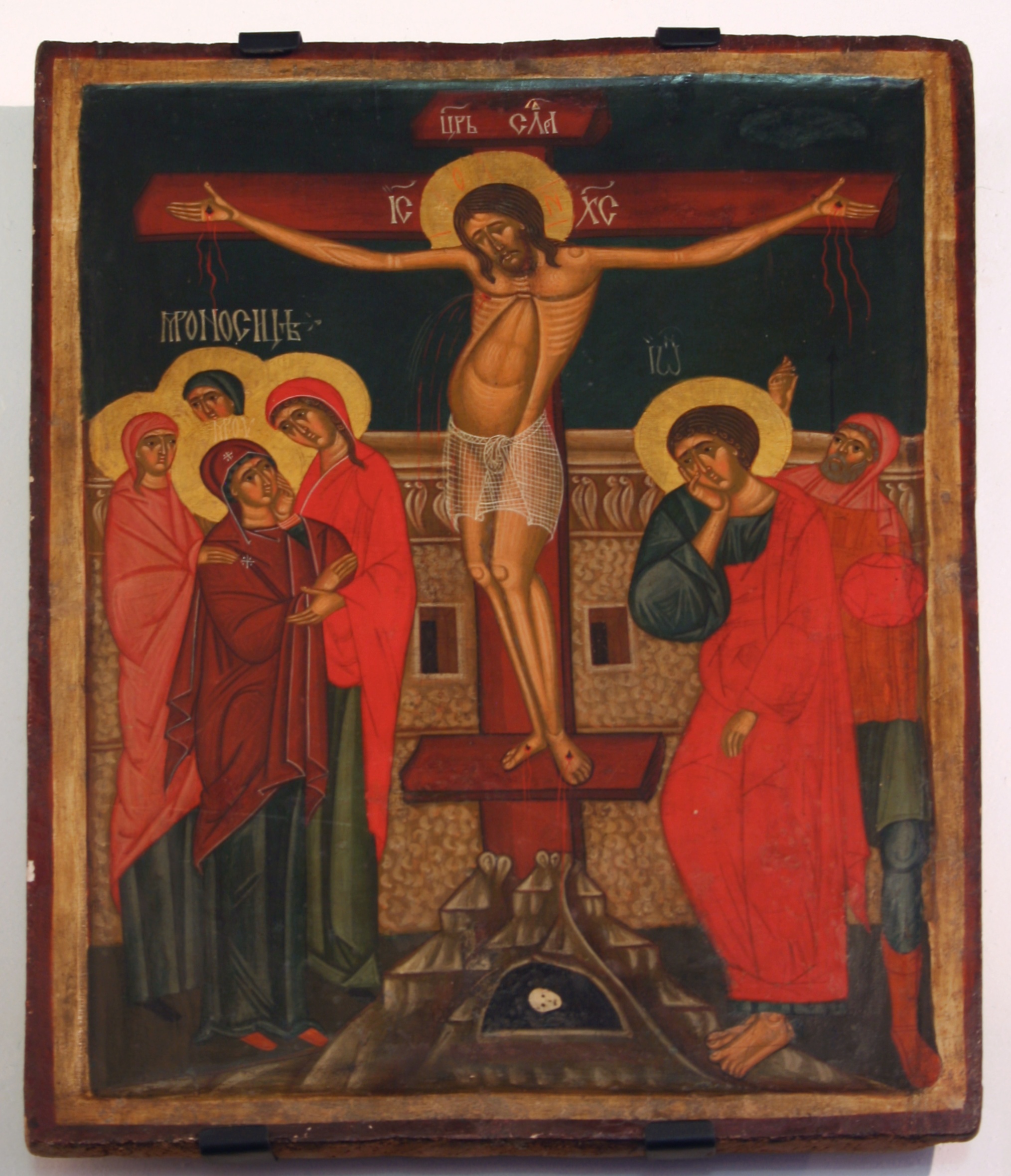
Arising late, I took the opportunity to read Matins and Lauds together this Good Friday morn, over the last forty minutes considering Our Lord's Passion, as a late Tenebræ.  Now I have before me an icon of the Cross; Our Lady weeps, comforted by the holy women; St John the Beloved beats his breast in sorrow; the centurion confesses the Lord; and between and above them all hangs Christ on His Cross, triumphant in death.

A book with prayers dear to me is E. Milner-White's A Procession of Passion Prayers, first published 1951, when the author was the Anglican Dean of York: the prayers are devout and catholic, and I cannot do better but quote now the last of them (cf. Rom. vi, 8; viii, 17; Eph. ii, 5-6; Col. ii, 12-13; II Tim. ii, 11):

The Tree of Life

ALMIGHTY everlasting God, who hast reared from earth unto heaven a mighty Tree, standing for ever, whereon before the face of men hangeth a Man, stretched and nailed, rejected, dying and alone: O thou that art true and shewest only truth, grant us to fear not to suffer with him, die with him and be buried with him, that we may also be made alive with him and glorified together in the heavenly places; where now he reigneth with thee and the Holy Ghost, one GOD, world without end.

Thursday, April 9, 2009

Dominican Preces at Tenebræ

The Friars Preachers retain - even for use in the modern Office, in place of the intercessions at Lauds - a once-widespread mediæval addition to Tenebræ: a set of preces, approximating to a farced or troped Kyrie plus the Christus factus est, which last alone (sung to the melody used for it at Mass) the Roman Office has an antiphon before the collect Respice.  Hence, where the Roman has but the singing of Christus factus est (all kneeling), the Dominican has:
Initially, a threefold Kyrie, thus - two of the Friars standing before the altar step sing:

Kyrie, eleison.

The choir (all facing the altar) respond:

Kyrie, eleison.

The two Friars repeat:

Kyrie, eleison.

Thereupon another pair of Friars, standing in the midst of the choir (that is, out between the two parallel lines of choir stalls), sing, in Latin, not Greek:

Domine, miserere.

And the choir responds:

Christus Dominus factus est obediens usque ad mortem.

Secondly and medially, a threefold Christe with verses is intoned - the pair before the altar step sing:

V/.  Qui passurus advenisti propter nos.

(But on Good Friday only, instead they sing:

(V/.  Agno miti basia cui lupus dedit venenosa.)

The choir:

Christe, eleison.

The two before the altar again:

V/.  Qui, expansis in cruce manibus, traxisti omnia ad te sæcula.

(But on Good Friday:

(V/.  Vita in ligno moritur, infernus et mors lugens spoliatur.)

The choir:

Christe, eleison.

The two before the altar a third time:

V/.  Qui prophetice prompsisti: Ero mors tua, o mors!

(On Good Friday instead:

(V/.  Te qui vinciri voluisti, nosque a mortis vinculis eripuisti.)

The choir again:

Christe, eleison.

Then the brethren in medio chori:

Domine, miserere.

And immediately the choir reprise:

Christus Dominus factus est obediens usque ad mortem.

Lastly, a final threefold Kyrie - the two standing before the altar sing:

Kyrie, eleison.

The choir respond:

Kyrie, eleison.

The two before the altar repeat:

Kyrie, eleison.

Next the pair of Friars standing in the midst of the choir sing:

Domine, miserere.

And the choir responds for the third time with:

Christus Dominus factus est obediens usque ad mortem.

Last of all, the brethren before the altar sing in a high voice:

Mortem autem crucis.

And all prostrate themselves.  (The silent Lord's Prayer and the Collect follow as in the Roman Rite.)
The chant for this ceremony is most impressive, and very moving:


Saturday, March 22, 2008

A Good Friday

Lauds and Sext from the Divine Office, then, the Solemn Liturgy... (I fitted in the Office of Readings later in the day.)

Good Friday: Fr Rowe (priest), Fr Terence (deacon), Fr Richard (subdeacon); the usual servers, including Aaron; Andrew, Justin, and I singing the chant; and about one hundred and twenty faithful (cf. Acts i,15!), including many friends and acquaintances, such as Anastasia and Brad (newly engaged), George, Rosemary, Sue, and so forth - all assembled in the cathedral parish centre's hall, turned into a stark but effective chapel for the occasion; Fr Rowe has a number of altars in storage, and brought out one of them for today's solemn liturgy.

The acoustic was very good, and I found myself getting a great deal out of the beautiful texts and music provided by Holy Mother Church this day: the haunting melody of the Tract Domine audivi (Habacuc iii, 2-3), whose words are customarily applied in the Eastern Church to the mystery of the Incarnation ("the Holy One from the shady and thickly covered mountain"), and the second Tract Eripe me (Psalm 139:2-10,14); the very moving chant of the St John Passion; the Ecce lignum Crucis; after creeping to the Cross, singing the Reproaches, with the Trisagion;


the Crux fidelis and Pange lingua gloriosi / Lauream certaminis; the antiphons at the procession of the Blessed Sacrament; and Psalm 21 during Communion. It was good to kneel down and receive our Lord with all the choir, and then to sing this psalm of His Passion. May His death be our life!


Hail to Thee, True Body, sprung
From the Virgin Mary's womb!
The Same That on the Cross was hung
And bore for man the bitter doom.

Thou, Whose Side was pierced
And flowed both with water and with Blood,
Suffer us to taste of Thee
In our life's last agony.

O kind, O loving One,
O sweet Jesu, Mary's Son!


A rich vein of doctrine was expressed in today's sermon, in which reference was made to "God is love" (I St John iv, 8) as the summation of our religion, a love revealed not merely in the blessings of creation, but shewn forth to the uttermost in Christ Crucified (cf. St John iii, 16; I St John iv, 9-10), and thereby manifest in suffering for us, as per Our Lord's words to St Angela of Foligno: "I have not loved you for fun". We, too, ought not merely give good things to all whom we love, as God does to all, but suffer also for others, as God in Christ has done on Calvary, reconciling the world to Himself.

A friend of mine is a subdeacon, and I was pleased to hear all such prayed for in one of the solemn collects; then I recalled that I have been instituted a lector, and was glad to know that I, too, the least such, have received the benefit of these prayers.

The solemn liturgy took just shy of two hours. Rather than drive home and then come back, Justin, Robert, Rosemary, Peter and myself decided to pop up to the Royal Perth Hospital cafeteria (just around the corner) and have a modest fish dinner, before making our way to Tenebræ. Better still, Anastasia and her fiance Brad came and joined us, so we had a good little meal with good company and talk.

In due course, we finished up, and drove the short distance to St Brigid's for Tenebrae of Holy Saturday, which, in rejection of Bugnini, and all his works, and all his empty promises, we do in the evening, when it should be done. Over a hundred came, and there was a goodly number in choir (well over a dozen) - including, apart from the three priests at the 3 o'clock liturgy, the local Franciscan Friars of the Immaculate, and most notably His Grace the Archbishop of Perth, the Most Reverend Barry James Hickey, who deigned to officiate (to make it easier for him, one of the clergy sang the ninth lesson on his behalf) and therefore concluded this Office of Matins and Lauds with its proper collect.

Andrew and Justin were cantors, and, in between chanting the psalms, hopefully sapienter, among the readers I exercised my ministry of lector for the first time in a long while, by managing to chant the fifth lesson. Andrew and his mates, who constitute Quartessence, sang the Responsories - the first three, by Croce, and the six remaining, those famous one by Victoria. They also sang the Christus factus est. At the end, what a strepitus! Tenebræ just exceeded the length of the afternoon liturgy, by running two hours exactly.

Afterward, eight of us joined Fr Rowe for a cup of tea at the presbytery, until "time, gentlemen, please!" at 11pm. (NB When having something to drink on a fasting day, one may take a little morsel with it, ne potus noceat - "lest the drink harm [thee]".) Then I drove two of my mates home, and got back to my place a little after midnight. I will end with Compline soon. Prosit.