Showing posts with label Christmas. Show all posts

Monday, December 25, 2023

Merry Christmas MMXXIII

Cum enim quietum silentium contineret omnia, et nox in suo cursu medium iter haberet, omnipotens sermo tuus de cælo, a regalibus sedibus... prosilivit. — Sap. 18, 14-15

For while all things were in quiet silence, and the night was in the midst of her course, thy almighty word leapt down from heaven from thy royal throne. — Wisdom 18:14-15

******

Thine all-powerful Word, O Lord, leapt down from heaven! The Incarnation of the Eternal Word, the Second Person of the most blessed Trinity hypostatically united henceforth forever to a human nature: all this a supreme mystery beyond the grasp of every created mind!

This text is used as the Introit on the Sunday within the Octave of Christmas, with the following changes, some quite minor – but rather than saying that a “quiet silence” (nominative singular) “contained” (singular) “all things” (accusative), the first phrase instead is made to say that “all things” (nominative plural) “held” (plural) a “moderate silence” (accusative)... and the magnificent verb prosilivit (leapt) becomes the more common venit (came):

Dum médium siléntium tenérent ómnia, et nox in suo cursu médium iter habéret, omnípotens Sermo tuus, Dómine, de cælis a regálibus sédibus venit.

While all things held a moderate silence, and the night was in the midst of her course, thine almighty Word, O Lord, came from the heavens from thy royal throne.

With further slight alterations (changing habéret to perágeret, omitting de cælis, and adding a final allelúja) this text is used as both the Magnificat Antiphon at first Vespers and the Benedictus Antiphon at Lauds on that same Sunday; while on the 4th Sunday of Advent, a shorter modified version of the second part is sung as the fifth psalm antiphon at both Lauds and Vespers, and also as the sole psalm antiphon at None – Omnípotens Sermo tuus, Dómine, a regálibus sédibus veniet. (Thine almighty Word, O Lord, shall come from thy royal throne.)

Friday, December 24, 2021

Merry Christmas 2021

Christ is born! Glorify him!

Christmas! the wondrous Nativity of our Lord Jesus Christ, both God and man, the Second Person of the Blessed Trinity, the Eternal Word incarnate for our salvation, who liveth and reigneth for ever and ever, who is and ever shall be the Victor over sin, Satan, death and hell.


"the Light shineth in darkness" — St John i, 5

This is now the third Christmas of the pandemic, for the virus was already about its fell work in Wuhan back in December 2019... may God see fit to deliver us before next Christmas.

A blessed, safe and happy Christmas to all.

Saturday, December 24, 2016

Thankfulness for Christ's Being Made Man


From the devout writings of John Kettlewell, Anglican clergyman and Nonjuror (1653-1695):

What am I, dear Lord, that thou shouldst leave the right hand of God, and come to visit me? Hadst thou no ease in thy own breast so long as I lay plunged in misery? How camest thou, being so highly exalted, and the eternal Son of God, to have any affectionate concern at all for me? Was I not a deformed, polluted wretch, and thy professed enemy? And was not either of these to turn away thy face from me? But if, notwithstanding all this, thy overflowing goodness would put thee upon doing something for my sake; why must thou come thyself upon earth, and be subject to the miseries of human nature, and to the affronts of an ungrateful world, to bleed and die to redeem me? How unfathomable is thy grace, and what an unsearchable depth of love is this, which thou hast opened to us! O! how happy do I think myself in it, and how doth my heart rejoice at the remembrance of it! Lord! I love thee dearly, and long to love thee more: would I had the heart of the seraphim, that I might be all over love, and feel my soul affected to that degree which I desire, and thou infinitely deservest of me: I wish no greater pleasure than to be found perfect in thy love, and to have thee so dear to me, that I may contemn all the gilded vanities and allurements of this world at the thoughts of it. O! that thou wouldest fill me, if that might be, with an affection full and absolute, like thy own, that so I might love thee infinitely, as I am beloved by thee. At least possess me with such a sense of thy love, and such thankfulness for all thy favours, as is somewhat worthy of thee: though should I offer the utmost acknowledgments, which the most affected and enlarged heart can pay, I should not give thee the thousandth part of what I owe thee. Let all the angels adore thy glorious goodness, and all the sons of men, so long as they have a tongue to speak, set forth thy noble praise; for thou, O sweetest Jesu, art the Son of the Blessed, the joy and glory of the world, the Lamb of God, the Saviour of Mankind, who was slain for our sakes, and art alive again, and sittest now for ever at the right hand of power, in the glory of the Father, that angels may submit to thee, and all the world may worship thee, and praise thy goodness, power, and glory, to all eternity. Amen.

A very blessed and holy Christmas to all, with ardent prayers for the good estate of the whole Church, that the Lord may grant her speedy and complete deliverance from the unhappy cause of all her recent trials, that his Virgin Mother's Immaculate Heart may triumph.

Thursday, December 24, 2015

End of Advent; Christmas Eve

I've had a blessed Advent: last week, I made a five-day silent retreat in Bowral, N.S.W., run by two priests from the Abbey of St Joseph de Clairval in Flavigny. What a marvel that such an orthodox Benedictine monastery flourishes, and has as its apostolate the giving of a condensed form of the Spiritual Exercises of St Ignatius to men, in conformity to the spirit of its founder and first abbot, God rest him, who was converted after making such a retreat in 1940, and in due course became a monk after the death of his wife, with the resolve to give to others what had so changed him. It was easily the best retreat I have ever done, really brilliant, and, I hope, marks a milestone in my spiritual life. I would heartily recommend these retreats to one and all.

Either side of the retreat, I spent the weekend in Sydney, and went to High Mass at Maternal Heart, Lewisham. Since my return home, I've prepared for Christmas in the commercial sense, by buying gifts for family and friends. Tonight, just after sunset, Mass at St Canice-in-the-fields, Glengarry, then Midnight Mass at Carmel; tomorrow morning, back to Carmel for the Day Mass.

My prayer is for all readers and friends to receive every holy blessing from above, with hearts opened wide to Christ Whose glorious Nativity in the flesh we celebrate on this most holy feast.

Tuesday, December 24, 2013

Merry, Merry, Merry Christmas

"You have begun your Christmas in the best way possible," said Fr Allan at the end of the Vigil Mass, "by welcoming Christ into your hearts at Mass in Holy Communion." Amen to that.

It was a charming Mass, complete with the dear children presenting a nativity play (the actual Gospel was read as normal, separately; and such a play seems innocent enough, an adjunct to the sermon I suppose): the choir turned out to consist of Mary and I, with Janet as organist, so we did our best with Christmas favourites. One amusing problem occurred at the Offertory: Janet transposed "Hark the herald angels sing" not down one note, but up! So the top notes proved quite painful for this bass-baritone...

After the final hymn, we sang "Merry, Merry, Merry Christmas", the last from a cycle of Australian Christmas carols by John Wheeler. Some of the parishioners, being Polish, were heading off straightaway after the Mass (which ended just after 7 pm) since they have their Christmas meal and present-giving party on this, the Eve.

Our family Christmas Eve tradition is to eat fish (cooked in cream, with almonds and breadcrumbs and lots of salt and pepper); so we kept the ancient fast. To partake, we met at my sister's home after Mass.

All this is but the start to Christmas 2013: I have to be at Church of Apostles at 10:45 pm, since I am singing in the choir there as well. Carols begin at 11:15 pm, and Midnight Mass follows. Then I will get up Christmas morning and go to Carmel for their 8:30 Mass, since my old friend Fr Paul, O.P., is visiting. 

Later in the day to-morrow, my aunt and uncle will join us, and it will be present time, followed by a gargantuan Christmas dinner… with luck, I can nap in the afternoon, before waking up for the Queen's Christmas message in the evening.

I do like another Australian Christmas carol: "The north wind is tossing the leaves":


Here in Tasmania it isn't normally scorching hot at yuletide, but on the Mainland it can be – in Perth it usually is, if I remember aright – so this carol strikes the right note for an antipodean Christmas.

Every blessing to all readers at this holy season: may the Christ Child enter into your heart and abide there evermore, joining earth to heaven, restoring all things in Himself.

******

P.S. Please don't forget the poor and suffering this Christmas, those near at hand and those far away: think of the people of Syria, of South Sudan, of the Philippines...

Saturday, August 17, 2013

Holy Days of Obligation - What Obligation? What Holy Days?


As I understand it, the Vatican told the various Bishops’ Conferences that, while various Holy Days of Obligation could be moved to the nearest Sunday, or have the obligation to attend Mass on them suppressed “for pastoral reasons” (to be cynical, does that mean the “faithful” couldn’t be trusted to go to Mass on weekdays, since the bishops feared that even Sunday Mass-goers wouldn’t bother?), for some sort of largely symbolic reason – lest no Holy Days of Obligation remain, in which case it seems bizarre to have them mentioned in Canon Law at all – at least one solemnity of the Lord (i.e. Christmas) and one of Our Lady had to be retained as Holy Days of Obligation.

This thinking seems confused: if, out of fear for souls lest the lazy be damned for not going to a Mass on a weekday, all but two Holy Days of Obligation are either transferred or have the obligation suppressed, why then retain two? Even more confusingly, while the obligation to attend church on Good Friday was suppressed in the seventeenth century, it still remains far more well-attended than many a Sunday! Wouldn’t it be more rational to make Christmas and Good Friday the two remaining Holy Days of Obligation, since that is how what remains of popular piety regards them? After all, despite the importance of the Assumption of the Blessed Virgin, it is nowhere near as popular as those two days in terms of attendance at the Liturgy.

For the record, according to Canon Law (Can. 1246 §1) the following ten solemnities are the Holy Days of Obligation for the whole Roman Rite:
  1. Christmas
  2. Epiphany
  3. Ascension
  4. Corpus Christi
  5. Mary Mother of God (the Octave Day of Christmas)
  6. Immaculate Conception
  7. Assumption
  8. St Joseph
  9. SS Peter and Paul
  10. All Saints
In Australia, these three Holy Days, all solemnities of the Lord, have been transferred to the nearest Sunday, as provided for in Canon 1246 §2:
  • Epiphany
  • Ascension
  • Corpus Christi
And the obligation to attend Mass has been suppressed for these five solemnities of Our Lady and the Saints, here in Australia (as also allowed for in Can. 1246 §2):
  • Mary Mother of God (the Octave Day of Christmas)
  • Immaculate Conception
  • St Joseph
  • SS Peter and Paul
  • All Saints
Does not this send the dangerous message that devotion to the Saints is of little importance?

Here in Australia, therefore, Christmas and the Assumption as the only two Holy Days of Obligation remaining; just as, by a similar process of minimalization, not to say failure of nerve and dumbing-down, the days of fasting and abstinence also have been reduced to two: Ash Wednesday and Good Friday (the minimum mandated by Canon Law – Can. 1251).

The bishops of England and Wales – not, as a body, known for their burning zeal in recent decades; so there is hope for us all – have restored the precept of abstaining from fleshmeat on all Fridays (excluding those falling on solemnities), which still is the norm throughout the Roman Church (Can. 1251), despite the perception in Australia, by those old enough to remember the former rule, that all that was abandoned as one of the “fruits” of Vatican II (the young, of course, have in many cases never even heard of it). It is wonderful to hear of bishops actually doing something for a change.

In recognizing the importance of reviving a custom that was once one of the universally known hallmarks of Catholic practice, the good bishops have imitated dear Fr Wells, a long-retired priest I remember from my university days, who told us at Mass one Sunday long ago that he had gone back to the discipline of meatless Fridays “Because I realized I was doing nothing instead”. It may be candidly admitted that few know, or care, that we are still meant to do some form of penance on Fridays – as usual, Paul VI’s efforts in that regard were singularly fruitless. Did he achieve anything?

If we are to start to rebuild, we need to restore disciplines – since the current drift into slackness and indifference simply indicates that Catholics have little commitment to anything, since they value the Faith so little. If we cared, if we actually believed, we would be willing to endure much. In the days of persecution, Catholics in England and Ireland stood firm in the face of adversity; these days, what firmness would be manifest? But I suppose if so few nominal Catholics even go to Sunday Mass, let alone bother with the occasional confession, let alone bother to get married before undertaking the marital act, let alone follow dear Paul VI's advice regarding that holy intimacy, well, no wonder even the bishops decided ditching a few more disciplines wouldn't matter.

In everything, we see the abandonment of the Catholic worldview, and a sort of play-acting in its place. We play children's games in the ruins.

Monday, December 24, 2012

Last Day of Advent

At early Mass, Fr Paul reminded us of that grief of separation from the Lord that the Church feels now, in these last days, between His Ascension and Second Advent. We yearn to be with the Lord; Communion, the Blessed Sacrament, is the foretaste and promise of this everlasting abiding with Him – hence Mass, a glimpse of heaven here below (till sacraments shall cease) is a pledge of what shall be forevermore, the Nuptial Banquet and Union with the Triune God through Christ.

Advent is not merely about getting ready for Christmas; as Parsch said (or was it Jungmann?), the Liturgical Year does not so much begin with Advent as end with it – end with it, and with Christmastide, finally concluding with the Presentation and old Simeon's Nunc dimittis.  The Year of Grace may be said to begin with Septuagesima, with Genesis telling of Creation and the Fall: Advent and Christmastide is the presage of the Second Coming, and of everlasting bliss in the Kingdom that shall have no end.

We ought not just look backward in sentiment, as look forward in hope tempered with holy fear: the Lord shall come, and all His Saints with Him, and He shall restore Jerusalem. Christ's coming in flesh in the last days is the guarantee that, His warfare ended, having run the race from womb to tomb, soon He shall return in glory, to judge the living and the dead and the world by fire: His Sacred Humanity, the first fruits of bodily resurrection and eternal deification for all who shall be found in Him.

A blessed Christmas to all: prepare yourselves, for in the morning the glory of the Lord shall shine upon us, and we shall behold His glory, glory as of the Father's Only-begotten Son, full of grace and truth.
Σὺ γὰρ εἶ τὸ ὄντως ἐφετὸν καὶ ἡ ἀνέκφραστος εὐφροσύνη τῶν ἀγαπώντων σε, Χριστὲ ὁ Θεὸς ἡμῶν, καὶ σὲ ὑμνεῖ πᾶσα ἡ κτίσις εἰς τοὺς αἰῶνας. Ἀμήν. 
For Thou art that which is truly sought for, and the unutterable gladness of those that love Thee, O Christ our God, and all creation hymneth Thee unto the ages. Amen.

Saturday, December 22, 2012

Christmas at St Anne's in Perth


My old parish priest, Fr Rowe, sent me this photograph of the sanctuary at St Anne's Church, Belmont, new headquarters of the Latin Mass in Perth, Western Australia. (It also features himself and the two workers who made the altar rail gates and restored the Marian altar, not shown.)


I remember what an ugly sanctuary it was back when it was arranged for the modern Mass: but the forward "Cranmer table" was ripped out, its low platform replaced with a high stepped affair, and a proper high altar put in, with altar rails installed.  Anything iconoclastic done to a church can be reversed.  

Here are the details about Christmas Masses at St Anne's (11 Hehir St, Belmont):

Christmas Eve Monday 24th December: 11.00pm Rosary & Carols, 12.00 Midnight Mass.
Christmas Day Tuesday 25th December 2012: 8.00am Dawn Mass; 10.00am Day Mass. 

Please note confessions are not able to be heard before these Christmas Masses unless arranged with the priest, except during Rosary & Carols at 11.00pm before Mass. (Normally, Fr Rowe hears confessions before all Masses, but at Christmas this is precluded by all the extra burdens.)

New Year’s Day, the Octave Day of Christmas, Tuesday 1st January 2013: Masses at 8.00am & 10.00am & 6.00pm - the plenary indulgence for the faithful who publicly recite the Veni Creator on New Year's Day may be gained on the usual conditions by joining in the singing of this hymn, which will be sung after each of these Masses.

Sunday Masses at St Anne's are as follows: 7.30am, 9.30am, & 11.30am.  (From memory, the 9.30am Mass is the Missa cantata.)


Sunday, December 26, 2010

A Visit to the Crib

Do thou also kneel down – thou hast delayed too long.  Adore the Lord thy God, and then reverence his Mother, and salute, with much respect, the saintly old man Joseph.  After this, kiss the feet of the Infant Jesus, laid as he is on his little bed, and ask Our Lady to give him to thee, or permit thee to take him up.  Take him into thine arms, press him to thy heart, and look well at his lovely face, and reverently kiss him, and show him confidently the delight thou takest in him.  Thou mayest venture on all this, because it is for sinners that he came, that he might save them: it was with sinners that he so humbly conversed, and at last gave himself to sinners, that he might be their food.  I say, then, that his gentle love will permit thee to treat him as affectionately as thou pleasest, and will not call it too much freedom, but will set it down to thy love.
— St Bonaventure, Meditations on the Life of Christ 
(Guéranger's Liturgical Year, Vol. II, p. 220)

Friday, December 24, 2010

Dominican Lessons and Sequence for the Christmas Masses

The Rite of the Friars Preachers retains several ancient elements not conserved in the wider Roman Rite; which is only to be expected, as it was codified and therefore fixed in form earlier, during the thirteenth rather than the sixteenth century.  Readers may be pleasantly surprised to learn that the Old Testament readings appointed for the four Masses of Christmas – for the Vigil, the Midnight, the Dawn and the Day Masses – in the modern Roman Rite are not innovations but attempted restorations, more or less (with a verse or more added or subtracted); for the Dominican Missal never abandoned them.  

(Likewise, the Carthusians, Premonstratensians and Carmelites retained these lessons; alas, the Cistercians removed them in 1657, out of misplaced zeal for conformity to the Roman liturgical books.  As the extinct English order of the Gilbertines apparently used these lessons, so sure enough they were also used in the Sarum Rite.)

Christmas Vigil

Lesson: Isaias lxii, 1-4a [the Novus Ordo adds vv. 4b-5]

Hæc dicit Dominus Deus:
Propter Sion non tacebo, et propter Jerusalem non quiescam donec egrediatur ut splendor justus ejus, et salvator ejus ut lampas accendatur.  Et videbunt gentes justum tuum, et cuncti reges inclytum tuum: et vocabitur tibi nomen novum, quod os Domini nominabit.  Et eris corona gloriæ in manu Domini, et diadema regni in manu Dei tui.  Non vocaberis ultra Derelicta, et terra tua non vocabitur amplius Desolata: sed vocaberis, Voluntas mea in ea, et terra tua Inhabitata, quia complacuit Domino in te.

Thus saith the Lord God:
For Sion's sake I will not hold my peace, and for the sake of Jerusalem, I will not rest till her just one come forth as brightness, and her saviour be lighted as a lamp.  And the Gentiles shall see thy just one, and all kings thy glorious one: and thou shalt be called by a new name, which the mouth of the Lord shall name.  And thou shalt be a crown of glory in the hand of the Lord, and a royal diadem in the hand of thy God.  Thou shalt no more be called Forsaken: and thy land shall no more be called Desolate: but thou shalt be called My pleasure in her, and thy land inhabited, because the Lord hath been well pleased with thee.

Marvellous prophecy!  The "Just One" cometh, and the "Saviour" shining as a lamp in the darkness, to be seen not by Jerusalem only, but by the Gentiles and "all kings", beholding the "Glorious One": Jesus. God will bestow a new name, that of Christian, on those He shall call; and He shall crown them with glory and honour, being well-pleased in His people in Christ Jesus our Lord.

Christmas Midnight

Lesson: Isaias ix, 2. 6-7a [N.O. includes vv. 3-5 & 7b also]

Hæc dicit Dominus:
Populus qui ambulabat in tenebris, vidit lucem magnam: habitantibus in regione umbræ mortis, lux orta est eis.  
Parvulus enim natus est nobis, et Filius datus est nobis, et factus est principatus super humerum ejus; et vocabitur nomen ejus Admirabilis, Consiliarius, Deus, Fortis, Pater futuri sæculi, Princeps pacis.  Multiplicabitur ejus imperium, et pacis non erit finis: super solium David, et super regnum ejus sedebit, ut confirmet illud et corroboret in judicio et justitia, amodo et usque in sempiternum.

Thus saith the Lord:
The people that walked in darkness, have seen a great light: to them that dwelt in the region of the shadow of death, light is risen.
For a Child is born to us, and a Son is given to us, and the government is upon his shoulder: and his name shall be called, Wonderful, Counsellor, God the Mighty, the Father of the world to come, the Prince of Peace. His empire shall be multiplied, and there shall be no end of peace: he shall sit upon the throne of David, and upon his kingdom; to establish it and strengthen it with judgment and with justice, from henceforth and for ever.

Nobis natus, nobis datus: "born for us, given for us" – Christ is come, Emmanuel, Whose kingdom shall have no end.  At midnight we hear the cry, "Behold the Bridegroom cometh!" – and to them that sit in darkness, a great light appeareth in dead of night, in the bleak mid-winter, in the darkness of the weary, fallen world, in its last age: "the Light that enlighteneth every man", born into this world.  Let us not slumber and sleep, but run with glad hearts to greet Him, "born this happy morning: Jesu, to Thee be glory given, Word of the Father, now in flesh appearing".

Christmas Dawn

Lesson: Isaias lxi, 1-3 [N.O. omits these]; lxii, 11-12a [N.O. adds v. 12b]

Hæc dicit Dominus:
Spiritus Domini super me, eo quod unxerit Dominus me: ad annuntiandum mansuetis misit me, ut mederer contritis corde, et prædicarem captivis indulgentiam, et clausis apertionem: ut prædicarem annum placabilem Domino, et diem ultionis Deo nostro: ut consolarer omnes lugentes: ut ponerem lugentibus Sion: et darem eis coronam pro cinere, oleum gaudii pro luctu, pallium laudis pro spiritu mœroris: et vocabuntur in ea fortes justitiæ, plantatio Domini ad glorificandum.
Ecce Dominus auditum fecit in extremis terræ, dicite filiæ Sion: Ecce Salvator tuus venit: ecce merces ejus cum eo, et opus ejus coram illo.  Et vocabunt eos: Populus sanctus, redempti a Domino Deo nostro.

Thus saith the Lord:
The spirit of the Lord is upon me, because the Lord hath anointed me: he hath sent me to preach to the meek, to heal the contrite of heart, and to preach a release to the captives, and deliverance to them that are shut up.  To proclaim the acceptable year of the Lord, and the day of vengeance of our God: to comfort all that mourn: to appoint to the mourners of Sion, and to give them a crown for ashes, the oil of joy for mourning, a garment of praise for the spirit of grief: and they shall be called in it the mighty ones of justice, the planting of the Lord to glorify him.
Behold the Lord hath made it to be heard in the ends of the earth, tell the daughter of Sion: Behold thy Saviour cometh: behold his reward is with him, and his work before him.  And they shall call them, The holy people, the redeemed of the Lord our God.

Here we hear Messiah proclaim His mission, sent by the Lord His Father, anointed with the Holy Spirit, to announce and preach salvation.  "Behold, thy Saviour cometh" with His work to do and his rewards to bestow, that His people may be holy, "the redeemed of the Lord our God".

Christmas Day

Lesson: Isaias lii, 6-10 [N.O. omits v. 6]

Hæc dicit Dominus:
Propter hoc sciet populus meus nomen meum in die illa; quia ego ipse qui loquebar, ecce adsum.  Quam pulchri super montes pedes annuntiantis et prædicantis pacem: annuntiantis bonum, prædicantis salutem, dicentis Sion: Regnabit Deus tuus!  Vox speculatorum tuorum: levaverunt vocem, simul laudabunt, quia oculo ad oculum videbunt cum converterit Dominus Sion.  Gaudete, et laudate simul, deserta Jerusalem, quia consolatus est Dominus populum suum: redemit Jerusalem.  Paravit Dominus brachium sanctum suum in oculis omnium gentium: et videbunt omnes fines terræ salutare Dei nostri.
Thus saith the Lord:
Therefore my people shall know my name in that day: for I myself that spoke, behold I am here.  How beautiful upon the mountains are the feet of him that bringeth good tidings, and that preacheth peace: of him that sheweth forth good, that preacheth salvation, that saith to Sion: Thy God shall reign!  The voice of thy watchmen: they have lifted up their voice, they shall praise together: for they shall see eye to eye when the Lord shall convert Sion.  Rejoice, and give praise together, O ye deserts of Jerusalem: for the Lord hath comforted his people: he hath redeemed Jerusalem.  The Lord hath prepared his holy arm in the sight of all the Gentiles: and all the ends of the earth shall see the salvation of our God.

Indeed and Amen!  The Lord Himself that spoke, "behold, I Am" is "here": thus His Name shall be known by His people, "He hath redeemed Jerusalem", and yet more, the Lord hath made known "His holy arm", that is, His Son, in the sight of all nations: "and all the ends of the earth shall see the salvation of our God", since God has become incarnate and visible and "dwelt amongst us" and "we have seen His glory, the glory as of the Onlybegotten of the Father, full of grace and truth".  Let these glad tidings be spread by the joyful evangelists, and the great company of preachers!

******

Furthermore, the Dominican Rite retains the beautiful mediæval sequence Lætabundus, sung at the Day Mass, and repeated in the Mass of the Epiphany, on the twelfth day of Christmas; and in the Mass of the Baptism of the Lord, on the Octave of the Epiphany at the end of the Christmas season; and yet once more in the Mass of the Presentation, that last re-echo of Christmastide forty days' hence, just before Lent.

Monday, June 21, 2010

Shortest Day

This year, the shortest day falls to-day, the 21st of June: the sun rose here in Launceston this morning at 7:38 am, and will soon set, at only 4:48 pm – only just over nine hours of daylight.  To-day's weather: partly cloudy, 0 to 13 degrees.  I am minded to see what my friend up in Edinburgh is experiencing, since for him this is the summer solstice, and so I'll quickly look up details (pause for googling): it appears he can expect some showers, and a range from 11 to 19 degrees (sounds like spring weather here).  Scotland's capital being further north than Launceston is south, the sun will rise there at 4:26 am and set very late, at 10:06 pm – imagine that! nearly eighteen hours' daylight, twice what we have now.  Given the lengthy twilight also, Edinburgh (were it not for cloud) would presumably have the "White Nights" of St Petersburg...

As good Christian folk will recall, the nearness of this event – the winter solstice in the Southern, but the summer solstice in the Northern Hemisphere – to the feast of the Nativity of the Baptist, and therefore the truth that from this feast onward, for those north of the equator, the days shorten, is considered significant by such worthies as St Augustine, mindful of St John's own words to Christ, the true Sun Who enlightens all men born into this world: "He must increase, I must decrease" – the lesson being that the Baptist came to herald Christ, Who must grow in us evermore.  Our Lord's Nativity, occurring in the North in darkest winter drear, thus symbolizes Christ coming "to those who sit in darkness and in the shadow of death", enlightening hearts more and more, just as, after Christmas in northern climes, the days grow longer daily thereafter.

Friday, January 8, 2010

Christmas in Florence

Not only have I kept Epiphany twice (in Oxford and Edinburgh), but yesterday I celebrated Christmas again, courtesy of the Ukrainian Catholic community here in Florence!

I was simply looking for Vivoli Gelateria, and on a whim turned up a side alley, ending up at a church which I decided to investigate (I missed and walked right past the gelateria, which I later found to be closed at this season anyway) - when I came in to SS Simon and Jude, I found myself in a packed congregation, all standing, and the priest facing east at the altar, about to start the Insistent Litany after the Gospel (which I recognized by the threefold Gospodi pomilui - "Lord, have mercy").

Thanks be to God, I have sufficient familiarity with the Liturgy of St John Chrysostom, albeit not with Ukrainian, that I was able to pray the Mass.  I must admit, the Byzantine Rite leaves the West for dead (and I'd been at a lovely Missa Cantata for the Epiphany the night before!): the beautiful singing, the sweeping sacred Action, carries one along into the heavenly places.

(As a friend once put it, the Roman Mass, solemn and sober, is precisely ordered and structured, able to be analysed into successive parts, expressive of the Western discursive mind; the Byzantine Divine Liturgy rather is all one great unfolding irruption of the Sacred, a form of contemplation rather than of meditation if you will.)

BTW, it was evident this was a Catholic not an Orthodox service, since the congregants nearly all knelt for the Sanctus and Consecration (not for the Epiclesis), and again at the Sancta Sanctis and response - "One is Holy, One is Lord: Jesus Christ, in the glory of God the Father".

Only a minority (the more fervent one assumes, standing up the front) communicated, and late that I was and not quite certain in myself, I refrained.  But to-day at 2.30 pm there will be Divine Liturgy for the Synaxis of the Soprasanta Theotokos, so I've been to confession at the Duomo and will keep a third feast, of Mary the Mother of God (whose memory the West keeps on the Octave Day of Christmas as its liturgy old and new indicates, whatever of the Circumcision), for the second time!

Friday, December 25, 2009

A Christmas Meditation – The High Mystery of the Nativity


WE reade in Holy Writ of three supernaturall Productions, the one of Adam, the other of Eve, the last of Christ; which as most Miraculous we are now to treat of. Here in his Nativitie, as before in his Conception, let us turne Inquisition into Thanksgiving; and with one Spirit and voyce ring aloud, “The Stone which the Builders refused is the Head of the corner. This was the Lords doing, and it is marvellous in our eyes. This is the day which the Lord hath made; let us rejoyce, and be glad in it. This is our wedding-day, wherein by the Sonne, we are joyned to the Father. This is the day of the new Union, wherein He Who is God, remaineth the same that He was, yet for our sakes is borne, and made what He was not; wherein He that was every where without a Body, is made present to us by a Body, that what God hath by Nature, men might receive by Grace. This is a great, a joyfull, a fortunate, a desired day, the end of the Law, the end of the Prophets, the beginning of the Gospell, nay the Gospell it selfe. This is a day of State, usher’d by the Angels, follow’d by the Apostles. Let our Mindes remove the distance of time and place, and dwell a while with our All-Holy Lord and Blessed Lady, lest we loose the pleasure of this day, the least accident whereof is Mysterious.
…let us now enter ourselves, and view this pretty one in his narrow lodging; lay ourselves prostrate before Him; worship Him; and recreate ourselues with the lovely Object. And that our delight may be the greater, let us first behold Him, and His sweetest Mother a part, and then both together. But let us here shut out the Pharisees, and barre them the sight of this Heavenly Infant, who urge the Law, and reject Him the Author of it. Let us exclude the Arrians, who deny his Coequalitie with the Father; and the Sabellians, who confound the Trinitie, of which He is distinctly One and hold that there is in It One Essence, and One Person: and the Samosatenians, who derogate from His Nature, and avouch the Word (Which truly He is) to be no other then a vanishing Sound. Nor let us onely keepe out these, but the whole swarme also of Atheists, and Hereticks. Let the Philosophers too stay without, who not so impious, yet more ignorant, cannot dive to the bottome of this Mystery. But to all those who are honour’d in the Assumption and Profession of His glorious Name, a free Accesse is granted. Enter then you little Flock, you few whom His Father hath bestowed on Him; and see Him, Who when He gave the Law appeared in Fire, now He offers Grace involv’d in Hay. Yet in this dejected posture, in this course manner while He lay, He wanted not a whole Army of Angelicall Spirits that declar’d His Birth to Men; and they who had before chanted His Praises as He sate in Glory, now sing His Goodnesse lying in the Cratch. Though He have a hoomely roofe over His Head, the East observes His Approach. Though the poverty of His Humanitie obscures His Deity, the Starres in Heaven make it known. Behold Him who came Humble to the humble, for the humble, and yet His Humility is above all sublimity. Reverently, and intentively, look on Him Who descended from Heaven to Earth; Who came to you, into you, Who is borne in the night, borne in the midst of Winter, and borne (after the wretched humane condition) naked, and none offer Him assistance. Swadling clothes are wanting; some ragges are found out; a Cradle is missing; a Manger is at hand.

Here He cryes to you, and holds up His pretty Hands to Heaven, which He cals to witnesse that He can humble Himselfe no lower. Can you view this humble, this mercifull spectacle, and not weepe yourselues into marble? O speedily put on sackcloth! besprinckle yourselues with Ashes; kneele downe in the dust and dung under the Manger, where your Lord lyes; knock your selues on the bosomes; fetch sighs and grones from the bottom of your hearts; repay Him the teares He lent you; and by your sad gesture and deportment demonstrate how much you are bound to Him who suffered for you even in His Birth.”

Anthony Stafford, The Femall Glory: or, the life of the Blessed Virgin Mary (1635), “Her Delivery”, pages 102-103 & 110-113.

Thursday, December 24, 2009

From the Christmas Martyrology

To-day, at Prime for the 24th of December in the Year of Our Lord Two Thousand and Nine, was read the Martyrology for to-morrow, the 25th of December (I imitate the seventeenth Century style):

...since the Creation of the World, when (in the Beginning) GOD created the Heaven and the Earth; and from the Flood, the Two Thousand Nine Hundred and Fiftieth Year; from the Birth of Abraham, the Two Thousand and Fifteenth; from Moses, and the Exodus of the people of Israel from Egypt, the One Thousand, Five Hundred and Tenth; from the anointment of David as King, the One Thousand, Three Hundred and Second; in the Sixty-Fifth Week, according to the Prophecy of Daniel; in the One Hundred and Ninety-Fourth Olympiad; in the Seven Hundred and Fifty-Second Year from the Building of the City of Rome; in the Forty-Second Year of the Emperor Octavian Augustus, all the World composed at Peace, in the Sixth Age of the World, JESUS CHRIST, Eternal GOD and eternal SON of the FATHER, desiring to consecrate the World by His most devout Advent, and nine months having pass'd since His Conception, 
(All kneel)

in Bethlehem of Judæa was born of the Virgin Mary, being made Man.


The Nativity of Our Lord JESUS CHRIST according to the Flesh.


This holy day is marked by four commemorations of Christ's beloved servants, His saints: St Anastasia, Virgin and Martyr, who together with two hundred men and seventy women suffered many and varied torments under the Emperor Diocletian; St Peter Nolasco, Confessor, Founder of the Order of Our Lady of Mercy for the Redemption of Christians held captive by the Moors and Saracens; St Eugenia, Virgin and Martyr, who was put to death by the sword at Rome in the reign of the Emperor Gallienus; and most notable of all, a great company of the shining army of martyrs praising God:

At Nicomedia, the Passion of many thousands of Martyrs, who, when they were come together for Mass upon the Nativity of CHRIST, Diocletian the Emperor ordered the doors of the Church closed, and a Fire prepared all about, and a tripod with Incense set before the doors, and with a great voice to cry a Proclamation that whosoever would wish to flee the Conflagration, should come out the doors and offer Incense to Jove; and when all with one voice replied that they most willingly would die for CHRIST, as Incense were they consumed with Fire, and thus on that very Day they deserv'd to be born in Heaven, upon which CHRIST once deigned to be born for the salvation of the World.

A Christmas Meditation - The Shepherds


What a brave assembly of Visitants of all conditions, resorted this day to this place, which then might rightly be called the Randevous of the Saints? Would you see those who are above men, but below Him who is borne? Behold the Angels singing His Birth. Do you desire to behold the Married? Here you have Zachary and Elizabeth. The Unmarried? Here you have Symeon. Widdows? Here you have Anna. Priests? Here againe you have Zachary. Wise men? Here you have them from the East. Ideots? You have here the Shepheards. But here is to be noted, that these keepers of beasts heare the voyce of the Angels before any of the other, first receive the Gospell, and first divulge it. And in this they were more happie than Augustus himselfe, who (though he had made a firme Peace by Sea and Land, and had now the third time shut up the Temple of Ianus) yet was he ignorant of the Blessed Peace concluded on betwixt God and Man.
O how much sometimes Ignorance avails in Divine Matters! Kings, Potentates, the Rulers of the Earth, and the Wise of this world are asleepe while Christ is borne. These most simple of Mortals, and innocent as the creatures they tend, watch all night; and therefore are first made partakers of these joyfull news. As their owne wooll, not yet dipt in any dye, readily drinks in any colour they please to bestow on it: so their minds voyd of all humane Wisedome, greedily suckt in the Divine; Faith is the Compendium of Salvation; and humane knowledge of times, the obstacle of Faith. Aristotle having confined to Heaven, the Maker, and Moover of it, would never have beleeved His Birth here below. Plato would have derided this Miraculous relation, who the more he attributed to God, the lesse would he have expected His so humble comming into the world. Neither would the Stoicks who held God to be a Fire; nor Hipocrates, who thought Him to be a Warm’th, ever have look’t for Him clad in Flesh and Bloud. Wherefore they are here elected Witnesses of this strange Truth, whose Science was of ability strongly to beleeve, not wittily to dispute. O what proficients in Faith did these rusticall Swaines prove in a moment! What a profound secret is imparted to them? Let us examine the verity of this by that infallible Touch-stone, the text.

[S. Luke ii. 8.] And there were in the same Country, Shepheards abiding in the field, and keeping watch by night, because of their flocke, and loe the Angell of the Lord came upon them, and the Glory of the Lord shone about them, and they were sore afraid. Then the Angell said unto them, ‘Be not afraid; for behold I bring you tidings of great joy, that shall be to all the people: That is, that unto you is borne this day a Saviour, Which is Christ the Lord. And this shall be a Signe unto you; you shall finde the Childe swadled and layd in a Cratch. And straight way there was with the Angell a multitude of heavenly Souldiers, praysing God, and saying; Glory be to God in the high Heaven, and Peace on Earth, and towards men good will. And it came to passe that when the Angels were gone away from thence into Heaven, that the Shepheards said one to another; ‘Let us goe then unto Bethlem, and see this thing that is come to passe, which the Lord hath shewed unto us; so they came with haste, and found both Mary and Ioseph with the Babe layd in the Cratch. And when they had seene it, they publisht abroad the thing that was told them of that Childe.”

Here three things especially are remarkable:
First, their forwardnesse in believing:
Secondly, the speed they made to see what they had believed, and
Thirdly, to publish what they had seene.

That they quickly believed, appeares by the haste they made to see. They no sooner saw Him, but they found Him to be the King of Israell indeed, yet withall to be a Shepheard. They instantly discerne this to be the Shepheard, Who was to lay downe His Life for His Flocke. The Prince of all Shepheards Whose sheepe-fold is the world; the Shepheard that was to seperate the Goates from the Sheepe. They discover’d this to be the immaculate Lambe that was to take away the sinnes of the world. They disclos’d this Lamb to be the greatest Lyon of the Tribe of Iudah. Whom now they looke on in the Cratch, Saint Iohn shall hereafter behold on His Throne. These men, in whom there was no guile, as they could not deceive others, so they could not in this be deceived. They needed not suspect any fallacy, and therefore might safely relate this Divine Wonder to all they met.

— Anthony Stafford, The Femall Glory: or, the life of the Blessed Virgin Mary (1635), “Her Delivery”, pages 103-7.

Saturday, December 19, 2009

Never Confess to a Pious Priest

The humorous, yet shrewd advice of a wise old Franciscan came to mind to-day: he said, "Never confess to a pious priest - whatever you tell him, he'll be horrified, and berate you, and make you do the Stations of the Cross with a Rosary between each Station... No, confess to an experienced, down-to-earth priest who's heard it all before, and whatever you tell him, he'll just say, 'Say three Hail Mary's!'"

We all laughed when he told us this, on a retreat some years ago, but the more I think about it, the more I realize the wisdom in these cheeky words, which I think I've already blogged on, but no matter, truth bears repeating.

That said, having gone to Saturday Confession as per usual, all I got was an Our Father!

(Some Anglo-Catholic friends of mine - now gone Russian Orthodox - rather sniffily told me many years back that this R.C. business of being allotted a penance of "five Hail Mary's," or "three Our Father's," was strange to them, for when they confessed to their priest, he would always suggest an apposite psalm to pray, given their particular condition and troubles. Dear soon-to-be-no-longer-separated brethren, any comments?)

This week I have rather broken both my Advent resolves, about praying the Breviary and hearing daily Mass, but have now clambered back on the wagon... while I find Matins of Friday and Saturday especially wearisome, I forced myself to the Hours yesterday, and found reading the Church's Morning Office (Matins and Lauds) in church after confessing very good. No pain, no gain.

After the sacred, the secular duties of this day: a rather pestilent business of doing Christmas shopping, including seeing over $80 spent on the obligatory ham and turkey!

At least it's all done now bar the shouting: the pudding's been collected from the Deanery (the good Catholics of New Norfolk raise much money by boiling up Chrissie puds each year in bulk, then selling them off through Tasmania's parishes), the materials for the punch have been assembled, the Christmas fruitcake is all ready for consumption, the wreath's about to go on the front door... all that remains is to soon to gather up the remaining necessities (fresh peas in the pod, brandy custard and other comestibles) for the gargantuan traditional yuletide feast that the family maintains as indispensable.

Mum once asked my sister and I, would we like to have anything different for our family Christmas dinner (when we all gather together around the long dining room table, whatever the weather)? Absolutely not, we said in unison. All change is pernicious.

While in Tasmania it is certainly easier to do than on the Mainland, I think it every Australian's duty to have a proper old-fashioned Christmas dinner, without any concession whatsoever to climate or lifestyle: arguably, it is all the more meritorious to suffer it during a scorching heatwave. One can always go lie groaning on the sofa after lunch...

To have some sort of seafood barbecue on the beach for Christmas - however nice to do so any other time of year - is an abomination.

Friday, November 6, 2009

Fourfold Gospel of the Incarnation

Here's a nice little bit of mediæval liturgy: the pre-Tridentine Cistercian Breviary included special blessings to be pronounced at the Lessons of the Third Nocturn of Christmas Matins, referring to each of the four Gospel passages read at the head of each Lesson - for, while in the Roman Rite, at Christmas Matins' Third Nocturn three Lessons were read, each with a passage from the one of the Gospels used at the three Masses of Christmas, in the Benedictine and Cistercian Breviaries four Gospels are referred to and commented on, the fourth being the opening of St Matthew's Gospel, which according to monastic custom is read at the very end of Matins.

So, as a meditation upon the Incarnation suitable for looking forward through the approaching season of Advent to Christmas (only fifty days away), I append these blessings, with my doggerel translations (to get the right sense, I had to change active subjunctives into passive), paired with the Gospels to which they refer (with an apposite quotation from the Scriptures attached):

Mysterium sanctæ incarnationis:
aperiat nobis Liber generationis.

The mystery of the holy Incarnation:
be opened unto us by The book of the generation.

St Matthew i, 1-16

The book of the generation of Jesus Christ, the Son of David, the Son of Abraham: Abraham begot Isaac. And Isaac begot Jacob. And Jacob begot Judas and his brethren. And Judas begot Phares and Zara of Thamar. And Phares begot Esron. And Esron begot Aram. And Aram begot Aminadab. And Aminadab begot Naasson. And Naasson begot Salmon. And Salmon begot Booz of Rahab. And Booz begot Obed of Ruth. And Obed begot Jesse. And Jesse begot David the king. And David the king begot Solomon, of her that had been the wife of Urias. And Solomon begot Roboam. And Roboam begot Abia. And Abia begot Asa. And Asa begot Josaphat. And Josaphat begot Joram. And Joram begot Ozias. And Ozias begot Joatham. And Joatham begot Achaz. And Achaz begot Ezechias. And Ezechias begot Manasses. And Manasses begot Amon. And Amon begot Josias. And Josias begot Jechonias and his brethren in the transmigration of Babylon. And after the transmigration of Babylon, Jechonias begot Salathiel. And Salathiel begot Zorobabel. And Zorobabel begot Abiud. And Abiud begot Eliacim. And Eliacim begot Azor. And Azor begot Sadoc. And Sadoc begot Achim. And Achim begot Eliud. And Eliud begot Eleazar. And Eleazar begot Mathan. And Mathan begot Jacob. And Jacob begot Joseph the husband of Mary, of whom was born Jesus, Who is called Christ.

[...Israelites, to whom belongeth the adoption as of children, and the glory, and the testament, and the giving of the law, and the service of God, and the promises: whose are the fathers, and of whom is Christ, according to the flesh, Who is over all things, God blessed for ever. Amen. (Romans ix, 4-5)]


Virgineum partum in præsepio angusto:
doceat nos Edictum a Cæsare Augusto.

The Virgin birth in the poor manger be taught us:
by A decree from Caesar Augustus.

St Luke ii, 1-14

At that time: there went out a decree from Caesar Augustus, that the whole world should be enrolled. This enrolling was first made by Cyrinus, the governor of Syria. And all went to be enrolled, every one into his own city. And Joseph also went up from Galilee, out of the city of Nazareth into Judea, to the city of David, which is called Bethlehem: because he was of the house and family of David, to be enrolled with Mary his espoused wife, who was with child. And it came to pass, that when they were there, her days were accomplished, that she should be delivered. And she brought forth her Firstborn Son, and wrapped Him up in swaddling clothes, and laid Him in a manger; because there was no room for them in the inn. And there were in the same country shepherds watching, and keeping the night watches over their flock. And behold an angel of the Lord stood by them, and the brightness of God shone round about them; and they feared with a great fear. And the angel said to them: Fear not; for, behold, I bring you good tidings of great joy, that shall be to all the people: For, this day, is born to you a Saviour, Who is Christ the Lord, in the city of David. And this shall be a sign unto you. You shall find the Infant wrapped in swaddling clothes, and laid in a manger. And suddenly there was with the angel a multitude of the heavenly army, praising God, and saying: Glory to God in the highest; and on earth peace to men of good will.

[And at midnight there was a cry made: Behold the Bridegroom cometh, go ye forth to meet Him. ...and they that were ready, went in with Him to the marriage, and the door was shut. (St Matthew xxv, 6. 10]


Puerum in præsepio jacentem:
demonstrent nobis Pastores loquentes ad invicem.

The Child lying in the manger:
be shewn unto us by The Shepherds saying one to another.

St Luke ii, 15-20

At that time: The shepherds said one to another: Let us go over to Bethlehem, and let us see this word that is come to pass, which the Lord hath shewed to us. And they came with haste; and they found Mary and Joseph, and the Infant lying in the manger. And seeing, they understood of the word that had been spoken to them concerning this Child. And all that heard, wondered; and at those things that were told them by the shepherds. But Mary kept all these words, pondering them in her heart. And the shepherds returned, glorifying and praising God, for all the things they had heard and seen, as it was told unto them.

[Wherefore, as the Holy Ghost saith: Today if you shall hear His Voice, harden not your hearts. (Hebrews iii, 7-8a)]


Ille qui In principio erat Verbum:
doceat nos qualiter sit hodie caro factum.

He Who In the beginning was the Word:
teach us how this day He flesh was made.

St John i, 1-14

In the beginning was the Word, and the Word was with God, and the Word was God. The Same was in the beginning with God. All things were made by Him: and without Him was made nothing that was made. In Him was life, and the life was the light of men. And the light shineth in darkness, and the darkness did not comprehend it. There was a man sent from God, whose name was John. This man came for a witness, to give testimony of the light, that all men might believe through him. He was not the light, but was to give testimony of the light. That was the true light, which enlighteneth every man that cometh into this world. He was in the world, and the world was made by Him, and the world knew Him not. He came unto His own, and His own received Him not. But as many as received Him, He gave them power to be made the sons of God, to them that believe in His name. Who are born, not of blood, nor of the will of the flesh, nor of the will of man, but of God. And the Word was made flesh, and dwelt among us, (and we saw His glory, the glory as it were of the Only Begotten of the Father,) full of grace and truth.

[God, Who, at sundry times and in divers manners, spoke in times past to the fathers by the prophets, last of all, in these days hath spoken to us by His Son, Whom He hath appointed Heir of all things, by Whom also He made the world. (Hebrews i, 1-2)]

Thursday, June 25, 2009

Half-way to Christmas

Somewhere Pius Parsch put it that we could think of the Liturgical Year as beginning at Septuagesima (when the Breviary begins at the beginning, with Genesis chapter i), and coming to its end with Advent (presaging the final Coming of the Lord) and then, at Christmastide through to Epiphanytide and Candlemas, delighting now in what will happen at the consummation of all the ages - the Lord having come, God and His people will be united forever, at the Nuptial Feast of the Lamb.  With this in mind, the 25th of June marks half-way to Christmas, when we celebrate not just the historical birth of Christ in Bethlehem of Judæa, but His eternal begetting by the Father, and His future return to abide in our midst evermore as our King.  

The time after Pentecost is the time of the Church, the Body of Christ on earth, the Kingdom in germ, His Immaculate Bride, given life by the promised Holy Spirit.  Therefore, quite rightly is this season illuminated by two principal celebrations: the ever-present power of the Crucified and Risen One, which is our focus every Sunday, the Lord's Day; and the ever-present power of the same Crucified and Risen One, which is our focus every Saint's Day, for then we delight in the triumph of His grace in a chosen soul, a true Christian, since Christianos means "one belonging to Christ".  What eternal Victory each Sunday shews us in the Saint of Saints, the selfsame victory achieved in the life of one baptized we see in each Saint whose anniversary we recall.  This is why St Paul could say, "Be ye imitators of me, as I am of Christ" (I Cor. xi, 1) - and the Church, guided by the Spirit into all truth, has feast by feast various Saints say the same to us would-be Christians: Imitate me, as I imitated Christ, and won the immarcescible crown.

Yesterday, and even the day before that, on the Vigil, we had the superlative witness of St John Baptist to behold, that as he told us and all men, Behold the Lamb of God, so too we should turn to Christ.  Heeding His Herald's wonderful humility we should - as is most just - cry out with St John, He must increase, I must decrease.  Not for nothing does the New Testament make so much of the Forerunner of the Lord; his example is peerless.  

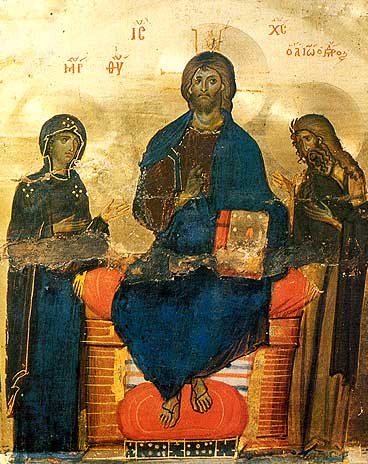
Byzantine iconography, in the type of image called the Deësis ("supplication"), loves to portray Christ, on His throne as our coming Judge, attended by the Virgin and the Baptist, both of whom are pleading with Him on our behalf.  


The Holy Roman Church likewise puts great emphasis on the Baptist's prayers - at Mass, he is named in the Confiteor, the Suscipe Sancta Trinitas, the Nobis quoque peccatoribus of the Canon, and the Last Gospel, while his words of witness to the Lamb of God are repeated in the Gloria in excelsis, the Agnus Dei, and the Ecce Agnus Dei.  Holy Mother Church prays in the Vigil Collect that, walking in the way of salvation, following John's exhortation, we may come safely unto Christ; she prays in the Vigil Postcommunion - just as Byzantine art depicts - that his potent prayer obtain for us the mercy of the Lord Whose coming he foretells; and all the orations of the Day Mass say much the same and more.

To-day the Traditional Rite places St William (Guglielmo) of Vercelli, Abbot of Monte Vergine, before us; a monastic founder of long ago... perhaps in our unmonastic age it is not for nothing that we should recall a monk, that is, one who is monachos, one alone with the Alone, seeking after the one thing necessary, the One Who alone is necessary.  His collect, which I have been mulling over this day, actually inspired these thoughts and this post:

Deus, qui infirmitate nostræ ad terendam salutis viam in sanctis tuis exemplum et præsidium collocasti: da nobis, ita beati Gulielmi Abbatis merita venerari, ut ejusdem excipiamus suffragia, et vestigia prosequamur.  Per...

(God, Who hast set in Thy Saints an example and defence for our infirmity, to smooth the path of salvation, grant unto us so to revere the merits of blessed Abbot William, that we may obtain the suffrages, and follow after the steps of the same.  Through Our Lord Jesus Christ, Thy Son, Who with Thee liveth and reigneth in the unity of the Holy Ghost, God, world without end.  Amen.)

I deliberately give the full ending of the Collect, because it reminds us that whatever example, whatever deserts, whatever prayers, whatever benefits soever, all are of avail and are inspired and are empowered and are granted only in and through and by Our Saviour, Who with His Father and the Holy Spirit is One God in perfect Trinity, evermore.