Showing posts with label St John the Baptist. Show all posts

Monday, June 21, 2010

Shortest Day

This year, the shortest day falls to-day, the 21st of June: the sun rose here in Launceston this morning at 7:38 am, and will soon set, at only 4:48 pm – only just over nine hours of daylight.  To-day's weather: partly cloudy, 0 to 13 degrees.  I am minded to see what my friend up in Edinburgh is experiencing, since for him this is the summer solstice, and so I'll quickly look up details (pause for googling): it appears he can expect some showers, and a range from 11 to 19 degrees (sounds like spring weather here).  Scotland's capital being further north than Launceston is south, the sun will rise there at 4:26 am and set very late, at 10:06 pm – imagine that! nearly eighteen hours' daylight, twice what we have now.  Given the lengthy twilight also, Edinburgh (were it not for cloud) would presumably have the "White Nights" of St Petersburg...

As good Christian folk will recall, the nearness of this event – the winter solstice in the Southern, but the summer solstice in the Northern Hemisphere – to the feast of the Nativity of the Baptist, and therefore the truth that from this feast onward, for those north of the equator, the days shorten, is considered significant by such worthies as St Augustine, mindful of St John's own words to Christ, the true Sun Who enlightens all men born into this world: "He must increase, I must decrease" – the lesson being that the Baptist came to herald Christ, Who must grow in us evermore.  Our Lord's Nativity, occurring in the North in darkest winter drear, thus symbolizes Christ coming "to those who sit in darkness and in the shadow of death", enlightening hearts more and more, just as, after Christmas in northern climes, the days grow longer daily thereafter.

Saturday, August 29, 2009

Off with His Head

The Decollation of St John Baptist: the prophet imprisoned by cruel wavering Herod; the insensate fury of Herodias at her false marriage being exposed and denounced; Herodias corrupting her daughter to dance the dance of the seven veils to captivate her father; Herod's delusion by perverse incestuous lust leading to his rash vow; his sinful adherence to that vow, wicked and deserving only of being justly broken; the Baptist's head is brought on a platter; and so the foul unholy trinity of tyrant, adultress and temptress compass the death of Christ's Forerunner - yet their free descent into evil is made to serve the glory of God through the martyrdom of John, just as within a few short years the conspiracy of Jews and Romans against Our Lord proves not deicide, but the salvation of mankind.


I rather like the unscriptural denouement of Wilde's Salome - she, the otherwise unnamed daughter of Herodias, who had changed her earthly and rejected love for John into diabolical hate, dares to kiss the pure lips of the severed head (that holy relic) in her insane desire, and at that moment Herod sees her monstrous crime: he commands his guards, "Kill that woman!" - curtain.

Thursday, June 25, 2009

Half-way to Christmas

Somewhere Pius Parsch put it that we could think of the Liturgical Year as beginning at Septuagesima (when the Breviary begins at the beginning, with Genesis chapter i), and coming to its end with Advent (presaging the final Coming of the Lord) and then, at Christmastide through to Epiphanytide and Candlemas, delighting now in what will happen at the consummation of all the ages - the Lord having come, God and His people will be united forever, at the Nuptial Feast of the Lamb.  With this in mind, the 25th of June marks half-way to Christmas, when we celebrate not just the historical birth of Christ in Bethlehem of Judæa, but His eternal begetting by the Father, and His future return to abide in our midst evermore as our King.  

The time after Pentecost is the time of the Church, the Body of Christ on earth, the Kingdom in germ, His Immaculate Bride, given life by the promised Holy Spirit.  Therefore, quite rightly is this season illuminated by two principal celebrations: the ever-present power of the Crucified and Risen One, which is our focus every Sunday, the Lord's Day; and the ever-present power of the same Crucified and Risen One, which is our focus every Saint's Day, for then we delight in the triumph of His grace in a chosen soul, a true Christian, since Christianos means "one belonging to Christ".  What eternal Victory each Sunday shews us in the Saint of Saints, the selfsame victory achieved in the life of one baptized we see in each Saint whose anniversary we recall.  This is why St Paul could say, "Be ye imitators of me, as I am of Christ" (I Cor. xi, 1) - and the Church, guided by the Spirit into all truth, has feast by feast various Saints say the same to us would-be Christians: Imitate me, as I imitated Christ, and won the immarcescible crown.

Yesterday, and even the day before that, on the Vigil, we had the superlative witness of St John Baptist to behold, that as he told us and all men, Behold the Lamb of God, so too we should turn to Christ.  Heeding His Herald's wonderful humility we should - as is most just - cry out with St John, He must increase, I must decrease.  Not for nothing does the New Testament make so much of the Forerunner of the Lord; his example is peerless.  

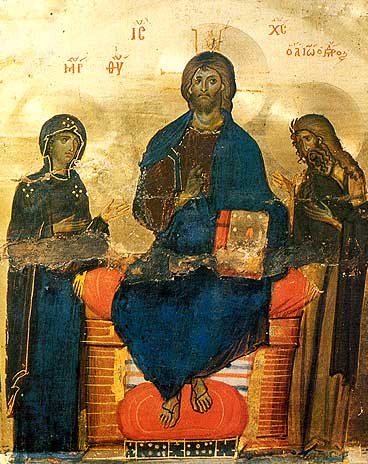
Byzantine iconography, in the type of image called the Deësis ("supplication"), loves to portray Christ, on His throne as our coming Judge, attended by the Virgin and the Baptist, both of whom are pleading with Him on our behalf.  


The Holy Roman Church likewise puts great emphasis on the Baptist's prayers - at Mass, he is named in the Confiteor, the Suscipe Sancta Trinitas, the Nobis quoque peccatoribus of the Canon, and the Last Gospel, while his words of witness to the Lamb of God are repeated in the Gloria in excelsis, the Agnus Dei, and the Ecce Agnus Dei.  Holy Mother Church prays in the Vigil Collect that, walking in the way of salvation, following John's exhortation, we may come safely unto Christ; she prays in the Vigil Postcommunion - just as Byzantine art depicts - that his potent prayer obtain for us the mercy of the Lord Whose coming he foretells; and all the orations of the Day Mass say much the same and more.

To-day the Traditional Rite places St William (Guglielmo) of Vercelli, Abbot of Monte Vergine, before us; a monastic founder of long ago... perhaps in our unmonastic age it is not for nothing that we should recall a monk, that is, one who is monachos, one alone with the Alone, seeking after the one thing necessary, the One Who alone is necessary.  His collect, which I have been mulling over this day, actually inspired these thoughts and this post:

Deus, qui infirmitate nostræ ad terendam salutis viam in sanctis tuis exemplum et præsidium collocasti: da nobis, ita beati Gulielmi Abbatis merita venerari, ut ejusdem excipiamus suffragia, et vestigia prosequamur.  Per...

(God, Who hast set in Thy Saints an example and defence for our infirmity, to smooth the path of salvation, grant unto us so to revere the merits of blessed Abbot William, that we may obtain the suffrages, and follow after the steps of the same.  Through Our Lord Jesus Christ, Thy Son, Who with Thee liveth and reigneth in the unity of the Holy Ghost, God, world without end.  Amen.)

I deliberately give the full ending of the Collect, because it reminds us that whatever example, whatever deserts, whatever prayers, whatever benefits soever, all are of avail and are inspired and are empowered and are granted only in and through and by Our Saviour, Who with His Father and the Holy Spirit is One God in perfect Trinity, evermore.

Wednesday, June 25, 2008

Why St John?

Guéranger answers my question of why Rome holds St John the Baptist as one of her principal patrons: the Cathedral of Rome, though originally dedicated to Our Saviour, came very many centuries ago to be known mainly as St John Lateran - and, although the Evangelist is also associated with it, this name refers in the first place to the Baptist. This is the more remarkable when one considers that neither St Peter's on the Vatican Hill, nor St Paul's Outside the Walls were designated the seat of the Bishop of Rome, despite the fact that these two Princes of the Apostles died for Christ at Rome.

Formerly, as at Christmas, there were three Masses on his feast, at midnight, dawn and Terce; moreover, the Leonine Sacramentary has two more Masses ad Fontem for neophytes, since once baptism was solemnly conferred on this day, as otherwise only at Epiphany, Easter and Pentecost.

It seemed to me a pity not to have a proper Preface at Mass for St John; here is that from the 1738 Paris Missal:

VD... Deus:
Qui nos de Præcursoris Unigeniti tui nativitate gaudere fecisti. Ipse enim fuit lucerna ardens et lucens: ipse est Elias venturus: ipse et quo inter natos mulierum nullus major, affirmante Unigenito tuo servatore nostro;
Per quem...


Oh, and I am not so opposed to the NO as to despise its Preface for St John the Baptist, except for its eschatocol (the part at the end about our joining with the carolling angels), which for this Preface is a bit anemic; as should be better known, it is permissible to use some of the modern Prefaces with the TLM, and this is no bad thing, whatever conspiratologists may imagine; consider the elegant Latin of the NO Preface:

VD... per XDN:
In cujus Præcursore beato Joanne
tuum magnificentiam collaudamus,
quem inter natos mulierum honore præcipuo consecrasti.
Qui cum nascendo multa gaudia præstitisset,
et nondum editus exsultasset ad humanæ salutis adventum,
ipse solus omnium prophetarum
Agnum redemptionis ostendit.
Sed et sanctificandis etiam aquæ fluentis
ipsum baptismatis lavit auctorem,
et meruit fuso sanguine supremum illi testimonium exhibere.
* Et ideo, cum cælorum Virtutibus, in terris te jugiter prædicamus, majestati tuæ sine fine clamantes:


* What I mean above is, the eschatocol Et ideo... above should be replaced with the fuller EF formula:

Et ideo, cum angelis et archangelis, cum thronis et dominationibus, cumque omni militia cælestis exercitus, hymnum gloriæ tuæ canimus, sine fine dicentes:

Fratres Oratorii; Nativity of St John the Baptist

It would have been nice to have had a bonfire tonight... The fallen leaves are blowing on the footpath outside the Pro.

Instead, we had Brothers of the Oratory Holy Hour (a chance to go to confession included), followed by sung Mass - yours truly having to sing it with Rosemary lending me a hand, thankfully. The attendance at Holy Hour and Mass was very sparse indeed, sadly.

For the Mass, we had "For all the saints" as processional, then I psalm-toned the Propers alone (would have loved to sing the Gregorian, but by myself I just can't do it), and we all sang Missa de Angelis and Credo III; at the Offertory and Communion, R. and I sang the Benedictus and Jesu dulcis memoria respectively; we ended with "Hark a herald voice is sounding" - it would probably have worked better at the start, with the opening hymn at the end, now I think about it, but no matter.

I had arrived at the Pro. just before 5.30pm; both Holy Hour and Mass started about 10 minutes late, for various reasons, Mass ended about 7.30pm if not a little earlier, and I left maybe fifteen minutes afterward. A good evening: always good to be brought to one's knees, to reflect, to confess, to offer thanksigiving.

I was struck by how St John the Baptist appears not merely in the Proper, but in the Ordinary of the Mass: in the Confiteor and in the Last Gospel, for instance; in the very Canon, we ask to be allotted some part and fellowship with the martyrs, firstly, St John, the Baptist (cf. Nobis quoque peccatoribus); the Agnus Dei and Ecce Agnus Dei are taken from his very words of prophecy; he is named first after the Blessed Virgin in the Suscipe Sancta Trinitas.

Along with the Holy Apostles Peter and Paul, he is one of the principal Patrons of the Holy Roman Church - I don't recall reading why this is so. Ideas, anyone?

May he, who pointed out the Lamb of God, obtain for us the grace to follow along the path of eternal salvation.

Vigil of St John Baptist

Owing to pressure of events I didn't blog this yesterday as intended...

Yesterday was the Vigil of the Nativity of St John the Baptist (Midwinter's Eve, in other words): I was surprised to find that Lauds I, not Lauds II, was appointed, and that the Preces were not said: it turned out that they had been snipped out from Vigils, once called "kneeling days" after the Preces said thereon, in one of the last pre-Conciliar reforms, or rather impoverishments, of the Office. So I tacked on all the omitted bits as devotions after the Hours instead. One curious feature of the Vigil Office: the Lessons at Matins are proper, but the responsories are ferial.
**UPDATE**
I was wrong: Lauds II is the correct Hour to use on a Vigil; my bad.
******
In the evening, having arrived early at the Pro., I led the Rosary for once, and served Fr's Mass - always a privilege. Being a Vigil, the vestments were purple, there was no Gloria nor Alleluia. Using the Common Preface for so great a saint seemed a bit infra dig. There was no Ite, either, but Benedicamus Domino.