Showing posts with label Divine Liturgy. Show all posts

Sunday, February 9, 2014

Sunday of the Pharisee and the Publican

As I had to attend a meeting in Hobart at lunchtime, I decided to drive down earlier, and attend the 10 am Divine Liturgy at the Ukrainian Catholic Chapel of the Transfiguration, where friends of mine customarily worship on Sundays. 

I haven't attended a Ukrainian Liturgy in Hobart since the construction and consecration of the chapel in August 2010; it was good to join the small but devoted congregation to sing the praises of the Trinity, and receive the Sacred Mysteries.


It proved a little hard to find the chapel – it is located within the Ukrainian Club, tucked anonymously among the commercial buildings and fast food restaurants of Moonah; luckily, as I knocked at the locked front door (not knowing of the open door leading in from the back car park), their priest, Fr Tony Warwarek, heard me and let me in.

As I drove down, I recalled that it was "Octogesima", the Sunday before Septuagesima – and, as Eastern and Western Easter coincide this year, that applied to the Byzantine Rite also: and in that Rite, as I realised when the Liturgy began, that means it is the Sunday of the Pharisee and the Publican.

This Sunday, which is of the 8th Tone, first signals the approach of Great Lent: the Gospel pericope's call to true compunction and humble self-awareness rather than delusive pride and contempt toward others accords with this; and of course this week in the Eastern Church calendar is wholly fast-free, the last before Easter Week.

In the Byzantine Rite, next Sunday (equivalent to Septuagesima) is that of the Prodigal Son; the Sunday after that is Meatfare Sunday, equivalent to Western Carnevale, being the last day for eating flesh meat till Easter, with the week after that being Cheesefare Week, culminating in Cheesefare Sunday, last chance for dairy products and eggs till after the fast; for Great Lent begins on Monday 3rd March (Monday after Quinquagesima), rather than on the Western Ash Wednesday, 5th March 2014.

Having, especially in Melbourne, attended the Divine Liturgy off and on, I feel familiar with this form of the Eucharistic Sacrifice; I just have to remember not to sing "Gospodi" as with the Russians, but "Hospodi" with the Ukrainians. Most of the service was in English, except for the continual "Hospodi pomilui", other suchlike responses, and certain important chants, such as the Trisagion (which I managed to sing: "Svyaty Bozhe, Svyaty Kripky, Svyaty Bezsmertny, pomilui nas"), the Creed, and the Lord's Prayer.

Having received Our Saviour's Body and Blood, I recalled the advice of a prayerbook: "And after the divine Communion of the life-giving and mystic Gifts, at once give praise and great thanksgiving, and fervently and heartily sing to God: Glory to Thee, O God; Glory to Thee, O God; Glory to Thee, O God."

The noble and immemorial worship of the Byzantine Rite lifts up the heart and mind and soul to God. Would that I could attend it more often!

Monday, December 17, 2012

Axios!


The Russian Catholic parish in Melbourne is flourishing, and has just had the great joy of the ordination of two of its members: Anton Usher to the diaconate, and Justin McDonnell to the subdiaconate – they are both good and devout men, much learned about all matters liturgical, musical and spiritual, and will certainly be a support and ornament to their pastor, Mitred Archpriest Lawrence Cross.

The ordinations took place on Sunday; I was able to fly over to Melbourne for the weekend, and stayed with Justin and his wife Lydia (whom now I address as Hypodiaconissa).  Come Sunday morning, we drove up from the outer suburb where they live, about 40 km (25 miles) to the Russian Catholic church of Holy Trinity-St Nicholas, in the inner suburb of St Kilda East.  This is a former congregationalist church recently purchased and extensively renovated for the use of the Russian Catholic parish, thanks to a most generous grant from the Vatican.  The ladies of the parish were already preparing the celebratory lunch to be had much, much later on... Soon enough, the choir arrived, much supplemented for the occasion by excellent singers from around Melbourne. (The singing was nearly all in English, save for some of the litanies and the Cherubikon.)  Yours truly was employed in menial tasks suited to his capacity, such as peeling hardboiled eggs and putting up party decorations.

His Excellency Robert Rabbat, Bishop of the Greek Melkite Eparchy of Australia and New Zealand came down from Sydney to celebrate the Divine Mysteries. (Unfortunately, the Russian Catholics have had no bishop of their own for many years now).  Both after the subdiaconal ordinations, and before the final prayer at the Divine Liturgy, the good bishop addressed us briefly (Archpriest Lawrence having been delegated to preach the sermon): I was most impressed to hear a bishop so conversant with the Gospels, and so spiritual in his understanding thereof - what a blessing! As he exhorted the congregation, by our prayers we ought help bear the Cross with Anton and Justin, rather than crucify them, as parishioners can.

(I ought add that two Ukrainian priests concelebrated with the Bishop, alongside Archpriest Lawrence, and two deacons attended, one Roman, one Ukrainian Rite - the latter undertaking the deacon's parts, being more adept at the requisite ceremonies.)

Worship began with the Third Hour (mainly in Church Slavonic, but with the Psalms in English) at 10:20 am. His Excellency entered the church for vesting at 10:30 am, an episcopal throne and bema having been erected for the occasion in the midst of the nave. That done, he proceeded to confer the lectorate on Anton; Justin had previously received this minor order. Next, the two men were ordained subdeacons together.

After that, Hierarchical Divine Liturgy began; I noted by my watch that the Epistle was read 90 minutes after we had began. Strangely, or not so strangely, this most elaborate and lengthy worship did not seem to deter at all the 60 or more parishioners and friends who were filling up the nave. I was next to a friend, a seminarian of the local Roman archdiocese; my only complaint was increasingly sore feet as we stood for the whole liturgy.

Most movingly, the order of the diaconate was conferred upon Anton in the appointed manner to me until then unknown - he was ordained directly after the Eucharistic Prayer, just before the Litany leading into the Lord's Prayer. When he came forth after Communion to lead the litany of thanksgiving, all were most glad and edified to see him our new deacon. The Liturgy concluded at 1:35 pm, some three and a quarter hours after our corporate worship commenced.

The ensuing festal lunch was most welcome, as was conversation with many friends new and old.  One of the Latin-Mass-goers who had come along for the occasion (many being friends of Justin) remarked to the effect that the Roman Liturgy moves the mind, but the Byzantine the heart.  I must say, as a Roman who loves the East, that the Divine Liturgy has a power to uplift to heaven the heart even of this poor sinner.

Ἄξιος! Многая Лета!

Monday, May 31, 2010

Corvopolis

To-night finds me at Wagga Wagga, "the place of many crows" – hence in Latin, this is the see of the episcopus Corvopolitanus, "the Corvopolitan bishop" (in English we prefer the possessive form to the adjectival, and say the Bishop of Wagga Wagga).  I had lunch at Wangaratta – as another bit of toponymic trivia, the a's in Wang. are all pronounced as a's (though some old folks there still say "Wongaratta"), whereas here the correct thing to say is "Wogga Wogga".  Why is it that so many English words contain "wa" pronounced "wo" – swan, wan, want, waltz, etc.?

The ferry trip across Bass Strait was uneventful (mainly because I went to bed very early, just as we pulled out of dock in fact!), thanks be.  I did have a very busy day yester-day in Melbourne, however, being up at 5.30 am (ready to drive off the ferry at 6.30) and not in bed till after midnight.  Things to do, people to see...

For old times' sake I had breakfast at the European Café, just opposite Parliament House, of which eatery I was an habitué in when first studying theology... huevos madrileños, with chorizo and black pudding, went down a treat.  

There's something very Melburnian – marvellous Melbourne! – about drinking good coffee, reading the newspaper, and having a cooked breakfast somewhere decent.  The fellows at the adjoining table gave some local colour, by seeming, insofar as appearance, manners and overheard snatches went, rather like the stereotypical mafiosi of this city...

After thus fortifying my body, I did my duty to my soul by making a visit at St Patrick's Cathedral just a few blocks away, and caught the blessing at the end of the early Mass.  Bizarrely, many older Italians  were assembling outside, ladies in traditional dress, men in outlandish military outfits, since the 9.30 am Mass was to be in celebration (?!) of the anniversary of the foundation of the Italian Republic (with commemoration of the Most Holy Trinity).  While I am as glad as anyone that the cursèd House of Savoy lost their ill-gotten throne, pinched from the Pope with the aid of Freemasons and worse, I wonder about celebrating a Republic...


Having admired the Cathedral, I drove over to North Fitzroy, off Alexandra Parade, to attend the Divine Liturgy at the Russian Catholic Chapel of St Nicholas; friends of mine were to be singing in the choir, and the service was to be in English.  (Also, because of the contretemps occasioned by my comments pursuant to my last visit to St Aloysius when the schola was singing there, as it was again on Sunday as I luckily found out in advance, I decided discretion was the better part of valour: let sleeping dogs lie.)

Archpriest Lawrence was assisted in the altar by Fr Bogdan, who I was delighted to discover is a convert  priest, formerly Russian Orthodox: he and his wife have both become Catholics.  The sublime mysteries of the Byzantine Liturgy lift one up into the heavenly places: I was deeply moved.  

While the Hours of the Day, according to my Breviary, were of course of the Trinity, in the Byzantine Rite this Sunday is All Saints Day, since the Easterners consider that Pentecost is the manifestation of the Trinity's irruption into the world.  That said, since I crossed myself the really traditional way (three fingers conjoined, two in the palm, right to left), ever so many times at the Liturgy, since one does so at each and every mention of Father, Son, and Holy Ghost, I by no means missed out on remembrance of the Trinity – indeed, the Byzantine Rite leaves the West for dead in this respect.  The East never ceases to praise the Trinity; how Trinitarian are Western Christians I wonder?

Fr Lawrence, as always, preached a very deep sermon about what holiness really is: the action of the Holy Spirit in one, transforming one's person.  To receive the Sacrament of Christ's Flesh and Blood is very great, but this is but the beginning: thereby we ought be filled with the Spirit Who sanctifies, the Lord and Lifegiver.

After the Liturgy, I then had to find my way to the Balaclava Hotel, where the Latin Massers lunch after the Solemn High Mass.  It was a good chance to catch up with friends, to profit by Fr Tattersall's counsel, and to congratulate Fr McDaniels on the occasion of his 70th birthday: ad multos annos!  After lunch, I had afternoon tea with my friends Justin and his sister, Karina, at their nearby flat.

Finally, having booked in where I was staying, again for old times' sake I drove over to East Camberwell, and joined the Dominicans for Vespers there.  It was great to see them again; Rev Br Paul and I caught up for dinner afterward, something I had been very keen to do since I had unavoidably missed his solemn profession and diaconal ordination last year.  God willing, come December, perhaps I will be able to make his priestly ordination and first Mass...

******

After such a hectic Sunday, to-day, my longest driving day, seemed almost anticlimatic.  I left at 9 am, and stopt at Euroa a bit after eleven o'clock.  There's a fine little secondhand bookshop there that I came across quite providentially; I must say, the magnificent four volume Breviarium Romanum (Antwerp, 1770) on display was a bit out of my price range at $1150, but I did find some little items to console myself with.

I had lunch at Wangaratta, and was careful to visit both St Patrick's Church (which should really be the Cathedral of a Catholic diocese based at Wangaratta, if Shepparton misses out; it's silly for all  north-east Victoria to be managed from Bendigo) and the Anglican Cathedral of the Holy Trinity (for the Anglicans do have their own separate diocese for this area, unusually, since nearly all Catholic dioceses in this country have a corresponding Anglican one, and vice versa).  The former visit was an occasion for prayer, of course, while the latter was an occasion for snooping about and estimating the degree of their churchmanship!  

I hear from my TAC sources that the new Anglican bishop of Wangaratta – once an Anglo-Catholic stronghold – is a strange and dangerous liberal: amongst recent enormities, rather than open the doors of his episcopal palace to too many visitors, he staged the elaborate dinner to host them all inside the very cathedral.  For the record, their cathedral had such accoutrements as a holy water stoup, votive candle stands, statues of Our Lady, and a tabernacle with a lamp burning beside it.  Unlike St Patrick's church, there were no statues of saints, but certainly stained glass images of several.

Most curiously, in a tiny oratory off to the left of the nave, on the small side altar therein were a set of altar cards (see photographs below), displaying an exact rendering into English of all the prayers on altar cards for the Traditional Latin Mass.  I wonder if they are used still?


I reached Wagga Wagga in the late afternoon, and have enjoyed catching up with a friend of mine here.  He tells me that there is a public Mass at 7.05 am at Vianney College chapel to-morrow, so I hope to start the day bright and early there.  All kudos to Bp Brennan who established his own diocesan seminary in the dark days of the early nineties, before either the Melbourne or the Sydney seminary was reformed and purged of illiberal liberals: thanks to his not uncontroversial move, Wagga Wagga diocese has the highest priest-to-people ratio, and the youngest average age of priests, in the whole of Australia: and they're orthodox, naturally.

Happy feast of the Queenship of Our Lady to all readers!

(I must say, though, the revisers of the Roman Rite were correct in moving the feast of the Queenship to the Octave Day of the Assumption, and therefore transferring the feast of the Immaculate Heart from that day to the Saturday after the feast of the Sacred Heart.  That said, why in the Novus Ordo the Visitation was moved to to-day, the 31st of May, from its old date of the 2nd of July I don't know!)

Saturday, January 9, 2010

Synaxis of the Theotokos; or, An Afternoon in Florence

I wonder if, having kept the feast of the Synaxis of the Theotokos (the Cyrillic I read as Sobor Bogoritsi) by attendance at the Divine Liturgy this afternoon, therefore to-day for me is a great feast excluding the usual Friday penance? But I heard two more Masses, just to be sure...

Pursuant to my post about keeping Ukrainian Christmas, I ought mention one blessed blessing of the Byzantine Rite: one is for ever crossing oneself in the older, Eastern fashion, with thumb and forefingers joined in honour of the Trinity, the last two digits pressed in the palm to remind us of Christ's Natures twain, and making the saving Sign from right to left, as was done also in the West until the time of Innocent III, who noted in his writings that people were starting to do it our modern way.  One also bows a good deal.

The priest preached a long and doubtless most Marian homily which unfortunately I couldn't understand, though I think he said he was preaching on the kontakion and hypakoe of the feast, and talked a great deal about the Mother of God (Bog / Bozhe, like Gospode, are some of the first words one learns in Ukrainian, being the equivalents of Deus and Dominus; he used both Bogoritsa, which is in Latin Deipara, in Greek Theotokos, and also something like Mater Bozhe).  I filled in the time by reading Sext, whose psalms (83 and 86) were most appropriate, as one can read them as referring to Our Lady.

As only three made their communion, I refrained out of a desire not to cause admiratio.  (Hence the other two Masses in the evening: at the first, at Santa Trinità, I had eaten less than an hour before, so I went to Santa Maria Maggiore for a second Mass so I could communicate fasting.)

Annoyingly, earlier on I couldn't find the church where St Mary Magdalen de' Pazzi's relics are kept.  But I did visit several other churches, among them that paramount gem, Orsanmichele, sheltering the most glorious image and shrine of the Madonna delle Grazie, so resplendent, as if Our Lady had in person descended to earth.

In particular, late in the day I came to Ognissanti (All Saints), now in care of the Immaculate Friars, where is preserved the very habit that St Francis wore when he received the Stigmata.  What a motive for prayer and contemplation!

Santa Trinità is in care of the Vallombrosan Benedictines.  Excellently, they have absolutely no modern Cranmer tables, only stone altars firmly fixed to glorious sacred images, and therefore Mass was said ad orientem, not ad populum (though pro populo, in the general sense).  It just looks and feels so much better.

Santa Maria Maggiore has an altar up the front on the left, with a most unusual inscription, which didn't seem to relate to any of the art around it:

ATTENDITE AD PETRAM VNDE EXCISI ESTIS
ISAIAS CAP.LI V.I

I take it as a message to be relayed to those thinking of a Tiber swim -

"Remember the Rock whence ye have been hewn"
(Isaias li, 1)

- that is, come to Rome, videre Petrum, to see Peter, in every sense.  As I've repeated before, it wasn't Lambeth Palace that lost a tile...

Friday, January 8, 2010

Christmas in Florence

Not only have I kept Epiphany twice (in Oxford and Edinburgh), but yesterday I celebrated Christmas again, courtesy of the Ukrainian Catholic community here in Florence!

I was simply looking for Vivoli Gelateria, and on a whim turned up a side alley, ending up at a church which I decided to investigate (I missed and walked right past the gelateria, which I later found to be closed at this season anyway) - when I came in to SS Simon and Jude, I found myself in a packed congregation, all standing, and the priest facing east at the altar, about to start the Insistent Litany after the Gospel (which I recognized by the threefold Gospodi pomilui - "Lord, have mercy").

Thanks be to God, I have sufficient familiarity with the Liturgy of St John Chrysostom, albeit not with Ukrainian, that I was able to pray the Mass.  I must admit, the Byzantine Rite leaves the West for dead (and I'd been at a lovely Missa Cantata for the Epiphany the night before!): the beautiful singing, the sweeping sacred Action, carries one along into the heavenly places.

(As a friend once put it, the Roman Mass, solemn and sober, is precisely ordered and structured, able to be analysed into successive parts, expressive of the Western discursive mind; the Byzantine Divine Liturgy rather is all one great unfolding irruption of the Sacred, a form of contemplation rather than of meditation if you will.)

BTW, it was evident this was a Catholic not an Orthodox service, since the congregants nearly all knelt for the Sanctus and Consecration (not for the Epiclesis), and again at the Sancta Sanctis and response - "One is Holy, One is Lord: Jesus Christ, in the glory of God the Father".

Only a minority (the more fervent one assumes, standing up the front) communicated, and late that I was and not quite certain in myself, I refrained.  But to-day at 2.30 pm there will be Divine Liturgy for the Synaxis of the Soprasanta Theotokos, so I've been to confession at the Duomo and will keep a third feast, of Mary the Mother of God (whose memory the West keeps on the Octave Day of Christmas as its liturgy old and new indicates, whatever of the Circumcision), for the second time!

Monday, October 19, 2009

Blessed is the Kingdom

Εὐλογημένη ἡ Βασιλεία τοῦ Πατρὸς ϗ τοῦ Υἱοῦ ϗ τοῦ Ἁγίου Πνεύματος, νῦν ϗ ἀεὶ ϗ εἰς τοὺς αἰῶνας τῶν αἰώνων.

Blessed is the Kingdom of the Father, and of the Son, and of the Holy Ghost, now and ever and unto the ages of the ages. Amen.
is the abbreviation for καὶ]

Thus begins the Divine Liturgy according to the Byzantine Rite, as the priest makes the sign of the Cross with the Gospel-book. Perhaps this is based on Tobit xiii, 1b: Εὐλογητὸς ὁ Θεὸς ὁ ζῶν εἰς τοὺς αἰῶνας καὶ ἡ βασιλεία αὐτοῦ (Blessed be God that liveth for ever, and blessed be His Kingdom).

But note that the Kingdom is of the Three Persons of the Trinity. The Trinity is King!

At the Divine Liturgy, the second ecphonesis, and the well-known doxology after the Lord's Prayer, are almost the same in their proclamation: "For Thine is the Kingdom and the power and the glory, of the Father, and of the Son, and of the Holy Ghost, now and ever and unto the ages of the ages. Amen."

We in the West rarely call the Holy Ghost our King - but in the Byzantine Rite, every sacred act begins with a complex of prayers beginning with this invocation of the Holy Ghost, somewhat answering to the Latin Veni Sancte Spiritus: "O heavenly King, Paraclete, Spirit of Truth..."

Of course, in East and West and wherever Christians are found, we all pray in the Lord's Prayer, "Our Father... Thy Kingdom come... on earth as it is in heaven." (Pater noster... adveniat regnum tuum... sicut in cælo et in terra.) God the Father is King we know, for (as at the Mass in the Western recension of the Gloria in excelsis), in the Byzantine Rite, their equivalent Great Doxology - sung at their Lauds and other Hours - includes the words Κύριε βασιλεῦ, ἐπουράνιε Θεέ, Πάτερ Παντοκράτορ ("Lord King, heavenly God, Father Almighty"): which is simply a slightly different division of words to the Latin Rex cælestis, Deus Pater omnipotens ("heavenly King, God the Father Almighty").

And what of the Great Entrance? The sublime Cherubicon is chanted: "...let us receive the King of all, invisibly escorted by the Angelic orders." Whiles the oblations are processed, which shall soon be consecrated, and so are already types of the Body and Blood of Christ, the priest and people cry, "May the Lord our God remember us all in His Kingdom... Lord, remember me in Thy Kingdom" (quoting St Dismas, the Good Thief: most blessed thief, who even stole Paradise!). Here Christ, our King and our God, is confessed, just as He is at the opening of each canonical Hour, in a threefold cry based on Psalm 94:6 (compare its use at Matins in the West):

Come, let us worship and bow down to the King, our God.
Come, let us worship and bow down to Christ the King, our God.
Come, let us worship and bow down to Christ Himself, the King, our God.

No one can say that the Byzantine Rite omits homage to Christus Rex!

The Three Persons are each King: the Father is King, and the Son is King, and the Holy Ghost is King: but they are not Three Kings, but One King. (Cf. Athanasian Creed.)

******

The genius of the Latin Liturgy is to be found encapsulated in the conclusion of the standard Roman Collect: Per Dominum nostrum Jesum Christum Filium tuum, qui tecum vivit et regnat in unitate Spiritus Sancti, Deus, per omnia sæcula sæculorum. Addressing God the Father, we pray through His Son, Jesus Christ, our Lord, Who with Him liveth and reigneth - as King - in the unity of the Holy Ghost, endlessly. Again, the Three are One King.

As for the Latin Mass, no less than in the Byzantine Rite, the Niceno-Constantinopolitan Creed solemnly declares that Cujus [Christi] Regni non erit finis - "Of whose [Christ's] Kingdom there shall be no end". St Cyril of Jerusalem - in his mystagogical catechesis to neophytes - energetically declares, "If thou shouldst hear that Christ's Kingdom hath an end, then hate this heresy!" Similarly, by confessing that Christ sits at the right of the Father, in the Gloria in excelsis and Creed, we declare indirectly that Our Lord Jesus Christ shares in the Kingship of His Father.

The Ascension of Our Lord into heaven, and His perpetual Session at the right hand of God, ruling all things in heaven and on earth, is the proximate foundation of the feast of Christ the King (which was only belately inserted into the Liturgy in 1925) - not that Christ, the Incarnate Word, was ever not our Sovereign Lord, but that, having conquered sin, Satan, death and hell by His Resurrection, He returned in triumph to reign in heaven. There, invisibly maybe but very truly, He rules even this world, which is totally under His sway and the direction of His Providence; for the moment, as this the last age rapidly draws to its ineluctable Judgement and end, He permits men still to sin and waste time away; but the sands in the hourglass are running out. God has appointed a day when Christ shall return, "to judge the living and the dead and the world by fire". May He grant us the grace and mercy to stand and be saved on that Day! (The Neo-Gallican Missals and Breviaries were not far wrong when they marked the Octave Day of the Ascension by a special feast in honour of Christ's Return as our Dread Judge.)

How we ought then call on Him Who is the King of Glory! In the Office, the Te Deum includes the stirring words, Tu Rex gloriæ, Christe: Thou art the King of glory, O Christ. And in Lent, instead of Alleluia, is sung Laus tibi, Christe, Rex æterne gloriæ: Praise unto Thee, Christ, King of eternal glory. On Palm Sunday, we sing the hymn with the refrain Rex Christe, Redemptor: King Christ, Redeemer.

Finally, it ought go without saying - as well the early Christians and the pagan Romans knew - that to call Christ (or for that matter the Holy Spirit) "Lord" is to solemnly acknowledge that this Person is King and God, ranking with the Eternal Father.

Friday, January 30, 2009

Curiouser and Curiouser: SS Tatiana & Martina

To-day we keep the feast of St Martina, Virgin & Martyr (at least if one is observing the Extraordinary Form, as by reading the 1962 Breviary); and when last Sunday I worshipped with the Russian Catholics, they were keeping the memory of St Tatiana, Martyr at Rome (whose feast occurs on the 12th of January, which was the date according to the Julian Calendar).  I thought to find out a little more about them, particularly the latter, who was unfamiliar to me, and thereby hangs a tale.

First, St Martina: apparently the evidence for her early cultus is obscure; Pope Donus (remember him?) dedicated a church to her in the Roman Forum in 677, as the modern Martyrology notes on this day (30th January, n. 3 and reference in its index), and in 1634 her relics, alongside those of SS Concordius, Epiphanius and friends, were uncovered in a crypt in an old church (the same one dedicated to her, by then having decayed and therefore being rebuilt): moved by this, Pope Urban VIII, then gloriously reigning, had the church (her church, known by this point as Santi Luca e Martina) repaired, and ordered her Office inserted into the Breviary, with special hymns newly composed by himself.  Their Latin I found very hard, so I looked them up and here append them with a translation courtesy of an old book found transcribed online...
Hymn at Matins [ previously divided in twain]

Martinæ celebri plaudite nomini
Cives Romulei, plaudite gloriæ:
Insignem meritis dicite Virginem,
Christi dicite Martyrem.

Hæc dum conspicuis orta parentibus
Inter delicias, inter amabiles
Luxus illecebras, ditibus affluit
Faustæ, muneribus domus,

Vitæ despiciens commoda, dedicat
Se rerum Domino, et munifica manu
Christi pauperibus distribuens opes,
Quaerit praemia coelitum.

Non illam crucians ungula, non feræ,
Non virgas horribili vulnere commovent;
Hinc lapsi e Superum sedibus Angeli
Cælesti dape recreant.

Quin et deposita sævitiæ leo
Se rictu placido projicit ad pedes:
Te Martina tamen dans gladius neci
Cæli cœtibus inserit.

Te, thuris redolens ara vaporibus,
Quae fumat, precibus jugiter invocat,
Et falsum perimens auspicium, tui
Delet nominis omine.

A nobis abigas lubrica gaudia
Tu, qui Martyribus dexter ades, Deus
Une et trine: tuis da famulis jubar,
Quo clemens animos beas.  Amen.


1. "Praise, Romuleian citizens [ i.e. of Rome, founded by Romulus], the illustrious name of Martina, praise her glory; celebrate in song a Virgin rendered illustrious by her merits; sing a Martyr of Christ."

2. "As she was born of distinguished parents, she lived amid pleasures, amid the fascinating allurements of luxury, and she abounded in the rich gifts of a prosperous house."

3. "But despising the comforts of life, she dedicates herself to the Lord of creation, and with a lavish hand she distributes her riches among the poor of Christ, and seeks for herself the reward of the Blessed."

4. "Neither the agonizing hook, nor wild beasts, nor the rods with their painful wounds shake her constancy; thereupon Angels descend from the abodes of the Blessed and strengthen her with heavenly food."

5. "And even the lion, laying aside his savage nature, with friendly gaping jaws lays himself down at her feet: thee, at length, Martina, the sword delivers up to death and enrolls thee among the hosts of heaven."

6. "The altar which smokes, redolent with the odors of incense, unceasingly invokes thee with prayers, and it destroys and annihilates by the omen* of thy name baneful idol-worship."

[* Martina means "warlike" - her warfare was against idolatry, which war she waged by prayer.]

7. "O God, Three and One, Thou who dost mightily assist the Martyrs, drive far from us dangerous pleasures: grant to Thy servants the light wherewith Thou dost graciously bless their souls.  Amen."

Hymn at Lauds and Vespers

Tu natale solum protege, tu bonae
Da pacis requiem Christiadum plagis;
Armorum strepitus, et fera prœlia
In fines age Thracios.

Et regum socians agmina sub crucis
Vexillo, Solymas nexibus exime,
Vindexque innocui sanguinis hosticum
Robur funditus erue.

Tu nostrum columen, tu decus inclytum,
Nostrarum obsequium respice mentium;
Romæ vota libens excipe, quae pio
Te ritu canit, et colit.

A nobis abigas lubrica gaudia
Tu, qui Martyribus dexter ades, Deus
Une et Trine: tuis da famulis jubar,
Quo clemens animos beas.  Amen.


1. "Protect thy native land and give to Christian nations the repose of holy peace: banish the din of arms and dreadful wars to Thracian fields [i.e. far away]."

2. "And uniting the armies of kings under the banner of the Cross, deliver Jerusalem from bondage, and as an avenger of innocent blood, utterly destroy the hostile power [of the Turks]."

3. "Thou, our pillar of strength, our illustrious ornament, behold the benevolent disposition of our hearts; graciously accept the prayers of Rome, who in a loving manner sings thy praises and honors thee."

4. "O God, Three and One, Thou who dost mightily assist the Martyrs, drive far from us dangerous pleasures: grant to Thy servants the light wherewith Thou dost graciously bless their souls.  Amen."
Second, St Tatiana: while the Byzantines keep her memory on the 12th of January, the modern Roman Martyrology makes no mention of her, again evidence of her early cultus in Rome seems hard to find, and it is even suggested, going on a great similarity between their Acts, that she and St Martina may be one and the same!  (She too, like St Martina, cast down idols by her prayers, was tormented but converted her very torturers by her miracles and constancy, thrown to a lion who refused to eat her, and finally suffered martyrdom by the sword, at Rome in the reign of Alexander Severus.)  Whatever of this skepticism, Tatiana is so popular among the Slavs that she is accounted Patron Saint of students, and her feast day is a public holiday in Belarus, Ukraine and Russia, called Tatiana Day or Student Day.

I do recall that at least her Kontakion was chanted at the Divine Liturgy, thus:
In your sufferings you shone brightly in the royal purple of your blood, and like a beautiful dove you flew to heaven, passion-bearer Tatiana. Therefore, always pray for those who honor you.

Thursday, January 29, 2009

Last Sunday

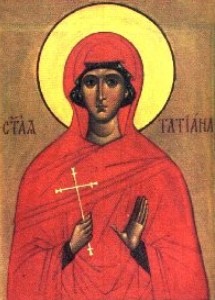
Last Sunday I worshipped with the Russians, at the Russian Catholic Chapel of St Nicholas.  As the Russian Rite still keeps to the Julian calendar and the older method for calculating Easter, their Easter this year will be a week later than the Roman, and the Sunday just past - the 25th of January New Style (i.e. Gregorian) / 12th January Old Style (Julian) was the Sunday after the Theophany (since the Julian calendar is now thirteen days behind the Gregorian and hence the 6th of January O.S. is the 19th of January N.S.).  Being the 12th of January O.S., it was also the feast of St Tatiana, martyr at Rome (see icon at the top and details at the end of a Russian Orthodox web page).

This afforded much spiritual delight: the icon of the Baptism of the Lord was exposed for veneration, and at the Little Entrance was sung the Troparion and Kontakion of the Feast, after the Troparion of the Resurrection:
At Your baptism in the Jordan, O Lord, worship of the Trinity was revealed, for the Father's voice bore witness to You, calling You His "beloved Son", and the Spirit in the form of a dove confirmed the truth of these words.  O Christ God, Who appeared and enlightened the world, glory to You!

You have revealed Yourself to the world today, and Your light, O Lord, has shined upon us.  We recognize You and exclaim to You: "You have come and revealed Yourself, O Inaccessible Light."
It must be remembered that one common Eastern name for baptism is enlightenment or illumination - hence Christ shone out in the Jordan, shedding His healing rays on all men, manifesting Himself in His Epiphany.

After the service, Fr Lawrence said casually that he hadn't been sure whether it were the 32nd or the 33rd Sunday after Pentecost (as the Byzantine Rite enumerates all Sundays from one Pentecost right through until the pre-Lenten preparatory Sundays commence, there being no Advent as such, just the Nativity Fast), but that in any case the readings settled upon had been manifestly suitable!  I discover now that he was joking, since there are proper readings assigned for the Sunday after the Theophany, whatever Sunday after Pentecost it be, and the proper readings were those that were chanted.

The Gospel was taken from St Matthew iv, 12-17; the Epistle, from Ephesians iv, 7-13 (part of which I read in the Roman Breviary at Matins to-day, hence my being reminded of all this Liturgy) - and I have always found rather admirable the way the reader chants the Epistle, beginning on a very low note, and gradually ascending as he goes till he finishes on a very high one...

Monday, January 26, 2009

Quick Melbourne Update

My Melbourne friends and acquaintances tell me that sometimes they fear catching up, since I may report all too much of their goings-on and gossip on this blog!

Well, if I were so anodyne that I said nothing, I can't see why I'd bother to write anything, nor why anyone would bother reading whatever I did write... upon beginning this blog, I resolved to write whatsoever I pleased, without regard to human respect (well, maybe not entirely) or literary style; so take it or leave it.

Enough of apology. I'll proceed with a quick posting en passant. To summarize:

I've done a bit of secondhand bookbuying, which has turned up some interesting items; I've met up with friends, gone up-country to Hanging Rock (which I'm told in its rocky fantasia bears some resemblance to Mt Sinai in miniature), and attended liturgies and speeches; and have had a very pleasant time.

In particular, it was good on Sunday morning, having made my customary weekly confession at the Burke Hall chapel, to attend the Divine Liturgy for Sunday in the Octave of the Theophany at the Russian Catholic chapel of St Nicholas, Alexandra Parade, Fitzroy. Since it was the last Sunday of the month, the liturgy was in English (but for some litanies), and the singing, icons, sacrament and ritual lifted me up into the heavenly realm: I'm a Roman Rite person, but find the Byzantine wonderful and powerful. Archpriest Cross preached with deep insight; I particularly liked his opening point, not to leave aside a text of Scripture till one has grasped its ethical content (the tropological sense, I think). More on his sermon later...

Dr Adam Cooper's booklaunch, and Bp Prowse's two speeches, one to launch it, the other previous to open the national colloquium of Catholic bioethicists, were really noteworthy. Again, hopefully I'll say a bit about it when I have more time.

I hear (scary, isn't it, to have been away from the computer for four days and so not to know what's going on) that His Holiness the Pope has quashed the excommunications of the four Lefebvrite bishops, and that - predictably, but rather missing the point of the reason for doing so, that is, to try and persuade the SSPX to be reconciled to the Church - some interested parties among our friends the Jews are annoyed that one of them is a Holocaust denier, striking them not unsurprisingly as being distastefully anti-Semitic, and yet has received this Papal indulgence; as if it's any of their business to comment on this, as this is being undertaken to heal a schism or suchlike rather than to give any credence to eccentric and unpleasant views, although of course they can hardly be delighted at the news from their perspective.

Many thanks to a pious Anglican, who I believe wishes to remain anonymous, for her very generous gift to me of a liturgical manual: may you be rewarded a hundredfold!

Saturday, July 26, 2008

WYD Memoirs: Friday 18th July 2008

Bp Meeking catechised us this morning, and very well too, my Lord!

I was privileged to be a torchbearer at his Pontifical Mass, this time on the Gospel side.


(In the image, I am nearest the camera on the left.)

Fr Rowe was deacon of the Mass, and had been exercising himself running over all the minutiae of what he had to do... but his efforts were well-rewarded, all went extremely well, and Fr Terence said afterward that he had not seen such a perfect Pontifical Mass. Deo gratias!

(And for any sour souls who think all this smacks of a mere liking for bells and smells, the external splendour and correctness is meant to be a manifestation of the inner majesty and perfect order of the Sacrifice of the Lamb for our salvation. So there.)

Bp Meeking preached a real stonker of a sermon on the Holy Cross, since the Mass was a Votive thereof: unfortunately, without a transcript to hand I can't do it justice.

After Mass, Mass: Fr Rowe and two other priests again offered simultaneous Low Masses. I served Fr Rowe, and he said Mass of St Camillus de Lellis, a most worthy saint on whom I must blog later. It was very moving to hear Fr Rowe reading the Last Gospel, and to genuflect with him at "And the Word was made flesh", just as first one, then the other priest consecrated and elevated the Sacred Species - truly a marvellous insight into the unity of the Mass, revealed by the Holy Ghost.

We then had some quick lunch, and by car and train raced into town, trying to get to the Cathedral, since His Holiness was to appear there briefly at the First Station of the Cross. (Our tickets were for Barangaroo, but after the crush of yesterday I couldn't bear going there again.) Only Fr Rowe and one other managed to slip past security!

Since we didn't know how or where else to watch the Stations, we gave up - after 4 Masses, I think the Mystery of the Cross had been well-served already - and walked through Hyde Park from the Cathedral perimeter to Starbucks, where, lo and behold! we all met Andrew, my American acquaintance, and also his girlfriend Melissa.

After meeting and greeting, in due course Fr Rowe took us all to St Patrick's, Church Hill, a magnificent church (follow the link and see the splendid interior!), where we attended Exposition of the Bl Sacrament. (I read Sext, and had great delight in praying Psalm 83 before Our Lord in His Sacrament.) Fr had to leave, but Andrew, Melissa and I stayed on for Mass (since they hadn't been to one yet), and then visited the relics of St Peter Chanel and St Marcellin Champagnat in the crypt.

I stayed with my American friends for long enough to finally find some dinner to eat on the run, but then had to farewell that happy couple: I had to catch the bus to Sydney University.

Having reached St John's College at the University, I made it to their glorious Gothic chapel (embellished with several large icons for the occasion), and was able, finally, at the end of this very liturgical day, to attend Russian Catholic Great Vespers ("Imploring Divine Protection for the Natural Environment"), followed by my sixth Mass of the day, the Divine Liturgy of St John Chrysostom (commemorating SS Sergius of Radonezh and Athanasius of the Holy Mountain). Archpriest Lawrence Cross - who normally celebrates the Russian Rite in Mebourne - was the celebrant, in the presence of His Excellency John, emeritus Archbishop of the United States, from the Catholic Patriarchate of Antioch.


Truly heavenly: I crossed myself (the Eastern way) so very many times; I made the poklons prescribed (many knelt for the Anaphora, but when in Byzantium, do as the Byzantines do...); the music (all English BTW, but for two of the short Litanies, and the Trisagion in English, Greek, Latin and Slavonic) was uplifting; all was wondrous. It was a pity so few had come to so divine a service. (Fr Rowe was going to, but had to change his plans at the last minute.) The Archpriest preached on St Sisoes of Egypt, one of the Desert Fathers, whose feast it was the next day, and how his icon shews him in horror at finding the tomb of Alexander the Great, and seeing but the poor time-ravaged skeletal remains within - this teaches us the vanity of earthly cares. I normally only receive Communion once a day, but felt I should make a lawful exception, and received the Holy Gifts.

I was delighted to later tell my friend Justin of all this, since he is of Russian Rite, and has Sergius as a patron: he explained to me what I found unusual - Abp John anointing each of us with oil (not sacramentally!) after the Liturgy - for it turns out to be oil blessed at the Polyeleos at Byzantine Matins on feasts, being a holy pun, since Polyeleos means both "[God's] many mercies" and "much oil" in Greek.

Vespers having taken 50 minutes, and the Liturgy an hour and a half, I was glad to travel back to my homestay on buses that permitted me to return by 11pm, finishing my Rosary on the way as I walked the last few blocks.

Six Masses! Deo gratias!