Showing posts with label Florence. Show all posts

Saturday, January 9, 2010

Synaxis of the Theotokos; or, An Afternoon in Florence

I wonder if, having kept the feast of the Synaxis of the Theotokos (the Cyrillic I read as Sobor Bogoritsi) by attendance at the Divine Liturgy this afternoon, therefore to-day for me is a great feast excluding the usual Friday penance? But I heard two more Masses, just to be sure...

Pursuant to my post about keeping Ukrainian Christmas, I ought mention one blessed blessing of the Byzantine Rite: one is for ever crossing oneself in the older, Eastern fashion, with thumb and forefingers joined in honour of the Trinity, the last two digits pressed in the palm to remind us of Christ's Natures twain, and making the saving Sign from right to left, as was done also in the West until the time of Innocent III, who noted in his writings that people were starting to do it our modern way.  One also bows a good deal.

The priest preached a long and doubtless most Marian homily which unfortunately I couldn't understand, though I think he said he was preaching on the kontakion and hypakoe of the feast, and talked a great deal about the Mother of God (Bog / Bozhe, like Gospode, are some of the first words one learns in Ukrainian, being the equivalents of Deus and Dominus; he used both Bogoritsa, which is in Latin Deipara, in Greek Theotokos, and also something like Mater Bozhe).  I filled in the time by reading Sext, whose psalms (83 and 86) were most appropriate, as one can read them as referring to Our Lady.

As only three made their communion, I refrained out of a desire not to cause admiratio.  (Hence the other two Masses in the evening: at the first, at Santa Trinità, I had eaten less than an hour before, so I went to Santa Maria Maggiore for a second Mass so I could communicate fasting.)

Annoyingly, earlier on I couldn't find the church where St Mary Magdalen de' Pazzi's relics are kept.  But I did visit several other churches, among them that paramount gem, Orsanmichele, sheltering the most glorious image and shrine of the Madonna delle Grazie, so resplendent, as if Our Lady had in person descended to earth.

In particular, late in the day I came to Ognissanti (All Saints), now in care of the Immaculate Friars, where is preserved the very habit that St Francis wore when he received the Stigmata.  What a motive for prayer and contemplation!

Santa Trinità is in care of the Vallombrosan Benedictines.  Excellently, they have absolutely no modern Cranmer tables, only stone altars firmly fixed to glorious sacred images, and therefore Mass was said ad orientem, not ad populum (though pro populo, in the general sense).  It just looks and feels so much better.

Santa Maria Maggiore has an altar up the front on the left, with a most unusual inscription, which didn't seem to relate to any of the art around it:

ATTENDITE AD PETRAM VNDE EXCISI ESTIS
ISAIAS CAP.LI V.I

I take it as a message to be relayed to those thinking of a Tiber swim -

"Remember the Rock whence ye have been hewn"
(Isaias li, 1)

- that is, come to Rome, videre Petrum, to see Peter, in every sense.  As I've repeated before, it wasn't Lambeth Palace that lost a tile...

Friday, January 8, 2010

From Edinburgh to Florence

These posts are getting all out of order...

Wednesday I kept the Epiphany with Mass and Office in Edinburgh.  Mark continued to be a generous friend, touring me around the city, to the Palace of Holyroodhouse, to the new Scottish Parliament (an excellent thing, devolution; and who knows, perhaps to...), to the church at the Cowgate - where we revered the shrine of the Venerable Margaret Sinclair (1900-1925), a poor hardworking local lass who died in the odour of sanctity as a Poor Clare extern, known as the "Edinburgh Wonder Worker", whose Cause is advancing - to Edinburgh Castle, on to a very decent late lunch at Dario's, then off in the early evening to Mass for the Epiphany, courtesy of Fr Emerson, F.S.S.P.  The choir were very good, mixing chant and polyphony, with a very talented organ accompaniment, to effect.

Alas, on Thursday I had to arise at 3 a.m. to get my taxi to the airport for a pre-dawn flight (such the time one must allow for airport security and all the rest these days).  The flight to Paris was very pleasant, but I found finding my way around Charles de Gaulle Airport quite terrifying, as I had little time and no idea where to go to find my connecting flight.  I was so distracted I left my mobile, rosary, etc. in my pockets when I was security-screened, setting off the scanner and making the security guards (on high alert owing to that Christmas bombing incident) very wary and a bit cross, fairly enough.  (Looking back to this I suddenly realize how serious it was, golly.)

Finally getting to the right place just in time, we were in due course off for Florence.  Compared to Heathrow (where the customs officer was rather harsh, unfriendly and even rude in his manner) and Paris (where owing to my blundering who knows what trouble I all unwittingly nearly brought down on myself), Italian airport security was, well, extraordinarily light: there was a dog sniffing bags, and I think I had to show my passport, but that was it!

Florence is beautifully warm after freezing England and Scotland.  Yester-day was sunny, to-day a bit rainy, but still great.

The taxi-driver turned out to have returned from several months' holiday in Australia, having seen more of it than I have...

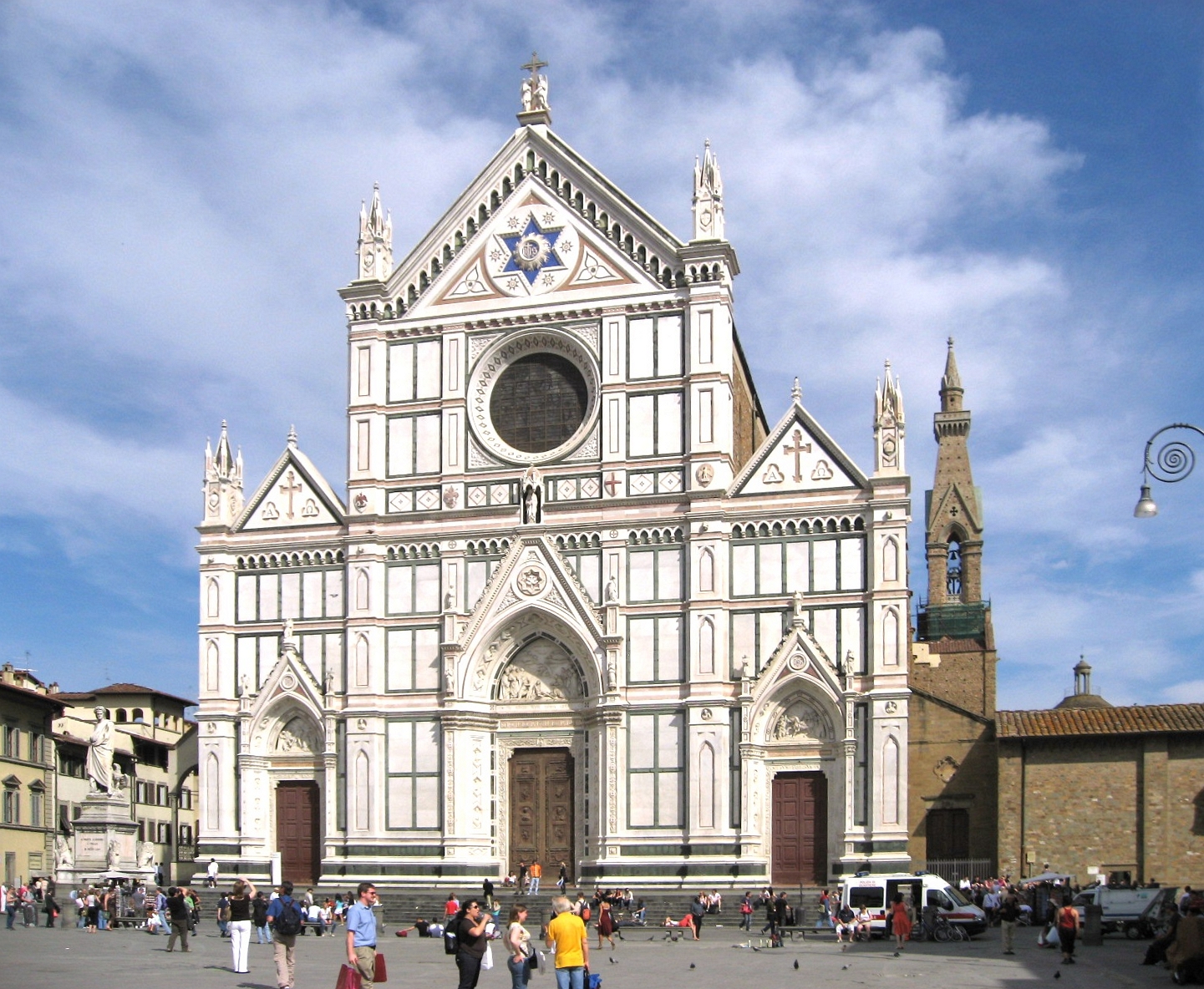
I've booked in at my customary lodgings, the Hotel Plaza Lucchesi: suffice to say I have my own balcony overlooking Santa Croce.  Why stay anywhere else?  (I'll sound like Fr Z, but the complimentary breakfast alone has three courses, with liveried waiters.)

After a good soaking bath to revive my drooping spirits, I set off around Florence for a good walk. 

First, I found what I'd missed last time: the Florentine Oratory, the Church of St Philip Neri (originally, the Church of San Firenze, an early eponymous bishop of the city).  Good Philip remains solicitous for me, his unworthy client.  The church has six side altars (one of St Philip, with painting thereof), a high altar (with the Bambino Gesu enthroned above the tabernacle, it being Christmastide), and a new and actually very appropriately furnished forward altar and sanctuary furniture.

It was providential that Thursday Sext contained the very words used in praying him since his death: "Look down from heaven and see, and visit this vineyard, and perfect the same which thy right hand hath planted" (quoted in Latin on the ceiling also, under the painting of him in ecstasy, with the quotation from Acts - Spiritus Domini rapuit Philippum).  A sign pointed into a side chamber for the Presepe (praesepio, crib): a whole altar (of the Sacred Heart) had been covered over with a huge representation of the Nativity scene, complete with running water and all.

In the side chamber was also the tomb of Pietro Bini, a Florentine and early follower of St Philip, who returning to their native city established the Oratory in Florence; he died a most holy death in 1635.

I didn't go far before I found myself at the Divine Liturgy (see last post below)... thank you, St Philip!

In the evening, I just wandered about entranced by the beauty of this Flourishing city, having a mild case of Stedhal syndrome (the palpitations and even psychosis engendered in visitors overcome by the concentration of art in Florence: the local mental hospital treats cases every year).

Again, I'll do a Fr Z and mention two nice comestibles: hot roasted chestnuts still in their shells bought off a street vendor; great big hot waffles stuck together into a prodigious sandwich with lashings of warm chocolate sauce - the latter of which I ate at the steps of the Duomo, at the foot of its facade, facing the Baptistery.

Florentia, civitas Christi Regis, floresce semper!

Christmas in Florence

Not only have I kept Epiphany twice (in Oxford and Edinburgh), but yesterday I celebrated Christmas again, courtesy of the Ukrainian Catholic community here in Florence!

I was simply looking for Vivoli Gelateria, and on a whim turned up a side alley, ending up at a church which I decided to investigate (I missed and walked right past the gelateria, which I later found to be closed at this season anyway) - when I came in to SS Simon and Jude, I found myself in a packed congregation, all standing, and the priest facing east at the altar, about to start the Insistent Litany after the Gospel (which I recognized by the threefold Gospodi pomilui - "Lord, have mercy").

Thanks be to God, I have sufficient familiarity with the Liturgy of St John Chrysostom, albeit not with Ukrainian, that I was able to pray the Mass.  I must admit, the Byzantine Rite leaves the West for dead (and I'd been at a lovely Missa Cantata for the Epiphany the night before!): the beautiful singing, the sweeping sacred Action, carries one along into the heavenly places.

(As a friend once put it, the Roman Mass, solemn and sober, is precisely ordered and structured, able to be analysed into successive parts, expressive of the Western discursive mind; the Byzantine Divine Liturgy rather is all one great unfolding irruption of the Sacred, a form of contemplation rather than of meditation if you will.)

BTW, it was evident this was a Catholic not an Orthodox service, since the congregants nearly all knelt for the Sanctus and Consecration (not for the Epiclesis), and again at the Sancta Sanctis and response - "One is Holy, One is Lord: Jesus Christ, in the glory of God the Father".

Only a minority (the more fervent one assumes, standing up the front) communicated, and late that I was and not quite certain in myself, I refrained.  But to-day at 2.30 pm there will be Divine Liturgy for the Synaxis of the Soprasanta Theotokos, so I've been to confession at the Duomo and will keep a third feast, of Mary the Mother of God (whose memory the West keeps on the Octave Day of Christmas as its liturgy old and new indicates, whatever of the Circumcision), for the second time!

Tuesday, December 1, 2009

Finalizing Holiday Plans

Persevering readers of this blog (if there are any) will know that I am heading to England, Scotland and Italy for a holiday at the very end of this year and the start of next - which is quite typical of me, being so contrary as to head to the far north in mid-winter! I know Traddies like to be climate change deniers out of a general sense of contrariety, but I for one wouldn't mind some warming coming up very soon...

While I have to sort out the English leg of my holiday, it will be spent in London and Oxford; but for the benefit of my Scottish contacts, my very distant relatives, I can confirm that I'll fly up to Edinburgh on Monday the 4th of January, and stay in the Athens of the North over three nights, before departing for Florence on Thursday: so I'll keep Epiphany in Scotland.

Firenze - città bellissima! I can't wait to get back there - I'll stay at my usual hotel on the banks of the Arno for two nights, and then take the train to Rome on the morning of Saturday January 9th. The local Carmelites tell me I simply must make it to the shrine of one of their incorruptibles, St Teresa Margaret of the Sacred Heart, of their Order...

Once in the Eternal City, I will catch up with several other Aussies, and we should have a pleasant time, hopefully at last including a day-trip to Assisi, before I have to leave for Australia on Thursday the 14th: I will have the weekend in Melbourne before finally getting home on Sunday afternoon.

Burns reminds me that best-laid plans gang aft agley... I trust the Lord will preserve and guide me, as He ever has.

Saturday, September 19, 2009

San Marco

I cannot believe that I forgot to mention earlier my visit to San Marco - it was ineffable. (I think it being the last thing I did before catching the train back to Rome may explain my oversight.)
What an indescribable experience, to stand awed before so much truly great art, and greatest because so faithful in witnessing to the truth about our Incarnate God.
I had to remind myself that these were the originals! Amazing.
Fra Angelico is indeed a pictor angelicus, and blessed, for his art seems to lift the mind to contemplation in a wonderful fashion. While that holy friar (Bl John of Fiesole, whose tomb at the Minerva I visited last week) was not beatified for his art, but for the heroic witness of his life adorned by a miracle, it could be said that the unique quality of his art as an aid to prayer is itself a moral miracle, wrought through him by the Lord: for Christ is the supreme Artist.
I must say I was, if not in heaven, at least lifted to contemplation by beholding such staggeringly lovely works of art, through which beauty, truth and holiness shine forth. The many images of Our Lord crucified moved me to compunction - I had to strike my breast in sorrow and confusion, as the crowds did that first Good Friday.
The only blot on my visit to San Marco was to overhear yet another loud, rude, ignorant, judgemental, self-satisfied (and, yes, American) tourist, who commented excessively loudly to her friend about Savonarola (whose cells we were viewing): "Well, I guess he just didn't know the meaning of 'All things in moderation'". Her smugly complacent words made me boil with anger - I almost turned and told her off for being a stupid cow. Mea culpa?

Thursday, September 17, 2009

Grumpy Train

Some Japanese were in my seat on the (crowded) train from Florence back to Rome. Their solicitous tour guide explained they were honeymooners and could not be separated. To the amusement of English-speakers aboard, I observed testily that no doubt they would soon not be separated...
The tour guide perforce gave me her seat, and with frustration and irritation I said Sumimasen to her with as much sarcasm as I could muster. I think this was rather rude of me in retrospect.

Santa Maria de Fiore

Holy Mary of the Flower - that is, Christ - is the beautifully named and superlatively beautiful Duomo, that is, cathedral, of Florence. As the guide pamphlet pointed out, Duomo comes from domus, "house" - it is the House of God and His people, a house of prayer for all the nations. I was delighted to note on the leaflet that there is in this archdiocese an office for "catechesis through art": beauty is truth, truth beauty...
There must be a real effort being made to revive religion: here is the schedule of devotions there:

Ferias


  • Masses at 7.30, 8.30, 9.30 (concelebrated by the Chapter of canons), 10.30 and 11.30 am (the last two in the Baptistery), and at 6 pm;

  • Office of Readings and Lauds (celebrated by the Chapter - imagine that in Australia!) at 8 am;

  • Confessions 9 am to 12 noon, and 4-6.30 pm daily (in four or more languages);

  • Rosary (or Vespers on feasts of Our Lord and His Mother) at 5.30 pm.

Sundays and Holy Days of Obligation


  • Masses at 7.30, 9 and 10.30 am (in Latin with Gregorian chant, concelebrated by the Cathedral Chapter), at 12 noon and at 6 pm;

  • Lauds at 10 am (very civilized);

  • Vespers (in Gregorian chant) at 5.30 pm;

  • Confessions as above.

It turned out to be very useful to carry a Breviary, since it proved I was a bona fide Catholic and not a godless tourist, thus allowing me to gain access in all churches to the large parts roped off for prayer. This began at the Duomo, which I then left in order to visit and pray in many other sanctuaries.

******

At last I found a church (I forget the name) where St Philip appeared shyly in the corner of a painting above a side altar, and later saw an outdoor image of the Blessed Virgin with him at her feet (in memory of a former Oratory on that site).

******

In San Lorenzo, I found the sacred relics of Bl Niels Stensen (1638-1686), a famously learned Danish doctor who came to Tuscany and converted to the Catholic faith, moved by the witness of a Corpus Christi procession (let Modernists take note!). He gradually put aside his scientific researches, and ended up a priest, then a bishop, who laboured in northern Germany, aiding Catholics and converting Protestants. The Grand Duke of Tuscany had his former court physician brought back to Florence for burial; he was beatified in 1988.
May he intercede for Christian unity, and in particular for Lutherans and ex-Lutherans!

******

At St Remigius, I found the venerated habit and cord of St Pio of Pietrelcina exposed for veneration - excellent.

******

Then, off, all too soon, back to Rome...

Wednesday Dawn in Florence

I arose mightily early that I might attend the "Lauds" as sung by the Monastic Communities of Jerusalem in their Florentine church:

  • Psalm 99 with Ps 94:1 as antiphon;
  • Psalms 24 and 7;
  • Canticle from the Old Testament (Osee vi, 1-6);
  • Psalmus laudativus (Ps 145);
  • Lesson - a Patristic reading, which I seemed to hear attributed to James (?) in the 2nd century (?);
  • Alleluia and verse;
  • Gospel (St Luke vii, 31-35), read by one of their priests;
  • Benedictus;
  • Trisagion with verse and doxology (Byzantine style, as at their Vespers);
  • Lord's Prayer;
  • Collect;
  • "Let us bless the Lord".

An interesting experiment. Unlike last night, I wasn't in good enough voice at such an early hour to join in the singing.

I returned to my hotel for a prodigious breakfast of several courses - pastries, fruits, sausage, bacon and eggs, the works - since, after all, one must get one's money's worth...

Going for a walk afterward, still before 9 am, I found the nearby Oratorio di Santa Maria delle Grazie open, and the candle stands already well filled with big tapers burning in honour of the Madonna e Bambino Gesù (imaged in an icon of 1313, by the anonymous Maestro di S. Cecilia). It was a holy place in which to pray Lauds cum Ecclesia, and meditate on the Incarnation.

I crossed the Ponte Vecchio as one does, bought some gelati and returned to the north bank of the Arno...

Vespers? Vespers! Vespers - II

Sorry, gentle readers, about the break in transmission...

******

Finally, after exploring Florence for some hours, I came to enter the great Baptistery. What a magnificent ceiling, in Byzantine mosaic, effulgent with gold, with Christos Pantokrator enthroned amid the choirs of angels!
Over opposite the Baptistery altar - where there is Mass twice daily, by the way - there is the famous font, where so many Florentines have received the sacred laver of regeneration. There, St Philip Neri received the spark of divine grace, that, by his remaining ever faithful to which, flowered into everlasting glory. All his particular graces - even the miraculous dilation of his heart by the Holy Ghost - were as nothing compared to this sacramental elevation that made his soul capax Dei.
Holy Baptism is never sufficiently to be praised. The Universal Call to Holiness consists in our fidelity to this saving grace given by our new birth from the font. If, unlike St Philip, we have not preserved our baptismal innocence, we can at least take his urgent advice and frequent the confessional, which is the "second plank after shipwreck", clinging to which we can be rescued from the lamentable ruin of sin.
******
The Duomo was closed to tourists by this hour, but I gained admittance by asking to attend Vespri (as was advertised). Vespers? No, not on a feria after all, but instead there was Rosario in Italiano - I just gave the responses in Latin. (Despite my advertisement of it, I don't say it nearly enough.)
******
On to Vespers! At the Badia Fiorentina - where the "Monastic Communities of Jerusalem", one of those new religious movements, has its house here in Florence - there was Vespers at six, to be followed by Mass.
Vespers turned out to be sui generis: there were twenty of the monks and nuns present (the two live separately but worship together), with many laity also. Vespers were sung (but for the reading) in four-part harmony, all in Italian but for one item. The order of service was as follows:
  • "God, come to my aid" and Glory Be with Alleluia;
  • Hymn to the Holy Spirit;
  • Verses proper to the feast, with the first stanza of the Stabat Mater (in Latin) as an antiphon;
  • Lucernarium (Ps 140:1-2) *, during which a monk censed the altar and people;
  • Phos hilaron (that very ancient evening hymn), during which a nun lit the altar candles;
  • Psalms 29 and 42;
  • Canticle from the Old Testament (Isaias liv, 11-15. 17);
  • Canticle from the New Testament (Apoc. iv, 11 & v, 9b-10. 12b);
  • Lesson - which to my ears sounded awfully like an extract from the Lamentation of the Theotokos by St Romanos the Melodist! - then organ music;
  • Intercessions with response;
  • Trisagion ("Holy God, Holy Mighty, Holy Immortal, have mercy on us"), sung thrice, with doxology, in Byzantine style, making a metanoia (bowing and touching the ground before crossing oneself) each time.
As can be seen, the Communities seem to have drawn on Ambrosian (*) and Byzantine sources for their liturgy.
Then it was time for Mass....
The celebrant, I was surprised to find, was the Archbishop of Florence. One of the communities' priests was principal concelebrant; the other four only joined them at the altar for the Eucharistic Prayer. Most of the service (unlike their Vespers) was not sung: however, the Kyrie, Responsorial Psalm, Alleluia, Gospel responses, Sanctus, Memorial Acclamation, Agnus Dei, Communion hymn, and a final Magnificat afterward (normally sung at the end of Vespers, with a Pater noster and Collect?) were.
The ritual seemed Catholic but a bit eccentric - if they have permissions for these oddities, well and good, they seemed pious, but I wonder...
For example, not the Archbishop, but one of the monks (standing in front of the altar) censed the oblations while His Grace offered them at the Offertory, and one of the nuns had previously led the offertory procession with a lighted candle, which she placed on the altar (a Sanctus candle?!). While in Italy it is the custom to kneel just for the Epiclesis and Consecration and Elevations, the monks and nuns merely bowed most devoutly and deeply. Come the sign of peace, they floated very piously through the church, bringing silent greetings to all of us! For Communion, they filed into the sanctuary, to receive at the same time as the Archbishop and priests (this was misguided, I believe, since there is an hierarchical order to be observed: as the ancient Mozarabic Rite had it, Accedite locis vestris - "Approach your [respective] places").
In any case, it was good to receive the Pontifical Blessing after my second Communion of the day.
Then, I read proper 1962 Vespers ad mentem Summi Pontificis.
******
Dinner (€20) was mixed antipasti, then bistecca fiorentina (what else would one eat?) and biscotti with vin santo. Very good.
I took a stroll around the city in the evening, then back to my hotel for a real long soak in the bathtub for my tired feet - luxury!

Wednesday, September 16, 2009

Vespers? Vespers! Vespers

Well, I've made it, and I do like Florence... it's on a more human scale than great Rome, and frankly a lot cleaner; even the grimy bits are less befouled, whereas Rome could do with an almighty scrub. Here in Firenze you hear a terrible lot of English in the streets (I try and speak the most basic Italian, but a lot of guess which nationality don't seem to bother) - around here is not called Chianti-shire for nothing.

I almost didn't make it to the train: having arisen early, and got to St Peter's for 7 am Mass, I had to hunt for Fr Withoos and all his Aussie hangers-on, who turned out to have been shunted over to the altar of the Navicella of St Peter, where the confessionals are. What a blessing, though, to have the Traditional (oops, almost wrote "real") Mass in the Vatican Basilica. The altarpiece being of the Apostles' boat tossed by the waves, and Christ rescuing Peter when his courage failed him when attempting to walk on water, as part of my prayer afterward I prayed Salva nos, Domine, perimus (Save us, Lord, we are perishing) and the Collect of the Votive Mass of SS Peter and Paul.

After the tremendous Oblation, I had the chance to visit the last of the altars in St Peter's that I hadn't reached previously, thereby coming to the relics of SS Processus and Martinian, the gaolers and converts of the Prince of the Apostles. The others were off to breakfast, but I had to hie me back to the hotel, bolt down my own continental breakfast there (curiously, the Italians call it an American breakfast!), then rush off to Ottaviani station (dragging my baggage), and over to Termini to catch the 9 am Express train to Florence.

Once settled on board (I took the wrong seat by mistake), I read over my mini-guide to Florence, had a coffee at the bar, then read Matins (the first two Nocturns). Very strangely, the Psalms at Matins of the Sorrows of the Blessed Virgin are all out of numerical order - they run in order in every other case I can think of, just as at all the other Hours except Lauds - and I must note that Nova et Vetera has another misprint, this time in the eighth Matins responsory.

What a pity, by the way, that Italy is "united" and the Grand Duchy of Tuscany is no more! I would have loved getting that stamp in my passport. Of course, as a pupil of St Philip I should long rather for the Republic of Florence (not that it treated Dante, say, or Savonarola terribly well); indeed, being of nostalgic mind I would that it were still Etruria of old, with Etruscan spoken - however, Florentia was a Roman colony, so I suppose I oughtn't wish her away...

We pulled in to Florence in good time, and a quick taxi ride later I was at my (very swish) hotel: I'm glad to have splurged on this part of my trip. Having signed in, I went for a walk about, and first to Santa Croce.

In the catastrophic flood of November 1966, the Arno burst its banks and ruined Florence: worst of all in a sense was the damage done at Santa Croce, where the Conventual Franciscans had only recently moved all their priceless artworks into a new museum, right at the lowest point on their property. It made me cry, I'm not ashamed to admit, to see Cimabue's ineffable Crucifixion, now restored as best several decades' work can do, but still parlously damaged. However, even thus, it is transcendently lovely: not all tears are in sorrow.

It took my breath away to see frescoes by Giotto, and fabulous mediaeval altarpieces. (But first, I finished off my morning Office.) I also venerated the sacred relics of Blessed Humiliana, praying her for myself and for Fr Terence (since the church belongs to his order).

On I went at last, and had some superlative gelati - excuse the Fr Z riff - of mulberry, cherry, bitter orange and rice pudding (!) flavours.

I found the Badia Fiorentina is now a centre of worship for a new community (the Monastic Communities of Jerusalem, to be precise), so before the Blessed Sacrament exposed I prayed some more. Ad te, Domine, animam meam levavi...

Then to my joy the Orsanmichele is open again, so I could go pray the Madonna delle Grazie: beauty and truth have met in her.

I saw the famous statuary outside the Signoria, then went back to my hotel for a rest...

This afternoon and evening, I visited San Carlo de' Lombardi, where also I found Exposition - I think Florence is having a religious revival of sorts - and S. Maria de' Ricci, built in expiation of a mediaeval sacrilege (a nobleman defaced Our Lady's image, but repented, just before he was justly hanged) and site of a more recent sacrilege and miracle (a vandalized crucifix shewed a sudden wondrous transformation of its face into a verisimilitude of the Man of Sorrows).

[I'm running out of time, and may have to publish this now.]
To be continued...

Tuesday, September 15, 2009

Florence

To-day, all being well, I'll train from Rome up to Florence, and stay the night in what should be pretty nice digs next to Santa Croce - which I have just discovered, such is my ignorance, to the largest Franciscan church on earth, and the burial place of Michelangelo, Galileo, and many other famous sons of Italy...


Ah, Firenze! Dear to me for two reasons: here, at San Marco (which pray God I'll visit), Fra Angelico painted his sacred art; and here St Philip Neri was born, baptized and raised. (Like all Florentines, he was immersed in the saving waters at the great baptistry of the cathedral.)

To-day is also the feast of the Seven Sorrows of the Blessed Virgin, sharing the voluntary, salvific sufferings of her Divine Son. Stabat Mater Dolorosa...

Tuesday, June 16, 2009

To Rome - and Florence

I have decided that it really would be remiss of me to spend over a week in Rome, partly as a pilgrimage to the churches associated with St Philip Neri, and not at least take a side trip to Florence - where he was born, where he was baptized (at the Duomo, surely), where he was schooled (at the famous Dominican Convent of San Marco, illuminated by the sacred art of Bl Fra Angelico) - and also stop by the headquarters of the ICKSP, at Gricigliano...

(That well-known traveller, my former parish priest, Fr Rowe, visited there with parishioners, and all found it a blessed experience as I recall.  As for myself, my only encounter with the Institute of Christ the King, Sovereign Priest is that one of their priests was in attendance at Juventutem during World Youth Day in Sydney - one year ago - and heard my confession.)

Again, any advice on travel to and around Rome - and Florence - in early to mid-September would be most appreciated...