Showing posts with label liturgical year. Show all posts

Friday, February 2, 2018

Candlemas: End - and Beginning - of the Liturgical Year

Just as, sixty-three days before Easter, Septuagesima Sunday, in its lessons at Matins, begins the liturgical year with the account of the Creation in the first chapter of Genesis, and the Magnificat antiphon at first Vespers warning Adam of death should he eat the forbidden fruit, so too Candlemas concludes the liturgical year, forty days after Christmas, with its solemn celebration of the entry of the Incarnate Word into his Father's Temple, showing forth under a shadow the eternal nuptials of the Lamb and his Bride, all redeemed humanity, world without end.

The fact that Candlemas is a fixed feast, recurring every year on the 2nd of February, signifies the eternal and everlasting truth of the life of the world to come; the truth that the date of Septuagesima varies from year to year, falling on a Sunday between the 18th of January and the 22nd of February, signifies the ontologically contingent facts of the Creation and Fall, which led – O happy fault! – to the redemption of the world by our Emmanuel, and his victory over sin and death, celebrated especially during the Paschal Triduum.

Septuagesima may fall before Candlemas, or after it, or may even displace it to the Monday – but the blessing of and procession with candles falls always on the 2nd of February. The liturgical cycle may end before its next beginning, or after it begins again, signifying that the perfect consummation of all things has not yet come. Even if, in the most complete manner possible in this life, Septuagesima falls on the day after Candlemas (when Easter falls on the 6th of April, as last in 1980 and next in 2042) yet still the second Vespers of the latter overlap with the first of the latter (first Vespers of Septuagesima being commemorated after the Collect of Candlemas, and followed by the farewell to the Alleluia made at the Benedicamus Domino).

(When Septuagesima Sunday thus falls on the 3rd of February, presumably the blessing of throats at the intercession of St Blaise takes place after Septuagesima Sunday Mass.)

The processional antiphon Adorna thalamum tuum well sums up the eschatological quality of today's feast:
Adorna thalamum tuum, Sion, et suscipe Regem Christum: amplectere Mariam, quæ est cælestis porta: ipsa enim portat Regem gloriæ novi luminis: subsistit Virgo, adducens manibus Filium ante luciferum genitum: quem accipiens Simeon in ulnas suas, prædicavit populis, Dominum eum esse vitæ et mortis, et Salvatorem mundi. 
(Sion, adorn your bridal chamber and welcome Christ the King; take Mary in your arms, who is the gate of heaven, for she herself is carrying the King of glory and new light. A Virgin she remains, though bringing in her hands the Son before the morning star begotten, whom Simeon, taking in his arms, announced to the people as the Lord of life and death and Saviour of the world.)

Sunday, December 1, 2013

First Day of Summer, First Day of the New Year of Grace

A glorious first day of summer in Hobart: after our sung Latin Mass at St Canice for the first Sunday of Advent, we gathered outside for lunch and a meeting, in order to plan for the future of our Latin Mass Community, in response to His Grace's instructions to do so. A committee was formed, and, God willing, arrangements will be made to organise more Latin Masses in the future.

There was a good attendance at our Missa cantata, the servers and I did our best, and the choir sang well: I was especially taken with their rendering of Veni, veni, Emmanuel at the Offertory and the Advent Prose Rorate cæli desuper at Communion.

Of your charity, please pray that, as our limited resources may allow, we may give greater glory to God by our liturgical worship and by our evangelical witness to Christ and His Church, that more and more may come to love and serve the Lord.

Saturday, January 30, 2010

Eve of Septuagesima: Farewell Alleluia: New Year of Grace

Pius Parsch once cogently argued that the Liturgical Year - the Church's Year of Grace - doesn't begin with Advent Sunday, but with Septuagesima Sunday!

For at Septuagesima, the Matins Lesson begin "In the beginning...", with Genesis chapter one, verse one.  The sober liturgy proceeds through the account of Man's Creation and Fall, and then through the Patriarchs and God's continual call of them back from doom to salvation - at Sexagesima, Noë and the Flood; at Quinquagesima, the call of Abraham.

(The Mozarabic Liturgy for Lent similarly proceeds through the Books of Moses and those of the Kings, but on a much more fulsome scale, with long readings even at the Little Hours, concluding with the Fall of Jerusalem, symbolic of Israel's persistent and final failure to keep the Law, of the ultimate frustration of the Old Testament without the grace of the New.  But even then, the Return from Exile in Babylon, and the comforting words of the prophets, foretell the Messianic Age when all Israel shall be saved.)

We cannot begin the New Year of Grace, without remembering how for Man it all started so well, and so quickly went so bad - we cannot begin the New Year of Grace without in sombre recollection thinking on our own sin.  We spend the time from now through till Easter turned toward the Lord, conscious of our need and insufficiency, conscious of His mercy and His making speed to save us.

We do not so much put away Alleluia for a time, as begin the Year with it - at first Vespers of Septuagesima (once at the start, and four times at the end with the Benedicamus Domino otherwise special to Paschaltide), signifying that "In the beginning" Man and all that God created was "very good" (as in the Dominican Office the special Responsory at first Vespers tells) - then immediately leave it aside (symbolizing the Fall and the consequent captivity of all men under sin) till Christ by His Victory, bursting forth from the tomb on Easter morn, restores all things in Himself, making all things new.

"Alleluia, our transgressions / Make us for a while give o'er..."

The mediævals called this the Depositio Alleluia, the burial, even of the Alleluia - for as Adam sinned and died and was buried, so the heavenly song of original justice must be laid aside.  (Some local ceremonies of old time for this involved writing Alleluia on parchment, and actually burying it!)

At Easter, all that had been foreshadowed is accomplished: "freed from Pharaoh's bitter yoke, Jacob's sons and daughters" - by the new Moses, Our Saviour, Who leads us through the waters of Baptism.  With Him as Shepherd and Guide, we set forth for the Promised Land...

We celebrate for fifty days the glory of the Resurrection, which is our resurrection, laying hold on it by grace - for Christ stretches forth His hand to draw us also, like Lazarus, from the tomb.

Pentecost is the Gift of the Spirit, completing the Paschal Mystery; after Pentecost, we live through the Ages of the Church; Advent is the season of looking forward to the Return of Christ; at Christmas and Epiphany, we ought not so much indulge in mawkish fawning upon "the Little Boy Jesus / Asleep on the hay" as see in Him our Goal, as see these feasts as prefigurations of the glory that is to come, that in Heaven we shall be united forever with the Lamb of God, "casting down [our] golden crowns" before Him.

The conclusion of the Liturgical Year, then, is not Stir-up Sunday, nor Christ the King (for, He reigns now, as He has for all ages as God, and as Incarnate Deity enthroned above since His Ascension, His return back to His Father in robes of glory, His Sacred Humanity: Christ the King ought not be an eschatological safe dream, but our motto for life in this age - Viva Cristo Rey!).

The End of the Liturgical Year is Candlemas, the Meeting with Christ in the Temple - when we too, as Simeon, can say Nunc dimittis.

How happy it is that Candlemas and Septuagesima Sunday so often overlap, as they do this year (2nd February and 31st January) - the Liturgical Year is the image, repeated for our edification and sanctification, until the Lord completes the cycle in us by our death, and in the Church by His Return in glory.  When we are judged, though like Adam, and ancient Israel, and the new Israel, the Church in her members, we will admit many falls and backslidings, may we in our own persons attest that God's grace is stronger than human weakness: "And all things shall be well, and all manner of things shall be well."

(Need I add that for sundry reasons, it seemed good and fitting to go to confession and disburden myself this morning?)

Thursday, June 25, 2009

Half-way to Christmas

Somewhere Pius Parsch put it that we could think of the Liturgical Year as beginning at Septuagesima (when the Breviary begins at the beginning, with Genesis chapter i), and coming to its end with Advent (presaging the final Coming of the Lord) and then, at Christmastide through to Epiphanytide and Candlemas, delighting now in what will happen at the consummation of all the ages - the Lord having come, God and His people will be united forever, at the Nuptial Feast of the Lamb.  With this in mind, the 25th of June marks half-way to Christmas, when we celebrate not just the historical birth of Christ in Bethlehem of Judæa, but His eternal begetting by the Father, and His future return to abide in our midst evermore as our King.  

The time after Pentecost is the time of the Church, the Body of Christ on earth, the Kingdom in germ, His Immaculate Bride, given life by the promised Holy Spirit.  Therefore, quite rightly is this season illuminated by two principal celebrations: the ever-present power of the Crucified and Risen One, which is our focus every Sunday, the Lord's Day; and the ever-present power of the same Crucified and Risen One, which is our focus every Saint's Day, for then we delight in the triumph of His grace in a chosen soul, a true Christian, since Christianos means "one belonging to Christ".  What eternal Victory each Sunday shews us in the Saint of Saints, the selfsame victory achieved in the life of one baptized we see in each Saint whose anniversary we recall.  This is why St Paul could say, "Be ye imitators of me, as I am of Christ" (I Cor. xi, 1) - and the Church, guided by the Spirit into all truth, has feast by feast various Saints say the same to us would-be Christians: Imitate me, as I imitated Christ, and won the immarcescible crown.

Yesterday, and even the day before that, on the Vigil, we had the superlative witness of St John Baptist to behold, that as he told us and all men, Behold the Lamb of God, so too we should turn to Christ.  Heeding His Herald's wonderful humility we should - as is most just - cry out with St John, He must increase, I must decrease.  Not for nothing does the New Testament make so much of the Forerunner of the Lord; his example is peerless.  

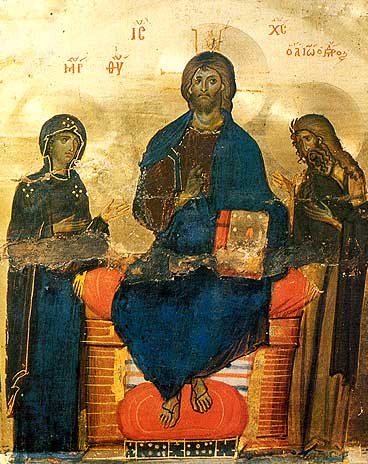
Byzantine iconography, in the type of image called the Deësis ("supplication"), loves to portray Christ, on His throne as our coming Judge, attended by the Virgin and the Baptist, both of whom are pleading with Him on our behalf.  


The Holy Roman Church likewise puts great emphasis on the Baptist's prayers - at Mass, he is named in the Confiteor, the Suscipe Sancta Trinitas, the Nobis quoque peccatoribus of the Canon, and the Last Gospel, while his words of witness to the Lamb of God are repeated in the Gloria in excelsis, the Agnus Dei, and the Ecce Agnus Dei.  Holy Mother Church prays in the Vigil Collect that, walking in the way of salvation, following John's exhortation, we may come safely unto Christ; she prays in the Vigil Postcommunion - just as Byzantine art depicts - that his potent prayer obtain for us the mercy of the Lord Whose coming he foretells; and all the orations of the Day Mass say much the same and more.

To-day the Traditional Rite places St William (Guglielmo) of Vercelli, Abbot of Monte Vergine, before us; a monastic founder of long ago... perhaps in our unmonastic age it is not for nothing that we should recall a monk, that is, one who is monachos, one alone with the Alone, seeking after the one thing necessary, the One Who alone is necessary.  His collect, which I have been mulling over this day, actually inspired these thoughts and this post:

Deus, qui infirmitate nostræ ad terendam salutis viam in sanctis tuis exemplum et præsidium collocasti: da nobis, ita beati Gulielmi Abbatis merita venerari, ut ejusdem excipiamus suffragia, et vestigia prosequamur.  Per...

(God, Who hast set in Thy Saints an example and defence for our infirmity, to smooth the path of salvation, grant unto us so to revere the merits of blessed Abbot William, that we may obtain the suffrages, and follow after the steps of the same.  Through Our Lord Jesus Christ, Thy Son, Who with Thee liveth and reigneth in the unity of the Holy Ghost, God, world without end.  Amen.)

I deliberately give the full ending of the Collect, because it reminds us that whatever example, whatever deserts, whatever prayers, whatever benefits soever, all are of avail and are inspired and are empowered and are granted only in and through and by Our Saviour, Who with His Father and the Holy Spirit is One God in perfect Trinity, evermore.

Wednesday, June 10, 2009

Vale, Semester Domini

Over at Pastor Weedon's blog (salutations! I haven't read any comments of yours at Schütz's blog for a while, alas), he mentioned how the festival half of the year, what he termed the Semester Domini, "the Lord's Half", is almost over - Advent, Christmastide, Septuagesimatide, Lent, Passiontide, Eastertide, Ascensiontide, Whitsuntide: all the great seasons recapitulating all the Lord has done for us in the Economy of Salvation, the magnalia Dei.  Now, I might add, Corpus Christi and the Sacred Heart are the last movable feasts still remaining before we move into the long season "after Pentecost", or as the Sarum Rite, and Anglicans and Lutherans and Dominicans (used) to call it, "after Trinity", what the modern Latin terms tempus per annum, what is described as the green season...

I am reminded of two items, one a children's hymn, one a poem - first, the hymn (written by Katherine Hankey in 1888), summarizing the Semester Domini:

Advent tells us Christ is near;
Christmas tells us Christ is here!
In Epiphany we trace
all the glory of his grace.

Those three Sundays before Lent
will prepare us to repent;
that in Lent we may begin
earnestly to mourn for sin.

Holy Week and Easter, then,
tell who died and rose agin;
O that happy Easter Day!
"Christ is risen indeed," we say.

Yes, and Christ ascended, too,
to prepare a place for you;
so, we give him special praise,
after those great Forty Days.

Then, he sent the Holy Ghost,
on the Day of Pentecost,
with us ever to abide;
well may we keep Whitsuntide!

Last of all, we humbly sing
glory to our God and King,
glory to the One in Three,
on the Feast of Trinity.

But now we move into what is described in John Meade Falkner's 1910 poem, "After Trinity":

We have done with dogma and divinity,
Easter and Whitsun past,
The long, long Sundays after Trinity
Are with us at last;
The passionless Sundays after Trinity,
Neither feast-day nor fast.

Christmas comes with plenty,
Lent spreads out its pall,
But these are five and twenty,
The longest Sundays of all;
The placid Sundays after Trinity,
Wheat-harvest, fruit-harvest, Fall.

Spring with its burst is over,
Summer has had its day,
The scented grasses and clover
Are cut, and dried into hay;
The singing-birds are silent,
And the swallows flown away.

Post pugnam pausa fiet;
Lord, we have made our choice;
In the stillness of autumn quiet,
We have heard the still, small voice.
We have sung Oh where shall Wisdom?
Thick paper, folio, Boyce.

Let it not all be sadness,
Not omnia vanitas,
Stir up a little gladness
To lighten the Tibi cras;
Send us that little summer,
That comes with Martinmas.

When still the cloudlet dapples
The windless cobalt blue,
And the scent of gathered apples
Fills all the store-rooms through,
The gossamer silvers the bramble,
The lawns are gemmed with dew.

An end of tombstone Latinity,
Stir up sober mirth,
Twenty-fifth after Trinity,
Kneel with the listening earth,
Behind the Advent trumpets
They are singing Emmanuel’s birth.

Saturday, November 29, 2008

Cool November; Another Year Over; St Saturnine

After my earlier fears of unpleasantly hot weather returning, for in the last part of October we had a heatwave with temperatures in the thirties five days running, November here in Perth has been pleasantly cool, with the hottest day so far - my birthday - a shade under 30°C, but quite comfortable as I recall, and the average for the month (23.5°C) several degrees cooler than usual.  This pleasant enough weather seems still to endure a while longer; while in Australia we generally count summer as starting on the 1st of December, I think that it may still be a little while till the really hot weather starts toward the second half of December - by which time I'll have moved back to Tasmania...

And in ecclesiastical news, to-day, the feast of St Saturnine, is the last day of the Church's Year of Grace, which segues into the first with Vespers of Advent Sunday to-night, which by God's grace I hope to sing.  My Advent plan this new year is to attend daily Mass (this will reaccustom me to the Novus Ordo, BTW).

Here is his short, straightforward and simple collect:

Deus, qui nos beati Saturnini Martyris tui concedis natalitio perfrui; ejus nos tribue meritis adjuvari.  Per...

(God, Who dost permit us to rejoice on the natal day of blessed Saturnine Thy Martyr, grant that we be aided by his merits.  Through...)

May we indeed rejoice at the triumph of this stedfast witness to Christ over the world, the flesh and the devil, and may his merits truly obtain for us assistance from the Lord, Who delights to work through secondary causes so as to work His works in us: for St Saturnine's "just deserts", far from being unspeakable torments as his evil tormentors thought and wrought, are those things he has deserved of God Himself for what he accomplished not of himself but of Him who strengthened him - supernatural rewards and benefits, not merely for himself, who won the everlasting crown of victory and rejoices and reigns evermore with God and His saints in heaven, but also for the whole Church militant, that we may not only profit by his example, but in the communion of saints all share in the graces won by this preëminent member of the Mystical Body.

But what of St Saturnine?  There are several of this name, such as the martyr-bishop of Toulouse (whose memory is also kept this day), or again the companion of SS Perpetua and Felicity; but the one commemorated in the Roman Mass is he that was a martyr at Rome, as the Golden Legend tells:

There was another Saturnine whom the provost of Rome held long in prison, and after, he raised him in the torment named Eculee [eculeus, the rack], and did do beat him with sinews, rods, and scorpions, and after, did do burn his sides, and then took him down and smote off his head, about the year of our Lord two hundred and ninety under Maximian.

The 2004 Martyrologium Romanum gives the following details about our saint:

Romæ in cœmeterio Trasonis via Salaria Nova, sancti Saturnini Carthaginensis, martyris, qui, ut sanctus Damasus papa refert, sub Decio imperatore pro Christo in patria in eculeo impositus est et Romam extorris missus, ubi, aliis atrocibus tormentis superatis, Gratianum tyrannum ad fidem convertit et capite obtruncato coronam martyrii adeptus est.

(At Rome, in the cemetery of Traso on the New Salarian  Way, [commemoration] of St Saturnine of Carthage, martyr, who, as Pope St Damasus tells, under the Emperor Decius for Christ in his fatherland [Carthage] was laid upon the rack and was sent, exiled, to Rome, where, triumphing over other atrocious torments, converted the tyrant Gratian to the Faith and by the chopping off his head won the martyr's crown. [c.250])

It also tells us of Saint-Saturnin, or Saint-Sernin, noble episcopal martyr of Toulouse:

Tolosæ in Gallia Narbonensi, commemoratio sancti Saturnini, episcopi et martyris, qui, ut fertur, ejusdem Decii temporibus, in Capitolio hujus urbis a paganis tentus est et de summa arce per gradus præcipitatus, ut, capite colliso et toto corpore dilaniato, Christo animam redderet.

(At Toulouse in Narbonensine Gaul, the commemoration of St Saturnine, bishop and martyr, who, 'tis said, in the times of the same Decius, was tried by the pagans at the Capitol [temple of idols] of this city and was thrown down the steps from the high gate [?], that, his head crushed and whole body rent, unto Christ he rendered up his soul.  [c. 250])

The Golden Legend supplies a rather forceful account of his sufferings: "And they took Saturnine which would not do sacrifice... and drew him unto the highest place of the capitol and cast him down the degrees and steps to the ground, so that his head was all to-broken and the brain sprang out, and so he accomplished his martyrdom."  

The 1738 Paris Missal provides the following Collect in stead of that of St Saturnine the Roman Martyr, both containing several references to Scripture in typical eighteenth century Gallican style, and finely alluding to the unshakeable faith of the Tolosan bishop's soul, despite the outrages committed upon his body, cast down and destroyed:

Deus, qui per beatum Saturninum Martyrem tuum atque Pontificem, infideles populos de tenebris ad lucem veritatis venire tribuisti; da nobis ejus intercessione, in fide stabiles, et a spe Evangelii quod prædicavit, immobiles permanere.  Per...

(God, Who through blessed Saturnine Thy Martyr and Pontiff, *didst grant unbelieving peoples to come from darkness to the light of truth*': †grant unto us at his intercession, to remain stedfast in faith, and immovable in the hope of the Gospel which he preached†'.  Through...)

*–*'   Cf. many passages in the New Testament, such as Acts xxvi, 17b-18: "...the nations, unto which now I send thee: to open their eyes, that they may be converted from darkness to light, and from the power of Satan to God, that they may receive forgiveness of sins, and a lot among the saints...".

†–†'  Cf. Col. i, 23: "...continue in the faith, grounded and settled, and immoveable from the hope of the gospel which you have heard, which is preached in all the creation that is under heaven, whereof I Paul am made a minister".

The other saints of the 29th of November are:

  1. St Philomenus, martyr at Ancyra in Galatia during the persecution of Aurelian under Felix the governor, who was thrown into the fire, then had his hands, feet and finally head pierced with nails, in the 3rd century [not to be confused with Philomenus, saintly martyr of Lyons, nor with the famous Philomena, whose cult remains somewhat uncertain].
  2. At Todi in Umbria [famously, Tuderti is misread as "Too dirty in Umbria"], St Illuminata the virgin, in the 4th Century [not to be confused with the unsaintly Illuminati of course!].
  3. St James (or Jacob), Bishop of Sarug, at Batnan in Osrhoene, whose sermons, homilies and letters illustrated the pure faith of the Church and is revered among the Syrians, together with St Ephræm, as a doctor and pillar of the Church, in 521.
  4. At Daventry in Frisia, the translation of St Radbod, bishop of Utrecht [Ultrajectum - more or less literally, "Thrown Out"?!], who, a teacher and pious pastor, died whilst visiting rustics, in 917.
  5. At York in England, Bl Edward Burden, priest and martyr, alumnus of the English College at Rheims, who dared to return as a priest to the dominion of wicked Queen Elizabeth I, and consummated his sufferings on the gibbet before a furious crowd, in 1588.
  6. In the same place, eight years later, BB George Errington, William Gibson and William Knight, who, when they but defended those proscribed as priests, by various torments were given over to martyrdom, in 1596.
  7. In Aceh in the island of Sumatra, the blessed martyrs Denis of the Nativity (Peter) Berthelot, priest, and Redemptus of the Cross (Thomas) Rodriguez, religious, both of the Discalced Carmelites, who were first enslaved by Mahometans and then slain with arrows by the sea shore, in 1638.
  8. At Luceria in Apulia, St Francis Antony Fasani, a priest of the Conventual Franciscans, who, a man by exquisite doctrine, preaching and penitential practice greatly supported, so consoled the poor and needy that he never stopped even to give away his habit, and to offer Christian aid to everyone, in 1742.
  9. At the place called El Saler near Valencia in Spain, Bl Alaphrid Simon Colomina, Jesuit priest and martyr, who in the persecution of the Church confirmed his fidelity to the Lord by his blood, in 1936.

Sancti Dei omnes, intercedere dignemini pro nostra omniumque salute!

Sunday, January 20, 2008

No Green Was Seen

Another liturgical year has begun, with one of the earliest Septuagesimas for nearly a century. Yes, odd as it may seem, according to Pius Parsch the Church's year of grace can be interpreted as beginning at Septuagesima, when the Breviary begins from the beginning, with the first part of the first chapter of Genesis (i, 1-26): In principio creavit Deus caelum et terram...


According to his interpretation, all of "salvation history"prior to Christ is recapitulated during Septuagestimatide and Lent, and then comes our Passover, Christ Himself, and His grace shed abroad during Paschaltide; the time after Pentecost corresponds with the current age of the world, and Advent represents the coming of Christ, consummated at Christmas and Epiphany with the triumphant manifestation of Christ as God-and-Man, Head and members united, reigning for ever without end.


Whatever of this (and it has much to recommend it), because of the extreme earliness of Easter this year there have been no ordinary Sundays after Epiphany, and green has not been seen, at least at St John's Pro-Cathedral: Fr Rowe loathes ferias, and will always celebrate a Mass in white or red instead, in honour of some saint.


This fine morning, since significant numbers of people are still away on holidays during lazy January, I ended up being the choir (with the admirable assistance of a fellow parishioner, shanghaied at short notice) - else there would have been no Missa cantata, perish the thought. The Proper I psalm-toned using Rossini's book, alone!, and this went alright [the Introit was maybe a little shaky, but given the text Circumdederunt me gemitus mortis, that's somehow appropriate]; the Gregorian Asperges, Missa de Angelis [whose parts I may have intoned a bit too low, since I'm most comfortable in the bass register; and something went wrong with the intonation of the Sanctus, mea culpa], and Credo III all rang out from many voices, as did the Ave maris stella at the Offertory; I sang the Jesu dulcis memoria during communion. Before and after Mass we sang "Holy God we praise Thy Name" and "To the Name that brings salvation", it being still January, the month of the Holy Name.


I was struck by the Epistle, St Paul to the Corinthians (I Cor. ix, 27 - x, 5): the mention of many running the race, but only one winning the crown (ix, 24), the necessity of going into training (cf. ix, 25-27) - literally, ascesis - and the bestowal on the faithful of the saving sacraments of Baptism and the Eucharist as foreshadowed by the events of Exodus (x, 1-4), yet the awful words "with most of them God was not well pleased" (x, 5), which ties in only too well with the last verse of today's Gospel of the labourers in the vineyard (S. Matthew xx, 1-16) that the last shall be first, the first last, and again, many are called, few chosen (S. Matt. xx, 16; see Newman's sermon thereon), all reminded me of Newman's other terrible statement, that there are many now growing in holiness and grace who shall NOT be saved at the last.


At least, thank God, I made a quick confession before Mass, but I fear my heart is still very divided and wayward.


Postscript: reading the introduction to Butler's Lives of the Saints this evening, giving an account of the Rev. Alban Butler himself, I note how far I am from the standard of Christian perfection our forefathers held; God grant I have the time to improve myself by his grace, that I may live according to the precepts of the Gospel and so be found a true, not a pretended Christian.