Showing posts with label Humour. Show all posts

Sunday, November 3, 2019

Senatus Populusque Martialis

The Pope-of-Mars-elect (or should that be the Pope-elect-of-Mars?) has graciously vouchsafed to inform me as his unworthy servant and private secretary that, once his reign begins after touch-down, he will be assisted in his temporal duties by several officials and institutions sensibly based upon those used in the Eternal City down through the ages. After all, the Papal States on Earth were known for their good governance, weren’t they? 

Oh dear… anyway, the Empire worked well, till it declined and fell, and the same is true of the Republic before that, not to mention the present Italian Republic and former Italian Kingdoms and petty states too, as exemplified by many famous political theorists and statesmen such as Berlusconi, Mussolini and Machiavelli. Hmmm… But in any case, Mars will certainly be run better – it won’t be very difficult to surpass the current low level of governance on Earth!

Sancte Michaël Archangele, defende nos in prœlio!

By the way, another proposed decision of His future Holiness ought be mentioned, prior to its official promulgation: idle googling having revealed the embarrassing fact that the planet Mars is associated by some bad folk with Azazel (to whom the scapegoat was driven off into the desert), all such nasty nonsense is going to be quashed and replaced with St Michael Archangel as Patron and Guardian of Mars.

Phobos eclipsing Deimos in real time

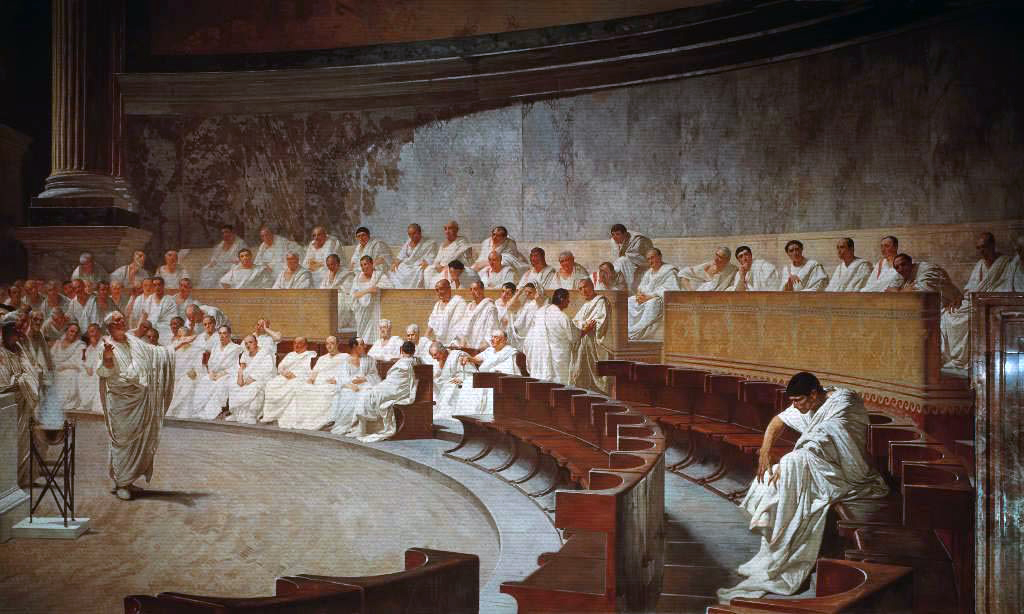
But to return to what is the topic of this update: to advise His Holiness in matters political, and in honour of the two moons of the Red Planet, two Consuls, the Deimotic and the Phobic, will be appointed each year; suffect Consuls will be appointed as replacements as needed, taking the place of one or the other. Likewise, in the New City, or Fourth Rome (the first three* having been on the Third Planet, naturally the fourth must be on the Fourth), there will be established a Martian Senate of six hundred, the lists of its members to be wisely chosen and regularly revised by the diligence of the Holy Father, though all such need not attend sessions – it being understood that Senators, as in Old Rome during the Empire, should attend the House only when they have agreed to vote placet (“yes”), just as is expected in Roman synods today.

There’s always one who won’t vote how they’re expected to...

[* For the moment, let us not worry about including in this count either the multifarious localities named Rome in sixteen of the United States of America, or the Paris Métro station of the same name.]

In addition to this, it will now be clear why St Paul VI in a pathetic yet ultimately prophetic gesture all but abandoned the Papal Nobility, as that has left open a void (quod Natura abhorret) for the soon-to-be-elected Supreme Pontiff of Mars to fill by creating many new Princes and Princesses, Dukes and Duchesses, Marquises and Marquises, Counts and Countesses, and Barons and Baronesses of the Holy Martian Church – some titles to be hereditary, some to be granted ad personam (depending on the merits displayed and/or level of financial contribution provided). Similarly, various equestrian orders will be established (for knighthoods, only modest talents or fees will suffice).

A Martian in native dress

It goes without saying that all of these serried ranks will be merely nominal dignities and sinecures of the sort beloved by those Catholic laity most likely to seek a one-way ticket to Mars. Of course, all actual and meaningful power of governance, temporal as well as spiritual, will remain in the Martian Sovereign Pontiff: after all, the Church has long recognised that the only sure, safe and certain guarantee of orthodoxy and the tranquillity of order is to ensure that the First See is judged by none, no matter what. What could possibly go wrong?

For utterly the same reason, the right of electing the Sovereign Pontiff (so frivolously and so foolishly exercised on Earth, as history sadly teaches) will be taken away from the Cardinals, and each Pope of Mars will simply name his own successor in his last will and testament, to be read out to the Cardinals in Conclave assembled after the Pope’s demise, but kept meanwhile in pectore, so as to preserve the traditional surprise of the announcement Habemus Papam by the Dean of the College of Cardinals. Prior to this, the incineration of the late Pope’s will will supply the necessary very small puff of smoke, oxygen being at a premium on Mars.

A Prince-Bishop (of Andorra, not Mars)

Finally, as settlements spread across Mars, the principle of subsidiarity dictates that local forms of government be introduced: and for this reason, in due season ecclesiastical principalities large and small will be established under the rule of Prince-Archbishops, Prince-Bishops, Prince-Abbots and Princess-Abbesses.

Speaking of Princess-Abbesses, it is good to see that consecrated women will assert their lawful authority on one planet at least; indeed, what on Earth has for many centuries past been granted only to Carthusian nuns will be extended on Mars to all women in solemn vows and Papal enclosure – they will all be consecrated as deaconesses. Amazonis Planitia is one of the youngest and smoothest of the great northern plains of Mars, after all.

Votive Mass for Oxygen

Let every thing that hath breath : praise the Lord. 
— Ps, 150, 6 (Ordinariate Psalter)

We should always work as if all depends on us, whilst ever praying knowing that all depends on God – to this end, for the benefit of future Martian Catholics, I subjoin a proposed Votive Mass from the forthcoming editio princeps of the Missale Martianum, in its native Latin first, to which is appended an unofficial English translation. It will be noted that the orations are of the neo-Gallican type, being pastiches of Scriptural texts, which may betray a Baroque tendency in their compiler!

******

Missa votiva pro oxygenio
ex Missali Martiano

Introitus Sap. 2, 1. 2. 3
Exiguum est tempus vitæ nostræ, quoniam fumus flatus est in naribus nostris: et transibit vita nostra tamquam vestigium nubis, et sicut nebula dissolvetur. (T.P. Alleluja, alleluja.)
Ps. 38, 14 Remitte mihi, ut refrigerer priusquam abeam et amplius non ero.
V. Gloria Patri.

Non dicitur Gloria in excelsis.

Oratio Cf. Dan. 5, 23 & 2 Mach. 7, 23
Deus, mundi Creator, qui habes flatum nostrum in manu tua, et omnes vias nostras: spiritum nostrum iterum cum misericordia redde et vitam. Per.

Lectio Danielis Prophetæ. 10, 2-19

In diebus illis ego Daniel lugebam trium hebdomadarum diebus: panem desiderabilem non comedi, et caro et vinum non introierunt in os meum, sed neque unguento unctus sum, donec complerentur trium hebdomadarum dies. Die autem vigesima et quarta mensis primi, eram juxta fluvium magnum, qui est Tigris. Et levavi oculos meos, et vidi: et ecce vir unus vestitus lineis, et renes ejus accincti auro obrizo: et corpus ejus quasi chrysolithus, et facies ejus velut species fulguris, et oculi ejus ut lampas ardens: et brachia ejus, et quæ deorsum sunt usque ad pedes, quasi species aëris candentis: et vox sermonum ejus ut vox multitudinis. Vidi autem ego Daniel solus visionem: porro viri qui erant mecum non viderunt, sed terror nimius irruit super eos, et fugerunt in absconditum. Ego autem relictus solus vidi visionem grandem hanc: et non remansit in me fortitudo, sed et species mea immutata est in me, et emarcui, nec habui quidquam virium. Et audivi vocem sermonum ejus: et audiens jacebam consternatus super faciem meam, et vultus meus hærebat terræ. Et ecce manus tetigit me, et erexit me super genua mea, et super articulos manuum mearum. Et dixit ad me: Daniel vir desideriorum, intellige verba quæ ego loquor ad te, et sta in gradu tuo: nunc enim sum missus ad te. Cumque dixisset mihi sermonem istum, steti tremens. Et ait ad me: Noli metuere, Daniel: quia ex die primo, quo posuisti cor tuum ad intelligendum ut te affligeres in conspectu Dei tui, exaudita sunt verba tua: et ego veni propter sermones tuos. Princeps autem regni Persarum restitit mihi viginti et uno diebus: et ecce Michaël, unus de principibus primis, venit in adjutorium meum, et ego remansi ibi juxta regem Persarum. Veni autem ut docerem te quæ ventura sunt populo tuo in novissimis diebus, quoniam adhuc visio in dies. Cumque loqueretur mihi hujuscemodi verbis, dejeci vultum meum ad terram, et tacui. Et ecce quasi similitudo filii hominis tetigit labia mea: et aperiens os meum locutus sum, et dixi ad eum, qui stabat contra me: Domine mi, in visione tua dissolutæ sunt compages meæ, et nihil in me remansit virium. Et quomodo poterit servus domini mei loqui cum domino meo? nihil enim in me remansit virium, sed et halitus meus intercluditur. Rursum ergo tetigit me quasi visio hominis, et confortavit me, et dixit: Noli timere, vir desideriorum: pax tibi confortare, et esto robustus. Cumque loqueretur mecum, convalui, et dixi: Loquere, domine mi, quia confortasti me.

Graduale Ps. 103, 29-30
Auferes spiritum eorum, et deficient, et in pulverem suum revertentur.
V. Emittes spiritum tuum, et creabuntur; et renovabis faciem terræ.

Alleluja, alleluja.
V. Job 32, 20 Aperiam labia mea, et loquar, et respirabo paululum.
Alleluja.

Post Septuagesimam, omissis Alleluja et versu sequenti, dicitur:

Tractus Job 33, 4; 27, 3; 32, 20
Spiritus Dei fecit me, et spiraculum Omnipotentis vivificavit me.
V. Quia donec superest halitus in me, et spiritus Dei in naribus meis.
V. Aperiam labia mea, et loquar, et respirabo paululum.

Tempore autem paschali omittitur graduale, et ejus loco dicitur:

Alleluja, alleluja.
V. Job 27, 3 Quia donec superest halitus in me, et spiritus Dei in naribus meis.
Alleluja.
V. Job 32, 20 Aperiam labia mea, et loquar, et respirabo paululum.
Alleluja.

Sequentia sancti Evangelii secundum Lucam. 7, 11-16

In illo tempore: Ibat Jesus in civitatem quæ vocatur Naim: et ibant cum eo discipuli ejus et turba copiosa. Cum autem appropinquaret portæ civitatis, ecce defunctus efferebatur filius unicus matris suæ: et hæc vidua erat: et turba civitatis multa cum illa. Quam cum vidisset Dominus, misericordia motus super eam, dixit illi: Noli flere. Et accessit, et tetigit loculum. (Hi autem qui portabant, steterunt.) Et ait: Adolescens, tibi dico, surge. Et resedit qui erat mortuus, et cœpit loqui. Et dedit illum matri suæ. Accepit autem omnes timor: et magnificabant Deum, dicentes: Quia propheta magnus surrexit in nobis: et quia Deus visitavit plebem suam.

Offertorium Is. 42, 5 & 8a
Hæc dicit Dominus Deus, creans cælos, et extendens eos; formans terram, et quæ germinant ex ea, dans flatum populo qui est super eam, et spiritum calcantibus eam: ego Dominus, hoc est nomen meum. (T.P. Alleluja.)

Secreta Cf. Dan. 10, 17-18 & Is. 42, 5 & Ps. 106, 22
Domine Deus, cujus angelus Danielem prophetiam, cum halitum ejus intercluderetur, confortavit: da, quæsumus, flatum et spiritum populo tuo, ut tibi sacrificent sacrificium laudis. Per.

Præfatio communis.

Communio Gen. 2, 7
Dominus Deus inspiravit in faciem hominis spiraculum vitæ, et factus est homo in animam viventem. (T.P. Alleluja.)

Postcommunio Cf. Act. 17, 24 & 25 & 28
Deus, qui fecisti mundum et omnia quæ in eo sunt: da omnibus, quæsumus, vitam et inspirationem et omnia; in quo vivimus et movemur et sumus. Per.

******

Votive Mass for Oxygen
from the Martian Missal

Introit Wis. 2, 1. 2. 3
The time of our life is short, for the breath in our nostrils is smoke: and our life shall pass away as the trace of a cloud, and shall be dispersed as a mist. (P.T. Alleluia, Alleluia.)
Ps. 38, 14 O forgive me, that I may be refreshed, before I go hence, and be no more.
V. Glory be.

The Gloria in excelsis is not said.

Collect Cf. Dan. 5, 23 & 2 Mach. 7, 23
O God, Creator of the world, who hast our breath in thy hand, and all our ways: restore to us again in mercy both breath and life. Through.

A lesson from the Prophet Daniel. 10, 2-19

In those days: I Daniel mourned the days of three weeks. I ate no desirable bread, and neither flesh, nor wine entered into my mouth, neither was I anointed with ointment: till the days of three weeks were accomplished. And in the four and twentieth day of the first month I was by the great river which is the Tigris. And I lifted up my eyes, and I saw: and behold a man clothed in linen, and his loins were girded with the finest gold: and his body was like the chrysolite, and his face as the appearance of lightning, and his eyes as a burning lamp: and his arms, and all downward even to the feet, like in appearance to glittering brass: and the voice of his word like the voice of a multitude. And I Daniel alone saw the vision: for the men that were with me saw it not: but an exceeding great terror fell upon them, and they fled away, and hid themselves. And I being left alone saw this great vision: and there remained no strength in me, and the appearance of my countenance was changed in me, and I fainted away, and retained no strength. And I heard the voice of his words: and when I heard, I lay in a consternation, upon my face, and my face was close to the ground. And behold a hand touched me, and lifted me up upon my knees, and upon the joints of my hands. And he said to me: Daniel, thou man of desires, understand the words that I speak to thee, and stand upright: for I am sent now to thee. And when he had said this word to me, I stood trembling. And he said to me: Fear not, Daniel: for from the first day that thou didst set thy heart to understand, to afflict thyself in the sight of thy God, thy words have been heard: and I am come for thy words. But the prince of the kingdom of the Persians resisted me one and twenty days: and behold Michael, one of the chief princes, came to help me, and I remained there by the king of the Persians. But I am come to teach thee what things shall befall thy people in the latter days, for as yet the vision is for days. And when he was speaking such words to me, I cast down my countenance to the ground, and held my peace. And behold, as it were the likeness of a son of man touched my lips: then I opened my mouth, and spoke, and said to him that stood before me: O my lord, at the sight of thee my joints are loosed, and no strength hath remained in me. And how can the servant of my lord speak with my lord? for no strength remaineth in me, moreover my breath is stopped. Therefore he that looked like a man touched me again, and strengthened me. And he said: Fear not, O man of desires, peace be to thee: take courage and be strong. And when he spoke to me, I grew strong: and I said: Speak, O my lord, for thou hast strengthened me.

Gradual Ps. 103, 29b-30
Thou shalt take away their breath, and they shall fail, and shall return to their dust.
V. Thou shalt send forth thy spirit, and they shall be created: and thou shalt renew the face of the earth.

Alleluia, alleluia.
V. Job 32, 20 I will open my lips, and I will speak and take breath a little.
Alleluia.

After Septuagesima, omitting Alleluia and the verse following, is said:

Tract Job 33, 4; 27, 3; 32, 20
The spirit of God made me, and the breath of the Almighty gave me life.
V. For as long as breath remaineth in me, and the spirit of God in my nostrils.
V. I will open my lips, and I will speak and take breath a little.

In Paschal Time, however, the gradual is omitted, and in its place is said:

Alleluia, alleluia.
V. Job 27, 3 For as long as breath remaineth in me, and the spirit of God in my nostrils.
Alleluia.
V. Job 32, 20 I will open my lips, and I will speak and take breath a little.
Alleluia.

The continuation of the holy Gospel according to Luke. 7, 11-16

At that time: Jesus went into a city that is called Naim; and there went with him his disciples, and a great multitude. And when he came nigh to the gate of the city, behold a dead man was carried out, the only son of his mother; and she was a widow: and a great multitude of the city was with her. Whom when the Lord had seen, being moved with mercy towards her, he said to her: Weep not. And he came near and touched the bier. And they that carried it, stood still. And he said: Young man, I say to thee, arise. And he that was dead, sat up, and began to speak. And he gave him to his mother. And there came a fear on them all: and they glorified God, saying: A great prophet is risen up among us: and, God hath visited his people.

Offertory Is. 42, 5 & 8a
Thus saith the Lord God, creating the heavens, and stretching them out: establishing the earth, and the things that spring out of it: giving breath to the people upon it, and spirit to them that tread thereon: I the Lord, this is my name. (P.T. Alleluia.)

Secret Cf. Dan. 10, 17-18; Is. 42, 5; Ps. 106, 22
Lord God, whose angel didst strengthen the prophet Daniel when his breath was stopped: give, we beg, breath and spirit to thy people, that to thee they may sacrifice the sacrifice of praise. Through.

The Common Preface.

Communion Gen. 2, 7
The Lord God breathed into the face of man the breath of life, and man became a living soul. (P.T. Alleluia.)

Postcommunion Cf. Act. 17, 24 & 25 & 28
O God, who didst make the world and all things that are therein: give to all, we beg, life, and breath, and all things; in whom we live and move and are. Through. 

Saturday, October 26, 2019

Fly Idolatry - Fly to Mars

The subjoined satire is the sort of nonsense only present and former Dominicans (of whom it may be said, as was of certain Anglicans of old, such are “of the world, but not in it”) would dream up after watching too many reruns of Pachamamas being precipitated into the Tiber; I post it to amuse a friend...

******

And it was night (John 13, 13)

“When therefore you shall see the abomination of desolation, which was spoken of by Daniel the prophet, standing in the holy place: he that readeth let him understand: then they that are in Judea, let them flee to the mountains” (Matt. 24, 15f) – mindful of these words, in the context of the impending presence of second-hand cheap tourist trinkets at a Mass in Rome tomorrow, the thoughts of more fanatical than usual Catholics (i.e., those who observe the last Sunday in October as the Feast of Christ the King) quickly turn from “that Jerusalem which now is, and is in bondage with her children” (Gal. 4, 25) – that is, this unhappy planet, also referred to as Judea in the apocalyptic Gospel text above – to “that Jerusalem, which is above, is free: which is our mother” (Gal. 4, 26) which, as all men know, is evidently a reference to Mars.

Mars... “which is above, is free”

If the symbolic Judea, groaning under the unhappy yoke of idolatry, subjected to cruel bondage, is the Earth (totally polluted with idol-worship as it is), then the mountains to which the faithful ought flee must by simple logic be the planets, known in Scripture as “wandering stars” (Jude 13), and to which veiled allusion is made by the mention in the Apocalypse of “the mystery of the seven stars” (1, 20), evidently referring to the eight planets now known, omitting the Earth; and again, of all the planets the only one remotely habitable is surely the Red Planet, as all astronomers know – “for star differeth from star in glory” (1 Cor. 15, 41).

There was a wicked Protestant speculation to the effect that, assuming Lowell’s observations of canals on its surface to be correct, then these were dug by the damned at the instigation of devils, and Mars was Hell: but Catholics naturally reject such foolishness, as Hell is within the Earth (in dreadful caverns hot and fiery), as all men know, while the planets are in Heaven. Reason teaches: flee Hell, and seek to fly to Heaven.

Not what happened in the Vatican Gardens

Furthermore, St Paul commands us to “fly from the service of idols” (1 Cor. 10, 14), having already remarked earlier in his same first Epistle to those contentious Corinthians that not to keep company with “the servers of idols” would mean that “you must needs go out of this world” (1 Cor. 5, 10) –  and lo! what was in his day impossible, is now quite possible, so those intent on salvation now must literally fly out of this world, lest they by fellowship with idolatry perish in the general impending doom.

It is well known that Elon Musk is engaged at this very moment upon the great task of preparing rockets sufficient for the colonization of Mars; and the vast sums of monies secreted in Swiss bank accounts by all the corrupt officials of the Curia will, once purified by being spent on this worthy cause (one assumes a certain Cardinal will be very happy to pass on the password details he uncovered prior to his unexpected summons home, as after all he now has nothing to lose and every Roman enemy to repay), suffice to pay for passage to the Fourth Planet by the tiny remnant (self-styled) who seek to flee thence.

The moment all spacefarers become sede-vacantists?

It is a truth well-known to all that the Pope, or at least whatever passes for one, is the Vicar of Christ *on Earth*. Therefore, those who leave the Blue Planet for the Red will have, alas, no longer any Pope, and, as soon as they pass lunar orbit†, become ipso facto sede-vacantists (it is pathetic how many misinterpret such simple science to think that papal utterances on aircraft in Earth’s lower atmosphere supposedly have no validity); and moreover – since Nature abhors a vacuum, particularly in vacuo – those who are in deep space (especially if their minds are already void of thought) spontaneously acquire the right and duty to elect a new Pontiff for whichever planet they eventually alight upon (should they survive re-entry).

St James Cathedral, Orlando, Florida: 
the Mother Church of the Moon

[† It must be remembered that the Moon (whose phases show it to partake of Earthly changeability, and so is more Purgatory than Heaven) is within the dominions of the Earthly Vicar of Jesus Christ, as it is part of the diocese of Orlando, Florida, by reason of its first explorers having launched from that particular part of our globe, which meant that its territory was annexed automatically to that diocese under the then-current rules of Canon Law.]

A Pope

Lest any be scandalized, it must be remembered that the Orthodox (and Eastern Catholics when they’re feeling feisty or remembering their lost independence) always refer to “the Pope of Rome”, insinuating that other Popes at least potentially exist; and both the Coptic and Greek Orthodox Patriarchs of Alexandria also style themselves Pope. Indeed, there are many higher-ranking priests styled “protopopes” in the Christian East, and in Greek any priest can be called papa. It is therefore hardly surprising that a future bishop of Mars should bear that fatherly title.

Christ Himself told St Peter, “Feed My sheep” (John 21, 17), yet also mysteriously remarked both that “Other sheep I have, that are not of this fold” (John 10, 16), and “In My Father’s house [that is, in Heaven], there are many mansions” (John 14, 2). Sheep of another fold, inhabitants of another mansion, will most surely be in need of a Vicar of the One Shepherd.

A pre-Copernican obscurantist

Given the large percentage of flat earthers, young-Earth creationists, raving loonies, geocentrists, and pre-Copernican obscurantists likely to be amongst those who will flee Earth in favour of life on Mars, they will be in need of curtains over the windows, lest their simple faith be shaken. (They will simply have to remember what silly old Luther said, Believe more strongly!)

At least one priest known to this writer has humbly offered his service to exiled earthlings as their chaplain and Pope-of-Mars-elect (he plans to reign as “Abel the Just”, presumably in contradistinction to some imagined Cain, I cannot imagine who). If he who desireth a bishopric “desireth a good work” (1 Tim. 3, 1), how brimming over with all goodness, according to the golden words contemplata aliis tradere, is he who purposeth to reign as Pope-King over a planet, and all out of disinterested love? As he has already deigned to indicate, his motto shall be “My kingdom is not of this world” (John 18, 36).

The Martian Papal style and title shall be, mutatis mutandis, more or less that currently used on Earth:

His Holiness Pope N., Bishop of New Rome, Martian Vicar of Jesus Christ, Apostolic Lord, Supreme Pontiff of the Martian Church, Patriarch of the Red Planet, Primate of All Mars, Archbishop and Metropolitan of the Fourth Planet, Sovereign of the Martian Papal States, Exarch of the exiles of God.

The sort of priest and layman likely to want to move planet are, fortuitously, precisely the sort of painful pious people the usual prelates, priests and layfolk would heartily desire to be well rid of (as they would opine, “they’re too good for this world”), so all shall be well, and all manner of things shall be well.

Receive the quadruple crown...

At last it becomes clear why St Paul VI’s papal tiara not only resembled the tip of a nuclear missile, but had four rings, not the expected three: his laying it aside (and sale to Americans) was a prophetic gesture intended to signify that it was to be worn by a future Pope on the Fourth Planet, to be delivered there (along with his followers and subjects) by US rocketry, paid for by Vatican cash.

Ezechiel’s vision of space travel (as von Däniken pointed out)

Lack of space (so to speak) forbids descriptions of the unimpeachable orthodoxy and unmatchable liturgy of the soon-to-be resettled Catholics of Mars (by contrast to those of this island Earth); suffice to say that Scripture (in, ahem, the Authorized Version) prophesies of them – bizarrely, in the past tense, but what can you expect of Anglican translators? – that “they were so high that they were dreadful” (Ezech. 1, 18).

Tuesday, December 20, 2016

I Can't Speak French

Being unable to understand French, I ran through an online automatic translator the instructions put out by the Cardinal Archbishop of Paris, back in 1874, for the customs to be retained when introducing the Roman Rite. This produced some hilarious results:

The custom of giving screams during Mass as well as vespers to the singers who are tonsured, and even to those who are not so, if they are allowed to wear the cassock in the Community where they are admitted.

…Indians may be admitted to High Mass... 
…we can use two apologists for the incensing of the Choir… 
…during the period of the Uffizi… 
The canons, the Celebrant and his assistants, if they are in a hat… 
The inclination is poor when you greet superiors, equals and Chorus.

All rise to render salvation to the Priest or Superior of the place.

…sometimes after the lessons precede the epistle… 
…Ave stella husbands… 
During the Magnificat, one is standing, without relying on mercy.

During the singing of memoirs, one standing shot Choir.

If some of MM. The Priests believe that in view of the number of Communists and the smallness of their church, two low Masses can not satisfy the need of the Faithful; they must address themselves to His Eminence, who will examine what number of Masses it is necessary to grant them.

Parisian jumpers carry on their backs a fairly typical cross… 
The practice existed almost everywhere in France, that during certain pieces sung, two singers "beat the chorus"… 
"We could not find the date of the introduction of the Indians into the Parisian Liturgy. The Missal of 1666 mentions them as serving the Metropolitan Church." 
When the clergy is standing shot in choir, those in the stalls rely on the mercy… 
…they do not rely on mercy when the choir is facing the altar.

The Canons can sit as soon as the last of them has been praised… 
The rule of Nicaea subsists in filigree in the Roman ritual… 
In fact, for the candlestick of Darkness… 
Many girls Updates to the tomb to be found in churches served the ceremony…

Saturday, March 14, 2015

Viva, viva Benedetto

An unremarked milestone was passed on the 16th of February: Pope Emeritus Benedict XVI surpassed the lifespan of Pope Clement XII (who died aged 87 years 306 days), to become the second-longest-lived Pope, outranked only by Leo XIII (who died aged 93 years 140 days): since Georg Ratzinger is still alive, aged 91, God willing, Benedict may indeed live on to surpass that span too, come the 5th of September 2020. Benedict XVI would by now have reigned for over nine years, had he not unexpectedly resigned.

(But do note that Pope John XXII's age at death is uncertain: some sources claim he may have been as many as 89 years old.)

Meanwhile, as the joke has it, the priests of Rome pray at Mass "for Benedict our Pope and Francis our Bishop"! – today begins the third year of the pontificate of Papa Bergoglio, our Latin American leader (caudillo?) from the Silver Republic (that being the literal meaning of his homeland's name). I do hope his second Synod on the Family is less embarrassing and more fruitful than the first; at least he has his own right-hand-man in Cardinal Pell, with the skills (less common in southern Europe and similar places) necessary to reform the murky details of Vatican finances.

If, according to the ineluctable designs of Providence, our one-lunged Argentinian Supreme Pontiff should predecease our former German Shepherd (for after all, as St John Paul the Great opined, the Church ought breathe with both lungs), could a future conclave re-elect the Pope Emeritus, that the Church return to the Golden Age from its current Silver Age, so to speak? And, if so, would he be Benedict XVI & XVII? Or could he take an entirely new Papal name – Ignatius, perhaps? That would be most confusing.

Monday, June 2, 2014

Christmas in June

Driving back from our first Sunday of the month Missa cantata yester-day, the first day of winter in Australia, got me musing on the way our southern seasons clash with the liturgical calendar inherited from our forebears in the northern hemisphere.  Having examined the calendar and worked out a correction that puts all to rights, it seems Sunday the 1st of June should really have been, not the Sunday after Ascension, but Advent Sunday.

Christmas, as all men know, falls soon after the boreal winter solstice, when Christ comes to enlighten those sitting in darkness and the shadow of death - but this imagery is reversed Down Under. For too long have we Antipodeans endured heat waves and broiling weather while singing of snow and holly, fainting in summer warmth over a heavy Christmas dinner!

Hence, to fit sacred time to the southern seasons, all in Australasia, temperate South America and South Africa ought keep the Lord's Nativity on the 25th of June, shortly after the austral winter solstice.

For the same reason, Easter, that feast of our true Spring, Christ's Resurrection, should be kept on the first Sunday after the first full moon after the austral spring equinox - which, by my calculations, would fall this year on the 12th of October (basing all this on the true astronomically determined dates, not on the old-fashioned computus).

I determine that the new calendar (which good Pope Francis, a fellow hemispherean, will no doubt grant with a wave of his hand, once he's apprized of it by a known enemy of the Immaculate Franciscans) for the Southern Hemisphere would run as follows for 2014:

Christus Rex (Last Sunday in April) – 27th April 2014
Advent Sunday – 1st June 2014
Christmas Day – Wednesday 25th June 2014
St Stephen, St John, HH Innocents on 26th, 27th, 28th, then SS Peter & Paul on 29th (for a most pleasing gathering of all saints round the crib)
Epiphany – Monday 7th July 2014 (not the 6th, since it must be 12 days after Christmas)
1st Sunday after Epiphany – 13th July 2014
Candlemas – Sunday 3rd August 2014 (40 days after Christmas)
4th & Last Sunday after Epiphany – 3rd August 2014
Septuagesima Sunday – 10th August 2014
Ash Wednesday – 27th August 2014
1st Sunday of Lent – 31st August 2014
Holy Cross – Monday 15th September 2014 (transferred because of the clash with the 3rd Sunday of Lent)
Annunciation – Thursday 25th September 2014 (nine months before Christmas)
Palm Sunday – 5th October 2014
Good Friday – 10th October 2014
EASTER Sunday – 12th October 2014
Ascension Thursday – 20th November 2014
Pentecost Sunday – 30th November 2014
Visitation (based on Paul VI’s wise removal of it from 2nd July to 31st May):  Monday 1st December 2014 (transferred this year from 30th November)
Trinity Sunday – 7th December 2014
Corpus Christi – Thursday 11th December 2014
Sacred Heart – Friday 19th December 2014
Nativity of St John the Baptist – 24th December 2014 (exchanged, as it were, with Christmas)

Apart from the moveable feasts shifted by six months, and the movement of various saints' days that seem inseparable from their setting relative to these, all other saints' days would remain the same, thus producing all manner of pleasing curiosities, such as the Immaculate Conception falling the day after Trinity Sunday, the Immaculata being the greatest of all after God himself.

You know it makes sense.

Friday, April 11, 2014

Bunyip Aristocracy

Aristocracy, as the Philosopher says, is the rule of the best; to-day, we have representative democracy, whereby certain elite groups compete to receive the fabled popular mandate. Tolkien said that he would prefer unconstitutional monarchy – and rulership of the sort displayed in his fiction, which seemed to mean that day-to-day affairs were almost unaffected by any government at all, most of all in the Shire, seems an excellent suggestion in these days of creeping totalitarianism. O for the days when the tithe was all the tax we paid!

Wentworth was lampooned when, in the debates before New South Wales (and several other Australian colonies) attained responsible government in the 1850's, he proposed an hereditary Upper House, after the model of the Lords in London (not of Lord's in London). This was thought ridiculous, a bunyip aristocracy of jumped-up Rum Corps profiteers and squatters, as odd as a platypus and about as useful.

But since our Prime Minister has fittingly restored knighthoods in the Order of Australia, our own home-grown system of awarding merit in right of the Crown, it amuses me to speculate on yet further prime ministerial largesse, should a Menzies-like longevity attend his time as the Queen's First Minister Downunder. Just what would an Australian peerage look like?

Peerages these days are titles and nothing else: I seem to recall that the last time a nobleman used the privilege of trial by his peers – the House of Lords – was back in the fifties or earlier; rights such as personal access to the Sovereign have fallen into desuetude; and the right most associated with power and authority, that of sitting in the House of Lords, has been taken away – only ninety or so hereditary Lords (elected by polling the peerage) still ornament that chamber named after their number. Of course it all went downhill when the mitred abbots were removed at the Reformation…

No rival to the Senate is proposed; merely that the particularly great and good (let's be honest, those great in donating to worthy causes, such as political parties, as well as those actually or merely seemingly good according to this world's passing standards) ought get not merely a knighthood but a dukedom. After all, who doesn't like Downton Abbey?

Having inquired to a very small degree, I find the surviving aristocracy of the Old Country has a little over eight hundred members (including Irish titles). For some reason, there are almost 70% more earls than viscounts, despite viscount being a lesser title than earl (then again, the name of viscount is a Continental importation, as is marquess, a rank for those not really suitable as dukes); otherwise, there are very roughly half as many peers in each succeeding rank, from the 450 barons (or Scottish Lords of Parliament) to the 24 non-royal dukes.

Now, as Australia has about one-third the population of the British Isles, it seems fair and proportionate to imagine a future local meritocratic peerage of about 280 members, allotted in proportion to state and territory populations, allowing each state at least one (so Tasmania would one day have a duke – no, not that impostor the Duke of Avram, a former state parliamentarian – even though our population is so small). I spare gentle readers the calculations; suffice it to say that Her Majesty would be asked to ennoble sufficient persons of merit that this nation gain 10 dukes, 19 marquesses, 36 earls, 71 viscounts and 143 barons…

Succession to these peerages would, of course, be open to the oldest child or nearest relative regardless of gender (a fraught issue these days in any case), unless, say, Countess Greer would wish to place her earldom off-limits to males. And it would be a matter for ecumenical consultation to see how Catholic and Anglican bishops (and abbots) would be ranked alongside the Lords temporal. Do cardinals outrank dukes?

I predict that, whatever the whining of lefties and the cultural Irish (it pleases me to imagine the outpourings of bile at the ABC), it would be quite remarkable how many fervent republicans would snap up the titles on offer; and titles would be all they would be, in plain truth, so how cheap and cheerful a present to offer to leading persons - it could help Lord Carr get an upgrade on Emirates from business to first class, for example, lest he suffer, poor man. After all, the Leader of Her Majesty's Loyal Opposition was fairly muted in his criticism of knighthoods, since his mother-in-law was the first to receive one and is now a Dame.

I would retain but one restriction corresponding to the very nature of the British nobility - as they cannot sit in the House of Commons, not being commoners, neither should any future Australian title-holders be permitted to hold elected office (needed, a declaratory Act to this effect): thus Clive, Marquess of Coolum, would have to relinquish his seat in the House of Representatives upon his accession to so titanic a dignity; but of course he could still manipulate his and another party's Senators behind the scenes, in the best tradition of the Whig and Tory aristocrats of old. Many likewise would rejoice at a peerage for Senator Abetz, not least his colleagues.

Finally and most nobly, in parallel to their British titles, the members of the Royal Family could each receive a royal dukedom here: Charles could be fittingly created Duke of New South Wales (for like a Botany Bay convict he's certainly doing his time, if not in exile, yet in waiting for the throne so many years), Philip Duke of Queensland (a nice pun, that), Anne Duchess of Victoria (fittingly for a female descendent of that monarch), Andrew Duke of Tasmania, Edward Duke of South Australia, William Duke of Western Australia (full of Poms as it is), Harry Duke of the Northern Territory (given his wild adventures), and dear little George Duke of the Australian Capital Territory – how fitting for our future King George VII, long may he one day reign.

I assume there is no need to pass legislation to enable all this fantasy, since the Sovereign is the fount of all honour and it would need but the respectful advice of the Prime Minister to move the Crown to issue the patents of nobility of some bunyip aristocracy. Unlike the American, our Constitution does not forbid such grants being one day made; and Malaysia, for example, has not merely its several state sovereigns, but an elected monarch and also titles of honour and nobility, so we would be but better inculturating ourselves into the Asian area – is not Thailand, too, a monarchy? Japan an Empire (I mean, a land with an emperor)? and Brunei the equivalent of a grand duchy? does not a Sultan still reside at Yogyakarta and hold court? – by developing our own analogues to such titles.

We nowadays solemnly recognise the fabled Dreamtime, its Rainbow Serpents and mythic creatures, in ritual moments opening civic and state occasions; likewise we love and retell tales of the bunyip and the banksia men; we mock not but value the platypus and the echidna, lament the passing of the Tasmanian tiger, and emblazon the kangaroo and emu as the supporters of our national coat of arms (as neither animal can walk backwards).

Forwards then to such a future, towards a true culture of entitlement!

Tuesday, February 25, 2014

Better Late Than Never - A Joint Contribution

How to hold a Septuagesima Eve or Farewell Alleluia Party

Septuagesima Eve is the lychgate of Lent – that way station marking entry into the churchyard, ere on Ash Wednesday we pass through the very portal of the church into Quadragesima Abbey, as it were, where for forty days and nights we will redouble our penances and in monkish wise undertake ascetic exercises, cloistering our souls from the busy world till the happy day of Resurrection.

Now a lychgate, as all men know, is a gate overshadowed by a roof, symbolic of Him Who is the Gate of the sheepfold, Himself overshadowed by the Holy Ghost, whereto a body brought for burial is carried, and the first part of the funeral conducted, before it is brought into the church. Hence, when as at first Vespers of Septuagesima the Alleluia is laid aside, in a manner its death is to be represented – just as the corpse, in shroud y-wrapt, ought be plonked down in the lychgate.

Moreover, a wake ought be held, for to mourn dead Alleluia (dear maiden), and, to prevent enormities, Alleluia ought be buried straightway. For this reason, on Septuagestima Eve, Alleluia is buried after Vespers; and, both before and after these affecting services, cocktails in the liturgical colours ought be served nearby.

Before the obsequies, as suitably accoutred guests arrive for this devotional pastime, the gracious host ought present each one with a green cocktail to fittingly conclude Epiphany-tide. It is not permitted to colour the drink with green food colouring – note in particular that green-tinted Guinness is an abomination, and one reserved in any case for St Patrick’s Day. Instead, cunning combinations of sundry decoctions, liqueurs and elixirs are to be employed. This verdant beverage, and all subsequent top-ups, should be consumed before the commencement of First Vespers of Septuagesima.

One should wait until all guests arrive before starting Vespers; it is most disruptive to have people scrabbling for chairs and music, and attempting to join in psalms half-way through. Note that, if the land be laid under interdict, the doors must be closed, and the Office recited on a low note; which will somewhat dampen the spirit of the occasion.

For Vespers, a mediæval chapel (Gothic or Romanesque) is required (every home should have one), or at least a large space, fittingly tricked out, with two rows of chairs facing each other. Do not use narrow hallways: otherwise there can be the risk of accidental concussion at every Gloria Patri. While purists may gasp in horror, it is suggested that the two choirs be mixed (with men and women on each side), lest the volume be too unequal.

It is preferable, whether there be a permanent or temporary chapel, to celebrate Vespers before a dressed and decorated altar (eastward facing) upon which the requisite number of lit candles burn. The Alleluia should be hung on the altar front for all to observe clearly. If no medieval tapestry is available, a large piece of cardboard, made to resemble parchment, with the Alleluia y-writ thereon in clearly visible lettering (employing a flowing font with serifs) will suffice, and may be attached to the altar with concealed tape if no hooks are provided.

Benedicamus Domino with doubled Alleluia having been sung, and Vespers concluded with the Fidelium animæ (or, if a bishop be present, after he has imparted his blessing – if several prelates be present, the highest-ranking blesses unless suspended a divinis), immediately two or four of the youngest present (juniores priores) approach the altar, make due reverence, detach the Alleluia in comely fashion, and gently lay it flat, text facing up, on the waiting bier, which has been prepared earlier.

Carrying their cargo with deserved decorum, these bearers then lead a funereal procession out from the chapel, through the house, and around the garden to the grave prepared (which must have been suitably decorated with purple flowers, and supplied with a handy pile of stones nearby). Meanwhile all sing the hymn Alleluia dulce carmen, preferably in polyphony, repeating its verses as necessary until Alleluia be buried into the grave. 

Having assembled at the graveside, the officiant first rolls up the Alleluia if necessary, then with sober deportment deposits it into a coffin or other apt receptacle. After sealing this, he lowers it into the grave. All present then process past this resting place of dead Alleluia, each one laying a stone on top as they pass, thus building a cairn while still singing. All depart the grave in solemn silence after a most liturgical pause.

Following the obsequies, as expeditiously as possible, the host and his attendants (as it were the celebrant and his ministers) should make and distribute purple cocktails to the guests. On no account are any left-over green cocktails to be consumed, under pain of serious sin and excommunication reserved to the Apostolic See. Nonetheless, exceptions to this rule are allowed for those who are allergic to the purple cocktail; or those who are only permitted one alcoholic beverage and who arrived too late to finish their drink before Vespers; or those holding a Papal indult or immemorial privilege: no others.

During the mixing these purple cocktails, it is fitting for guests to retire and shed their green garments in favour of purple ones, if possible. Men of limited imagination may choose simply to change their neck tie. Since the liturgical portion of the evening has been completed (as Compline will be recited in private), guests may innocently disport themselves henceforth as befits any polite social gathering, taking care to remember that utterance of the ‘A’ word is strictly forbidden.

It is appropriate to serve dinner now. Please note that serving only purple food would be considered excessive, not to mention nauseating. A reasonable use of vegetables in such shades would be appropriate, however.

Saturday, February 22, 2014

Almost Finished

While in Rome on pilgrimage, four of us, during our visit to Santa Maria Maggiore, decided to go to confession. A little later, we compared penances, feeling a rather hard done by… a young lady had been told to say her Rosary every day for a week for a certain intention; one of our priests had been told to offer up his Breviary every day for a week for a similar cause; and Mike and I, upon learning that each of us had been told to offer up the Rosary for such and such an intention (I got "sincerity"), daily – for a month – felt uniquely put-upon.

I recall that, according to that devout book, The Secret of the Rosary, St Dominic assigned just such a lengthy penance to a pious Roman matron, who was in the habit of doing the rounds of the Seven Churches every day. Like her, I own to feeling more than a little discomfited!

Doubtless the … son of St Dominic in question (for the confessors at St Mary Major are Blackfriars) had been a-reading some such "manual of penance". I am now nearly finished fulfilling this penance – at least I have thereby got back to saying the Rosary. Perhaps that was the desired result.

Moral of the story: when on pilgrimage with no less than three priests, don't think to shop elsewhere. Or at the least, avoid the confessionals of Friars Preachers like the plague.