Sunday, November 7, 2010

M. C. at Missa Cantata

M. C. at Mass! – I haven't done this since arranging a Requiem for Brett, God rest his soul; I well recall Fr Tattersall tapping the missal in annoyance when I hesitated, unsure whether yet to move it or not...  In any case, despite making many errors (it all seemed so simple when I skimmed through Fortescue-O'Connell-Reid, pp. 162-8), Fr Gerald (who only gets to say a Latin Mass once a month) seemed pleased to have someone at hand to help gently direct proceedings, as did the servers, and things did run a bit more smoothly, which is all one could ask for, given that is in fact what the M. C. ought ensure.

Once safely back in the sacristy, I did tease Fr by saying what a good omen it was that he sang the blessing, as only bishops do!  We could do with a good replacement very soon.  (Rubricarius will remind me for sure: did not the actual Missal published under Pope St Pius V command this very practice of priests singing the blessing? in that case, we had a Tridentine Mass in every respect.)

Looking over F.-O'C.-R. (is that the right abbreviation?) reminded me once again that I am a lector (I always think of the scene in The Madness of King George where one of that unfortunate monarch's indolent sons*, absurdly bewigged, powdered and attired, idly picks at one of the decorations he's wearing, and remarks, "I say, I'm a bishop!"): apparently, I could therefore sing the Epistle, omitting of course particular details reserved to subdeacons such as receiving a blessing from the priest; but I could hardly be both M. C. and take part as lector, since I would need to be in two places at once...
[* It was Prince Frederick, Duke of York and Albany, for ever famous in the nursery-rhyme as "the grand old Duke of York", who was appointed Prince-Bishop of Osnabrück in 1764, aged less than a year old – by a strange arrangement, between 1648 and 1803, Catholic and Protestant prince-bishops alternately held the see and principality, down to its eventual suppression; Frederick was the last prince-bishop.  To answer the unspoken question, during each Protestant period, the Archbishop of Cologne had the cure of the Catholic souls; while the (Anglican) Frederick was technically head of the Lutherans there.  Weird.]
Being M. C., one is so caught up in supervising things that one can't pray the Mass as one would like.  At least when in the choir I was singing the Mass-texts, and otherwise attending to the Tremendous Sacrifice, kneeling.  Inwardly I did bemoan my lack of fear and trembling when I had perforce to stand by the Missal throughout the Canon, especially after the Consecration, when the Divine Victim lies upon the altar, and it would be preferable to lie prostrate in awe.  Later on I recalled, however, that "Emotion is not devotion" and obedience to one's duty (in this case, to turning the pages for the priest) is worthier far than pious passions which may well be pious piffle.

A side benefit of my trip from the north of the State to the south and back was the opportunity to pray the Office; only Vespers and Compline to go!  (I maintain my private practice of only reading three psalms at Matins, since doing so is preferable to not reading it at all, and I find reading all nine psychologically daunting and exhausting.)

Furthermore, in the car, apart from listening to News Radio, I could play some CD's: Palestrina on one, and Biber's Missa Alleluja with Schmeltzer's Vesperæ sollemnes on the other: marvellous.  The trip down began most appropriately with Palestrina's setting of that terrifying, yet oh-so-true Responsory from Matins of the Dead:
Peccantem me quotidie et non me pænitentem, timor mortis conturbat me, quia in inferno nulla est redemptio: miserere mei, Deus, et salva me.
(Sinning daily and not repenting, the fear of death troubles me, for in hell there is no redemption: have mercy on me, O God, and save me.)
How many souls at various times have struggled with precisely such a dilemma!  There but for the grace of God...  Only Divine grace, besought in prayer, can inspire the free will of man to turn from sinning and not repenting, that he may escape endless hell.

Saturday, November 6, 2010

Embarrassing Error

"Last Friday was Good Friday; but, as this was overlooked, we will keep it next Friday" – so wrote Mgr Ronald Knox when in a fey mood, imagining the evil consequences of being without an Ordo.

I am without an Ordo.

And it transpires that the very nice calendar the Sons of the Most Holy Redeemer sold me has a big error in it: this Sunday is the 5th after Epiphany.

(I forebear to write the words that come to mind, doubtless owing to incipient Tourette's Syndrome...)

Mea culpa.  I will correct my posts below...

Breviary Homily for 4th Sunday after Epiphany

Talk about the Breviary being, as its name implies, an abbreviated Office... while its prayers, hymns and psalms may not be, the Matins readings certainly are.  The dangerous practice of clipping away at the lessons used of old has had bad effects over the ages; how far the liturgy has fallen from the great lengthy extracts used during Advent at Cluny, where all of Isaias was read through within a week or so.  It was particularly foolish of the last pre-Conciliar liturgical reform to slice away the remaining Patristic texts almost to nothing on Sundays – no wonder the Council Fathers called for longer readings (and less psalms) at Matins!

Herewith, the third lesson for the 4th Sunday after Epiphany in the 1962 Roman and Dominican Breviaries:

Homily of St Jerome the Priest
The fifth sign He wrought, when going up into the boat from Capharnaum, He commanded the wind and sea.  The sixth, when in the region of the Gerasenes he gave power to the demons in the pigs.  The seventh, when entering into His city, he cured the second paralytic on a bed.  For the first paralytic is the son of the centurion.

And that's it.

For somewhat more than this barest of outlines, I turn to a 1953 Monastic Breviary and translate the rest of the extract from St Jerome's commentary:

For He Himself had slept: and they approached unto Him, and woke Him, saying: Lord, save us.  A type of this sign we read in Jonas, when amongst other perils, he himself was secure, and slept, and was awoken; and by the authority (imperio) and sacrament of His passion He freed those awaking Him.
Then arising He commanded the wind and sea.  From this place we understand, that all creatures know the Creator.  For what he rebuked, and what He commanded, knew the Commander: not according to the error of heretics, who believe that all things are ensouled, but according to the majesty of the Maker, of which amongst us we are insensible, of which they were aware.
Moreover, the men were amazed, saying: Of what sort is this man, for the wind and sea obey Him?  It was not the disciples, but the sailors, and others, who were in the boat, who marvelled.  If however some contentious man should wish that those, who were surprised, to have been the disciples: we will respond, rightly they are yclept men, who as yet knew not the power of the Saviour.

Now, this at least supplies some meat.

How stupid of the revisers not to take up the second passage as the most pregnant with meaning...

To Hobart, for the V Sunday after Epiphany

To-morrow I'll depart bright and early for the 200 km drive to Hobart, to assist at our monthly Missa cantata at the chapel of St Canice, which will be the Mass of the 5th* Sunday after Epiphany (prayers, Epistle and Gospel), combined with the Proper chants of the Mass of the 23rd Sunday after Pentecost, Dicit Dominus.

[* I am indebted to Rubricarius for gently correcting my mistake: having no Ordo to hand, I relied upon the calendar sold me by the Sons of the Most Holy Redeemer, which turns out to erroneously term this Sunday the 4th, not the 5th as it should be.]

Rubrical Query – II: An Answer

Eureka!  I have found it: in a pre-Pius X Dominican Breviary, it is noted that the Little Office of the Blessed Virgin Mary is said before all the Hours of the Daily Office (whereas in the Roman Breviary, it is said after the Little Hours, and before the Martyrology at Prime), except that Compline of the Blessed Virgin is said after the blessing at the end of Compline of the Day, immediately before the Salve Regina, omitting therefore its usual final Ave.  (The Cistercian practice was the same.)

As I prefer to use the Dominican Breviary for sundry reasons, I can, if I wish, thus combine Compline of the Day with Compline of Our Lady, without having to repeat the Marian anthem &c.  Much better.

I must also thank Rubricarius for his help.

Friday, November 5, 2010

Onias and Jeremias: Saints Alive! Pray for us

The Dominican Breviary gives as its Matins lessons for to-day, Friday in the fifth week of October (so-called because, according to the '62 rubrics, the first week of November doesn't begin until the first Sunday thereof), a significant extract from II Machabees chapter xv, verses 12-14, 15-17 and 20-21.

(The Roman Breviary, which has longer Matins lessons, appoints more or less the same passage for to-morrow, divided into two lessons only, since the third will always be for a saint or for Our Lady on Saturday: II Machabees xv, 7-11 and 12-19.)

It is significant because it represents "a dream worthy of belief" (verse 11) that Judas Machabeus had, featuring both the saintly Onias, a former High Priest who had died, lifting up his hands in prayer for Israel, and also the great prophet Jeremias playing a mediatorial role: and what is this, but direct testimony to the intercession of the saints?  No wonder Luther had to seek a reason to reject the Scriptural authority of this book, which in chapter xii had already testified to prayer and sacrifice for the dead!

Herewith, the three lessons (the second and third being read together to-day, making room for the third hagiographical lesson in honour of St Martin de Porres):


First Lesson (II Mach. xv, 12-14)

From the second book of the Machabees.

Now the vision was in this manner: Onias who had been high priest, a good and virtuous man, modest in his looks, gentle in his manners, and graceful in his speech, and who from a child was exercised in virtues, holding up his hands, prayed for all the people of the Jews.  After this there appeared also another man, admirable for age, and glory, and environed with great beauty and majesty: then Onias answering, said: This is a lover of his brethren, and of the people of Israel: this is he that prayeth much for the people, and for all the holy city, Jeremias the prophet of God. — But Thou, O Lord, have mercy upon us.  R/.  Thanks be to God.

Second Lesson (II Mach. xv, 15-17)

Whereupon Jeremias stretched forth his right hand, and gave to Judas a sword of gold, saying: Take this holy sword a gift from God, wherewith thou shalt overthrow the adversaries of my people Israel.  Thus being exhorted with the words of Judas, which were very good, and proper to stir up the courage, and strengthen the hearts of the young men, they resolved to fight, and to set upon them manfully: that valour might decide the matter, because the holy city and the temple were in danger. — But Thou, O Lord, have mercy upon us.  R/.  Thanks be to God.

Third Lesson (II Mach. xv, 20-21)

And now when all expected what judgment would be given, and the enemies were at hand, and the army was set in array, the beasts and the horsemen ranged in convenient places, Machabeus considering the coming of the multitude, and the divers preparations of armour, and the fierceness of the beasts, stretching out his hands to heaven, called upon the Lord, that worketh wonders, who giveth victory to them that are worthy, not according to the power of their arms, but according as it seemeth good to him. — But Thou, O Lord, have mercy upon us.  R/.  Thanks be to God.

All Relics

Like Gollum, I consider some things very precious: such as my collection of second- and third-class relics.  Ever deserve they to be kissed and revered, for in doing so I pay veneration to the spirits of just men made perfect, one day to rise again in glory (may I be numbered amongst them), and ultimately refer all honour and glory to Him, our King Christ, Who elected them and made them holy by His most Precious Blood.

As a layman, of course, I can hardly lay claim to any great hoard of sacred remains: it would hardly be fitting if I had such; for Canon Law prescribes that a bishop's permission is needed for to have first class relics, I recall.  (Yet I knew a priest who kept relics of all the apostles in a shoebox under his bed!  And a former seminarian of my acquaintance had known "a corrupt nun at the relics' office" from whom he had obtained many valuable relics which he shouldn't have had.  But worst of all was the American seminarian in Rome who was dismissed in the late nineties for forging relics out of animal bones and selling them to gullible countrymen of his.)

The relics:
  • Of Bl Columba Marmion, abbot (feast day: 3rd Oct.) – attached to a holy card, a piece of cloth labelled "A piece of the Religious habit worn by Blessed Columba Marmion" (2nd class);
  • Of St Dominic, priest, founder of the Dominicans (4th Aug.) – attached to a holy card, a piece of cloth labelled "Cloth which has touched the Head of St. Dominic" (3rd cl.);
  • Of St Antony Mary Zaccaria, priest, founder of the Barnabites (5th July) – attached to a holy card, a piece of cloth labelled pannolino che toccò le ossa di S. Antonio M. Zaccaria (3rd cl.);
  • Of St Pio of Pietrelcina, priest, O.F.M.Cap. (23rd Sep.) – attached to a holy card, a piece of cloth labelled "third class relic" (3rd cl.);
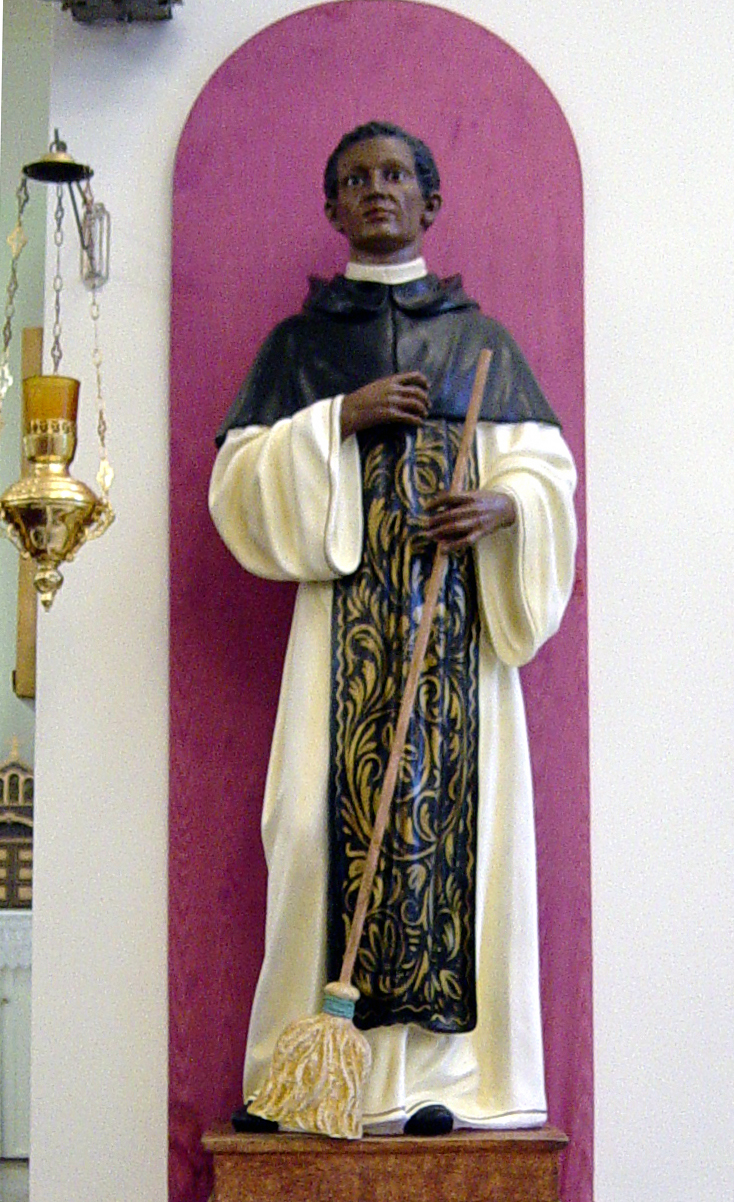
  • Of St Martin de Porres, O.P. (5th Nov.) – attached to a holy card, a piece of cloth labelled "Linen touched to his body" (3rd cl.);
  • St Peregrine, priest, Servite (1st May) – attached to a medal, a piece of cloth labelled "relic" (prob. 3rd cl.);
  • St Catherine of Siena, virgin (30th April) – attached to a medal, a piece of cloth labelled reliquia (probably 3rd cl.);
  • St Faustina, virgin (5th Oct.) – attached to a holy card, a unlabelled piece of cloth (prob. 3rd cl.);
  • St Thérèse of Lisieux, virgin, O.C.D. (3rd Oct.) – attached to a medal, a small unlabelled piece of cloth (prob. 3rd cl.); and, attached to a holy card, a small piece of cloth labelled "cloth touched to relic of St Thérèse" (3rd cl.);
  • Bl Maria Sagrario of St Louis Gonzaga, virgin & martyr, O.C.D. (16th Aug.) – attached to a holy card, a small unlabelled piece of cloth (prob. 3rd cl.).
Out of curiosity I have compiled this list of these relics I have; they repose with icons, crucifix and candles on the makeshift altar (or, as the Russians would have it, in the "beautiful corner", the krasnyy ugol, красный угол) in my study, in front of my prie-dieu.  What prayer to pray?  That said by the priest when kissing the altar at the start of Mass, Oramus te, or, more anciently, Oro te - in either case, perhaps changing to the plural at the end to pray for all; or perhaps that used of old likewise at the farewell osculation of the altar; and of course the Collect for the feast of All Relics, observed in sundry places on this very day, the 5th of November:

Oramus [Oro] te, Domine, per merita Sanctorum tuorum, quorum reliquiæ hic sunt, et omnium Sanctorum, ut indulgere digneris omnia peccata mea [nostra].  Amen.

(We [I] pray thee, Lord, by the merits of Thy Saints, whose relics are here, and of all the Saints, that Thou wouldst deign to forgive all my [our] sins.  Amen.)

Meritis et intercessionibus istorum et omnium Sanctorum suorum misereatur nobis omnipotens Dominus.

(By the merits and intercessions of these and of all His Saints, may the Lord almighty have mercy upon us.)

Auge in nobis, Domine, resurrectionis fidem, qui in Sanctorum tuorum reliquiis mirabilia operaris: et fac nos immortalis gloriæ participes, cujus in eorum cineribus pignora veneramur.  Per...

(Increase in us, O Lord, faith in the resurrection, Who dost work wonders by the relics of Thy Saints: and make us partakers of that immortal glory, a pledge of which we venerate in their ashes.  Through...)

St Martin de Porres

Martinus, filius Joannis de Porres, equitis Hispaniæ, et Annæ Velasquez, suffuscæ libertæ, Limæ in America meridionali anno millesimo quingentesimo [septuagesimo*] nono lucem aspexit  – "Martin, son of Juan de Porres, knight of Spain, and Anna Velasquez, mulatto freedwoman, at Lima in south America in the year 1579 [first] beheld the light": thus begins the third lesson at Matins for to-day in the Dominican Breviary, marking this fifth of November as the feast of St Martin de Porres proper to the Friars Preachers.  (In the modern liturgy, his feast has been moved to the third, the day of his death or rather of his birth into eternal light and life; but I do hope that, in Adelaide, Fr Mannes has offered Mass in his honour to-day.)

[* A strange oversight omits the word "seventy" from his date of birth, implying that he was born in Lima during the Inca Empire!]

Adopting for the moment my latest system of praying the Hours (reading only three psalms at Matins, as is done in the Dominican Breviary throughout Eastertide), which enables me, a reasonably busy layman, to gain most of the benefits of the Office, has indeed brought blessings, such as this holy memorial.  I was minded to reach for my second- and third-class relics, among which I have a holy card of St Martin complete with a piece of linen touched to his body: I paid due veneration to him through this.  How apt, given that in many places to-day is also the feast of All Relics...

St Martin famously wears a now-suppressed variant of the habit of the Blackfriars; pray for Dominican lay-brothers, that their vocation prosper and not perish, and that they get back their proper habit of the black scapular, taken from them on the pretext of equality...

St Martin, son of Spain and son of Africa, son of a gentleman and son of a slave, born and bred in the new conquests of Spain in South America, trained as a surgeon, but aspiring after holiness as a Dominican Tertiary, was in course of time admitted as a lay brother to the convent of the Friars Preachers in Lima, where he exercised a humble and holy ministry as a true servant to all, both within and outwith, to the fathers and to the slaves, to orphans and dumb animals, filled with prayer and working wonders on all sides.  All Lima lamented his passing: but with miracles he continues to coruscate and shine.  

I know a Dominican who owes his parents' meeting, his birth and that of his siblings, and his vocation, to an apparition of St Martin in Melbourne in the last fifty years: an event implicitly commemorated in the Wallace window at St Carthage's Cathedral, Lismore.

Herewith, the Dominican Rite Proper for St Martin de Porres:


Officium (Ps. 91, 13-14)

Justus ut palma florebit: sicut cedrus Libani multiplicabitur: plantatus in domo Domini, in atriis domus Dei nostri.  Ps. 91, 2.  Bonum est confiteri Domino: et psallere nomini tuo, Altissime.  Gloria Patri…  Justus…

Oratio

Deus humilium celsitudo, qui beatum Martinum confessorem tuum ad cælestia regna transire fecisti; ejus meritis et intercessione concede, nos ejus humilitatem ita imitari in terris, ut cum ipso exaltari mereamur in cælis.  Per…

Epistola (Phil. iii, 7-12)

Fratres: 
Quæ mihi fuerunt lucra, hæc arbitratus sum propter Christum detrimenta.  Verumtamen existimo omnia detrimentum esse propter eminentem scientiam Jesu Christi Domini mei: propter quem omnia detrimentum feci, et arbitror ut stercora, ut Christum lucrifaciam: et inveniar in illo non habens meam justitiam, quæ ex lege est, sed illam, quæ ex fide est Christi Jesu: quæ ex Deo est, justitia in fide: ad cognoscendum illum, et virtutem resurrectionis ejus, et societatem passionum illius, configuratus morti ejus, si quo modo occurram ad resurrectionem, quæ est ex mortuis.  Non quod jam acceperim, aut jam perfectus sim: sequor autem, si quomodo comprehendam, in quo et comprehensus sum a Christo Jesu.

Responsorium (Ps. 20, 4-5)

Domine, prævenisti eum in benedictionibus dulcedinis: posuisti in capite ejus coronam de lapide pretioso.  V/.  Vitam petiit a te: et tribuisti ei longitudinem direum in sæculum sæculi.

Alleluia (Ps. 63, 11)

Alleluja, alleluja.  V/.  Lætabitur justus in Domino, et sperabit in eo: et laudabuntur omnes recti corde.  Alleluja.

Evangelium (S. Matt. xi, 25-30)

In illo tempore: Respondens Jesus dixit: Confiteor tibi, Pater, Domine cæli et terræ, quia abscondisti hæc a sapientibus, et prudentibus, et revelasti ea parvulis.  Ita Pater; quoniam sic fuit placitum ante te.  Omnia mihi tradita sunt a Patre meo.  Et nemo novit Filium, nisi Pater: neque Patrem quis novit, nisi Filius, et cui voluerit Filius revelare.  Venite ad me omnes qui laboratis, et onerati estis, et ego reficiam vos.  Tollite jugum meum super vos, et discite a me, quia mitis sum, et humilis corde: et invenietis requiem animabus vestris.  Jugum enim meum suave est, et onus meum leve.

Offertorium (Ps. 91, 13)

Justus, ut palma florebit: sicut cedrus, quæ in Libano est, multiplicabitur.

Secreta

Hanc hostiam, Domine, quam tibi in honorem beati Martini confessoris sacrandam offerimus, benignus suscipe; et præsta ut ejus pia intercessione, nobis effectum tuæ salvationis impendat.  Per…

Communio (S. Matt. xix, 28-29)

Amen dico vobis, quod vos, qui reliquistis omnia, et secuti estis me, centuplum accipietis, et vitam æternam possidebitis.

Postcommunio

Cælestibus alimentis enutriti, supplices te rogamus, Domine Deus noster, ut beato Martino confessore pro nobis intercedente, tuis semper valeamus obedire mandatis.  Per…

Thursday, November 4, 2010

Any Coverage Yet of the Christus Rex Pilgrimage?

It's Thursday, I'm off work with a heavy cold, and while I try to rest and recuperate, I wonder: was, is, or will there be any coverage of the recent, highly successful Christus Rex Pilgrimage online?  I haven't seen any photos yet, apart from those I took myself - I foolishly thought I wouldn't need to take snaps at most of the celebrations since there were others who would do so.

So, what's going on?

Tuesday, November 2, 2010

Little Hours of All Souls in the Dominican Rite

Unlike in the Roman Breviary, in the Dominican the Little Hours for All Souls consist of the following: a silent sign of the Cross, then the festal psalms, that is, spread over Prime, Terce, Sext, and None, Psalms 53 and 118, the latter broken up into eleven parts, none with any doxology or Requiem, but with the antiphon Requiem æternam instead.  In contrast, the Roman Breviary, since the time of Pope St Pius X, appoints proper psalms for all these Hours, with no antiphon but the Requiem at the end of each psalm.  It may be seen that the Dominican practice more closely imitates the Office for the Easter Triduum.

At Prime alone, the Confiteor and Misereatur follow; at all the Little Hours, next is recited the versicles A porta inferi and Dominus vobiscum, with the Collect Fidelium and the concluding versicle Requiescant in pace.

At Pretiosa (answering to the second half, the so-called Chapter Office, of Roman Prime, after the Benedicamus Domino, and beginning with the Martyrology if in choir), to the contrary, all is done as on ordinary days, with even the Gloria Patri being used; while the proper Gospel passage appointed is taken from the Requiem Mass.  In the Roman Office, the corresponding part is drastically modified.

Finally, Compline is sung in its Sunday form, with no observation of All Souls whatsoever - whereas the Roman Compline for All Souls is conformed to the pattern of the day's other Hours, with proper psalms, entirely devoted to prayer for the dead.

It may be noted parenthetically that Dominican Matins, Lauds and Vespers for All Souls are utterly the same as their usual form – but for that the nine lessons at Matins are for this day wholly taken from St Augustine, and the final responsory, the fearful Libera me, is augmented with no less than five versicles, in true mediæval style.

Monday, November 1, 2010

Mass in the Horse-Float

Within the Chapel of Christ the King, within the Corboys' horse-float, late on Friday afternoon the 29th of October:

Fr Rowe descends to the foot of the altar for the beginning of Low Mass, a Votive of the Passion...


The Introit...


The Elevation of the Host...


Through + Him,
and with + Him,
and in + Him,
is unto Thee,
O God the Father + Almighty,
in the unity + of the Holy Ghost,
all honour and glory,
world without end.
Amen.

(I had perforce to depart at the end of the Canon in order to catch up with the pilgrim procession for the last leg of the day.  Glory be to God!)

¡Viva Cristo Rey!

Just arrived back from the Christus Rex Pilgrimage: stupendous!

All glory be to God.

The sacred ministers, keeping dry, discuss the expected arrival of the servers for the Missa multarum aquarum on Saturday.  Over the weekend, the environs received two inches of rain.

A marvellous spiritual recharge: an experience, in a very humble manner, of the Triduum, of Death and Resurrection, coming through suffering closer to the Lord - for, after beginning with great eagerness, and having assisted at our first Solemn High Mass, by Friday night, having through stupid pride pushed myself to walk all 35 km of the first day, I was so tired and miserable I could have crawled into a ditch; come Saturday, with its rain, and my exhaustion, I couldn't keep up past our mid-morning break, and took the bus for the weary pilgrims, joining the main party for our second Solemn High Mass in the pouring rain (the altar alone under shelter), a very Missa multarum aquarum, and then wisely resolving to join the two busloads' unable to proceed further in the wet and cold; yet, Sunday dawned and I arose and walked and prayed, and all ended gloriously.

His Lordship Bishop Elliott met us at the doors of Bendigo Cathedral, after we had sung in procession and consecrated ourselves to Christ the King: there then unfolded Pontifical Mass at the faldstool, with Palestrina's Missa brevis and sundry motets and organ voluntaries.  The occasion was magnificent, as was the hard-hitting sermon; I suspect the NLM may well cover it...

Sunday evening we feasted at the Queen's Arms Hotel, and, further refreshed, we kept All Saints' holy with our third Solemn High Mass, followed by brunch.  "O blest communion, fellowship divine!"

Other highlights: hearing most of Fr Rowe's Low Mass on Friday, and serving it on Sunday morning, on both occasions using the amazing portable chapel that the indefatigable Corboys have made out of a ute-drawn horse float!