Showing posts with label rubrics. Show all posts

Sunday, February 14, 2021

When Not to Say "Amen"

Especially at Low Mass, sometimes the overeager faithful reply Amen when they ought not.

The priest begins the prayers at the foot of the altar by making the sign of the Cross, saying In nomine Patris, et Filii, et Spiritus Sancti. Amen. No one, neither the server(s) nor the rest of the congregation, replies here - the priest himself says the Amen.

When the priest recites the Introit, he reads the Gloria Patri, ending with an Amen; however, as he immediately repeats the Introit antiphon, it is far less likely that an overzealous attendee would attempt to say Amen at that point.

It should be carefully noted, though, that when the priest recites the Gloria in excelsis, and, likewise, the Credo, in both cases he himself concludes each with an Amen, which is his to say, and is not the province of the faithful present at Mass, however heartily they concur – despite this, some mistakenly try to reply Amen, not realising that here there is no reply to give.

When the priest administers Communion to the faithful, he says to each Corpus Domini nostri Jesu Christi custodiat animam tuam in vitam æternam. Amen. Again, the individual communicant ought say nothing – as they are at that moment kneeling with their tongue extended, ready to receive the Host, by trying to saying Amen, they will only obstruct the administration of Communion.

It is always wise to be aware of the rubrics.

Tuesday, December 20, 2016

I Can't Speak French

Being unable to understand French, I ran through an online automatic translator the instructions put out by the Cardinal Archbishop of Paris, back in 1874, for the customs to be retained when introducing the Roman Rite. This produced some hilarious results:

The custom of giving screams during Mass as well as vespers to the singers who are tonsured, and even to those who are not so, if they are allowed to wear the cassock in the Community where they are admitted.

…Indians may be admitted to High Mass... 
…we can use two apologists for the incensing of the Choir… 
…during the period of the Uffizi… 
The canons, the Celebrant and his assistants, if they are in a hat… 
The inclination is poor when you greet superiors, equals and Chorus.

All rise to render salvation to the Priest or Superior of the place.

…sometimes after the lessons precede the epistle… 
…Ave stella husbands… 
During the Magnificat, one is standing, without relying on mercy.

During the singing of memoirs, one standing shot Choir.

If some of MM. The Priests believe that in view of the number of Communists and the smallness of their church, two low Masses can not satisfy the need of the Faithful; they must address themselves to His Eminence, who will examine what number of Masses it is necessary to grant them.

Parisian jumpers carry on their backs a fairly typical cross… 
The practice existed almost everywhere in France, that during certain pieces sung, two singers "beat the chorus"… 
"We could not find the date of the introduction of the Indians into the Parisian Liturgy. The Missal of 1666 mentions them as serving the Metropolitan Church." 
When the clergy is standing shot in choir, those in the stalls rely on the mercy… 
…they do not rely on mercy when the choir is facing the altar.

The Canons can sit as soon as the last of them has been praised… 
The rule of Nicaea subsists in filigree in the Roman ritual… 
In fact, for the candlestick of Darkness… 
Many girls Updates to the tomb to be found in churches served the ceremony…

Sunday, November 4, 2012

The number and hardness of the rules called the Pie

...to turn the book only was so hard and intricate a matter, that many times there was more business to find out what should be read, than to read it when it was found out.
— 1662 BCP, Concerning the Service of the Church

First, I set up the three ribbons in my new Customary of Our Lady of Walsingham, in readiness to say Evensong of the 22nd Sunday after Trinity (one less than the 23rd Sunday after Pentecost, the Mass of which I M.C.'d to-day): the red one at Evening Prayer (page 100); the blue, at the post-Biblical reading for the 22nd after Trinity, from William Beveridge (page 434); the white, at the Office Lectionary (page 300), since the readings must be selected from those cited for Sunday 31 per annum (following the modern Roman Calendar, Ordinary Form - thankfully I have a wall calendar indicating what Sunday this Sunday is).

I have marked the reading from Beveridge because, according to page 26, such a passage, "having the character of a homily", may be used "in place of a sermon"; of the positions for such suggested on pages 26 and 111, I choose to read it after the Third Collect.

Next, I choose between the three Old Testament readings suggested; I pick Wisdom 8:1-21. Taking up my RSV Bible, I put markers in for this and for the New Testament reading (1 Peter 1:3-9). I note that Wisdom 8:21 ends with the words "and with my whole heart I said:" – but that I will not have a chance to find out what until to-morrow evening, when Wisdom 9:1-18 is an allowable lection.

Having set the readings, now to the psalms: according to page 841 (where I have put a holy card as marker), Sundays per annum have various allowable combinations of proper psalms; being a Traditionalist, I opt (!) for Pss 110-115, as allowed according to footnote 3.  I put a holy card, therefore, on page 801, against Ps 110, Dixit Dominus.

Furthermore, yet another holy card marks the Collect of the 22nd Sunday after Trinity (on page 441). I am glad that I will not be singing, and so have no need to mark the hymn so thoughtfully provided on page 392 (Lucis creator optime, as translated by Neale) - but, since I have decided to start with the seasonal Sentence of Scripture and Penitential Act, I must put another marker on page 388, where "God is Spirit: and they that worship him..." is printed as the relevant Sentence.

As provided on page 23, I prefer to say "Holy Ghost" rather than "Holy Spirit" throughout the Daily Office; and, to be ever so Anglicanesque, I even take advantage of the permission on the same page to say "which art", "in earth" and "them that" in the Lord's Prayer. I decide not to use the optional Lucernaria on pages 102-3, and am glad not to be singing the Office, else I would need to have a marker set for pages 124 and so forth.

Similarly, I prefer not to say, as one may, "The Word of the Lord" (with response) after each Lesson; as there is no provision explaining how to read the title of each, I decide to do it the way the 1662 prescribes, by saying "Here beginneth the eighth chapter of the Book of Wisdom" and "Here beginneth the third verse of the first chapter of the First Epistle of St Peter"; it is not clear to me if to say "Here endeth the First/Second Lesson" is forbidden by reason of being unmentioned or not.

Since I will not be reading Compline later (having wasted so much time already), I will not need to replace the Nunc dimittis on page 106 with an alternative New Testament canticle, as listed on page 116 onwards. I choose to use Suffrages A1, the traditional 1662 set, rather than A2 or B (from the American BCP via the BDW, A2 being an adapted set of versicles and responses, while B is of Byzantine origin).

According to the rubric on page 111, after the Third Collect,
The order for the end of the service may include:
a. Hymns or anthems
b. A sermon
c. Benediction of the Blessed Sacrament
d. Further Prayers (including the Prayers below)
I will not be singing, nor have authority to reserve, carry about and lift up about the Sanctissimum (cf. Article XXVIII – though I do worship It), so decide to run with a. and d.  The Further Prayers are: the General Thanksgiving (1662), A Prayer for the Pope (translated from the Missale Romanum), A Prayer for the Clergy and People (1662, replacing "Curates" with "Clergy"), A Prayer for the Queen and Royal Family (again, from the old Roman Missal, albeit ending Qui vivis, and not taken from 1662), and A Prayer of St Chrysostom (1662).  I choose to end with "The grace" on page 115 rather than the alternative provided.

A final rubric directs me to the Anthem to the Blessed Virgin Mary, to be said or sung after the last Office of the day: so I will conclude Evensong with the "Hail Holy Queen", plus versicle, collect and final versicle, on page 154 (where I insert yet another holy card, the fifth in fact, to mark the spot).

Simple direct worship...

Now, almost time to begin, but first to double-check: holy card for the Sentence, then red ribbon (moving it along as I go), then Psalms (as marked), then First Lesson (from Bible, as marked), then red ribbon for Mag., then Second Lesson (from Bible, as marked), then red ribbon for Nunc and so forth, then Collect of the Day (as marked), then back to the Second and Third Collects (red ribbon), then blue ribbon for post-Biblical reading (in place of sermon), then red ribbon again for Further Prayers down to "The grace"; and finally another holy card marks the Salve Regina.

Ah, "the number and hardness of the rules called the Pie, and the manifold changings of the service" – well said, O Cranmer...

Wednesday, August 1, 2012

Rubrical Notes

For mystical reasons, sevenfold are the gestures of the celebrant at Low Mass according to the Roman Missal when reciting the Gloria in excelsis:
  1. at the opening exclamation, Gloria in excelsis Deo, the priest extends, raises and joins his hands, before devoutly bowing his head at Deo;
  2. at Adoramus te, he likewise bows his head in worship of the Almighty;
  3. at Gratias agimus tibi, he again bows his head in awefilled thanks;
  4. at Jesu Christe, he bows his head in honour of the Holy Name of Jesus;
  5. at suscipe deprecationem nostram, he humbly bows as a suppliant before Lord, that our prayer be accepted, our prayer for mercy;
  6. when he repeats Jesu Christe, he again bows in adoration;
  7. he makes the sign of the cross at the closing words in gloria Dei Patris. Amen.
(Dominican priests, be it noted, do not cross themselves at the end; for mystical reasons, that their gestures be sevenfold, it may be noted that instead they begin the Gloria at the middle of the altar, then move back to the Epistle side to continue it.  Dormitionists do likewise.)

But it must be asked, why is it that, at the twice-prayed words miserere nobis, the celebrant does not strike his breast?  Certainly at these same words during the Agnus Dei he does so.

It will please, therefore, those souls anxious for orthopraxy (an alas! uncommon yearning in these unrubrical days, when to say Mass aright is looked on as affectation or worse), who wonder at such seeming omissions, to know – as was not mentioned earlier, owing to an oversight – that when the grave Dormitionist fathers offer the Holy Sacrifice, observing their own proper rite, they do in fact strike their breast at each repetition of miserere nobis during this, the Major Doxology.

Furthermore, is not this Dormitionist peculiarity most fitting?  For is not this canticle the Angelic Hymn, its opening quoting the glad cry of the heavenly hosts above Bethlehem that happy morn long ago, and the words following, devoutly composed, making various references to Scripture, by some Greek of the Primitive Church, fortunately put into better Latin by none other than St Hilary, Bishop, Confessor and Doctor?  Yes, in veneration of the nine choirs of the Holy Angels, the Dormitionist at the altar performs nine significant gestures during this, their hymn.

It is a wonder that more mediæval Mass-plans for sundry dioceses and Orders did not command the same, given the predilection of the Middle Ages for such numerical symbolism.

******

It may also be noted that the Dormitionists observe to perform certain like gestures during the Lord's Prayer at Mass.  As is the custom at Milan, their priests bow their head at Sanctificetur nomen tuum, that even by their comportment they hallow God's ineffable name.  Likewise, following the practice at Hippo of old (as St Augustine reports), these Mass-saying penitential religious strike their breasts at Et dimitte nobis debita nostra.

(As they do not do so at all during their proper Agnus Dei, neither do they at the outset of Mass – having no Confiteor at that point – these men fulfil the expectations of God and nature by such a tunsio pectis, that speechless avowal of contrition, at two different points, not to mention during the Canon's Nobis quoque of course.)

As the rubrics direct, they say the Pater noster gazing in love and fear upon the Host, for Jesus Christ, truly present within the sacramental veil that conceals and yet reveals His Real Presence by its sacramental sign, is the visible consubstantial Image of the unseen God; and it is a devout custom of many to pause momentarily after the words Panem nostrum quotidianum da nobis hodie, that the words Jesum Christum may be added mentally, as an aspiration of the heart's longing.

However, as their closely-related religious brethren the Friars Preachers do not cross themselves at the end of the Gloria in excelsis, neither do the Canons Sleepers make the signum crucis at the end of the Pater noster (a practice attested in England, at least amongst some schismatics).

******

It would, of course, be ridiculous and unseemly to strike one's breast nine times at the Kyrie eleison.  Such an affected display of piety would seem hypocritical, and quite unworthy the sober austerity of the Roman liturgy.

"Mass should be frigid in its solemnity," as an old choir master of mine averred in outraged tones.

Saturday, November 6, 2010

Embarrassing Error

"Last Friday was Good Friday; but, as this was overlooked, we will keep it next Friday" – so wrote Mgr Ronald Knox when in a fey mood, imagining the evil consequences of being without an Ordo.

I am without an Ordo.

And it transpires that the very nice calendar the Sons of the Most Holy Redeemer sold me has a big error in it: this Sunday is the 5th after Epiphany.

(I forebear to write the words that come to mind, doubtless owing to incipient Tourette's Syndrome...)

Mea culpa.  I will correct my posts below...

Rubrical Query – II: An Answer

Eureka!  I have found it: in a pre-Pius X Dominican Breviary, it is noted that the Little Office of the Blessed Virgin Mary is said before all the Hours of the Daily Office (whereas in the Roman Breviary, it is said after the Little Hours, and before the Martyrology at Prime), except that Compline of the Blessed Virgin is said after the blessing at the end of Compline of the Day, immediately before the Salve Regina, omitting therefore its usual final Ave.  (The Cistercian practice was the same.)

As I prefer to use the Dominican Breviary for sundry reasons, I can, if I wish, thus combine Compline of the Day with Compline of Our Lady, without having to repeat the Marian anthem &c.  Much better.

I must also thank Rubricarius for his help.

Friday, October 22, 2010

Rubrical Query

If one says Compline, and wishes to add Compline of Our Lady (from her Little Office), does one first say the Marian anthem &c. at the end of Compline, and then add Compline de Beata, or does one interpolate the latter after the blessing and before the Marian anthem?

I came to think this may be the case because Compline of the Little Office, when given as an appendix in a Breviary, was given with neither a final blessing nor Marian anthem until the 1962 edition – yet did appear with such when printed as a standalone devotion.  This made me surmise that when the two Complines were said one after the other, the blessing and Marian anthem of the daily Office supplied for its little sibling as well.  It would certainly seem strange, strictly following the '62 rules, to sing Salve Regina twice in close succession...

I recently found that in the Carmelite Breviary, the following rubric appears after the blessing: Statim dicitur Completorium de beata Virgine, si dicendum sit, quo dicto (vel si dicendum non sit) data benedictione, statim dicitur Antiphona Salve Regina...  [It would appear to me that the second parenthesis is misplaced, and should have been after benedictione.]

Therefore, at least in the Carmelite Rite, Our Lady's Compline is interpolated between Compline of the day and the Marian anthem following.

However, the Roman and other Breviaries make no such note, and indeed have a seemingly contrary rubric to the effect that, after the Benedicamus Domino, Fidelium animæ is not said, but rather the blessing and Marian anthem follow immediately.

Saturday, February 6, 2010

Mass All Alone?


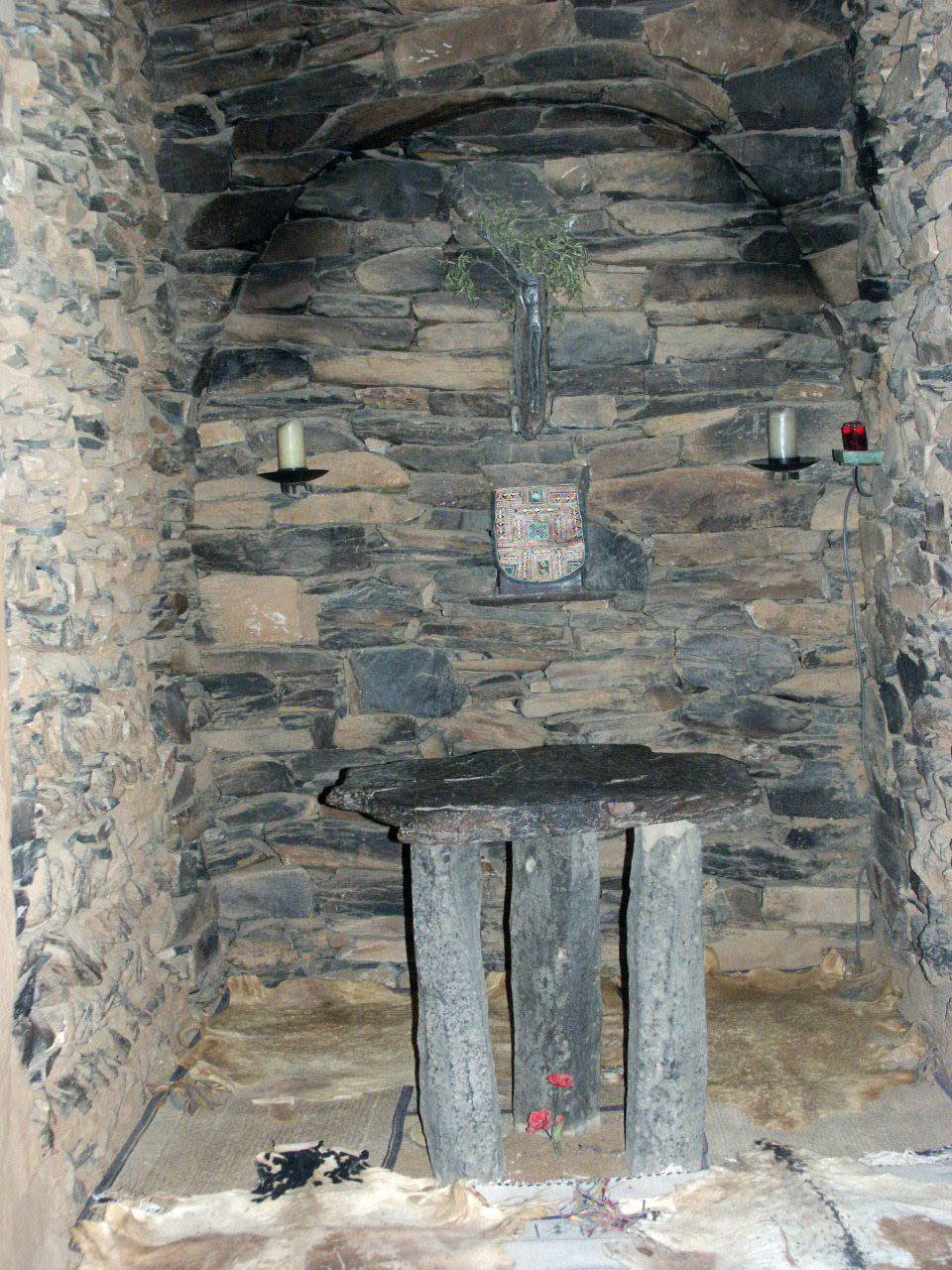
The altar within de Foucauld's hermitage

I recall that while Bl Charles de Foucauld was a hermit out in the wilds of the Sahara, for long years, though he was a priest, he couldn't say Mass – because there was no one to attend it.

The old rule always was that even at a private Low Mass, there must always be a server, or, in default of that, someone (even a laywoman) kneeling at the altar rail to give the responses.  In fact, even if he or she couldn't give the responses, that person's mere presence would minimally suffice: for at least someone had to be there as well.

Just as the priest acts in the person of Christ the Head, there must be a member of the Church present (the server, so to speak, acts in the name of the Church when he gives the responses - for at High Mass, the choir sings the responses, as ideally the whole congregation does).

After some years, Bl Charles obtained special permission from the Holy See to say Mass entirely alone – since there were no other Christians anywhere at all nearby, and the local Muslims were hardly to be expected to come and assist at Mass (seeing as he never converted any of them).

(In passing, the question may be asked, would the attendance of a pagan, an unbaptized person, suffice?  One suspects not...)

But, when Mass is said by a priest entirely alone, what special rubricks would he observe?

Some concerns are already provided for, as in the case of the absence of a server (so for instance the priest himself moves the missal, etc.).  Obviously, as in a private Mass anyway, there would be no ringing of bells; since the priest would have no one to pour the first ablution over his fingers, I suppose he would first dip them in the fingerbowl (the correct name for this escapes me) next to the tabernacle, and later consume the water therein [UPDATE – no, see 0. below for the right rule]: but there should be rubrickal directions for this, at least in the approved authors.

Five points come to mind:

1.  The priest would say everything the server normally would (as in the recitation of the Office, prior to the last preconciliar changes, he would himself respond to his own Dominus vobiscum), following any special rules (as for example the special form of the Suscipiat, already provided in the missal for the priest to say if the server fail to make the response);

2.  As there is no one to reply with the Misereatur, the priest would presumably follow the rule for when Compline is said by one alone, and say it himself (suitably modified) – the server's Confiteor and the priest's reply being utterly omitted, then at once would follow the Indulgentiam;

3.  Would the priest need to turn from the altar toward the non-existent congregation at the Dominus vobiscum and Orate fratres? it would seem superfluous and ridiculous to do so – but perhaps he ought, remembering that the Angels are present;

4.  At the end of Mass, it would seem again silly and pointless to give a blessing in the absence of any people present – the Carthusians never do, precisely since they have no layfolk at their Masses, though significantly their books note that if, for some strange reason, some such are present, then a blessing should be given as is the general custom.

I await some advice from rubrickal experts about all this...

******

UPDATE: I finally thought to open up Fortescue-O'Connell-Reid (the latest, 15th, Summorum Pontificum, 2009 edition), and behold!  My queries are answered.

Firstly, the strictures against Mass entirely alone have been much relaxed in the new Code of Canon Law, since the priest's desire of and devotion to saying Mass, even if no one be in attendance, are considered a solid reason for doing so.

0.  At the ablutions, either the priest first pours wine then water over the index finger and thumb of his left hand, and then does the same for his right hand (swapping the cruets from hand to hand as necessary), or he may thus cleanse the left hand digits in question, then dip those of his right into the chalice to purify them;

1.  O'Connell questioned the saying the Dominus vobiscum, but the other expert authors reject this – and as noted above, in the Suscipiat the priest makes the modification of saying de manibus meis;

2.  According to a response from the Sacred Congregation of Rites (no. 3975), the Confiteor is to be said only once, omitting entirely vobis fratres and vos fratres, and similarly the priest says at once Misereatur nostri;

3.  The question of whether to turn or not at the salutations and admonition is not dealt with – I suppose that silence betokens consent, and the priest should still turn ad populum (though no one be there!), since this signifies the truth that, even when the priest celebrates alone, Mass is an action of the whole Church, and he truly offers up the Saving Victim for all and on behalf of all;

4.  I had sided with O'Connell's minority opinion about omitting the blessing at Mass's end, but in a footnote the other authors contradict him on this, for the same reasons as noted immediately above.

Some other directions: when moving the missal, the priest does not genuflect (as a server would when doing so) but merely bows his head to the altar crucifix.  For convenience, the cruets and lavabo bowl are either arranged on a credence close to the altar, or even placed on the altar itself.

Sunday, January 31, 2010

Septuagesima till Easter: Rubricks

In the Dominican Office, as in the Roman, of course no use is made of Alleluia from after first Vespers of Septuagesima until Easter Sunday.  In place of that heavenly word, after the initial Glory be of each Hour, we sing the earthly words Laus tibi, Domine, Rex æternæ gloriæ.

From this day until Easter (excepting 3rd class feasts until Ash Wednesday - and from that day on never save on the few feasts of 1st and 2nd class: the Chair of St Peter; St Matthias; for Dominicans, St Thomas Aquinas; for Australians and the Irish, St Patrick; St Joseph; the Annunciation), no Te Deum is said at Matins, nor Gloria in excelsis sung at Mass.  (To avoid such festal joy entirely during the penitential season before Easter, the Mozarabic and Ambrosian Rites moved all such feasts out of Lent.)

At Lauds of ferias from now till Easter, the second, more penitential set of psalms are used, beginning every day with Psalm 50, the Miserere.  On Sunday, moreover, Psalm 117 is sung next at Lauds (not as usual at Prime, where Psalm 53 substitutes), thus entirely omitting the joyful Psalms 92 and 99.

 The old, longer daily canticles of Lauds, those used before the reforms of Pope St Pius X, also reappear: on Monday, Confitebor tibi, the Canticle of Isaias; on Tuesday, Ego dixi, the Canticle of Ezechias (Hezekiah); on Wednesday, Exsultavit cor meum, the Canticle of Anna; on Thursday, Cantemus Domino, the triumphant Canticle of Moses at the Red Sea; on Friday, Domine audivi, the Canticle of Habacuc; on Saturday, Audite cæli, the terrible Canticle of Moses against faithless Israel.  On Sunday, however, lest the Hour be too burdensome by reason of length, in place of the traditional Benedicite is sung the shorter Benedictus es, also from the Canticle of the Three Young Men.

Furthermore, in the Dominican Rite, on all ferias (as has been the case since the end of Christmastide on the 13th) the preces - threefold Kyrie and Pater noster - are said at Lauds, at Terce, Sext, and None, and at Vespers, before the Dominus vobiscum and collect.

Once Lent begins, the ferial days thereof take precedence of all 3rd class feasts, which are reduced to a Memorial at Lauds.

Already, from Septuagesima Sunday, the way the short responsories at Terce, Sext and None are read changes: the respond (the initial line) is not repeated at once as usual, but instead the versicle is said directly, then the second half of the respond (after the asterisk) as usual, then the Glory be, then the respond in full, thus:

R/.
V/.
*
Gloria Patri...
R/.

(This variation is proper to the Dominican Rite.)

Tuesday, January 19, 2010

Catholic Ærobics

All this kneeling, sitting, and standing at Mass - a friend once called it "Catholic ærobics".

(The Eastern equivalent is the continual crossing of oneself and bowing - making the metanoia - at the Divine Liturgy; their continual standing is itself quite penitential, given the length of the service and the fact that no change of posture is really tolerated, apart from the Catholic practice of kneeling at the consecration, in imitation of the Western Rite; I am aware that the people may sit at certain parts such as the reading of the Epistle, particularly in Western lands where the churches are furnished with pews, but this is likewise not original.)

I got thinking about this topic last night...

Consider, firstly, the customary posture for the faithful at High Mass:


  • stand for the entrance of the priest and ministers;
  • kneel for the prayers at the foot of the altar;
  • stand when the priest ascends to the altar;
  • sit if the priest sits for the (Kyrie and) Gloria, given the length of the singing thereof;
  • stand for the Collect;
  • sit for the Epistle and following chants;
  • stand for the Gospel;
  • sit for the Homily;
  • stand for the Creed (kneeling at the Incarnatus est), remain standing for the salutation Dominus vobiscum and Oremus;
  • sit for the Offertory;
  • stand to be censed;
  • stand for the per omnia sæcula sæculorum, the ensuing Sursum corda dialogue and the Preface;
  • kneel for the Sanctus and Canon;
  • stand for the Pater noster, Embolism and Pax;
  • kneel at the Agnus Dei and remain kneeling until the tabernacle is closed after communion (standing only to go up to the altar rails for communion and to return therefrom), after which one may sit;
  • stand for the Dominus vobiscum, Postcommunion and Ite missa est;
  • kneel for the blessing;
  • stand for the Last Gospel (genuflecting at Et Verbum caro factum est) and for the priest's egress.

(While the above is what I am used to in Australia, Fortescue-O'Connell-Reid suggests instead that the faithful ought continue standing until the Consecration, for which they kneel, only to stand up again for the rest of the Canon!  Similarly, it provides that the people remain standing until Communion, saying nothing of kneeling at the Agnus Dei.  Clearly, the times for kneeling varied widely in the old rite, according to the custom of the place.)

Compare this to the far simpler arrangement for Low Mass (which, while technically overruled and conformed to the High Mass practice in 1960 or 1961, is still observed for Low Mass in most places, as Fortescue-O'Connell-Reid notes):

  • stand for the priest's progress to the altar;
  • kneel when he begins Mass with the sign of the cross;
  • sit for the Epistle (some if not many continue kneeling, but I always sit, following the custom I learnt);
  • stand for the Gospel;
  • sit for the Homily if there is one;
  • stand for the Creed if there is one (genuflecting in the usual place);
  • sit for the offertory onwards;
  • kneel at the Sanctus, and remain kneeling (but for going to and from the altar rails);
  • if desired, sit after the tabernacle is closed, during the ablutions (otherwise remain kneeling);
  • stand for the Last Gospel (genuflecting at the usual words);
  • stand as the priest leaves.

At the modern form of the Mass, these practices are modified, and the posture observed mainly parallels that at High Mass.

There are two exceptions: the priest, ministers and people no longer kneel for the preparatory, penitential prayers - except in Ireland - and neither do the faithful kneel for the blessing at the end of Mass - again, except in Ireland, where they still do, following what their bishops decreed.

While in the Ordinary Form of Mass there is no provision made for sitting during a long sung Kyrie or Gloria, by custom (as at the Cathedral in Melbourne, and elsewhere, such as the Oxford Oratory) the clergy and people still sit at this point: one can't stay standing forever...

Liturgical scholars sometimes assert that the salutation and Oremus at the start of the offertory in the Extraordinary Form is the remnant of the old intercessory prayers at this point; as these are restored (more or less happily) in the new Mass, quite sensibly all stand for them.

As I discussed in my last post, a small rubrickal change has been recently made in the new Mass: rather than standing for the Prayer over the 'Gifts' (Oblations), now all stand at the Orate fratres - which equates to the Oremus said elsewhere.

Another change in the modern rite compared to the older form - according to the rules observed in English-speaking countries - is that the congregation kneels after the Sanctus and Agnus Dei, rather than when they start.  If these are chanted, or sung to some simple modern tune, both are quite quickly over; however, if both are long-drawn-out settings, it would be sensible to kneel down, rather than stand stupidly while the choir sings on and on...

Observe that these last two rules apply only in some nations, because the universal rule in the Novus Ordo is to stand from the Orate fratres until the end of the whole Mass, excepting only to kneel at the Consecration itself (setting it off from the rest of the Eucharistic Prayer as the sacred moment of transsubstantiation and worship of Christ made present, be it noted), and to sit, if desired, during the silent pause (if any) after communion.

Clearly, the bishops of the U.S.A., of Australia, of England and Wales, and so forth, feeling that it would be cause for scandal among the faithful if they were suddenly told to stand rather than kneel at these accustomed times, obtained - as the current Roman Missal itself permits - permission from Rome for such local adaptations of the rubricks.  Indeed, the current General Instruction goes so far as to say that, where it is the custom of kneeling for the whole Eucharistic Prayer, such a practice may laudably be retained - which is Rome's way of saying it were wished this pious Catholic practice be kept!

As noted above, in Ireland all fall on their knees for the Penitential Rite, directly after the Sign of the Cross and the opening salutation, and likewise observe a kneeling posture for the blessing.  It would be nice, and more in continuity with the traditional practice, to do this at Mass not just in Ireland but elsewhere - I recall that in the aborted 1990's ICEL proposals for Mass in English, one suggested option was precisely to kneel for the penitential prayers (the Confiteor, Kyrie and suchlike) at least in Lent: who could disagree?  When in Italy just last week, noting how there was much more freedom of posture among the different people at Mass, I happily knelt for the blessing when attending the Ordinary Form in Florence: why not!

I still want to find out, though, why it is that the posture of the faithful, both in the old and new forms of Mass, is so divergent in Scotland...

Sunday, April 12, 2009

Rubrical Conundrum

I have a rubrical conundrum that any readers may be able to help to puzzle out: my 1962 Breviary (a 1995 FSSP reprint of the 1961 Dessain edition) has, for Monday to Saturday in the Octave of Easter, a versicle to be said at Lauds (In resurrectione) and Vespers (Mane nobiscum) instead of the Hæc dies that is appointed for Easter Sunday; but in the General Rubrics of the Breviary, no. 205 specifies that versus dicitur... in festo et per octavam Paschatis in solo nocturno, which I take to mean that during the Easter Octave, a versicle is only said at the sole Nocturn of Matins, and not at Lauds nor at Vespers, and this would imply that the Hæc dies ought be said every day of the Easter Octave, even at Lauds and Vespers. 

Can anyone advise how to solve this contradiction between the Proper and the General Rubrics?