Showing posts with label All Relics. Show all posts

Friday, November 5, 2010

All Relics

Like Gollum, I consider some things very precious: such as my collection of second- and third-class relics.  Ever deserve they to be kissed and revered, for in doing so I pay veneration to the spirits of just men made perfect, one day to rise again in glory (may I be numbered amongst them), and ultimately refer all honour and glory to Him, our King Christ, Who elected them and made them holy by His most Precious Blood.

As a layman, of course, I can hardly lay claim to any great hoard of sacred remains: it would hardly be fitting if I had such; for Canon Law prescribes that a bishop's permission is needed for to have first class relics, I recall.  (Yet I knew a priest who kept relics of all the apostles in a shoebox under his bed!  And a former seminarian of my acquaintance had known "a corrupt nun at the relics' office" from whom he had obtained many valuable relics which he shouldn't have had.  But worst of all was the American seminarian in Rome who was dismissed in the late nineties for forging relics out of animal bones and selling them to gullible countrymen of his.)

The relics:
  • Of Bl Columba Marmion, abbot (feast day: 3rd Oct.) – attached to a holy card, a piece of cloth labelled "A piece of the Religious habit worn by Blessed Columba Marmion" (2nd class);
  • Of St Dominic, priest, founder of the Dominicans (4th Aug.) – attached to a holy card, a piece of cloth labelled "Cloth which has touched the Head of St. Dominic" (3rd cl.);
  • Of St Antony Mary Zaccaria, priest, founder of the Barnabites (5th July) – attached to a holy card, a piece of cloth labelled pannolino che toccò le ossa di S. Antonio M. Zaccaria (3rd cl.);
  • Of St Pio of Pietrelcina, priest, O.F.M.Cap. (23rd Sep.) – attached to a holy card, a piece of cloth labelled "third class relic" (3rd cl.);
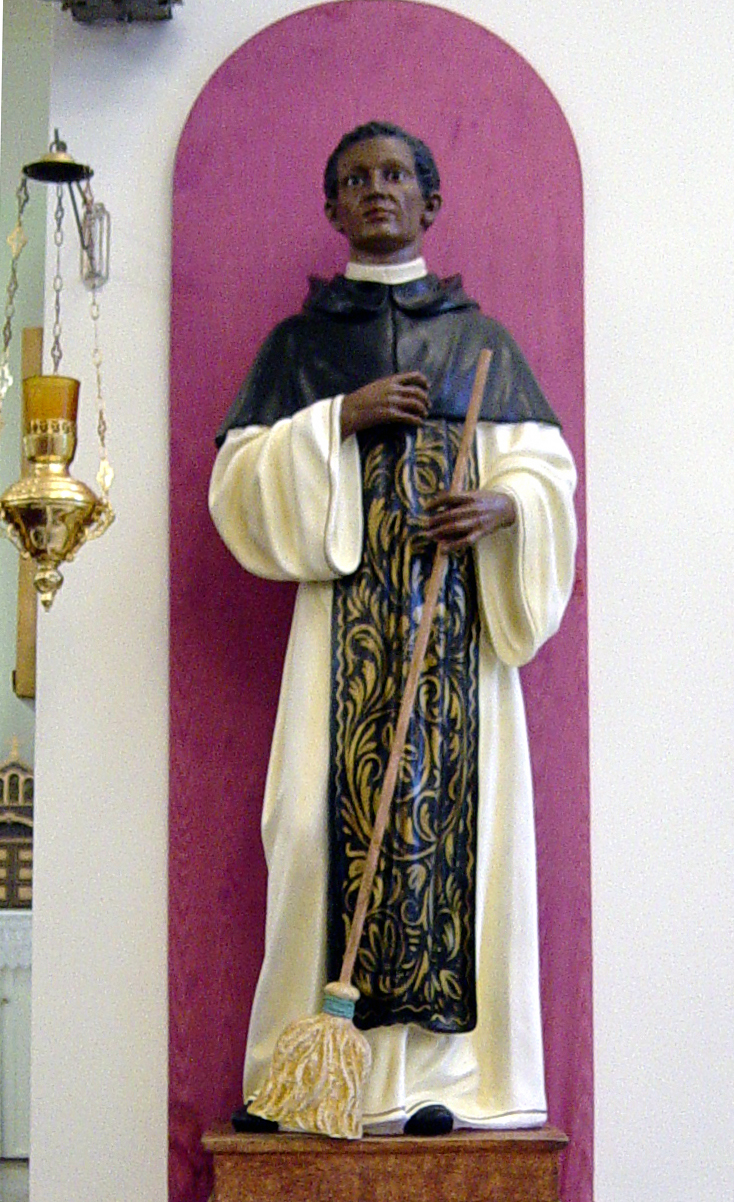
  • Of St Martin de Porres, O.P. (5th Nov.) – attached to a holy card, a piece of cloth labelled "Linen touched to his body" (3rd cl.);
  • St Peregrine, priest, Servite (1st May) – attached to a medal, a piece of cloth labelled "relic" (prob. 3rd cl.);
  • St Catherine of Siena, virgin (30th April) – attached to a medal, a piece of cloth labelled reliquia (probably 3rd cl.);
  • St Faustina, virgin (5th Oct.) – attached to a holy card, a unlabelled piece of cloth (prob. 3rd cl.);
  • St Thérèse of Lisieux, virgin, O.C.D. (3rd Oct.) – attached to a medal, a small unlabelled piece of cloth (prob. 3rd cl.); and, attached to a holy card, a small piece of cloth labelled "cloth touched to relic of St Thérèse" (3rd cl.);
  • Bl Maria Sagrario of St Louis Gonzaga, virgin & martyr, O.C.D. (16th Aug.) – attached to a holy card, a small unlabelled piece of cloth (prob. 3rd cl.).
Out of curiosity I have compiled this list of these relics I have; they repose with icons, crucifix and candles on the makeshift altar (or, as the Russians would have it, in the "beautiful corner", the krasnyy ugol, красный угол) in my study, in front of my prie-dieu.  What prayer to pray?  That said by the priest when kissing the altar at the start of Mass, Oramus te, or, more anciently, Oro te - in either case, perhaps changing to the plural at the end to pray for all; or perhaps that used of old likewise at the farewell osculation of the altar; and of course the Collect for the feast of All Relics, observed in sundry places on this very day, the 5th of November:

Oramus [Oro] te, Domine, per merita Sanctorum tuorum, quorum reliquiæ hic sunt, et omnium Sanctorum, ut indulgere digneris omnia peccata mea [nostra].  Amen.

(We [I] pray thee, Lord, by the merits of Thy Saints, whose relics are here, and of all the Saints, that Thou wouldst deign to forgive all my [our] sins.  Amen.)

Meritis et intercessionibus istorum et omnium Sanctorum suorum misereatur nobis omnipotens Dominus.

(By the merits and intercessions of these and of all His Saints, may the Lord almighty have mercy upon us.)

Auge in nobis, Domine, resurrectionis fidem, qui in Sanctorum tuorum reliquiis mirabilia operaris: et fac nos immortalis gloriæ participes, cujus in eorum cineribus pignora veneramur.  Per...

(Increase in us, O Lord, faith in the resurrection, Who dost work wonders by the relics of Thy Saints: and make us partakers of that immortal glory, a pledge of which we venerate in their ashes.  Through...)

St Martin de Porres

Martinus, filius Joannis de Porres, equitis Hispaniæ, et Annæ Velasquez, suffuscæ libertæ, Limæ in America meridionali anno millesimo quingentesimo [septuagesimo*] nono lucem aspexit  – "Martin, son of Juan de Porres, knight of Spain, and Anna Velasquez, mulatto freedwoman, at Lima in south America in the year 1579 [first] beheld the light": thus begins the third lesson at Matins for to-day in the Dominican Breviary, marking this fifth of November as the feast of St Martin de Porres proper to the Friars Preachers.  (In the modern liturgy, his feast has been moved to the third, the day of his death or rather of his birth into eternal light and life; but I do hope that, in Adelaide, Fr Mannes has offered Mass in his honour to-day.)

[* A strange oversight omits the word "seventy" from his date of birth, implying that he was born in Lima during the Inca Empire!]

Adopting for the moment my latest system of praying the Hours (reading only three psalms at Matins, as is done in the Dominican Breviary throughout Eastertide), which enables me, a reasonably busy layman, to gain most of the benefits of the Office, has indeed brought blessings, such as this holy memorial.  I was minded to reach for my second- and third-class relics, among which I have a holy card of St Martin complete with a piece of linen touched to his body: I paid due veneration to him through this.  How apt, given that in many places to-day is also the feast of All Relics...

St Martin famously wears a now-suppressed variant of the habit of the Blackfriars; pray for Dominican lay-brothers, that their vocation prosper and not perish, and that they get back their proper habit of the black scapular, taken from them on the pretext of equality...

St Martin, son of Spain and son of Africa, son of a gentleman and son of a slave, born and bred in the new conquests of Spain in South America, trained as a surgeon, but aspiring after holiness as a Dominican Tertiary, was in course of time admitted as a lay brother to the convent of the Friars Preachers in Lima, where he exercised a humble and holy ministry as a true servant to all, both within and outwith, to the fathers and to the slaves, to orphans and dumb animals, filled with prayer and working wonders on all sides.  All Lima lamented his passing: but with miracles he continues to coruscate and shine.  

I know a Dominican who owes his parents' meeting, his birth and that of his siblings, and his vocation, to an apparition of St Martin in Melbourne in the last fifty years: an event implicitly commemorated in the Wallace window at St Carthage's Cathedral, Lismore.

Herewith, the Dominican Rite Proper for St Martin de Porres:


Officium (Ps. 91, 13-14)

Justus ut palma florebit: sicut cedrus Libani multiplicabitur: plantatus in domo Domini, in atriis domus Dei nostri.  Ps. 91, 2.  Bonum est confiteri Domino: et psallere nomini tuo, Altissime.  Gloria Patri…  Justus…

Oratio

Deus humilium celsitudo, qui beatum Martinum confessorem tuum ad cælestia regna transire fecisti; ejus meritis et intercessione concede, nos ejus humilitatem ita imitari in terris, ut cum ipso exaltari mereamur in cælis.  Per…

Epistola (Phil. iii, 7-12)

Fratres: 
Quæ mihi fuerunt lucra, hæc arbitratus sum propter Christum detrimenta.  Verumtamen existimo omnia detrimentum esse propter eminentem scientiam Jesu Christi Domini mei: propter quem omnia detrimentum feci, et arbitror ut stercora, ut Christum lucrifaciam: et inveniar in illo non habens meam justitiam, quæ ex lege est, sed illam, quæ ex fide est Christi Jesu: quæ ex Deo est, justitia in fide: ad cognoscendum illum, et virtutem resurrectionis ejus, et societatem passionum illius, configuratus morti ejus, si quo modo occurram ad resurrectionem, quæ est ex mortuis.  Non quod jam acceperim, aut jam perfectus sim: sequor autem, si quomodo comprehendam, in quo et comprehensus sum a Christo Jesu.

Responsorium (Ps. 20, 4-5)

Domine, prævenisti eum in benedictionibus dulcedinis: posuisti in capite ejus coronam de lapide pretioso.  V/.  Vitam petiit a te: et tribuisti ei longitudinem direum in sæculum sæculi.

Alleluia (Ps. 63, 11)

Alleluja, alleluja.  V/.  Lætabitur justus in Domino, et sperabit in eo: et laudabuntur omnes recti corde.  Alleluja.

Evangelium (S. Matt. xi, 25-30)

In illo tempore: Respondens Jesus dixit: Confiteor tibi, Pater, Domine cæli et terræ, quia abscondisti hæc a sapientibus, et prudentibus, et revelasti ea parvulis.  Ita Pater; quoniam sic fuit placitum ante te.  Omnia mihi tradita sunt a Patre meo.  Et nemo novit Filium, nisi Pater: neque Patrem quis novit, nisi Filius, et cui voluerit Filius revelare.  Venite ad me omnes qui laboratis, et onerati estis, et ego reficiam vos.  Tollite jugum meum super vos, et discite a me, quia mitis sum, et humilis corde: et invenietis requiem animabus vestris.  Jugum enim meum suave est, et onus meum leve.

Offertorium (Ps. 91, 13)

Justus, ut palma florebit: sicut cedrus, quæ in Libano est, multiplicabitur.

Secreta

Hanc hostiam, Domine, quam tibi in honorem beati Martini confessoris sacrandam offerimus, benignus suscipe; et præsta ut ejus pia intercessione, nobis effectum tuæ salvationis impendat.  Per…

Communio (S. Matt. xix, 28-29)

Amen dico vobis, quod vos, qui reliquistis omnia, et secuti estis me, centuplum accipietis, et vitam æternam possidebitis.

Postcommunio

Cælestibus alimentis enutriti, supplices te rogamus, Domine Deus noster, ut beato Martino confessore pro nobis intercedente, tuis semper valeamus obedire mandatis.  Per…

Thursday, November 6, 2008

Relics - IV

I've finally tracked down the Roman Office of Holy Relics; as I surmised, it is almost wholly taken from the Common of Many Martyrs, excepting only the proper Collect (which I have already given in an earlier post), the use of the second alternative lessons for the 3rd Nocturn (from St Ambrose - they are in the Breviary, Adverte omnia and so forth), and, as the only special item, 2nd Nocturn lessons from St John Damascene - honestly, not so relevant as those provided in the Paris Breviary - which I here append in both the original Latin (thanks to a tip given by a commenter at NLM, located at Google Books) and in the Marquess of Bute's idiosyncratic translation:

Ex Tractatu Sancti Joannis Damasceni
de Fide orthodoxa. 


Lectio iv.   (Lib. 4. c. 15.)

Christus Dominus Sanctorum Reliquias velut salutíferos fontes præbuit, ex quibus plurima nobis beneficia manant, suavissimumque unguentum profluit. Nec vero quisquam huic sermoni fidem detrahat; nam si aqua in deserto ex áspera et solida rupe, atque ex asini maxilla ad sedandam Samsonis sitim, Deo ita volente, prosiliit, eritne, cur cuiquam incredibile videatur, ex Martyrum Reliquiis suave unguentum scaturire? Minime certè; iis quidem, quibus Dei potentia, honorque, quo Sanctos suos afficit, perspectus et exploratus est. Atque illud quidem veteri lege comparatum erat, ut quisquís mortuum contigisset, immundus censeretur; verùm hi in mortuorum numéro minime habendi sunt.

Lectio v.

Ex quo enim ipsamet vita, ac vitæ auctor inter mortuos adscriptus est, eos, qui in spe resurrectionis fideíque erga eum diem extremum clauserunt, mortuos haudquaquam appellamus. Qui enim mortuum corpus miracula edere queat? Per ea dæmones expelluntur, morbi profligantur, ægroti sanantur, cæci prospiciunt, leprosi mundantur, tentationes ac mærores discutiuntur, ac denique omne donum optimum a Patre luminum, eorum opera, ad eos, qui flde minine dubia postulant, descendit. Quid non laboris suscipias, ut patronum quemdam nanciscaris, qui te mortali régi оfferat, ас tuo nomine ad eum verba faclat? An non igitur hi honorandi sunt, qui totius humani generis patronos se profitentur, ac Deo nostra causa supplicant?

Lectio vj.

Honorandi certè, et quidem ita, ut in eorum nomine templa Deo extruamus, dona offeramus, eorum memoriam colamus, atque in ea spiritualiter oblectemur; quo nimirum lætitia nostra iis, a quibus invitamur, congruat, ne, dum eos colère et demereri studemus, offendamus potiùs, et irritemus. Quibus enim rebus Deus colitur, iisdem quoque servi ipsius oblectantur; quibus autem Deus offenditur, iisdem etiam ipsius milites offenduntur. Quocirca in psalmis, et hymnis, et canticís spiritualibus, et compunctione, et eorum, qui in egestate versantur, commiseratione, quibus obsequiis Deus potlssimùm conciliator, Sanctos colamus, statuas ipsis, et visibiles imagines erigamus; imo ipsi virtutibus eorum imitandis hoc consequamur, ut vivæ eorum statuæ atque imagines simus.


The Lesson is taken from the Treatise by St John of Damascus upon the Orthodox Faith (iv. 15.)

He the Lord Christ hath made the relics of the Saints to be as it were healing wells, whence floweth for us much good, and a right sweet balm. Do not let any one gainsay this. If God was pleased that water should flow out of the hard and living rock in the desert, or again out of the jaw bone of an ass in order to quench the thirst of Samson, why should it seem to any one impossible to believe that He should cause a sweet balm to flow from the relics of the martyrs? Nay. None will gainsay this who hath seen and known that power and honour wherewith God doth glorify His Saints. It is written in the old Law, [Num. xi. 16] "Whosoever toucheth… a dead body, or a bone of a man, or a grave, shall be unclean." But the martyrs we cannot reckon among the dead. 

For since the Life Himself and the Author of life was numbered among the dead we cannot call them dead who have died in the hope of the Resurrection, and in faith toward Him. How could a corpse work miracles? But through the Saints devils are cast out, diseases are put to flight, the sick are healed, the blind receive their sight, lepers are cleansed, trials and sorrows are done away; in short, through the Saints every good gift and every perfect gift cometh down from the Father of Lights upon them who believe, nothing wavering. What trouble wouldst thou not take to find a patron to commend thee unto an earthly king and to speak unto him on thy behalf? and are not they to be honoured who offer themselves as the patrons of all mankind and who entreat God on our behalf? 

In good sooth are they to be honoured, and thus honoured that we should build temples and offer oblations to God in their name, that we should worship their memories and rejoice therein with spiritual joy, but a joy which should become them by whom we are invited thereto, and not one by which, while we are seeking to worship them and deserve well of them, we should rather insult and provoke them. Those things by which God is worshipped give pleasure to His servants. Those things by which God is insulted offend His champions, therefore let us worship the Saints with psalms and hymns and spiritual songs, and repentance, and pitifulness toward the poor, the which things are a service acceptable to God. Let us put up to them statues and visible images, but let us rather by imitating their goodness make ourselves their living images.

Relics - III

While I have been unable to locate the Breviary Office for Holy Relics pro aliquibus locis, I have found, via Google Books, the Neo-Gallican Office of this feast, which in the Paris Breviary was celebrated on the 8th of November, the Octave Day of All Saints (see the Autumn volume of the Breviarium Parisiense, pages 493 to 500).  

As was the fashion in the eighteenth century among innovating liturgists, all the antiphons, responsories, versicles and such were taken from Holy Writ alone, and that a very fulsome and rich collection of apposite passages was assembled it must be admitted; the only Ecclesiastical compositions present were the Patristic texts for the second and third Nocturn (from St Chrysostom's 26th Homily on II Corinthians, n. 5; and St Jerome's Letter LXXV against Vigilantius), the reading of a short canon approving the cult of relics from a 1584 French provincial synod (a peculiarity of Prime according to the French diocesan breviaries), the two Office hymns O vos unanimes and Adeste sancti plurimo (by a contemporary French writer) and the collect, which is the same as the Roman.

Here's the Canon:


(We honour the Relics of the Martyrs, that God, Whose servants they are, we may adore: we honour the servants, that the honour of the servants may redound to the Lord.  For if the bones of the Martyrs pollute those who touch them, how, Elias the Prophet being dead, did he raise the dead?)

To give an idea of some modernistic notions of the compilers of the Paris Breviary, for the whole feast, at every Hour, the ferial psalms are prescribed, and there are no proper Scripture readings for the 1st Nocturn; instead, they were to be taken from the occurring lectio continua!

Here, then, are the proper Lessons (for the 2nd and 3rd Nocturns) from the Parisian Breviary for the feast of Holy Relics:

A Sermon of St John Chrysostom

[
Homily 26 on II Corinthians, n. 5]

And the tombs of the servants of the Crucified are more splendid than the palaces of kings; not for the size and beauty of the buildings, (yet even in this they surpass them,) but, what is far more, in the zeal of those who frequent them. For he that wears the purple himself goes to embrace those tombs, and, laying aside his pride, stands begging the saints to be his advocates with God, and he that has the diadem implores the tent-maker and the fisherman, though dead, to be his patrons. Will you dare then, tell me, to call the Lord of these dead; whose servants even after their decease are the patrons of the kings of the world? And this one may see take place not in Rome only, but in Constantinople also. For there also Constantine the Great, his son considered he should be honoring with great honor, if he buried him in the porch of the fisherman; and what porters are to kings in their palaces, that kings are at the tomb to fisherman.

But if you will compare these tombs with the royal palaces, here again the palm remains with them. For there indeed there are many who keep off, but here many who invite and draw to them rich, poor, men, women, bond, free; there, is much fear; here, pleasure unutterable. 'But,' says one, 'it is a sweet sight to look on a king covered with gold and crowned, and standing by his side, generals, commanders, captains of horse and foot, lieutenants.' Well, but this of ours is so much grander and more awful that that must be judged, compared with it, to be stage scenery and child's play. For the instant you have stepped across the threshold, at once the place sends up your thoughts to heaven, to the King above, to the army of the Angels, to the lofty throne, to the unapproachable glory.

… the bones of the saints… summon demons and put them to the torture, and loose from those bitterest of all bonds, them that are bound. What is more fearful than this tribunal? Though no one is seen, though no one piles the sides of the demon, yet are there cries, and tearings, lashes, tortures, burning tongues, because the demon cannot endure that marvellous power. And they that once wore bodies, are victorious over bodiless powers; [their] dust and bones and ashes rack those invisible natures. And therefore in truth it is that none would ever travel abroad to see the palaces of kings, but many kings and have often traveled to see this spectacle. For the Martyries of the saints exhibit outlines and symbols of the judgment to come; in that demons are scourged, men chastened and delivered. Do you see the power of saints, even dead?

A Homily of St Jerome the Priest.

[Ep. 75 adversus Vigilantium, n. 5]

It is nothing less than the relics of the martyrs which he is vexed to see covered with a costly veil, and not bound up with rags or hair-cloth, or thrown on the midden, so that Vigilantius alone […] may be worshipped. Are we, therefore guilty of sacrilege when we enter the basilicas of the Apostles? Was the Emperor Constantius [I] guilty of sacrilege when he transferred the sacred relics of Andrew, Luke, and Timothy to Constantinople? In their presence the demons cry out, and […] confess that they feel the influence of the saints. And at the present day is the Emperor Arcadius guilty of sacrilege, who after so long a time has conveyed the bones of the blessed Samuel from Judea to Thrace? Are all the bishops to be considered not only sacrilegious, but silly into the bargain, because they carried that most worthless thing, dust and ashes, wrapped in silk in golden vessel? […] You show mistrust because you think only of the dead body, and therefore blaspheme. Read the Gospel— [Matthew 22:32] “The God of Abraham, the God of Isaac, the God of Jacob: He is not the God of the dead, but of the living.”

[n. 6]  You say, in your pamphlet, that so long as we are alive we can pray for one another; but once we die, the prayer of no person for another can be heard, and all the more because the martyrs, though they [Revelation 6:10] cry for the avenging of their blood, have never been able to obtain their request. If Apostles and martyrs while still in the body can pray for others, when they ought still to be anxious for themselves, how much more must they do so when once they have won their crowns, overcome, and triumphed? A single man, Moses, oft wins pardon from God for six hundred thousand armed men [cf. Exodus 12:37, etc.]; and [Acts 7:59-60] Stephen, the follower of his Lord and the first Christian martyr, entreats pardon for his persecutors; and when once they have entered on their life with Christ, shall they have less power than before? The Apostle Paul [Acts 27:37] says that two hundred and seventy-six souls were given to him in the ship; and when [Philippians 1:23], after his dissolution, he has begun to be with Christ, must he shut his mouth, and be unable to say a word for those who throughout the whole world have believed in his Gospel? 

[n. 8]  Does the bishop of Rome do wrong when he offers sacrifices to the Lord over the venerable bones of the dead men Peter and Paul, as we should say, but according to you, over a worthless bit of dust, and judges their tombs worthy to be Christ's altars? And not only is the bishop of one city in error, but the bishops of the whole world, who, despite […] Vigilantius, enter the basilicas of the dead, in which “a worthless bit of dust and ashes lies wrapped up in a cloth,” defiled and defiling all else. Thus, according to you, the sacred buildings are [Matthew 23:27] like the sepulchres of the Pharisees, whitened without, while within they have filthy remains, and are full of foul smells and uncleanliness. […] Oh, monster, who ought to be banished to the ends of the earth! 

Tuesday, November 4, 2008

All Holy Relics & St Martin de Porres, O.P.

To-morrow, Fr Rowe will be celebrating (from the Masses pro aliquibus locis) the Mass of All Holy Relics; while Dominicans using their traditional liturgy will offer up the Sacrifice in honour of St Martin de Porres (according to the new books, his feast has just been held on Monday the 3rd).

Mirabilis Deus in sanctis suis - "God is wonderful in His saints" (Ps 67:36): how true this is, is made manifest in the cult of relics.

The Epistle for All Holy Relics is taken from Ecclesiasticus xliv, 10-15: which ends Corpora ipsorum in pace sepulta sunt, et nomen eorum vivit in generationem et generationem.  Sapientiam ipsorum narrent populi, et laudem eorum nuntiet Ecclesia.  ("Their bodies in peace are buried, and their names have lived in generation and generation.  Their wisdom let the peoples declare, and their praise let the Church proclaim.")  As for the Gospel, it is from St Luke vi, 17-23, which announces Our Lord's healing ministry and the shorter, Lukan version of the Beatitudes; as He is the Saint of saints, the fact that omnis turba quærebat eum tangere: quia virtus de illo exibat, et sanabat omnes, "all the multitude sought to touch Him: for virtue went forth from Him and healed all" serves as the preëminent and all-surpassing exemplar of the power of all relics.  

In the case of Christ, His sacred Humanity was and is the physical instrument of His Divinity, whereby he worked theandric acts (as Ps-Dionysius put it originally).  In the case of His saints, they were and are united to Christ by grace as members of His Body Mystical; their bodies were temples of the Holy Ghost, and, sundered from their holy souls in death, remain venerable, remain by God's goodpleasure instruments whereby their glorious suffrages and merits may be piously invoked, whereby the Lord may deign to grant graces according to His Will, Who ever delighteth in working through secondary causes.  It must not be forgotten, and indeed the Collect of the feast puts this in the first place, that the remains of the saints shall not moulder for ever, but are destined - as is all mortal flesh - to be one day reunited with the soul and rise incorruptible evermore: hence, relics may be said to venerated not so much for what they were, as for what they shall be - the glorified bodies of the saved.  As is par excellence the Body of Christ in the Eucharist, so too in their lesser configurement to Him the remains of His hallowed servants are "a pledge of future glory", which we pray we may share.

If I had been asked to consider what passages would answer as readings and chants for this feast, I would have guessed IV Kings xiii, 20-21 (a corpse, upon touching the bones of the holy prophet Eliseus disciple of Elias, is restored to life) and also Acts v, 14-16 (the new believers laid the sick on the streetside, that the shadow of St Peter fall on them as he passed; and they were all cured) and xix, 11-12 ("and God worked more than the usual miracles [!] by the hand of Paul" - even handkerchiefs that had but touched him effected cures).  If such be the effect of the shadow and of cloths touched to Princes of the Apostles, what virtue would not their sacred relics possess? - as shewn by the vivifying influence of the mortal remains of a prophet: all of these results being images of the greater spiritual healing and restoration to supernatural life that due veneration of relics can work in souls, by the grace of God.

(Recall that a first-class relic is an actual part of the physical remains of a saint, as the body of Bl Pier Giorgio Frassati, brought from Turin to Sydney for WYD, during which I venerated it along with so many others; a second-class relic, some item belonging to them, as for instance a piece of a religious habit worn by St Thérèse; a third-class, something merely touched to a first-class relic, as a piece of cloth touched to the relics of St Dominic.)

The Collect for All Sacred Relics:

Auge in nobis, Domine, resurrectionis fidem, qui in Sanctorum tuorum Reliquiis mirabilia operaris: et fac nos immortalis gloriæ participes; cujus in eorum cineribus pignora veneramur.  Per... 

(Increase in us, Lord, faith in the resurrection, Who in the Relics of Thy Holy Ones workest wonders: and make us partakers of the immortal glory, whose pledge we revere in their ashes.  Through...)