Showing posts with label Dominicans. Show all posts

Saturday, March 1, 2014

Rosary Prayers

After introductory versicles, begin the Rosary with the "Hail, Holy Queen", its usual versicle and the collect "O God, Whose Only-begotten Son" – this was the somewhat startling advice I found in several late nineteenth century books, said to follow the official method laid down for use amongst Dominicans.

These days, of course, one expects to say such prayers at the end of the decades (Dominicans still maintain the introductory versicles, instead of the newfangled Creed, Lord's Prayer and three Hail Mary's); then, instead, they were said beforehand, and afterward – where now they are recited – instead came first the Litany of Loreto, and then the Sub tuum and an anthem to St Dominic, with appropriate versicles and collects.

The collect connected to the Sub tuum in this arrangement seemed familiar, as I have seen it referred to as St Pius V's prayer for use at the conclusion of the Rosary – the more familiar "O God, Whose Only-begotten Son" having been introduced by his successor, Gregory XIII, when he approved a proper Mass and Office for the feast of the Rosary. But the prayer appointed by St Pius V is itself a modification of the Dominican collect for Marian feasts – unsurprising, as Pius was a Friar Preacher:
Supplicationem servorum tuorum, Deus miserator, exaudi, ut, qui in societate sacratissimi Rosarii Dei Genitricis et Virginis congregamur, ejus intercessionibus, a te de instantibus periculis eruamur. Per eumdem Christum Dominum nostrum. R/. Amen. 
(Hear, O merciful God, the prayer of thy servants: that we, who meet together in the Society of the most holy Rosary of the Virgin Mother of God, may, through her intercession, be delivered by thee from present dangers. Through the same Christ our Lord. R/. Amen.)
Having come across this old form, I now preface the Rosary with the Sub tuum, versicle Post partum and collect Supplicationem servorum quorum, plus – from what I've learnt from our local Monday night Rosary group – the Memorare, before I make the usual start by signing myself with sign of the Cross, saying the Creed, and so forth. 

Spanish sources gave a variant to the Dominican or rather "Pian" collect for the Sub tuum (which they paired with the collect of the Angelus for good measure), which I prefer, as it is not so much that we meet together in a society of the Rosary as instead meet to recite it – hence its use in the version given below (Dominicans omit "gloriosa et" in the Sub tuum, by the way):
Aña. Sub tuum presidium confugimus, sancta Dei Genitrix: nostras deprecationes ne despicias in necessitatibus, sed a periculis cunctis libera nos semper, Virgo gloriosa et benedicta. 
V/. Post partum, Virgo, inviolata permansisti. R/. Dei Genitrix, intercede pro nobis.
Oremus.
Supplicationem servorum tuorum, Deus miserator, exaudi: ut, qui ad recitandum sanctissimum Rosarium Dei Genetricis et Virginis Mariæ congregamur, ejus intercessionibus a te de instantibus periculis eruamur. Per eumdem Christum Dominum nostrum. R/. Amen. 
Ant. We fly to thy patronage, O Holy Mother of God: despise not our petitions in our necessities, but ever deliver us from all dangers, O glorious and blessed Virgin.
V/. After childbirth, O Virgin, thou didst remain undefiled. R/. Mother of God, intercede for us.
Let us pray.
Hear, O merciful God, the prayer of thy servants: that we, who meet together to recite the most holy Rosary of Mary, Mother of God and Virgin, may, through her intercession, be delivered by thee from present dangers. Through the same Christ our Lord. R/. Amen.

Saturday, February 22, 2014

Almost Finished

While in Rome on pilgrimage, four of us, during our visit to Santa Maria Maggiore, decided to go to confession. A little later, we compared penances, feeling a rather hard done by… a young lady had been told to say her Rosary every day for a week for a certain intention; one of our priests had been told to offer up his Breviary every day for a week for a similar cause; and Mike and I, upon learning that each of us had been told to offer up the Rosary for such and such an intention (I got "sincerity"), daily – for a month – felt uniquely put-upon.

I recall that, according to that devout book, The Secret of the Rosary, St Dominic assigned just such a lengthy penance to a pious Roman matron, who was in the habit of doing the rounds of the Seven Churches every day. Like her, I own to feeling more than a little discomfited!

Doubtless the … son of St Dominic in question (for the confessors at St Mary Major are Blackfriars) had been a-reading some such "manual of penance". I am now nearly finished fulfilling this penance – at least I have thereby got back to saying the Rosary. Perhaps that was the desired result.

Moral of the story: when on pilgrimage with no less than three priests, don't think to shop elsewhere. Or at the least, avoid the confessionals of Friars Preachers like the plague.

Friday, October 14, 2011

A Very Dominican Doctorate

Heard yester-day: Fr Joseph (of Missa contra amicas fame) was asked how his doctoral studies are progressing; he replied, I intend to finish the first draft of my thesis this year – then I plan to begin reading.

How very Dominican!

Saturday, February 19, 2011

Worship

As the late Fr Peter Knowles, O.P., forcefully stated, all the Sacraments are acts of worship – even Confession.  Confitemini Domino, quoniam bonus: quoniam in sæculum misericordia ejus – Confess to the Lord for He is good, for his mercy endureth for ever.  We cannot but worship God and praise Him for His goodness and mercy in offering us forgiveness of sins.

(He was a notable and beloved eccentric; having given up on the Western liturgy after its postconciliar reforms, and gone all Byzantine, he would often enquire of the brethren as to such matters as, "How do you Latins baptize?"  Fr Paul, whose ordination I attended last year, likes to joke that the proper reply to such a query is - say it in a broad Aussie accent - "We pour the water over the arse, Faaather!"  Likewise, whilst feasting on fresh oysters, he would hold forth on the rigours of Great Lent...  He is also famous for telling seminarians, making a retreat with him as director, that "The Holy Trinity is not a young man, an old man, and a bird!"  Quite right.)

What brings me to all this?  Going to confession this morning, as is my wont, and realizing anew what grace draws one to this sacrament, and what a plenitude of power for healing, temporal and eternal, it is – when, humanly speaking, how could man ever expect forgiveness for any sin?


Sunday, December 5, 2010

Seven Miles from Sydney

Thanks be to God: Fr Paul's Ordination and First Mass have been wonderful, and it was great to catch up afterward with so many old friends from all around Australia.  As he reminded us at the end of Mass this morning, Holy Mother Church grants a plenary indulgence (under the usual conditions) for the priest who offers and the people who attend his first Mass; and of course yester-day I received his priestly blessing, of inestimable value.

Please pray that Fr Paul may be a good and wise priest and preacher, for the salvation of souls and the greater glory of God.

******

Being in Manly, too, right on the Pacific, seven miles from Sydney on that spectacular ferry route, has been good indeed.

I'll while away the afternoon by visiting John, whose wedding I will attend next week, also in Sydney (it's just a simple wedding, with Solemn High Mass in the Cathedral; I forget if he's persuaded the Cardinal to assist).

Enjoying the view of the Harbour Bridge from Circular Quay last night, having taken that marvellous scenic ferry into the city for to see a movie, I was reminded of former P.M. Paul Keating's dictum, "If you're not in Sydney you're just camping out"; and earlier on, while traipsing round Manly, was amused and pleased to come across the electorate office of another great potential leader, Tony Abbott...

Time to go have yum cha for lunch again, I think.

******

P.S.  Looking back, I discover that the date I blogged this was the 3rd anniversary of my beginning this blog: St Sabbas (whose feast-day it is, and whom I have taken as patron of this enterprise), pray for us!

Friday, November 5, 2010

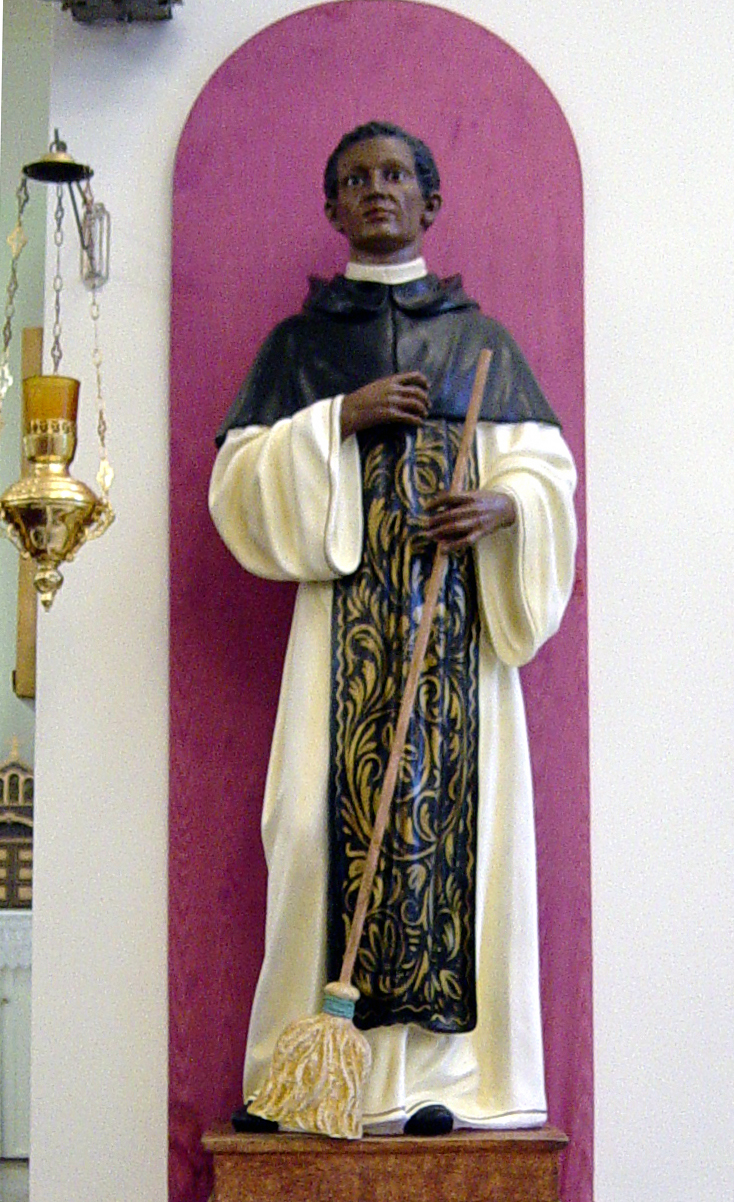
St Martin de Porres

Martinus, filius Joannis de Porres, equitis Hispaniæ, et Annæ Velasquez, suffuscæ libertæ, Limæ in America meridionali anno millesimo quingentesimo [septuagesimo*] nono lucem aspexit  – "Martin, son of Juan de Porres, knight of Spain, and Anna Velasquez, mulatto freedwoman, at Lima in south America in the year 1579 [first] beheld the light": thus begins the third lesson at Matins for to-day in the Dominican Breviary, marking this fifth of November as the feast of St Martin de Porres proper to the Friars Preachers.  (In the modern liturgy, his feast has been moved to the third, the day of his death or rather of his birth into eternal light and life; but I do hope that, in Adelaide, Fr Mannes has offered Mass in his honour to-day.)

[* A strange oversight omits the word "seventy" from his date of birth, implying that he was born in Lima during the Inca Empire!]

Adopting for the moment my latest system of praying the Hours (reading only three psalms at Matins, as is done in the Dominican Breviary throughout Eastertide), which enables me, a reasonably busy layman, to gain most of the benefits of the Office, has indeed brought blessings, such as this holy memorial.  I was minded to reach for my second- and third-class relics, among which I have a holy card of St Martin complete with a piece of linen touched to his body: I paid due veneration to him through this.  How apt, given that in many places to-day is also the feast of All Relics...

St Martin famously wears a now-suppressed variant of the habit of the Blackfriars; pray for Dominican lay-brothers, that their vocation prosper and not perish, and that they get back their proper habit of the black scapular, taken from them on the pretext of equality...

St Martin, son of Spain and son of Africa, son of a gentleman and son of a slave, born and bred in the new conquests of Spain in South America, trained as a surgeon, but aspiring after holiness as a Dominican Tertiary, was in course of time admitted as a lay brother to the convent of the Friars Preachers in Lima, where he exercised a humble and holy ministry as a true servant to all, both within and outwith, to the fathers and to the slaves, to orphans and dumb animals, filled with prayer and working wonders on all sides.  All Lima lamented his passing: but with miracles he continues to coruscate and shine.  

I know a Dominican who owes his parents' meeting, his birth and that of his siblings, and his vocation, to an apparition of St Martin in Melbourne in the last fifty years: an event implicitly commemorated in the Wallace window at St Carthage's Cathedral, Lismore.

Herewith, the Dominican Rite Proper for St Martin de Porres:


Officium (Ps. 91, 13-14)

Justus ut palma florebit: sicut cedrus Libani multiplicabitur: plantatus in domo Domini, in atriis domus Dei nostri.  Ps. 91, 2.  Bonum est confiteri Domino: et psallere nomini tuo, Altissime.  Gloria Patri…  Justus…

Oratio

Deus humilium celsitudo, qui beatum Martinum confessorem tuum ad cælestia regna transire fecisti; ejus meritis et intercessione concede, nos ejus humilitatem ita imitari in terris, ut cum ipso exaltari mereamur in cælis.  Per…

Epistola (Phil. iii, 7-12)

Fratres: 
Quæ mihi fuerunt lucra, hæc arbitratus sum propter Christum detrimenta.  Verumtamen existimo omnia detrimentum esse propter eminentem scientiam Jesu Christi Domini mei: propter quem omnia detrimentum feci, et arbitror ut stercora, ut Christum lucrifaciam: et inveniar in illo non habens meam justitiam, quæ ex lege est, sed illam, quæ ex fide est Christi Jesu: quæ ex Deo est, justitia in fide: ad cognoscendum illum, et virtutem resurrectionis ejus, et societatem passionum illius, configuratus morti ejus, si quo modo occurram ad resurrectionem, quæ est ex mortuis.  Non quod jam acceperim, aut jam perfectus sim: sequor autem, si quomodo comprehendam, in quo et comprehensus sum a Christo Jesu.

Responsorium (Ps. 20, 4-5)

Domine, prævenisti eum in benedictionibus dulcedinis: posuisti in capite ejus coronam de lapide pretioso.  V/.  Vitam petiit a te: et tribuisti ei longitudinem direum in sæculum sæculi.

Alleluia (Ps. 63, 11)

Alleluja, alleluja.  V/.  Lætabitur justus in Domino, et sperabit in eo: et laudabuntur omnes recti corde.  Alleluja.

Evangelium (S. Matt. xi, 25-30)

In illo tempore: Respondens Jesus dixit: Confiteor tibi, Pater, Domine cæli et terræ, quia abscondisti hæc a sapientibus, et prudentibus, et revelasti ea parvulis.  Ita Pater; quoniam sic fuit placitum ante te.  Omnia mihi tradita sunt a Patre meo.  Et nemo novit Filium, nisi Pater: neque Patrem quis novit, nisi Filius, et cui voluerit Filius revelare.  Venite ad me omnes qui laboratis, et onerati estis, et ego reficiam vos.  Tollite jugum meum super vos, et discite a me, quia mitis sum, et humilis corde: et invenietis requiem animabus vestris.  Jugum enim meum suave est, et onus meum leve.

Offertorium (Ps. 91, 13)

Justus, ut palma florebit: sicut cedrus, quæ in Libano est, multiplicabitur.

Secreta

Hanc hostiam, Domine, quam tibi in honorem beati Martini confessoris sacrandam offerimus, benignus suscipe; et præsta ut ejus pia intercessione, nobis effectum tuæ salvationis impendat.  Per…

Communio (S. Matt. xix, 28-29)

Amen dico vobis, quod vos, qui reliquistis omnia, et secuti estis me, centuplum accipietis, et vitam æternam possidebitis.

Postcommunio

Cælestibus alimentis enutriti, supplices te rogamus, Domine Deus noster, ut beato Martino confessore pro nobis intercedente, tuis semper valeamus obedire mandatis.  Per…

Saturday, November 14, 2009

A Chance Meeting

Well, I'll be stonkered - I was walking through town this morning, when I spotted a character who looked familiar... and having done a double-take, it did indeed turn out to be that learned peripatetic, Fr Gregory OP! He's been in Launceston all week giving philosophy lectures to the good Carmelite nuns here. To-morrow, then, I'll go back to Carmel for their early Mass, for he is a devout celebrant of the Sacred Mysteries, and a very good preacher.

Sunday, October 18, 2009

Why Contemplata Aliis Tradere?

It is well known - or ought be - that the Dominicans have three mottoes, of which one is contemplata aliis tradere (quoting Aquinas). I have appropriated this as a worthy intention for this blog: to hand over to others what I've contemplated. Now, this ought be explored - for a start, of course, what is thought upon ought be true, and no delusion: that is why the shortest, and arguably the core motto of those Preaching Friars is Veritas, "truth" - which I would render in Aussie slang as Strewth, an abbreviated form of "God's Truth"!

As the Scriptures tell us, we ought contemplate the things above – Suspice cælum, et intuere: et contemplare æthera quod altior te sit (Job xxxv, 5) – which are invisible and eternal, not those all too visible, being terrene and transient – non contemplantibus nobis quæ videntur, sed quæ non videntur. Quæ enim videntur, temporalia sunt: quæ autem non videntur, æterna sunt (II Cor. iv, 18) – as the Apostle says. Again, as is said, we ought at least have the right eye upon things eternal, if we must needs suffer the left eye to look at what is passing.

Just as Moses was directed by the Lord to contemplate the Promised Land, a foreshadowing of heaven, from the mountain (a symbol of Christ) – Dixit quoque Dominus ad Moysen: Ascende in montem istum Abarim, et contemplare inde terram, quam daturus sum filiis Israël (Num. xxvii, 12) – and as Elijah directed his servant to contemplate the Sea, and sent him back seven times till he should see the cloud heralding the breaking of the drought (which is a type of the coming of Holy Mary, Stella Maris, from whom came Christ, bringing grace to men) – et [Elias] dixit ad puerum suum: Ascende, et prospice contra mare. Qui cum ascendisset, et contemplatus esset, ait: Non est quidquam. Et rursum ait illi: Revertere septem vicibus (III Reg. xviii, 43) – so ought we contemplate, and think on these great truths of the Incarnation and the promise of salvation in our Lord.

From contemplating the vanity and needless cares of all earthly works as did the Ecclesiast – Rursum contemplatus sum omnes labores hominum, et industrias animadverti patere invidiæ proximi; et in hoc ergo vanitas et cura superflua est (Eccles iv, 4) – and from contemplation of foolishness, we ought turn to wisdom, as did Solomon – Transivi ad contemplandam sapientiam, erroresque, et stultitiam (Eccles ii, 12).

Finally, from an abundance of contemplation, we should turn and pass on the fruits thereof to others, as did the Preacher – mens mea contemplata est multa sapienter, et didici (Eccles i, 16b); Cumque esset sapientissimus Ecclesiastes, docuit populum, et enarravit quæ fecerat; et investigans composuit parabolas multas (Eccles xii, 9) – he, being most wise, taught and spoke of what he had accomplished, and made many similitudes. For in considering and imparting such to others, they are aided, lest any be wanting in God's grace – contemplantes nequis desit gratiæ Dei (Heb 12:15a).

Saturday, September 19, 2009

Thursday Afternoon in Rome

I was very tired, and my time in the Eternal City was fast passing away...

In the mid-afternoon, I slowly walked down across one of the Tiber bridges into Trastevere, stopt for a Belgian beer, then found the ancient basilica of Santa Cecilia.

It brought me to my knees, seeing the beautiful sculpture of that Virgin Martyr - a statue copied from her incorrupt body, which was discovered, and displayed to all Rome, for almost the whole of 1599 (at least thirteen hundred years after her death in witness to Christ). To think that her body still sleeps in the reliquary of the crypt below (which I viewed through a grille), together with several other early martyrs!

The mosaic of the apse is of the ninth century, and in its ancientry and naive style breathes the pristine spirit of holiness. Pope Paschal (who then rebuilt the church, even then falling into ruin by reason of the centuries having elapsed since its foundation) is pictured with St Cecilia, SS Peter and Paul, Our Lord, St Valerian (the chaste husband of Cecilia, and fellow martyr), and St Agnes (another primitive Virgin-Martyr). Below, there is a procession of sheep (Christians) approaching the Lamb of God.

******

I then walked further down the Tiber, crossed over on the Ponte Sublico (?) and made my way toward Santa Sabina - but first, and very fittingly, found the property of the Knights of St John (whose estate is the smallest sovereign state in the world, they having previously lost Jerusalem and then Rhodes to the Turks, and Malta to Napoleon), where, looking through the keyhole of their gate, one espies a perfect prospect of the dome of St Peter's at the end of a beautiful path hedged about by vegetation.

******
Santa Sabina, HQ of the Dominicans...
Well, let's just say it was very Dominican - let the reader understand!
The church is very bare and sober, in antique Roman style: excellent. I finally got around to reading Lauds. But then, the advertised bookshop being closed because the person manning it "just popped out for a minute", I sat down and read several more Hours, till finally they got the message and found some Pole to open it up.
I bought a number of interesting items, such as small reproductions of works of Fra Angelico, and best of all (E15.50) a mint-condition 1956 Dominican Diurnal, in perfect pocket-book size. It was so well-preserved the pages needed carefully to be separated, so as to read it.
But... the Polish fellow had put on what turned out to be an excruciatingly corny and heterodox CD of mad US Dominicans, singing wicked propaganda - for instance, one song said, If your image of God is an old man on a cloud, discard it because it doesn't exist and it is a symptom of your fears and repressions... Need I say more? Oh, and there was the expected feminist revisionist angle represented as well. Puke, puke, puke!
I went back into the basilica to finish off the Hours through to Vespers - and found an even more bizarre thing. I was moving round from the altar of St Hyacinth, when I noticed a friar I'd seen earlier doing something odd at the Bl Sacrament altar: to my consternation, he had the tabernacle open, revealing a mini-monstrance (before which he had lit several tiny candles, commendably enough), but had pulled a chair right up onto the altar step, and was lounging on this, with his bare feet stretched out in front against the altar, and his hands on his head!
I honestly didn't know whether to cry or laugh, it was so hysterically eccentric and peculiar. Talk about giving scandal. And then, his mobile phone rang, so he just walked away from Our Lord and took a long, loud telephone call right in the middle of the church. Eventually he returned, only for his phone to ring again and him to abandon his wierd adoration for a second conversation...
For the benefit of posterity, I have acquired a photograph of this madness, which I will upload once I'm back in Australia. I think even Coo-ees couldn't come up with a strange thing like this.
******
Well, I missed seeing St Paul's outside the Walls, and many other churches (including several, like San Stefano Rotondo and San Clemente, that are quite close to where I've been staying), but I have done much... till next time.

San Marco

I cannot believe that I forgot to mention earlier my visit to San Marco - it was ineffable. (I think it being the last thing I did before catching the train back to Rome may explain my oversight.)
What an indescribable experience, to stand awed before so much truly great art, and greatest because so faithful in witnessing to the truth about our Incarnate God.
I had to remind myself that these were the originals! Amazing.
Fra Angelico is indeed a pictor angelicus, and blessed, for his art seems to lift the mind to contemplation in a wonderful fashion. While that holy friar (Bl John of Fiesole, whose tomb at the Minerva I visited last week) was not beatified for his art, but for the heroic witness of his life adorned by a miracle, it could be said that the unique quality of his art as an aid to prayer is itself a moral miracle, wrought through him by the Lord: for Christ is the supreme Artist.
I must say I was, if not in heaven, at least lifted to contemplation by beholding such staggeringly lovely works of art, through which beauty, truth and holiness shine forth. The many images of Our Lord crucified moved me to compunction - I had to strike my breast in sorrow and confusion, as the crowds did that first Good Friday.
The only blot on my visit to San Marco was to overhear yet another loud, rude, ignorant, judgemental, self-satisfied (and, yes, American) tourist, who commented excessively loudly to her friend about Savonarola (whose cells we were viewing): "Well, I guess he just didn't know the meaning of 'All things in moderation'". Her smugly complacent words made me boil with anger - I almost turned and told her off for being a stupid cow. Mea culpa?

Monday, September 14, 2009

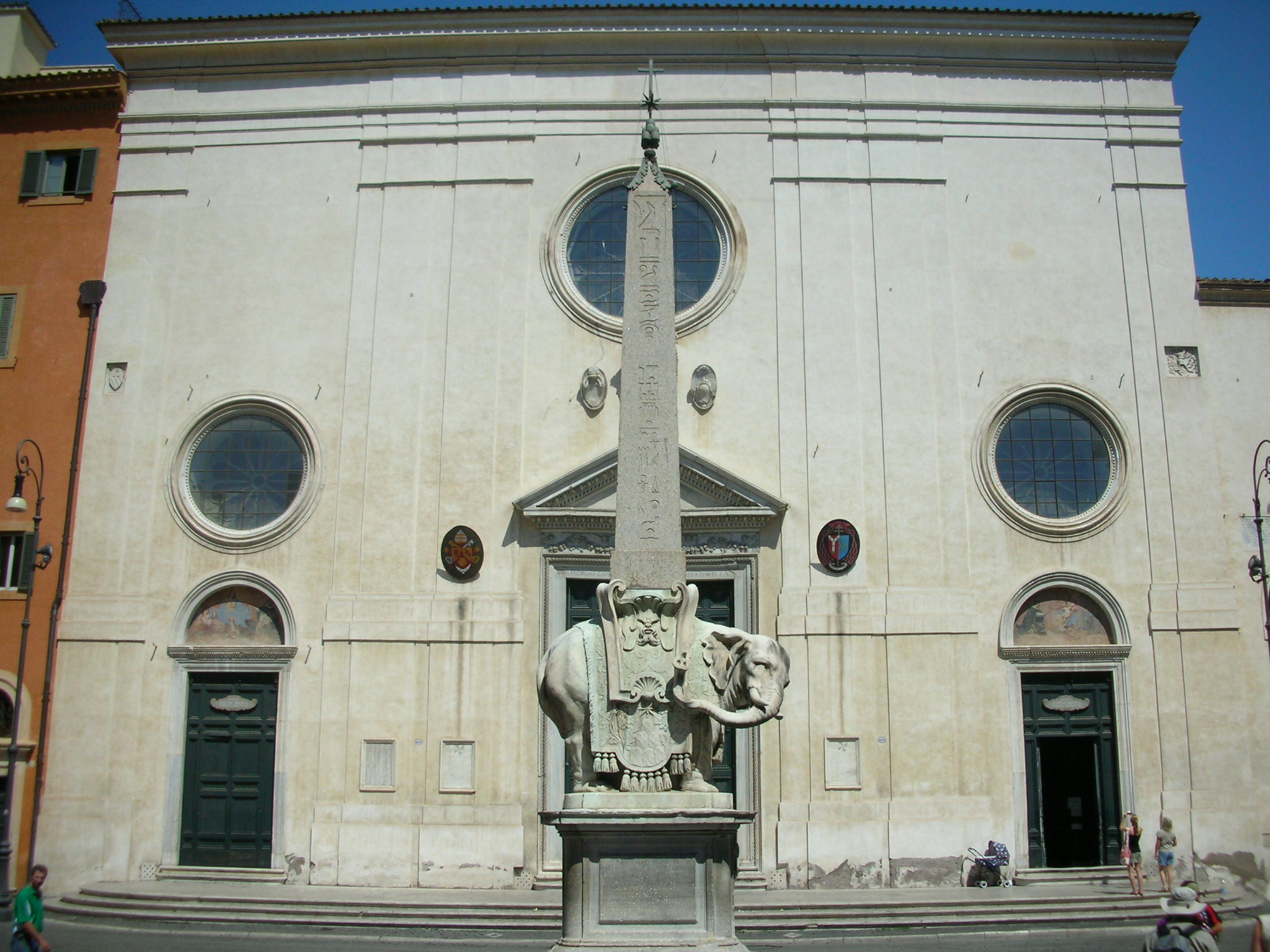
Santa Maria sopra Minerva


Behold, Santa Maria sopra Minerva - note the amusing elephant! (To the right, out of frame, are marks on the façade noting how high different floods of the Tiber came; the highest, back in the sixteenth century, would have flooded well in through the doors. One quaint inscription has it that, but for Holy Mary interposing her hand, all Rome would have been swept away.)


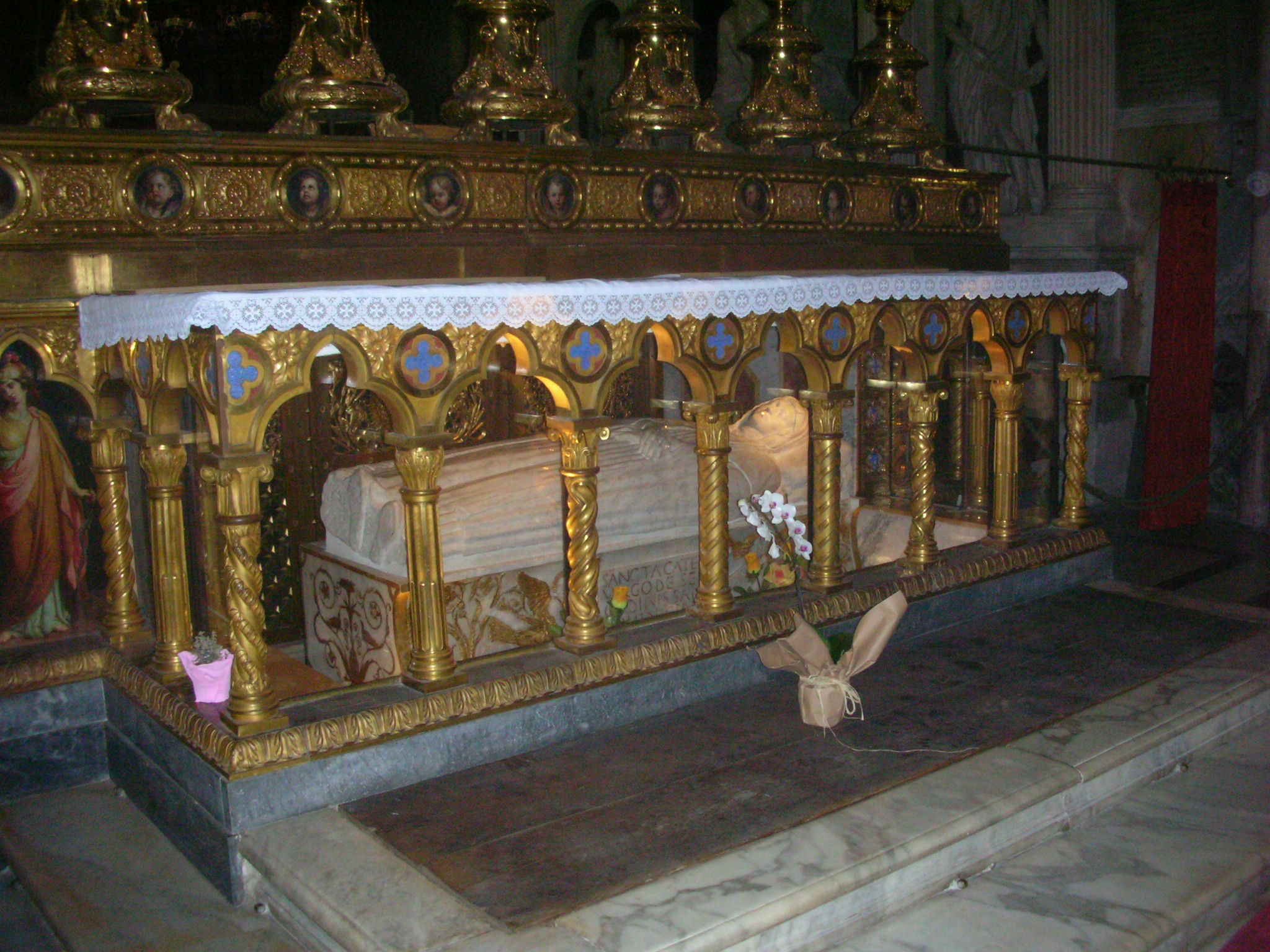
I forgot to mention this before: on Friday afternoon I also wandered into Santa Maria sopra Minerva - I had no idea till I went in how huge it is! And to find under the High Altar the body of St Catherine of Siena, and close by Bl John of Fiesole, a.k.a. Fra Angelico!

I prayed for my old friends the Dominicans there.

Tuesday, June 23, 2009

Solemn Vows


May I extend my congratulations and friendly prayers to Br Paul Rowse, O.P., who has just made his lifelong solemn vows as a Friar Preacher on the Feast of the Sacred Heart last Friday.

I look forward to soon seeing him a deacon, and, please God, a priest.

St Dominic, pray for him.

Monday, April 27, 2009

Happy News: Solemn Vows

I am delighted to learn that a friend of mine, Br Paul Rowse, O.P., has been accepted to make solemn vows as a Dominican Friar on the feast of the Sacred Heart of Jesus on the 19th of June this year.  Well I remember the Master of the Order clothing him with the white wool of St Dominic on Trinity Sunday 2003, marking his reception as a novice; while (owing to work commitments) I most likely, unfortunately, will be unable to attend the ceremony at St Dominic's, East Camberwell, in Melbourne, I do pray and give thanks to God that Br Paul may live and die a religious - and, one day, a priest - through his upcoming enunciation of his vow usque ad mortem, the formula of which would run as follows:

I, brother Paul Rowse, make profession, 
and promise obedience to God,
to blessed Mary, to blessed Dominic,
and to you, brother Kevin Saunders, 
Prior Provincial of the Province of the Assumption,
in place of brother Carlos Azpiroz Costa, 
Master of the Order of Friars Preachers
and his successors,
according to the rule of blessed Augustine
and the Constitutions of the Friars Preachers
that I will be obedient to you and to your successors,
until death.

The Dominican formula of solemn vows is notable in that it is an oath of obedience, since by promising to observe the rule and Constitutions of the Order it includes the avowal of poverty, chastity, and all else that a religious and a Friar Preacher must undertake to observe as a holocaust of himself to the Lord.  The vow is a free oblation to God, willingly laying aside things lawful in themselves that the great race may be run in liberty without hindrance, the better to serve the Lord and carry out His evangelical mission after His own model and that of His Apostles; and is at once also made to Our Lady - a consecration to and through her to the Lord - and an entrustment to the Apostolic Patriarch Dominic, the man of the Lord, to live after his pattern and so more closely, more surely and more sacrificially cleave unto Him, for His glory, for the preaching of the Gospel and the salvation of souls.

The vow taken must be lived!  The religious life is defined as the state of acquiring perfection (that most high calling that all must strive to answer, but the vowed in a most strict way).  Please pray that Br Paul, and many more like him, may, following in the footsteps of Our Divine Master (himself the Model and engenderer of obedience, poverty and chastity in the service of the Father in the salvation of all), of Our Lady (and her unceasing Fiat) and of all saintly religious moved by the Holy Spirit, give themselves to God for His honour and glory and the salvation of mankind.

Monday, December 22, 2008

Torrens in Austro

The Wills are currently entertaining some guests, including myself, and kindly gave me a chance to update my blog, now that I've been fortified with a vol-au-vent and some cups of tea!

In reverse order:
  • This morning I had the privilege of serving two private Masses: Fr Rowe's, and Fr Mannes' - the latter being assisted at this his first Roman Rite Low Mass by Fr Rowe as chaplain. A select group ('stable' group?) attended. I was doubly privileged in that Fr Mannes offered Mass for my intentions, as I'd handed him a stipend for his first Latin Mass, a repetition on this feria of the Mass of the 4th Sunday of Advent. The Epistle (I Cor. iv, 1-5), proclaiming that "Let a man so account of us as of the ministers of Christ and the dispensers of the mysteries of God. Here now it is required among the dispensers that a man be found faithful...", was most appropriate for the first Low Mass of a priest; and the Gospel (St Luke iii, 1-6), read to-day as yesterday and as the day before, detailing as it does the preaching ministry of St John Baptist, very apposite for a Friar Preacher! And it struck me that the Postcommunion Sumptis muneribus - about the greater and greater increase of the effect of our salvation being accomplished by frequentation of the sacred mysteries - was certainly being fulfilled.
  • Yesterday was marked (after I first served Fr Rowe's private Mass, and received a post-Mass blessing with a relic of St Monica) by Fr Mannes' first Ordinary Form Mass, which was quite a splendid affair, held at Holy Rosary Church before a large congregation. While an altar crucifix was overruled, in most ways otherwise it was a reform of the reform affair, with a choir of friends chanting the Introit Rorate cæli, the Kyrie, Sanctus, Agnus Dei and Communion, together with many other pleasant items - such as "O come, O come, Emmanuel" at Offertory, and at Communion, Pange lingua in alternating chant and polyphony, followed by polyphonic Alma Redemptoris Mater and the ineffable Sicut cervus of Palestrina: having made my communion, I was almost in ecstasy hearing this! Curiously, there were an awful lot of kneeling communions, including those of several priests and deacons in choir - let bishops and friars take note. (The auxiliary of Adelaide was at a prie-dieu in the sanctuary, and Dominicans, Franciscans and secular priests concelebrated.) Before I forget, Rev Br Vincent preached a very fine and intellectual homily, which I cannot now recall in extenso, and the other deacon assisting Fr Mannes sang the Gospel. I noticed Fr Mannes kept his fingers conjoined from Consecration to the ablutions, and observed a number of traditional and Dominican usages... About the only drawback was the lack of ad orientem celebration (which is still too brave a statement for Australia), together with the embarrassment of lady readers - one of whom suddenly appeared at the lectern to ask us all to "read the communion antiphon", a gauche intervention that she noticeably regretted when the choir struck up soon after.
  • In preparation for the ordination to come, I served Fr Rowe's Ember Saturday Low Mass earlier in the afternoon on Saturday, he agreeing in consideration of the occasion to read all six lessons. The actual grand joint ordination took place at the Cathedral here in Adelaide, His Grace Philip Wilson officiating. Again, the liturgy was very high church by general Australian standards (though His Grace unfortunately - unlike Fr Mannes - doesn't sing at all), but reminded me of how much the Novus Ordo can resemble learning to drive in a manual car: too much bumping and grinding of the gears! For instance, a fine hymn to a very Anglican tune opened the liturgy (and a versified Magnificat to the tune of "Jerusalem" closed it), and Missa Orbis factor provided the Kyrie - but alas la(d)y readers, none too skilled in reading, irrupted into the sanctuary, providing a strange contrast to the Gospel chanted by a deacon; and a friend of mine sang the Responsorial Psalm very well, a piece which is usually annoying after all, but then very wierdly sang the Alleluia verse to a modern tune but in Latin - why? Wilson more or less got the ordination alright, though he misnamed Br Vincent as "James" shortly after diaconizing him, and almost stuffed up the laying on of hands for Rev Br Mannes prior to the prayer of consecration - we twitted him at the afterparty, was he really ordained? The music, provided by the same choir of friends mentioned above, was very pleasant, and I was very glad to hear Ronan's setting of Tu es sacerdos being sung! After the one-and-a-half hours of the liturgy passed by, we all received Fr Mannes' first blessing, Deo gratias.
And lack of time precludes me more than alluding to the good time that was had by all at the various post-liturgy functions that were held over this weekend, or to the good folk who kindly put me up and/or put up with me (such as Roman and Terra), or to my enjoyment of this return visit to the beautiful city of Adelaide, or to my nearly missing my plane from Perth to Adelaide because I was sitting quietly in the departure lounge trying to finish Lauds, didn't know the flight was boarding since the P.A. system wasn't working!

As I'm in the capital of South Australia, on the river Torrens, the following Psalm 125 seems highly applicable:

In convertendo Dominus captivitatem Sion,
facti sumus sicut consolati.
Tunc repletum est gaudio os nostrum,
et lingua nostra exsultatione.
Tunc dicent inter gentes:
Magnificavit Dominus facere cum eis.
Magnificavit Dominus facere nobiscum;
facti sumus lætantes.
Converte, Domine, captivitatem nostram,
sicut torrens in austro.
Qui seminant in lacrimis,
in exsultatione metent.
Euntes ibant et flebant,
mittentes semina sua.
Venientes autem venient cum exsultatione,
portantes manipulos suos.

When the Lord brought back the captivity of Sion,
we became like men comforted.
Then was our mouth filled with gladness;
and our tongue with joy.
Then shall they say among the Gentiles:
The Lord hath done great things for them.
The Lord hath done great things for us:
we are become joyful.
Turn again our captivity, O Lord,
as a stream ["torrens"] in the south.
They that sow in tears
shall reap in joy.
Going they went and wept,
casting their seeds.
But coming they shall come with joyfulness,
carrying their sheaves ["maniples"?!].