Showing posts with label Martyrs. Show all posts

Saturday, December 28, 2013

Childermas


Until the last preconciliar reforms, Mass of the Holy Innocents – Childermas – was said (except if it fell on a Sunday, or was kept as a double of the first class) without Gloria in excelsis, without Alleluia and without Ite missa est: for all these joyful cries were seen as inappropriate to so sad a day. For the same reason, not the red of martyrs but the violet or purple of penance and sadness was worn, with the same exceptions.

Unsurprisingly, this day Fr Paul preached on the evils of abortion and the pro-life cause; Mass was offered up for the protection of human life from conception to natural death. As ever, the culture of life is face to face with the culture of death, as the West embraces societal suicide.

How many little children suffer at the hands of Herods today! And in Belgium we have the gruesome spectacle of euthanasia for children – you'd think the Belgians would have remembered the Nazi regime and all its evil deeds, and not emulated them in pervertedly imagining that there can be "life unworthy of life". How long, O Lord! Such crimes can only cry to heaven for vengeance.

At the end of Mass at Carmel we sang the piteously plaintive Coventry carol: 
Lully, lullay, Thou little tiny Child,
Bye, bye, lully, lullay.
Lullay, thou little tiny Child,
Bye, bye, lully, lullay. 
O sisters too, how may we do,
For to preserve this day
This poor youngling for whom we do sing
Bye, bye, lully, lullay. 
Herod, the king, in his raging,
Charged he hath this day
His men of might, in his owne sight,
All young children to slay. 
That woe is me, poor Child for Thee!
And ever mourn and sigh,
For thy parting neither say nor sing,
Bye, bye, lully, lullay. 

Saturday, September 12, 2009

Pandemonium at the Pantheon

Tourists are a heedless lot: despite the plethora of signs alerting them that the Basilica of Santa Maria ad Martyres is a Christian church, and has been for fourteen hundred years, they filled up the Pantheon with gawping incomprehension, managing to do everything that the signs clearly stated to be forbidden (talking, lying down, parading about scantily clad, taking photographs, etc.).

I must say, as a Christian pilgrim coming in for motives of prayer and reverence, it was dismaying to find it so. I did manage to find the holy water fonts and bless myself; no one else seemed even to have heard of the practice. So far as I could tell, the Blessed Sacrament is not reserved in the Basilica, presumably since it would be shewn no respect or even notice.

On a noticeboard I found a decree of the Apostolic Penitentiary granting a Plenary Indulgence for visits to the Pantheon during this its jubilee year, for it was on the 13th of May 608 that St Boniface IV consecrated this former house of idolatry a temple of Christ (having been given the building by the Eastern Emperor, Phocas). The Jubilee stretches from All Saints 2008 to the Vigil of All Saints 2009, so I made it!

Bizarrely, the general norms for gaining indulgences were given in Italian and English - but the special decree giving the conditions for this Jubilee was posted only in Latin! I suspect I was about the only visitor able to puzzle it out...

For the record, one may gain this plenary indulgence by: (1) visiting the Basilica for a liturgical celebration or other pious exercise; (2) coming as a pilgrim either alone or with others, spending a reasonable time in pious contemplation, and ending this devotion with the Lord's Prayer, Creed, and invocations of Our Lady and the Holy Martyrs.

It was good, even in that raucous unawareness, to stop and be silent in the midst of the madding crowd, lift my mind to God, and recall that this is the House of God and the Gate of heaven, a place of prayer and sacrifice, sacred to the Blessed Virgin Mother of God, through whom Our Saviour took flesh that He might suffer and save our race, and to His fearless Martyrs who defeated all the machinations of the Devil and the pagan Empire of Rome. I felt sorry for the tourists - what a treasure of grace and merit was available for them, all unawares. God bless.

Tuesday, August 11, 2009

Supper for St Clare

Our nascent schola had sung through most of the music for Sunday Compline (according to the modern Office) in Gregorian chant at our practice this evening, when our leader Fr Allan very unexpectedly and graciously invited us to join him at the friary for a little eat and drink in honour of St Clare, whose feast day falls to-day in the Ordinary Form, on the anniversary of her death (it is kept to-morrow in the Extraordinary Form). He was most hospitable: a decent few glasses of merlot from the Clare Valley in South Australia, some cheeses with crackers, some cake and lamingtons, and a drop of port to finish off - a good time was had by all. How appropriate that it was in the Clare Valley (not the Lutheran Barossa) that Catholics settled, and good German Jesuits among them: Seven Hills, still owned by the Society of Jesus, still makes Australia's altar wine.

We were reminded that St Clare is patroness of television (one hopes she can redouble her prayers!) and, together with St Lucy, of the blind: St Clare having once been vouchsafed a vision of Mass when she was laid up in bed by illness, and having a name meaning clearness and clarity, just as Lucy means light. At the end of the soiree, Fr kindly shewed us a large landscape photograph of Assisi, pointing out the sites - I hope to visit there come September.

According to the modern Martyrology, to-day is also the feast of the martyr St Rufinus, first bishop of Assisi, and of a famous Irish abbess, St Attracta, who received the virgin's veil from St Patrick himself. Martyrs died this day under the Romans (such as SS Tiburtius and Susanna), under Elizabeth I, during the French Revolution, and in the midst of the Spanish Civil War. Most recently, in 1949, Bl Maurice Tornay was martyred on the borders of Tibet (to which land he had brought the Gospel) out of hatred for the name of Christ. May all the saints intercede for us!

Monday, July 27, 2009

Saints o' the Day

Is it true, gentle readers all, that ye are displeased seeing I have posted less concerning the saints of late? The lessening of your visits here would seem to teach me this.

Well, this evening I've opened up my martyrologies, and behold!

To-day is the commemoration of the Seven Sleepers (secondary patrons of the Dormitionists), and of St Symeon Stylites (the Elder - referred to here), doyen of pillar-dwelling ascetics, to name but some of the hallowed men who fell asleep in the Lord on this great day.

Likewise, to-day died St Celestine I, he who defeated proud Nestorius the archheretic by the agency of the Council of Ephesus, declaring Mary Most Holy the true Mother of God (Dignare me laudare te, Virgo sacrata: da mihi virtutem contra hostes tuos; Gaude, Maria Virgo, cunctas hæreses sola interemisti). To-day also reposed in the Lord St Clement of Ochrid, Apostle of the Bulgarians.

To-day died many holy martyrs, such as five slain at Cordoba by the Moors during their fanatical rule in Spain; and five martyrs slain in Spain by the Communists during their fanatical rule in Spain: how times change... I also note a passionbearing nun, St Anthusa, whipped and exiled for her stedfastness in the cult of icons by Constantine Copronymous (aptly so-named: at his baptism, he crapped in the font, foretelling his later treatment of holy things), and two priests martyred (one in England, one in Wales) under wicked Elizabeth I (she who died, paranoid and alone, lying amongst her own ordure: departing thence to the stench of hell).

The white-robed army of martyrs praise thee, O God!

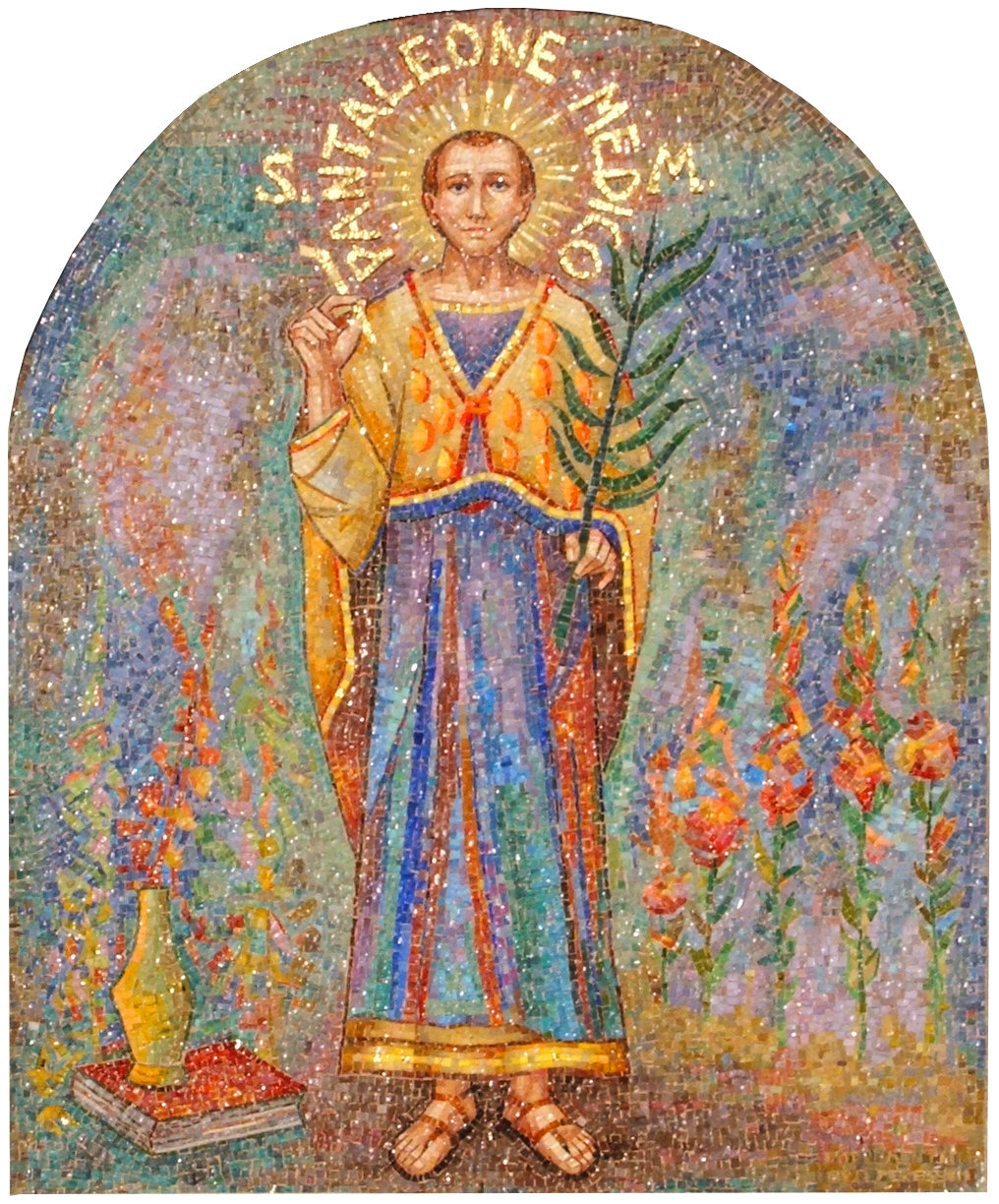
Last but first, comes St Pantaleon, martyr at Nicomedia in Bythinia, one of the holy unmercenaries, who has a commemoration at Lauds in the Breviary to-day:

Grant, prithee, God almighty: that, blessed Pantaleon Thy Martyr interceding, both from all adversities we may be delivered in body, and from depraved thoughts be cleansed in mind. Through our Lord Jesus Christ...

Sunday, July 5, 2009

Enemies of the Human Race

Reading about the martyrs of the Roman persecutions helped me better to understand the central charge against them - that Christians were "enemies of the human race", foes of the common good, haters of and hated by all men: for they refused to sacrifice to the gods by whose favour the Pax Romana endured, and thus were thankless atheists; they refused the commands of the Emperors, and thus were stiff-necked, obstinate, disobedient rebels and traitors; they were members of a sinister secret society, by its cloak of darkness gravely suspect of plotting against the State, and containing a whole illegitimate rival hierarchy; and they held to beliefs and practices subversive of public morals (contemporaries found them odious and shocking, thinking they worshipped a condemned criminal or even an ass, partook of cannibal feasts, and even committed incest).  The Empire was the world, and the Christians were a fifth column within it.

At least the stiff-necked and obstinate Jews, against whose revolts the Empire had to fight on several occasions, were adherents of an ancient religion, the proper cult of their fathers and their nation, and their peculiar religion was recognized, even permitted unusual privileges by the laws - but Christians, seemingly holding perverted Jewish beliefs blasphemous to the Jews themselves, were every one a traitor to their own individual ancestral religions, having spurned their native gods and turned to a new and disturbingly exclusive deity, whose worship had not been permitted by the Senate (part of whose purview was the detection and punishment of strange and vile religious cults that undermined public order).


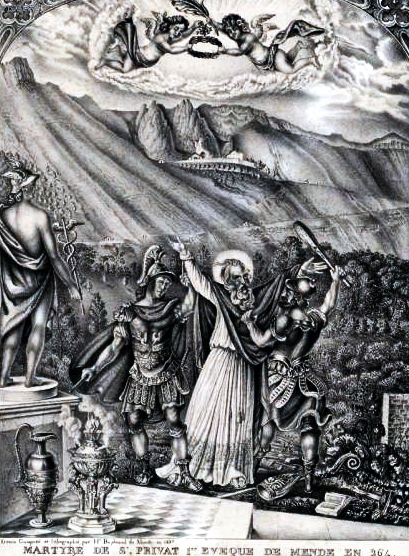
(Refusing to sacrifice to the Roman gods as the Emperor commands for the good of the State, the Christian bishop is done to death as an enemy of the world, an ingrate atheist, a dangerous innovator, a spreader of unlawful superstition and a rebel rabble-rouser.)

As the West sloughs off more and more vestiges of Christianity, as secularism bites or rather disbelief spreads, what is found is a return to paganism - for as Chesterton pointed out, those who believe nothing will believe anything.  Ever seen the pages of astrology, fortune telling, numerology, tarot card reading, and worse in women's magazines?  What of ghosts, witches and mediums on television - the last being on non-fiction programmes!  It's a wonder animal sacrifice isn't back in vogue.  Pagans could read fine philosophy, albeit vitiated by horrendous moral deviations not excluding infanticide - sound familiar?  But their morality was expediency...

Note how every other religion (even, ahem, one that seems to have more than its fair share of aggressive members, yet is forever being declared in its pure form "a religion of peace" - which ought be Christianity's title), in a suitably watered down version acceptable to bourgeois sensibilities, is accorded unquestioning respect: visit some odd New Age shop and see a vast kitsch collection of Buddhas, angels, crystals and more... a veritable idol shop.   But one thing you will not find: a crucifix.  The world cannot abide the Crucified.

Christianity to-day, above all the Catholic Church, faces more and more the same accusations that it faced in the beginning: of practising an irrational, immoral, exclusive, world-hating religion, completely inappropriate for our enlightened age, discriminating against decent citizens: it's a wonder it's allowed at all, as it is its inappropriate and politically incorrect views deserve to be banned from being propagated or followed.  Note that "politically incorrect" means precisely "not appropriate for the City, the Polis" - that is, our civil society.

St Peter writes of the pagans' uncomprehending hatred of Christians in his First Epistle (iv, 1-4):

Christ therefore having suffered in the flesh, be you also armed with the same thought: for he that hath suffered in the flesh, hath ceased from sins: that now he may live the rest of his time in the flesh, not after the desires of men, but according to the will of God.  For the time past is sufficient to have fulfilled the will of the Gentiles, for them who have walked in riotousness, lusts, excess of wine, revellings, banquetings, and unlawful worshipping of idols.  Wherein they think it strange, that you run not with them into the same confusion of riotousness, speaking evil of you.

To our cost, too many Christians have behaved anything but as becomes saints - the filthy crimes revealed to the world's eyes have deeply scandalized many both inside the Church, and those who, outside in darkness, might otherwise have been curious to seek after Truth, but now have recoiled in horror.  We have been a stumbling block to many.  The scandals besetting the Church, especially in lands with a strong Irish background, have been pleasing to none but Satan, the Deceiver.  They have also revealed how compromised many in sacred orders have been, and how the innocent have suffered, the guilty prospered.  All this seems to confirm the common external diagnosis: that Christianity is a wicked false religion, imposing guilt and slavish obedience on its dupes, while those in positions of power use it for their fell ends and personal gain.

What eventually overcame three hundred years and ten great Persecutions?  The blood of the martyrs, which is the seed of the Church as Tertullian noted: the witness of sanctity, of unheard of generosity (such as the Christians who laboured to help plague victims and died trying - why? for they weren't even coreligionists or relations!), and the fact that ordinary folk were willing to suffer and die horribly for their belief.  No pagan cult could claim such power to make the weak strong.  The Holy Spirit was indeed active in His Saints, as these noble athletes ran in the footsteps of Christ Who in His Passion had preceded them: and in their witness God was glorified, and the world converted.

Persecution does seem, perversely enough, to crystallize the real issue - to be really Christ's, or not - and thus strangely to bring not death but life to the Church: as someone said, believers would be more fervent "if they were burning priests on Bourke Street" (the main road leading through the city up to Parliament House in Melbourne).  A friend of mine, speaking of what he considers to be the impending return to the times of persecution, such is the falling away, cheerfully said, "Of course we'll all be martyrs!"  The martyrs confessed themselves all unworthy of the gratuitous gift that was theirs - to fight the good fight, keep the faith, and for the sake of temporary suffering win eternal glory in Christ Jesus our Lord.  I rather agree with the blogger who said, "She thought she could be a martyr, if they killed her quick".  We must all seriously ask ourselves whether we bear witness to the Lord, or keep cowed, frightened and silent; as the roadside poster said, "If you were tried for being a Christian, would there be enough evidence to convict you?"  

Only if one can be convicted of Christianity can one's witness hope to convert others - to the greater glory of God.


Te martyrum candidatus laudat exercitus.
(The white-robed army of martyrs praise Thee.)

Wednesday, June 17, 2009

Callista

The last few evenings - as my bedtime reading! - I've gone back to Newman's novel Callista, which sits beside Wiseman's Fabiola in the "Catholic novel" section of my bookshelf (alongside Cather's Death Comes to the Archbishop - no, not a wish-fulfilment fantasy, but a lovely lyric work, well-able to be dipped into as a soothing tonic - Robinson's melodramatic The Cardinal, and Marshall's comic but moving All Glorious Within).

Wiseman and Newman, writing in the mid-1850's, have the quaint old-time habit of interjecting as the omniscient author throughout their works, but that is part of the charm of both books, which deal with Christianity during the great persecutions - Newman's, that of Decius, as it struck North Africa; and Wiseman's, the greatest and last of all, that of terrible Diocletian, in Rome itself, then truly the seat of Antichrist, drunk with the blood of the saints (many of whom have cameo roles in the novel).

Both romances, for their true Christian message, their loving portrayal of the sanctity of the primitive Church, and their old-fashioned style are well-worth reading.  I turn now to a work of non-fiction: Frend's Martyrdom and Persecution in the Early Church.

Pray for us, all ye holy Martyrs, - That we may be made worthy of the promises of Christ.

By the triumph of Thy grace in all Thy holy Martyrs, – Lord, deliver us.

Tuesday, June 9, 2009

SS Primus and Felician

It's quite hard to get used to the season after Pentecost, given the great length of time the Church has had us celebrate feasts and holy seasons (wot, no Alleluia?)...

This morning at Lauds occurs the commemoration of two early Martyrs, SS Primus and Felician; according to my St Andrew's Missal's notes, they were brothers, and their relics are preserved at the church of St Stephen on the Cælian Hill; my Juergens edition of the Missal further details that after severe torment they were beheaded for the Faith in 286, at Rome.

The modern Martyrology records them on this day as follows: "On the Nomentine Way at Arcas by the fifteenth milestone from the City of Rome, of the holy Primus and Felician, martyrs."  (In the index to the Martyrology, there is a note that the century of their death is now considered uncertain; presumably they suffered during one of the Roman persecutions.)  Nomentum, whither led the Nomentine Way, was a town fourteen miles north-east of Rome, so they appear to have been put to death outside the town limits.  This must be in the Sabine Hills (as the old Martyrology relates); a further detail given in the pre-Conciliar Martyrology is that they were executed by order of Promotus, who was the official in charge at Nomentum.  Furthermore, but perhaps in a melodramatic manner, the older edition had them living long in Christ's service, yet enduring sundry tortures both together and separately.

Primus, "the first, the best", and Felician, whose name derives from felicitas, "fertility, happiness, good fortune, success" - how well their names become them.  Though in the eyes of a scoffing world they perished for nought, the faithful recognize in them men who knew the true estimation of things, and rather died for Christ that they might live with Him evermore: far from vanquished, they are conquerors with Christus Victor, having by His power trodden down the devil, overcome all evil, kept faithful unto death; and thus obtained the palm, won the crown of life (cf. Apoc. ii, 10), and merited - imagine! - to sit victorious with Christ Himself upon His throne (Apoc. iii, 21).  

May they pray for us who devoutly revere their triumphant sufferings in the cause of Christ our God, that they obtain for us who still strive to stand and fight the Divine gifts that alone will protect us and give us the victory:

Fac nos, quæsumus, Domine, sanctorum Martyrum tuorum Primi et Feliciani semper festa sectari: quorum suffragiis protectionis tuæ dona sentiamus.  Per...

(Make us, we beg, Lord, ever eagerly to attend upon the feast of Thy holy Martyrs Primus and Felician: by whose suffrages may we feel the gifts of Thy protection.  Through...)

[Sector is the intensified form of the verb sequor, to follow.]

Monday, May 18, 2009

Novena to St Philip Neri: 2nd Day

Philip Neri ever counselled his disciples to read saint's lives, to be attent to sermons, to be assiduous in prayer, to be habitues of the confessional. He lived in close communion with the saints of primitive times, and so would have gladly celebrated the Mass and Office of to-day's saint, Venantius, a martyr at Camerino under Decius - just as he hailed the students of the English College with the words Salvete flores martyrum, recognizing them as worthy heirs of the faithful of old, who would stand fast for Christ unto death.

One of Philip's devotees used to say,

"When I consider my sins I feel myself a lost man; but through the prayers of Father Philip I hope to be saved."

With such thoughts in mind, pray Newman's Litany of St Philip; and consult Fr Faber's meditation on St Philip, which I published here last year...
******
This is the Collect of St Venantius:

Deus, qui hunc diem beati Venantii Martyris tui triumpho consecrasti: exaudi preces populi tui, et praesta; ut qui ejus merita veneramur, fidei constantiam imitemur. Per...

(God, Who hast consecrated this day to the triumph of blessed Venantius Thy Martyr: hear the prayers of Thy people, and grant, that we who revere his merits, may imitate the constancy of his faith. Through...)

The Martyr's triumph is the irruption in his life of the Paschal Victory of Christ: it ought be for us not merely a cause of passing joy, but a serious call to imitation of such faith, a stedfast witness to Our Lord usque ad mortem - as the Apostle said, "Imitate me, as I imitate Christ." (I Cor. xi, 1.)
Apparently Pope Clement X was previously bishop of Camerino (a small town in the Marches of the Papal States), and he it was who composed the proper Office hymns for the feast of St Venantius, the patron of his former see:

Matins Hymn


Athleta Christi nobilis
Idola damnat gentium,
Deique amore saucius
Vitae pericla despicit.

Loris revinctus asperis,
E rupe praeceps volvitur:
Spineta vultum lancinant:
Per saxa corpus scinditur.

Dum membra raptant martyris,
Languent siti satellites:
Signo crucis Venantius
E rupe fontes elicit.

Bellator o fortissime,
Qui perfidis tortoribus
E caute praebes poculum,
Nos rore gratiae irriga.

Sit laus Patri, sit Filio,
Tibique sancte Spiritus:
Da per preces Venantii
Beata nobis gaudia. Amen.


Noble champion of the Lord!
Armed against idolatry!
In thy fervent zeal for God
Death had naught of fear for thee.

Bound with thongs, thy youthful form
Down the rugged steep they tear,
Jagged rock and rending thorn
All thy tender flesh lay bare.

Spent with toil, the savage crew,
Fainting, sinks with deadly thirst;
Thou the cross dost sign; and lo!
From the rock the waters burst.

Saintly warrior-prince! who thus
thy tormentors couldst forgive;
Pour the dew of grace on us,
Bid our fainting spirits live.

To thee, O Father, with the Son
And Holy Spirit, glory be;
Oh, grant us through thy martyr's prayer
The joys of immortality. Amen.


Lauds Hymn

Dum nocte pulsa lucifer
Diem propinquam nuntiat,
Nobis refert Venantius
Lucis beatae munera.

Nam criminum caliginem,
Stygisque noctem depulit,
Veroque cives lumine
Divinitatis imbuit.

Aquis sacri baptismatis
Lustravit ille patriam:
Quos tinxit unda milites,
In astra misit martyres.

Nunc angelorum particeps,
Adesto votis supplicum:
Procul repelle crimina,
Tuumque lumen ingere.

Sit laus Patri, sit Filio,
Tibique sancte Spiritus:
Da per preces Venantii
Beata nobis gaudia. Amen.


The golden star of morn
Is climbing in the sky;
The birthday of Venantius
Awakes the Church to joy.

His native land in depths
Of pagan darkness lay;
He o'er her guilty regions poured
The light of heavenly day.

Her in baptismal streams
Of grace he purified;
E'en those who came to take his life,
With him as martyrs died.

With the angels now he shares
Those joys which never cease;
Look down on us, O Spirit blest,
And send us gifts of peace.

Praise to the Father, Son,
And, Holy Ghost, to thee,
Oh, grant us through thy martyr's prayer
A blest eternity. Amen.


Vespers Hymn


Martyr Dei Venantius,
Lux et decus Camertium,
Tortore victo et judice,
Laetus truimphum concinit.

Annis puer, post vincula,
Post carceres, post verbera,
Longa fame frementibus
Cibus datur leonibus.

Sed ejus innocentiae
Parcit leonum immanitas,
Pedesque lambunt martyris,
Irae famisque immemores.

Verso deorsum vertice
Haurire fumum cogitur:
Costas utrimque et viscera
Succensa lampas ustulat.

Sit laus Patri, sit Filio,
Tibique sancte Spiritus:
Da per preces Venantii
Beata nobis gaudia. Amen.


Venantius, hail! God's martyr bright,
thy country's honour and her light;
Who didst with joy thy triumph sing,
thy judge and tortures conquering.

A child in years, he heeds no pain,
Nor dungeon damp, nor galling chain;
The tender youth for food is thrown
To lions, mad with hunger grown.

O wondrous sight! the beasts of prey
Their food reject, and turn away;
Then tamely lick the martyr's feet,
A tribute to his virtue meet.

Then downwards hung, his mouth exposed
To clouds of smoke beneath disposed,
Whilst with slow torches, burning clear,
His naked breasts and sides they sear.

Praise to the Father, and the Son,
And Holy Spirit, Three in One;
Oh! grant that through this martyr's prayer,
Your blissful joy we all may share. Amen.

Wednesday, April 22, 2009

SS Soter and Caius

It was a delight to read Matins, Lauds and Prime this morning - beginning the day properly.  And after work and a coffee, the Little Hours, once around the Gorge (about 50 minutes) and Vespers.  Compline awaits my retiring to-night...

Why the obsession?  Because I seriously do believe one should live the liturgy of the Church.  The Office (new and old) has been the nourishment of my prayer life (apart from Holy Mass of course) for 15 years or more, since my early university days, and I hope it may be for many others a joy and a link to the truths of our Holy Faith, to the worship of Almighty God, to the cult of his saints, to the piety of our forefathers and to the Holy Scriptures, particularly the Psalms.

To-day we feast SS Soter and Caius, two early Martyr Popes.  Amusingly, the Breviary (following, I guess, the Liber Pontificalis) credits the former (who reigned c.166-c.174) with forbidding sacred virgins from touching the sacred vessels, and likewise prohibited them from exercising the office of thurifer!  A bloody good idea, and one that should be vigorously reënforced...
  
St Caius (r. 283-296) was a Dalmatian, of noble parents related to the family of the wicked Diocletian - that arch-enemy of Christ, whose name appears on every page of the Martyrology, yet was no martyr but their ravening persecutor and very dupe of Satan, whom he followed down to hell.  By the infamous cruelty of his distant relative Pope Caius too was crowned with martyrdom, along with his brother Gabinus - and both were buried in the same catacomb as St Soter, in the cemetery of Callixtus.

Celebrating the feast of martyrs during Paschaltide is a happy joy: the Martyrs stand in close company with the Lamb once slain Who lives now for ever and ever, and Alleluias of triumph resound as the Church lauds their sharing in the Easter Victory of her Divine Spouse.  The sacred Liturgy takes up a text even from the apocryphal Fourth Book of Esdras (ii, 35) to sing their blessedness, echoing in a different key both the traditional prayer for the dead and the texts of the Requiem Mass:

V. Lux perpétua lucébit Sanctis tuis, Dómine, allelúja.
R. Et ætérnitas témporum, allelúja.


(V. Light perpetual shall shine upon thy Saints, O Lord, alleluia.
(R. And an ageless eternity, alleluia.)

[Cf. Parati estote ad praemia regni, quia lux perpetua lucebit vobis per aeternitatem temporis. (IV Esdras ii, 35)]

May SS Soter and Caius pray with us and for us, that our part, too, may be among the saints in light.

Monday, April 13, 2009

Easter Martyr: St Hermenegild

On the 13th of April 585, after refusing to receive the Easter Communion at the hands of an Arian bishop, the heir to the throne of Spain was murdered on the orders of his father, the King.

It is a classic tale of family feuding, and as in any whodunnit, cherchez la femme!  In this case, there were two ladies involved: the prince's evil step-mother, the unlovely Goiswintha, fomented King Leovigild's anger; the prince's saintly wife, Ingund (or Ingunthis) - daughter of the Frankish King Sisebert I of Austrasia - was a stedfast Catholic despite the attempted suasions of her step-mother-in-law: and she, together with St Leander, Bishop of Seville (whose brother, St Isidore, later succeeded to that same see), had wrought her husband's conversion from the Arian heresy.  For these were the days of Visigothic Spain, when a Teutonic military aristocracy ruled the Romanized Spanish; and the Visigoths, prior to their irruption into the rich provinces of the Roman Empire, had been converted by Arian missionaries, not Catholics.

St Hermenegild's younger brother, Reccared (like him, a child of the King's first wife, Theodosia, who had died), had attempted to reconcile father and son during their previous feuds; but now it was too late.  Hermenegild, reconciled instead to thoughts of winning through to heaven, bowed his neck to the sword. Being slain rather than deny the Faith by sacrilegiously communing with a heretic, he won the crown of the everlasting kingdom, and reigns with Christ evermore.


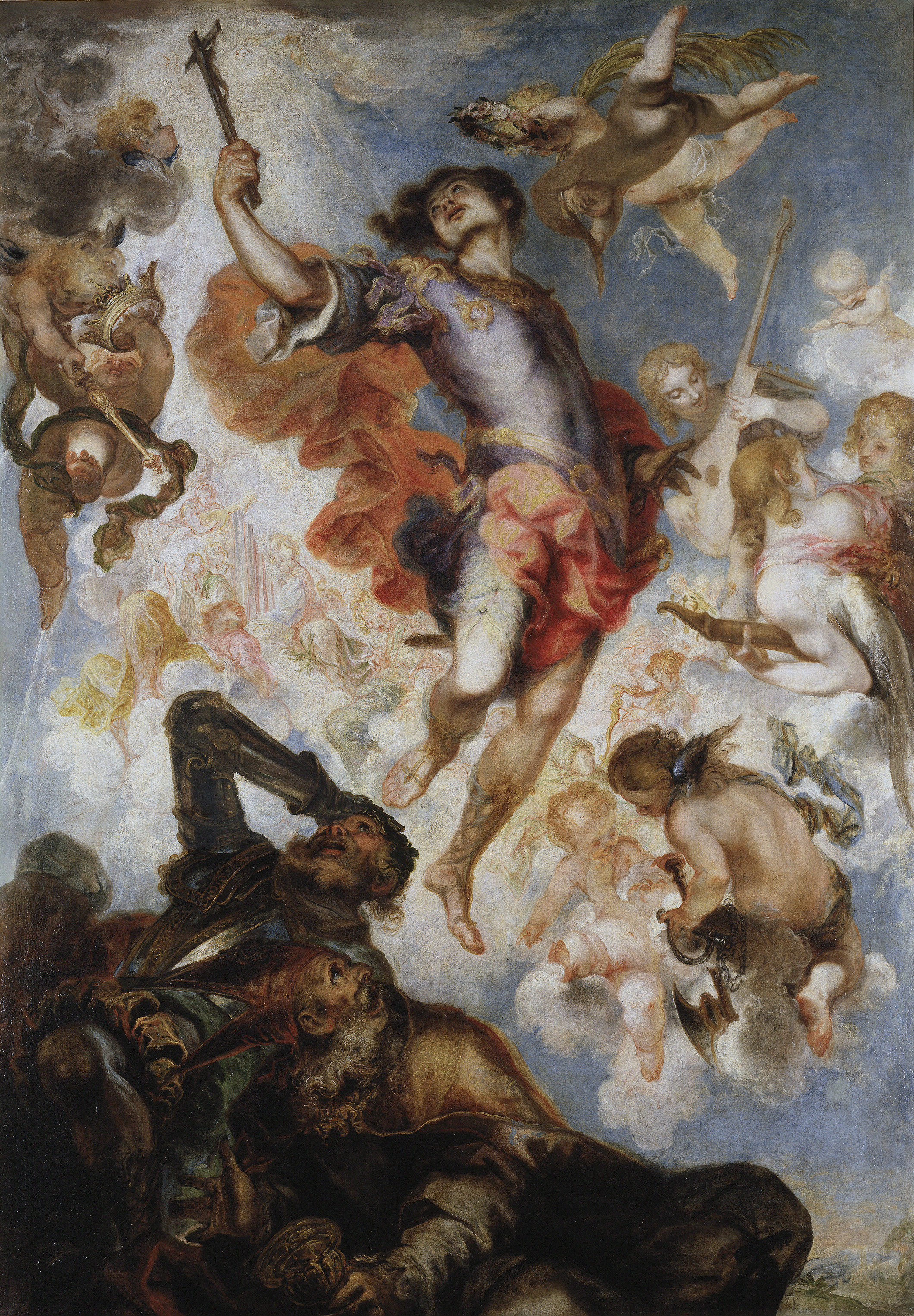
(Hermenegild, spurning the promise of an earthly crown, triumphantly wins the crown of martyrdom, to the joy of the angels; his father laments, and the Arian bishop cowers away.)

From the truth thy soul to turn,
Pleads a father's voice in vain;
Naught to thee were jewelled crown, 
Earthly pleasure, earthly gain. 

Angry threat and naked sword 
Daunted not thy courage high; 
Choosing glory with the Lord, 
Rather than a present joy. 

Now amidst the Saints in light,
Throned in bliss forevermore; — 
Oh! from thy exalted height, 
Hear the solemn prayer we pour. 

Honor, glory, majesty, 
To the Father and the Son, 
With the Holy Spirit be, 
While eternal ages run. Amen.

(Hymn at Lauds, Nullis te genitor, by Pope Urban VIII.)

King Leovigild died the next year; Hermenegild's younger brother, Reccared, who succeeded as King of Spain, himself became a Catholic in 587, and by May of 589, at the Fourth Council of Toledo, the whole Visigothic nation abjured Arianism, and the great St Leander of Seville preached a famous sermon on "the triumph of the Church at the Conversion of the Goths".  Amazingly, even the Arian clergy converted, and were confirmed in their ministries!  All this, it is piously believed, was obtained by the celestial intercession of the royal martyr, whose glorious merits and suffrages won sweet grace from God.  Truly, Hermenegild was an immense treasure (Ermen Gild), for whose life the Lord paid a rich wergild: the gift of Faith to a whole people.

Pope St Gregory the Great, who was a friend of St Leander, having known him during his exile from Spain prior to his return in triumph, sings the praises of St Hermenegild in his Dialogues (III, 31).  It has been argued that the prince, having rebelled against his father, was no worthy martyr; but as St Gregory of Tours states, whatever his sins, they were blotted out by his suffering and martyrdom, whereas, if he had but accepted the Arian bishop's offer of Holy Communion, he would have been restored to his princely estate and reconciled to the King, yet at the price of abandoning the Catholic Faith: this he would not abandon, as the pearl of great price, and it was for this that he died a true martyr.

As for the martyr's widow and infant son, they had taken refuge in the Byzantine Empire, where they prospered; and his great-grandson returned to Spain to reign as King Erwig (680-687).

Deus, qui beatum Hermenegildum Martyrem tuum, cælesti regno terrenum postponere docuisti: da, quæsumus, nobis; ejus exemplo caduca despicere, atque æterna sectari.  Per...

(God, Who didst teach blessed Hermenegild Thy Martyr to esteem earthly things less than the heavenly kingdom: grant, we beg, unto us, that by his example we may despise things perishable and rather seek after things eternal.  Through...)

[BTW, caducus is a great word: tottering, falling, fallen, frail, vain, perishable...]

Thursday, December 13, 2007

Santa Lucia, Santa Lucia!

Traditional, beautiful and dangerous: Scandinavian maidens wear wreathes with lighted candles on St Lucy's day, impersonating the saint.  Surely OH&S would never allow this in Australia!   (Don't believe me, believe Wikipedia: see entry referring to all this.  And yes, there is an allusion here to her name, referring to light.)

According to the Breviary, the wicked (they always are) Prefect Paschasius (odd name for a pagan) first tried to have the virginal Lucy dragged off to a whorehouse (the Lesson is very explicit as to why), but the Holy Ghost made her immobile as a column, whereupon nasty Paschasius (cunningly inventive, these Romans) ordered a fire lit around her (hence the surely dangerous custom of presumably Lutheran maidens wearing candles in their hair): but when this didn't work, at last after many torments – the worst, her eyes were plucked out (yet still she could see! hence she's patroness of the blind) –  her throat was cut.

Advice to tormentors of martyrs: whipping, branding, throwing to beasts, cutting out tongues and cutting off hands (St Maximus Confessor), ripping off breasts (St Agatha), plucking out eyes (see above!), burning, raking with iron claws, shooting with arrows (St Sebastian), tying to a revolving wheel set afire (St Catherine of Alexandria), etc. may or may not work, but chopping off the head or at least slitting the throat does.  The saint may walk off with his head (St Denis et al.) or it may bounce thrice in honour of the Trinity, producing three miraculous fountains (St Paul), or, it not being properly chopped off, the saint may spend three days in prayer, consecrating her house as a church (St Cecilia), but eventually they go to reign forever with Christ; whereas (unless converted by their very victim) the persecutor ends up in hell with the devil.

Don't get me wrong: the Kingdom of heaven suffers violence, and those who win through to it must endure much.  Hence the expression "to storm heaven".  As St John the Baptist did, so did St Lucy, and the other martyrs who suffered this day.  (I am alluding to the readings as I heard them at Mass today in the ordinary form, for Thursday in the second week of Advent.)  To be so devoted to the Lord as to offer oneself a victim, to die as a faithful and true witness to Him, is perhaps the greatest grace given to men.  Would that one be graced with such constancy as to persevere to the end and be saved, as the holy martyrs.

The new Martyrology very finely says of St Lucy (excuse my translation):

The Ides of December, the fourth day of the moon [in 2008].

Of the memory of holy Lucy, virgin and martyr, who guarded, whilst she lived, her lighted lamp for the coming of her Spouse, and, dragged to death for Christ at Syracuse in Sicily, with Him she merited to enter into the wedding feast and to possess undying light.

I append the lovely Office hymn, Jesu corona Virginum; it has several tunes, but this is a favourite; the translation is also a favourite, even tho' it omits the second verse (see below):

O Jesu, Thou the Virgins' Crown, 
Thy gracious ear to us bow down, 
Born of that Virgin whom alone 
Both Mother and a Maid we own.

*

In Thee, their Bridegroom and their Lord, 
The virgins find their bright reward, 
And wheresoe'er Thy footsteps wend 
With hymns and praises Thee attend.

O gracious Lord, we Thee implore 
Thy grace into our minds to pour; 
From all defilement keep us free, 
And make us pure in heart for thee.  

All praise to God the Father be, 
All praise, Eternal Son, to Thee, 
Whom we the Spirit we adore, 
For ever and for evermore.  Amen.

(*Verse 2: Amongst the lilies Thou dost feed, / And thither choirs of Virgins lead; / Adorning all Thy chosen brides / With glorious gifts Thy love provides.)