Showing posts with label Epiphany. Show all posts

Saturday, January 7, 2012

I Love the Epiphany

The Lord's Epiphany, I realize, is a favourite feast to me, dearer perhaps than Christmas! - being more spiritual, more mystical, the older of the two feasts, more easily solemnized, not dumbed down, not commercialized, not kiddified, not just a feast at table, not dominated by considerations of cooking turkeys and hams and puddings, nor of giving and receiving gifts (good, very good, though such are).

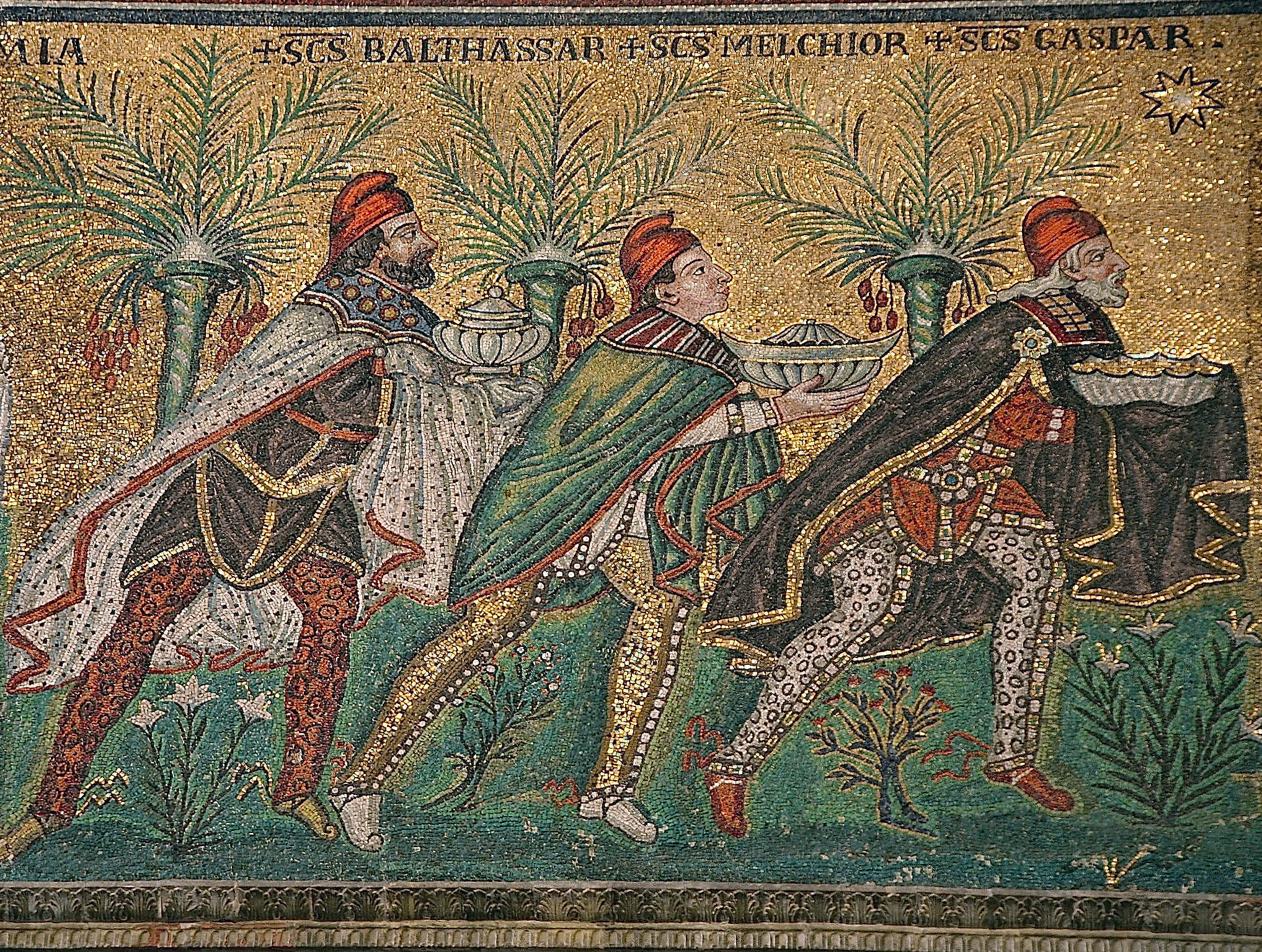
I love Christmas, the Lord's Nativity; I love Epiphany almost more, what with its triple mystery - Magi adoring, falling down in worship upon entering the House to find the Christ-Child with Mary His Divine Mother, first-fruits of the Gentiles foreshadowing our own entry into the Church; and the echo resounds also of the Lord's Baptism in the Jordan, sanctifying its waters by His All-Sanctifying, Holy Flesh; and yet a second echo rings out, telling of the first of His signs, wrought at Cana of Galilee, at His Mother's mediation, His disciples believing in Him, when He reddened water into finest wine, foretaste of the Eucharist, His Blood shed and given for us, Itself a foretaste of the nuptial feast of the Lamb forever celebrated in the Kingdom, without any end.

Just to-night, in my parish, we had a splendid vigil Mass for this Solemnity (which is kept in Australia in the Ordinary Form on the Sunday after the 6th, hence it falls on Sunday the 8th this year).  Something about singing "We three kings of Orient are" to begin and end, and Father's use of the Roman Canon in its revealed beauty in the new translation, made everything more exalted...  Dinner to-night was a simple but delicious affair, to match the solemnity: chicken kiev with potatoes baked in their jackets, then a peach for dessert.

But with to-day's particular date, the 7th of January, I associate many happy memories: last year, I travelled on this day on a tour from Queenstown to the Franz Josef Glacier in New Zealand; and two years ago, in 2010, on this day I flew from Edinburgh to Florence, and had the unexpected privilege of attending a Ukrainian Catholic Divine Liturgy for Christmas (according to the Julian calendar), having kept Epiphany that year in both Oxford (a wonderful Latin OF, at the Oratory) and Edinburgh (EF), which helped make up for the fact that I completely missed Epiphany in 2011, first in the OF (as I was flying across the Tasman) and then in the EF (as the Sunday Mass in Christchurch was of the Holy Family)!  Truly, I am blessed.

Friday, January 6, 2012

Invenerunt Puerum cum Maria Matre ejus, et procidentes adoraverunt eum.


They found the Child with Mary His Mother, (genuflect)
and falling down they adored Him.
St Matthew ii, 11.

Especially at Christmastide, most especially on the feast of the Epiphany, when I come before the Crib, I love to repeat these words as I kneel to adore the Saviour Whose image I see before me, offering not gold, frankincense nor myrrh, but my heart's oblation, as I find the Child with Mary His Mother, and adore Him with the Magi.

I apply these words when I genuflect before the tabernacle, where He reposes as once in the Manger, within the church, which is the true Bethlehem, verily the "House of Bread".  We must come into the Church to do so: Et intrantes domum, "And entering into the house...".

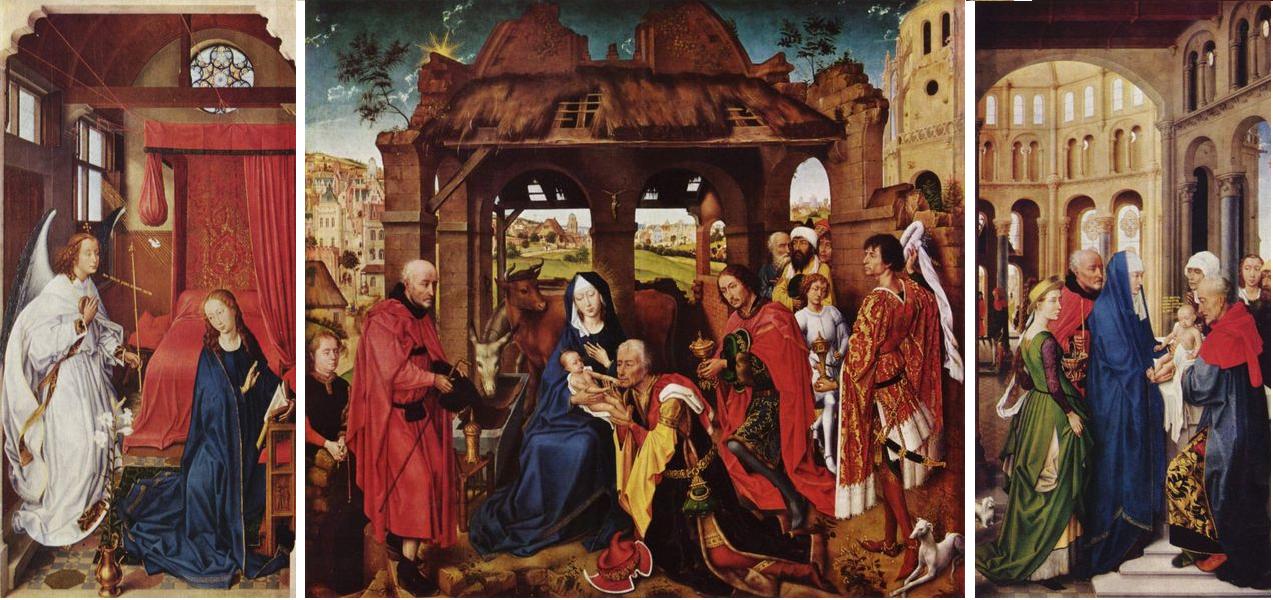
The above image, a triptych known as the Columba altarpiece, by Rogier van der Weyden (1399/1400-1464), I reproduce here because, in my parish church, a reproduction has been placed above the votive candle stand next to Our Lady of Perpetual Succour, and so I light a candle before her and this representation of the Annunciation, Nativity and Presentation of Our Lord, her Son.

Noveritis EF and OF

Know, dear brethren, that, as we have rejoiced at the Nativity of our Lord Jesus Christ, so by leave of God's mercy we announce to you also the joy of his Resurrection, who is our Saviour. [On the 5th day of February will be Septuagesima Sunday. ‡] On the 22nd day of February will fall Ash Wednesday, and the beginning of the fast of the most sacred Lenten season. On the 8th day of April you will celebrate with joy Easter Day, the Paschal feast of our Lord Jesus Christ. On the 17th* / 20th† of May will be the Ascension of our Lord Jesus Christ. On the 27th day of May, the feast of Pentecost. On the 7th* / 10th† of June, the feast of the Most Holy Body and Blood of Christ. On the 2nd day of December, the First Sunday of the Advent of our Lord Jesus Christ, to whom is honour and glory for ever and ever. Amen.
Noveritis
the Announcement of Easter and the Moveable Feasts:
proclaimed after the Gospel on the Epiphany of the Lord 
(Roman Missal 2011 edition)

* Extraordinary Form and normative Ordinary Form date (as in Germany, where I will be for Corpus Christi);
† Ordinary Form date in some countries, where these solemnities are transferred to the following Sunday (as in Australia);
‡ Extraordinary Form only (translated from the Latin).

Friday, January 8, 2010

From Edinburgh to Florence

These posts are getting all out of order...

Wednesday I kept the Epiphany with Mass and Office in Edinburgh.  Mark continued to be a generous friend, touring me around the city, to the Palace of Holyroodhouse, to the new Scottish Parliament (an excellent thing, devolution; and who knows, perhaps to...), to the church at the Cowgate - where we revered the shrine of the Venerable Margaret Sinclair (1900-1925), a poor hardworking local lass who died in the odour of sanctity as a Poor Clare extern, known as the "Edinburgh Wonder Worker", whose Cause is advancing - to Edinburgh Castle, on to a very decent late lunch at Dario's, then off in the early evening to Mass for the Epiphany, courtesy of Fr Emerson, F.S.S.P.  The choir were very good, mixing chant and polyphony, with a very talented organ accompaniment, to effect.

Alas, on Thursday I had to arise at 3 a.m. to get my taxi to the airport for a pre-dawn flight (such the time one must allow for airport security and all the rest these days).  The flight to Paris was very pleasant, but I found finding my way around Charles de Gaulle Airport quite terrifying, as I had little time and no idea where to go to find my connecting flight.  I was so distracted I left my mobile, rosary, etc. in my pockets when I was security-screened, setting off the scanner and making the security guards (on high alert owing to that Christmas bombing incident) very wary and a bit cross, fairly enough.  (Looking back to this I suddenly realize how serious it was, golly.)

Finally getting to the right place just in time, we were in due course off for Florence.  Compared to Heathrow (where the customs officer was rather harsh, unfriendly and even rude in his manner) and Paris (where owing to my blundering who knows what trouble I all unwittingly nearly brought down on myself), Italian airport security was, well, extraordinarily light: there was a dog sniffing bags, and I think I had to show my passport, but that was it!

Florence is beautifully warm after freezing England and Scotland.  Yester-day was sunny, to-day a bit rainy, but still great.

The taxi-driver turned out to have returned from several months' holiday in Australia, having seen more of it than I have...

I've booked in at my customary lodgings, the Hotel Plaza Lucchesi: suffice to say I have my own balcony overlooking Santa Croce.  Why stay anywhere else?  (I'll sound like Fr Z, but the complimentary breakfast alone has three courses, with liveried waiters.)

After a good soaking bath to revive my drooping spirits, I set off around Florence for a good walk. 

First, I found what I'd missed last time: the Florentine Oratory, the Church of St Philip Neri (originally, the Church of San Firenze, an early eponymous bishop of the city).  Good Philip remains solicitous for me, his unworthy client.  The church has six side altars (one of St Philip, with painting thereof), a high altar (with the Bambino Gesu enthroned above the tabernacle, it being Christmastide), and a new and actually very appropriately furnished forward altar and sanctuary furniture.

It was providential that Thursday Sext contained the very words used in praying him since his death: "Look down from heaven and see, and visit this vineyard, and perfect the same which thy right hand hath planted" (quoted in Latin on the ceiling also, under the painting of him in ecstasy, with the quotation from Acts - Spiritus Domini rapuit Philippum).  A sign pointed into a side chamber for the Presepe (praesepio, crib): a whole altar (of the Sacred Heart) had been covered over with a huge representation of the Nativity scene, complete with running water and all.

In the side chamber was also the tomb of Pietro Bini, a Florentine and early follower of St Philip, who returning to their native city established the Oratory in Florence; he died a most holy death in 1635.

I didn't go far before I found myself at the Divine Liturgy (see last post below)... thank you, St Philip!

In the evening, I just wandered about entranced by the beauty of this Flourishing city, having a mild case of Stedhal syndrome (the palpitations and even psychosis engendered in visitors overcome by the concentration of art in Florence: the local mental hospital treats cases every year).

Again, I'll do a Fr Z and mention two nice comestibles: hot roasted chestnuts still in their shells bought off a street vendor; great big hot waffles stuck together into a prodigious sandwich with lashings of warm chocolate sauce - the latter of which I ate at the steps of the Duomo, at the foot of its facade, facing the Baptistery.

Florentia, civitas Christi Regis, floresce semper!

Christmas in Florence

Not only have I kept Epiphany twice (in Oxford and Edinburgh), but yesterday I celebrated Christmas again, courtesy of the Ukrainian Catholic community here in Florence!

I was simply looking for Vivoli Gelateria, and on a whim turned up a side alley, ending up at a church which I decided to investigate (I missed and walked right past the gelateria, which I later found to be closed at this season anyway) - when I came in to SS Simon and Jude, I found myself in a packed congregation, all standing, and the priest facing east at the altar, about to start the Insistent Litany after the Gospel (which I recognized by the threefold Gospodi pomilui - "Lord, have mercy").

Thanks be to God, I have sufficient familiarity with the Liturgy of St John Chrysostom, albeit not with Ukrainian, that I was able to pray the Mass.  I must admit, the Byzantine Rite leaves the West for dead (and I'd been at a lovely Missa Cantata for the Epiphany the night before!): the beautiful singing, the sweeping sacred Action, carries one along into the heavenly places.

(As a friend once put it, the Roman Mass, solemn and sober, is precisely ordered and structured, able to be analysed into successive parts, expressive of the Western discursive mind; the Byzantine Divine Liturgy rather is all one great unfolding irruption of the Sacred, a form of contemplation rather than of meditation if you will.)

BTW, it was evident this was a Catholic not an Orthodox service, since the congregants nearly all knelt for the Sanctus and Consecration (not for the Epiclesis), and again at the Sancta Sanctis and response - "One is Holy, One is Lord: Jesus Christ, in the glory of God the Father".

Only a minority (the more fervent one assumes, standing up the front) communicated, and late that I was and not quite certain in myself, I refrained.  But to-day at 2.30 pm there will be Divine Liturgy for the Synaxis of the Soprasanta Theotokos, so I've been to confession at the Duomo and will keep a third feast, of Mary the Mother of God (whose memory the West keeps on the Octave Day of Christmas as its liturgy old and new indicates, whatever of the Circumcision), for the second time!

Wednesday, January 6, 2010

Edinburgh

Inattention to matters financial meant I hadn't realized that using my mobile phone outside Australia involves quite some extra costs - including paying for incoming calls as well as outgoing ones!  Ah well.

I find Scotland snowbound but friendly; my contact here has treated me royally.

(And you get decent snacks like hot slices of black pudding in a soft bread roll!  I've yet to have haggis, though I've been taken numerous times already to Starbucks, and once to an Italian restaurant...)

Yesterday I rugged up and set off long before dawn to walk (very circumspectly) the frozen streets to Mass.  It must have been about a mile and half or more, and in this weather it took me over three-quarters of an hour - you can't stride out when in the snow you might go head over tails.  I arrived at the Orate fratres...

Later in the day, Mark and I heard another Mass, at the Jesuit church; Father had evidently mislaid his glasses, since he had difficulty reading the missal and got a bit mixed up.  But far more curious than this was the fact that, when I went to arise at the Orate fratres (as the latest command for the Novus Ordo is, as observed in Australia and in England and elsewhere), the congregation knelt instead, for the Preface and Sanctus and all, whereas back home we stand.  Similarly, no one stood for the Prayer after Communion and Blessing: no, they knelt right through to the dismissal.

I asked Mark afterward and he seemed surprised I was surprised: apparently this is just what one does at the Ordinary Form Mass here in Scotland.  (I don't object, just register this to-me-unknown "contrary custom".)

I see out the window that it's snowing again (it's dawn, about 9 am).

From the weather reports, I'm lucky to have come North when I did: all England is snowed under, with roads snarled and many unable to get to work or school.  Apparently it may be the coldest winter in thirty years...

A Meditation for the Epiphany

The second witnesses of this Miracle [of Christ… his Nativitie] are the Wise-Men. After God had laid open the Treasure of his Divine Secrets to Idiots [the Shepheards… rusticall Swaines], He shewes them also to the Wise. It seemes the Earth, at this time, was become the Booke of Gods greatest Mysteries, and Heaven the Index. In this they finde the Star of this King of the Iewes, which (having beene before the declarer of his Nativity) they now make their guide in their journey. The Starre performing this duty to its Creator, at length brings them to Bethlem, where they view Him in the Cratch, Whose Nativity before they had found in the Heavens. To Him they doe Homage, tender Adoration, and pay Tribute; and opening their Treasures, make him an Oblation of Gold, Incense, and Mirrhe. Whom before they had in vaine sought in the Heavens, they now finde on the Earth; and in the most sorded part of it, a Stable, full of severall stinkes; where He (to Whom none are worthy to be servants) had two dull Beasts for His Companions.

Returne now you Sonnes of Wisedome to your owne home, by much more learned, by more than much more happy than when you set out. Heaven is now set open to you, which before your unbeliefe kept shut against you. If you be Chaldeans or Persians, or both, spreade through those Nations the fame of that which you have seene. Publish in all places this the greatest Mystery of Piety, which God is onely able to produce, onely Faith can apprehend. Of all Creatures to man onely belongs the gift of Reason, by the rule whereof he measures all things. But doe not you doe so, lest you fall not onely into an irreparable, but a damnable errour. Follow you the instruction of Faith, and where ere you come with a holy Pride, proclaime that God is manifested in the Flesh; justified in the Spirit; seene by Angels; reveal’d to Shepheards; found out, and ador’d, by you your selves; and hereafter to be assum’d, and to sit in Glory farre above those Starres you daily read. Goe, and give out that there is nothing greater in Heaven, than what you have found in a Stable.

— Anthony Stafford, The Femall Glory: or, the life of the Blessed Virgin Mary (1635), “Her Delivery”, pages 108-9

Thursday, January 29, 2009

Last Sunday

Last Sunday I worshipped with the Russians, at the Russian Catholic Chapel of St Nicholas.  As the Russian Rite still keeps to the Julian calendar and the older method for calculating Easter, their Easter this year will be a week later than the Roman, and the Sunday just past - the 25th of January New Style (i.e. Gregorian) / 12th January Old Style (Julian) was the Sunday after the Theophany (since the Julian calendar is now thirteen days behind the Gregorian and hence the 6th of January O.S. is the 19th of January N.S.).  Being the 12th of January O.S., it was also the feast of St Tatiana, martyr at Rome (see icon at the top and details at the end of a Russian Orthodox web page).

This afforded much spiritual delight: the icon of the Baptism of the Lord was exposed for veneration, and at the Little Entrance was sung the Troparion and Kontakion of the Feast, after the Troparion of the Resurrection:
At Your baptism in the Jordan, O Lord, worship of the Trinity was revealed, for the Father's voice bore witness to You, calling You His "beloved Son", and the Spirit in the form of a dove confirmed the truth of these words.  O Christ God, Who appeared and enlightened the world, glory to You!

You have revealed Yourself to the world today, and Your light, O Lord, has shined upon us.  We recognize You and exclaim to You: "You have come and revealed Yourself, O Inaccessible Light."
It must be remembered that one common Eastern name for baptism is enlightenment or illumination - hence Christ shone out in the Jordan, shedding His healing rays on all men, manifesting Himself in His Epiphany.

After the service, Fr Lawrence said casually that he hadn't been sure whether it were the 32nd or the 33rd Sunday after Pentecost (as the Byzantine Rite enumerates all Sundays from one Pentecost right through until the pre-Lenten preparatory Sundays commence, there being no Advent as such, just the Nativity Fast), but that in any case the readings settled upon had been manifestly suitable!  I discover now that he was joking, since there are proper readings assigned for the Sunday after the Theophany, whatever Sunday after Pentecost it be, and the proper readings were those that were chanted.

The Gospel was taken from St Matthew iv, 12-17; the Epistle, from Ephesians iv, 7-13 (part of which I read in the Roman Breviary at Matins to-day, hence my being reminded of all this Liturgy) - and I have always found rather admirable the way the reader chants the Epistle, beginning on a very low note, and gradually ascending as he goes till he finishes on a very high one...

Wednesday, January 7, 2009

Unpacking

My boxes having arrived from W.A., I now have some unpacking to do...

I also want to unpack the Epiphany Preface; and will consider it in its three constituent parts.

Vere dignum et justum est, æquum et salutare,
nos tibi semper et ubique gratias agere,
Domine, sancte Pater, omnipotens æterne Deus:

(Truly it is worthy and just, right and salutary,
[for*] us always and everywhere to give thanks unto Thee,
Lord, Holy Father, Almighty Eternal God:)

Here we have the first part, the protocol of the Preface, the same (but for those of Easter and of the Apostles) in all Prefaces, which reminds us of what reason and religion alike instruct us, that unto God ought be rendered all honour and glory at all times and in every place, giving thanks in all things and for all things to God the Father of lights, from Whom cometh down every good and perfect gift; for so to pray is our duty and a most fruitful one.  The use of duplication and reduplication to give majestic sound is notable: four descriptive terms, then two, then God Himself named with six titles.  [* The Ambrosian Rite uses the expression Vere quia &c., For it is truly right....]

Quia,
cum Unigenitus tuus in substantia nostræ mortalitatis apparuit,
nova nos immortalitatis suæ luce reparavit.

(For,
when Thine Onlybegotten appeared in the substance of our mortality,
He repaired us by the new light of His immortality.)

The short body of the Preface - pregnant with meaning - is our proclamation before the Lord as to our especial reason for giving Him thanks before the priest alone embarks upon the silent consummation of the most sacred mysteries within the Canon of the Mass (præfari, to speak before).  God's Very Son deigned to shew Himself Incarnate, partaking of our own flesh and blood, so by this unparalleled illumination making manifest and displaying before our astonished eyes a truth previously unguessable; and being immortal and impassible in His Divinity, by enduring all for us in a nature that is our own He carried out an inconceivable transaction, that in due process of time gave us, all undeserving, access to a share in that immortality, translating us from the kingdom of darkness into His own marvellous light.  Glory to Him for ever!

But here is the alternative, Ordinary Form passage:

Quia ipsum in Christo salutis nostræ mysterium
hodie ad lumen gentium revelasti,
et cum [-] in substantia nostræ mortalitatis apparuit,
nova nos immortalitatis ejus gloria reparasti.

(For Thee Thyself in Christ the mystery of our salvation
to-day revealed as a light to the nations,
and when He appeared in the substance of our mortality,
Thou didst repair us by the new glory of His immortality.)

Curiously enough, the Novus Ordo Epiphany Preface expands on the Traditional text of the Epiphany Preface by including a new 'couplet' and changing a few words (suæ luce to ejus gloria, and reparavit to reparasti), giving a focus somewhat more directly on God the Father: Who Himself deigned to unveil the mystery of salvation, formerly hidden from all ages, and made it appear in Christ, the Light of the Gentiles; and Who Himself restored us by Christ's immortal glory.

Et ideo cum Angelis et Archangelis,
cum Thronis et Dominationibus,
cumque omni militia cælestis exercitus,
hymnum gloriæ tuæ canimus,
sine fine dicentes:

(And therefore with Angels and Archangels,
 with Thrones and Dominations,
and with all the companies of the heavenly host,
we sing a hymn of Thy glory,
saying without ceasing:)

The last part, the eschatocol of the Preface, comes in four forms, of which this, Et ideo, is the most common; but where it is preceded by (Per) Christum Dominum nostrum, the matching form Per quem is used; while the Pentecost Preface ends with Sed et, and the Trinity Preface with Quam laudant.  (It must be noted that the All Saints Preface pro aliquibus locis has a variant form of the Per quem, and the quasi-Preface formerly used at the blessing of palms on Palm Sunday has a variant of the Et ideo.)  Four choirs of the celestial armies are named, then the whole in its array, making a resounding and emotional climax before we join in their continual cry, Sanctus, Sanctus Sanctus!

This the Epiphany Preface is noteworthy finally because the sentiments expressed in it, being quite general, could indeed have been used equally well at Christmastide or indeed at other times in the Christian Year - this is a quality of the older Roman Rite, that its prayers and euchological texts by their very brevity and profundity repay careful unpacking and consideration, and that their wealthy of meaning makes them appropriate not merely at their assigned time and season, but in wider spheres also.

Epiphany Collect

...the Magi advance with the Star: 
for Thou art born for us, 
Little Child, God Eternal!
(Byzantine Troparion)

In the Traditional Rite (which at present I'm following in the Breviary only, more's the pity), yesterday was the feast of the Epiphany of Our Lord, and to-day and succeeding days are ferias of Epiphanytide, with the upcoming Sunday the Feast of the Holy Family (which the Ordinary Form observed on the Sunday in the Octave of Christmas), and the Octave Day of the Epiphany on the 13th to be the Feast of the Baptism of the Lord (which I will perforce observe at Mass on this coming Sunday as the Novus Ordo directs).  Therefore, from 1st Vespers on Monday evening just past until None on Saturday inclusive, the Collect of the Epiphany will be the prayer used at the Hours in the Breviary:

Deus, qui hodierna die Unigenitum tuum gentibus stella duce revelasti: concede propitius; ut, qui jam te ex fide cognovimus, usque ad contemplandam speciem tuæ celsitudinis perducamur.  Per eumdem...

(God, Who this day revealed Thine Onlybegotten to gentiles by the leading of a star: propitiously concede, that we who now know Thee by faith, may be brought unto the contemplation of the beauty of Thine eminence.  Thro' the same...) 

It is well-known that Cranmer, tho' a heretic, was rather good at translating liturgical prose; this is his version as preserved in the B.C.P. (the 1549 read "which" for the first "who"):

O God, who by the leading of a star didst manifest thy only-begotten Son to the Gentiles: Mercifully grant, that we, which know thee now by faith, may after this life have the fruition of thy glorious Godhead; through Jesus Christ our Lord.  Amen.

This strikes me as a wonderful prayer, asking that we may pass from beholding God as in a glass darkly by faith, unto the clear Vision of His boundless light: it is a prayer that the faith by which we know Him now may not fail of its object, but have its eternal fruition in the rapturous gazing upon the sight, the beauty, the glory (speciem) of the infinite eminence, height and loftiness (celsitudinis) of our God in heaven evermore.  This collect makes reverent play on these two words: only through Our Lord Jesus Christ can we ever hope to be conveyed from our earthly lowliness unto such a vantage point that could yield us such a surpassing sight of our God so far above us.  

By leading gentiles (the Magi) by a star, the instrument of His designs, they were brought from ignorance of true religion unto the Very God made visible; likewise in all ages Divine Providence is at work to direct both Jews and Gentiles, all nations, all men in freedom to attain unto their salvation by coming nigh unto Christ - and so knowing Him now in faith, all must pray for the precious and unmeritable gift of final perseverance, that our faith may not fail, but may be succeeded by the Beatific Vision of God.

Sunday, January 13, 2008

The Lamest Canticle

I have no objection to the use in the modern Office of New Testament Canticles at Vespers in an analogous manner to the immemorial use of Old Testament Canticles at Lauds (and Monastic Vigils), in addition to the traditional three Gospel Canticles (Benedictus, Magnificat and Nunc dimittis) used at Lauds, Vespers and Compline.  Scholarly research revealed good suggestions that certain passages in the epistles of St Paul were hymnic in structure, after all.


However, the excuse for a Canticle slotted into 1st Vespers of the Epiphany and the Lord's Baptism is just dreadful, because it is a failed pastiche: it interlards the sublime concision of I Timothy iii, 16 with a response (yuk! deliver me from the Responsorial Psalm, too-aptly defined as "an exercise in short-term memory"), worked in poorly, from Ps 116:1a.  It would have been better far to either use I Tim. iii, 16 as a short reading at one of the Hours of these feasts (for which it is manifestly appropriate, excuse pun), or have it as a super-short canticle (longer at least than Psalm 116, and only a bit shorter than Psalm 132 or the Canticle from Apoc. xv, 3-4).

Saturday, January 12, 2008

Tribus miraculis

Over at Pastor Weedon's blog, mention of the Epiphany Magnificat anthem Tribus miraculis arose.  Since (in the Novus Ordo at least) tomorrow is the Feast of the Lord's Baptism (since it's a Sunday, in the Old Rite the Holy Family trumps it, unfortunately), it seems good to mention this very impressive text, which links the three miracles commemorated in a kind of triptych: the Adoration of the Magi, the Baptism of the Lord, and the Wedding Feast at Cana – today, the sacred Liturgy proclaims, all these wonders took place, to our great and endless comfort: "If today ye hear His voice, harden not your hearts..." (Ps 94).

We honour this holy day adorned with three miracles: 
today the star led the Magi to the manger: 
today wine was made from water at the nuptials: 
today in the Jordan Christ willed to be baptized by John, 
that He might save us, alleluia.

Palestrina's setting of this anthem is available here, thanks to the St Gregory Society.

NB St Augustine, I recall, and St Bede, subjoin a fourth miracle – the multiplication of the loaves and fishes – to the Epiphany, and the Mozarabic Rite adds a fifth, a renewed commemoration of the Nativity of the Lord: in all cases the miracles are considered as manifestations of the Divine saving power of Christ.

Here is the solemn Blessing for the Epiphany, as bestowed in the Mozarabic Rite before Communion (Missale Mixtum, col. 238f):


Jesus Christus Rex noster qui profanum Regem sua nativitate terruit: 
ipse in vobis cum suis virtutibus regnet.  
R/.  Amen.
Cujusque signum stella radiante Magis apparuit: 
ejus vos gratia sine fine clarificet.  
R/.  Amen.
Det vobis spiritualem intelligentiam: 
qui aquarum naturam vini in suavitate fecit esse saporem.  
R/.  Amen.
Et qui populorum millia exiguo panis fragmine satiavit: 
corda vestra doctrine sue alimento locupletet.  
R/.  Amen.
Conferens vobis veram innocentiam: 
qui Spiritus Sancti tranquillam simplicitatem demonstare voluit per columbam.  
R/.  Amen.
Quod ipse prestare dignetur: 
cujus regnum et imperium sine fine permanet in secula seculorum.  
R/.  Amen.

(May Jesus Christ our King, Who terrified the profane King by his birth: 
Himself reign in you with his virtues.
Amen.
And may He Whose sign appeared to the Magi as a radiant star: 
by His grace make you to shine without end.
Amen.
May He give you spiritual understanding: 
Who made the nature of waters to be the flavour of wine in sweetness.
Amen.
And may He Who satiated thousands of people with scanty fragments of bread: 
enrich your hearts with the food of his teaching.
Amen.
Conferring on you true innocence: 
Who willed to shew forth the tranquil simplicity of the Holy Ghost by a dove.
Amen.
Which may He deign to grant: 
Whose reign and empery abideth without end unto the ages of the ages.
Amen.)

Epiphany Blessings

As Epiphanytide draws to a close, I thought I might post the blessings at Epiphany Matins – which are in rhyme, as usual – from the Ambrosian Breviary of old, asking a blessing from Christ at his Manifestation to the Gentiles:

Nos defendat a pœnis inferni 
cui tulerunt munera Magi.  R/.  Amen.
Per apparitionem stellæ 
perducat nos Dominus ad gaudia vitæ.  R/.  Amen.
Christus lux lucis 
det nobis gaudia pacis.  R/.  Amen.
Qui in Jordane est baptizatus, 
nostros deleat ipse reatus.  R/.  Amen.
Filius Dei vivi 
faciat nos per omnia placere sibi.  R/.  Amen.
Christus Rex regum 
nos faciat vivere secum.  R/.  Amen.
Christi Jesu Stella vera 
illuminet sensus et corda nostra.  R/.  Amen.
Jesus Deus noster 
benedicat nos et nunc et semper.  R/.  Amen.

(May He defend us from the pains of hell, 
to Whom the Magi brought gifts.  R/.  Amen.
By the apparition of a star 
may the Lord bring us to the joys of life.  R/.  Amen.
May Christ the Light of Light 
give us the joy of peace.  R/.  Amen.
May He Who was baptized in the Jordan 
Himself efface our guilt.  R/.  Amen.
May the Son of the living God 
make us to please Him in all things.  R/.  Amen.
May Christ the King of kings 
make us to live with Him.  R/.  Amen.
May the true Star of Christ Jesus 
enlighten our minds and hearts.  R/.  Amen.
May Jesus our God 
bless us both now and ever.  R/.  Amen.)

Friday, January 11, 2008

St Romanos the Melodist

News from my friend David Schütz that he's applying to be considered for the permanent diaconate – please God, this will come to pass – made me think about sainted deacons, such as the three great martyrs SS Stephen (my confirmation patron), Lawrence and Vincent, and three great confessors among the glorified ranks of levites, SS Romanos the Melodist, Ephræm, and Alcuin of York.


St Romanos, a convert from Judaism and hierodeacon at Constantinople, is justly famed as a peerless hymnographer (the Akathist is attributed to him; it bears the same indulgences nowadays as the Rosary); one of his greatest compositions, legendarily given him by the Blessed Virgin herself, together with the gift of melodious singing, is his Nativity Kontakion (see icon: he's holding the text she gave him): in its full form, it is a dialogue between Our Lady and the Magi, since in the Byzantine Rite the Gospel of Christmas Day is St Matthew ii, 1-12; as this is the Western Rite Gospel for the Epiphany, whose sometime Octave is still in progress, it seems most appropriate at this season to link to it here.


As to venerating St Romanos himself, these are the Byzantine Kontakion and Troparion for him, who is feasted on the 1st of October:


Thou wast adorned from childhood with the godly virtues of the Spirit; thou wast a precious adornment of the Church of Christ, all wise Romanos, for thou didst make it lovely with beautiful hymnody.  Therefore, we entreat thee, grant thy divine gift to those who desire it, that we may cry out to thee: Rejoice, all-blessed Father, beauty of the Church.

Thou didst gladden Christ's Church by thy melodies like an inspired heavenly trumpet.  For thou wast enlightened by the Mother of God and didst shine on the world as God's poet.  We lovingly honour thee, O righteous Romanos.


The couplet given in the Menaion for St Romanos is quite beautiful, I found (thanks to a consultation of the Acta Sanctorum for October, Tome I, pp. 56-59):


Before indeed with hymns Romanos celebrated the Divine Word; 
But he celebrates now, however, with angels.

Thursday, January 10, 2008

Christ our Star our Map our Road

Australian Catholics are hopefully still familiar with the hymns written by James McAuley (d. 1976) and given music by Richard Connolly, which IMHO are the last decent examples of the genre; most if not all more modern stuff betrays an ideological bias.


One of McAuley's hymns has the stirring couplet "Christ our star, our map, our road / To the Father's high abode"; and this I was put in mind of by a passage of St Ambrose.


Until the reforms of Pius XII and Bl. John XXIII, the Epiphany had its own Octave, with Patristic readings each day in Matins of nine lessons.  Unfortunately, these were gone by the publication of the 1962 Breviary; the modern Divine Office provides quite excellent Patristic readings of course, but only concentrate on the coming of the Magi on the Epiphany itself, and on the succeeding day – the rest of the time (excepting the Saturday) till the feast of the Lord's Baptism simply presages that (highly important) event.  (In the same way, the newer form having abolished the Octave of Pentecost, now the days after Ascension must needs focus already on the coming Holy Spirit, to the exclusion of Christ's return to His Father and Session in majesty at His Right).


Years ago I first noted the extract from St Ambrose's Commentary on St Luke's Gospel (yes, St Luke's - he presumably digresses to compare and contrast St Matthew's account of the Magi) that appeared at Matins of the 11th of January, as part of the 8th Lesson, describing Christ as our Star; here is the passage, and my translation:


Stella ab his vidétur: ubi Heródes est, non vidétur; ubi Christus est, rursus vidétur, et viam demónstrat.  Ergo stella hæc via est, et via Christus [cf. S. Jo. xiv, 6]: quia secúndum incarnatiónis mystérium Christus est stella.  ‘Oriétur’ enim ‘stella ex Jacob, et exsúrget homo ex Israël’.  [Num. xxiv, 17.] Dénique ubi Christus, et stella est.  Ipse enim est ‘stella spléndida et matutína’ [Apoc. xxii, 16].  Sua ígitur ipse luce se signat.

[The star is seen by them, but where Herod is, it is not seen; where Christ is, it is again seen, and shews the way.  Therefore this star is the way, and the way, Christ (cf. S. John xiv, 6); for according to the mystery of the Incarnation Christ is a star.  For ‘there shall arise a star out of Jacob, and a man shall arise out of Israel’ (Numbers xxiv, 17).  And so where Christ is, also the star is.  For he himself is the ‘splendid and morning star’ (Apoc. xxii, 16).  Therefore by his very own light he signifies himself.]


Christ is our Star, Who is Light from Light and Splendour of the Father, shining down and lighting our Way: for He both shews the Way, and is our Way, the only Way, to the Father.  As travellers and seafarers of old marked the stars – above all, the Pole Star – that they might determine their perilous course through the darkness of night, so only Christ (Who never sets, Who is ever risen, at the Right Hand of God) shines amidst the changes and chances of this darkened world as the sure beacon alone indicating our true path.


The Liturgia Horarum gives this apposite collect for the 7th of January, or Monday after Epiphany (if transferred to a Sunday):


Corda nostra, quæsumus, Domine, tuæ majestatis splendor illustret, quo per mundi hujus tenebras transire valeamus, et perveniamus ad patriam claritatis æternæ.  Per Christum Dominum nostrum.  R/.  Amen.

(May the splendour of Thy Majesty enlighten our hearts, we beseech Thee, Lord, whereby we may be able to pass through the darkness of this world, and attain to the eternal brightness of our fatherland.  Through Christ our Lord.  R/.  Amen.)