Showing posts with label private Mass. Show all posts

Tuesday, October 30, 2012

Low Mass – Votive of the Passion

As the Friday High Mass on pilgrimage had been a Votive of the Holy Cross, I suggested to Fr Rowe, when he readied himself to offer his Low Mass in the Christus Rex mobile chapel, that perhaps a Votive of the Five Wounds would be a suitable variant; but – most annoyingly – even a search of the Missæ pro aliquibus locis in the only available Missal failed to turn it up: so we settled for a Votive of the Passion (from which the Votive of the Five Wounds varies only in its orations in any case).  I was privileged to be Father's server, and took the opportunity to memorialize the occasion thanks to my iPhone's camera...

The Introit

The Gospel

The Secret

The Canon

After the Consecration

The Pre-Communion Prayers

The Last Gospel

The orations of the Votive Mass of the Passion are particularly mediæval in feel:
Lord Jesu Christ, who didst descend from the heavens to earth from the bosom of the Father, and shed thy precious Blood in remission of our sins: humbly we pray thee, that at the Day of Judgement, at thy right hand we may deserve to hear: Come, ye blessed: Who with the same Father and the Holy Ghost livest and reignest God, world without end. Amen. 
May the sacrifice offered unto thee, O Lord, by the interceding Passion of thy Onlybegotten Son, ever quicken and defend us: Who liveth and reigneth with thee in the unity of the Holy Ghost, God, world without end. Amen. 
Lord Jesu Christ, Son of the living God, who at the sixth hour didst ascend the gibbet of the Cross for the redemption of the world, and shed thy precious blood in remission of our sins: we humbly pray thee, that, after our death, thou grant us joyfully to enter the gates of paradise: Who livest and reignest with God the Father in the unity of the Holy Ghost, God, world without end. Amen.
It is interesting how the thoughts of the Collect are repeated in the Postcommunion; He Who came down from heaven, from the bosom of the Father, to redeem the world went up upon the infamous gibbet, there to shed His Blood, that great price of our salvation, that costly offering of His life which alone purchased the forgiveness of our sins; He we pray, that after death we may enter into the courts of the Lord with rejoicing, hearing on the Day of Doom that most joyful voice, Come, ye blessed. 

Fr Hunwicke points out that this Mass was very popular in late mediæval England, to the extent that Cranmer reused this phraseology at the conclusion of the intercession before the prayer of consecration in his 1549 recasting of the Mass: 
...that, at the day of the generall resurreccion, we and all they which bee of the misticall body of thy sonne, may altogether be set on his right hand, and heare that his most ioyfull voyce: Come unto me, O ye that be blessed of my father, and possesse the kingdom, whiche is prepared for you from the begynning of the worlde...

Monday, October 29, 2012

Back from Christus Rex

As always, I return refreshed and recharged from the annual Christus Rex Pilgrimage: what camaraderie, what singing, what chanting, what prayers, what sermons, what High Masses – yes, and what tiredness, what early mornings, what aching feet...  (Note to self: next year, take Thursday off work as well, so I get to Ballarat a good deal earlier than half nine at night!)

It was particularly pleasant to meet up with my old friend and erstwhile parish priest, Fr Rowe; and it was a deeply felt honour for me that he had me serve his private Masses on the three days of the pilgrimage (which provided an additional benefit, since it entailed remaining behind during one leg of  each day's march, and afterward being driven to the head of the pilgrim column that had moved off in the mean time, shaving several kilometres off the trek each day).

There is more, much more, to say about the pilgrimage, but I will sign off for now with a humorous note: another priest, after saying his private Mass on the Friday, revealed that he had forgotten the Christian name of the new Bishop of Ballarat (in whose diocese we were), and in desperation made dog-Latin of his surname – saying "Birdo" in the Canon!

Saturday, February 6, 2010

Mass All Alone?


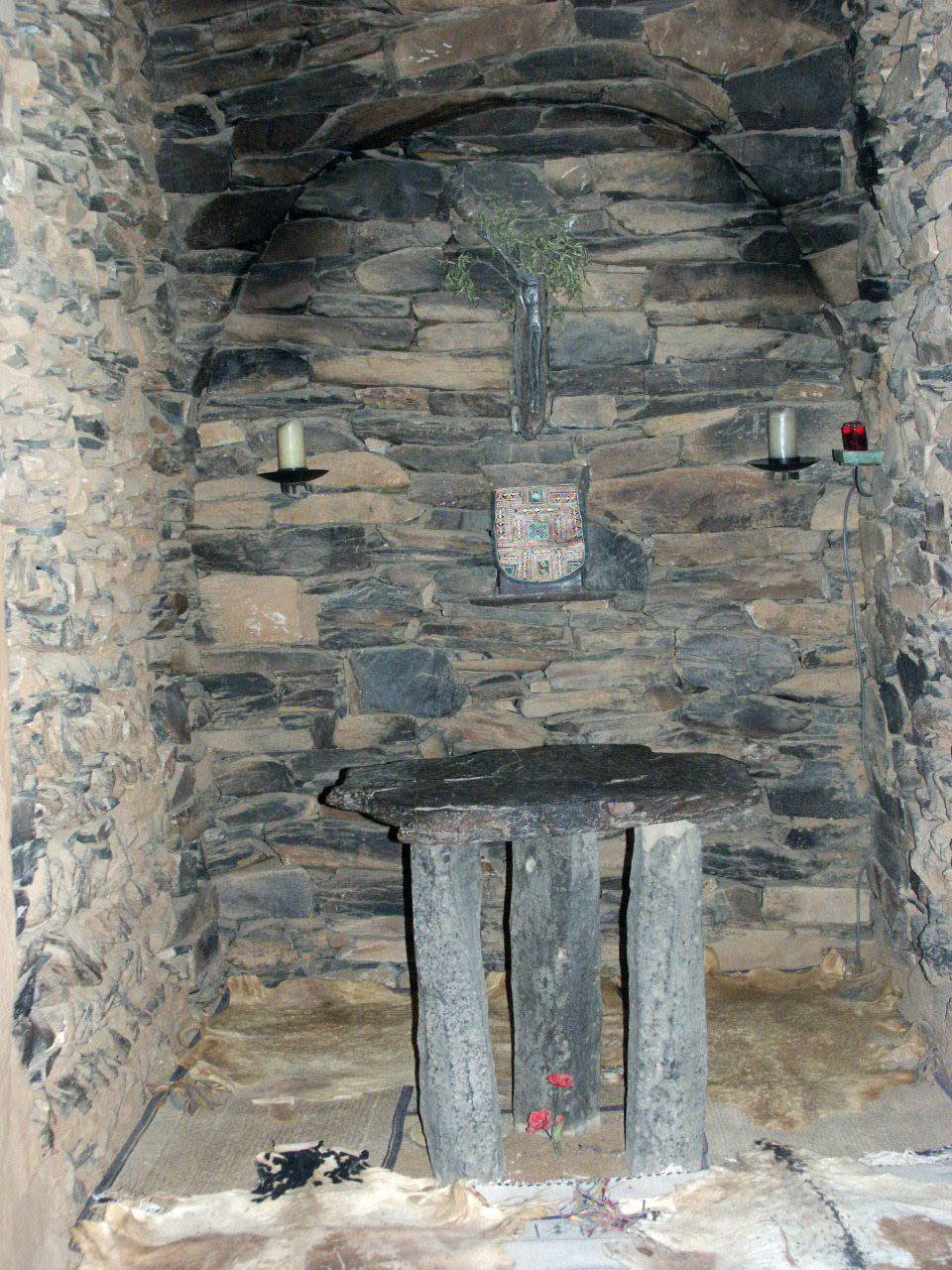
The altar within de Foucauld's hermitage

I recall that while Bl Charles de Foucauld was a hermit out in the wilds of the Sahara, for long years, though he was a priest, he couldn't say Mass – because there was no one to attend it.

The old rule always was that even at a private Low Mass, there must always be a server, or, in default of that, someone (even a laywoman) kneeling at the altar rail to give the responses.  In fact, even if he or she couldn't give the responses, that person's mere presence would minimally suffice: for at least someone had to be there as well.

Just as the priest acts in the person of Christ the Head, there must be a member of the Church present (the server, so to speak, acts in the name of the Church when he gives the responses - for at High Mass, the choir sings the responses, as ideally the whole congregation does).

After some years, Bl Charles obtained special permission from the Holy See to say Mass entirely alone – since there were no other Christians anywhere at all nearby, and the local Muslims were hardly to be expected to come and assist at Mass (seeing as he never converted any of them).

(In passing, the question may be asked, would the attendance of a pagan, an unbaptized person, suffice?  One suspects not...)

But, when Mass is said by a priest entirely alone, what special rubricks would he observe?

Some concerns are already provided for, as in the case of the absence of a server (so for instance the priest himself moves the missal, etc.).  Obviously, as in a private Mass anyway, there would be no ringing of bells; since the priest would have no one to pour the first ablution over his fingers, I suppose he would first dip them in the fingerbowl (the correct name for this escapes me) next to the tabernacle, and later consume the water therein [UPDATE – no, see 0. below for the right rule]: but there should be rubrickal directions for this, at least in the approved authors.

Five points come to mind:

1.  The priest would say everything the server normally would (as in the recitation of the Office, prior to the last preconciliar changes, he would himself respond to his own Dominus vobiscum), following any special rules (as for example the special form of the Suscipiat, already provided in the missal for the priest to say if the server fail to make the response);

2.  As there is no one to reply with the Misereatur, the priest would presumably follow the rule for when Compline is said by one alone, and say it himself (suitably modified) – the server's Confiteor and the priest's reply being utterly omitted, then at once would follow the Indulgentiam;

3.  Would the priest need to turn from the altar toward the non-existent congregation at the Dominus vobiscum and Orate fratres? it would seem superfluous and ridiculous to do so – but perhaps he ought, remembering that the Angels are present;

4.  At the end of Mass, it would seem again silly and pointless to give a blessing in the absence of any people present – the Carthusians never do, precisely since they have no layfolk at their Masses, though significantly their books note that if, for some strange reason, some such are present, then a blessing should be given as is the general custom.

I await some advice from rubrickal experts about all this...

******

UPDATE: I finally thought to open up Fortescue-O'Connell-Reid (the latest, 15th, Summorum Pontificum, 2009 edition), and behold!  My queries are answered.

Firstly, the strictures against Mass entirely alone have been much relaxed in the new Code of Canon Law, since the priest's desire of and devotion to saying Mass, even if no one be in attendance, are considered a solid reason for doing so.

0.  At the ablutions, either the priest first pours wine then water over the index finger and thumb of his left hand, and then does the same for his right hand (swapping the cruets from hand to hand as necessary), or he may thus cleanse the left hand digits in question, then dip those of his right into the chalice to purify them;

1.  O'Connell questioned the saying the Dominus vobiscum, but the other expert authors reject this – and as noted above, in the Suscipiat the priest makes the modification of saying de manibus meis;

2.  According to a response from the Sacred Congregation of Rites (no. 3975), the Confiteor is to be said only once, omitting entirely vobis fratres and vos fratres, and similarly the priest says at once Misereatur nostri;

3.  The question of whether to turn or not at the salutations and admonition is not dealt with – I suppose that silence betokens consent, and the priest should still turn ad populum (though no one be there!), since this signifies the truth that, even when the priest celebrates alone, Mass is an action of the whole Church, and he truly offers up the Saving Victim for all and on behalf of all;

4.  I had sided with O'Connell's minority opinion about omitting the blessing at Mass's end, but in a footnote the other authors contradict him on this, for the same reasons as noted immediately above.

Some other directions: when moving the missal, the priest does not genuflect (as a server would when doing so) but merely bows his head to the altar crucifix.  For convenience, the cruets and lavabo bowl are either arranged on a credence close to the altar, or even placed on the altar itself.