Showing posts with label 1962 Breviary. Show all posts

Wednesday, January 21, 2015

The Joy of the Psalms

Deo gratias, I have been putting into practice, in some small way – I hope – the advice tendered by this blog's title, Psallite sapienter; for as Chesterton once said, if something's worth doing, it's worth doing badly. In other words, ever since Sunday the 28th of December, I have resumed reciting the Day Hours from the Roman Breviary of 1962.

I find that the nine psalms of Matins "occasions psychological difficulties", but, since the Feast of the Holy Family (EF) I have adopted an expedient, whereby I say a shortened Matins, including but three psalms out of the nine, omitting the other six: it's not the Office as it should be, but it's better than nothing.

UPDATE: For any who may be interested, I have determined to choose three out of the nine Matins psalms according to the following cycle, so that every three weeks I read over all of them.


Selection of Psalms for Shortened Matins

1st Sunday of Advent & week following 3 Pss of Noct. 1
2nd Sunday of Advent & week following 3 Pss of Noct. 2
3rd Sunday of Advent & week following 3 Pss of Noct. 3
4th Sunday of Advent & week following 3 Pss of Noct. 1
Christmas      9 Pss as given
Sunday in Christmas Octave & week following 3 Pss of Noct. 2
H. Name (Sun. aft. Xmas Oct.*) & week following 3 Pss of Noct. 3
[* if it occur]
Epiphany 9 Pss as given
1st Sunday after Epiphany & week following 3 Pss of Noct. 1
2nd Sunday after Epiphany & week following 3 Pss of Noct. 2
3rd Sunday after Epiphany & week following 3 Pss of Noct. 3
4th Sunday after Epiphany & week following 3 Pss of Noct. 1
5th Sunday after Epiphany & week following 3 Pss of Noct. 2
6th Sunday after Epiphany & week following 3 Pss of Noct. 3
Unused Sundays after Epiphany used before the Last after Pentecost
Septuagesima & week following 3 Pss of Noct. 1
Sexagesima & week following  3 Pss of Noct. 2
Quinquagesima & week following  3 Pss of Noct. 3
1st Sunday in Lent & week following  3 Pss of Noct. 1
2nd Sunday in Lent & week following  3 Pss of Noct. 2
3rd Sunday in Lent & week following  3 Pss of Noct. 3
4th Sunday in Lent & week following  3 Pss of Noct. 1
1st Sunday of the Passion & week following 3 Pss of Noct. 2
Palm Sunday & week following 3 Pss of Noct. 3
Last 3 Days of Holy Week 9 Pss as given
_________________________________________________
Traditional Dominican Practice:
Easter Octave 3 Pss as given
1st Sunday & Week after the Easter Octave 3 Pss of Noct. 1
2nd Sunday & Week after the Easter Octave 3 Pss of Noct. 2
3rd Sunday & Week after the Easter Octave 3 Pss of Noct. 3
4th Sunday & Week after the Easter Octave 3 Pss of Noct. 1
5th Sunday & Week after the Easter Octave 3 Pss of Noct. 2
Sunday & following Ferias after the Ascension 3 Pss of Noct. 3
Pentecost Octave (Whitsuntide) 3 Pss as given
________________________________________________

Trinity Sunday (1st after Pent.) & week following 3 Pss of Noct. 1
2nd Sunday after Pentecost & week following 3 Pss of Noct. 2
3rd Sunday after Pentecost & week following 3 Pss of Noct. 3
4th Sunday after Pentecost & week following 3 Pss of Noct. 1
5th Sunday after Pentecost & week following 3 Pss of Noct. 2
6th Sunday after Pentecost & week following 3 Pss of Noct. 3
7th Sunday after Pentecost & week following 3 Pss of Noct. 1
8th Sunday after Pentecost & week following 3 Pss of Noct. 2
9th Sunday after Pentecost & week following 3 Pss of Noct. 3
10th Sunday after Pentecost & week following 3 Pss of Noct. 1
11th Sunday after Pentecost & week following 3 Pss of Noct. 2
12th Sunday after Pentecost & week following 3 Pss of Noct. 3
13th Sunday after Pentecost & week following 3 Pss of Noct. 1
14th Sunday after Pentecost & week following 3 Pss of Noct. 2
15th Sunday after Pentecost & week following 3 Pss of Noct. 3
16th Sunday after Pentecost & week following 3 Pss of Noct. 1
17th Sunday after Pentecost & week following 3 Pss of Noct. 2
18th Sunday after Pentecost & week following 3 Pss of Noct. 3
19th Sunday after Pentecost & week following 3 Pss of Noct. 1
20th Sunday after Pentecost & week following 3 Pss of Noct. 2
21st Sunday after Pentecost & week following 3 Pss of Noct. 3
22nd Sunday after Pentecost & week following 3 Pss of Noct. 1
23rd Sunday after Pentecost & week following 3 Pss of Noct. 2
Any unused weeks after Epiphany inserted here
24th Sunday after Pentecost & week following 3 Pss of Noct. 3


This method is based on that of the Dominican Breviary, which employs only three psalms at Matins for the whole of Eastertide (as indicated above) – in addition to the practice in the Roman Breviary, whereby only three psalms are said at Matins during Easter Week and Whitsuntide.

In addition, it is well-known that Matins of the Little Office of Our Lady contains only three psalms, while in the Office of the Dead one may read either one Nocturn, or all three.

As there are a maximum of 53 Sundays in the year, and Matins during the Octaves of Easter and Pentecost already have their assigned psalmody of three psalms, this scheme spreads the recitation of the psalms at Matins over a three-week cycle that, ideally, repeats 17 times a year. (In reality, of course, this neat pattern is likely to be broken…)

In any case, it has really helped me, this return to prayer, even if not to the full Hours, as I love the psalms and the cycles of the liturgy; so to God be the glory.

Friday, December 6, 2013

Same Collect, Different Collect

Having read the Collect of Advent Sunday quite a number of times in the Breviary this week, I was intrigued to hear it read in English at morning Mass at Carmel today, Friday the 6th (since sadly St Nicholas was not commemorated, his being but an optional celebration in the modern West):
Stir up your power, we pray, O Lord, and come, that with you to protect us, we may find rescue from the pressing dangers of our sins, and with you to set us free, we may be found worthy of salvation. Who live and reign…
This struck me as a very able rendering of the Latin:
Excita, quæsumus, Domine, potentiam tuam, et veni: ut ab imminentibus peccatorum periculis, te mereamur protegente eripi, te liberante salvari: Qui vivis et regnas…
However, the traditional Collect of St Nicholas – not reproduced in the Novus Ordo – was evidently a little too strongly worded for sensitive moderns, despite the great need the sinners of this age have of it:
Deus, qui beatum Nicolaum Pontificem innumeris decorasti miraculis: tribue, quæsumus; ut, ejus meritis et precibus, a gehennæ incendiis liberemur. Per…
That is, 
O God, Who didst adorn the blessed pontiff Nicholas with miracles uncountable, grant, we beg, that, by his merits and prayers, we may be delivered from the fires of hell. Through…
It saddens me to find that what our wicked and sinful age stands most in need of – above all, to be spared Hell, and at the intercession of the saints to be saved through Christ at the last – to have been by overly contented "experts" judged too controversial, when, given the slaughters and every vile crime of the past century, one would think there to be abundant motivation to utter such a plea daily.

As usual, Vetus melius est, "The old is better" – and we have the authority of Pope Francis for calling the traditional Roman Rite the Vetus Ordo, and hence my referring this text of the Gospels to the same.

May I extend to the Russian Catholic parish of Holy Trinity – St Nicholas in Melbourne, every good wish for their patronal feast: though, of course, as they keep to the Julian calendar, they will not serve the Divine Liturgy in his honour until the 19th of December according to the Gregorian.

I note that their services contains a similar prayer to St Nicholas (the 2nd troparion after the heirmos of the 2nd Canon of the 4th Ode at Matins):
Standing before the throne of God, cease thou never to make earnest supplication in behalf of all of us, thy faithful servants, O wise and wondrous Nicholas, that we may be delivered from everlasting fire, from the enemy, from the wicked tongue, and from affliction.
May St Nicholas intercede for us with Christ God, that He save our souls.

Friday, June 17, 2011

Do I Do Penance or Not?

All men should do penance – myself not least.

Of course, Fridays not being solemnities are appointed days of penance by Holy Mother Church; and, in Australia, there is no obligation to fulfil this by abstaining from fleshmeat except on Good Friday (and also on Ash Wednesday), but some proportionate penance ought be done in order to fulfil this obligation.

That said, while on Friday I normally avoid eating meat in order thus to do an acceptable, traditionally hallowed penance of abstinence from flesh, but sometimes instead I spend some time in prayer – for a long time, I tended to say the Penitential Psalms for this purpose – if for whatever reason meat appears on the menu.

Now, in the more particular of the present case, do I or do I not need to do Friday penance this Friday?  Because, in the Office I pray, to-day is Ember Friday in the Octave of Pentecost, and is a first-class feast; but, as I have no 1962 Mass to attend, if I did go to church to-day it would be just a Friday in Ordinary Time (horrid term!).

As it is, while walking down to town earlier I used my new iPhone (free advertisement for Apple, please note – and yes, I use Apple for all my computing needs) to read Matins and Lauds according to the Roman Rite via Divinum Officium, that excellent website. Perhaps I'll say a bit more...  Hmmm, perhaps a Missa sicca... (I remember myself and a seminarian friend, years ago, who wickedly emailed our long-suffering theology lecturer to invite her to a pretend Dry Mass, complete with elevation of a "relic", actually an animal-bone: don't worry, it was all in good fun.)

It seems to me that I do follow the Extraordinary Form, so does that suffice to prove I'm not bound by the law of Friday penance to-day?

Thursday, November 18, 2010

Ordo (1939) 2011

Thanks to one Rubricarius, I am to-day in receipt of a handsome, detailed, all-Latin Ordo for 2011.  Unfortunately, since in conformity with the 2007 motu proprio of our sovereign lord the Pope, I use the 1962 edition of the Breviary (whether Roman or Dominican), I therefore anticipate that this gift, based as it is upon the 1939 edition of the Roman liturgical books, will prove less useful to me than to others who continue to prefer the pre-Pius XII forms of the classical Roman Rite.  It will at the very least save me from such embarrassing errors as the one I made some weeks back, mistaking which Sunday it was!

(Furthermore, as I have never fathomed the intricacies of the double and semi-double rites and their various classes, to say nothing of the complexities of which and how many orations may or must be said at Mass on days of different rank, I am unable to intelligently critique this doubtless perfect product – sorry, R.)

I understand the strong desire to follow such earlier forms as arguably truer to the genius of the Roman Rite, since of course the immediately pre-conciliar abbreviation in particular of Matins on Sundays and many feasts, all formerly of nine lessons, to say nothing of the annoying changes made to Holy Week, or of many other points such as the almost total removal of the preces from the Roman Breviary, are deplorable, and were evidently intended as steps towards the wholesale liturgical reform that followed Vatican II; nonetheless, I prefer to pray the liturgical forms now officially in active use, whether modern or '62, rather than, say, the pre-Pius X Breviary with its far more traditional disposition of the psalms.  Indeed, some may think it already sufficiently eccentric of me to use the Dominican Breviary!

May I take this opportunity, however, to again thank my learnèd correspondent for sending me a gift I fear I have insufficiently praised: it is evidently a labour of love and patient scholarship.

Tuesday, December 29, 2009

Have Breviaries, Will Travel

To-morrow I leave for my European holiday; I'm finalizing packing, and have decided to take with me not just my brick of a Breviary (the F.S.S.P. reprint, 50×120×180mm, weighing nearly a kilogram), but – that I may have a pocket prayerbook, not necessitating a backpack – the 1956 Dominican Diurnal I bought while in Rome last time: it only weighs 150g, and measures a much more convenient 25×88×130mm, including slipcase.

The other day, for the feast of St Stephen, I prayed Matins from my full 1962 Dominican Breviary, mainly because he is my confirmation patron, and I knew that the Office of the Friars Preachers includes proper Matins antiphons for his feast (as for St John's and the Holy Innocents'); the Lessons, by the way, are slightly shorter than the Roman, so the Hour would have been about the same length overall.


(This is not my Diurnal!)

Why not just bring the Breviarium S.O.P., midway in size and weight between the two?  Well, I will be catching up in Italy with a priest I know who sometimes likes to say parts of the Office in common...  So I can have a little book of Horæ Diurnæ S.O.P. on my person, and have the full Roman Breviary either back at my lodgings, or bring it along if I know it will be needed.

Only one tedious task has been involved: I've just had to pencil in all the changes to the Dominican Office between 1956 and 1962!  One must follow the rubricks.

Wednesday, September 9, 2009

St Peter Claver & St Gorgonius

In the modern Roman Rite, to-day is the optional memorial of St Peter Claver, Jesuit Apostle of the Slaves, while in the older Form, it is a feria with commemoration of the martyr St Gorgonius: in both cases, either the ferial Mass may be said (with commemoration in the Extraordinary, without it in the Ordinary), or Mass of the saint; the difference is that in the modern Divine Office, St Peter Claver's full Office may be read ad lib., whereas in the Breviary, only a commemoration is made of St Gorgonius at Lauds.

All that is known of this Gorgonius (there is another more famous Martyr of this name who died at Nicomedia at the outset of the Great Persecution of Diocletian) is that he died for the Faith sometime in the 3rd century, and was buried at the spot named "the two laurels" on the Labican Way; by Pope Gregory IV, his relics were transferred to St Peter's (where I hope to venerate them).

St Peter Claver (1580-1654), meanwhile, is a most amazing saint, a saviour of men after the model of Our Lord, whose indefatigable care for the bodies and souls of the poor African slaves brought into Cartagena (now in Colombia) caused him to so preach Christ and baptize in His Name that 300,000 - yes! even the modern Martyrology with its severe critical spirit attests to this! - received the laver of regeneration at his hands.

All this was summarized in his famous vow: Æthiopum semper servus (Ever the slave of the Ethiopians, or the African slaves).

Meanwhile, back in his religious community, he was the innocent victim of persecution from his fellow Jesuits, which only added to the severe penances with which he macerated his flesh - such as wearing a fearsome crown of thorns while studying in his cell, and also each morning before the rest awoke, when, shouldering a life-sized Cross, he lived out the last steps of Christ to Calvary by dragging this painful burden from his cell to the chapel (no wonder the other Jesuits complained!).

He died on Our Lady's birthday, hence, most appropriately, his feast is appointed for the day after pro aliquibus locis (and presumably for the Society of Jesus). There would be no reason why a Traditional Mass could not be said in his honour on the 9th (so long as St Gorgonius was commemorated if it were a Low Mass, juxta rubricas). Indeed, if the liturgical reform had not occurred, it would seem probable that his feast would eventually have been extended to the whole world, with St Gorgonius as his companion. Here is his collect from the Traditional Missal, and - modified - from the Novus Ordo:

TRADITIONAL

Deus, qui abreptos in servitutem nigritas ad agnitionem tui nominis vocaturus, beatum Petrum mira in eis juvandis caritate et patientia roborasti, ejus nobis intercessione concede, ut, quæ Jesu Christi sunt* quærentes, proximos opere et veritate diligamus. Per eumdem...

(God, Who intending to call the negroes abducted into slavery to the knowledge of Thy Name, didst strengthen blessed Peter with wonderful love and patience in aiding them: grant to us by his intercession that, seeking what things are Jesus Christ's*, in work and truth we may love our neighbours. Through the same...)

NOVUS ORDO

Deus, qui beatum Petrum servorum servum effecisti eumque mira in eis juvandis caritate et patientia roborasti, ejus nobis intercessione concede, ut, quæ Jesu Christi sunt*, quærentes, proximos opere et veritate diligamus. Per [eumdem]...

(God, Who didst make blessed Peter the slave of the slaves, and didst strengthen him with wonderful love and patience in aiding them, grant to us by his intercession that, seeking what things are Jesus Christ's*, in work and truth we may love our neighbours. Through...)
* Cf. Philippians ii, 21: "For all seek the things that are their own:
not the things that are Jesus Christ's".


Note that the Novus Ordo is a little shy of referring to the trapped and enslaved negroes, and prefers a play on words (servant of servants, slave of slaves), which unfortunately loses the great focus of the Traditional prayer on the signal work of St Peter, not just in patiently and charitably serving them, but above all in baptizing so many to be made sons of God and co-heirs with Christ, that they might inherit life eternal. There are too many instances of such a this-worldly focus in modern prayers...

(If it were desired to read the Breviary, keeping his feast, all would be from the Common of Conf's-non-Pont's, but for his proper prayer.)

Sunday, September 6, 2009

Mass and Blessing

As is my wont, I went to Mass at St Francis, Riverside - but this morning, rather than for the Vigil Mass last night. The Novus Ordo for me is at least an opportunity to pray Matins and Lauds - the latter part of which in thanksgiving for Holy Communion - and Prime after its end. It's amazing how much wasted time can be profitably used in this manner!

(Lest any be scandalized, I do attend to making the responses, listening to the prayers, the Gospel, the sermon, and above all I attend to the Eucharistic Prayer.)

After Mass, I spoke briefly with Fr Allan, and he kindly gave me the blessing of pilgrims to speed my travels and protect them. In return, he asked for me to pray for him and all at the holy places in Rome, and to bring back interesting pamphlets and holy cards - which I fully intend doing.

This Tuesday, the new chant group will have Benediction; I'll miss this of course, but will see Father and friends on Tuesday the 22nd for our next practice.

And to-morrow morning, I plan to leave home at 7.30 am, so as to be at the airport bright and early for my flight to Melbourne, and thence to Rome...

Now, to packing!

Friday, September 4, 2009

The Greater Part of Our Penance

My Scottish correspondent commented some posts below, in regard to the Breviary: "Humbert of Romans said that the 'greater part of our Penance consists in the daily recitation of the Office'. Notice he says part, so it alone is not all our penance; besides, it is not only penance - it can also be a joy."

Of ourselves as sinful men (and I speak first of myself), all we deserve is penance; but the Lord deigns to console us also, such is His mercy.

I fully agree with Humbert's opinion: that's why, despite its sometimes fatiguing length, I do make it a rule to say some form of the Divine Office every day: for well over a decade, it was the modern Liturgy of the Hours; then more recently I've more and more used the 1962 Breviary; and for the past seven weeks, I have been reciting the Little Office of Our Lady (whose relative brevity turns out to fit more easily with my work commitments), to the point that much of it is becoming second nature to me.

Why the Office? Well, fundamentally it is singing the praise of God in His own words: and since this shall be our entire occupation hereafter (if we avoid hell), it is fitting to make some preparation for this in the present. Prayer is not about changing God's will, but about conforming our will to His: praying the Scriptures is of signal use in this. Add to this the holy prayers of the Church, and the remembrance of notable saints as models for us, yes, and intercessors...

Being sick at home and away from work, these last three days I've managed the full Office again, and it has been both a penance, and a joy. While I have a great and even-deeper love for the Office of the Blessed Virgin, which is hard to tear myself away from, the sombre majesty of the ferial Office in particular is important, part of the innate genius of the Roman Rite.

Matins of Fridays - with the very long Psalm 77 (in six parts), then Psalms 78, 80 and the enjoyable 82 (confounding Israel's enemies) - is penance indeed! So, too, is Friday None, as I've blogged about before: Psalm 88 is prodigiously long. Lauds is, also, with a particularly long canticle from Isaias xlv, 15-26, Vere tu es Deus absconditus, to be prayed: an important text, but fatiguing.

But there are joys, too - the Passion Psalm, Psalm 21, at Prime; several familiar Psalms at Lauds (98 and 142, both splendid, plus 84 and 147, used at Prime and Vespers of Our Lady); and the blessedly short Terce and Sext (Psalms 79, 81, 83 and 86, all beaut psalms, the last used at Matins of the Virgin) to make up for the length of the rest of the Hours.

(Wednesday, Thursday, and to-day I've prayed the Hours from Matins to None en bloc in the mid-afternoon, after 3 pm, the hour of Christ's Death on Calvary. Penance, penance...)

Wednesday, September 2, 2009

My God, My Mercy

I have a little prayer book entituled My God, My Mercy (quoting Psalm 68:18b - Deus meus, misericordia mea); this line one strikes each Wednesday at None in the Breviary, and to-day (being sick at home) I had the sudden inspiration (after a very spiritually dismal time) of reading the full Office again, which has at least restored my spirits while being insufficient penance for my sins, double-mindedness and backslidings.


(By special grant of the Holy See,
St Stephen and all his successors down to
Bl Charles, last Emperor of Austria and King of Hungary,
had the right to have the Cross carried before them.)

St Stephen the Confessor, King and Apostle of Hungary! What a figure, the flower of Magyar piety and chivalry, the Duke who led his nation to Christ, promoted the Church everywhere for the salvation of his people, received the crown of Hungary from the Pope himself, and, ever-devoted to the Holy Mother of God, whom he had declared Patroness of Hungary, was taken up to heaven at her intercession on the very day of her Assumption, called in Hungary the Day of the Great Lady. As his collect prays, may the Almighty grant St Stephen to be a potent fighter for the Church from heaven, who on earth was her zealous propagator.

(Note that his feast is kept some days earlier, on the 20th of August, in the new Calendar, and is a public holiday in Hungary - it is the anniversay of the translation of his relics to Buda.)


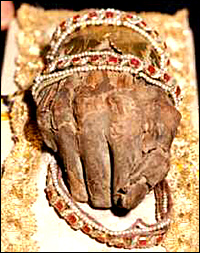
(The Holy Right Hand, principal relic of St Stephen:
with this hand he ministered to the sick and poor,
and it was preserved as a signal sign of his charity
while the rest of his body crumbled into dust.)

I liked, too, reading and praying the Wednesday psalms, some of them especially familiar to me nowadays by their continual reappearance in the Little Office, but some of them old friends not seen for some time: Pss 44, 45, 47, 48, 49 and 50 at Matins (a very happy sequence on which I've blogged before); Pss 96, 64, 100, 145 and the Canticle of Judith (xvi, 15-21) at Lauds; at Prime and the Little Hours, Pss 25, 51, 52, 53, 54, 55, 56, 57, 58, 59. (Vespers will be from the second half of the Gradual Psalms, including the beautiful Ps 131, Memento Domine David, and Compline uses Pss 33 and 60.) There's nothing quite like a Psalm.

I took the time also to read the Martyrology: such saints! What am I in comparison; what am I called to be...

As always, one reads the Martyrology for the next day, as a kind of holy advance notification: to-morrow brings (for Traddies) Pope St Pius X (may he pray for the Church, to drive away all Modernism, to redouble worthy reception of the Eucharist, and to restore peace and good order between the Society of his name and the Holy See, for the salvation of souls - to the glory of God).

But also commemorated are St Phœbe, known to St Paul; many holy martyrs and virgin-martyrs (many tortured and put to the sword, one plunged into molten lead, another cast into a fiery furnace, many monks of Lerins and their Abbot St Aigulf who were slain by the Saracens, and one, St Basilissa, a nine year old girl, who by her stedfast witness converted the Roman magistrate who ordered her put to torment and death); holy bishops and confessors; a hermit (St Simeon Stylites the younger); and the ordination of St Gregory the Great to the Supreme Pontificate, that his rays of sanctity might the more surely irradiate the Globe from the City - in the Novus Ordo, this is his feast day.

Friday, July 10, 2009

It's Nova et Vetera Misprint Time Again

In volume II of the otherwise quite excellent Nova et Vetera edition of the 1962 Breviary, in the Common of Martyrs at Sext (on page 60), the versicle has an extra word inserted, by evident confusion with the text of the short responsory immediately preceding:

V/.  Exsúltent iusti in conspéctu Dei, iusti [sic].
R/.  Et delecténtur in lætítia.

While still minor, this is a worse misprint than the mistaken substitution of A for Æ...

Wednesday, July 8, 2009

Eructavit cor meum verbum bonum

Spiritual aerobics: walking up and down and up and down and up and down the stairs here at home, reading Matins.  Told you I was crazy.

Because of time constraints, I usually say Matins (if at all) out of due order: before work, I say Lauds and Prime (asking for a blessing the day and my actions), perhaps fit in Terce and/or Sext at breaks, but in any case get them and None done by mid- to late-afternoon (I hope)... Vespers is said in the evening, then Compline to complete the day.  Or at least that is my general aim...

I must note that to me, Wednesday Matins are very beautiful because of their sublime (and not overly long) psalmody: Psalms 44 (Eructavit cor meum verbum bonum - a royal epithalamium, the song of David's love for his wife the queen, of God's love for Israel, of Jesus' love for His Mother, for His Church, for the Christian soul), 45 ("God is for us a refuge and strength"), 47 ("Great is the Lord and exceedingly to be praised"), 48 ("Hear this, all ye nations"), 49 ("The God of gods, the Lord, has spoken and summoned the earth") and 50 - the incomparable Miserere.  (Psalm 46, which would fit in the midst of these, is read at Lauds on Mondays - "All nations, clap your hands... psallite sapienter...")  Since to-day is the feast of a canonized queen who, widowed, took the habit as a holy religious, how fitting to sing Psalm 44 at the opening of her Office!

While my Latin is by no means perfect, I know these psalms well, having prayed them for many years in English in the modern Divine Office (let us say that some psalms aren't quite so well-recalled)...

Friends, such as Terra, prefer to pray the Benedictine Breviary, wherein Psalm 44 is instead the last of the twelve psalms at Monday Matins (or "Vigils"), while on Tuesdays at Matins the following psalms are prayed: the six Psalms 45, 46, 47, 48, 49, 51 in the First Nocturn, and another six, Psalms 52, 53, 54, 55, 57, 58 in the Second Nocturn.  Phew!  (And Psalm 50 makes its appearance as the second psalm daily at Lauds.)  

It is considered that St Benedict based his arrangement of the weekly cursus of psalms on that then current at Rome, making various changes here and there, while the Roman arrangement endured until the minor reform of St Pius V (who removed Psalms 21, 22, 23, 24, and 25 from Sunday Prime, and redistributed them among the other weekdays - until his day, Sunday Prime had nine psalms!) and the major reform of St Pius X (who decreed that each psalm - with the exception of the Venite, Psalm 94, and at penitential times the Miserere, Psalm 50 - was to be assigned but one Hour at week at which it was to be said, thus cutting back substantially on the length of the Office). 

Before 1912, the Roman Breviary, too, had twelve psalms at Matins - this number allegedly goes back to the Egyptian Fathers of the Desert, who received a response from an angel to their question of the proper number of psalms for the night office.  To this day, their lineal descendants, the Copts, pray in their Office an astonishing number of psalms every day, but they have a cheeky way of speeding up their devotions: one monk says the first of the psalms appointed, another the second, and so on - all together saying their respective psalms at once!

Whatever of this, the psalms for Wednesday Matins in the 1962 Breviary were previously included in the twelve said at Tuesday Matins until 1912: Psalms 38, 39, 40, 41, 43, 44, 45, 46, 47, 48, 49, and 51 - for Psalm 50 was instead said every day at ferial Lauds (and when this happens in the 1962 Breviary on Wednesdays, as in Lent, Psalm 50 is dropped from that day's Matins).

Thursday, July 2, 2009

The Visitation - Roman and Dominican Offices


To-day I was very thankful to have the time and earnest desire to read the Hours in sequence, more or less at their proper times, including Matins - for to-day is the feast of the Visitation of Our Blessed Lady to her cousin St Elizabeth, and the secret synaxis of the Unborn Christ and His unborn Herald, St John the future Baptist.  Matins features three strong sets of readings: passages from the Canticle of Canticles (ii, 1-17); a vivid elevated passage from Chrysostom (reworked by the Metaphrast, then done into Latin); and an extract relevant to to-day's Gospel from the Commentary on St Luke's Gospel from St Ambrose.  It was a wonderful beginning to the day.

Something reminded me to look to my copy of the Dominican Breviary, that I might compare and contrast it with the Roman Breviary (I have the latest ad last editions of both: those of 1962).  Matins in the Office of the Friars Preachers has the same selection of lessons, but, in line with the Dominican custom of having even shorter readings, in each of the three Nocturns the O.P. version's three lessons equate to only two or two and a half of their Roman equivalents.  

Evidently the Dominican book based its Visitation Hours on the Hours of Our Lady's Birthday - at Matins, the responsories and suchlike come from the Office for the 8th of September, with only the word Visitation substituted for Nativity - while the Roman Matins responsories are more scriptural.  This is likewise true regarding the antiphons at Lauds.

However, there is one evident improvement in the Dominican Breviary relative to the Roman: the former appoints, not the usual extracts from Ecclesiasticus for the Little Hours that traditionally are applied to Holy Mary, but passages taken (as are the first Lessons at Matins of this feast) from the Canticle of Canticles, of evident application to the Visitation:

Arise, make haste, my love, my dove, my beautiful one, and come.  For winter is now past, the rain is over and gone.  The flowers have appeared in our land.

– Little Chapter at Lauds, Terce and Vespers (Cant. ii, 10b-12a)

Behold [my beloved] cometh leaping upon the mountains, skipping over the hills.  My beloved is like a roe, or a young hart. 

– Little Chapter at Sext (Cant. ii, 8b-9a)

Shew me thy face, let thy voice sound in my ears: for thy voice is sweet, and thy face comely.

–Little Chapter at None (Cant. ii, 14b)
 
The Dominican Collect I think also superior to the Roman (albeit longer), since the Roman seems clumsily to pray for peace as a kind of afterthought, whereas the Dominican more closely adheres to the thought of the feast:

Omnipotens et misericors Deus, majestatem tuam suppliciter exoramus: ut, sicut Unigenitum tuum per Visitationem et salutationem Genetricis ejus puero clauso in utero revelasti, ita, meritis ejusdem Genetricis et precibus, ipsum nos facias revelata facie perpetuo contemplari: Qui tecum vivit...

(Almighty and merciful God, bowing low we pray Thy Majesty: that, as Thou didst reveal Thy Onlybegotten by the Visitation and salutation of His Mother by a child in the womb, so, by the merits and prayers of His same Mother, Thou may make us to contemplate forever the Same revealed face to face: Who with Thee liveth...)

May this indeed be our goal; and may the Communion we receive - as all unworthy I did this day - hasten our tracks to heaven.

Wednesday, July 1, 2009

Varia: Mass and Readings

I was pleased, upon coming to hear Mass early this evening, to learn that two local doctors, a married couple, had come to give thanks for twenty years of their medicine practice in Launceston on this the anniversary of its establishment: Deo gratias.  Father Allan (our local Franciscan priest) was the celebrant, and he prays Mass devoutly.  Fittingly, he chose to use the votive orations for the sick.

Amusingly, given to-day is in the old calendar the feast of the Precious Blood, we were reminded of Archbishop Doyle's latest ruling, to the effect that, owing to the swine flu (Tasmanian casualties: hardly any), communion from the chalice was to be discontinued for the moment... I must say, I am not doctrinaire about this matter, and will communicate under both kinds if it is offered, despite being a Traddie (since after all, in and of itself Our Lord's Blood is much to be desired as our soul's true drink), of course fully believing in concomitance and holding the need to drive irreverence and folly out of the sacred liturgy.  If, say, a deacon is administering the chalice, I see no reason not to kneel down and partake of it.

In other news, I've just now finished reading James Belich's masterly history of New Zealand (Making Peoples and Paradise Reforged); despite some reservations concerning a page or two about some few modern moral issues which he attempts to report on dispassionately, overall I would most heartily recommend it as a fascinating and well-written magnum opus, running to nearly a thousand pages all told.  Whoever would have thought New Zealand history could be so interesting?  (As a typical Australian would think!)

To-morrow, for the fifth day in a row, I will be reading the Sunday festal psalms at Lauds - after the Lord's Day came SS Peter and Paul on Monday, the Commemoration of St Paul on Tuesday, to-day (Wednesday) the Precious Blood, and in some several hours, Thursday and Our Lady's Visitation; and of these days, three (Sunday, Monday and to-day) have had the traditional Sunday Psalms (53 and 118) at the Little Hours too.  Every night from Sunday to Thursday will have featured the original Compline Psalms: 4, 90 and 133.  I like feasts.

The Most Precious Blood

Sometimes one forgets that "precious" means valuable, pricey: if Our Lord in His parables speaks of the "pearl of great price", then even one drop of His Blood was worth more than anything material, than everything material - and He shed it in torrents, prodigally.  Many years ago I read Fr Faber's devotional book on the Precious Blood; I must admit, his purple prose makes it almost unreadable, but it does contain solid insights couched in flowery language: and I think Faber was right to emphasise the prodigality of the Precious Blood.  We were purchased at a great price: not silver or gold, not pearls or jewels, but with the precious Blood of Christ, as of a pure Lamb without spot or blemish (so writes St Peter).  

It is from the Epistle to the Hebrews, chapters ix and x, that the Sacred Liturgy draws the lyric passages, full of doctrine and piety, that constitute the Lessons of the First Nocturn at Matins, and (in shorter extracts) the little chapters at the Day Hours.  Christ, High Priest of the good things that are to come, Mediator of the New and Eternal Testament, has entered once and for all into the Holy Place, heaven itself, with His Own Blood, a Blood able to wash us from the works of death, and make us to serve the Living God.  Therefore we have faith and trust ourselves in entering the Holy Place by the might of that same Blood.  (The Magnificat antiphon of First Vespers speaks of this, again quoting Hebrews: Ye have come unto Mount Sion, and the City of the Living God... .) 

Chrysostom - in the passage quoted in the Lessons of the Second Nocturn of this feast, which in the modern Divine Office has been not inappropriately given star billing as the patristic reading on Good Friday itself - points out that Christ's Blood is of astounding power: the mere foreshadowing of it, the blood of irrational lambs painted over the Hebrews' doorlintels, sufficed to ward off the very Angel of Death (as Exodus tells - quoted in this feast's Benedictus Antiphon); so how much more so does the Blood of Christ empurpling the lips of the faithful, His very temples, terrify and drive off the demons?  And again, as Augustine (quoted in the Third Nocturn) concurs, the shedding of water and Blood from the side of Christ, dead on the Cross, is the symbol and power of the Saving Mysteries - of Baptism and the Eucharist.

The Office of today, the 1st of July, is a splendid composition, wonderfully paying due and solemn adoration to the Most Precious Blood.  Four of the antiphons of both Vespers are taken from Isaias lxiii, 1-3a:

Who is this that cometh from Edom, with dyed garments from Bosra, this beautiful one in his robe...  I, that speak justice, and am a defender to save.  Why then is thy apparel red, and thy garments like theirs that tread in the winepress?  I have trodden the winepress alone, and of the Gentiles there is not a man with me...

The third antiphon, however, from the Apocalypse of St John (xix, 13) answers the question posed by the prophet:

And he was clothed with a garment sprinkled with blood; and his name is called, THE WORD OF GOD.

At Matins, the nine antiphons make reference to the Seven Bloodsheddings of Our Lord (at His circumcision, His agony, His scourging, His crowning with thorns, His carrying the Cross, His Crucifixion, and the piercing of His Side in death), and also to Judas confessing that he had betrayed innocent blood, to Pilate attempting to wash his hands of His Blood, and to the crowd's frenzied cry, His Blood be upon us.  The responsories of Matins, and the short responsories and versicles at the Little Hours, make quotation from the great references to the Blood of Christ found in the Epistles of the New Testament, from St Paul, from St Peter, from St John.

At Lauds and the Little Hours, the focus of the psalm antiphons is on the redempti, those washed clean in the Blood of the Lamb: all of these come from the Apocalypse (vii, 13b. 14b-15a; cf. xii, 11a; xxii, 14a):

These that are clothed in white robes, who are they? and whence came they? ... These are they who are come out of great tribulation, and have washed their robes, and have made them white in the blood of the Lamb.  Therefore they are before the throne of God, and they serve him day and night...

And they overcame [the dragon] by the blood of the Lamb, and by [their]testimony [to His Word]...

Blessed are they that wash their robes in the blood of the Lamb...

Lauds, too, features the hymn Salvete Christi vulnera, a pæan to the Five Wounds of Our Lord, taking up the earlier mediæval devotion to these founts of Emmanuel's Blood, and points of access to His Sacred Heart.  (Compare two other hymns: "Glory be to Jesus", a Catholic composition and translation; and the Protestant Cowper's "There is a fountain filled with blood" - both products of eighteenth century piety, and not dissimilar in sentiment.)

The Collect is at first sight one of those recent orations that ends a little predictably "may we do X on earth that we may have Y in heaven" - but after all, ought we not hope thus, trusting in the grace won for us on Calvary?  It is thankfully easy to translate:

Almighty, everlasting God, Who hast established Thine Onlybegotten Son as the world's Redeemer, and hast willed to be placated by His Blood: grant, we beg, that we may so revere the price of our salvation with solemn cult, and by its power be defended from the evils of this present life, that we may rejoice in its endless fruit in heaven.  Through the same...

What more can be said?

Let us kneel and pray, ut mos est:

TE ERGO QVÆSVMVS TVIS FAMVLIS SVBVENI QVOS PRETIOSO SANGUINE REDEMISTI

(We therefore beseech Thee to come to the aid of Thy servants, whom Thou didst redeem by Thy Precious Blood.)

Saturday, June 27, 2009

Our Lady's Office

Apart from reading Lauds of the Day, all the other Hours I've read to-day, for convenience sake while out, and pro pia devotione, from my little pocket edition of Our Lady's Little Office - not from the Baronius Press edition, full as it is of misprints, but from my smaller, well-thumbed and annotated Carmel Books edition of 1997, being a facsimile of a 1914 publication.  This I did apart from anything else because to-day the Office of Our Lady on Saturday is read anyway in the Breviary, and because the Little Office, while being quite as liturgical as the full Office, is shorter, and this comforted me.  (I will soon enough return to the larger volume for 1st Vespers of the 4th Sunday after Pentecost, and therein will pray again the moving Psalms 143 and 144.)

While on the subject of the Breviary, I note an article on the New Liturgical Movement blog, and the very large numbers of comments made, all in earnest discussion of it as it pertains to the laity's use of it and suchlike forms of the Divine Office - all such praying, united in the differing forms of the Prayer of the Church, is excellent and laudable.  While I have declined from reading the Night Office, I still adhere to the Day Hours of the Breviary, and aim at least to read each day's Lessons if not the whole of Matins.   There is something very good about the weekly praying the Psalms - each day of the week, I am pleased to read again the same Psalms at each Hour, and certain verses become as old friends.  On Tuesdays, for example, I read at None Quoniam propter te mortificamur tota die, and am forcibly put in mind of my old friend Peter, now Br Paul Marie of the Cross, who prays the selfsame words and lives them in his godly penitential life devoted to the Lord as a Carmelite Monk in Wyoming.

As I read at Matins of Our Lady, Nos cum Prole pia benedicat Virgo Maria - or, as the Marquess of Bute once rendered it, "Bless us, Mary, Maiden mild; Bless us, Jesu, Mary's Child."

Tuesday, June 16, 2009

Misprint of the Day

This is getting ridiculous:

For Confudantur at the start of Psalm 39 part iii (Tuesday Terce), read Confundantur.

(1962 Breviarium Romanum, Nova et Vetera edition, Vol. II, p. 471.)

Monday, June 15, 2009

Breviary Misprint Again

The Nova et Vetera edition of the 1962 Breviary incorrectly gives St Gregory Barbarigo's feast as occurring on the 15th of June (Vol. II, p. 644) - that should be (as in the Calendar) the 17th of June.

Please don't think me curmudgeonly, this edition is really very fine and handy, it's just that I do feel bound to note its misprints, especially as some reviewers overtly contrasted its purity of text with the F.S.S.P. reprint edition.

Sunday, June 14, 2009

Corpus Christi Again

I will pass over the Mass I attended this morning, for Corpus Christi juxta modum Novi Ordinis...

I decided to look back to the Office of Corpus Christi according to the Dominican Rite (since I have the 1962 Breviarium S.O.P.) and compare it with the Roman:

According to the custom of the Friars Preachers (shared I believe with many mediæval uses), the psalms at Vespers are sung under one antiphon only - Sacerdos at first and Sapientia (from Lauds) at second Vespers - and furthermore, the psalmody at first Vespers is taken from the Laudate psalms: Pss 112, 116, 145, 146 and 147 (at second Vespers, the same psalms as those in the Roman Office are used).

At first Vespers, furthermore, after the Capitulum is sung a long responsory (again, a common mediæval custom): Homo quidam fecit cenam magnam.

The Little Chapter at both Vespers, Lauds and Terce is Dominus Jesus in qua nocte tradebatur (I Cor. xi, 23b-24a), which is an abbreviation of the Roman Fratres: Ego enim accepi a Domino (I Cor. xi, 23-24).

Compline of the eve and of the feast itself features a proper Nunc dimittis antiphon: Alleluia, panis quem ego dabo (for in the Dominican Rite, Compline has seasonal and festal variants, and there exists a common tune for this antiphon, festooned with alleluias, with its text changed to match several different solemnities.)

At Matins, the lessons of the first Nocturn are entirely different from the Roman (which are taken from I Cor. xi, 20-32), being instead from Exodus xii, 1-8 (the Passover, so tying into the first Responsory Immolabit hædum), Exodus xvi, 10-15 (the coming of the manna, and hence connecting with the second Responsory Comedetis carnes) and III (I) Kings xix, 3b-8 (Elias being fed by the angel with such food as to walk to the Mount of God, which segues into the third Responsory Respexit Elias).  The lessons of the second Nocturn - from Aquinas - are about the same as those of the Roman Rite, but constitute a shorter extract, amounting to little more than two equivalent lessons.  The lessons of the third Nocturn - from Augustine - are the same as the Roman, but differently cut up into three passages.

The Responsories of Matins are very similar, but the fourth and ninth Responsories (Panis quem ego and Unus panis) are proper to the Dominican Rite, omitting the sixth Roman Responsory, and so renumbering two of the remaining Responsories.

Before Lauds, after the Te Deum of Matins, there is the sacerdotal verse Comedi favum (again, it was common in the Middle Ages to have such a versicle).

One thing that surprises me in both the Roman and Dominican Offices for Corpus Christi is that the short Responsory at Prime does not have a special versicle appointed for it, whereas it does for the feasts of the Sacred Heart, the Precious Blood, the Transfiguration, Christus Rex, etc. - I had expected something like "Who givest us Thy Body to eat."

Friday, June 12, 2009

Yet More Nova et Vetera Breviary Misprints

I've only read the first Nocturn - three psalms - of Friday Matins from my new Breviary, and I find, twice:

Ant. 3 Ianuas cæli aperuit * Dominus, et pluit illis mana [sic] ad manducandum.

Ant. Ianuas cæli aperuit Dominus, et pluit illis mana [sic] ad manducandum.

[Breviarium Romanum, Nova et Vetera ed., Volume II, pages 547 and 548.]

At least manna is spelt correctly in the psalm itself (Ps 77:24)!

Bizarrely this reminds me of my recent reading of James Belich's Making Peoples: A History of the New Zealanders from Polynesian Settlement to the End of the Nineteenth Century (which I would thoroughly recommend as a very learned and enjoyable read), since the Maori regarded the search for mana (roughly, prestige) as all-important; a sort of "keeping up with the Joneses" exercise.

But I must away, I'm consulting a climatologist...

Thursday, June 11, 2009

Lauds I & II

Have you heard about the well-meaning but liturgically unread priest who, all afire with zeal, preferred the Breviary to the modern Office - but didn't realize the reason the Breviary has both a Lauds I (which is for ordinary and festal days) and Lauds II (for penitential days, replacing the first psalm with the Miserere), and read BOTH Lauds every day for a long while till someone discovered his unfortunate unintentional work of supererogation?

And one night I dreamed there was a Lauds III as well...