Showing posts with label Good Friday. Show all posts

Saturday, March 30, 2013

Happy Easter!

Happy Easter to all! I'm safely back home (and had dinner, and the first Easter chocolates), after our Easter Vigil at St Francis, Riverside. We did start rather early (at 6:00 pm), but some of our parishioners had to drive in from Beaconsfield, 40 km away; and our esteemed parish priest is 79 (though hale and hearty, thanks be). The Vigil – at which yours truly was thurifer (and, rather unexpectedly, extraordinary minister of the chalice! at least I was vested) – took just on an hour and forty minutes.

The Triduum has been beautiful, and promptly carried out: Holy Thursday Evening Mass took an hour and ten, and the Solemn Commemoration of the Passion on Good Friday an hour and a quarter. Neither seemed rushed, nor did the Vigil, and at all three liturgies there was plenty of good music; Fr Allan used the Roman Canon at the two Masses, so there was no skimping on the Eucharistic Prayer either: evidently, being a wise and experienced priest, he simply knows how to celebrate the sacred mysteries with devotion, but without tardiness.

I feel spiritually recharged, and look forward to celebrating Easter – all fifty days of it. Surrexit Dominus vere, alleluja.

Friday, March 29, 2013

One a Penny, Two a Penny

For brunch this Good Friday morning (thank God for some extra hours of sleep – work has been very tiring, including meetings in the evening; with that, and choir, and an invitation to a talk, I've been out late every workday this week): two hot cross buns, buttered, with a cup of coffee. (I will have fish for dinner this evening.)

It amuses me to calculate the price of these buns (bought yester-day, but baked in Hobart, at the excellent Jackman and McRoss bakery – the shopkeepers who sold them on to me told me they had had to have a second truckload sent up, since the day before they had sold thirty dozen packs!): each pack contains six buns, for a total cost of $9.95; so the two buns I ate had a value of $1.66.

I see that a 1733 almanac mentions that hot cross buns indeed were then sold for one or two a penny; inflation – that wicked thing – has seemingly turned the price of one penny for one or two buns into $1.66 for two.

This, however, is on closer analysis not too bad: for when King Offa of Mercia introduced the silver penny into circulation in the eighth century, its mass was 22.5 "Tower" grains, equivalent to 15.8 troy grains, or almost exactly 1 gram; and one gram of silver costs 87 Australian cents. Hence, the price of a (silver) penny for one hot cross bun is actually about right, taking the long view.

(En passant, it would clearly be wicked to eat thirty, let alone sixty, hot cross buns, since their cost would amount to thirty silver pennies – the wages of Judas.)

Tuesday, April 10, 2012

Creeping to the Cross, Sleeping in modo Crucis

While these days the Church speaks of Good Friday’s afternoon Liturgy as the Solemn Commemoration of the Passion, and, in older times, named it (when held in the morning) the Mass of the Presanctified, after the last part of its fourfold structure, the English mediæval tradition, as late as Bad King Henry, referred to it instead as the Creeping to the Cross – a ritual that Henry VIII, even in his bloated, raddled old age insisted on performing, a vestige of his full-blooded Catholicism that all the Zwinglian plottings of Cranmer his heresiarch had not yet extirpated, just as he maintained the Mass until his death, whatever of his break from Rome.

It will therefore be unsurprising to find such eager adherents of traditional practices as the Canons Regular of the Dormition do maintain precisely this title for their early evening capitular worship in the stript, bare choirs of their secluded oratories: for, remaining prostrate in mournful, penitent adoration, if not yet quite entirely reposing in the Lord, they do creep unto the Cross, hardly daring even to rise to their knees, such penitent sinners do they in their continual compunction accuse themselves of being!

Of course, the first part of their Good Friday service begins identically to that practiced immemorially in the West, save for that peculiarity whereby (like certain Franciscans) their conventual Mass is always Low, without song or note.  The celebrant advances to the altar, then prostrates himself to the ground, as do all the canons in choir; he alone, however, presently rises, as he must needs do to fulfil his duty, rather wishing that, if not the servant of his brethren for the moment, he too could rest in peace as they will throughout this most solemn act, as on all days in their Dorter or Dormitory.

He reads the traditional Lessons, Tracts and St John’s Passion; he reads the Solemn Intercessions; then comes the Creeping to the Cross.  The brethren, in imitation of the once-slumbering disciples, have rested for an hour; now, they will creep unto Calvary’s Tree, in mystery to kiss as repentant Magdalene did the Blood, as it were, streaming down that bitter wood.  Ecce lignum Crucis!

As in the Carthusian Rite, the Creeping begins with the antiphon Nos autem gloriari oportet – “But it behooveth us to glory in the Cross of our Lord Jesus Christ, by which the world is crucified to us and we to the world”.  Indeed, the procumbent brethren, each canon regular stretched forth in modo Crucis, already represent this deep wish, this truth.  The priest having brought forth the Crucifix, and laid it upon the altar steps, he throwing himself down before it then crawled unto its foot and kissed it, saying secretly what each succeeding adorer shall likewise repeat: Adoramus te, Christe, et benedicimus tibi, quia per crucem tuam redemisti mundum.

The brethren then having at length (indeed, given all their prostrate creeping, at great length) completed their most humble Creeping to the Cross on hands and knees – a ceremony all the more impressive for the greatly yawning silence in which it transpires – it remaineth for their solemn adoration to be consummated in the Missa Præsanctificatorum, in the manner proper to the Order.

First, repairing to the sacristy, the canon celebrant attireth himself in chasuble; then, the server meanwhile arranging and lighting the candles, he brings in the chalice to the altar, and mixes wine and water therein without (however) any blessing thereof, before returning to the lowest step and there bowing low (the brethren remaining as if already dead in Christ, he praying for a like grace) and says the usual ancient apologia, Deus qui non mortem.  In like manner, at Paris, and in the priories of the Carmelites and Dominicans of old, the Confiteor and other preparatory prayers were said ere the Mass of the Presanctified was embarked upon.

The Blessed Sacrament has been kept in the usual tabernacle, as is also the Carthusian practice, and therefore there is no lugubrious funereal procession to the altar of repose to fetch It forth.  Instead, an Offertory anthem is recited – Hoc est corpus meum, quod pro vobis datur, dicit Dñs: hoc facite in meam commemorationem (St Luke xxii, 19b)– and forthwith, the Host is brought forth and laid upon the corporal, the priest making a double genuflection on this most sacred day.

There is prayed as usual Dirigatur Domine, In spiritu humilitatis, and Orate fratres, but of course no Veni sanctificator omnium; just as there is no Secret nor Preface on Good Friday, nor is the Canon read.  Instead, having first washed his hands saying the usual Dele Dñe (“Delete, Lord, all my iniquities, that I may be able worthily to handle Thy mysteries”), the priest thereupon elevates the Sanctissimum, praying – as do all Dormitionists – Pie Jesu Domine, dona nobis requiem.

This done, the Lord’s Prayer, with its usual preface and following oration (this, the Libera, still silent, as amongst the Premonstratensians), is read, but without any Pax nor Agnus Dei; the Host is broken into three, figuring forth the Death of the Lord, and a particle thereof dropt into the chalice (sanctifying, but not consecrating the watered wine therein, as the Summa Triviæ rightly notes) without form of words.  Immediately he communicates himself with the Host and drains the chalice, saying Corpus D.N.J.C. custodiat me in requiem æternam. Amen.  O most fervent petition!

Performing the ablutions as is customary, reciting secretly the Order’s proper prayer of the Nunc dimittis, without the doxology, the celebrant completes the Mass of the Presanctified and retires from the altar – there being, as is traditional, no general communion on this day, whenas only faithful Mary and John stood ’neath the Cross, types of the Church and the Priest, while all the apostles (here represented by the procumbent Canons) hid themselves for fear of the Jews.

Having crept to the Cross, meanwhile, the assembled brethren rest as if dead, recalling ever the words of the Risen and Glorious Christ to that same Apostle John, who “fell at His feet as if dead”: “Fear not, I am the First and the Last, and the Living One: I died, and behold, I am alive for ever more, and I have the keys of Death and of Hell.” (Apoc. i, 17f.)

Let this be our own recollection, as we return in our imagination from the oratories of the Dormitionist Order, and now rejoice this Eastertide.

Thursday, April 28, 2011

Good Friday in Melbourne at St Aloysius

By the time I reached the apartment where I was staying, and had a very late dinner, it was almost midnight on Thursday; so I awoke fairly late on Good Friday morning.  I had intended to read Matins and Lauds, but in the event I only had time for the Little Hours – for, after attending Stations of the Cross back at St Aloysius at 10:30am, which took half an hour, and then getting coffee and a hot cross bun for breakfast, I ended up joining the ad hoc schola for Easter Sunday's coming services, and we practiced the Mass and Vesper music for a good two hours and more.  I had barely enough time to go back to my quarters and change into a suit for the afternoon's solemn service.  So much for my intention of reading over Dix's masterful sermons for the Three Hours' Devotion...

The Commemoration of the Passion lasted two and a half hours: it is always a long, sombre service; the sung Gospel (the crowd parts in polyphony), a short sermon, the solemn prayers, the Reproaches whilst we crept to the Cross, the Communion, all was rightfully lengthy and fatiguing – for there was One Who hung on the Rood three hours, long ago.

After the liturgy, hot soup and hot cross buns were available for the weary faithful; after a rest at my apartment, I returned for Tenebræ (8:00-9:50pm).  I must say, I always find Tenebræ a very difficult service to appreciate intellectually, especially as one must concentrate so hard on properly chanting the psalms, without the time to savour them, and especially as the particular choice of Lessons from Lamentations and St Augustine I find difficult to appreciate, as to the meaning of the words selected; but the emotional impact of this worship is great: the chanting of the Lamentations, Victoria's settings of the Responsories in particular, and the ever-deepening darkness, till the final candle is hidden, the strepitus terrifies, and then the light returns.

Friday, April 2, 2010

Good Friday

As I wrote earlier, I was again struck by the truth that I, as a sinful man, yet redeemed by Christ's Passion, am Barabbas, set free while the Holy One is made the scapegoat, our atonement and our lasting peace.  Last night (after finishing work, thanks be) I went off to hear Mass for Holy Thursday at Carmel; I felt quite unworthy to communicate, and was mindful of the fate of Judas, into whom the devil entered, so sacrilegious a communion that traitor-apostle made!

After Mass, while yet so low, I had perforce a second appointment to keep, at 9pm – to help out with the singing of Compline at St Francis, Riverside, as a conclusion to their period of adoration at the altar of repose.

To-day, Good Friday, marks not only the Lord's Passion, but (I know it sounds bad to say) the start of a most welcome holiday from work.  Thanks be indeed!  I hope I don't scandalize my readers by saying that I marked this morning by sleeping in: one can only do what one can do.  There is no Tenebræ in these parts, and I had no inclination to attend Stations mid-morning; rather, after a walk, I went off to Carmel again for the Solemn Liturgy at 3pm.

The good nuns have a Dominican friar over to celebrate the Triduum for them, which meant we had a good sermon at Mass yester-day, and another to-day: Fr remarked at the outset that our atheistic age is frightened of death and despises its mystery and meaning, preferring to wallow in emotion at best, or to commit abortion and euthanasia at worst.  That woke up the congregation!  

Being a good Thomist, our preacher then went on to carefully distinguish between the real and true suffering that Our Lord underwent in His Sacred Humanity, and the deep truth that in His Divine Nature, as God, remains transcendent and beyond all suffering – hence He both knows our woes and has undergone all for us, while being also Almighty to save.  If God in His Godhead suffered, He would no longer be all-perfect, being rather "hopelessly enmeshed in the world" and unable to save us out of our mess.  I do like anti-Modernist homilies.

When I went up to kiss the crucifix, I was consoled by the thought that there are two rituals in which all may partake: receiving the ashes at the start of Lent, and venerating the Cross at the end of it.

It greatly calmed me when Father announced he would hear confessions after the Liturgy: so having heard the readings and above all St John's Passion (in which we read the Crowd parts together with the nuns: "Not this Man, but Barabbas"...), said Amen to the Solemn Prayers, crept to the Cross, and then prayed while Communion was given, I had the consolation of making my humble confession, being reconciled on this most holy day, indeed being laved in Christ's Blood.  A decade of the Rosary before the Crucifix followed.

I can't wait now for Easter!

Monday, February 8, 2010

In pietate tua

Good Friday's solemn liturgy concludes with what used to be called the Mass of the Presanctified.  In the traditional Carthusian Rite, before the celebrant sings the Pater noster, he first intercedes in secret for the whole Church – this is evidently intended as a sort of substitute for the Canon of the Mass, and is interesting to compare and contrast to the solemn prayers offered earlier in the Good Friday service.  

Here is the prayer (taken from my copy of A.A.King's Liturgies of the Religious Orders), with my own rough rendering:

Pietate tua, quæsumus, Domine, nostrorum solve vincula delictorum: et intercedente beata et gloriosa semper Virgine Dei Genitrice Maria cum omnibus sanctis tuis, domnum Apostolicum, pontifices, abbates et priores nostros, sed et omnes congregationes illis commissas, reges et principes nostros, et omnem populum Christianum, et nos famulos tuos, atque locum istum, et omnia loca nostra in omni sanctitate custodi, omnesque affinitate, societate ac familiaritate nobis conjunctos, et nos a vitiis purga, virtutibus illustra, pacem et salutem nobis tribue, hostes visibiles et invisibiles remove, carnalia desideria repelle, aërem salubrem indulge, amicis inimicis nostris et nobis veram caritatem largire, et omnibus fidelibus tuis vivis et defunctis in terra viventium vitam et requiem æternam concede.  Per eumdem Dominum...
(In thy pity, we beseech, Lord, dissolve the bonds of our sins: and the blessed and glorious ever Virgin Mary Mother of God with all Thy Saints interceding, the Apostolic See, our pontiffs, abbots and priors, and all congregations committed to them, our kings and princes, and all Christian people, and us Thy servants, and this place, and all our places guard in all sanctity, and all conjoined to us by affinity, society and familiarity; and us purge from vices, enlighten with virtues, grant unto us peace and health, remove our enemies seen and unseen, repel carnal desires, give healthy air, grant true charity to our friends and enemies and to us, and to all Thy faithful living and dead concede life to those living on earth and eternal rest.  Through the same our Lord...)

Friday, April 10, 2009

The Solemn Commemoration of Our Lord's Passion

At Carmel the solemn liturgy of this day was enacted; all to note was that - as it is a monastery of nuns - when the St John Passion was read, the roles of the Chronicler and the Synagogue were taken by some of the nuns from within the screen, the priest of course reading the part of Christ, and all, even the laity in attendance, joining in the crowd parts.  During the Adoration of the Cross, the nuns sang some of the Reproaches and part of the appointed hymn (in English).

Fr Greg - as is his wont - preached a stark and confronting sermon on the inescapable fate of death that awaits all, no matter how we seek to avoid and deny it, or still our fear by distracting ourselves with worldly things; and how not merely through Christ's death on the Cross, but our necessary embrace of the same by dying to ourselves and living His life, suffering the burthen of our own cross, enduring the pain and sacrifice of living as becomes Christians, can we alone by "the royal road of the Holy Cross" pass from earth to heaven through death: thus fulfilling the mystery into which we were plunged at Baptism, to live no longer for ourselves, but for Him Who died and rose again for us, that it may be no longer we who live, but Christ Who lives in us.  No matter how wicked we are, we can in penitence embrace the Cross, in which alone there is grace, life and salvation.

Good Friday Vespers

Vespers need only be read by those who attend not the Solemn Commemoration of the Lord's Passion; but, despite attending it, as it was held at 3 p.m. and over within an hour and a quarter, as day drew on toward evening I decided to say Good Friday's Vespers pro pia devotione.  

These Vespers parallel in structure the solemn sobriety of their brother Lauds during the Triduum, with one curious difference - while they begin at once with the first antiphon of the first psalm, and continue with five psalms, each without Gloria Patri but with antiphon before and after, unlike at Lauds there is no versicle: how strange.  (They continue of course with the Magnificat and its antiphon, followed by the Christus factus est, silent Pater noster, and Collect Respice, all kneeling; the silent doxology of the last brings the Hour to a close.)

Good Friday

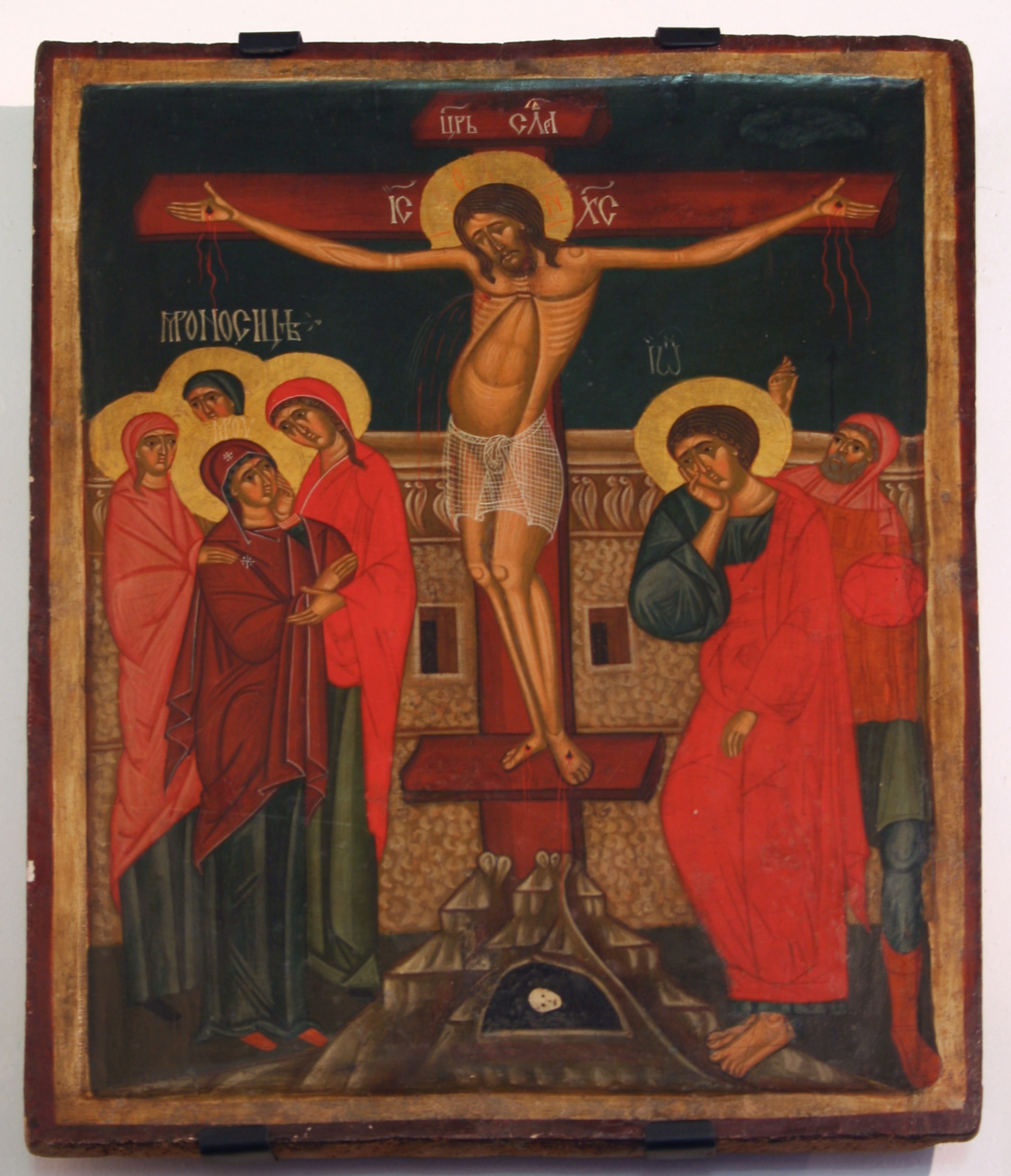
Arising late, I took the opportunity to read Matins and Lauds together this Good Friday morn, over the last forty minutes considering Our Lord's Passion, as a late Tenebræ.  Now I have before me an icon of the Cross; Our Lady weeps, comforted by the holy women; St John the Beloved beats his breast in sorrow; the centurion confesses the Lord; and between and above them all hangs Christ on His Cross, triumphant in death.

A book with prayers dear to me is E. Milner-White's A Procession of Passion Prayers, first published 1951, when the author was the Anglican Dean of York: the prayers are devout and catholic, and I cannot do better but quote now the last of them (cf. Rom. vi, 8; viii, 17; Eph. ii, 5-6; Col. ii, 12-13; II Tim. ii, 11):

The Tree of Life

ALMIGHTY everlasting God, who hast reared from earth unto heaven a mighty Tree, standing for ever, whereon before the face of men hangeth a Man, stretched and nailed, rejected, dying and alone: O thou that art true and shewest only truth, grant us to fear not to suffer with him, die with him and be buried with him, that we may also be made alive with him and glorified together in the heavenly places; where now he reigneth with thee and the Holy Ghost, one GOD, world without end.

Thursday, April 10, 2008

Bone Pastor, Panis Vere

...
Ah, Divus Thomas! I recall now what we should have sung for Good Shepherd Sunday: the last stanzas, following, of the Lauda Sion, that masterly sequence for Corpus Christi:

Bone pastor, panis vere,
Jesu, nostri miserere:
Tu nos pasce, nos tuere,
Tu nos bona fac videre
in terra viventium.

Tu qui cuncta scis et vales,
qui nos pascis hic mortales:
tuos ibi commensales,
coheredes et sodales
fac sanctorum civium.

Amen. Alleluia.


Very Bread, Good Shepherd, tend us,
Jesu, of Thy love befriend us,
Thou refresh us, Thou defend us,
Thine eternal goodness send us
In the land of life to see.

Thou Who all things canst and knowest,
Who on earth such food bestowest,
Grant us with Thy Saints, though lowest,
Where the heavenly feast thou shewest,
Fellow heirs and guests to be.

Amen. Alleluia.

Saturday, March 22, 2008

A Good Friday

Lauds and Sext from the Divine Office, then, the Solemn Liturgy... (I fitted in the Office of Readings later in the day.)

Good Friday: Fr Rowe (priest), Fr Terence (deacon), Fr Richard (subdeacon); the usual servers, including Aaron; Andrew, Justin, and I singing the chant; and about one hundred and twenty faithful (cf. Acts i,15!), including many friends and acquaintances, such as Anastasia and Brad (newly engaged), George, Rosemary, Sue, and so forth - all assembled in the cathedral parish centre's hall, turned into a stark but effective chapel for the occasion; Fr Rowe has a number of altars in storage, and brought out one of them for today's solemn liturgy.

The acoustic was very good, and I found myself getting a great deal out of the beautiful texts and music provided by Holy Mother Church this day: the haunting melody of the Tract Domine audivi (Habacuc iii, 2-3), whose words are customarily applied in the Eastern Church to the mystery of the Incarnation ("the Holy One from the shady and thickly covered mountain"), and the second Tract Eripe me (Psalm 139:2-10,14); the very moving chant of the St John Passion; the Ecce lignum Crucis; after creeping to the Cross, singing the Reproaches, with the Trisagion;


the Crux fidelis and Pange lingua gloriosi / Lauream certaminis; the antiphons at the procession of the Blessed Sacrament; and Psalm 21 during Communion. It was good to kneel down and receive our Lord with all the choir, and then to sing this psalm of His Passion. May His death be our life!


Hail to Thee, True Body, sprung
From the Virgin Mary's womb!
The Same That on the Cross was hung
And bore for man the bitter doom.

Thou, Whose Side was pierced
And flowed both with water and with Blood,
Suffer us to taste of Thee
In our life's last agony.

O kind, O loving One,
O sweet Jesu, Mary's Son!


A rich vein of doctrine was expressed in today's sermon, in which reference was made to "God is love" (I St John iv, 8) as the summation of our religion, a love revealed not merely in the blessings of creation, but shewn forth to the uttermost in Christ Crucified (cf. St John iii, 16; I St John iv, 9-10), and thereby manifest in suffering for us, as per Our Lord's words to St Angela of Foligno: "I have not loved you for fun". We, too, ought not merely give good things to all whom we love, as God does to all, but suffer also for others, as God in Christ has done on Calvary, reconciling the world to Himself.

A friend of mine is a subdeacon, and I was pleased to hear all such prayed for in one of the solemn collects; then I recalled that I have been instituted a lector, and was glad to know that I, too, the least such, have received the benefit of these prayers.

The solemn liturgy took just shy of two hours. Rather than drive home and then come back, Justin, Robert, Rosemary, Peter and myself decided to pop up to the Royal Perth Hospital cafeteria (just around the corner) and have a modest fish dinner, before making our way to Tenebræ. Better still, Anastasia and her fiance Brad came and joined us, so we had a good little meal with good company and talk.

In due course, we finished up, and drove the short distance to St Brigid's for Tenebrae of Holy Saturday, which, in rejection of Bugnini, and all his works, and all his empty promises, we do in the evening, when it should be done. Over a hundred came, and there was a goodly number in choir (well over a dozen) - including, apart from the three priests at the 3 o'clock liturgy, the local Franciscan Friars of the Immaculate, and most notably His Grace the Archbishop of Perth, the Most Reverend Barry James Hickey, who deigned to officiate (to make it easier for him, one of the clergy sang the ninth lesson on his behalf) and therefore concluded this Office of Matins and Lauds with its proper collect.

Andrew and Justin were cantors, and, in between chanting the psalms, hopefully sapienter, among the readers I exercised my ministry of lector for the first time in a long while, by managing to chant the fifth lesson. Andrew and his mates, who constitute Quartessence, sang the Responsories - the first three, by Croce, and the six remaining, those famous one by Victoria. They also sang the Christus factus est. At the end, what a strepitus! Tenebræ just exceeded the length of the afternoon liturgy, by running two hours exactly.

Afterward, eight of us joined Fr Rowe for a cup of tea at the presbytery, until "time, gentlemen, please!" at 11pm. (NB When having something to drink on a fasting day, one may take a little morsel with it, ne potus noceat - "lest the drink harm [thee]".) Then I drove two of my mates home, and got back to my place a little after midnight. I will end with Compline soon. Prosit.