Showing posts with label Easter Vigil. Show all posts

Saturday, March 30, 2013

Happy Easter!

Happy Easter to all! I'm safely back home (and had dinner, and the first Easter chocolates), after our Easter Vigil at St Francis, Riverside. We did start rather early (at 6:00 pm), but some of our parishioners had to drive in from Beaconsfield, 40 km away; and our esteemed parish priest is 79 (though hale and hearty, thanks be). The Vigil – at which yours truly was thurifer (and, rather unexpectedly, extraordinary minister of the chalice! at least I was vested) – took just on an hour and forty minutes.

The Triduum has been beautiful, and promptly carried out: Holy Thursday Evening Mass took an hour and ten, and the Solemn Commemoration of the Passion on Good Friday an hour and a quarter. Neither seemed rushed, nor did the Vigil, and at all three liturgies there was plenty of good music; Fr Allan used the Roman Canon at the two Masses, so there was no skimping on the Eucharistic Prayer either: evidently, being a wise and experienced priest, he simply knows how to celebrate the sacred mysteries with devotion, but without tardiness.

I feel spiritually recharged, and look forward to celebrating Easter – all fifty days of it. Surrexit Dominus vere, alleluja.

Thursday, April 12, 2012

Holy Saturday in the Dormitionist Order

Three General Chapters must each affirm any alteration to the Rule, customs or rites of the Canons Regular of the Dormition (and those of their sisters in holy religion, the Dormitionistine Canonesses); and, since all who were in holy religion at the time of the last General Chapter must have gone to their reward ere a new General Chapter may be summoned, it will be unsurprising to learn that the questionable modifications to the Sacred Liturgy otherwise effected throughout the Roman Church have not yet even been discussed by the Dormitionists.

Given the well-known criticisms of those first fruits of the liturgical reform that are the new rites of Holy Week, it seems to this scribe and friend of their Order rather unlikely that any great changes to their Missal will be considered at their upcoming General Chapter (for Canon Serapion, last survivor of those alive at the Chapter of 1931, expired at this year's Paschal Vigil just a few days ago, its very protracted length constituting the Last Rites for him – a circumstance of which I have just been informed, prompting these reflections), especially given the well-known latitude, not to say favour, extended by the present Sovereign Pontiff to the venerable liturgical forms of old.

What venerable, what lengthy rites?  Amongst the Dormitionists, the Vigil of Easter has always been maintained as indeed the Vigil of all Vigils: for not only have they kept it always in the evening, having retained the ancient custom of evening Mass, they have retained on this night of nights the primitive custom of the Roman Church, whereby each of the twelve prophecies is read first in Latin, then in Greek, to total twenty-four passages of Holy Writ.  (It will be thus evident why Canon Serapion expired.  As Dom Odo Casel dropt dead after singing the Exsultet, so to go to God at the Paschal Vigil is to indeed be united ever to the Paschal Mystery.)

However, in other respects the Dormitionist Holy Saturday service is somewhat simpler, for they have something of the Carthusian simplicity about their sober liturgical practices, as is only to be expected of an enclosed contemplative Order, not given to gaudy show.  As should be obvious, for instance, their oratories have no font, and therefore there is no blessing thereof: instead, the last of the prophecies concluded, the Litanies of the Saints are begun forthwith.  (During these, the celebrant prostrates as if dead, the Litanies prayed by all from memory in a low, procumbent mumble.  Once the words Peccatores, te rogamus, audi nos are said, the priest thus addressed arises and retires to the sacristy to change his purple vestments to white for Mass.)

But, far more startlingly to the uninitiated, as with the Carthusians, there is no Easter fire, no reed, no Paschal Candle, nor Exsultet – no gaudy show.  Instead, the great length of this Vigil is occupied with “searching the Scriptures”.  In this, these retiring Canons in their humility act as their brothers the Carthusians, and as did the lesser churches of Rome, in the ages before the privilege of having their own Paschal candle was extended to them by Pope Zosimus – for, all Easter baptisms being carried out by the Supreme Pontiff at St John Lateran, there and there alone were Candle and Font once blessed.

There are a few unusual practices to remark upon during this beginning of the solemn Paschal liturgy: just as on Good Friday according to their Missal, neither Flectamus genua nor Levate are said, and for utterly the same reason – as is the custom in the Order, the Canons in choir lie prostrate throughout, and so ’twould be superfluous and ridiculous to bid them bend the knee and then arise.  Furthermore, what in the older Roman Rite were the eleventh and twelfth prophecies are read in reverse order, so that Nabuchodonosor rex (Dan. iii, 1-24) is read in Latin and Greek before Scripsit Moyses (Deut. xxxi, 22-30) is: in this way, just as after the first eight lessons (four in Latin, four in Greek) there occurs a canticle or Tract (Cantemus Dño), and likewise after the middle eight another (Vinea facta est), so too the last eight conclude with a Tract, Attende cœlum.

Attentive students of symbolism will at once remark upon the wise ordering of these pericopes, gathered into three sets of eight: for eight is the number of the Resurrection, and three that of the prefatory Three Days’ Rest in the Sepulchre, or again of the three ages of the spiritual life, from purgative via illuminative unto unitive, as Christ’s Resurrection grace produces.  Again, if the three Tracts be numbered with all the Lessons, we have three times nine, nine being the number of choirs of the Angels, who ever do worship and laud the Trinity, the Three Persons in One God; or, if with each eight lessons the four collects accompanying are enumerated, we have three times twelve, but I digress.  (The Summa Triviæ supplies further details on these and related points.)

There remains little else to remark upon, for the Easter Mass that begins as the Litanies end is the same as that otherwise celebrated throughout the Roman Church down to modern times, save for those peculiarities of the Dormitionist Ordo Missæ discussed elsewhere.  Of course, on this night there is no Introit – the last cadences of the Litany supply it – nor Creed, nor Offertory, nor Agnus Dei, nor Communion antiphon: for all these are later additions to the venerable solemnities, and (as Baumstarck noted) on days of the greatest solemnity, the most ancient rites are most faithfully preserved.  Mindful, too, of the more primitive practice, the Dormitionists alone of all in Western Christendom celebrate no Vespers at all on this holy night (for the short Vespers otherwise inserted into the Mass on Easter Eve are a later invention).  Instead, as is their peculiar wont, they proceed at once to Compline.

Saturday, April 7, 2012

Easter Triumph, Easter Joy

Every Easter blessing to all readers!

I've just returned, refreshed and uplifted, from the Easter Vigil at St Francis, Riverside, my parish (indeed, where I was baptized and confirmed).  Daylight saving having ended, it was already darkening into night as the Easter fire was kindled (yours truly again looking after the "smoking handbag" as one wry Dominican calls it) just after six o'clock; Exsultet sung, readings read, psalms chanted (mirabile dictu, in between thurifying I had to sing one myself), Baptismal vows renewed, Sacrifice offered, consecrated and received, all concluded by a quarter to eight – including a most uplifting fervorino delivered after the Prayer after Communion by our special guest in choir, Bishop Robarts of the TAC, keeping Easter Vigil with us and our parish priest, his "mentor" in the process of reception into full communion with Rome, as he and his little flock await the official word from Rome on the date of commencement of the Australian Ordinariate.  The packed church gave him an ovation.

The only person not entirely delighted by the music, incense and all else was – of all people! – my dear Mum, who had come along unawares of Father's liking for incense and my willingness to accommodate him: she said (as only one's mother would do to a grown man) that I had smoked the place out far too much and had been very naughty: LOL.  The irony is that I have a particularly poor sense of smell and, while I can enjoy the sight of the smoke as it "from the censer curling rise[s]", I could hardly smell it at all myself, and certainly never once coughed nor spluttered in that sillly way some people do: yet the vapours would surely have been most potent in their effects on me, which just goes to show...

A special blessing had been to have my confession heard before Mass; my penance, the beautiful words of the Victimæ Paschali laudes, the Easter Sequence:

Victimæ paschali laudes
immolent Christiani.

Agnus redemit oves:
Christus innocens Patri
reconciliavit peccatores.

Mors et vita duello
conflixere mirando:
dux vitæ mortuus, regnat vivus.

Dic nobis Maria,
quid vidisti in via?

Sepulcrum Christi viventis,
et gloriam vidi resurgentis:

Angelicos testes,
sudarium, et vestes.

Surrexit Christus spes mea:
præcedet suos in Galilæam.

Scimus Christum surrexisse
a mortuis vere:
tu nobis, victor Rex, 
miserere.


Amen.
Alleluja.

Saturday, April 3, 2010

CHRIST IS RISEN – HE IS RISEN INDEED

Whatever the malice and cunning of man can devise, whatever our faults and follies, whether we are saints or repentant sinners, despite the scoffing and hatred of the world at the instigation of the devil, this truth stands: Christ our God is risen to save – glorify Him!  And let us live worthy of Him by sloughing off all sin and misbelief, purging all vice and error, truly reforming (not destroying) His Church, that we may be His true witnesses, lest we scandalize those we ought be converting by our hopefilled example.

While the prophecy about Noah and the Ark was not read at the Vigil (OF) I attended, I had it and its matching Collect in mind, since I think the message very appropriate at present:

Let us pray.

Let us kneel.  [We fall down before God in our need, in our brokenness, in supplication, in awe of Him.]

Arise.  [Christ is risen: His is the Victory!  In Him we too are raised up beyond all hopes.]

[Therefore, collecting together our heartfelt faith and hope, we dare to pray the Almighty Father of Our Lord, in Whom we stand with confidence as adopted sons and free, empowered by the gift of His Spirit:]

O God, unchangeable power and light eternal, mercifully regard the wonderful mystery of Thy whole Church, and peacefully effect by Thy eternal decree the salvation of mankind, that all the world may experience and see that which was fallen raised up, that which was old made new, and all things restored through Him from Whom they received their beginning, even our Lord Jesus Christ, Thy Son, Who with Thee liveth and reigneth in the unity of the Holy Ghost, God, world without end.  Amen.

Happy Easter, one and all!

Monday, April 13, 2009

Three Sermons

Fr Greg, the visiting Dominican at our local Carmel, has continued his masterly sermon series.  I cannot do them justice in extenso, but can summarize the burthen of his words.  

At the Easter Vigil, he impressed upon us what oft we neglect to note in the Gospel account: that the myrrhbearing women at the Tomb were amazed and terrified, not just by the Angel, but by the news of the Resurrection of Christ - for Easter, while joyous, should also amaze and alarm us.  After all, now that One has risen from the dead, our lives take on a totally different meaning: with eternal life now in prospect, we must needs reorder our affairs to take cognizance of this fact, and this will be no simple or painless task (as the lives of the Apostles, Martyrs, and all Christian Saints illustrates).  

On Easter morning, Fr's homily concerned the deepest truth of this Feast of feasts: that the Resurrection signifies the Father's Yes to Christ, His Yes to His Son's trust in Him, and therefore His Yes to all human hopes for deliverance, for life, for salvation.  Having had such an answer, what sure-founded joy is ours!

To-day, commenting on the Novus Ordo Gospel appointed, about the holy women seeing Our Lord, falling down before Him and clasping His sacred Feet, our preacher pointed out what he had once years before told me in pithy form: that the cure for all doubt and fear is worship and prayer.  (As he had put it, and as I ever remember it and repeat to others and pay heed to it, "If you lose your faith, the last thing you do is stop saying your prayers and stop going to Mass" - for that is precisely when you most need to pray and go to Mass!  True.)  

How do we have hope and trust and faith in Jesus Christ, in His salvation, in Him saving even us?  For we can feel unworthy of God's love - "As if that had anything to do with it," Fr commented forcefully: leaving unsaid what we ought ever recall,  that God's love is gratuitous and unmerited!  Or we may feel - in our Pelagian age - that we have no need of His salvation, which our goodness will deserve of itself, thank you very much, God perforce granting it, as too many suppose.  (O wretched deception and presumptuous heresy!  Salvation is unmeritable!)

We strengthen our faith and win against doubt and fear when we come to worship God at Mass, when we pray, when we contemplate Divine things.  The contemplative life is essential for our souls.  (I suspect the nuns well know the force of this: that's why they are in Carmel, for God's love and to save their souls, yea, and by intercession and example to help save men.)

As always, Fr Greg's homilies are deserving of praise, and I do wish he will one day publish them.  In the meanwhile, I will continue to note what I comprehend of them: but be mindful that "everything is received according to the mode of the receiver" - I do note them do with my emphases, in my language, with my editing, comments, revisions and excisions!  Poor Father...

Thursday, February 19, 2009

More about Noë

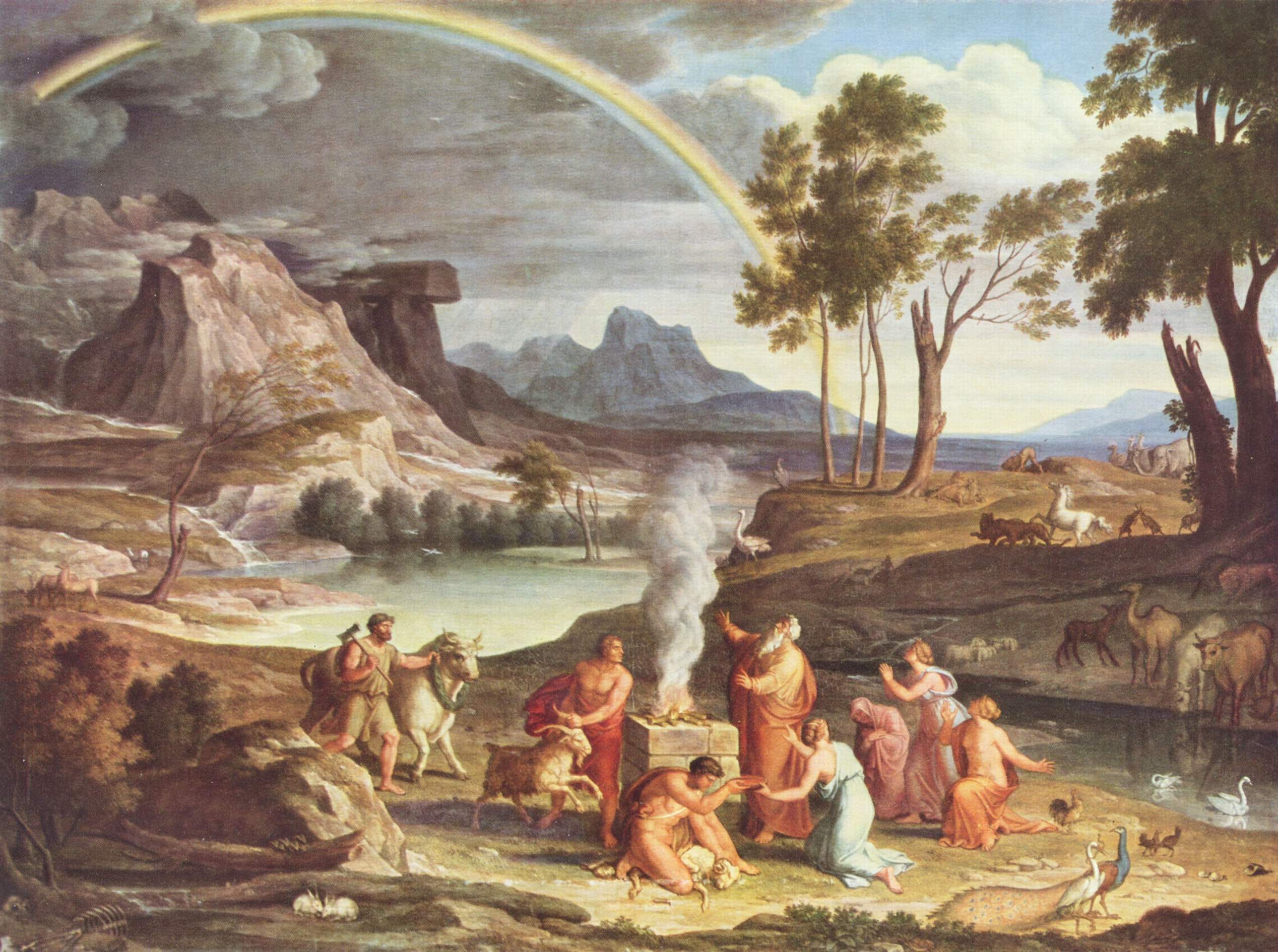
Thinking about the Church's setting before her children Noë, I recalled that in the traditional Easter Vigil the second of the twelve Prophecies read was of Noë, the Ark, and the Deluge (Genesis v, 31; vi; vii, 6. 11-14. 18-22. 23-24; viii, 1-3. 6-12. 14-21), which in my old St Andrew's Missal has this explanatory heading: "Noe, who was at the head of humanity sacred [sic; lege saved] by God, is a figure of Christ, and Noe's ark is a figure of the Church which saves us from the condemnation of the world after sin."

The Collect following this prophecy shews its interpretation, by referring to the Church - it's a marvellous prayer, one well worth praying when in the slough of despond:
Deus, incommutabilis virtus, et lumen æternum: respice propitius ad totius Ecclesiæ tuæ mirabile sacramentum, et opus salutis humanæ, perpetuæ dispositionis effectu tranquillius operare; totusque mundus experiatur et videat, dejecta erigi, inveterata renovari, et per ipsum redire omnia in integrum, a quo sumpsere principium: Dominum nostrum Jesum Christum Filium tuum: Qui tecum vivit et regnat in unitate Spiritus Sancti, Deus, per omnia sæcula sæculorum. R/. Amen.

(O God of unchangeable power and eternal light, look favourably on thy whole Church, that wonderful and sacred mystery; and by the tranquil operation of thy perpetual providence carry out the work of man's salvation, and let the whole world feel and see that things which were cast down are being raised up, and things which had grown old are being made new, and all things are returning to perfection through him from whom they took their origin, even Jesus Christ our Lord. Who with thee liveth and reigneth in the unity of the Holy Ghost, God, world without end. R/. Amen.)
Unfortunately, while this Collect is still included in the Novus Ordo for use at the Paschal Vigil, the reading about Noe and the Flood is not.  (Noë appears in the modern Lectionary for Mass on the first Sunday of Lent in Year B - as this year - and in the 6th week of Ordinary Time in Year I - again, this year: in fact, yesterday, to-day and to-morrow, a coincidence of which I was unaware! - on Tuesday, Wednesday and Thursday: the relevant references are to Genesis ix, 8-15 and to Genesis vi, 5-8 & vii, 1-5. 10; viii, 6-13. 20-22; ix, 1-13.)  However, in The Book of Divine Worship for the Anglican Use of the Catholic Church (approved for use in the United States under the Pastoral Provision there), the Great Vigil of Easter includes this a version of this lesson (Genesis vii, 1-5. 11-18; viii, 6-18; ix, 8-13), with Psalm 45(46) - Deus noster refugium - suggested to be used after it, and then the following Collect:
Almighty God, you have placed in the skies the sign of your covenant with all living things: Grant that we, who are saved through water and the Spirit, may worthily offer to you our praise and thanksgiving; through Jesus Christ our Lord.  Amen.
What the praise of Noë in Holy Writ? Let us hear what the Spirit says to the churches (cf. Apoc. ii & iii): "Noe found grace before the Lord... Noe was a just and perfect man in his generations, he walked with God" (Genesis vi, 8. 9); "And Noe did all things which God/the Lord commanded him." (Genesis vi, 22; vii,5) "Noe was found perfect, just, and in the time of wrath he was made a reconciliation. Therefore was there a remnant left to the earth, when the flood came. The covenants of the world were made with him, that all flesh should no more be destroyed with the flood." (Ecclesiasticus xliv, 17-19) "By faith Noe, having received an answer concerning those things which as yet were not seen, moved with fear, framed the ark for the saving of his house, by the which he condemned the world; and was instituted heir of the justice which is by faith." (Hebrews xi, 7) 

Indeed, before the face of hardened, unbelieving sinners, God constituted Noë "the preacher of justice" (II Peter ii, 5), so that, if they had not grieved the Spirit and resisted the call of grace, they would have been saved, had they not "been disobedient when the patience of God waited in the days of Noe while the ark was a-building" (I Peter iii, 20), for all of a hundred and twenty years, that is, for a very long while, according to one interpretation of Genesis vi, 3; alas, thus shall it be at the coming of the Son of Man (cf. St Matthew xxiv, 37f & St Luke xvii, 26f) - when he comes, shall He find faith on the earth, that is, in the hearts of carnal men?  That old revival hymn "Out of the Ark" well sums up what is at stake...

And Noah built an altar unto the Lord: and... offered holocausts... (Genesis viii, 20)

Therefore, seeing as Nöe is accounted an ancestor (cf. St Luke iii, 36) and a type or figure of Christ (as through him alone was mankind saved from the Deluge in the Ark, so through Christ alone is mankind saved in the Church from eternal death) - his name signifying comfort and rest (Genesis v, 29; cf. Hebrews iii, 7 - iv,11), being graced, just and perfect, walking with the Lord, fulfilling all commands, by faith believing in holy fear, rejecting the sinful world going down to its doom, preaching justice in season and out of season, being an heir of justice through faith, acting as a reconciliation, worshipping God by a pleasing sacrifice (Genesis viii, 20ff), receiving a blessing and a covenant (Genesis ix, 1ff) - he is a fine model of all virtue and religion for Christians. "He who has an ear, let him hear"!  (Cf. Apoc. ii & iii.)

Over at Pastor Weedon's blog, I found that the Lutheran Church - Missouri Synod observes the commemoration of Noah on the 29th of November (the Orthodox, by the way, commemorate him along with all the ancestors of Christ on one of the Sundays before Christmas; and, in some manner, on the 8th of August); and from Luther's "Flood Prayer" for use at Baptism the Lutheran Treasury of Daily Prayer draws this nice collect for keeping the memory of Noah, succinctly linking up believing Noah, the Ark and the Church believing in the Lord, as against the unbelieving world condemned through the Flood:
"Almighty and eternal God, according to Your strict judgment You condemned the unbelieving world through the flood, yet according to Your great mercy You preserved believing Noah and his family, eight souls in all. Grant that we be kept safe and secure in the holy ark of the Christian Church, so that with all believers in Your promise, we would be declared worthy of eternal life; through Jesus Christ, our Lord." (TDP, p. 966)

While I don't have them to hand, I recall from years back that Jean Cardinal Daniélou commented on the figure of Noë in several of his books; these would be well worth consulting...

Sunday, March 23, 2008

Anniversary of Pope Benedict's Baptism

Early in the morning of Holy Saturday, 16th April 1927, the Ratzingers brought little Joseph, only a few hours old, to their church in their Bavarian village: in those days, today's evening Easter Vigil was anticipated in the morning, and the priest was happy to include in the ceremonies not merely the customary blessing of the font, but a baptism as well. “The more I think about it, the more fitting it seems that I was baptized on Easter Eve, not Easter,” the future Pope was to write; “We live in this world not in the full light of Easter, but journeying toward that light, full of hope.”

Christ Has Conquered Sin, Satan, Death, and Hell

Christus resurrexit! Surrexit vere!

Christ is Risen! He is risen indeed!

Хрїстóсъ воскрéсе! Воистину воскресе!
(Christos voskrese! Voistinu voskrese!)

Χριστός ἀνέστη! Ἀληθῶς ἀνέστη!
(Christós Anésti! Alithós Anésti!)

Alleluja, alleluja, alleluja.


Christ is Victor, Christ is Ruler, Christ is Lord of all: He has conquered, He has triumphed, He has harrowed hell, and snatched the human race from the tyranny of the devil. May He conquer us, may He triumph in us, may He harrow our souls, break the bars and chains, cast out every sin and snare, release us from bondage to Satan, and have us share in His Paschal conquest evermore. To Christ be glory forever, with the Father and Holy Ghost, one God in perfect Trinity: Amen.

To all in the blogosphere, a very happy Easter to you all!

It's after half-past three in the morning, and I've just given my friends a lift home after some beer and chocolate (Guinness, on top of a Corona, and a Lindt chocolate bunny each) at my place, after the Vigil. Please pray for Robert, as he screws up his courage to ask to be received into the Church; and for Tim, another new acquaintance and friend of a friend, who came to Mass for the first time tonight, and is very interested by the Faith, and I trust "not far from the kingdom of God": I offered up my Paschal Communion for them, since I felt for them as they were unable to receive Our Lord this most blessed night.

The Vigil of the Twelve Prophecies took just over an hour; four of us in rotation - Fr Terence, Justin, Aaron, and I - read the said prophecies in English (I had the choice passages from Genesis v-viii about Noe, from Baruch iii, and from Jonas iii regarding Nineveh), Justin and I sang the three canticles/tracts, and Fr Rowe chanted the collects, in Latin of course. The collects are really quite grand, and so long and involved as to seem more Gallican than Roman; the whole service I found a great exercise in the hallowed art of lectio divina, and the faithful who attended in preparation for the true Vigil to come would have been a good crowd at any weekday Mass, about thirty or so.

Then, off to St Brigid's to set up... The ceremonies began a little late, at 9.48pm, and the long Vigil lasted two hours; then came the glorious High Mass of the Resurrection, so we took three hours in total. Quartessence sang the chant, and much polyphony too; Justin and I assisted in soutane and surplice from the start till the end of the Vigil, for we sang two of the prophecies each - a difficult task, in Latin, especially since we had only learned the right cantillation this evening. I somehow got through it: pronouncing the text doesn't worry me, but I kept mucking up the drop of a fifth at the full stops through nervousness. It was a great relief, giving how hot and muggy it was, to change back into lay attire and go to the pews for the Mass itself.

It was windy outside, and lighting the Paschal Candle and keeping it lit proved difficult - O for the Serpent, that wondrous old threefold candle that nasty Bugnini et al. got rid of! Surprise, surprise, far from being an impediment it would have really been a great help in getting the light of Christ successfully transferred from the bonfire to the Candle in church. The Exultet and Prophecies came next and worked well, but why was it felt needful in the reforms of the 1950's to split the Litanies of the Saints in half, move the Sicut cervus, add to the already long blessing of the Font by tacking on an aspersion of the faithful and renewal of baptismal promises, and only then conclude the Litanies? It was rather cluncky and vexing, especially with the changes of vestments needed, and I wryly remarked to Justin that if Cranmer had done such a bad job as Bugnini certainly did with his liturgical tinkerings, then the BCP would never have lasted as long as it did!

(We felt a bit like the two grumpy old men from the Muppets, criticizing the service, but as Traddies I suppose that's par for the course - no disrespect to the reverend clergy! - for it was difficult to do the ceremonies in an unfamiliar church.)

Finally on a humorous note, tonight we saw the resurrection of the subdeacon! Recall that on Palm Sunday we lost him after the Passion... well, tonight the subdeacon arrived during the Prophecies... (On both occasions, the duty to assist at another Mass had meant that both had to skip part of the liturgy.)

Tonight's Epistle is a favourite text of mine (Colossians iii, 1-4):

Brethren: If you be risen with Christ, seek the things that are above, where Christ is sitting at the right hand of God: mind the things that are above, not the things that are upon the earth. For you are dead, and your life is hid with Christ in God. When Christ shall appear, Who is your life, then you also shall appear with Him in glory.