Showing posts with label Easter. Show all posts

Saturday, February 21, 2015

The Chinese Calendar and the Date of Easter

The Chinese lunisolar calendar – whose New Year occurred adjacent to Ash Wednesday this week – is, as all men know, a Jesuit production. For imperial decrees of 1611 and 1629 commanded those expert mathematicians and astronomers, being missionaries of the Society of Jesus then resident in Beijing, to correct the traditional calendar of the Ming Empire; the work was completed between 1642 and 1644; and, after an invasion and change of dynasty, was promulgated in the first year of the Qing (that is, Manchu) Empire, in 1645.

There was some contretemps back in Rome at the involvement of Fr Johann Adam Schall von Bell, S.J., in the composition of such a calendar, providing as it did for the various feasts and fasts of pagan idolatry, not to mention days of good and bad fortune as prescribed by oriental superstition; but his involvement was all carefully examined and approved by a curial commission, Fr Schall's role being revealed as simply providing the calculations upon which substructure native officials arranged their customary observances, without any acquiescence of that Jesuit in their non-Christian rites; and in the same year of 1664, Pope Alexander VII officially approved the good father's appointment as a mandarin and chief mathematician of the Empire of China.

Being a lunisolar calendar, its lunar months (stretching from new moon to new moon, with the full moon occurring, more or less, on the fifteenth day of each) are carefully disposed to correspond to the solar year, with the intercalation of an extra month from time to time (roughly every three years). Though its solar year is calculated between successive (northern hemisphere) winter solstices, it is interesting to note several convenient properties of the Chinese calendar that relate instead to the vernal equinox, which must always fall within the second lunar month.

I wonder if the Jesuits, who laboured for the Son of Heaven that he be converted and turn to worship the Son of Man, that he, too, and all the peoples of his Empire, become sons of God and co-heirs of heaven, did not spot the eminent suitability of their clever improvement of the Chinese calendar for the determination of the date of Easter, in conformity with the then-recent Gregorian calendrical reform?

For I have been checking if a simple algorithm applied to the Chinese calendar will correctly yield the date of Easter: and it seems it does, if two safeguards be applied.

To begin with, recall what the first Ecumenical Council decreed: that Easter falls on the first Sunday after the first (or "Paschal") full moon after the (northern) vernal equinox. The West (whether non-Chalcedonian, Greek or Latin) has always determined this date by the use of tables. However, in principle astronomical calculations would yield an equal or superior result.

The reformed Chinese calendar of 1645 is based upon observations of the true rather than the mean sun and moon. (Since early last century, it has not been based upon the meridian of Beijing, but upon that of 120 degrees East; this is about the only change made after the Jesuits' codification and improvement of ancient tradition.)

To determine the date of Easter by use of the Chinese calendar, first one finds the date of the vernal equinox in the relevant year (this always falls in the second lunar month), converting if necessary from the Gregorian to the Chinese date (though most Chinese calendars provide the "solar terms", including the relevant equinox). Then one notes if that equinox occurs before or after the fifteenth of the lunar month (when the full moon, in almost all cases*, occurs). If before, then the first Sunday after that fifteenth* day will be Easter Sunday. If after, then the first Sunday after the fifteenth* of the third month will be Easter.

I add an asterisk (*) above to signify that I have made a perhaps unwarranted simplification (though it works well enough in over 93% of cases): for, having downloaded a table of all lunar phases and their timings from 1600 to 2200 inclusive, it appears that the fifteenth day of the Chinese month is not always the date of the full moon: sometimes it is the sixteenth, or even the seventeenth.

For the eighty years from 1974 to 2053, four times (in 1994, 2021, 2025 and 2048) the calculation of the date of Easter requires not merely assuming that the fifteenth of the lunar month is the date of the full moon, but a careful checking of its exact date. Obviously, a truly comprehensive Chinese calendar table will include the exact date of the full moon each lunar month, so providing a wholly accurate method for finding Easter Sunday.

There is a further rule necessary: in 1981, this method would suggest that Easter falls on the 26th of April, but Easter can only fall between the 22nd of March and the 25th of April – so an added rule must prescribe that, in such a case, Easter be observed a week earlier.

If only the good fathers of the Society of Jesus (in those days, not merely great scholars, but staunchly orthodox too) had managed to convert the Emperor of China! If only the Chinese Rites controversy had been correctly resolved in 1704 (when instead those observances were banned, raising the wrath of the Kangxi Emperor, and resulting in the persecution of Chinese Christians), rather than only in 1939! If only Clement XI had been as well-informed and truly irenic as Pius XII – without in any way being syncretistic!

Ah, the might-have-beens of history: if only Matteo Ricci's understanding of Chinese customs had been upheld rather than spurned, then the conversion of China could have been effected centuries earlier, rather than postponed until the Sino-Japanese conflict and the Communist conquest of mainland China; or, to speak of another theatre of conflict, why did Mary, James II, the Old Pretender and the Young Pretender fail, and Elizabeth and the Prince of Orange succeed? We must bow before the inscrutable decrees of Providence.

In any case, once the men of Han are converted in God's good time – and there are many Christians and Catholics among them, despite all persecution – then indeed one providential convenience will be that the Chinese calendar is admirably adapted to the calculation of the date of Easter.

Sunday, April 15, 2012

Endless Alleluia

Whilst in this vale of tears Kyrie eleison is our song, in heaven for ever down all the ages of the ages we shall cease not from singing Alleluia to God the Lord.

Those holy souls the Dormitionists know this well, for at all Hours of their Office they cry Kyrie ere the Lord's Prayer they pray; but, so great is their wordless, inexpressible, unquenchable joy at the Resurrection, Christ's triumph and ours in Him, that they "make all things new" by devoting their Paschal Hours to some foreshadowing of that endless Alleluia sung by those in endless rest above.

The Monastic Office, as is well known, only follows that of Rome for the Easter Triduum, when no hymns are sung, and from Easter Sunday onwards reverts to its usual use of hymns, little chapters and whatnot, liberally adorned with the Easter cry of Alleluia, Praise the Lord; the Roman Breviary and kindred Uses such as the Dominican, however, retain for the Easter Octave an ancient form of solemnity, joyful indeed, but as with the Triduum still laying aside hymns and capitula, in place thereof repeating Hæc dies - "This is the day the Lord hath made".

The Dormitionist Breviary takes up, extends, and in a manner simplifies further the manner of simply celebrating Easter without hymns and short readings from Scripture at the Hours, by inserting yet more cries of jubilation – the ineffable Alleluia, again and again - and prolonging the time for special forms of the Hours over the whole of Eastertide, not just the Octave.  For as Augustine notes, when our joy soars beyond all form of words, then truly we sing with jubilation, crying Alleluia.

Therefore, during Paschal Time, Matins begins, as in other Uses, with the Invitatory Alleluja, alleluja, * Alleluja to garland the Venite.  There is no hymn, but at once another threefold Alleluia is read as the antiphon for the psalmody (12 psalms daily, more on Sundays, as previously noted).  The versicle after the repeated antiphon concludes the psalms is Christus resurrexit a mortuis, alleluja - Primitiæ Dormientium, alleluja – evidently chosen on account of the last word, "of the Sleepers".

Three passages from St Paul, himself a witness to the Resurrection "last of all, out of due time" are read daily, as encapsulating the doctrine of the Resurrection as Dormitionists especially view it: I Corinthians xv, 1-6; Romans vi, 3-8; and Colossians iii, 1-4 (†).  Rather than reading from the Fathers about so great a mystery, the Canons prefer to listen to the inspired preaching of the Apostle himself, eagerly repeating his words each passing day of Eastertide.

But most notably, after each Lesson is found one of the great liturgical treasures of the Order, which are together the justly famous three Alleluiatic Responsories, the first sevenfold, the next ninefold, and the last fortyfold:

R/. i. Alleluja, alleluja, alleluja, * Alleluja.
V/. Alleluja, alleluja, * Alleluja.

R/. ii. Alleluja, alleluja, alleluja; alleluja, alleluja, alleluja; alleluja, alleluja,  * Alleluja.
V/. Alleluja, alleluja, * Alleluja.

R/. iii. Alleluja, alleluja, alleluja; alleluja, alleluja, alleluja;  * Alleluja, alleluja, alleluja; alleluja, alleluja, alleluja.
V/. Alleluja, alleluja, alleluja, alleluja.  * Alleluja, alleluja, alleluja; alleluja, alleluja, alleluja.
Gloria Patri et Filio et Spiritui Sancto.  * Alleluja, alleluja, alleluja; alleluja, alleluja, alleluja.
R/. Alleluja, alleluja, alleluja; alleluja, alleluja, alleluja;  * Alleluja, alleluja, alleluja; alleluja, alleluja, alleluja.

Endless Alleluias indeed...

How repetition thus aids in attaining the special charism and grace proper to the Order, of repose in Christ – hence the proverbial expression, "From A to Z", or, in its older wording, "From A's to Z's".

It will be noted that the fifty-six Alleluia's of these three Alleluiatic Responsories equate to the fifty-six days of Eastertide, from Easter Sunday to Whit Saturday inclusive.  Many mystic reasons are adduced for this, but clearly the profound Scriptural significance of each of the numbers added together, of seven, of nine, and of forty, is sufficiently obvious?  Dormitionist novices are oft told to meditate on these numbers and their sum in order to achieve the grace of sleep in Christ.

To conclude Matins, of course the Te Deum (or "tedium" as one impatient priest refers to it, a shrewd insight shewing how all unawares the Dormitionist charism has spread everywhere through the Church as a most subtle fragrance or odour) next is prayed, and then the sacerdotal versicle preceding Lauds (a feature of non-Roman mediæval Uses, be it noted): Mortui enim estis, alleluja – Et vita vestra est abscondita cum Christo in Deo, alleluja (Col. iii, 3).  The Dormitionist Canons, following the lead of the Beloved Apostle when in exile on Patmos, love to prostrate as if dead before the Living One, imitating now what they hope to be evermore, "hid with Christ in God".

Lauds – and for that matter, all the Little Hours and Vespers (Compline always excepted) – is celebrated in a typically Paschal fashion.  The psalms of this and the other Day Hours are sung under one antiphon, a triple Alleluia (recalling, however, that by "sung" is meant "form the words upon the lips silently", as only Compline is sung in common in the Order, the rest being said whenever the brethren may happen awake in their respective cells, much psalmody being soporific and therefore dear to those who seek for rest, as all men, especially priests and religious, know).

As previously mentioned, the Dormitionists prolong the peculiar forms of the Easter Octave Hours, by continuing to omit capitulum, hymn and versicle throughout Paschaltide. In their stead, directly the psalmody is concluded with the repeated antiphon (for they always "double" antiphons, a primitive practice revived, no doubt owing to their example, in more modern times throughout the Roman Office), instead of the expected Hæc dies, instead, as a better expression of unfathomable rejoicing at the stupendous mystery, a fourfold Alleluia is uttered.  Vespers is the magnificent exception, the noble fortyfold Alleluia's of the third Matins Responsory instead being repeated, almost ad infinitum it may be said (scoffing worldlings would mistakenly add, et ad nauseam).

At Lauds and Vespers, the Easter antiphon for the Gospel Canticle is a ninefold Alleluia (found in Monastic Breviaries only as the first antiphon at Lauds of Low Sunday); after this, or directly the fourfold Alleluia is ended at Prime, Terce, Sext and None, follows the invariant Kyrie and Pater noster, with Collect and so forth – for, howsoever long we rejoice in Christ, we remain yet in the prison of our body, still in the midst of this miserable and naughty world, and so must fall to petition and prayer after exulting in the Lord and His victory.

So, too, after the Benedicamus Domino (with double alleluia on all days of the Octave, and on other Eastertide Sundays and feasts at Lauds and Vespers, and single alleluia on ferias, as in the Dominican Breviary), at those two greater Hours come the daily memorials and prayers in commemoration of the Holy Sepulchre, of the Dormition, of  St Lazarus, of  the Seven Sleepers, for Rest, and for the Living and the Dead that together constitute the staple of Dormitionist piety (with alleluias attached during all Easter Time, of course).  Then Benedicamus is repeated (another mediæval survival), this time unadorned as at the Little Hours; and so the Hours of Lauds and Vespers end.

All that remains to be noted is that, at Compline, the Canons together sing a triple Alleluia indeed as the psalm antiphon, but otherwise content themselves with the same responsory, versicles, Nunc dimittis antiphon and Marian anthem  as always, simply adding alleluias to these as done in more well-known Breviaries.

Simple calculations will demonstrate that thus the Dormitionist Breviary repeats Alleluia three hundred-odd times a day during all of Paschal Time.  It will be evident, therefore, why these good but ever-fatigued, absolutely exhausted Canons have a strange aversion to saying the Regina cæli...

******

† The three Matins Lessons are, in English:

From the first  Epistle of blessed Paul the Apostle to the Corinthians.


Now I make known unto you, brethren, the gospel which I preached to you, which also you have received, and wherein you stand; by which also you are saved, if you hold fast after what manner I preached unto you, unless you have believed in vain. For I delivered unto you first of all, which I also received: how that Christ died for our sins, according to the scriptures: and that he was buried, and that he rose again the third day, according to the scriptures: and that he was seen by Cephas; and after that by the eleven. Then he was seen by more than five hundred brethren at once: of whom many remain until this present, and some are fallen asleep. — But thou, O Lord, have mercy upon us.  R/. Thanks be to God.


From the Epistle to the Romans.

Brethren: Know you not that all we, who are baptized in Christ Jesus, are baptized in his death? For we are buried together with him by baptism into death; that as Christ is risen from the dead by the glory of the Father, so we also may walk in newness of life. For if we have been planted together in the likeness of his death, we shall be also in the likeness of his resurrection. Knowing this, that our old man is crucified with him, that the body of sin may be destroyed, to the end that we may serve sin no longer. For he that is dead is justified from sin. Now if we be dead with Christ, we believe that we shall live also together with Christ. — But thou, O Lord, have mercy upon us.  R/. Thanks be to God.


From the Epistle to the Colossians.

Brethren: Therefore, if you be risen with Christ, seek the things that are above; where Christ is sitting at the right hand of God: mind the things that are above, not the things that are upon the earth. For you are dead; and your life is hid with Christ in God. When Christ shall appear, who is your life, then you also shall appear with him in glory. — But thou, O Lord, have mercy upon us.  R/. Thanks be to God.

[The third Lesson is shortened on account of the long Responsory that follows.]

Saturday, April 14, 2012

Easter Bunny

This morning, I took two visitors (my aunt, and a mutual friend from overseas) to the local farmers' market; this evening, having made use of some of the produce thereof, I dished up a nice rabbit stew, which seemed tasty enough.  The rabbits are farmed, not wild-shot (my uncle told me that the latter, to be found up at the Great Lake, would be more flavoursome).  Herewith, the recipe, based on my own very hazy notions of what to do with the ingredients (all of which came from the market, excepting wine, onion and salt already in the kitchen, plus thyme picked from the garden):

Ingredients

50g butter
1 kg rabbit forequarters
1 onion, finely diced
1 bunch baby leeks, washed and diced
1 bunch heritage carrots in various colours, peeled and roughly chopped
1 bunch baby parsnips, peeled and roughly chopped
1 large handful of fresh thyme shoots
1 cup white wine (semillon sauvignon blanc)
generous pinch of salt

1. In a fry pan, successively melt sufficient butter wherein to saute first the rabbit, then the onion, then the leeks, then the carrots and parsnips.

2. Put each sauteed foodstuff into a slowcooker or large ovenproof casserole with snug lid.

3.  Deglaze the pan with the white wine, and add the liquid to the rest of the ingredients, throwing in the thyme leaves (stripped from the shoots) and seasoning.

4. Cook for hours at low temperature in slowcooker or oven until the rabbit comes away from the bones.

5. Serve with plenty of mashed potato (a little salt and cream stirred through the latter) and a glass of white wine.

Serves 3 or 4.

******

I just recollected that Tolkien tells (in The Lord of the Rings, Book Four, Chapter IV: "Of Herbs and Stewed Rabbit") how hobbits on the lam fix coneys: catch and dress two small rabbits, and simmer them in water scented with foraged bay-leaves, thyme and sage over an open fire.  Sam remarks that he would would want stock, onions, turnips, carrots and famously potatoes – the latter a trifle anachronistic for Middle Earth, one might think, but then the Númenóreans of old were famous navigators – but made do with what he could scrounge, and what Gollum could catch.  Now I think of it, I could have used home-grown sage and bay-leaves, but no matter.

(Of course, on Easter Sunday itself we all dined on roast lamb, and have partaken of rather too much chocolate all the days since.)

Monday, April 13, 2009

Easter Martyr: St Hermenegild

On the 13th of April 585, after refusing to receive the Easter Communion at the hands of an Arian bishop, the heir to the throne of Spain was murdered on the orders of his father, the King.

It is a classic tale of family feuding, and as in any whodunnit, cherchez la femme!  In this case, there were two ladies involved: the prince's evil step-mother, the unlovely Goiswintha, fomented King Leovigild's anger; the prince's saintly wife, Ingund (or Ingunthis) - daughter of the Frankish King Sisebert I of Austrasia - was a stedfast Catholic despite the attempted suasions of her step-mother-in-law: and she, together with St Leander, Bishop of Seville (whose brother, St Isidore, later succeeded to that same see), had wrought her husband's conversion from the Arian heresy.  For these were the days of Visigothic Spain, when a Teutonic military aristocracy ruled the Romanized Spanish; and the Visigoths, prior to their irruption into the rich provinces of the Roman Empire, had been converted by Arian missionaries, not Catholics.

St Hermenegild's younger brother, Reccared (like him, a child of the King's first wife, Theodosia, who had died), had attempted to reconcile father and son during their previous feuds; but now it was too late.  Hermenegild, reconciled instead to thoughts of winning through to heaven, bowed his neck to the sword. Being slain rather than deny the Faith by sacrilegiously communing with a heretic, he won the crown of the everlasting kingdom, and reigns with Christ evermore.


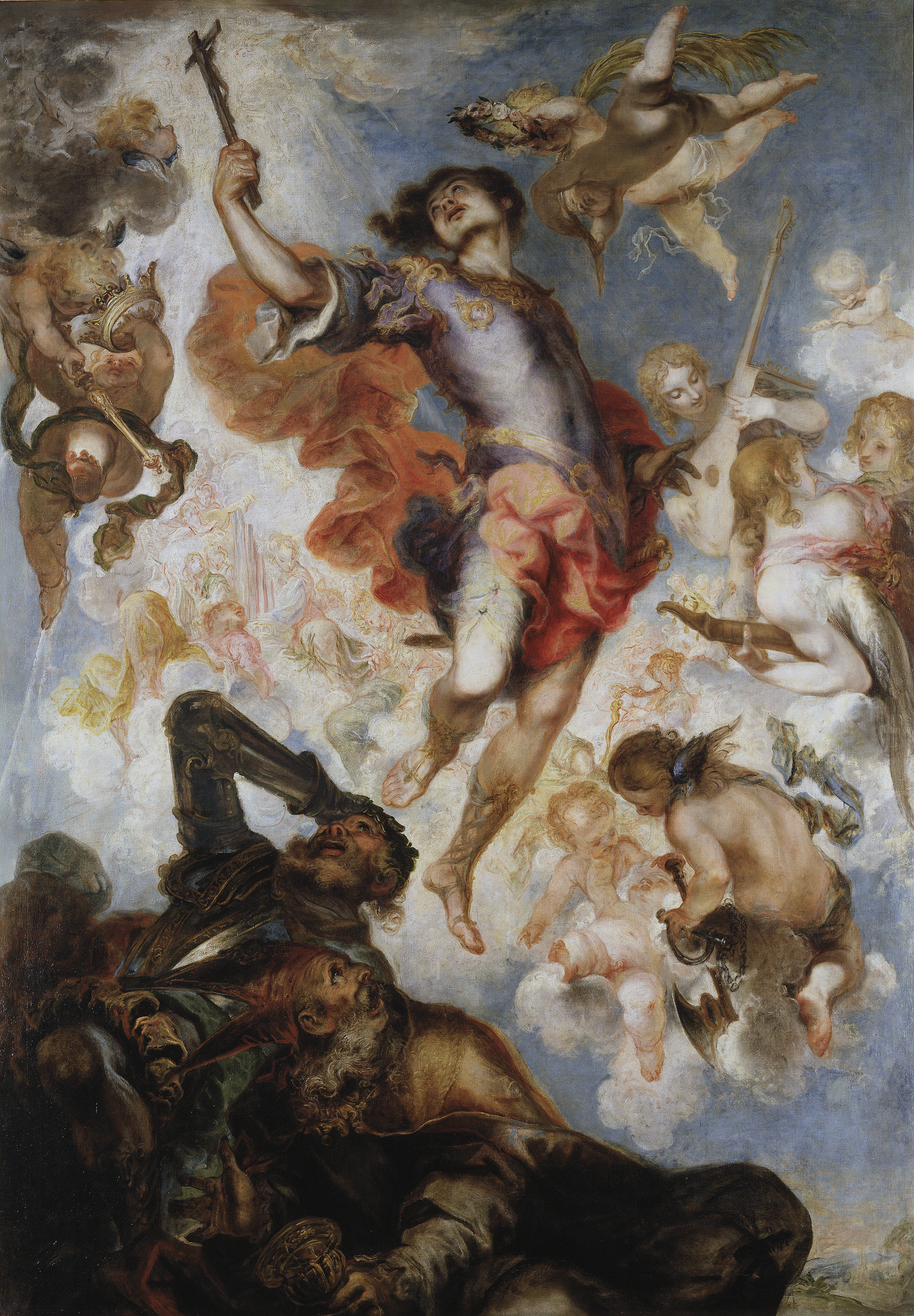
(Hermenegild, spurning the promise of an earthly crown, triumphantly wins the crown of martyrdom, to the joy of the angels; his father laments, and the Arian bishop cowers away.)

From the truth thy soul to turn,
Pleads a father's voice in vain;
Naught to thee were jewelled crown, 
Earthly pleasure, earthly gain. 

Angry threat and naked sword 
Daunted not thy courage high; 
Choosing glory with the Lord, 
Rather than a present joy. 

Now amidst the Saints in light,
Throned in bliss forevermore; — 
Oh! from thy exalted height, 
Hear the solemn prayer we pour. 

Honor, glory, majesty, 
To the Father and the Son, 
With the Holy Spirit be, 
While eternal ages run. Amen.

(Hymn at Lauds, Nullis te genitor, by Pope Urban VIII.)

King Leovigild died the next year; Hermenegild's younger brother, Reccared, who succeeded as King of Spain, himself became a Catholic in 587, and by May of 589, at the Fourth Council of Toledo, the whole Visigothic nation abjured Arianism, and the great St Leander of Seville preached a famous sermon on "the triumph of the Church at the Conversion of the Goths".  Amazingly, even the Arian clergy converted, and were confirmed in their ministries!  All this, it is piously believed, was obtained by the celestial intercession of the royal martyr, whose glorious merits and suffrages won sweet grace from God.  Truly, Hermenegild was an immense treasure (Ermen Gild), for whose life the Lord paid a rich wergild: the gift of Faith to a whole people.

Pope St Gregory the Great, who was a friend of St Leander, having known him during his exile from Spain prior to his return in triumph, sings the praises of St Hermenegild in his Dialogues (III, 31).  It has been argued that the prince, having rebelled against his father, was no worthy martyr; but as St Gregory of Tours states, whatever his sins, they were blotted out by his suffering and martyrdom, whereas, if he had but accepted the Arian bishop's offer of Holy Communion, he would have been restored to his princely estate and reconciled to the King, yet at the price of abandoning the Catholic Faith: this he would not abandon, as the pearl of great price, and it was for this that he died a true martyr.

As for the martyr's widow and infant son, they had taken refuge in the Byzantine Empire, where they prospered; and his great-grandson returned to Spain to reign as King Erwig (680-687).

Deus, qui beatum Hermenegildum Martyrem tuum, cælesti regno terrenum postponere docuisti: da, quæsumus, nobis; ejus exemplo caduca despicere, atque æterna sectari.  Per...

(God, Who didst teach blessed Hermenegild Thy Martyr to esteem earthly things less than the heavenly kingdom: grant, we beg, unto us, that by his example we may despise things perishable and rather seek after things eternal.  Through...)

[BTW, caducus is a great word: tottering, falling, fallen, frail, vain, perishable...]

Sunday, April 12, 2009

Easter Elevation Aspiration

Si consurrexistis cum Christo, quæ sursum sunt quærite, ubi Christus est in dexteram Dei sedens; quæ sursum sunt sapite, non quæ super terram.  Mortui enim estis, et vita vestra abscondita est cum Christo in Deo.  Cum Christus apparuerit, vita vestra, tunc et vos apparebitis cum ipso in gloria. - "If ye be risen with Christ, seek ye the things that are above, where Christ is, sitting at the right of God: savour the things that are above, not those that are upon earth.  For ye are dead, and your life is hidden with Christ in God.  When Christ appears, who is your life, then you also will appear with Him in glory."  (Col. iii, 1-4)

This is a favourite text of mine, being the Easter Vigil Epistle in the Old Rite, and the Easter Day Epistle in the New!  I know it (in Latin) by heart; the above English is my translation.  (The whole of Colossians iii could well form a complete rule of life.)

But why this?  Because it leads into my change of Elevation aspiration; normally, adoring the Host and Chalice as they are successively elevated, I pray the Ave verum; but during Eastertide, the following verses of Ad cenam Agni providi instead:

O vera, digna hostia,
Per quam franguntur tartara,
Captiva plebs redimitur,
Redduntur vitæ præmia.

(O true, worthy Victim, / By Whom Tartarus is smashed, / A captive people redeemed, / The rewards of life restored.)

Quæsumus, Auctor omnium,
In hoc paschali gaudio,
Ab omni mortis impetu
Tuum defende populum.  Amen.

(We beg, Author of all, / In this paschal joy, / From all motions of death / Defend Thy people.  Amen.)

[St Pius V breathed forth his pure soul to God while praying the last-quoted verse of this hymn.]

On the Resurrection of Christ


Alleluia!  Christ is risen!  Glorify Him!

From the late mediæval Scottish poet William Dunbar (reading aloud may help to puzzle out the words so spelled):
Done is a battell on the dragon blak,
Our campioun Chryst confountet hes his force;
The yettis* of hell ar brokin with a crak,
The signe triumphall rasit is of the croce,
The divillis trymmillis† with hiddous voce,
The saulis ar borrowit and to the blis can go,
Chryst with his blud our ransonis dois indoce‡:
Surrexit Dominus de sepulchro.

[*gates; †tremble; ‡doth endorse]

Dungin* is the deidly dragon Lucifer,
The crewall serpent with the mortall stang;
The auld kene tegir with his teith on char†,
Quhilk in a wait‡ hes lyne for us so lang,
Thinking to grip us in his clows strang;
The mercifull Lord wald nocht that it wer so,
He maid him for to felye of that fang§:
Surrexit Dominus de sepulchro.

[*Beaten; †ajar; ‡Which in wait; §prize]

He for our saik that sufferit to be slane,
And lyk a lamb in sacrifice wes dight*,
Is lyk a lyone rissin up agane,
And as gyane raxit† him on hicht;
Sprungin is Aurora radius and bricht,
On loft‡ is gone the glorius Appollo,
The blisfull day depairtit fro the nycht:
Surrexit Dominus de sepulchro.

[*treated; †stretched; ‡Aloft]

The grit victour agane is rissin on hicht,
That for our querrell to the deth wes woundit;
The sone that wox all paill now schynis bricht,
And dirknes clerit, our fayth is now refoundit;
The knell of mercy fra the hevin is soundit,
The Cristin ar deliverit of thair wo,
The Jowis and thair errour ar confoundit:
Surrexit Dominus de sepulchro.

The fo is chaisit, the battell is done ceis,
The presone brokin, the jevellouris fleit and flemit*;
The weir is gon, confermit is the peis,
The fetteris lowsit and the dungeoun temit†,
The ransoun maid, the presoneris redemit;
The feild is win, ourcumin is the fo,
Dispulit of the tresur that he yemit‡:
Surrexit Dominus de sepulchro.

[*fled and banished; †emptied; ‡kept]
[For any who wish, I will supply a modernized version...]