Showing posts with label conversions. Show all posts

Saturday, February 21, 2015

The Chinese Calendar and the Date of Easter

The Chinese lunisolar calendar – whose New Year occurred adjacent to Ash Wednesday this week – is, as all men know, a Jesuit production. For imperial decrees of 1611 and 1629 commanded those expert mathematicians and astronomers, being missionaries of the Society of Jesus then resident in Beijing, to correct the traditional calendar of the Ming Empire; the work was completed between 1642 and 1644; and, after an invasion and change of dynasty, was promulgated in the first year of the Qing (that is, Manchu) Empire, in 1645.

There was some contretemps back in Rome at the involvement of Fr Johann Adam Schall von Bell, S.J., in the composition of such a calendar, providing as it did for the various feasts and fasts of pagan idolatry, not to mention days of good and bad fortune as prescribed by oriental superstition; but his involvement was all carefully examined and approved by a curial commission, Fr Schall's role being revealed as simply providing the calculations upon which substructure native officials arranged their customary observances, without any acquiescence of that Jesuit in their non-Christian rites; and in the same year of 1664, Pope Alexander VII officially approved the good father's appointment as a mandarin and chief mathematician of the Empire of China.

Being a lunisolar calendar, its lunar months (stretching from new moon to new moon, with the full moon occurring, more or less, on the fifteenth day of each) are carefully disposed to correspond to the solar year, with the intercalation of an extra month from time to time (roughly every three years). Though its solar year is calculated between successive (northern hemisphere) winter solstices, it is interesting to note several convenient properties of the Chinese calendar that relate instead to the vernal equinox, which must always fall within the second lunar month.

I wonder if the Jesuits, who laboured for the Son of Heaven that he be converted and turn to worship the Son of Man, that he, too, and all the peoples of his Empire, become sons of God and co-heirs of heaven, did not spot the eminent suitability of their clever improvement of the Chinese calendar for the determination of the date of Easter, in conformity with the then-recent Gregorian calendrical reform?

For I have been checking if a simple algorithm applied to the Chinese calendar will correctly yield the date of Easter: and it seems it does, if two safeguards be applied.

To begin with, recall what the first Ecumenical Council decreed: that Easter falls on the first Sunday after the first (or "Paschal") full moon after the (northern) vernal equinox. The West (whether non-Chalcedonian, Greek or Latin) has always determined this date by the use of tables. However, in principle astronomical calculations would yield an equal or superior result.

The reformed Chinese calendar of 1645 is based upon observations of the true rather than the mean sun and moon. (Since early last century, it has not been based upon the meridian of Beijing, but upon that of 120 degrees East; this is about the only change made after the Jesuits' codification and improvement of ancient tradition.)

To determine the date of Easter by use of the Chinese calendar, first one finds the date of the vernal equinox in the relevant year (this always falls in the second lunar month), converting if necessary from the Gregorian to the Chinese date (though most Chinese calendars provide the "solar terms", including the relevant equinox). Then one notes if that equinox occurs before or after the fifteenth of the lunar month (when the full moon, in almost all cases*, occurs). If before, then the first Sunday after that fifteenth* day will be Easter Sunday. If after, then the first Sunday after the fifteenth* of the third month will be Easter.

I add an asterisk (*) above to signify that I have made a perhaps unwarranted simplification (though it works well enough in over 93% of cases): for, having downloaded a table of all lunar phases and their timings from 1600 to 2200 inclusive, it appears that the fifteenth day of the Chinese month is not always the date of the full moon: sometimes it is the sixteenth, or even the seventeenth.

For the eighty years from 1974 to 2053, four times (in 1994, 2021, 2025 and 2048) the calculation of the date of Easter requires not merely assuming that the fifteenth of the lunar month is the date of the full moon, but a careful checking of its exact date. Obviously, a truly comprehensive Chinese calendar table will include the exact date of the full moon each lunar month, so providing a wholly accurate method for finding Easter Sunday.

There is a further rule necessary: in 1981, this method would suggest that Easter falls on the 26th of April, but Easter can only fall between the 22nd of March and the 25th of April – so an added rule must prescribe that, in such a case, Easter be observed a week earlier.

If only the good fathers of the Society of Jesus (in those days, not merely great scholars, but staunchly orthodox too) had managed to convert the Emperor of China! If only the Chinese Rites controversy had been correctly resolved in 1704 (when instead those observances were banned, raising the wrath of the Kangxi Emperor, and resulting in the persecution of Chinese Christians), rather than only in 1939! If only Clement XI had been as well-informed and truly irenic as Pius XII – without in any way being syncretistic!

Ah, the might-have-beens of history: if only Matteo Ricci's understanding of Chinese customs had been upheld rather than spurned, then the conversion of China could have been effected centuries earlier, rather than postponed until the Sino-Japanese conflict and the Communist conquest of mainland China; or, to speak of another theatre of conflict, why did Mary, James II, the Old Pretender and the Young Pretender fail, and Elizabeth and the Prince of Orange succeed? We must bow before the inscrutable decrees of Providence.

In any case, once the men of Han are converted in God's good time – and there are many Christians and Catholics among them, despite all persecution – then indeed one providential convenience will be that the Chinese calendar is admirably adapted to the calculation of the date of Easter.

Tuesday, May 10, 2011

Alleluia: another Neophyte

I was moved and delighted to learn recently that a work colleague, a quiet fellow, was received into the Church at the Easter Vigil: of your charity, please pray for him, that he remain strong and steadfast in the Faith.

Sunday, November 8, 2009

Dedication of St John Lateran

To think I was in the Lateran Basilica only a few months ago... I must say, I wasn't that taken with it (!), but probably that's because I was rushing through on my way helter-skelter to a number of important shrines that day: from St Peter's, I'd walked to St Mary Major's, then - after swiftly passing through St John Lateran - I did the Holy Stairs, and then hurried on to veneratethe relics of the Passion at Santa Croce, before walking yet further...

What struck me about the Lateran was the nave with its huge statues of the Apostles.

However, the significance of the Lateran is that it - not St Peter's - is the Cathedral of Rome: hence it is the Mother and Head of all churches in the City and throughout the wide world; there the Pope has his chair, his cathedra, his throne, and from there he teaches the nations. And it is the Papal Archbasilica of Our Saviour, for all stems from Christ, Who is our King, and King of all; and the Pope, Father of Christendom, is His Vicar, granted full ordinary power to bind and loose, till He come again.

What strikes me, now I think about it, is that this day marks an important anniversary for a priest and prelate who's been a great influence on me: on this day in 1965, the future Bp Jarrett of Lismore was received into the Church, after he had been for some years an Anglican minister. Hence his episcopal motto: Supra firmam petram - Upon solid rock. It was the antiphon at None on that day.

Thursday, September 17, 2009

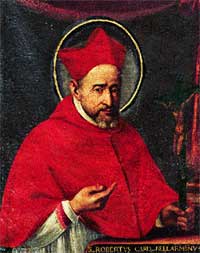
St Robert Bellarmine

I don't know if I'll be able to visit it, but at the Church of St Ignatius (the chapel of the Roman College), St Robert Bellarmine is buried, next to his beloved student St Aloysius Gonzaga. In the Extraordinary Form, Bellarmine's feast fell way back on the 13th of May, but in the Ordinary Form, it is celebrated (with an optional memorial) to-day, the anniversary of his death in 1621.

I pray for my friend and recent convert Robert especially as I keep the memory of this great Doctor of the Church, a learned defender of the Catholic Faith.

Ut unum sint!

Friday, August 28, 2009

St Augustine and His Conversion

Dear St Augustine, that stupor mundi, convert and confessor, bishop and doctor of the Church down all the ages!

It glads my heart to see his feast again.

He who so clearly saw that the history of mankind is the tale of two cities, the City of Man and the City of God, himself beheld the ruin of transient things, lying on his bed of pain praying the Penitential Psalms, and came to pass over from this miserable world to the Father on this very day, the 28th of August, 430, while his episcopal see was besieged by the cruel Arian Vandals, who were ravishing once-fair North Africa, putting priests and virgins to the sword.

It is said that soon after an Imperial messenger arrived in doomed Hippo, bearing a purple scroll all written with gold characters, summoning him to the Council of Ephesus, where the Fathers assembled would soon condemn Nestorius and declare Holy Mary to be Mother of God - but this Light of the West had already departed for the pure light of Truth above.

May he pray for me, that I be converted entirely to the Lord; may he pray for all nations, that they all turn and be saved. As the Saint so beautifully and truly put it,

Fecisti nos ad te, Domine, et inquietum est cor nostrum, donec requiescat in te.

(Thou hast made us for Thyself, Lord, and our heart is restless until it rest in Thee.)

******


Famously, St Augustine's conversion in the summer of 386 (which, like St Paul's, had a feast all its own in calendars of congregations - such as the Dominicans - adhering to his Rule, on the 15th of May - see an online Breviarium S.O.P., page 337ff) was proximately triggered by his opening the Scriptures, upon hearing mysterious voices chanting Tolle, lege; his eye fell upon Romans xiii, 13f:

Let us walk honestly, as in the day: not in rioting and drunkenness, not in chambering and impurities, not in contention and envy: but put on the Lord Jesus Christ: and make not provision for the flesh in its concupiscences.

Thus was answered his well-known imperfect prayer during his time of wandering with divided heart - "Lord, grant me chastity, but not yet." Thus were superabundantly rewarded all his stumbling steps toward the light. Thus were answered the endless prayers and tears of St Monica, his mother, to whose piteous intercession, under God, is attributed the grace of his conversion!

Handing on the scroll to St Alypius, his friend, who was thereupon converted by reading the next verse (Romans xiv, 1 - "Now him that is weak in faith, take unto you: not in disputes about thoughts"), Augustine experienced no more doubts or dismay, and was baptized by St Ambrose at the Easter Vigil at Milan, on the 24th of April 387. Pious fancy has these two later canonized saints and Doctors extemporizing the Te Deum at the moment of St Augustine's reëmergence from the font: well may we sing Te Deum and Non nobis, Domine, non nobis, sed nomini tuo da gloriam, on such a great feast!

Here is the old Dominican collect for the feast of St Augustine's conversion:

Deus, qui ineffabili providentia beatum Augustinum ab errorum tenebris ad lucem evangelicæ veritatis adduxisti: da nobis, quæsumus, ut, qui ejus [hodie] Conversionem colimus, ejusdem ad te precibus, actus nostros in melius reformemus. Per...

(God, Who didst bring blessed Augustine by Thine unspeakable Providence from the darkness of error to the light of Gospel truth: give unto us, we beseech, that we who observe his Conversion [to-day], at the prayers of the same to Thee, may reform our actions for the better. Through...)

This would be a very suitable daily prayer. St Philip Neri used to declare upon recovering from any illness that he really purposed to begin to reform his life, considering that all his efforts thus far were nugatory - and this was the set resolve of a saint! Much the more so ought worldlings pray at least for grace to at last slough off sin and walk manfully in the way of Christ.

The Conversion of St Paul, the Conversion of St Augustine, and, may one add the Conversion of soon-to-be-Blessed John Henry Newman (9th October 1845, when he was received into the Church by Bl Dominic Barberi, C.P.*) - these, together with the anniversary of one's own embrace of the Faith, should be days kept with solemnity and ever remembered.

[* This holy priest once converted two anti-Catholic youths on the spot, when they observed that the stones they threw at him in their bigoted violence he picked up and kissed!]

Sunday, January 4, 2009

Te Deum

I've just bought a CD of yet another recording of Charpentier's Te Deum, but partnered with his rarer Messe pour plusieurs instruments au lieu des orgues: it even has a nice picture of Pope Benedict XIV* on the front. This music has been accompanying my tripping around Hobart and environs...

[* Wishful thinking on my part: it's actually Clement XIII!]

And how appropriate to have a Te Deum to hand: since I learn from Herr Schutz that Dr Adam Cooper, until now a Lutheran Pastor, together with his family, has just been received into the Church on the 28th of December, feast of the Holy Family. I have been hoping to have a chance to study under him for some time, since learning of his recent appointment as lecturer at the John Paul II Institute in Melbourne, and am delighted to sincerely congratulate him and his on this great step. Ut unum sint!

I think this makes at least four Aussie Lutheran pastors to have Poped in recent years, and I know two Canadian pastors who've done the same. Watch out world: these men are all Christ-loving, zealous and learned, and they play important roles in the New Evangelization.

Te, Deum, laudamus:
te, Dominum, confitemur.
Te, aeternum Patrem,
omnis terra veneratur.
Tibi omnes Angeli;
tibi caeli et universae Potestates;
Tibi Cherubim et Seraphim
incessabili voce proclamant:
Sanctus, Sanctus, Sanctus,
Dominus Deus Sabaoth.
Pleni sunt caeli et terra
majestatis gloriae tuae.
Te gloriosus Apostolorum chorus,
Te Prophetarum laudabilis numerus,
Te Martyrum candidatus laudat exercitus.
Te per orbem terrarum
sancta confitetur Ecclesia,
Patrem immensae maiestatis:
Venerandum tuum verum et unicum Filium;
Sanctum quoque Paraclitum Spiritum.

Tu Rex gloriae, Christe.
Tu Patris sempiternus es Filius.
Tu ad liberandum suscepturus hominem,
non horruisti Virginis uterum.
Tu, devicto mortis aculeo, aperuisti
credentibus regna caelorum.
Tu ad dexteram Dei sedes, in gloria Patris.
Judex crederis esse venturus.
Te ergo quaesumus, tuis famulis subveni:
quos pretioso sanguine redemisti.
Aeterna fac cum sanctis tuis in gloria numerari.

Salvum fac populum tuum,
Domine, et benedic hereditati tuae.
Et rege eos, et extolle illos usque in aeternum.
Per singulos dies benedicimus te;
Et laudamus Nomen tuum in saeculum, et in saeculum saeculi.
Dignare, Domine, die isto sine peccato nos custodire.
Miserere nostri domine, miserere nostri.
Fiat misericordia tua,
Domine, super nos, quemadmodum speravimus in te.
In te, Domine, speravi:
non confundar in aeternum.

Sunday, November 23, 2008

Gaudeamus

The Last Sunday after Pentecost - Pre-Advent Sunday, "Stir up Sunday" - is upon us; to-night also marks Vespers of St Cecilia, dear to me because I sang them with my old schola over a decade ago; and I have spent a very pleasant evening with a friend, who tells me that during the past week he has been privately received into the Church.  Deo gratias.

A quirky resonance: the second antiphon for Lauds and Vespers of St Cecilia (Lauds I've prayed, Vespers will instead be the first of Sunday), with its striking ascending incipit, refers to her sainted husband, Valerian, who "in the bedroom found Cecilia praying with an Angel", upon which event he converted!


(Valerian, along with Tiburtius and Maximus, is commemorated on the 14th of April, the feast of St Justin Martyr.)

Since my friend comes from an Anglican background, he does hope, as we may, that such actions as the ongoing discussions between the TAC and Rome will issue perhaps in permission for former Anglicans to utilize appropriate elements of their liturgical heritage within the Catholic fold, much as has already been done in the United States under the Pastoral Provision, providing an Anglican Use with its own Book of Divine Worship.  Lest any critique this, it must be said at once that the Novus Ordo could be greatly improved in its ethos by a larger injection of the best features of the High Church tradition, such as better singing, better preaching, and more attention to liturgical best practice...

During our spiritual conversation, he let me know that he feels at peace, after what has been a long process; I was reminded of some words from that golden book, The Imitation of Christ, which I mentioned to him and now post here for the benefit of us all:

I am accustomed to visit my elect in two ways: by temptation and by consolation.  (III, iii, 5)

Therefore, when God gives you spiritual consolation, receive it with thanksgiving; but reflect that it is a gift of God, not your merit.  ...become more humble in this gift; also more cautious and fearful in all your actions; because this hour will pass away and temptation will follow.  When consolation will be taken away from you, do not despair immediately; but with humility and patience wait for another heavenly visit, because God is potent in redonating you a greater consolation.  (II, ix, 4)

À Kempis goes on to observe that this state of affairs is known to all the Saints and Prophets, and gives an exegesis of Psalm 29 with this in mind (II, ix, 4-5).

Sunday, November 16, 2008

Converted Aged Ninety

While strolling through town after Mass, I rang some friends in Tasmania - to explain to them, as I put it, that I'm coming back as "the first Climate Change Refugee" (after reading, as Traddies like, some apocalyptic, but of the secular variety) - and heard the encouraging news that the nonagenarian mother of Mary's husband has just become a Catholic.

Apparently the family have been praying for this for years, but when Mary asked Fr Quinn, C.P., to visit her mother-in-law in hospital, where she was after suffering a serious accident, and at least to bless her, she added "And receive her into the Church if she asks" - to which Fr replied, "She'll never become a Catholic".  But what do you think was the first thing the dear old lady said to Fr?  She was baptized (sub conditione I presume) and received into the Church at her hospital bed, with four generations of her family in attendance.

Deo gratias!

I should add that Fr Quinn (the humblest of men) is known for his indefatigable hospital ministry; the number of persons he has received into or reconciled with the Church, the number of marriages he's regularized, the numbers he's baptized and confirmed, must be incalculable.  I consider that he has been given a special power or grace for this salvific work.  

For instance, on one occasion of which I'm aware, he came to the sole Catholic patient in a four-bed ward, and administered the sacraments to him.  No sooner had he left than the nurses came running, since the other three patients had all pressed their emergency buzzers: and they told the bewildered nurses, "We want him to do the same for us!"  He was recalled, and received all three into the Church.  True story.