Showing posts with label Cookery. Show all posts

Saturday, June 30, 2012

Next Time, Chinese

I was rather looking forward to barbecued duck – however, the bird, once cooked and served, was a little underwhelming.  This is in fact almost my usual experience with duck: I rarely have it, look forward to it, finally get around to having it, and then feel disappointed.  A few restaurant meals of yester-year spring to mind also.

Sometimes, preparing a certain foodstuff yourself is not worth the effort.  Yes, home-baked bread is marvellous, home-made pasta divine; but who has the time?  I certainly don't, nor have the skills nor any great success in so doing.  Unlike a good straightforward lamb, beef, chicken, turkey, pork or ham roast, I think roast or other duck is a bit beyond me – I'm no master chef.

(Also, nearly twenty dollars for a 1.9 kg frozen duck – the only way it can be bought locally – is rather steep; just as I saw some wild rabbits for sale at the local providore, but they were just as dear.  I'd rather go and do as I do each Saturday for that money or a little more: enjoy coffee and a spot of breakfast while reading The Australian in a cafe.)

However, as all men know, two great nations and cuisines do duck well: those of the French and the Chinese.  The duck confit at the Cafe Serpente next to Chartres Cathedral was excellent; and so, always, is Chinese duck, BBQ or otherwise.  French-style duck cannot around here be bought as takeaway, whereas Chinese-style duck can.  Rather than prepare it myself, then, it will be a case of, next time, Chinese.

Saturday, April 14, 2012

Easter Bunny

This morning, I took two visitors (my aunt, and a mutual friend from overseas) to the local farmers' market; this evening, having made use of some of the produce thereof, I dished up a nice rabbit stew, which seemed tasty enough.  The rabbits are farmed, not wild-shot (my uncle told me that the latter, to be found up at the Great Lake, would be more flavoursome).  Herewith, the recipe, based on my own very hazy notions of what to do with the ingredients (all of which came from the market, excepting wine, onion and salt already in the kitchen, plus thyme picked from the garden):

Ingredients

50g butter
1 kg rabbit forequarters
1 onion, finely diced
1 bunch baby leeks, washed and diced
1 bunch heritage carrots in various colours, peeled and roughly chopped
1 bunch baby parsnips, peeled and roughly chopped
1 large handful of fresh thyme shoots
1 cup white wine (semillon sauvignon blanc)
generous pinch of salt

1. In a fry pan, successively melt sufficient butter wherein to saute first the rabbit, then the onion, then the leeks, then the carrots and parsnips.

2. Put each sauteed foodstuff into a slowcooker or large ovenproof casserole with snug lid.

3.  Deglaze the pan with the white wine, and add the liquid to the rest of the ingredients, throwing in the thyme leaves (stripped from the shoots) and seasoning.

4. Cook for hours at low temperature in slowcooker or oven until the rabbit comes away from the bones.

5. Serve with plenty of mashed potato (a little salt and cream stirred through the latter) and a glass of white wine.

Serves 3 or 4.

******

I just recollected that Tolkien tells (in The Lord of the Rings, Book Four, Chapter IV: "Of Herbs and Stewed Rabbit") how hobbits on the lam fix coneys: catch and dress two small rabbits, and simmer them in water scented with foraged bay-leaves, thyme and sage over an open fire.  Sam remarks that he would would want stock, onions, turnips, carrots and famously potatoes – the latter a trifle anachronistic for Middle Earth, one might think, but then the Númenóreans of old were famous navigators – but made do with what he could scrounge, and what Gollum could catch.  Now I think of it, I could have used home-grown sage and bay-leaves, but no matter.

(Of course, on Easter Sunday itself we all dined on roast lamb, and have partaken of rather too much chocolate all the days since.)

Monday, June 20, 2011

Healthy Sleeping, Moderate Eating

“We will not have you ignorant, brethren, concerning them that are asleep” (I Thess. iv, 12a): this being the counsel of the Apostle, I cannot but continue to spread the spread the good news about that most noble Order of Canons Regular, the Dormitionist: indeed, woe is me, if I do not.  For if to convert one sinner be a most worthy deed, what must it be to turn man’s mind to holy religion, toward embracing an utterly contemplative live, wholly oriented toward Him Who is the true East, the Eschaton, being both Alpha and Omega, by even now striving to sleep the sleep of the just, just as all the blessed do sleep in the Lord?

(Any inquiries may be left in the comment box.)


The bed, the prie-dieu, the study-desk, the dining-table...
all important facets of the Dormitionist charism.

These redoubtable religious sleepers-in-Christ, having chosen the better part (cf. St Luke x, 42), shall have a premier place and part in the Kingdom: for we, at “the coming of the Lord, shall not prevent them who have slept” (I Thess. iv, 14b): no, as is only right, those who have striven to practise in this life what they hope to do for all eternity, shall by no means be the last and least to enter heaven.  If to desire a bishoprick is to desire a good work (I Tim. iii, 1), how much greater must it be to desire to be a holy religious? – indeed, a greater work in truth, since the religious life is the state of acquiring perfection, whereas the fulness of the priesthood is the state of acquired perfection (cf. St Thomas Aquinas, S.T., II-II, 184, 7).

Furthermore, as the Dormitionists in all humility cannot forebear to point out, their Order is clearly foretold in Holy Writ under the figure of Israel, and indeed most commended therein: “Lying down he hath slept as a lion, and as a lioness, whom none shall dare to rouse.” And Balaam was constrained by the Spirit of the Lord to continue, and to declare, “He that blesseth thee, shall also himself be blessed: he that curseth thee shall be reckoned accursed.” (Numbers xxiv, 9.)  Yea and amen, just as the Dormitionist Fathers are most potent sleepers-in-Christ, and thus deserving of all praise for fulfilling this meditative office vicariously on behalf of the whole Church, so those scoffing worldlings who would say unto them – as once the pagan sailor to Jonas, himself a type of the sleeping Christ (Jonas i, 6) – “Why art thou fast asleep?” do but risk the divine displeasure.

An inability “rightly to divide the word of truth” (II Tim. ii, 15) may be the fault that binds men in ignorance: for, while lazy slug-a-beds are rightly castigated, even in the very Scriptures, such carnal, fleshly slumber is utterly different from godly sleep, as is indicated in the parable of the wise and foolish virgins: “for all slumbered and slept” (St Matthew xxv, 5), the five wise and five foolish, and the different verbs distinguish the two – the former slept prepared for the Eschaton, that is, the Advent of the Bridegroom; while the latter did not.  This is plainly declared in the second Book of the Machabees: “they who [have] fallen asleep with godliness, [have] great grace laid up for them” (cf. xii, 45b).

******

Now, in order that the Dormitionist in his cell within his Dorter (Dormitory) may say with the Patriarch, “I awoke, and then fell asleep again” (Genesis xli, 21b), and dream sacred dreams, the better to fulfil his elected avocation, he ought most carefully maintain a proper diet.  It is known that the Apostle instructed Timothy, his fellow bishop, to take a little wine for his stomach and his debilities (I Tim. v, 23); and for utterly the same reason, some wine or beer, a hemina or so (howsoever much that is) as St Benedict suggests (cf. his Rule, chapter 40), should be imbibed to ensure placid slumbers.  Likewise, decent sleep requires, not a stodgy meal or gluttonous feast, but a temperate supper – else the overstuffed flesh will give rise to uneasy dreams.  Christus Somnifer, Christ the Bringer of Sleep and Sacred Dreams, visits not the couch of the intemperate.

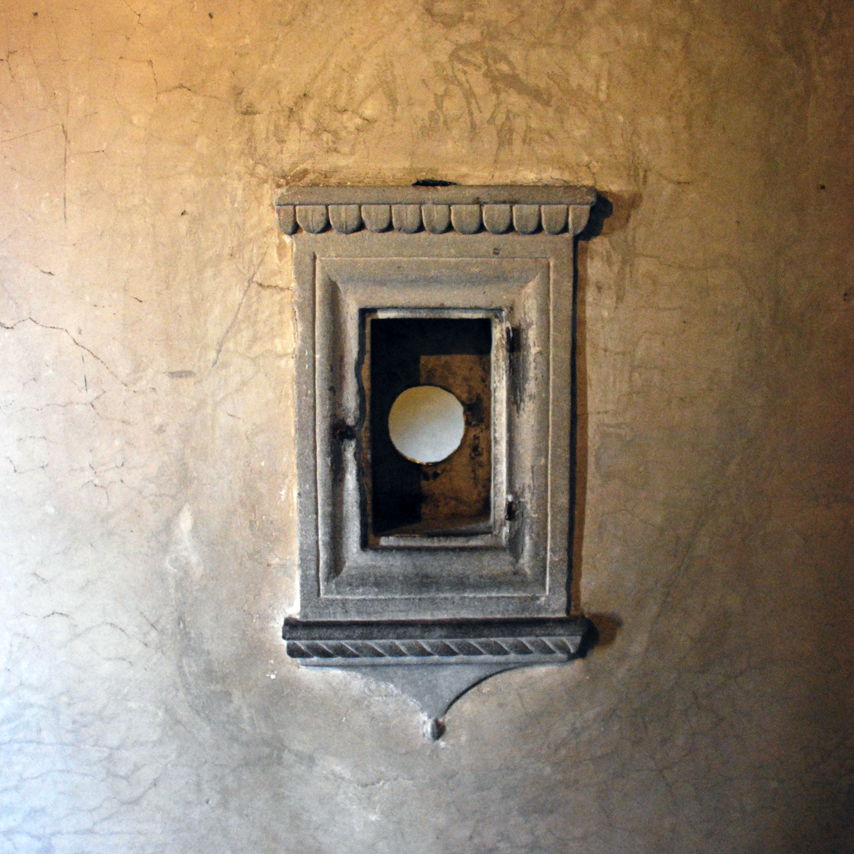
For this reason, ere he sup within his cell on the meal passed through the trap-door (for the Dormitionists do not dine in a common refectory, only coming together in the church for their evening vigil Mass and Compline), it is the custom in the Order to read over again every time the following passage from Ecclesiasticus xxxi, 22-25:
Quam sufficiens est homini eruditio vinum exiguum! et in dormiendo non laborabis ab illo, et non senties dolorem. Vigilia, cholera et tortura viro infrunito, somnus sanitatis in homine parco: dormiet usque mane, et anima illius cum ipso delectabitur. Et si coactus fueris in edendo multum, surge e medio, evome, et refrigerabit te, et non adduces corpori tuo infirmitatem.
(How sufficient is a little wine for a man well taught, and in sleeping thou shalt not be uneasy with it, and thou shalt feel no pain. Watching, and choler, and gripes, are with an intemperate man: sound and wholesome sleep with a moderate man: he shall sleep till morning, and his soul shall be delighted with him. And if thou hast been forced to eat much, arise, go out, and vomit: and it shall refresh thee, and thou shalt not bring sickness upon thy body.)
The reader will be unsurprised to learn that, consequent upon the sage advice of this sapiential pericope, each cell has an attached vomitorium after the Roman mode (the ancients, they thought of everything).  Any errors in diet may thus decently be corrected, lest the Dormitionist charism be impeded.  How the wise Founders of the Order thought of everything!

******

(Photographs in this article are of Carthusian Charterhouses, sincee the Dormitionists do not yet permit photography, or "the production for pious ends of daguerreotypes and the like" – only two General Chapters, those of 1855 and 1931, have so far approved of this novelty; it is expected that the forthcoming General Chapter will give the necessary third approval.)

Friday, January 28, 2011

All'Aglio e Olio

Elizabeth David, via a book! long ago gave me the recipe for my fasting dinner to-night.  I was going to have salmon, but, having to dine alone, I fixed on a simpler supper (and had had sardines in a bread roll for a late lunch in any case).

So, dinner was pasta all'aglio e olio: boil some pasta (David suggested spaghetti, I used penne, all I had to hand this evening), and meanwhile dice up lots of garlic to be heated up in good olive oil; once all is ready, mix it all together and serve.  I added a sprinkle of salt.

Earlier, I gave blood to-day, the first time since last year (I donate on and off), and I commend doing so to all.

It is interesting, though, to note the strict rules the Red Cross still applies: no one who's spent six months or more in the U.K. during the Mad Cow epidemic, no one who's had a tattoo in the past year, no one who's been in prison, no one's who's used drugs even once, no one who's visited a harlot, no one who's committed unnatural acts may donate blood.  

Isn't it remarkable, when the voices of morality are cowed by those of vice, that even now, in this dark age, the Red Cross's standards of hygiene still remind us that certain grave sins, not only disordered and degrading, are also notorious ways to catch foul diseases?

Monday, February 15, 2010

Lamb Roast

I had the whole family at table to-night for a celebratory dinner: a roasted leg of lamb (about 5 pounds' weight), slow-cooked till meltingly tender and falling off the bone, served with gravy, mint sauce, roast potatoes and pumpkin, cauliflower with cheese sauce, and zucchini with tomatoes (the latter fresh from the garden).  I had a beer while cooking...  And dessert was peaches poached in syrup with vanilla and whisky.

The simple things in life are often the best.

Monday, December 14, 2009

Aglio e Olio

And now for something completely different...

Taking a leaf out of Fr Z's cookbook - he was an accomplished chef ere he became a priest, in case readers aren't aware of quite why he so oft waxes lyrical about culinary delights - I must return to my occasional mentions of things edible and drinkable.

It goes without saying that, like most other people these days in the idle West (for one cannot escape the Zeitgeist), it seems a wan day if it be spent without having a good coffee at some café, reading the newspaper(s); though this morning, I brewed up some coffee instead...

Just recently, it's been simple pleasures for me, such as thick-cut marmalade on buttered toast, or kippers (for I like strong tastes very much), but most recently, I've several times snacked on a favourite comfort food, pasta aglio e olio.

I recall that it was in Elizabeth David's classic work on Italian cookery that I first read of this dish. As she put it, those who love garlic will love it; those who do not will abominate it.

Well, as I make it, it is of the simplest - and the strongest! - with only four ingredients: a handful of whatever pasta I have available (the cupboard being bare, it's been some macaroni lately), cooked up in some salted water (salt stops it sticking, my sister told me), to which is added, after it is al dente and drained, another sprinkle of salt, plus some chopped garlic sautéed in olive oil. I would use three or four cloves of garlic just for myself! (Watch out, world.)

The (super) garlic-infused oil coats the pasta, the salt gives it that lip-smacking quality, the little bits of garlic provide contrast (I think I overfried them this last time - they should be only gently heated through, not crispy), and it tastes great.

(Some will add pepper - otherwise a favourite condiment to me - and/or chilli flakes, even cheese and some tomatoes, but I prefer the wholly garlicky goodness of the most basic form.)

If you think this is perhaps a flavour overload, tell that to the Koreans - the average Korean eats seven heads of garlic per week!

Monday, August 10, 2009

Triple Vespers

The Levite Lawrence hath wrought a good work,
who by the Sign of the Cross gave sight to the blind,
and gave the treasures of the Church to the poor.
– Magnificat antiphon of 1st Vespers of St Lawrence

Having been grilled alive, defying the most impious tyrant by telling him, "I'm cooked, turn and eat!", by a surprising piece of ecclesiastical grim humour, St Lawrence is the Patron Saint of cooks: how appropriate, therefore, on this his feast ten years ago that devout Catholic Jennifer Paterson breathed her last, she of "Two Fat Ladies" fame...

I recall the amusing story about her and how she came to be a food writer and later a television personality: for years she was cook at the London offices of The Spectator, but was finally driven mad by the last-minute demands of her boss the editor ("Oh, Jennifer, we're having fifteen extra at lunch, including the Prince of Wales - they'll be here in forty-five minutes"), promptly opened the kitchen window and threw out all the crockery, which smashed in the courtyard far below - but, instead of sacking her, the editor admired her plucky spirit, and made her a writer for the magazine instead.

Famously, Paterson was a parishioner of the London Oratory, and her uncle was gentiluomo to Cardinal Hume; apparently a bequest from her helped the publication of The Catholic Hymn Book, a fine collection of hymns. I pray that St Lawrence, St Philip and the Blessed Virgin intercede for her, that she have eternal rest in Christ.

I myself am one of those people that enjoy the pleasures of the table, and also quite like reading cookbooks - in fact, providentially a new tome arrived today: Darra Goldstein's The Georgian Feast: The Vibrant Culture and Savory [sic] Food of the Republic of Georgia. (I have hopes of travelling to Georgia in time, but unfortunately the situation there remains tense, with 30,000 Georgian refugees still unable to return to South Ossetia, still more displaced from Abkhazia, both those puppet states being propped up by the Russian military in a shameless manner: Georgia remains straitened within her narrow bounds - only just larger in area than Tasmania - with 18% of her territory under foreign occupation. It seems to me to be somewhat imprudent to travel there at present, alas.)

I think those in the know would agree with me that Georgian cuisine is underrated and not well-enough known: after all, from Poti (ancient Phasis) on the Georgian Black Sea coast (ancient Colchis, end of Jason's quest, the land of the Golden Fleece) came in the beginning the bird of Phasis - the pheasant, king of birds, Phasianus colchicus. I could go on...

But to return to St Lawrence: whenever I think of him, I recall the first portion of the antiphon quoted above - "The Levite Lawrence hath wrought a good work, / Who by the Sign of the Cross gave sight to the blind" - which is also used in shorter form both as another antiphon and as a versicle, and in longer form as the first responsory of his Matins:

R/. The Levite Lawrence hath wrought a good work,
who by the Sign of the Cross gave sight to the blind,
* and gave the treasures of the Church to the poor.
V/. He dispersed, and gave to the poor:
his justice shall abide world without end.
* And he gave the treasures of the Church to the poor.

All true miracles are gratia gratis data, ad ædificandam Ecclesiam: graces given gratis, for the building up of the Church; so it was no wonder that Lawrence the Deacon, that is, one who was a Minister and a Servant, a sacramental icon of Christ the Servant and Minister, performed a signal sign by curing the blind - most significantly, by the Sign of the Cross, that which from a ignominious gibbet has become the Sign of Salvation.

Christ gave sight to the blind, in token that He was the true and only Light of the world, and to shew that in due process of time He would bring light to them that sat in darkness and in the shadow of death, by opening unto them the gate and door of salvation. The servant is not greater than his Master, but follows in His steps: St Lawrence wrought a good work, by freeing from physical blindness a man, thereby giving visible proof to the invisible realities at work, that God through His servants and ministers can not only cure the blind, but through holy Baptism bring illumination to the blind, sinladen soul: not for nothing was Baptism anciently called Photismos and the bath of enlightenment.

Christ may have healed but a few in His day, as the Gospels tell, but by His Cross He saved the dying world going down to death, rising again to be its Life. Likewise, in due measure, St Lawrence, faithful and true witness to Him Who is Faithful and True, healed one, but by his great martyrdom - so the Fathers dare to say - merited the final conversion of pagan Rome, thus bringing salvation to a great Empire of earth, so extending the rule of Christ the King.

It must also be noted that St Lawrence combined in his own person, as servant of the Church of Rome, and in a sense locum tenens thereof (Pope St Sixtus II having but days before been slaughtered at the altar), both faith and good works in an heroic degree: by his miracles he gave proof positive of the power of God, and by his brave almsdeeds he gave witness to the overflowing charity that Christ preached: for as He, being rich, became poor for our sakes, that we may be made rich by His poverty, so St Lawrence, rather than hand over the Church's treasures to bulge the insatiable Imperial purse and feed the licentious luxury of the tyrant, gave rather to the poor these goods for their support, converting gold and silver into everlasting riches stored up in heaven: For inasmuch as ye have done so unto the least of My brethren, ye have done so unto Me, saith the Lord.

To celebrate his feast day, I read Vespers of Our Lady first (keeping to her Little Office as is my wont nowadays), then Vespers of St Lawrence (making my first use of the Breviary Office for some weeks), and finally Vespers of the Dead, in suffrage for the suffering souls in Purgatory, enduring purification by penitential fire (praying for all the faithful departed, including dearly departed Jennifer).

As his Collect reminds us, it is through, with, and in Christ our Lord, by His all-meritorious Passion, by His power and grace, that St Lawrence was able to overcome the dread trial of being charred and cooked on a gridion, and that we may overcome our own vices, burn and inflame they us ever so hotly:

Grant us, we beg, almighty God, to extinguish the flames of our vices, Who didst give unto blessed Lawrence to overcome the fires of his torments: through Christ our Lord. Amen.

Blessed Lawrence, Martyr of Christ, intercede for us.

Tuesday, January 20, 2009

SS Fabian & Sebastian

I was delighted - having visited an old retired priest I know, had a good chat with him, and made my confession since he's a wise and experienced and consoling confessor - to read in Matins of this feast the hymn Christo profusum sanguinem, especially its last stanza:

Te nunc, Redemptor, quæsumus,
Ut Martyrum consortio
Jungas precantes servulos
In sempiterna sæcula.  Amen.

(Thee, now, Redeemer, we beseech,
That to the consort of Martyrs
Thou join Thy praying servants least
Throughout sempiternal ages.  Amen.)

I was also taken by the lessons at Matins (from II Corinthians v, 1-15) which says so much about our hope in Christ, that our mortality put on immortality, that after our earthly tabernacle be dissolved, we find a heavenly one, that death be swallowed up in life, and so whether we live or die, we seek to please the Lord, for before His dread tribunal we shall all appear, to give an account of all we have done in the flesh, whether it be good, or bad.  Therefore, we hope to have a right fear of the Lord, and are persuaded that, since One died for all, all are dead, so to speak, meaning that we who live ought live no longer for ourselves, but for Him who died for us and rose again.

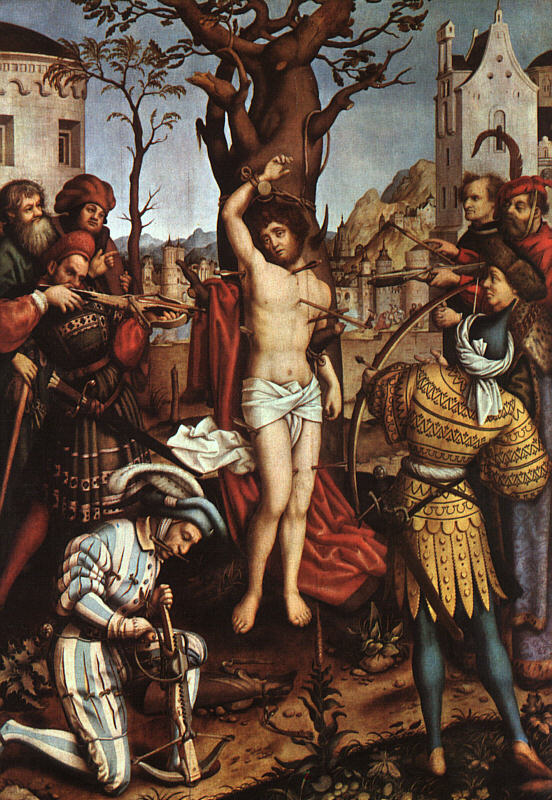
This day we commemorate two more heroes of the Faith, two more champions of the persecuted Church, Pope Fabian - crowned with martyrdom in the persecution of Decius - and that noble soldier Sebastian, invincible even to the arrows shot into him, which he bore unstintingly for the love of Christ, to the confutation of wicked Diocletian.


(Since the surname of my fellow-blogger David Schütz signifies "an archer", perhaps he ought hold St Sebastian the Martyr as a patron saint?  As a blogger hosting - or is it being parasitized by? - many commenters, he may sometimes feel like St Sebastian...)

Finally, the Collect caught my attention:

Infirmitatem nostram respice, omnipotens Deus: et, quia pondus propriæ actiones gravat, beatorum Martyrum tuorum Fabiani et Sebastiani intercessio gloriosa nos protegat.  Per...

(Look upon our infirmity, almighty God: and since we are weighed down by our own acts, may the glorious intercession of Thy blessed Martyrs Fabian and Sebastian protect us.  Through Our Lord Jesus Christ, Thy Son, Who with Thee liveth and reigneth in the unity of the Holy Ghost, God, world without end.  Amen.)

I thank God for His saints, who are such by His grace, for He is pleased by their intercession before His Face, He is pleased to grant their prayers, which He had resolved to grant, whom He had resolved to save, since before the foundation of the world.  All glory to Him for ever: God is glorified in His saints.  And we make this prayer, and hope for its granting only through our Mediator, Christ Jesus, the Saint of Saints because the Holy One, the Son of God, Who is both Man and God, and alone reigns with the Father and the Holy Spirit in perfect Trinity.

Matins were said late to-day, as I've alluded; and in fact only ended in the midst of my efforts at cookery: to-night, I'd resolved, we were to have roast duck, in fact duck à l'orange; what a pity the gravy didn't turn out!  The duck was nice, though, with well-crisped potatoes roasted in goose fat and some plain silver beet to accompany it.  It's been a hot day, and I've been in the kitchen for hours!  At least the bottle of shiraz (a $7 cleanskin bought for cooking) washed everything done - for as is the chef's prerogative, I drank every drop except for the half-glass actually needed for the dish...

Furthermore, there's soup for to-morrow (made of leftover celery plus some leeks) and a quarter of duck too.  So we won't starve.

Wednesday, November 5, 2008

More on Relics - and Ferial Vespers - and Food

Being in didactic mood, here's some more about relics: now, besides my earlier comments, one notable Scriptural warrant for relics is that afforded by Eliseus taking up the mantle of Elias (dropt as he set off in that fiery chariot à la Erich von Däniken) and by its instrumentality working the wonder of parting the Jordan (IV Kings ii, 13f).  And in the sub-Apostolic age, the moving account surviving of the martyrdom of great St Polycarp (see the Letter of the Smyrnæans, chapters xvii & xviii) shews us his Christian flock desiring to "touch his holy flesh", made venerable by his holy life and death (xvii, 1; cf. xiii, 2-3) and so gathering his "his bones which are more valuable than precious stones and finer than refined gold" (xviii, 2) and declaring their due veneration thereof, as expressed through their keeping his annual festival as commemoration of his triumph and training for their own trials (xviii, 3), but duly distinguishing all this from their adoration and worship of God alone to the exclusion of other pretended gods (xvii, 2-3): for that was what their aged bishop had died to defend, after all.

The Fathers adduce four reasons for venerating relics, which of course in the beginning were always the relics of martyrs: (i) in their relics one sees the saints; (ii) the relics of those who bore witness even unto death acts as a spur to one's courage and constancy in persevering in all trials; (iii) the miracles worked through relics is testimony enough of God's approval thereof; and (iv) relics are the remains of our true friends, the saints made perfect, who are so close to the Lord and yet also to us their would-be coheirs.

As is well-known, a Traditional altar will contain the relics of saints (or, in the Byzantine Rite, the antimension - answering to the corporal - contains sewn into it such relics), whether the whole body of a martyr below the mensa, or small fragments in an altar-stone upon a temporary altar.  For this reason, at his ascension to the altar, the celebrant kisses the spot beneath which the relics lie, and prays Oramus te, Domine, per merita sanctorum tuorum, quorum reliquiæ hic sunt, et omnium sanctorum, ut indulgere digneris omnia peccata mea.  (Curiously, the prayer begins in the plural and ends in the singular! - "We pray Thee, Lord, by the merits of Thy holy ones, whose relics are here, and of all the saints, that Thou deign to forgive all my sins.")  Similarly, the Suscipe sancta Trinitas mentions - after Our Lady, the Baptist and the Princes of the Apostles - istorum et omnium sanctorum, where istorum ("of these") is considered to mean those saints whose relics are enshrined in the altar.  While of course the priest in kissing the altar principally acts to worship Christ, Whom the altar signifies and represents, the thought of subordinately revering His Saints, brought to heavenly glory by His Blood alone, is not absent.

There is of course a distinction to be made between the relative dulia paid to relics of the saints (a more intense veneration, by the way, than that due to sacred images: for in the icon the saint is religiously depicted, but in his relic his very earthly remains are present) and the absolute dulia paid to the saints in heaven, where they reign with Christ.  Aquinas handily distills the Church's teaching on relics in his inimitable Summa (III, xxv, 6).

Finally, there are four types of cultus to be lawfully rendered to relics: they may be exposed for veneration (and here it may be noted that reliquaries must not closely resemble monstrances, lest the faithful confuse the altogether singular adoration paid to the Blessed Sacrament with the religious regard paid to the remains of the saints); they may be borne in procession (as at the consecration of a church or altar or otherwise during the translation of relics or the solemnity of a saint - but in a distinct manner to that of a Eucharistic procession, of course); they may be kissed as a sign of reverence (this tending to prove the distinction between such lawful dulia, the supernatural counterpart of the natural honours paid to images of one's sovereign, and the latria paid to Christ in His Sacrament - for no one would dare attempt to kiss the Host, let alone imagine the far greater and dread privilege of receiving It did not Our Lord so command His Flesh be eaten); and they may used by priests as sacred instruments with which to bless the people, as once Eliseus took up the mantle of Elias to provoke the parting of the Jordan.

******

Since Oliver is taking his time moving in, our chapel is still usable, so Michael and I again used it for ferial Vespers.

For the record, Guéranger tells us that Vespers of All Relics is taken wholly from the Common of Many Martyrs, adding only the proper Collect (again, see my previous post) - this must be because relics are principally the mortal remains of martyrs (though in process of time they have come to encompass such traces of confessors and virgins as well), since the sacred relics of the countless hosts of early martyrs, those dauntless athletes of Christ and sharers in His Passion, were the first relics to be accorded veneration by the primitive Church, in memory of their faithful witness to the Lord: Te martyrum candidatus laudat exercitus!  By a process of deduction, it seems clear that Lauds and the Little Hours would also be taken wholly from that Common, with the addition of the proper Collect; moreover, Matins would surely be of the same, but with proper Lessons for the second Nocturn at least.

I think I'll now go and pray Vespers of All Holy Relics pro pia devotione...

******

Oh, and I've had a pleasant enough evening of cooking - which I find relaxing and engrossing in approximately equal portions, that's the recipe for happiness - serving up chicken kiev with cauliflower, broccoli and corn-on-the-cob for dinner here, while preparing a pork mini-roast (now sliced) to provide cold cuts for sandwiches, plus a chicken curry and a mulligatawny-inspired soup, both of which will serve for meals later this week.  I've also enjoyed a pork pie as a snack after work, before settling down to this serious business of cooking...

Wednesday, May 14, 2008

Beer and Soup on Ember Wednesday

I'm enjoying, more or less, a rather strong beer (8.1%) as I type, and am about to go in search of nibbles to have with it... a Tripel Karmeliet, Belgian of course, brewed with not just water, hops, yeast and (barley) malt, but, oats and wheat as well. [I scrounged and found some almonds.]

So as to keep in the spirit (Spirit?) of this Ember Wednesday in Whitsuntide, I prayed Lauds before work, and after work, in between getting the car washed, doing some shopping, having afternoon tea while reading the paper, etc., I managed to say the Little Hours. Soon I will attempt Vespers. I know Matins is thus bizarrely out of order, but realistically thought it best to say what parts I had the time for when I could, rather than start Matins and then have to finish it much much later on, without any other Hours said at all.

Having got home, and had some leftovers for dinner (a simple pearl barley soup, with some vegetables for flavour), I then got on with making some more soup of a tasty sort, according to a half-remembered and very primitive receipt, as follows:

Leek and Ham Hock Soup

Two leeks, chopped
Two ham hocks, whole
Two onions, chopped
Half a dozen or more stalks celery with leaves, chopped
Two potatoes, chopped [these were left over from last night!]
Black peppercorns to taste [maybe a teaspoon or more]

Method:

1. Put all ingredients in large pot(s) with water to cover, bring to boil, simmer until meat falls from bones.
2. Remove bones, remove meat and chop up if necessary, return all meat to pot.
3. Cool and skim off fat if necessary.
4. Serve.


I have bought some button mushrooms, and am undecided as to whether or not to add some or all to the soup as a garnish toward the end of the cooking.

[Update: I left out the mushrooms, but the soup tastes good! I may have been a bit heavy handed with the peppercorns though...]

Ideas, advice, tips, contributions, revulsion?

Monday, December 24, 2007

Christmas Eve: Fish Dish

We have a tradition in our family, that on Christmas Eve we eat fish – strange, because, tho' very Catholic to abstain from flesh before the feast, the side of the family the custom comes from was not Catholic.


Mum's cooking is always best.


In individual ramekins, place some good fish, sprinkled with almonds  – and doused in cream.  Season with salt and lots of pepper; perhaps cover with breadcrumbs; bake; serve piping hot.  This year, we ate it with new potatoes.