Showing posts with label Sequence. Show all posts

Friday, May 4, 2018

Hymns for St Monica

In honour of St Monica, whose feast occurs today, here follows an opening invocation, and then a longer account of her life, being the hymns for each Hour of a Little Office in her honour, all from a little booklet published in Munich at the end of the seventeenth century (Officium Novum cum Litaniis S. Monicæ Matris S. Augustini Hipponensis Episcopi, et Ecclesiæ Doctoris Eximii. Monachii. Typis Joannis Lucæ Straubii, 1695). As for both the metre is 8.8.7.8.8.7. and the rhyme scheme AABCCB, they would serve better in liturgical use as a rhyming antiphon and a sequence respectively. It will be seen that the successive first letters of each line of the Invocation and Commendation spell out Sancta Monica; moreover, the successive first letters of the last word in each line of the Commendation spell out adjuva filios. May she indeed help her spiritual sons!

Invocatio. 

Salve, decus feminarum,
Atque norma viduarum,
Nostra, salve, gloria,
Cujus lacrymis debemus
Tanta (quibus indigemus)
Augustini merita.

Magna Parens nos clientes,
Omnes tuis impendentes
Nostras vires laudibus,
Intellectum, voluntatem,
Cor, et omnem facultatem
Addimus applausibus. Amen.

******

Ad Matutinum. Hymnus.

Ab æterno plurimorum
Quondam Mater filiorum
Præelecta Monica
Ex parentibus honestis,
Perdevotis ac modestis
Nascitur in Africa.

Ab his pie educata,
Cunctarumque exornata
Est virtutum genere:
Æmulas hinc accendebat,
Omnibusque prælucebat
Pietatis munere.

Ad Primam. Hymnus.

Sic virtutibus exculta,
Atque annis jam adulta
Jungitur Patritio
Sponsa viro perdilecta,
Pia, prudens, circumspecta,
Carens omni vitio.

Is cum esset præceps ira,
Perque verba petens dira
Innocentem conjugem,
Cuncta silens perferebat;
Sic per suam corrigebat
Virum mansuetudinem.

Ad Tertiam. Hymnus.

Augustinum cælo datum,
Et ad alta destinatum
Læta parit filium,
Quem ob lumen secuturum,
Jam in spiritu futurum
Dixerat Aurelium.

Hunc ad omnem pietatis,
Optatæque probitatis
Componebat semitam,
Dans cum lacte Jesu nomen,
Velut veram cordis gnomen
Ac salutis tesseram.

Ad Sextam. Hymnus.

Sed incassum sunt hæc nato
Ad perversa inclinato
Sana Matris monita:
Abit, et Manichæorum
Novem spatio annorum
Tenet falsa dogmata.

Sentibus his irretitum,
Vinculisque compeditum
Mater luget filium;
Piæ lacrymæ parentis
Rogant Dei miserentis
Desuper auxilium.

Ad Nonam. Hymnus.

Audi, Mater, consolantem
Et afflictæ prophetantem
Præsulem Ambrosium,
Posse neutiquam tantarum
Precum, atque lacrymarum
Deperire filium.

Eja ergo! Phœbus splendet
(Salus filii impendet)
Fletuum post nubila:
En jam Deum adorantem
Augustinum, tecum stantem
In eadem regula.

Ad Vesperas. Hymnus.

Post Baptismum Roman pergit
Augustinus, inde vergit
Tiberis ad Ostia:
Hic cum ventos expectaret,
Ut in Africam mearet
Cum Parente Monica.

Ad fenestram incumbentes,
Et de cælo colloquentes
Soli valde dulciter,
Spretis mundi his figmentis
De supernis jam fluentis
Delibarunt suaviter.

Ad Completorium. Hymnus.

Tota viribus jam fracta,
Atque voti compos facta
De salute filii,
Ait: dum me sepelitis,
Mei memores tunc sitis
Ad Altare Domini.

Ergo cælis implantanda,
Angelisque socianda
Ad æterna avolat,
Super uno peccatore
Pænitentiam agente
Ut post fletum gaudeat.

Commendatio.

Sublevamen anxiatis,
Ac solamen desolatis,
Nobis præsta indig[n]is;
Corda Deo fac unita,
Tribuatur per te vita
Animabus aridis.

Mentem firma fluctuantem,
Orci nobis inhiantem
Noctem pelle lumine;
In æternum jubilare,
Contra hostes nos ovare,
Ac salvari, satage. Amen.

Saturday, September 9, 2017

Parisian Sequence for Our Lady's Nativity

From the 1738 Paris Missal comes this Sequence for Our Lady's Nativity:
1. Gaudii primordium,
Et salutis nuntium
Diem nostræ canimus.
2. Quæ dat hora Virginem,
Spondet Deum hominem:
En venit quem quærimus. 
3. Quam in matrem eligit,
Hujus ortum dirigit,
Deus omnis gratiæ.
4. Domum quam inhabitet,
Mox e qua nos visitet
Ornat Sol justitiæ. 
5. Quot micat luminibus,
Suis Deus usibus,
Quod vas fingit gloriæ!
6. Quot latent miracula!
Fiet hæc nubecula
In vim magnam pluviæ. 
7. Benedicta Filia,
Tota plena gratia,
Tota sine macula.
8. Cæli quod jam habitas,
Pande nobis semitas,
Prece, Virgo, sedula. 
9. Iram promeruimus,
Christe; pacem petimus:
Hanc da matris precibus.
10. Ut in nobis maneas,
Corda nostra præbeas
Pura culpis omnibus.
Amen. (Alleluja.)
And, thanks to Google Translate taking a French translation from the Schola Sainte Cecile's website, here is an English version:
We celebrate the day that begins our joy, the day that announces our salvation.
The moment that gives birth to the Virgin Mary promises us a God-man: the one we are expecting will appear.
The God of all grace, who chose Mary for her mother, presides over her birth: he overwhelms her with his blessings.
The Sun of Justice decorates with his gifts the house he wishes to inhabit, and from which he comes to make himself visible to men.
With what glory must shine this precious vessel, which God takes care to form for himself!
What prodigies are here confined! It is a little cloud which rises, but which will yield for us a fertile and abundant rain.
Holy and blessed daughter, filled with the graces of the Lord, pure and spotless virgin:
Pray for us unceasingly, O holy Virgin, and open to us by this means the entrance of heaven, where you dwell.
We have deserved thine anger, O Jesus; we sigh after our reconciliation: grant it at the prayers of thy Mother.
So that we may be a dwelling worthy of thee, O Lord, deign to purify our hearts from all sin. Amen. Alleluia. 

Friday, July 22, 2016

Dominican Sequence for St Mary Magdalen

The Dominican Missal of 1603 is online, and it contains (on pages 308 to 309) the following delightful Sequence for the feast of St Mary Magdalen (herself referred to as Apostolorum Apostola in the Benedictus Antiphon of the feast according to the Dominican Breviary):

1. Monti Sion dat virorem, 
Ros Hermon, et viror florem,
Fecundum in gratia.
2. Ad honorem Magdalenæ,
Roris hujus imbre plenæ,
Cuncta spirent gaudia.

3. Rigans montes gratiarum,
Ad convallem lacrymarum,
Ros cælestis effluit.
4. Ibi jacens Magdalena,
Lacrymarum imbre plena,
Christi pedes abluit.

5. Abluentis cor fecundat,
Et tergentis corpus mundat,
A culparum sordibus.
6. Mandat pacem osculanti,
Et unguentis abundanti,
Largus est muneribus.

7. Auster fugans aquilonem,
Lux illustrans rationem,
In amorem perfecit.
8. Grande signum pietatis,
Mox purgatam a peccatis,
Sibi sponsam efficit.

9. Dulcis luctus, dulcis clamor,
Dulcis magis ardens amor,
In tali connubio.
10. A dilecti nulla forte, 
Nec in vita, nec in morte,
Lassatur obsequio.

11. Lugens astat morienti,
Sed congaudet resurgenti,
Ejus narrans gloriam.
12. Et regnantem confitetur,
Dum in rupe profitetur,
Vitam solitariam.

13. Novis modis ibi rapta,
Novis demum donis aucta,
Sponsi gaudet præmiis.
14. Ad hanc partem quam elegit,
Ducat nos qui mundum regit,
Ejus patrociniis. Amen.


Friday, June 3, 2016

A Sequence for the Sacred Heart

From the Mass of the Most Divine Heart of Our Lord, proper to the Sisters of the Good Shepherd, comes this admirable Sequence in worship of that Sacred Heart (verses 1 to 14: 8.8.7.; verses 15 to 18: 8.8.8.7.; verses 19 to 20: 8.8.8.8.7.; verse 21: 7.7.7.7.7.7.):

1. Gaudeamus exultantes
Cordis Jesu personantes
Divina præconia.

2. Hæc est dies veneranda
In qua Patris adoranda
Laudamus præcordia.

3. Cor amandum Salvatoris,
Melis fontem et amoris,
Corda cuncta diligant;

4. Cor beatum summi regis,
Cor et vitam novi legis
Omnes linguæ concinant.

5. Sit laus plena, sit immensa,
Sit perennis, sit accensa
Ardoribus pectoris.

6. Laudet, canat orbis totus,
Colat, amet tota virtus
Et cordis et corporis.

7. Ora, manus, sensus, vigor,
Fides viva, parus amor
Cor divinum consonent;

8. Flammis sacris inflammata,
Corda, voces atque facta
Cor amoris prædicent.

9. Cor mirandum Redemptoris
Coadunans terram cælis,
Unitatis speculum,

10. Digna sedes Trinitatis,
Plenitudo Deitatis,
Amoris miraculum.

11. Amoris evangelium,
Puri cordis incendium,
Magna Dei gloria,

12. Cæli nectar vivificans,
Cordis manna deificans,
Amor et lætitia,

13. Cleri sacri præsidium,
Rector benigne cordium,
Nostra rege pectora.

14. Fons æternæ pietatis,
Ardens fornax caritatis,
Corda flammis devora.

15. Domus amoris aurea,
Turris amantum flammea,
Cœtus nostri lex ignea, 
Fons perennis gratiæ,

16. Cor thesaurus sanctitatis,
Abyssus humilitatis, 
Thronus Dei voluntatis
Et centrum clementiæ.

17. Paradisus beatorum,
Consolator afflictorum,
Pax et salus peccatorum,
Cor omnibus omnia.

18. O Jesu, raptor cordium,
Amore flagrans mentium,
Cor tuum trahat omnium
Mentes et præcordia.

19. O Cor summa benignitas,
Immensa liberalitas,
Incomprehensa caritas,
Cordis vera felicitas,
Cor esto supplicibus.

20. Fac nos Jesu flammescentem
Cordis tui caritatem
Et divinam pietatem
Summam quoque sanctitatem
Sanctis sequi moribus.

21. O beata Trinitas,
Cordis Jesu caritas,
Immensæ clementiæ,
Immensæ sint gratiæ,
Æterna est gloria,
Amen dicant omnia.
Amen. Alleluja.

Friday, December 27, 2013

Sequence for the Feast of St John Evangelist

A blessed feast to all priests – for this day, being dedicate to St John Evangelist, adopted son of Mary the Virgin, and of all the Apostles the virgin priest, is a feast called in better days "the feast of priests".

Unfortunately, I managed to sleep in, and missed attending Mass… so I'll have to unite myself spiritually to the Sacrifice, and pay my respects to the clergy from afar.

In a very nice book I found secondhand (Jeffrey F. Hamburger, St. John the Divine: The Deified Evangelist in Medieval Art and Theology), I discovered a Dominican Sequence for the feast of St John the Evangelist; it appears in the Gradual of St Katharinensthal (dated about 1312).

This Sequence seems to have been given quite some attention – googling turned up several learned articles and even a book referring to it. Herewith, the Sequence, in charming mediæval style:

Verbum dei, deo natum, / quod nec factum nec creatum, / venit de celestibus
Hoc vidit, hoc attrectavit, / hoc de celo reseravit, / Johannes hominibus
Inter illos primitivos / veros veri fonti rivos / Johannes exilivit;
Toti mundo propinare / nectar illud salutare / quod de throno prodiit.
Celum transit veri rotam / solis ibi vidit totam / mentis figens aciem
Speculator spiritalis / quasi seraphim sub alis / dei videns faciem
Audiit in gyro sedis / quid psallant cum cytharedis / quater seni proceres
De sigillo trinitatis / nostre nummo civitatis / inpressit caracteres.
Celi cui sacrarium / suum Christus lylium / 
filio tonitrui / sub amoris mutui / pace commendavit.
Iste custos virginis / archanum originis /
divine mysterium / scribens evangelium / mundo demonstravit
Haurit virus hic letale / ubi corpus virginale / virtus servat fidei
Pena stupet quod in pena / sit Johannes sine pena / bullientis olei.
Hinc naturis imperat / ut et saxa transferat / indecus gemmarum
Quo iubente riguit / aurum fulvum induit / virgula silvarum.
Hic infernum reserat / morti iubet referat /quos venenum stravit.
Obstruit quod ebyon / cherintus et marcion / perfide latravit.
Volat avis sine meta /quod nec vates nec propheta / evolavit altius
Tam implenda quam impleta, / numquam vidit tot secreta / purus homo purius
Sponsus rubra veste tectus, / visus sed non intellectus / referre mysterium
Aquilam ezechielis / sponse misit que de celis / redit ad palacium.
Dic dilecte de dilecto, / qualis sit ex dilecto, / sponsus sponse nuntia.
Dic quis cibus angelorum / que sint festa supernorum / ut sponse presentia.
Veri panem intellectus, / cenam Christi supra pectus / sumptam nobis resera;
Ut cantemus de patrono, / coram agno coram throno, / laudes super ethera. 
Amen.

The Word of God, born of God, that was neither made nor created, came from the heavens
This he saw, this he touched, this he, John, unlocked from heaven for mankind.
Among those first true rivulets of the true source, John sprung forth;
To supply the whole world that saving nectar which flowed from the throne.
He transcended heaven, there he saw the wheel of the sun entirely transfixing his piercing mind
A spiritual speculator, like the seraphim seeing the face of God beneath their wings
He hears in their dwelling place what the four times six elders were singing with the harpists
From the seal of the Trinity on the coin of our condition he imprinted the characters.
To whom the shrine of heaven, his lily, Christ, the sun of thunder entrusted in peace.
He, the protector of the Virgin, showed the world the arcane mystery of the divine origins, writing his Gospel 
He drank the deadly poison by which his virginal body maintained the power of faith
Punishment is perplexed, that in punishment John is without pain in the bubbling oil
He commanded the laws of nature, that stones be transformed into beautiful gems.
By which command he stiffened and covered with tawny gold the litle branches of the forest.
He entered hell and commanded death that he give back those he had punished with poison.
He denied what Ebion, Cerinthus and Marcion barked perfidiously.
He flies like a bird without limit, in that neither seer nor prophet ever flew higher
As much what would be fulfilled as what has been, never were so many secrets seen so purely by a pure man
The bridegroom, adorned with a red garment, seen, but not comprehended, has to represent the mystery
He sent the bride the eagle of Ezechiel, which from the heavens returns to its palace.
Speak, O loved one, of the beloved, what his nature is and how he proceeds from the beloved, this the bridegroom announces to the bride.
Tell us about the food of angels, about the feasts of those above, in the presence of the bride.
The bread of true understanding, the feast of Christ, on his breast consumed: reveal yourself to us:
So that we may sing of our patron, before the Lamb, before the throne, praises above the air. 
Amen.

Sunday, July 22, 2012

Ancient Dominican Sequence of Our Lady


 Bl Humbert of Romans, 5th Master General of the Dominican Order, explained why Our Lady is specially honoured on Saturday, and even cited the Sequence then sung at Mass on Saturdays; hereunder, my translation:


From The Exposition of Master Humbert on the Constitutions of the Friars Preachers.

XXIV. Why the Sabbath is attributed to the Blessed Virgin.

And it is expedient not to be ignorant why those who are devout to the Blessed Virgin honour her more on Saturday than on another day.

[i] Therefore it must be attended to that on the Sabbath day it is said that the Lord rested: also, he rested in her as if in his tabernacle.  Thus the Sabbath and the Virgin accord, for the Saturday is the time, and she is the place, of the rest of the Lord.

[ii] Also, on the Sabbath the work of creation was completed, or, of nature: while in her was completed the work of re-creation, or, of grace.  Bernard [says]: In thee and through thee, Most Benign, the hand of the Creator hath re-created whatsoever it had created; therefore she and the Sabbath accord in this manner of completion.

[iii] Also, the Sabbath day was blessed above the other days, whence Genesis 2 [says]: The Lord blessed the seventh day; also, she is blessed above all women.

[iv] Also, the Sabbath day was holier than the rest, whence also in the same [chapter it says]: And he hallowed it.  And she is holier than everyone.  Wherefore it is fitting that the one blessed above others and holier than all is more specially to be honoured on the blessed day and on the holier day.

[v] Again, as the Sabbath day is mid-way between the Day of Venus [Friday] which is that of suffering, and the Lord’s Day which is the day of joy, and neither is anyone able to pass from that day of suffering to the day of joy, unless through the Sabbath day; so neither from the suffering of this world to the joy of heaven is anyone able to pass, unless by the Mediatrix of the world herself.

[vi] Again, as the Saints say, the others failed [in faith] on the Sabbath day, she stood by her faith.

[vii] Again, the Sabbath day is filled by her doing many miracles, and coming to the aid of men, as the example is given by John Beleth, of a certain icon of her, whose veil was lifted up on the Sabbath day.  And there are many others similar.

These therefore are the seven reasons why it is we serve her more on the Sabbath day, doing devoutly and solemnly her whole Office in the church.

Then even in the office of the church is sung a certain sequence of her proper to the Saturday, in which the preceding reasons are touched on why Saturday is more specially attributed to her:

Jubilemus in hac die
Quam Reginæ cœli piæ
Dicavit Ecclesia.

Hæc est dies in qua sua
Vota tibi, Virgo, tua
Reddit hæc familia.

Omne sæculum, omni die
Servi Virgini Mariæ:
Sed in hac devotius.

In hac psallas, in hac ores,
In hac laudes et labores,
Et cantes jucundius.

Virgo quæ non habet parem
Diem sibi singularem
Non injuste vindicat.

O quam digne sibi dari
Diem hunc et consecrari
Res inspecta prædicat!

Hodiernæ lux diei
Dies fuit requiei
Plasmatoris omnium.

Sic quievit in Maria,
Dum ipsius in hac via
Virgo fit hospitium.

Cunctæ tunc sunt creaturæ
Factæ dum opus naturæ
Complet Deus hodie.

Universa tunc refecit,
Dum in Matre qui nos fecit
Complet opus gratiæ.

Dies olim benedicta,
Dies quoque sancta dicta
Fuit ista septima.

Quam benedicta dicaris
Scimus, Virgo singularis,
Et quam sis sanctissima.

Dum transis ad gaudiosum
Diem, relinquens pœnosum,
Dies est hæc media.

Hæc de pœnis nos educit
Mediatrix, et adducit
Ad superna gaudia.

In hac die dum desperat
Grex pusillus qui tunc erat
Fidem tenet firmius.

In hac die suspirantes
Ad se, seque deprecantes
Obaudit frequentius.

Veneremur ergo, fratres,
Ut sanxerunt sancti patres,
In hac die Virginem.

Exorantes ut conducat
Nos hic, et tandem perducat
Ad illam dulcedinem.  Amen.


******


Let us rejoice on this day
Which to the pious Queen of heaven
The Church hath dedicated.

This is the day on which their
Vows to thee, Virgin, this
Thy family pays.

Every age, every day
The Virgin Mary is served:
But on this more devoutly.

On this thou sing’st, on this thou pray’st,
On this thou praisest and labourest,
And chantest more happily.

The Virgin who has no peer
To this singular day she herself
Not unjustly lays claim.

O how worthy to be given to herself
This day and to be consecrated
The thing viewed preaches!

The light of today’s day
Was the day of rest
Of the Maker of all.

So he rested in Mary,
When in this way of he himself
The Virgin was made the host.

Then all creatures were
Made when the work of nature
God finished today.

Then all things were re-made,
When in the Mother he who made us
Completed the work of grace.

The day once blessed
And the day called holy
Was the seventh one.

How blessed thou art called
We know, singular Virgin,
And how thou art most holy.

When thou passest to the day
Of joy, relinquishing suffering,
This day is in the middle.

This from pain us led
The Mediatrix, and brought us
To supernal joys.

On this day when despaired
The little flock, she was then
Holding more firmly to faith.

On this day those sighing
To her, and praying to her
She hears more frequently.

Let us revere, brethren,
As hallowed the holy fathers,
On this day the Virgin.

Praying that she conduct
Us here, and at length lead us
To her delight.  Amen.

— Expositio Magistri Humberti super Constitutiones Fratrum Prædicatorum, XXIV. (Quare sabbatum attribuitur Beatæ Virgini). Opera de Vita Regulari, ed. J. J. Berthier O.P., Rome: A. Befani, 1889, Vol. II.

Wednesday, October 14, 2009

A Latin Sequence for Nuptial Mass

Something amusing I've found, for Latinists to look at: a sequence for use at Nuptial Masses, according to the Neo-Gallican Paris Missal of 1738. The opening stanza (cf. Tobit viii, 5) would not be very acceptable in English these days!

[PROSA] DE SPONSALIBUS

Sub cantu Pentecostes [i.e. Veni Sancte Spiritus]

Instar infidelium
Deum nescientium
Nefas sanctos nubere.
Dæmoni subjaceat,
Brutus cujus audeat
Mens Deum excludere.

Huc ades, et fortibus
Hostem liga funibus,
Sacræ dux militiæ.
Deus, ipse venias;
Has ades ad nuptias,
Fons, o Christe, gratiæ.

Magnum o mysterium!
O Dei consortium
In Christo cum homine!
O sacra commercia
Christi cum Ecclesia,
Virginis cum virgine!

Vir uxorem diligat,
Sociam dux dirigat,
Christus ut Ecclesiam.
Christo crux, opprobria;
Puram ut Ecclesia
Consequatur gloriam.

Christum ut Ecclesia;
Docilis ad omnia,
Uxor virum timeat.
Metum amor pariat;
Læta mens obediat;
Cor apertum pateat.

Jam duo non eritis;
Unum corpus stabitis:
Sit et unus spiritus.
Purus omni macula,
Casta servet vincula
Thorus Deo cognitus.

Quidquid hic est carneum,
Et e terra terreum,
Tollet mors propinquior.
Sacramenti pietas,
Spiritus societas
Mortem vincet fortior.

Hic, si præsis, prospera;
Si recedis, aspera
Erunt, Deus, omnia.
Quod sacrat oblatio,
Firmet benedictio
Et mansura gratia. Amen.

Thursday, June 4, 2009

Whitsuntide Sequence

The inimitable Fr Z has provided an excellent podcazt about the Sequence Veni Sancte Spiritus which is sung throughout Pentecost and its Octave; he points out what I had not previously noted - the chiastic structure of the Sequence, which I will now summarize:

1. & 2.  Veni... Veni... Veni... Veni... (once in the former, thrice in the latter stanza)

3. & 4.  Six titles of the Holy Ghost (three in each stanza)

5. & 6.  Transition and summary

7. & 8.  Six petitions to the Holy Ghost (three in each stanza)

9. & 10.  Da... Da... Da... Da... (once in the former, thrice in the latter stanza)

In each pair of stanzas, the same tune is repeated, of course, so grouping them into five strophes.  The Sequence many times contrasts positives and negatives: the presence of the Spirit, or His absence; what He does in us, and what we are without Him; fulness and emptiness.  

(I had myself previously noted how this Sequence expands upon the words of the preceding Alleluia verse, Veni, Sancte Spiritus, reple tuorum corda fidelium... and in fact repeats many of its words: Veni, Sancte Spiritus... Veni... Veni... Veni... cordium... Reple cordis... Tuorum fidelium...)

The last pair of stanzas is particularly important, in that in the first of the two we ask for the sevenfold gifts of the Holy Spirit, which we need in this present life, while in the second we ask for the reward of virtue, a happy end, and eternal joy - that is, for eternal life.  I recall Pope John Paul II in one of his writings repeated this closing line:

Da virtutis meritum, 
Da salutis exitum, 
Da perenne gaudium.  

Amen.  Alleluia.

Saturday, April 18, 2009

Return to the North

This week has been noteworthy for my resumed attendance at weekday Mass - something I didn't achieve during Lent!  I've been off-blog; the past few days have been pleasantly spent in Hobart, with some dear friends of mine.  One thing that has been on my mind (having sung along with it, in the vernacular, at Mass at Carmel) is the Easter Sequence, the Victimæ paschali laudes:

Victimae Paschali laudes immolent Christiani.
Agnus redemit oves: 
Christus innocens Patri 
reconciliavit peccatores.
Mors et vita duello 
conflixere mirando: 
dux vitæ mortuus 
regnat vivus.
Dic nobis, Maria, 
quid vidisti in via?
Sepulcrum Christi viventis 
et gloriam vidi resurgentis.
Angelicos testes, 
sudarium et vestes.
Surrexit Christus spes mea: 
præcedet vos in Galilæam.
[Credendum est magis soli 
Mariæ veraci 
quam Judaeorum turbæ fallaci.]*
Scimus Christum surrexisse
 a mortuis vere: 
tu nobis, victor Rex, miserere.
Amen. Alleluia.

Christians, to the Paschal Victim offer sacrifice and praise.
The sheep are ransomed by the Lamb;
and Christ, the undefiled,
hath sinners to his Father reconciled.
Death with life contended: 
combat strangely ended!
Life's own Champion, slain, 
yet lives to reign.
Tell us, Mary: say 
what thou didst see upon the way.
The tomb the Living did enclose;
I saw Christ's glory as he rose!
The angels there attesting; 
shroud with grave-clothes resting.
Christ my hope has risen: he goes before you into Galilee.
That Christ is truly risen from the dead we know.
Victorious king, thy mercy show!  
Amen.  Alleluia!

* Omitted since 1570.

What an extraordinary line: dux vitæ mortuus regnat vivus - "the leader of life, dead, reigns alive"! But better far than any commentary of mine is that given by the late John Paul II of happy memory, in his 1997 Urbi et Orbi address.

******

On my trip to and from Hobart, I had the chance to pass by Colebrook, though I was unable to obtain the key to open up Pugin's little masterpiece church (now being restored) of St Patrick.  However, this afternoon St Matthew's, Pontville, was unlocked, so I said some Office there, and a prayer for my godmother buried in the adjoining cemetery, plus one for "the Venerable Archdeacon Marum" whose remains lie interred before the high altar, as his memorial in the church porch proclaims.

******

In the State capital, I did some CD and secondhand book buying: Mexican Baroque: Music from New Spain, being recordings of sacred choral music, including a Mass, by Ignacio de Jerusalem and Manuel de Zumaya, as sung by Chanticleer (to go with a favourite CD of theirs I already have); two books about life in pioneer New Zealand, A First Year in Canterbury Settlement (first issued 1864; new edition, 1964) and Erewhon (first 1872; my copy, 1936 - a Penguin Books paperback, still with its original wrapper), both by Samuel Butler; Barbara Celarent: A Description of Scholastic Dialectic (1949) by the late great Thomas Gilby, O.P., he of Gilby-edition-of-the-Summa fame; and a rather racy biography of a notorious Nazi sympathizer, Unity Mitford: A Quest (1976; reprint, 1981), by David Pryce-Jones - something light for a change.  

(I ought mention I've also recently read a rather racier double biography, one of Gertrude Stein and Alice B. Toklas - Janet Malcolm's Two Lives: Gertrude and Alice; long ago I read, as the authoress reveals herself to have done, The Alice B. Toklas Cookbook, all unawares of who either lady was, or of their, ahem, closeness... It was pleasing to read that years after Gertrude's death, Alice was baptized a Catholic in old age; she spent the last decade of her life enduring poverty, but praying and suffering, hoping that perhaps by God's secret grace her erstwhile fellow Jewess would be found to have been saved.  Ms Malcolm is rather ignorantly flippant about this, I was sorry to note.)

Monday, December 29, 2008

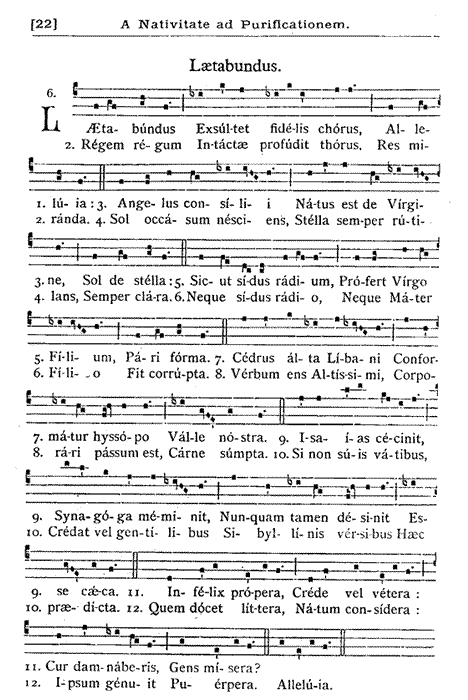
Lætabundus

An ageless music of beauty from the Dominican Liturgy: the Christmas, Epiphany and Presentation Sequence Lætabundus:


Attentive listeners will note that the Dominican chant melody as sung above doesn't quite match the chant extract below! Note that each full verse ends with the letter -a, since the Sequence is historically a development of the long melisma, the jubilus, on the last syllable of Alleluia, founded upon setting a syllable to each note; and note further that in the modern Dominican books (but not on the recording!) some words supposedly overly critical of the Jews have been modified, such as electa for misera in the last verse.


Faithful people,
Sweeten all your song with gladness.
Alleluia.
Matchless maiden
Bringeth forth the Prince of princes:
O! the marvel.

Virgin compasseth a man,
Yea, the angel of the plan:
Star the Dayspring.
Day that sunset shall not close,
Star that light on all bestows,
Ever cloudless.

As the star, light crystalline,
Mary hath a Son divine
In her likeness.
Star that shining grows not dim,
Nor his Mother, bearing him,
Less a maiden.

The great tree of Lebanon
Hyssop's lowliness puts on
In our valley;
And the Word of God Most High
Self-imprisoned doth lie
In our body.

So Isaias sang of old,
So the Synagogue doth hold,
But the sunrise finds her cold
Hard and blinded.

Of her own she will not mark,
Let her to the gentiles hark;
For the Sybil's verses dark
Tell of these things.

Make haste, O luckless one,
Give ear to the saints bygone:
Why perish utterly,
O race undone?

He whom thy seers foretell
Born is in Israel:
Mary's little Son,
O mark him well.
Alleluia.