Showing posts with label Our Lady on Saturday. Show all posts

Sunday, July 22, 2012

Ancient Dominican Sequence of Our Lady


 Bl Humbert of Romans, 5th Master General of the Dominican Order, explained why Our Lady is specially honoured on Saturday, and even cited the Sequence then sung at Mass on Saturdays; hereunder, my translation:


From The Exposition of Master Humbert on the Constitutions of the Friars Preachers.

XXIV. Why the Sabbath is attributed to the Blessed Virgin.

And it is expedient not to be ignorant why those who are devout to the Blessed Virgin honour her more on Saturday than on another day.

[i] Therefore it must be attended to that on the Sabbath day it is said that the Lord rested: also, he rested in her as if in his tabernacle.  Thus the Sabbath and the Virgin accord, for the Saturday is the time, and she is the place, of the rest of the Lord.

[ii] Also, on the Sabbath the work of creation was completed, or, of nature: while in her was completed the work of re-creation, or, of grace.  Bernard [says]: In thee and through thee, Most Benign, the hand of the Creator hath re-created whatsoever it had created; therefore she and the Sabbath accord in this manner of completion.

[iii] Also, the Sabbath day was blessed above the other days, whence Genesis 2 [says]: The Lord blessed the seventh day; also, she is blessed above all women.

[iv] Also, the Sabbath day was holier than the rest, whence also in the same [chapter it says]: And he hallowed it.  And she is holier than everyone.  Wherefore it is fitting that the one blessed above others and holier than all is more specially to be honoured on the blessed day and on the holier day.

[v] Again, as the Sabbath day is mid-way between the Day of Venus [Friday] which is that of suffering, and the Lord’s Day which is the day of joy, and neither is anyone able to pass from that day of suffering to the day of joy, unless through the Sabbath day; so neither from the suffering of this world to the joy of heaven is anyone able to pass, unless by the Mediatrix of the world herself.

[vi] Again, as the Saints say, the others failed [in faith] on the Sabbath day, she stood by her faith.

[vii] Again, the Sabbath day is filled by her doing many miracles, and coming to the aid of men, as the example is given by John Beleth, of a certain icon of her, whose veil was lifted up on the Sabbath day.  And there are many others similar.

These therefore are the seven reasons why it is we serve her more on the Sabbath day, doing devoutly and solemnly her whole Office in the church.

Then even in the office of the church is sung a certain sequence of her proper to the Saturday, in which the preceding reasons are touched on why Saturday is more specially attributed to her:

Jubilemus in hac die
Quam Reginæ cœli piæ
Dicavit Ecclesia.

Hæc est dies in qua sua
Vota tibi, Virgo, tua
Reddit hæc familia.

Omne sæculum, omni die
Servi Virgini Mariæ:
Sed in hac devotius.

In hac psallas, in hac ores,
In hac laudes et labores,
Et cantes jucundius.

Virgo quæ non habet parem
Diem sibi singularem
Non injuste vindicat.

O quam digne sibi dari
Diem hunc et consecrari
Res inspecta prædicat!

Hodiernæ lux diei
Dies fuit requiei
Plasmatoris omnium.

Sic quievit in Maria,
Dum ipsius in hac via
Virgo fit hospitium.

Cunctæ tunc sunt creaturæ
Factæ dum opus naturæ
Complet Deus hodie.

Universa tunc refecit,
Dum in Matre qui nos fecit
Complet opus gratiæ.

Dies olim benedicta,
Dies quoque sancta dicta
Fuit ista septima.

Quam benedicta dicaris
Scimus, Virgo singularis,
Et quam sis sanctissima.

Dum transis ad gaudiosum
Diem, relinquens pœnosum,
Dies est hæc media.

Hæc de pœnis nos educit
Mediatrix, et adducit
Ad superna gaudia.

In hac die dum desperat
Grex pusillus qui tunc erat
Fidem tenet firmius.

In hac die suspirantes
Ad se, seque deprecantes
Obaudit frequentius.

Veneremur ergo, fratres,
Ut sanxerunt sancti patres,
In hac die Virginem.

Exorantes ut conducat
Nos hic, et tandem perducat
Ad illam dulcedinem.  Amen.


******


Let us rejoice on this day
Which to the pious Queen of heaven
The Church hath dedicated.

This is the day on which their
Vows to thee, Virgin, this
Thy family pays.

Every age, every day
The Virgin Mary is served:
But on this more devoutly.

On this thou sing’st, on this thou pray’st,
On this thou praisest and labourest,
And chantest more happily.

The Virgin who has no peer
To this singular day she herself
Not unjustly lays claim.

O how worthy to be given to herself
This day and to be consecrated
The thing viewed preaches!

The light of today’s day
Was the day of rest
Of the Maker of all.

So he rested in Mary,
When in this way of he himself
The Virgin was made the host.

Then all creatures were
Made when the work of nature
God finished today.

Then all things were re-made,
When in the Mother he who made us
Completed the work of grace.

The day once blessed
And the day called holy
Was the seventh one.

How blessed thou art called
We know, singular Virgin,
And how thou art most holy.

When thou passest to the day
Of joy, relinquishing suffering,
This day is in the middle.

This from pain us led
The Mediatrix, and brought us
To supernal joys.

On this day when despaired
The little flock, she was then
Holding more firmly to faith.

On this day those sighing
To her, and praying to her
She hears more frequently.

Let us revere, brethren,
As hallowed the holy fathers,
On this day the Virgin.

Praying that she conduct
Us here, and at length lead us
To her delight.  Amen.

Expositio Magistri Humberti super Constitutiones Fratrum Prædicatorum, XXIV. (Quare sabbatum attribuitur Beatæ Virgini). Opera de Vita Regulari, ed. J. J. Berthier O.P., Rome: A. Befani, 1889, Vol. II.

Tuesday, October 4, 2011

Our Lady on Saturday – Why?

On the seventh day, God rested, and hallowed the Sabbath with an everlasting sanctification; in the womb of Mary, God's Son rested, the blessed Fruit sanctifying her uniquely maternal virginal integrity; on the Sabbath, the dead Christ rested in the tomb, having run the great race and perfectly accomplished all His works; and in process of time Our Lady rested in Him, as once He had rested in her, and passed to her everlasting rest, body and soul, "hid with Christ in God" till He, who is our life, shall appear, and manifest shall be the Holy Mother of God, together with all souls faithful to the new Adam and His helpmate, the new Eve.

Is it perhaps out of regard to the Dormition of the Blessed Virgin, as the Easterners so beautifully term her Assumption, that Saturday is Mary's day?

Bl Guerric, Abbot of Igny, one of the earliest Cistercians, indeed, one of the "Four Evangelists of Citeaux", wrote thus in her honour, preaching upon the text In omnibus requiem quæsivi, opening words of the traditional Epistle for the 15th of August, Our Lady's great feast, and alluding also to the traditional passage used for the Gospel on that day in both East and West – I give an English translation first, from a book of mine, then the Latin original, both being abbreviated of course from the full sermon:


A Sermon of Abbot Guerric.

“In all I sought rest.” (Ecclus 24:11) Rest is welcome to the weary. Therefore while we celebrate the rest of God’s holy Mother not only may our bodies be refreshed by this rest but also our hearts may draw breath in remembrance and love of that eternal rest. Mary, too, like any faithful soul, sought rest in all her actions; but today at last she has found it, when at length today she can say: “’Turn, my soul, into your rest, for the Lord has done well to you.’ (Ps 114:7) He who created me, was created from me and found rest in the tent (cf. Ecclus 24:12) of my body; he will not be able to refuse me the rest of his heaven. He heaps up grace for others as a free gift: how should he not return like for like to his Mother?” Rest, then, happy that you are, in the arms of the Bridegroom. He will recall to you amid embraces and kisses, if I am not mistaken, how pleasantly he rested in the tent of your body, how with greater delight he dwelt in the inner chamber of your heart.

Happy is he who in all his labours and in all his ways seeks blessed rest, always hastening, as the Apostle exhorts, to enter into that rest (cf. Heb 4:11). For desire of it he afflicts his body, but already prepares and disposes his spirit for that rest, being at peace with all men (cf. Rom 12:18) as far as it lies with him. Giving the preference, where his will is concerned, to the rest and the leisure of Mary, to the extent that necessity demands he accepts the toil and the business of Martha, yet does this with as much peace and quiet of spirit as he can, and always brings himself back from that manifold distraction to the one thing necessary (Lk 10:42).

For I say this, brethren: unless the Lord finds with us the rest he is seeking, we shall not find in him the rest we desire. “Upon whom will I rest,” he says, “if not with the humble and the quiet and him who fears my words?” (Is 66:2) In order then, my brethren, that he who loves quiet and bestows it may rest in you, make a point, as the Apostle advises, of being quiet. “If you turn back and become quiet, you shall be saved.” (Is 30:15) Let us all then together so make a point of being quiet (cf. 1 Thess 4:11) that in our quiet we may always be occupied with meditation on eternal quiet. May the blessed Mother of God, whose rest we are celebrating, obtain this for us by her prayers from him who rested in the tabernacle (cf. Ecclus 24:12) of her body and her heart. He is eternal rest, Christ Jesus, to whom be honour and glory for ever and ever. Amen.


Sermo Guerrici Abbatis.
Sermo 49, 1. 3
In omnibus requiem quæſivi. Grata quies feſſis. Dum ſanctæ Dei Genitricis requiem celebramus, non ſolum corpora recreentur hac quiete, ſed etiam corda reſpirent in recordationem et amorem illius æternæ quietis. Maria, ſicut et quælibet fidelis anima, in omnibus actionibus ſuis requiem quæſivit; ſed hodie demum invenit, cum tandem hodie dicere datum eſt ei: Convertere, anima, in requiem tuam, quia Dominus benefecit tibi. Qui creavit me, creatus ex me, requievit in tabernaculo corporis mei, negare non poterit mihi requiem cœli ſui. Qui enim gratiam ultro cumulat aliis, par pari quomodo non referet matri? Requieſce igitur, o felix, inter brachia Sponſi. Replicabit tibi ni fallor, inter amplexus et oscula, quam ſuaviter requieverit in tabernaculo corporis tui, quam ſuavis in cubiculo cordis tui.

Sermo 49, 2
Felix qui in omnibus laboribus et viis ſuis requiem quærit beatam: ſemper feſtinans ingredi, ut Apoſtolus monet, in illam requiem, ejus deſiderio corpus affligens, animum autem jam illi requiei parans et componens: cum omnibus hominibus, quod ex ipſo eſt, pacem habens; requiem et otium Mariæ voluntate præeligens, laborem autem et negotium Marthæ neceſſitate quidem ſuſcipiens; ſed quanta prævalet pace et quiete ſpiritus adimplens, et ſemper ad illud unum neceſſarium de illa multiplici distractione ſeſe recolligens.

Sermo 49, 4. 5. 6


Hoc enim dico, fratres, niſi Dominus requiem quam quærit, invenerit apud nos, nec nos optatam requiem inveniemus in illo. Super quem autem requieſcam, inquit, niſi ſuper humilem, et quietum, et trementem verba mea? Ut ergo requieſcat in vobis, o fratres mei, amator ille largitorque quietis, date operam, juxta conſilium Apoſtoli, ut quieti ſitis. Si revertamini, et quieſcatis, ſalvi eritis. Omnes ergo pariter ſic operam demus, ut quieti ſimus, ut in quiete noſtra ſemper in meditatione æternæ quietis occupemur. Hoc nobis impetret beata Dei Genitrix, cujus requiem celebramus, ab eo qui requievit in tabernaculo corporis et cordis ejus. Ipſe eſt requies æterna Chriſtus Jeſus; cui eſt honor, et gloria per omnia ſæcula ſæculorum. Amen.


(Unsurprisingly, it may be said that Dormitionists read this passage in their Breviary, both on the great feast itself, and on each successive Saturday if not otherwise occupied.)

Saturday, July 24, 2010

Ave Stella Matutina

To-day being a free Saturday (but for memorial of St Christina, Virgin & Martyr, at Lauds), the Office is of Our Lady; and that means that the Benedictus antiphon is the beautiful Ave stella matutina:


Ave stella matutina,                      Hail, morning star,
peccatorum medicina,                  remedy of sinners,
mundi princeps et regina,             ruler and queen of the world,
sola virgo digna dici,                    alone worthy to be called a virgin,
contra tela inimici                         against the spears of the enemy
clipeum pone salutis,                    interpose the shield of salvation,
tuae titulum virtutis.                      the sign of thy virtue.
O sponsa Dei electa,                    O chosen bride of God,
esto nobis via recta                       be for us a straight road
ad aeterna gaudia                         to eternal joys.

Saturday, April 17, 2010

Our Lady in Eastertide

This Saturday, being an Easter feria, is kept as the commemoration of Our Lady on the Sabbath.  Taking up the Office at last after falling into much accidie and worse, having made my confession this morning as is my wont, was a beautiful consolation and grace.  Thanks be to God.

The Easter Office, combined with the Marian Office, is lovely.  For instance, there was the functional equivalent of the Byzantine staurotheotokion, commemorating the Mother of God at the foot of the Cross: for at Prime in the Dominican form, the Gospel extract read is the first verse detailing that very incident, St John xix, 25 (the matching Mass of the day, for Our Lady in Eastertide, appoints the whole of St John xix, 25-27).  And the Cross-and-Resurrection, that summation of the Paschal Mystery, likewise appear together as is most fitting, in the versicle at Saturday Matins: 

V/.  Surrexit Dominus de sepulchro, alleluja.  R/.  Qui pro nobis pependit in ligno, alleluja.
(The Lord hath arisen from the tomb, alleluia; Who for us hung upon the [Cross's] wood, alleluia.)

The psalms are read with a triple alleluia for antiphon; responsories and versicles are likewise adorned with that cry of joy and victory.  A nice detail: for all Sundays and feasts during Eastertide, even for Our Lady's Saturday Office, the Benedicamus Domino at Lauds and Vespers has a double alleluia added, just as throughout the Easter Octave; otherwise, on ferias in Paschal Time, a single alleluia is added at those cardinal Hours.

At Matins, first part of the Apocalypse was read (chapter v, 1-9a), depicting the Lamb once slain Who now liveth for ever, opening the book sealed with seven seals, at the acclaim of all the saints; then came a sweet effusion in honour of Our Lady, from whom was born Christ, the Saviour of our souls, written by the great St Epiphanius: "...by thee heavenly peace hath been given to the world... by thee men are made angels... by thee the Cross shineth forth throughout the whole world, upon which hung thy Son Christ our Lord; by thee death is trodden down and hell is despoiled... by thee we have come to know the Onlybegotten Son of God, Whom thou didst bear in thy womb."  Alleluia!

The 3rd Matins responsory at once took up the theme, praising she who did merit to bear the Lord, all to the glory of the Triune God:

R/.  Virgo parens Christi, paritura Deum genuisti: fulgida stella maris, nos protege, nos tuearis: * Dum paris et gaudes, cantant cæli agmina laudes.  Alleluia.  V/.  Intercede pia pro nobis, Virgo Maria. * Dum paris et gaudes, cantant cæli agmina laudes.  Gloria Patri et Filio et Spiritui Sancto.  Alleluia.  
(R/.  Virgin parent of Christ, bringing forth the God thou begottest: shining star of the sea, protect us, defend us: * Whilst thou bearest and rejoicest, the hosts of heaven sing praises.  Alleluia.  V/.  Intercede sweetly for us, Virgin Mary. * Whilst thou bearest and rejoicest, the hosts of heaven sing praises.  Glory be to the Father and to the Son and to the Holy Ghost.  Alleluia.)

Every great theme of the whole economy of redemption has been given full play.  What a joy to pray this!

Saturday, August 29, 2009

Madame et Monsieur Croque

After Confession this morning, I said my allotted penance (a very fitting Memorare for Our Lady's aid in the spiritual combat, and three Gloria Patri's in thanksgiving to the Trinity), lit some candles, and read Matins, Lauds and Prime of the Blessed Virgin. It was good to have the chance to do so kneeling by the sacred images, near the High Altar where the Blessed Sacrament is reserved... on my way from the confessional to the candlerack, I passed the large Crucifix, and am not ashamed to say I kissed the Feet it portrays as nailed there - for only thereby am I saved.

My Saturday morning routine consists of having a sleep-in past my usual workday waking hour, then going to confession at Church of Apostles; after that, I make my way into town, look about, and read The Australian over coffee and brunch. To-day, I was pleased to find that the café serves not only croque-monsieur ("Mister Crunch"), a French riff on a toasted ham and cheese sandwich (made with gruyere cheese and quality ham with a scattering of gherkin, between baguette slices panfried in butter, not toasted), but his partner, croque-madame ("Mrs Crunch"), which contains a fried egg as well. Very nice, especially on a cool, rainy day (the very wet weather is still continuing, after a bizarrely fine day yesterday; the Gorge remains in flood).

Making my way back to the car, on a sudden inspiration I made a return visit to church and read Terce and Sext, plus the texts of Our Lady's Mass as meditation.

(By the way, a pious custom I picked up from my former parish priest, Bp Jarrett, is to say three Glory be's after the Angelus on Saturdays, in thanksgiving to the Trinity for Our Lady's glorious privileges: I think this is a decent practice.)

Saturday, August 22, 2009

Short Temper

"Be ye angry and sin not" (Ps 4:5) - well, this morning, after Confession, I'd said my penance (five Pater's and Ave's), lit some votive candles, and was just settling down to pray, when two ladies coming from out the side chapel and across the sanctuary steps decided to have a fairly loud conversation. A cough or two elicited no change. When they came over, still talking, to the Marian icons and side altars of Our Lady and the Sacred Heart, I thought they were going to leave by the side door; but no, they kept on chatting.

At this point I lost my short temper. "Excuse me, ladies, I'm trying to pray," said I, still kneeling at the forward pew, voicing my irritation at their distracting converse. Then I snapped, and added still more tersely, "This is a church, not a gossip-chamber."

They scuttled off, but instantly I felt frustrated, angry, and wretched again: so much for going and sinning no more! (The fact that, in amongst their conversation, they'd mentioned some silly devotional fad had helped annoy me particularly: so I was judging them rashly.)

After managing to calm down (it seemed overscrupulous to go back to the confessional), and lamenting my lack of charity, I turned, chastened, back to praying over the words of the Mass of Our Lady on Saturday: Salve, sancta Parens... As it says in the Gospel of Mary's Mass, "Blessed rather are those who hear the word of God, and keep it" (St Luke xi, 28). I especially repeated the words of the Confiteor and so forth at the start of Mass.

I was praying over the words of the Mass, perhaps blindly and hypocritically, because Fr had mentioned in Confession that we should remember that we are reborn as sons of God, and not just fallen mortals born "of blood, or of the will of the flesh, or of man" (St John i, 13), so I had resolved to recite the Last Gospel, the Prologue of St John (i, 1-14) and think on this truth:

In the beginning was the Word, and the Word was with God, and the Word was God. The same was in the beginning with God. All things were made by him: and without him was made nothing that was made. In him was life, and the life was the light of men. And the light shineth in darkness, and the darkness did not comprehend it. There was a man sent from God, whose name was John. This man came for a witness, to give testimony of the light, that all men might believe through him. He was not the light, but was to give testimony of the light. That was the true light, which enlighteneth every man that cometh into this world. He was in the world, and the world was made by him, and the world knew him not. He came unto his own, and his own received him not. But as many as received him, he gave them power to be made the sons of God, to them that believe in his name. Who are born, not of blood, nor of the will of the flesh, nor of the will of man, but of God. And the Word was made flesh, and dwelt among us, (and we saw his glory, the glory as it were of the only begotten of the Father,) full of grace and truth.

"[D]arkness did not comprehend it... His own received Him not." Oh dear...

I later spoke with my mate Justin via mobile phone, and he seemed to think that persons talking away loudly in church do need to be told to stop doing so; but I know I overstepped the mark. Mea culpa; ora pro me peccatore.

Saturday, June 27, 2009

Our Lady's Office

Apart from reading Lauds of the Day, all the other Hours I've read to-day, for convenience sake while out, and pro pia devotione, from my little pocket edition of Our Lady's Little Office - not from the Baronius Press edition, full as it is of misprints, but from my smaller, well-thumbed and annotated Carmel Books edition of 1997, being a facsimile of a 1914 publication.  This I did apart from anything else because to-day the Office of Our Lady on Saturday is read anyway in the Breviary, and because the Little Office, while being quite as liturgical as the full Office, is shorter, and this comforted me.  (I will soon enough return to the larger volume for 1st Vespers of the 4th Sunday after Pentecost, and therein will pray again the moving Psalms 143 and 144.)

While on the subject of the Breviary, I note an article on the New Liturgical Movement blog, and the very large numbers of comments made, all in earnest discussion of it as it pertains to the laity's use of it and suchlike forms of the Divine Office - all such praying, united in the differing forms of the Prayer of the Church, is excellent and laudable.  While I have declined from reading the Night Office, I still adhere to the Day Hours of the Breviary, and aim at least to read each day's Lessons if not the whole of Matins.   There is something very good about the weekly praying the Psalms - each day of the week, I am pleased to read again the same Psalms at each Hour, and certain verses become as old friends.  On Tuesdays, for example, I read at None Quoniam propter te mortificamur tota die, and am forcibly put in mind of my old friend Peter, now Br Paul Marie of the Cross, who prays the selfsame words and lives them in his godly penitential life devoted to the Lord as a Carmelite Monk in Wyoming.

As I read at Matins of Our Lady, Nos cum Prole pia benedicat Virgo Maria - or, as the Marquess of Bute once rendered it, "Bless us, Mary, Maiden mild; Bless us, Jesu, Mary's Child."

Saturday, May 23, 2009

Novena to St Philip Neri: 7th Day


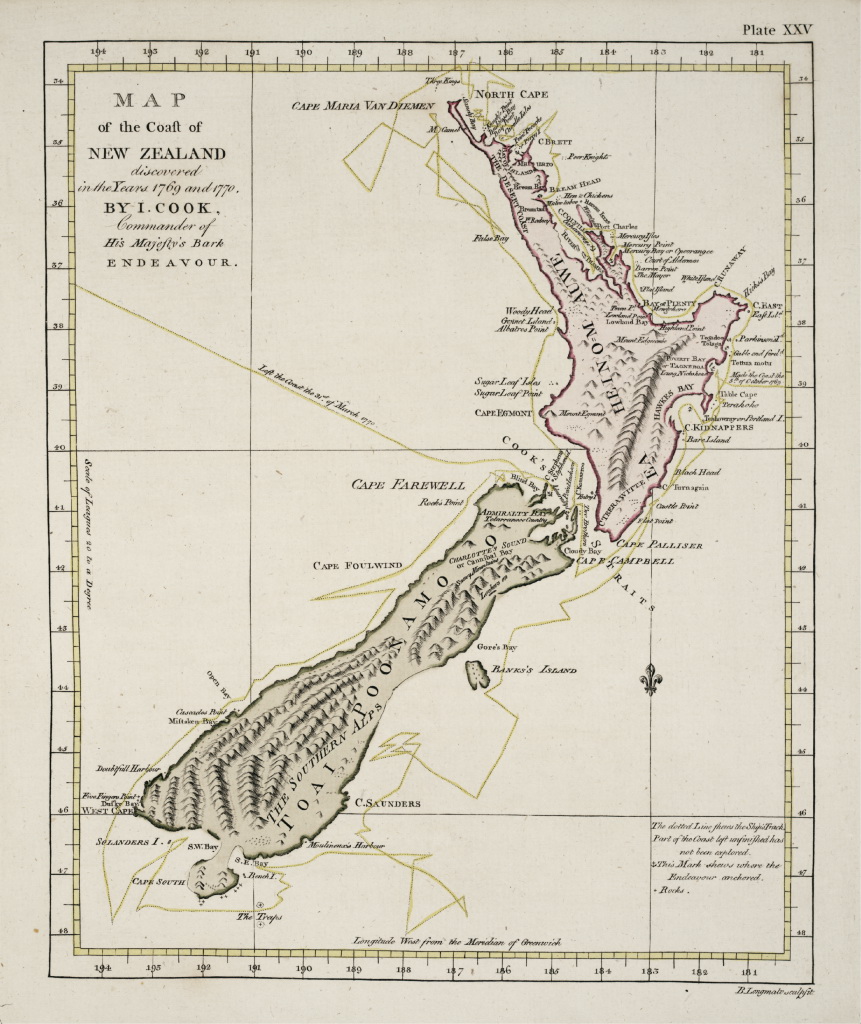
(The first map of New Zealand, made by Captain Cook during his, the first circumnavigation thereof in 1769-1770.  The North Island is labelled Eaheinomauwe, and the South Island Toai Poonamoo - Cook's transcriptions of their Maori names Tehinga o Maui, a variant of Te Ika a Māui, and Te Wai Pounamu.)

I will appreciate readers sparing a prayer for a safe journey for me - I fly from here in Tasmania to the South Island of New Zealand this afternoon and evening.  (If I'm still in Australia when about to read Vespers, they would be first Vespers of Our Lady Help of Christians, whose proper Office I posted last year - but if I'm out of the country, it will be first Vespers of Sunday after the Ascension...)

As this is a Saturday, the Breviary celebrates Our Lady in the usual manner.

Prayers ought also be said in preparation for the feast of St Philip Neri, Confessor, Founder of the Oratorians - such as the soon-to-be beatified Cardinal Newman's Litany of St Philip.  Here is a link to a relevant text of Fr Faber that I posted last year; it may be used with profit as a meditation concerning St Philip.

Saturday, January 10, 2009

Our Lady on Saturday

Text not available

The perils of not having an Ordo: on the 3rd, I realize now, I forgot entirely to recite the Saturday Office of the Blessed Virgin, which takes precedence of all 4th class ferias, as the days between before and after Epiphany are!  It reminds me of Mgr Knox's joke - there was a priest who didn't buy an Ordo, and had to write in his parish bulletin "Last Friday was Good Friday, but as this was overlooked, we will celebrate it this Friday".

In any case, the last of the readings from Romans will still be read at Matins (three merged into two) and the Epiphanytide short reading will be read at the end of Prime; but, as the rubrics specify, nulla fit commemoratio feriæ - there shall be no commemoration of the feria - and theEpiphanytide verse Qui apparuisti hodie, used in the short responsory at Prime, which would still have been retained if a saint's day had occurred, will be replaced by the proper Marian verse Qui natus es de Maria Virgine.

The third lesson at Matins will be that appointed for Our Lady's Saturdays in January:

From the Epistle of St. Ambrose the Bishop to Pope Siricius
Epist. 81, alias 7 post initium

Some contentious persons are wont to say: She was virgin when she conceived, but when she brought forth she thereby ceased to be virgin. But where conception hath taken place, childbirth of necessity followeth. For which reason, would not a virgin-conception make a virgin-motherhood? Therefore, if the contentious will not accept the instruction given them by the Church's priesthood, let them at least believe the words which have come down from Christ. Yea, let them believe the declaration of the Angel who said: With God nothing shall be impossible. Or let them believe the Apostles' Creed, which same the Church in Rome hath ever guarded, and held ínviolate. Mary heard the Angel speak, and then made an enquiry: How shall this be? Now this question of hers was no lack of faith, but rather was a questioning in preparation for that obedience of faith which moved her immediately to say: Behold the handmaid of the Lord; be it done unto me according to thy word. - But thou, O Lord, have mercy upon us.
R/. Thanks be to God.

Saturday, September 13, 2008

Mass and Fatima Devotions

I was racing to get to church on time this morning, having just finished Lauds; but Fr was also running a bit late, so I was able to volunteer to serve for Mass and so forth.  After the Holy Sacrifice, George (also togged up to serve) and I set out the candelabras, and I lit the twenty candles for Benediction...

Oh no!  - yes, I did think this when I realized that we were to say the Rosary as well as all the other items for the Holy Hour: but my knees do get sore after serving Low Mass.  Anyway, Fr noticed me grimacing and said I could go back to the sacristy for a bit, which I did.  George was already there, having put away the thurible; we said the Rosary there, having a break from kneeling, and then went back for the Litany of Loreto and the rest.  Sad but true!

The Fatima Devotions were as follows:
  • "O purest of creatures"
  • O salutaris hostia* - Exposition
  • Novena Prayer to Our Lady of Fatima
  • Five Decades of the Rosary (Glorious Mysteries)
  • Prayers for Our Holy Father the Pope (Pater, Ave, Gloria)
  • Litany of Loreto
  • Consecration to the Immaculate Heart of Mary
  • Prayer for the Conversion of Australia
  • Tantum ergo* with versicle and collect
  • Benediction itself*
  • Divine Praises
  • Adoremus in æternum with Psalm 116 and Gloria - Reposition
  • "O come to the throne of grace" ("O Lady of Fatima hail")
While the devotions were for the most part addressed to Our Lady, Our Lord, truly present in the Sacrament of His Love, was the object of our worship, as revealed by the Eucharistic Hymns sung, and, most particularly, by the offering of incense as the very act of latria: for when the Blessed Sacrament is censed, whether at the Elevation at Mass or at Eucharistic Adoration, unlike at other times the incense is not blessed - as it is when it is used to impart a blessing to people and objects - but is left unblessed, signifying that it is being offered up as an act of divine worship.  (*The asterisks in the list above note the times incense is offered.)

After packing up, Prime and Terce; then I had some morning tea with some of the parishioners, and headed off into town (including a rather good lunch), before coming home again.  And now, a rest for a bit...

Our Lady on Saturday - and Fatima Devotions

O Lady of Fatima, hail,
Immaculate Mother of grace:
O pray for us, help us to-day,
Thou hope of the human race!

This morning will feature a third Mass in honour of Our Lady this week, and Monday will bring the feast of her Seven Sorrows, so we are in the midst of a September run of Marian feasts; today, we commemorate St Mary the Virgin (as the English call her) with a special Saturday Mass and Office; which Mass, at 9am - it being the 13th of the month - will be followed at the Pro. with Benediction and Litany of Loreto, in honour of Our Lady of Fatima.

Concede nos famulos tuos, quæsumus, Domine Deus, perpetua mentis et corporis sanitate gaudere: et, gloriosa beatæ Mariæ semper Virginis intercessione, a præsenti liberari tristitia, et æterna perfrui lætitia. Per...