Showing posts with label marriage. Show all posts

Monday, October 20, 2014

News Catch-up

Two weekends ago, I went to Sydney for the wedding of Sidney and Tien – a beautiful occasion of course! I ended up attending three Solemn High Masses in succession: the first, in the evening of Friday 3rd October at St Benedict's, Broadway, followed by solemn Benediction (and then dinner with friends old and new);  the second, in the late morning of Saturday the 4th at Maternal Heart, Lewisham, the wedding of the happy couple followed by Mass of St Francis (using the Franciscan propers, as the celebrant was a friar minor), with the nuptial blessing and so forth, followed by a reception that lasted till late evening; and on Sunday the 5th, the usual Sunday Mass at Maternal Heart (followed by lunch with mates at the pub). It was pleasant though rather warm in Sydney – when I walked from Annandale to Circular Quay on Sunday afternoon, it hit 34 degrees, which made my subsequent return trip on the Manly ferry a great relief. Many thanks to a friend who put me up (or rather put up with me) at his place over the weekend.

Sister Mary Stephanie of Divine Providence, OCD,  died at the Launceston Carmel on Sunday morningthe 13th of October, in the 53rd year of her religious life and the 91st year of her age – to whose soul may the Lord grant eternal rest. I attended her first Requiem on Monday, and on Tuesday was privileged, after and during morning Mass at Carmel, to pay my last respects before her open casket, placed just on the other side of their choir screen, which the nuns left open for the occasion. On Friday, I attended her moving funeral Mass, which was followed by her burial in the monastic crypt, out of sight to layfolk, where her mortal remains lie alongside those of her sisters, awaiting the resurrection.

This weekend past, I went to Hobart on Saturday, since our mid-month Sunday Missa cantata was to be at the earlier than usual hour of 9:30 am. Unfortunately, Father was late starting Mass (at 9:45 am) owing to various factors, and he had to rush to get to his flight back to the mainland – which was why Mass was scheduled so early to begin with.

I forebear to comment on the recent synod debacle, or rather, utter shambles, pleasing to the Devil only and not to Christ, since I fear I would not edify my readers. Many layfolk, priests and even bishops have been through a severe trial this past week – I certainly have. I commend Rorate cæli for their fearless and honest reporting, and take the opportunity of publically retracting some of my previous criticisms of that blog, ever since the election of Papa Bergoglio – since they have been proven correct, time and again, much as I would have hoped otherwise.

Thank God for the good bishops and Cardinals who actually know what our holy Faith teaches, and have not given in to relativism. Thank God they were not called upon to do what Scripture suggests in extreme cases ("But when Cephas was come to Antioch, I withstood him to the face, because he was to be blamed." – Galatians ii, 11). And thanks to St John Paul II, who worked a miracle, doubtlessly obtained from Our Lady, Mediatrix of All Grace.

Gaude, Maria Virgo: cunctas hæreses sola interemisti in universo mundo.

Friday, July 4, 2014

Off to Sydney and Melbourne

It's been a while since I last posted, but various matters have taken up my time.

To-night, I'm off to Sydney for the weekend, then I'll fly down to Melbourne for the week, and be back here on Saturday, before driving to Hobart, where I'll stay the night, then MC morning Mass there, before driving myself and Fr Rowe (who'll be visiting Tasmania that week) back to Launceston, where I'll MC the special 6 pm Missa cantata at St Francis, Riverside, on Sunday 13th July. Please do come if you can!

Some matters are too serious to trust to the internet, but do keep me in your prayers.

Tuesday, October 29, 2013

Pilgrimage Mementos

Three special blessings of this year's Christus Rex Pilgrimage: the first blessings of two new priests – that of Bendigo's Fr Ashley Caldow on Friday (who was ordained on the 14th of September) and that of Ballarat's Fr James Kerr on Saturday (ordained on the 6th of September) – and the chance to attend what must be a first for this pilgrimage, the wedding on the Monday morning after (that is, yester-day the 28th of October) of two pilgrims, Jacob and Esther.

I say ad multis annos to all of them, and wish for them what my old parish priest, Bp Jarrett, told me ages ago: that happily married couples are the best role models and supports to the vocation of priests, and holy priests happy in their vocation are likewise the best examples and helps to husband and wife.

The two new priests kindly distributed holy cards as mementos of their ordination, seeking prayers; it strikes me that perhaps married couples ought do the same thing, and not merely provide a booklet for the wedding – for prayer is the great underpinning of all.

Saturday, September 3, 2011

To Melbourne for a Wedding

A happy day – the wedding of Justin and Lydia at St Aloysius, North Caulfield.  I'm flying over to Melbourne for to attend, and the day has dawned splendid and bright.

Please pray the happy couple every blessing.

Saturday, April 30, 2011

The Royal Wedding - II

As noted in my last post, it transpires that the wedding of Prince William and Catherine, Duke and Duchess of Cambridge, was conducted according to the rites allowed in the Church of England as an alternative to the Book of Common Prayer service in Series One (1966), and that this in turn (but for an inserted blessing of the ring, ultimately from the Latin) was the service for marriage in the Proposed B.C.P. of 1928.

I also expressed surprise at the notable omissions and alterations in the prayers for holy wedlock, changes made when revising the 1662 order of service back in the nineteen twenties.  I do not refer to minor changes (such as changing "ordinance" to "law"), but to the deletion of references to God's creation of man in the state of original justice, to His uniting Adam and Eve as man and wife, and to Old Testament persons who are models of godly living: both the three patriarchs Abraham, Isaac and Jacob, and two holy couples – Isaac and Rebecca, Abraham and Sarah.  Here, I give the changes made to which I refer:

in the time of man’s innocency > himself
as Isaac and Rebecca lived faithfully together, so these persons > living faithfully together, they
Abraham, God of Isaac, God of Jacob > our fathers
Look, O Lord, mercifully upon them from heaven, and bless them. And as thou didst send thy blessing upon Abraham and Sarah, to their great comfort, so vouchsafe to send thy blessing upon these thy servants; that they > that so, … they
who by thy mighty power hast made all things of nothing; who also (after other things set in order) didst appoint, that out of man (created after thine own image and similitude) woman should take her beginning; and, knitting them together, didst teach > who hast taught us
who at the beginning did create our first parents, Adam and Eve, and did sanctify and join them together in marriage > the Father of our Lord Jesus Christ,

It amazes me that these abbreviations remove every one of the Old Testament references!  If I were the Chief Rabbi (who was in attendance at the wedding), and had this brought to my attention, I suppose I would be both rather annoyed at this suppression of tradition, if unsurprised at Gentiles doing this: the Anglican liturgical revisers of the twenties appear almost Marcionist in their determination to delete Jewish references.

Friday, April 29, 2011

The Royal Wedding

As a loyal subject, I (and half the world) watched the wedding of Prince William, Duke of Cambridge, and (as she now is) Catherine, Duchess of the same.  How handy is the Internet!  I had the Order of Service before me, thanks to the Guardian's website; and, having the 1662 Marriage Service looked up also, I realized that it was basically that, albeit somewhat edited (and filled out with sundry anthems).  Next, I realized that it was probably what a quick search of my bookshelf, and then the Internet, confirmed: it was the Alternative Form of Solemnization of Matrimony, from the 1928 Proposed B.C.P.

Most startlingly to me, the principal difference between the 1662 and the 1928 services is that the latter omits every one of the former's references to Old Testament persons whose history and example are so important: Adam and Eve; Abraham, Isaac, and Jacob; Isaac and Rebecca; Abraham and Sarah. It also omits reference to God as Creator of all things out of nothing, as maker of man in His own image, and of woman from man, and of "the time of man's innocency".  How shocking, that as far back as 1928 all such Scriptural references were deleted.  What a dreadful commentary on liturgical reform so-called.

But stay!  There were some interesting differences and augmentations also present in to-day's royal wedding.  Some were beautiful, but not of great import: as the singing of an anthem and hymn at the entrance into the Abbey, before the service proper; and likewise the singing of the National Anthem (The Queen of course being present) and another anthem, followed by solemn musick, after the final blessing.  I believe it is a longstanding Anglican custom to interlard the service with congregational hymns – which sufficiently explains the hymn after the blessing "God the Father, God the Son..." about half-way through (which marks the break between the two halves of the service), and the hymn before the final collect and blessing.

The two notable inserts into the service were, firstly, the blessing of the ring, and, secondly, the insertion of a Lesson and Address (each accompanied by an anthem) where the 1928 form of service contemplates only a psalm (Ps 128 or 67) – which presumably the centonized anthem "This is the day", drawn from divers psalms, replaced.  It appears that, rather than read a passage of Holy Writ, or the Address as given in 1662, or a Sermon at the very end of all, as the 1928 proposes, the decision was taken to have the Word proclaimed and preached between the two halves of the service – which worked well.

(It ought of course be recognized that the Anglican marriage service descends from the Sarum forms used to marry couples and then to bless their union during the ensuing Nuptial Mass: that is why the couple approached the altar for the various prayers at the end.)

I did feel a bit annoyed, it must be said, to see the rather anti-Catholic, and very anti-Ordinariate, Bishop of London preach, though his words were quite decent.

But most interesting to this liturgically-minded person was the unexpected blessing of the ring – because neither the 1662 nor the 1928 provide any such prayer.  It appears that it instead is a conflation of the prayer provided for this in the 1929 Scottish BCP with that in the 1928 US BCP, as follows:
Scottish 1929 BCP:
BLESS this ring, O merciful Lord, that he who giveth and she who weareth it may ever be faithful one to another; through Jesus Christ our Lord. Amen.
1928 US BCP:
BLESS, O Lord, this Ring, that he who gives it and she who wears it may abide in thy peace, and continue in thy favour, unto their life's end; through Jesus Christ our Lord. Amen.
The prayer used at the royal wedding:
BLESS, O Lord, this ring, and grant that he who gives it and she who shall wear it may remain faithful to each other, and abide in thy peace and favour, and live together in love until their lives’ end. Through Jesus Christ our Lord. Amen.
Of course, these forms all stem from the Latin original: 
Benedic, Domine, annulum hunc, quem nos in tuo nomine benedicimus, ut quæ eum gestaverit, fidelitatem integram suo sponso tenens, in pace et voluntate tua permaneat, atque in mutuali caritate semper vivat.  Per Christum Dominum nostrum. Amen.
Or, if there be two rings:
Benedic, Domine, annulos hos, quos nos in tuo nomine benedicimus, ut qui eos gestaverint, fidelitatem integram suis sponsis tenentes, in pace et voluntate tua permaneant, atque in mutuali caritate semper vivant.  Per Christum Dominum nostrum. Amen.
All very interesting. Some more researching has discovered to me that this prayer is found, together with the 1928 form for marriage, in the form for marriage provided by the Church of England as one of its Alternative Services, Series One, which essentially at last made fully licit the 1928 Proposed BCP.  The interpolations mentioned above, however, must be a result of flexible rubrical interpretation.

God bless the happy couple: now united in marriage at last, after quite enough practising, as the Prince of Wales slyly but all too truly remarked some time ago.  Then again, he is hardly in a position to criticise: it struck me most forcibly what a liar he is known by all men to be, given that he, too, at his wedding to the late Princess Diana, was asked somewhat as follows (if they too used the 1928 service or similar):
I REQUIRE and charge you both, as ye will answer at the dreadful day of judgement when the secrets of all hearts shall be disclosed, that if either of you know any impediment, why ye may not be lawfully joined together in matrimony, ye do now confess it. For be ye well assured, that so many as are coupled together otherwise than God’s word doth allow are not joined together by God; neither is their matrimony lawful.
Charles... wilt thou have this woman to thy wedded wife... and, forsaking all other, keep thee only unto her, so long as ye both shall live?
For it is notorious that he was even then in the midst of an ongoing adulterous affair.  Indeed, from a Catholic viewpoint the first marriages of both Charles and Camilla would be easily found invalid on such grounds – with the result that their current union probably could be validated.  How ironic.

Her Majesty is now getting on in years, but hopefully long still to reign over us; a nice short reign for Charles, with his Princess Consort, would suffice for all and sundry to bear with; and all I think even now look forward further, as William and his Catherine should serve as King and Queen consort splendidly.

Thank God that referendum for a republic failed.  The monarchy has served us well, and it is doubtful that a better arrangement could be devised in the present state of the world (much as a Catholic monarchy would be preferable).

Saturday, October 17, 2009

Dufay Mass, and a Motet


(Kyrie from Dufay's Missa "Se la face ay pale")

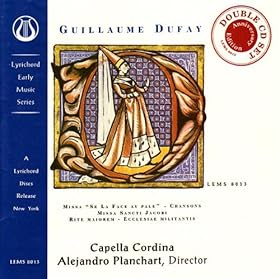
I have a CD of a vintage recording (directed by Planchart) of Guillaume Dufay's Mass "Se la face ay pale" - Jennifer told me the performance is a bit dated, but I rather like it. Anyhow, I've just ordered a CD of a different performance (directed by Binkley), which as a bonus comes with the chants, prayers and readings of the Nuptial Mass.

Why a Nuptial Mass? Because Dufay's famous Mass setting is the first cantus firmus Mass based on a secular chanson - Se la face ay pale is a rather predictable late mediæval love-song about suffering pangs of love for a puissant lady, complete with a play on words ("love", "bitter" and "sea" all sound much the same in French), which Dufay set to music in the 1430's - and it is thought this Mass was first sung at a royal or ducal wedding about 1450. With the passage of time, what would have fallen under the condemnation of Trent against sacred music making profane allusions is now quite acceptable!

Here is the text (the first part), with a rather clumsy translation:

Se la face ay pale,
la cause est aimer,
c'est la principale
et tant m'est amer aimer
qu'en l'amer me voudroye voir.

Or scet bien de voir,
la belle a qui suis
que nul bien avoir
sans elle ne puis.

If [my] face is pale,
the cause is love,
that is the principal,
and so bitter it is to love
that I want to throw myself into the sea [!].

Now she knows well,
the lady whom I serve,
that without her
I cannot be happy.

See what I mean about a rather ordinary collection of clichés? But the Mass is very beautiful.

******

As all men know, it is de rigueur to sing Ave Maria at a wedding: and I think this sentiment Catholic and orthodox, howsoever modern liturgists may complain, since after all the Orthodox sing a Megalynarion to the Mother of God just after the very Consecration at every Liturgy, and it seems strange at a wedding to make no plea whatsoever to Our Lady, who is our "most gracious advocate", as well as in her marriage to St Joseph a most holy model for all.


(Raphael's Marriage of the Virgin)

You'd think that at the Reform of the Liturgy some effort would have been made to add some reference in the marriage rites to Holy Mary and her most chaste spouse. But no: in fact, to add insult to injury, the modern recension of the Nuptial Blessing (to which two 1960's compositions have been added, as alternatives) dumps the reference to Rachel, Rebecca and Sarah, and the former final blessing, invoking the God of Abraham, Isaac and Jacob, has been entirely removed from the Novus Ordo. So much for a return to the sources: out with Abraham and Sarah, Isaac and Rebecca, Jacob and Rachel.

The Introit, too, alluding to Tobias and Sarah, has been left out of the new Gradual. Only reference to our first parents Adam and Eve, and to Christ's mystical marriage to the Church, seem to have survived. Predictably, given the vast selection of readings that bemused couples must choose from, the readings from Tobit, or what St Paul says to the Ephesians, are left aside in favour of I Corinthians xiii, used shamelessly at both weddings and funerals (even dreadful Diana's).

Now, while singing Ave Maria is all very well, the Bach-Gounod, let alone the Schubert settings are so hackneyed and dripping with sugary sentiment as to be a bit vulgar. Better is a restrained, tasteful polyphonic setting. But I am amused to learn that my favourite Ave Maria, while attributed to Victoria, is in fact almost certainly a late forgery, which first appears in print in the 19th century, and has no manuscript evidence for it at all! At least it is good counterpoint, clear and devout, not too difficult for four voices to sing successfully.

Marital Musings

Just lately, my thoughts have turned to marriage (apparently the Christus Rex Pilgrimage, like Antioch youth groups of old, and the Catholic tennis clubs of yesteryear, is somewhat of an occasion of matchmaking!)... But of course, on this blog and for this demented soul, that means "thinking about the liturgy and rubrics of the rite of holy matrimony"... of which more anon.

Anyhow, earlier I teed up with my mate Justin to meet up this Friday evening at Southern Cross station in Melbourne, to catch the evening train to Ballarat - from whence we bachelors will, God willing, be collected and taken over to the pilgrim encampment en route to Bendigo. (Synchronicity: it transpires that he's busy this weekend with setting up for and singing at a wedding of a friend of his who's Russian Orthodox: a friend of mine was married in the Byzantine Rite, and it was a truly splendid and moving service.) After we arrive in Ballarat at a quarter to ten at night, all is in the Lord's hands; I note that Saturday is the feast of St Raphael Archangel, patron saint of those in search of a spouse. (For my directly contrary earlier thoughts on being a contented bachelor, see an earlier post.)

One thing I'm very glad of is that, unlike some devout young Catholics I know of the "golly-gee, have you heard of Theology of the Body?" variety (it is important, but not the be-all and end-all), I have never been afflicted by the modern mania for "discernment", which seems to mean thinking and praying ad nauseam, per omnia sæcula sæculorum, without ever coming to a definite conclusion. (My Mum tells of two dear old Presbyterian spinsters, who took such to extremes: seeking the Lord's will as to whether they ought purchase a piano, they persevered in prayer till they seemed to hear the tinkling of ivory keys! Such is my settled view of the overpious approach of some.)

One acquaintance of mine spent a decade or so "discerning" whether to join a certain Order - when he finally went and joined it, after years of pious fantasies, he gave it over within a month. Others have bizarrely "discerned", for years, whether or not to marry - when surely that is the lot of most mortals, and the problem is rather finding the other party to the wedding! Moral of the story: get going and don't dream. If you seek to be a priest, go to the seminary.

With marriage it is a little different of course: now, I don't at all think one should flirt, disport and consort with many and varied girlfriends ("partners", not in the business sense), although that is not at all the same as having many and varied female friends! It has always seemed to me that as an adult one shouldn't seriously "go out" with someone one would not contemplate in the end marrying: for, once one's through the puppy love stage of starry-eyed adolescence when holding hands and feeling all sappy is the go, being boyfriend and girlfriend should be but the prelude to courtship, then engagement, and a Christian marriage. Playing the field and playing around is sin that leads to hell.

The best recipe for marriage is to follow the example of happily married couples one knows. A prelate of my acquaintance told me that the best model for priests are such happy couples, just as happy couples find good models in contented priests: for the two vocations are in ways analogous and complementary, if they are lived well.

My dear friends, Ben and Jane, have an amusing tale of how they ended up marrying over fifty years ago: a lady friend of Ben suggested he ask Jane out; Jane was very dubious about this doubtful fellow, but finally couldn't make up any excuse and accepted his invitation; she had a happy time, but already had a good job and many funloving male friends and hadn't any great wish to settle down; insensibly they grew closer and more accustomed to one another; they went on a trip (staying separately course), in the course of which Ben proposed - Jane refused, saying it was all bosh and a romantic holiday fancy! - but a few months later, she rang him back and said, "Oh, all right". That's the secret of their success - that, and the very important fact that both were Catholics who practised their faith and shared a commitment to virtuous living. They also have a good sense of humour.

While who knows where love may turn up, all things being equal it is obviously better to marry a likeminded lady, herself a committed Catholic (and, please God, better than oneself, and so virtuous as to be a shining lamp to love and imitate in goodness), rather than fall into a mixed marriage. (An old priest hereabouts used to rail against "Mixed marriages and Mass missers"! But even non-Catholics used to seek his advice in their relationship troubles.)

Now, as I've said before, I don't believe in discernment, and am content as a bachelor to serve the Lord; but I have always thought that if little Miss Right comes along, it would be insulting to Him and to her to turn down an excellent alliance! (St Philip Neri had an analogous fate: while of himself he would have remained a simple single layman, he was ordered by his confessor to become a priest.)

As St Paul says, I have been speaking like a fool, but do bear with a little of my foolishness.

Wednesday, October 14, 2009

A Latin Sequence for Nuptial Mass

Something amusing I've found, for Latinists to look at: a sequence for use at Nuptial Masses, according to the Neo-Gallican Paris Missal of 1738. The opening stanza (cf. Tobit viii, 5) would not be very acceptable in English these days!

[PROSA] DE SPONSALIBUS

Sub cantu Pentecostes [i.e. Veni Sancte Spiritus]

Instar infidelium
Deum nescientium
Nefas sanctos nubere.
Dæmoni subjaceat,
Brutus cujus audeat
Mens Deum excludere.

Huc ades, et fortibus
Hostem liga funibus,
Sacræ dux militiæ.
Deus, ipse venias;
Has ades ad nuptias,
Fons, o Christe, gratiæ.

Magnum o mysterium!
O Dei consortium
In Christo cum homine!
O sacra commercia
Christi cum Ecclesia,
Virginis cum virgine!

Vir uxorem diligat,
Sociam dux dirigat,
Christus ut Ecclesiam.
Christo crux, opprobria;
Puram ut Ecclesia
Consequatur gloriam.

Christum ut Ecclesia;
Docilis ad omnia,
Uxor virum timeat.
Metum amor pariat;
Læta mens obediat;
Cor apertum pateat.

Jam duo non eritis;
Unum corpus stabitis:
Sit et unus spiritus.
Purus omni macula,
Casta servet vincula
Thorus Deo cognitus.

Quidquid hic est carneum,
Et e terra terreum,
Tollet mors propinquior.
Sacramenti pietas,
Spiritus societas
Mortem vincet fortior.

Hic, si præsis, prospera;
Si recedis, aspera
Erunt, Deus, omnia.
Quod sacrat oblatio,
Firmet benedictio
Et mansura gratia. Amen.

Monday, August 24, 2009

Raise your glasses

...to Andrew and Melissa, friends and fellow-pilgrims I met at WYD just over a year ago: though I'd lost contact with them for ages, by pure coincidence, I received a message from Andrew just before dinner, and thus just learnt that these two Americans were married (in the Traditional Rite) on the 2nd of May this year, and now make their home together in Arizona. Many congratulations! May Christ and His Mother, who graced the wedding at Cana, bless them also.

In belated honour of their nuptials, I had a glass of Chimay Blue with my goulash for dinner: very nice.

Here, unlike in roastingly hot Arizona, the weather remains cold and very wet - you'd think it had rained on St Swithun's day (the 15th of July), and indeed it did (though July wasn't very wet), for the rain has just kept on coming all August, which is our rainiest month: 101 mm so far, 18 days of rain out of 24. Just this evening after work I drove home over the bridges that link Launceston over her rivers, and both the North and South Esks were in flood (as are other northern rivers): the water has crept up and up, even onto the riverside boardwalks around King's Park, as the Tamar rises higher. The Cataract Gorge still foams (literally) with the roiling waters descending its rapids...

******

The saints in heaven all rejoice together in the happiness of one communion with the Lord and with each other in Him: so, as St Swithun would say, happy St Bartholomew's day for this feast of an admired Apostle:

Omnipotens sempiterne Deus, qui hujus diei venerandam sanctamque lætitiam in beati Apostoli tui Bartholomæi festivitate tribuisti: da Ecclesiæ tuæ, quæsumus; et amare quod credidit, et prædicare quod docuit. Per...

(Almighty everlasting God, Who hast granted a venerable and holy joy to this day in the festival of Thy blessed Apostle Bartholomew: give unto Thy Church, we beseech, both to love what he believed, and to preach what he taught. Through...)