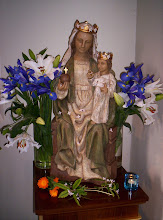
Upon requesting it, I have been kindly emailed the interim texts for the proper Mass of Our Lady of the Southern Cross, at present celebrated in the Diocese of Toowoomba in Queensland. I anticipate there is nothing wrong with posting these here on my blog for the purpose of analysing and critiquing them... Please be aware that I offer these thoughts without wishing to be uncharitable, but rather that my fisking may be constructive.
To be honest, I was looking forward to finding some nice devout prayers to say to Our Blessed Lady under this title, but have been disappointed.
1. So, first, the opening prayer, which I prefer (following the newest Latin editions of the Missal as well as the older) to name the collect:
Blessed Virgin Mary of the Southern Cross
Interim Texts*
Opening Prayer
God of all peoples,
you inspire us by the courage of our pioneers
and enrich us by the ancient wisdom
of the Indigenous people who first inhabited this land.
Through the intercession of Mary of the Southern Cross
may the people of this Diocese
and all who live within our shores
be gathered together to form one people
working together for your kingdom, in harmony and peace.
We ask this through our Lord, Jesus Christ...
I must admit that I find this a very contrived, politically correct, awkward prayer. No doubt God is indeed the God of all peoples (Deus gentium omnium), but the Roman Rite typically uses an address along the lines of "Almighty God", "Lord God", or somesuch: this business of using an adjectival genitive - "God of loving-kindness", "God of our sisters and brothers" - is sadly typical of many would-be contemporary euchologists; one suspects it is really about avoiding what amusingly enough ICEL invented: the constant use of "God our Father" and other "patriarchal" references to the First Person of the Trinity, which are actually quite rare in the Latin orations. So much for the invocation!
Next, telling the Lord (as if He weren't aware, if it is in fact the case) that "you inspire us" by courageous pioneers and indigenous wisdom is in fact rather trite, and simply increases the feelgood aura of niceness that cloys this collect. Do we really need to point out in prayer that the indigenous were the first inhabitants of Austalia? After all, isn't that what the very word "indigenous" means? So we do away with a relative clause for God (and use "you" rather than "who"), but next insert one to labour the point about our dear aboriginal friends...
Let us be honest, who exactly are really, actually enriched by indigenous wisdom? Can this honestly be said to be true for the good Christians of Toowoomba? The truth in rural Australia is often far otherwise. And frankly what has this to do with a prayer honouring Our Lady of the Southern Cross? No doubt all indigenous wisdom is inspired by the Lord to both benefit its possessors and act as a præparatio Evangelica, but it seems overdone and self-conscious to drone on about it, bespeaking a certain fashionable middleclass guilt.
And, harking back to the blessed early settlers and their courage, again, are they (rather than, say, the All-Holy Mother of God, all brave martyrs and the saints triumphant who have fought the good fight) really to be lauded and praised, as so amazingly significant Christian heroes for the Catholics of Toowoomba - in a collect for a Marian feast?
We finally arrive at a mention of Our Lady of the Southern Cross, and her intercession. Now, the central problem is this: the title "of the Southern Cross" is pregnant with meaning, but the prayer expounds none of it. Surely the title has at least a threefold signification, bringing to mine her dauntless stance at the foot of the Cross on Calvary, her coredemptive office there, standing as a sign to all Christians to take up their cross, have their share in Christ's sufferings, and fill up what is lacking therein for the sake of His Body, the Church (cf. Col. i, 24), and furthermore alluding to her patronage over Australia, the land of the Southern Cross, which for countless ages before Christ and the consequent advent of His Gospel here had hung as a mysterious sign of the coming redemption in the skies of the Great South Land? But this collect is dumb as regards all this and whatever else it may signify, sadly.
What are we to pray for, through Holy Mary's intercession? That all in the Diocese, and all in our nation girt by sea, shall work for the coming of the kingdom in justice and peace.
O social justice! What crimes have been committed in your name!
Being gathered together to build a socialist utopia is Marxism, not Christianity: of course, this prayer doesn't pray for that, it is of course a worthy aim to advance God's kingdom on earth (as by extending the social reign of Christ the King, converting Australia and making it a confessional state by concordat with the Holy See - but I suspect this idea is not quite what the liturgical author intended). However, in practice such a nothing statement is interpreted in relentlessly secular terms, reducing the Gospel to helping the poor (most laudable) but leaving the universal call to holiness aside (which is Americanism). Having been through Catholic schooling, I have long past had a gutful of social justice pestering, and like Goering it makes me wish to reach for a revolver.
Being "gathered together" reminds me of that dreadful modern misguided notion of patronizingly didacticizing the opening rites of Mass, into a meet-and-greet à la kindergarten show and tell. And "working together" is such a jejune phrase in its current setting.
In short, I find the prayer sums up the worst of modern Catholic obsessions with secondary matters, to the exclusion of unpacking the tremendous symbolism of the title "of the Southern Cross" as applied to the Blessed Virgin: it is not a product of organic development from the traditional models of collect-writing in the one Roman Rite.
2. Next, to the oratio super oblata:
Prayer over the Gifts
God of all the ages
receive the fruits of the earth that we bring as gift to you,
who first gifted us with this rich and diverse land,
so that, gathered from every people and nation,
we who receive them may become one body
alive in the one spirit, through Jesus Christ the Lord.
Here we are in the midst of the mindset that can seem to imply, as Bishop Elliott satirically opined, that the Eucharist is a cereal offering.
The people will already most likely have heard the modern preparation of the gifts prayers recited ("Blessed are you, Lord, God of all creation. Through your goodness we have this... to offer... which earth has given... work of human hands..."), so why labour the point that bread and wine are now prepared upon the altar? They are indeed the fruits of the earth, and thus ultimately come from God - "Thine own of thine own do we offer unto Thee".
However, the purpose of what was for long ages called the secret prayer is not to point out the obvious, but to look forward to the consecration of these oblations (the Latin is things brought and offered, oblata; "gifts" is too banal in English) and to pray for the effects of the sacrifice to be effected in the consecration of the sacrament. This offertory prayer doesn't know what it's for. Indeed, without making explicit that the offerings will be changed into holy mysteries, the Sacrament of the Eucharist, it seems peculiar to pray that these fruits of the earth may mystically incorporate and spiritualize us.
Another annoyance reappears: again that potty adjectival genitive rears its head: perhaps "God of the new world order" would be the phrase with which to parody it. Of course the Lord is ruler of all the ages; of course this land Australia is rich and diverse (as the national anthem insists), and its peoples have come across the seas to live herein, a sign in the natural order of our supernatural ingathering into the Ecclesia Christi, that we be one Body and one Spirit in Christ: but is this prayer for Australia Day? No, it is for the feast (to be imprecise) of Our Lady of the Southern Cross; so surely she deserves a mention, as after all it was by her agency that Our Lord took flesh and dwelt amongst us, that we should, by His Sacrifice and Presence offered us in the Sacrament, become partakers of His Divinity.
3. The Preface to be used is that of "The Blessed Virgin at prayer with the Apostles" from the Sacramentary of Masses for the BVM, which has Vatican approval, so I shall omit commentary upon it. I think, however, that a great opportunity to write some sublime liturgical poetry was missed here; or, why was not the Preface for "The Blessed Virgin Mary at the Foot of the Cross" used?
4. Now for the postcommunion:
God of our joy,
through the communion we receive
unite us under the care of Mary of the Southern Cross,
as one people in Jesus Christ
who dwells with you forever and ever.
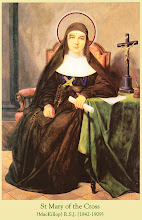
This prayer after receiving Holy Communion is I think quite decent: it is a happy turn of phrase to pray that we be united "under the care of Mary of the Southern Cross" - though I think it would sound less jarring if she were given a title such as Holy Mary or such (else it sound a bit too much as if it were referring to Blessed Mary (MacKillop) of the Cross, Australia's one and only beata) - and most certainly we would hope and pray that our reception of the Sacrament would make us to be one people in Christ.
However, the issues plaguing these prayers (and their author?) glare forth in the first and last lines. As I said above, the adjectival genitive when used of the Deity can sound absolutely ridiculous: "God of our joy" indeed! (At least we are not subjected to "Joyful God" or "God of our happiness and laughter".) And the theological, or rather ideological mindset that shrinks from Christ "living and reigning" with the Father is manifested by the strange use of "dwells" (the Johannine notion of abiding, no doubt), which is foreign to the Roman tradition: the short ending is by definition qui (tecum) vivit et regnat in sæcula sæculorum.
5. At least the solemn blessing supplied (vide infra), which I suspect but cannot at this moment prove to come from that collection of Marian Masses (because of the un-Australian spelling of "Savior", if for no other reason), is perfectly orthodox and quite good:
Blessing
May you be filled with the grace of God the Father,
whose Word was conceived in the womb of the Blessed Virgin
to become the Savior of the human race. R/. Amen.
May your hearts rejoice at the salvation won by Christ,
Son of God, and Son of Mary, as he hung upon the cross. R/. Amen.
May the light and grace of the Holy Spirit
that filled Mary of Nazareth remain with you,
that you may await the Coming of Christ
vigilant in prayer and with songs of praise on your lips. R/. Amen.
May almighty God bless you,
the Father, and the Son, + and the Holy Spirit. R/. Amen.
So much for the euchological texts of this local Mass.
6. The readings are taken from the Common of the Blessed Virgin Mary: they are Apocalypse 11:19 and 12:1-6,10 (in Eastertide: signum magnum apparuit in cælo, alluding to Our Lady and her connexion to the Southern Cross in the starry sky) or Isaiah 9:1-6, which can be construed as having an apposite application, although probably 7:10-14 would have been better; Galatians 4:4-7; and St John 19:25-27 (so at last the Cross, the Virgin's steadfast stance thereat, and Our Lord's gift of His Mother to us get a mention). The responsorial psalm to be used was not mentioned in the email I received, but is probably the one paired with whichever of the first readings gets used.
Update: having been able to check a lectionary (tho' annoyingly the page numbers didn't match, and the original references I was given gave only page numbers), and now having had further correspondence to clarify these details, it appears the responsorial psalm used is Ps 44:11-12,14-17 (R/. v. 11). As for the Gospel Acclamation or Alleluia verse paired with the Gospel reading, it is "Blessed is Mary who stood by the cross of her son, believing that the promises of the Lord would be fulfilled." (Cf. Jn 19:25; Lk 1:45.)
* The proper is an interim text approved for use by Bishop William Morris for use in the Diocese of Toowoomba.