Showing posts with label St Philip Neri. Show all posts

Saturday, May 28, 2016

The Other Chants of the Mass of St Philip Neri

Having in my last post identified the musical source for the chant setting of the Offertory for the feast of St Philip Neri, I thought next to mention the melodic origins of the rest of the Proper of his Mass. 

To begin with, the Introit, Caritas Dei, is self-evidently taken from the Mass of Whit Saturday, omitting the first, internal alleluia (and the last two, except in Eastertide), raising the first note of per by a tone and replacing the Whit Saturday melody for the last word, nobis, with that of the last two syllables of the first (itself identical with the corresponding part of the last) Whit Saturday alleluia

Likewise, the Gradual Venite is taken without change from the Mass of the 7th Sunday after Pentecost.

The Alleluia and verse De excelso is set to the same melody as the first Eastertide Alleluia and verse for the feast of St Irenaeus (28th June), but it is unclear to me as to which is the original.

I have not yet found a source for the music of the second Eastertide Alleluia and its verse Concaluit.

Most interestingly, the Communion Cor meum is set to a very prominent chant – that of the Communion Viderunt of the Mass of Christmas Day. Doubtlessly this conveys something of the joy whereby the heart and flesh of such a saint do ever exult in the living God.

Friday, May 27, 2016

Musical Source of the Offertory for St Philip Neri


Having checked through the Offertoriale, it is clear that the chant for the Offertory for the feast of St Philip Neri is taken from that of the 19th Sunday after Pentecost, Si ambulavero, thus: 

1Viam1 2man2-3datorum tuorum cucurri3, 4cum dilatasti4  5cor meum.5 (T. P. Alleluja.) 
1Si am1-bulavero in medio tribulationis, 4vivificabis4 me, Domine: et super 2i2-ram ini-3micorum meorum extendes3 manum tuam, et salvum me faciet 5dextera tua.5 

Monday, May 26, 2014

St Philip's Day

While I didn't make it to early Mass to-day, I attended evening Rosary, and went to confession; which struck me as a decent and apposite manner of worshipping on St Philip's feast, being as he was a great patron of penitents of every walk of life. He is a great saint and powerful intercessor, to whom I owe much, and especially at this present time, given the signal benefits vouchsafed unworthy me. Pippo buono, prega per noi.

Thursday, August 22, 2013

Support the Brisbane Oratory in Formation

Earlier this year, the great and good project of establishing an Oratory in Brisbane – first mooted for Australia, we learn, in 2011 – was made public with the blessing of Archbishop Mark Coleridge. Fr Paul Chandler, a priest of that archdiocese, together with two other priests (who wish to remain anonymous for the time being, at the request of their respective bishops), and a seminarian, Shawn Murphy, who has just begun his studies for the priesthood with the Oratorians in Toronto, are working toward establishing this new Oratorian community in 2015 or 2016. God bless their endeavours!

Now these nascent Oratorians have a website for the Brisbane Oratory in Formation: on their behalf, I ask you to above all pray for them, but also please consider donating funds for their many needs, particularly the education of their seminarian (further details may be accessed via the relevant section of their website).

As readers may realize, I am (all unworthy) a devotee of St Philip Neri, Founder of the Congregation of the Oratory, and third Apostle of Rome. Indeed, a reproduction painting of him looks down on me as I type... would that I would heed his advice to the same extent as I beseech his prayers. It was a special pleasure to me to visit his glorious relics at the Chiesa Nuova on my various visits to the Eternal City; may he intercede by his merits and suffrages for the Brisbane Oratory in Formation: "Look down from heaven and see, and visit this new vineyard: and perfect the same, which thy right hand hath planted" (Ps 79:15b-16a).

I am minded to repeat one of Newman's hymns in his honour:
St. Philip in his School (A Song.) 
This is the Saint of gentleness and kindness, 
Cheerful in penance, and in precept winning; 
Patiently healing of their pride and blindness, 
Souls that are sinning.  
This is the Saint, who, when the world allures us, 
Cries her false wares, and opes her magic coffers, 
Points to a better city, and secures us 
With richer offers.  
Love is his bond, he knows no other fetter, 
Asks not our all, but takes whate’er we spare him, 
Willing to draw us on from good to better, 
As we can bear him.  
When he comes near to teach us and to bless us, 
Prayer is so sweet, that hours are but a minute; 
Mirth is so pure, though freely it possess us, 
Sin is not in it. 
Thus he conducts by holy paths and pleasant, 
Innocent souls, and sinful souls forgiven, 
Towards the bright palace where our God is present, 
Throned in high heaven. 
******

These future Oratorians of course seek the patronage of Our Lady Help of Christians above all under God. And may Bl John Henry Newman and Bl Pier Giorgio Frassati, the other well-chosen patrons of the future Brisbane Oratory, add their prayers to those of St Philip, that in God's time things now hoped for may come to be.

Saturday, May 25, 2013

Farewell Whitsuntide, Paschaltide, and Regina cæli

This week I have striven to say some of the Breviary Hours, thus participating in some degree in the liturgy of Whitsuntide, the Octave of Pentecost, the last echo of the Paschal season. Just as in the Extraordinary Form, the traditional, immemorial form of the Roman Rite, Lent is preceded by Septuagesimatide, beginning 63 days before Easter Sunday, so the Octave of Pentecost follows on and continues the celebration of Pentecost, the fiftieth day of Easter, until the 56th day, Whit Saturday. (If, as is now common, Corpus Christi is kept on the Sunday after Trinity, the Solemnity of the Sacrament of the Altar falls on the 64th day, 63 days after Easter, exactly parallel to Septuagesima Sunday 63 days before Easter.)

At midday this Whit Saturday, walking back to my car after brunch, I prayed for the last time this year the Regina cæli, which I first repeated with the special Premonstratensian and Dominican forms:
Regina cæli, lætare, alleluja,
Quia quem meruisti portare, alleluja,
Spiritum misit, sicut dixit, alleluja:
Ora pro nobis Deum, alleluja. (O.Præm.) 
Regina cæli, lætare, alleluja,
Quia quem meruisti portare, alleluja,
Jam ascendit, sicut dixit, alleluja:
Ora pro nobis Deum, alleluja. (O.P.) 
Regina cæli, lætare, alleluja,
Quia quem meruisti portare, alleluja,
Resurrexit, sicut dixit, alleluja:
Ora pro nobis Deum, alleluja.
("Queen of heaven, rejoice, alleluia, for He Whom thou didst merit to bear, alleluia, hath sent the Spirit / now ascended / risen again, as He said, alleluia: pray for us to God, alleluia.")

Eastertide ends after None; first Vespers of the Holy Trinity marks the beginning of the long Sundays per annum. This year, Trinity Sunday falls on the feast of St Philip Neri, and he will not be marked by any commemoration because of this (except among his sons the Oratorians, who transfer his feast to Monday); he will I am sure be pleased by this coincidence, being one who preferred to hide his sanctity, and who has now been "hidden with Christ in God" for over four hundred years. "Eternity!" – such he once cried; and what must that be like?

I will be serving at the parish vigil Mass this evening, and will be asking St Philip's prayers – not least for the Oratorians throughout the world, and specially for those in process of establishing a new Oratory in Brisbane. 

Saturday, April 13, 2013

Gaudete, Populi: an Oratory to be established in Brisbane

According to this press release from the Archdiocese of Brisbane, a new Congregation of the Oratory – that excellent form of priestly life in common established by St Philip Neri – is to be set up in Brisbane by 2016. Four experienced priests from around Australia, together with two current seminarians (who will go overseas to train) will form the nucleus of this new Oratory, which has been in planning for two years.

As a devout (though sinful) client of St Philip, I can only rejoice at this wonderful and unexpected news, and beseech him to intercede with the Lord that this venture may be blessed with every success.

Saturday, May 19, 2012

Novena to St Philip Neri: 3rd Day

Of your charity, continue this day to pray a Novena to St Philip Neri, having the special intention of begging ordination graces for John Hunwicke of the English Ordinariate, to be deaconed on St Philip's Day.  Consult my post of yester-year for some suitable prayers...

Friday, May 18, 2012

Novena to St Philip Neri: 2nd Day

Of your charity, continue this day to pray a Novena to St Philip Neri, having the special intention of begging ordination graces for John Hunwicke of the English Ordinariate, to be deaconed on St Philip's Day.  Consult my post of yester-year for some suitable prayers...

Thursday, May 17, 2012

Novena to St Philip Neri: 1st Day

Of your charity, begin this day to pray a Novena to St Philip Neri, having the special intention of begging ordination graces for John Hunwicke of the English Ordinariate, to be deaconed on St Philip's Day.  Consult my post of yester-year for some suitable prayers...

Monday, May 14, 2012

The Once and Future Father

Fr John Hunwicke – as out of respect I have not ceased to address him, in regard to his renowned wisdom as a spiritual elder, disseminated via his far-famed blog of old – having come into full communion with the Holy Father last year on Wednesday of Holy Week, as part of the English Ordinariate, and having endured a bitter test by having his ordination deferred for a year (owing to the machinations of certain... persons), is – rejoice! – to be deaconed on the 26th of May, the feast of good St Philip Neri (whose sons the Oratorians have, I trust, been faithful supports to Fr H.); and one hopes in Christ that He will have very soon thereafter "a wise and faithful priest, who in his days pleased God" standing at the altar to sacrifice in the beauty of holiness.

May I invite one and all to join in a Novena to St Philip Neri this year, with the special intention of praying a double portion of grace for this faithful man?

While on the 26th I'll be in Europe – hurrah! – I'll be in France, not England, and walking the pilgrim way to Chartres from Paris; together with prayers for Fr H., I also plan to ask graces for another cleric, himself resident in France, recommending them to Our Lady (and of course, begging her to cast a pitying eye on me a sinner, on all those near and dear to me, and on all poor sinners).

The Novena to St Philip begins, of course, this Thursday the 17th of May: I will post daily texts for it.

Oremus.

Thursday, May 26, 2011

Happy St Philip's Day

The glorious feast-day of St Philip Neri!

Good St Philip played a trick on me: Suzie (being a rather poorly trained pet dog) was up while it was yet pitch-black night, barking at the gate, and bleary-eyed me had to find the way to the window from my comfy bed to sharply tell her off; which meant I had a nice view of the cold and frosty sky, with the Pointers and the Southern Cross hanging close to the horizon.

For the sake of amusement, have a look back at that curious liturgical text, the Missa contra amicas...

Friday, May 28, 2010

From a Roman Correspondent

I received this message from a friend of mine in the Eternal City; as it relates to St Philip and his feast day on the 26th of May, I could not but publicize the good cheer it brings:

Wonderful!
I went to visit the tomb of St. Philip after class, and I did manage to remember you in my prayers before the Holy Saint. There were lots of guys from the NAC streaming in and out during the day. It was quite moving. The chapel was decorated with beautiful red roses and there was a delightful aroma in the air.
God be praised!

Thursday, May 27, 2010

Whit Thursday

Parsch informs me that, before Pentecost accumulated an Octave, its celebration was for a Triduum only, from Whit Sunday to Whit Tuesday inclusive; then came the Ember Days of spring (here in the southern hemisphere, they fall in autumn, if I may pun), consisting of the Wednesday, Friday and Saturday – the latter day having its Mass at night, amplified by many lessons and ordinations to all the minor and major orders, stretching into Sunday morning.  For this reason, the Mass of the First Sunday after Pentecost was a late composition, not used in all places – providentially providing a place for the Feast of the Most Holy Trinity in due course.

But the Thursday after Pentecost, what of it?  It was anciently a-liturgical, having no Mass; when Pentecost gained its Octave, subsuming the Ember Days, Whit Thursday was the only day without a Proper: so the Mass of Pentecost is repeated, but for a special Epistle and Gospel.  The station was at St Lawrence's, and so an appropriate passage, about the evangelizing mission of Philip the deacon, was provided:

In those days: Philip going down to the city of Samaria, preached Christ unto them.  And the people with one accord were attentive to those things which were said by Philip, hearing, and seeing the miracles which he did.  For many of them who had unclean spirits, crying with a loud voice, went out.  And many, taken with the palsy, and that were lame, were healed.  There was therefore great joy in that city.

Since yester-day was the 26th of May, normally St Philip Neri's feast, I dare to read this Epistle (actually, from Acts viii, 5-9a) in reference to him, as the following responsory (my own composition) demonstrates – the City, with a capital C, being of course Rome; perhaps I should write Urbem, not Civitatem:

Acts viii, 5.6.8.12a.13b
R/. Philíppus ascendens in Civitatem, prædicabant illis Christum.  Intendebant autem turbæ his quæ a Philíppo dicebantur, unanimiter audientes, et videntes signa quæ faciebat. * Factum est ergo gaudium magnum in Civitate. 
V/. Cum vero credidissent Philíppo evangelizanti de regno Dei, adhærebant Philíppo. Videntes etiam signa et virtutes maximas fieri, stupentes admirabantur. * Factum est ergo gaudium magnum in Civitate. 
R/.  Philip going up to the City, preached Christ unto them.  And the people with one accord were attentive to those things which were said by Philip, hearing, and seeing the miracles which he did. * There was therefore great joy in the City.
V/.  When in truth they had believed Philip preaching of the kingdom of God, they adhered to Philip. And being astonished, they wondered to see the signs and exceeding great miracles which were done. * There was therefore great joy in the City.

Wednesday, May 26, 2010

Festa di Pippo Buono

To keep the feast of San Philippo Neri, Pippo Buono (Phil Black, "Good Pip", as we would say in English) – joy!  And a joy it was to go to Mass this evening to honour the saint and worship God Who made him.  I had abundant lights at Communion, reminding me that from one so overwhelmingly blessed as to receive the Lord, what great things ought be expected.  

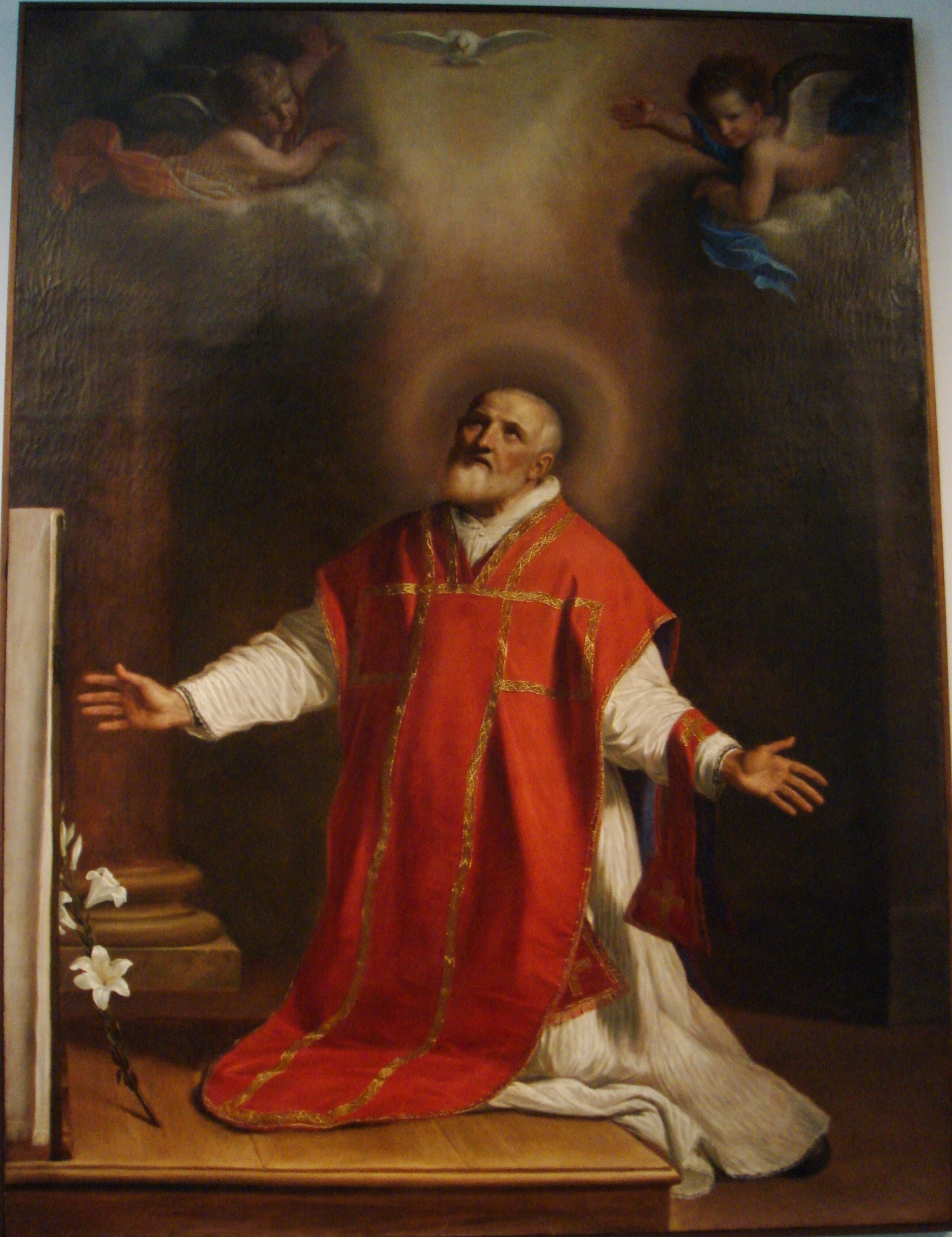
St Philip, with the lily of purity afore him, is shewn at the footpace of the altar in Mass-vestments of red, signifying his priestly focus upon the Mass and his entire devotion to the Holy Ghost, seen (flanked by angels) illapsing upon him

St. Philip, inflamed with the love of God and a desire of praising him worthily, after offering him all the affections of his soul, and the homages of all his creatures, seeing in their poverty and inability nothing equal to his infinite greatness, comforted himself in finding in the Mass a means of glorifying him by a victim worthy of himself.  This he offered to him with inexpressible joy, devotion, and humility, to praise and honor his holy name, to be a sacrifice of perfect thanksgiving for his infinite benefits, of expiation for sin, and of impetration to obtain all graces.  Hence in this sacrifice he satiated the ardent desires of his zeal, and found such an excess of overflowing love and sweetness in the closest union of his soul with his divine Redeemer.
(Taken from Vol. V of “The Lives or the Fathers, Martyrs and Other Principal Saints” by the Rev. Alban Butler, the 1864 edition published by D. & J. Sadlier, & Company)


******

The Postcommunion of this feast is entirely apposite: 

Cælestibus, Domine, pasti deliciis, quæsumus, ut * beati Philippi [confessoris tui, meritis et] imitatione * semper eadem, per quæ veraciter vivimus, appetamus.  Per...
(Fed, Lord, with celestial delicacies, we beseech that * by the imitation [and merits] of blessed Philip [thy confessor] * we may ever desire the same, by which we truly live.  Through...)

Interestingly enough, St Philip himself often prayed this prayer!  For, saving only the insertion of the words "by the imitation [and merits] of blessed Philip [Thy confessor]", which I have enchased with asterisks, it is the Postcommunion of the 6th Sunday after Epiphany – nowadays used in the Ordinary Form for the 6th Sunday in Ordinary Time.  This prayer is thus very ancient and expresses the doctrine of Holy Church with sureness.  At how many altars, for well over twelve hundred years, has this been prayed!

How greatly St Philip's heart dilated at these words of truth... how ought my heart likewise expand.  For in receiving Our Lord in Holy Communion, we partake of the true Manna by which we may expect life without end, beginning even now in this world.  I recall the famed and mysterious Mass of St Philip, celebrated in private as he grew older, that he might without embarrassment give full vent to his mystic love of Christ – a Mass lasting 3 hours, his Communion taking up most of the time; the saint could be heard to whisper in awe when drinking from the chalice, "It's real Blood".

The words in square brackets are omitted in the Novus Ordo, which is usually allergic to the mention of merit, presumably as "unecumenical", meaning, not pleasing to Protestants (thank God the editorial committee didn't remove reference to the saints' merits from the Canon), and which, in the interests of brevity, omits reference to non-martyrs as confessors, especially as the category of "confessor", however ancient, no longer exists as a separate Common.

Tuesday, May 25, 2010

Eve of St Philip's Feast

"Considering my sins, I am a dead man, but having confidence in Father Philip, I hope to be saved" – thus said an early devotee of St Philip Neri while yet the saint lived; thus say I.

Four hundred and fifteen years ago this night, St Philip passed over from this world to the Father.  Glory be to God!

It is strange the attraction he exercises over me, this saint whose character, so different to mine! yet so greatly appeals: in God's mysterious plan, this man totally inflamed by the Holy Ghost, this holy fool-for-Christ, by his example and doctrine and love and prayers sweetly and gently draws me upwards toward things divine.  


How good it was to visit him in his sacred remains last September and in January again...  it will be not so very long until God returns his soul to his body, which appears as if in a gentle sleep, and he will rise again with all the just to live and reign for ever and ever.  God grant I be set on the right with them.

"The best ensue, the worst eschew, my heart is set; all goodly sport, for my comfort, who shall me let" – so all the more appropriately might St Philip have sung, in place of its true author, the terrible Henry VIII!  He was ever active to gently and sweetly draw souls to God.

Here is the Traditional Preface of St Philip Neri, as conceded to his sons, the Oratorians, which sums up much of this:

Vere dignum, et justum est, æquum et salutare nos tibi semper et ubique gratias agere, Domine sancte, Pater omnipotens, æterne Deus.  Qui beatum Philippum gratiæ tuæ muneribus, amoris igne æstuare fecisti: qua ineffabili charitate inflammatus, novam ad animarum lucrum Congregationem instituit, et quæ aliis dedit salutis monita, operum exhibitione complevit.  Quæsumus clementiam tuam ut illius nos festivitate lætifices, exemplo piæ conversationis exerceas, verbo prædicationis erudias, grataque tibi supplicatione tuearis.  Et ideo cum Angelis et Archangelis cum Thronis et Dominationibus cumque omni militia cœlestis exercitus, hymnum gloriæ tuæ canimus, sine fine dicentes: Sanctus...
(Truly it is worthy and just, right and salutary for us always and everywhere to give thanks unto thee, holy Lord, Father almighty, eternal God.  Who hast made blessed Philip by the gifts of thy grace to burn with the fire of love: enkindled by that ineffable charity, he instituted a new Congregation for the gain of souls, and those salutary precepts he gave others, he accomplished by the example of his deeds.  We beseech therefore thy clemency, that thou mayest give us joy by his feast, exercise us by the example of his pious conduct, instruct us by the word of his preaching, and protect us by his thankful supplication unto thee.  And therefore with Angels and Archangels, with Thrones and Dominations, and with every army of the host of heaven, we sing a hymn to thy glory, saying without end: Holy...)

The friend of the Bridegroom well knows that he must decrease, that Christ must increase evermore: St Philip's dictum was amare nescivi, to love to be unknown.  How pleased he must have been with his faithful English son, Cardinal Newman, for accomplishing an amusing disappearing act: in preparation for his impending beatification by the Pope, the English Oratorians prepared a grand reliquary, and went off to disinter their Venerable, only to find – nothing!  Loving to be unknown, Newman managed to rot away entirely, leaving only his shoes...

How entirely appropriate, then, that this year Whit Wednesday (in the 1962 Calendar) takes precedence of St Philip's feast on the 26th of May – St Philip, who lived permanently set on fire by the Holy Spirit, Who miraculously enlarged his heart beyond that of Phar Lap!  The Collect of this day is entirely, marvellously appropriate:

Mentes nostras, quæsumus, Domine, Paraclitus, qui a te procedit, illuminet; et inducat in omnem, sicut tuus promisit Filius, veritatem: Qui tecum vivit... in unitate ejusdem...
(May the Paraclete, we beg, Lord, Who proceedeth from Thee, illumine our minds; and lead us into all truth, as Thy Son hath promised: Who with Thee liveth... in the unity of the same...)

How concisely is the entire Trinity invoked!  We address the Father, asking Him that the Paraclete Who proceeds from Him may enlighten us, and lead us into all truth, as His Son promised us while on earth.

Good St Philip, pray for me, pray for us all: beg of God through Christ that He pour forth into our hearts also the gifts and graces of the Holy Ghost, that we nevermore be parted from the Lord.

Friday, January 8, 2010

From Edinburgh to Florence

These posts are getting all out of order...

Wednesday I kept the Epiphany with Mass and Office in Edinburgh.  Mark continued to be a generous friend, touring me around the city, to the Palace of Holyroodhouse, to the new Scottish Parliament (an excellent thing, devolution; and who knows, perhaps to...), to the church at the Cowgate - where we revered the shrine of the Venerable Margaret Sinclair (1900-1925), a poor hardworking local lass who died in the odour of sanctity as a Poor Clare extern, known as the "Edinburgh Wonder Worker", whose Cause is advancing - to Edinburgh Castle, on to a very decent late lunch at Dario's, then off in the early evening to Mass for the Epiphany, courtesy of Fr Emerson, F.S.S.P.  The choir were very good, mixing chant and polyphony, with a very talented organ accompaniment, to effect.

Alas, on Thursday I had to arise at 3 a.m. to get my taxi to the airport for a pre-dawn flight (such the time one must allow for airport security and all the rest these days).  The flight to Paris was very pleasant, but I found finding my way around Charles de Gaulle Airport quite terrifying, as I had little time and no idea where to go to find my connecting flight.  I was so distracted I left my mobile, rosary, etc. in my pockets when I was security-screened, setting off the scanner and making the security guards (on high alert owing to that Christmas bombing incident) very wary and a bit cross, fairly enough.  (Looking back to this I suddenly realize how serious it was, golly.)

Finally getting to the right place just in time, we were in due course off for Florence.  Compared to Heathrow (where the customs officer was rather harsh, unfriendly and even rude in his manner) and Paris (where owing to my blundering who knows what trouble I all unwittingly nearly brought down on myself), Italian airport security was, well, extraordinarily light: there was a dog sniffing bags, and I think I had to show my passport, but that was it!

Florence is beautifully warm after freezing England and Scotland.  Yester-day was sunny, to-day a bit rainy, but still great.

The taxi-driver turned out to have returned from several months' holiday in Australia, having seen more of it than I have...

I've booked in at my customary lodgings, the Hotel Plaza Lucchesi: suffice to say I have my own balcony overlooking Santa Croce.  Why stay anywhere else?  (I'll sound like Fr Z, but the complimentary breakfast alone has three courses, with liveried waiters.)

After a good soaking bath to revive my drooping spirits, I set off around Florence for a good walk. 

First, I found what I'd missed last time: the Florentine Oratory, the Church of St Philip Neri (originally, the Church of San Firenze, an early eponymous bishop of the city).  Good Philip remains solicitous for me, his unworthy client.  The church has six side altars (one of St Philip, with painting thereof), a high altar (with the Bambino Gesu enthroned above the tabernacle, it being Christmastide), and a new and actually very appropriately furnished forward altar and sanctuary furniture.

It was providential that Thursday Sext contained the very words used in praying him since his death: "Look down from heaven and see, and visit this vineyard, and perfect the same which thy right hand hath planted" (quoted in Latin on the ceiling also, under the painting of him in ecstasy, with the quotation from Acts - Spiritus Domini rapuit Philippum).  A sign pointed into a side chamber for the Presepe (praesepio, crib): a whole altar (of the Sacred Heart) had been covered over with a huge representation of the Nativity scene, complete with running water and all.

In the side chamber was also the tomb of Pietro Bini, a Florentine and early follower of St Philip, who returning to their native city established the Oratory in Florence; he died a most holy death in 1635.

I didn't go far before I found myself at the Divine Liturgy (see last post below)... thank you, St Philip!

In the evening, I just wandered about entranced by the beauty of this Flourishing city, having a mild case of Stedhal syndrome (the palpitations and even psychosis engendered in visitors overcome by the concentration of art in Florence: the local mental hospital treats cases every year).

Again, I'll do a Fr Z and mention two nice comestibles: hot roasted chestnuts still in their shells bought off a street vendor; great big hot waffles stuck together into a prodigious sandwich with lashings of warm chocolate sauce - the latter of which I ate at the steps of the Duomo, at the foot of its facade, facing the Baptistery.

Florentia, civitas Christi Regis, floresce semper!

Saturday, September 26, 2009

Better

To-day the family got together for breakfast at the First Basin café, overlooking the again-flooded Gorge (the swirling waters are over the swimming pool and lower lawn) - will it ever stop raining? - and our get-together was for a happy occasion: my Mum's birthday. Many happy returns!

Afterwards, we all headed off on various errands; I did as I do, and went to church for confession. It was as I find it ever: confession, as well as an exercise in honesty, and above all a signal instance of God's merciful ever-faithfulness ("we may be unfaithful, but He is always faithful"), is refreshing to the soul.

Later on, I recalled that this is the 26th of the month, and therefore, happy thought, the monthly reminder of the feast of St Philip Neri, on the 26th of May: I do believe his intercession for me, a stumbling half-devotee, who tried to see something of him and his Rome, has helped me now as in the past. Good Philip, pray for us to Christ-God, that He save our souls!

I had a pleasant conversation with David Schütz this morning, also, and made some varied purchases, now I've my wallet back at last:

  • a new watch, with a proper Roman numeral clockface (my old one finally gave up the ghost in Rome);
  • Primeval - Series Three (an entertaining sci-fi DVD set);
  • John Hatcher, The Black Death: The Intimate Story of a Village in Crisis, 1345-1350;
  • Kunzig & Broecker, Fixing Climate: The Story of Climate Science - and How to Stop Global Warming (I just love can-do tech fixes: man is the master of this God-given earth, so if we have unwittingly altered the climate, it is for us to assume control - take that, backward hippies!);
  • Dante, Vita Nuova (his courtly love for Beatrice - for me, a memento of Florence the beautiful);
  • Edgar Allen Poe, Tales of Mystery and Imagination (having just read Lovecraft's essay on supernatural horror in literature, this seemed a good choice).

I also visited my travel agent, and had her investigate the price of a trip to New Zealand in late January 2010. Scott, a friend of mine, is interested in joining me, so I hope all will work out. It will definitely be cheaper than holidaying in Italy, and I afforded that alright!

The TV is already on in the background, for the Grand Final soon begins, in unseasonably wet and cold Melbourne, with conditions that may be the worst in memory (hail is predicted). Carn the Saints!

Thursday, September 17, 2009

Roaming Rome

I'm very tired and spending some time in the heat of the day (when the churches are closed) catching up on my blogging-cum-diary of this my holiday-cum-pilgrimage.
A little earlier, I felt tired and in need of some comfort, so I had a very pleasant lunch at ristorante Don Chisciotte (Italian spelling of Quixote), sitting out under cover on the Piazza Navona, with Bernini's fountain playing and some nearby musicians too. Entree of salmon and swordfish, then spaghetti carbonara, and then cotoletta milanese with grilled vegetables. Add to that some excellent natural sparkling mineral water, the usual bread on the side, a caffe freddo, and il conto totalled €50!!!
Previous to that, I visited S. Augustino - and venerated: (a) the Crucifix before which St Philip prayed, and which moved him to devote himself entirely to the Lord; (b) the relics of St Benedict Martyr; (c) the relics of St Monica. I asked her to intercede for me and mine, that as her tears and prayers won her son for Christ as a great saint, so we all might be converted and be saved.
(I also popped in to S. Luigi dei Franceschi.)
Earlier still, I paid a last visit to St Philip at the Chiesa Nuova. I hadn't got around to booking a tour of his rooms, so that I forego for this visit; ditto for my hopes of making it out all the way to the catacombs of St Sebastian, where he received the Holy Ghost. (Fr Rowe told me of it - he said Mass there at the very spot.) However, I did stop at San Tommaso in Parione: the church was closed, and there was no answer at the office of the Procurator General of the Oratorians, but I did see the commemorative plaque in honour of the ordination there of St Philip to the minor orders and subdiaconate; he was ordained priest on the 23rd of May 1551, unusually late in those days (he was already 36 years old).

Tuesday, September 15, 2009

My 7th Day in Rome

Unfortunately in some respects, I had to spend this morning moving from San Gregorio to the Hotel Emmaus - not because they kicked me out, but because when months ago I organized to stay at the former, they were already booked out for to-night and to-morrow: now, to-morrow I'll overnight in Florence, but to-night had to organized while I was in Rome (thanks, Mike, for your help), owing to an oversight on my part.

In any case, having had a sleep-in, and moved out, I took the metro across to Ottaviano station, and walked down just past St Peter's to the hotel. It seems very pleasant and comfortable, with a TV and air-con, benefits not available at the monastery! For this reason, having to pay €75 for a single room seems fair: it's only just a bit more than double the very cheap San Gregorio rate (one of the lowest in Rome, even among religious houses), and would compare favourably with accommodation rates back in cities in Australia. I have been very fortunate.

Because the churches are closed in the heat of mid-day, I didn't head off on my afternoon adventures till after 2 pm. This may have been unideal...

First, I walked all the way to Santa Maria Maggiore (making a few detours along the way by mistake). What a church!

I first adored in the Exposition chapel, then prayed before the ancient and venerable icon of Our Lady Salus Populi Romani (Health, Safety and Salvation of the Roman People).

A memorial inscription recorded that it was here at her altar that Eugenio Pacelli - later Pius XII - offered his first Mass, out of devotion to the Holy Virgin.
But wait - then I descended the stairs of the confessio beneath the high altar...


I was overpowered with amazement to behold, in its gold and silver reliquary, beams of wood from the Crib of Jesus Christ Our Lord: the Word Made Flesh dwelt first amongst us in His Mother, and then was cradled therein when He was born in Bethlehem of Judea. Behold the wood of the Crib, on this day when we venerate the Wood of His Cross!

Kneeling there in wondering awe, I prayed the Gloria in excelsis, the Angels' hymn over the Babe of Bethlehem, then turned to the texts of Christmas in my missal:


Apparuit gratia Dei Salvatoris
nostri...

(The grace of God our Saviour hath
appeared...)


Apparuit benignitas et humanitas
Salvatoris nostri Dei...

(The benignity and humanity of God our
Saviour hath appeared...)

Et peperit filium suum primogenitum,
et pannis ejus involutum, et reclinavit eum in praesepio ...natus est vobis
hodie Salvator, qui est Christus Dominus, in civitate David. Et hoc vobis
signum: invenietis infantem pannis involutum, et positum in
praesepio. ...et invenerunt Mariam, et Joseph, et infantem
positum in praesepio.

(And she brought forth her Firstborn Son,
and wrapt Him in swaddling clothes, and laid Him in a manger ...For you is born
this day the Saviour, Who is Christ the Lord, in the city of David. And
this shall be for you the sign: you shall find the Infant wrapt in swaddling
bands, and laid in a manger. ...and they found Mary, and Joseph, and the
Child lying in the manger.)


Concede, quaesumus, omnipotens Deus,
ut nos Unigeniti tui nova per carnem Nativitas liberet, quos sub peccati jugo
vetusta servitus tenet. Per eumdem...

(Grant, we beg, almighty God, that the new
birth of Thine Onlybegotten in the flesh may deliver us, who are held by the old
servitude under the yoke of sin. Through the same...)

Moving on round the basilica, I admired the sumptuous and ancient apse mosaics of the Coronation of the Virgin and her Dormition, surrounded by angels, accompanied by the small suppliant figure of Pope Xystus III, who had them done for this great church of St Mary Major, in commemoration of the decree of the Council of Ephesus against all heretics that the Blessed Virgin is truly Theotokos, Deipara, Mother of God.
Then I espied a familiar face in one of the confessionals - Fr Denis Hallinan, O.P., a wise and caring old priest, dear to me from years past. He and the other Dominicans who man the confessionals (which are kept busy the whole time: each friar sits administering the Sacrament of Penance for at least 24 hours a week) are employed by the Apostolic Penitentiary that the multitudes of the faithful may have confessors fluent in many languages.

He was surprised and delighted to see me, and I him. We had a very pleasant chat (before I left him to his next penitent), and he shewed me where the former penitential wand used to sit - before miserable Paul VI abolished so many fun Catholic things, and ruined most of the rest, you could gain a plenary indulgence just by the touch of the wand (à la Harry Potter). How sad that what was a part of the rich tapestry of Catholicism is now a superstitious plaything.
Fr Denis generously accepted a stipend to say a Mass for my family, and I bade him adieu.

Next, on to St John Lateran! On the way I bought a gelato (almond flavour), and had to miss visiting Santa Prassede (it would have been impious to walk in licking an icecream), but I did make a station at St Alphonsus, where the original icon of Our Lady of Perpetual Succour is kept.
Further along, I visited two churches opposite each other: SS Marcellinus and Peter (annoyingly, their sacred remains were long ago translated to Heilegenstadt) and St Anthony of Padua (a very disappointing building).
At last, San Giovanni in Laterano! I was getting tired, and walked the interior without so much devotion. I did like the great Baroque statues of the Apostles, superhuman in size, all down the nave.

When moving on, I realized from my map that it was only a block to the Santa Scala... so a few minutes later saw me going up them on my knees, which is painful and no joke I can tell you. For the sake of Thy sorrowful Passion, O Lord! That was my prayer, and I hope to thus have gained the plenary indulgence.

But I had still further to go: Santa Croce in Gerusalemme was my final objective before turning back. This is the feast of the Exaltation of the Holy Cross after all. I cannot say how solemn, sombre, stark and moving was the chapel of the sacred relics of the Passion: there was a notable hush, and a larger proportion of sisters and priests in evidence, in silent meditation upon the Nail, the Thorns, the Fragments of the True Cross, the Titulus or superscription (written in Latin, Greek and Hebrew) that Pilate wrote and had pinned above Our Lord on Calvary, and the Finger of St Thomas, which touched the Wounds in the Hands and Side of the Risen Christ: for, supreme over Death, He still and for ever bears the scars of His Triumph, which are evermore glorious and adored.

I should have spent longer at all these sites, but it was a quarter to six, and I was a long way from SSma Trinità, where I desired to hear Mass of the Holy Cross. So, back I hobbled along the streets - Deo gratias, and thank you to my Guardian Angel, a bus going in exactly the right direction appeared just as I reached the Viale delle Terme di Caracalla, about half a kilometre the wrong side of San Gregorio! It brought me to within striking distance of my objective, so I got to Mass in time, at six thirty.

Low Mass began at the high altar, "in thanksgiving for the second anniversary of the [coming into effect] of the Motu Proprio Summorum Pontificum". But at the side altar next to my pew, a second, private Mass soon began; so I kept an eye on it while assisting at the main service. First the Elevations at the high altar, then at the side... Holy Communion... then two blessings! (It turned out that the second Mass was that of a visiting F.S.S.P. priest from the U.S., here with a pilgrim group).
I calculate that I have walked something like 2 1/2 km in the morning, then 10 km in the afternoon! Ouch.
Did I mention that one of my two pairs of shoes has actually given out, and the heel has come away from the sole? Cobblestones...
I've only done four of the Sette Chiese so far, and only three and a half to-day, since I didn't actually enter St Peter's. To think that to do the Seven Churches in a day, as was St Philip's devotion, would require walking a far way further - 12 km more in fact: from Santa Croce to San Lorenzo fuori le Mura, then down the Appian Way to San Sebastiano f. l. M., and along the Via delle Sette Chiese to Saint Paul's outside the Walls.

I may have to put off this devotion...

Monday, September 14, 2009

Chiesa Nuova


On Saturday afternoon I had another serendipitious encounter: returning to Santa Maria in Vallicella for to venerate St Philip, I found a French group (seminarians?) in course of singing a beautiful Novus Ordo Mass in the saint's chapel. There were four priests concelebrating, with two deacons and two others serving, plus about a dozen men who sang music in several parts, in both French and Italian. They all seemed notably pious. Having arrived at the start of the Offertory, I was delighted to find, through attendance to the prayers, that it was indeed a Votive of St Philip Neri: God has been very kind to me in stirring up devotion to this saint, for the good of my soul.

(Much later that night, I read over the readings and such for the Mass of St Philip, so as to supply as it were the half I'd missed. Interesting, isn't it, that one can miss the first half of Mass and not miss it, but not contrariwise; for the Liturgy of the Word is ordered to the Liturgy of the Eucharist, not vice versa - the Fore-Mass by itself is but a paraliturgy; though in Latin, it is a Missa sicca!)

I venerated the saint at closer quarters eventually, but first there was a baptism in the chapel. (Will I see all seven sacraments before I leave Rome?! I've seen now Baptism, the Eucharist, Confessions being heard, a Marriage, Ordinations... only Confirmation and Extreme Unction, which God avert, to go!)

In the huge sacristy, which itself could be a church, complete with a supermassive statue of St Philip above a noble altar, I was able to obtain a guide to the church, ever so many cards of St Philip and the Chiesa Nuova, and best of all a holy medal, which one of the Oratorian fathers kindly blessed for me. I saw another good son of St Philip patiently waiting in the confessional as I left the sacred edifice.