Sunday, August 16, 2009

Amusing Icon

Upon walking into the Greek church the other day, all lit candles and venerated the festal icon of the Dormition of Our Lady. This actually depicted the funeral procession of the Virgin, after her death (according to ancient tradition, she truly died - the contrary view is a late Western innovation - and was buried, like her Son; but a few days later, like Him, she was discovered to have been resurrected, and assumed into heaven, when her tomb was opened to reveal nothing but flowers).


There was an amusing and most politically-incorrect detail: a man with his hands chopped off - complete with blood coming forth! - by an angel wielding a sword. This illustrates the ancient tale of how a Jew attempted to upset the bier, but instead lost both hands (they remained grasping the bier). Chastised in so miraculous a manner, he thereupon confessed Holy Mary to be Mother of God, and, having come to Faith in Christ, his hands were restored to him: for, as the Good Book says, Seek first the Kingdom, and all else shall be added unto you...

Saturday, August 15, 2009

Proper of the Dormition Divine Liturgy

While I was in attendance at a Byzantine Rite Liturgy to-day for the feast of the Assumption, I didn't have to hand the Propers of the feast; for interest's sake, here they are:

Antiphons

Through the prayers of the Theotokos, O Saviour, save us!

O Son of God, wondrous in Thy saints; save us who sing to Thee: Alleluia!

Troparion

In giving birth, you preserved your virginity! In falling asleep you did not forsake the world, O Theotokos! You were translated to life, O Mother of Life, and by your prayers you deliver our souls from death!

Kontakion

Neither the tomb, nor death, could hold the Theotokos, who is constant in prayer and our firm hope in her intercessions. For being the Mother of Life, she was translated to life by the One who dwelt in her virginal womb!

Prokeimenon (St Luke i, 46b-48)

My soul magnifies the Lord and my spirit rejoices in God my Saviour!
For He has regarded the low estate of His handmaiden: For behold, henceforth all generations will call me blessed.

Alleluia Verses (Psalm 131:8,11b)

Arise and go to Thy rest: Thou and the Ark of Thy might!
The Lord swore Truth to David from which He will not turn back!

Megalynarion

Seeing the dormition of the Most Pure One, the Angels were filled with awe at how the Virgin went from earth to heaven.

The limits of nature are overcome in you, O Pure Virgin: for birthgiving remains virginal and life is united to death! A virgin after childbearing and alive after death! You ever save your inheritance, O Theotokos!

Communion (Psalm 115:4)

I will receive the cup of salvation and call on the name of the Lord!

Dormition of Our Lady

The Greek Orthodox in Launceston (and the rest of northern Tasmania) have a church, dedicated in honour of the Dormition of the Theotokos, but no priest; instead, once a month, on a Saturday, Fr Timothy comes up from Hobart to celebrate the Divine Liturgy. Since to-day is both a Saturday and their church's titular feast, not only Fr Timothy, but a whole busload of Greeks - and Ethiopians! - from Hobart came up for the Liturgy, together with others travelling by car. Among them were my friends Ron and Nicola, with their children... I had agreed to go all ecumenical and join them for this special occasion.

This morning, after walking up the Gorge to see the ever-burgeoning flood, I returned to my car and drove over to their church; hearing the Trisagion sung, it transpired that Orthros (Lauds) was ending, and, upon entering the church and lighting a candle for a consideration (as seemed fitting), I went and stood with the large congregation while the Artoklasia (blessing of bread for a name-day) was celebrated, since obviously all Greek ladies with Mary in their names were keeping this day in a special manner.

I should note here that Fr Timothy has no deacon, so he perforce sang all the litanies himself; he only had one server, too, an older man.

The Divine Liturgy commenced at 10:30, and concluded at 11:45 am. It was edifying to see the large congregation - including a dozen or so Ethiopians all in white in their church-going finery - which spilled over from the little church itself into the adjoining hall. The rites were conducted half in Greek, half in English, alternating for every petition, prayer, etc. (though the responses were sung in Greek only). Even the words of consecration were done this way: the Host was consecrated in Greek, the Chalice, in English! Certain parts, such as the Epistle, the Gospel, the Creed, and the Lord's Prayer were pronounced twice, once in each language. (The sermon, on Our Lady as model of humility, was in English only.)

Here are the Epistle (Philippians ii, 5-11) and Gospel (St Luke x 38-42; xi, 27-28):

For let this mind be in you, which was also in Christ Jesus: who being in the form of God, thought it not robbery to be equal with God: but emptied himself, taking the form of a servant, being made in the likeness of men, and in habit found as a man. He humbled himself, becoming obedient unto death, even to the death of the cross. For which cause God also hath exalted him, and hath given him a name which is above all names: that in the name of Jesus every knee should bow, of those that are in heaven, on earth, and under the earth: and that every tongue should confess that the Lord Jesus Christ is in the glory of God the Father.

Now it came to pass as they went, that he entered into a certain town: and a certain woman named Martha, received him into her house. And she had a sister called Mary, who sitting also at the Lord's feet, heard his word. But Martha was busy about much serving. Who stood and said: Lord, hast thou no care that my sister hath left me alone to serve? speak to her therefore, that she help me. And the Lord answering, said to her: Martha, Martha, thou art careful, and art troubled about many things: but one thing is necessary. Mary hath chosen the best part, which shall not be taken away from her.
And it came to pass, as he spoke these things, a certain woman from the crowd, lifting up her voice, said to him: Blessed is the womb that bore thee, and the paps that gave thee suck. But he said: Yea rather, blessed are they who hear the word of God, and keep it.

I was impressed by the choir (three older laymen, joined partway through by a younger man and his two sons): they had a number of armrests to lean on, as they stood by one wall, grouped about a mediæval-style lectern for their music. Amusingly, the reader couldn't quite find the right Epistle in the lectionary, so Fr Timothy popped out through the door of the iconostasis right in the middle of the chanting to give him a hand.

The Creed was recited, first by one of the choir in Greek, then by the two boys in English. Interestingly, few sang even an Amen or Kyrie, though we were all ever fervently crossing ourselves at every mention of the Trinity (and there were many) and also at other important bits (sorry, Bugnini, more really is more, less really is less); but when it came to the Lord's Prayer, all said it aloud together.

In the reverse to the Western practice, all the children were first mustered to receive the Holy Gifts; but then an impressively large fraction (about twenty or more) of the adults present also communicated. My friend's daughter brought me some of the antidoron (the blessed bread eaten after receiving Communion). During Communion, the choir sang a beautiful hymn in honour of the Theotokos, which Ron tells me is a favourite of the Greeks and always used at Communion; many even sang the refrain.

I recognized the refrain of this hymn as the same as that of the Akathist Hymn: Χαίρε Νύμφη Ανύμφευτε - or, "Hail, Bride unbrided" (the Greek doesn't quite work in English). Having now searched a bit, it turns out that this hymn is Αγνή Παρθένε, a famous nineteenth century composition by Bishop Nectarius of Aegina (whom the Orthodox have canonized):

O Virgin Queen and Mother,
O dewy fleece most sacred:
Rejoice, O unwedded Bride!

O height transcending heaven above,
O beam of light most radiant:
Rejoice, O unwedded Bride!

O joy of chaste and virgin maids,
surpassing all the angels:
Rejoice, O unwedded Bride!

O brilliant light of heaven above,
most clear and most radiant:
Rejoice, O unwedded Bride!

Commanding chief of heaven above,
O holiest of holies:
Rejoice, O unwedded Bride!

O ever-virgin Mary,
O Mistress of creation:
Rejoice, O unwedded Bride!

O Bride all-pure and spotless,
O Lady all-holy:
Rejoice, O unwedded Bride!

O holy Mary, Bride and Queen,
O cause of our rejoicing:
Rejoice, O unwedded Bride!

O Maiden Queen most honorable,
O Mother most holy:
Rejoice, O unwedded Bride!

More precious than the cherubim,
more glorious than the seraphim:
Rejoice, O unwedded Bride!

Surpassing principalities,
dominions, thrones and powers:
Rejoice, O unwedded Bride!

Rejoice, song of the cherubim,
Rejoice, hymn of the angels:
Rejoice, O unwedded Bride!

Rejoice, ode of the seraphim
and joy of the archangels:
Rejoice, O unwedded Bride!

Rejoice, O peace; Rejoice, O joy
and haven of salvation:
Rejoice, O unwedded Bride!

O bridal chamber of the Word,
unfading, fragrant blossom:
Rejoice, O unwedded Bride!

Rejoice, delight of paradise,
Rejoice, life everlasting:
Rejoice, O unwedded Bride!


Some other observations: while as mentioned the Greeks are forever crossing themselves at the naming of the Three Persons of the Blessed Trinity, I noticed that they do not have the Western custom of bowing the head at the Holy Name of Jesus; and unlike the Russians, they miss out the litanies in between the Gospel and the Great Entrance.

After the final blessing, the processional crucifix and ripidia were brought forth, and thereupon we all processed around the outside of the church with the large icon of the Dormition (covered in flowers), with an occasional stop for prayers.

The procession ended, we all received more of the blessed bread from Fr Timothy - and soon enough fell to on the huge lunch that had been prepared for all and sundry, including yours truly.

It was a sacred, festive, and familial occasion. I must say I felt very much at home. (Luckily, having some Greek, and more importantly a grasp of the flow of the Divine Liturgy through study and prior attendance of it in Russian and Ukrainian Rite churches, I didn't even need to open my pocket copy of The Divine Liturgy Explained.) How sad it is that these Orthodox are clearly so familiar with their beautiful and sacred rites, and yet would surely find the modern Roman Rite bare and alien. The Traditional Latin Mass is certainly more evidently a different, but very Catholic, form of the same Eucharistic Sacrifice, and closer in spirit to the unchanged and dearly-loved Eastern Rites.

After the lunch, my friends and I went up the Gorge (in my case, for the second time to-day) to admire the spectacle of the surging flood and whitewater rapids. I must admit, after also standing for an hour at the Greek service, my poor legs ache.

But I must now go to Catholic Mass, for the Sunday Vigil.

******

I've now returned from Mass, pleased and refreshed. I've resolved to keep attending Mass at St Francis, which is my canonical parish, since apart from anything else it delivers me from dire diocesan priests! I like the liturgy at Carmel, but for one thing: Father. Having a pious and reverent priest at the altar is more important than ever when attending the Novus Ordo.

Friday, August 14, 2009

The Gorge in Flood


(This small clip gives the sound, but doesn't do the full spectacle justice.)

No photos yet, but a description at least demands writing: after work, in the late afternoon grading to twilight, I did as many good burghers of Launceston, and stopped half-way home, parked the car, then walked up the cliffside path from the King's Bridge to the First Basin, up through the Cataract Gorge, the raging flood-waters of the South Esk spilling down the descent in a magnificent, thundering spectacle of churning silt-laden water, the very air tasting of earth and salt, as the surging waters shot down from further upstream, through the deep-chiselled defile, roaring over the huge boulders normally seen below, but for now submerged in the sudden maelstrom...

Casting an eye over the ferocious scene, I read again the following verses (3b-5) of Psalm 123:
Cum irasceretur furor eorum in nos, * fortisan aqua absorbuisset nos.
Torrentem pertransivit anima nostra: * fortisan pertransisset anima nostra aquam intolerabilem.

When their fury was enkindled against us, * perhaps the waters had swallowed us up.
Our soul hath passed through a torrent: * perhaps our soul had passed through a water insupportable.
How glorious to be safe and secure, calmly beholding the raging torrent from an eyrie of security! Heaven must be like that.

And again, from Psalm 92, the opening of festal Lauds (verses 3-4):
Elevaverunt flumina, Domine, * elevaverunt flumina vocem suam.
Elevaverunt flumina fluctus suos, * a vocibus aquarum multarum.
Mirabiles elationes maris: * mirabilis in altis Dominus.

The floods have lifted up, O Lord: * the floods have lifted up their voice.
The floods have lifted up their waves, * with the noise of many waters.
Wonderful are the surges of the sea: * wonderful is the Lord on high.
The very euphony of these words paints a picture of the billowing waves, and of the voices of the many waters. Blessed be the Lord Who made them, orders them and ever makes them be. May all His wondrous works praise Him:
Benedicite, maria et flumina, Domino: laudate et superexaltate eum in sæcula.

O ye seas and rivers, bless the Lord: praise and exalt him above all for ever.
(Daniel iii, 78)

While the Trevallyn Dam further upstream has been shedding water over the spillway on and off for some weeks now (and the level of water in the Gorge has risen, fallen, and risen again), now, with all the runoff from the past days of flooding rains in the upcountry gathering and coming through, a prodigious display of nature's strength is underway. The green grassy sward around the swimming pool by the First Basin is now almost wholly submerged, the pool itself far underwater, and I walked in the dimming light by the water's edge as it foamed and churned and threw waves toward my feet, while all along this strange new shore huge driftwood piles built up. Out in the Basin itself (which even at its usual level is a lake over 200m deep), enormous logs, whole trees, could be seen being carried by on tremendous waves.

Standing on the "swing bridge" as we call it, the pedestrian suspension bridge at the debouchment of the upper reaches of the Gorge into the First Basin, it was astounding to behold without fear the giant rush of speeding waters below, sending up such fine mist that the handrail was damp. Sublime!

Even downstream, where the Gorge empties its waters to swell the Tamar, boats and the rowing club pontoon have been moved out of the way, since the forecast flow of 1200 cubic metres of water a second is well being achieved. (Yet this is only a quarter the size of the Great Flood of 1929!)

Still, the peak isn't expected till mid-day to-morrow. [The eventual peak of 1100 cubic metres per second came early Saturday morning.]

It's been years since the last decent flood.

Vigil of the Assumption


Heaven with transcendent joys her entrance graced,
next to his throne her Son his Mother placed;
and here below, now she's of heaven possessed,
all generations are to call her blessed.

– Thomas Ken, "Her Virgin eyes saw God incarnate born"

I like the words of an Anglican blogger - that the St Mary the Virgin was assumed into heaven that she might perpetually intercede for us.

Immaculate at her own conception, ever sinless, graced and all-holy in her life, virginal in her conception of the Eternal Word, sacred in her overshadowing and indwelling by the Holy Spirit, blessed for her firm believing and stedfast adherence to the will of God, blest for her firm and stedfast stance at the foot of the Cross, blest for her continual intercession for the nascent Church and for every Christian soul bequeathed her by her Son, blest in her sacred repose, blest in her assumption into the celestial tabernacle and nuptial chamber on high, wherein her Son reigns on a starry throne - for all ages, in the heaven of heavens above all the heavens, in the Empyrean, by the power of the Almighty there abide a Man and a Woman, the Sacred Humanity of Our Lord, and the all-glorified Mother of God.

As was said at Mass to-night, the Assumption marks God's acceptance of creatureliness into His perfect heaven. What must it be to be so glorified, superglorified, that one is brought to be united body and soul with God in heaven evermore - a grace second only to that of the hypostatic union! In principio erat Verbum, et Verbum erat apud Deum... Signum magnum apparuit in cælo, mulier amicta sole... (St John i, 1; Apoc. xii, 1)

As the Preface at Mass has it (echoing the Marian decree of Vatican II, contained in its larger work on the Church), Our Lady in heaven is the image and exemplar of the Church and each soul, that we may see in her made perfect what is our most high calling. And therefore with angels and archangels and the whole company of the heavenly host, even now here on earth let us join in their worshipping song without end, joining in the Eucharistic Sacrifice as our point of cross-over from this world to the Father: Sanctus, Sanctus, Sanctus...

Finally, in the offering of the Sacred Victim - Per ipsum, et cum ipso, et in ipso, est tibi, Deo Patri omnipotenti, in unitate Spiritus Sancti, omnis honor et gloria - and the unspeakable grace of reception thereof, we have our foretaste of what bliss Our Lady ever has with her Son our Lord: God grant that we prove worthy of what we have received in mystery, that we may too one day made perfect be forever with the Lord. (But we must not rest: Newman frighteningly says that there are many who are now growing in grace and virtue that yet shall not come to be saved!)

Very appropriately, especially as I've been reading it daily in the Little Office, we sang at Mass the great Marian hymn of Venantius Fortunatus, Quem terra, pontus, sidera, in Neale's incomparable translation, for the central dogma of all Mariology is that Mary is Mother of God - all stems from it, from her Immaculate Conception to her Corporeal Assumption and everlasting Queenship:

The God whom earth, and sea, and sky
adore, and laud, and magnify,
who o'er their threefold fabric reigns,
the Virgin's spotless womb contains.

The God whose will by moon, and sun,
and all things in due course is done,
is borne upon a Maiden's breast,
by fullest heavenly grace possessed.

How blest that Mother, in whose shrine
the great Artificer Divine,
whose hand contains the earth and sky,
vouchsafed, as in His ark, to lie.

Blest, in the message Gabriel brought;
blest, by the work the Spirit wrought;
from whom the great Desire of earth
took human flesh and human birth.

All honor, laud, and glory be,
O Jesu Virgin-born, to Thee,
all glory, as is ever meet,
to Father and to Paraclete. Amen.

(Look at my posting from last year on this solemnity, gentle reader, for links to two fine Assumption hymns...)

Thursday, August 13, 2009

Beata Dei Genetrix

Each morning at Lauds of the Blessed Virgin, the Benedictus antiphon is as follows:

Beata Dei Genitrix Maria, Virgo perpetua, templum Domini, sacrarium Spiritus Sancti:
sola sine exemplo placuisti Domino nostro Jesu Christo:
ora pro populo, interveni pro clero, intercede pro devoto femineo sexu.

(Blessed Mother of God Mary, ever a Virgin, temple of the Lord, shrine of the Holy Ghost:
alone without peer thou didst please our Lord Jesus Christ:
pray for the people, intervene for the clergy, intercede for consecrated women.)

Interestingly, this Marian anthem is composed of three parts - the first is a series of Our Lady's titles; the second, a slightly expanded quotation from Sedulius (Carmen paschale, II, 69 - Sola sine exemplo placuisti femina Christo); the third, part of the prayer of Fulbert of Chartres long attributed to St Augustine (Serm. IX - ora pro populo; interveni pro clero; intercede pro devoto femineo sexu).

Sedulius also gives us the Introit for Our Lady, Salve sancta Parens (at which words the Carthusians genuflect in memory of the Incarnation): his verses were Salve, sancta parens, enixa puerpera regem, / Qui caelum terramque tenet per saecula... (Carmen paschale, II, 63f), but these the Church has expanded upon by changing the last words to regit in saecula saeculorum.

Salve, sancta parens,
enixa puerpera Regem,
qui caelum, terramque regit
in saecula saeculorum.

(Hail, holy Parent,
a woman in labour who didst bring forth the King,
Who ruleth heaven and earth
for ever and ever.)

From his abecedarian hymn A solis ortus cardine come some wonderful Christmas and Epiphany hymns, though his full text extends from the Infancy to the Passion and Resurrection of Christ. From the Carmen comes also the following lines (II, 66-68):
...quæ ventre beato
Gaudia matris habens cum virginitatis honore
Nec primam similem visa es nec habere sequentem:


(... by whose blessed womb
having the joys of a mother with the honour of virginity:
neither was one like seen before thee nor shall there be another)
These appear reused in various places in the Liturgy, such as in this antiphon sung before Christmas in some rites:

O Virgo virginum, quomodo fiet istud?
Quia nec primam similem visa es nec habere sequentem.
Filiæ Jerusalem, quid me admiramini?
Divinum est mysterium hoc quod cernitis.

(O Virgin of Virgins, how shall this be?
For neither before thee was any like thee, nor shall there be after.
Daughters of Jerusalem, why marvel ye at me?
The thing which ye behold is a divine mystery.)

As Gambero notes, Sedulius offers a synthesis and summary of all Mariology in a short passage of his Carmen (II, 63-69), parts of which have already been quoted above, parts taken up into the official Liturgy of Christ's Church:
Hail, O holy mother; you gave birth to the King
Who governs heaven and earth forever, whose
Divinity and dominion embrace everything in one eternal realm
And endure without end. In your blessed womb
You hold a mother's joy, yet you enjoy the honour of virginity.
No woman like you was seen before, nor did one appear after;
You alone, without comparison, were the woman who pleased Christ.
May the Blessed Virgin intercede for us with her Son, Who refuses nothing to His Mother in whom He is well-pleased.

Wednesday, August 12, 2009

Both Lungs

Theophan the Recluse (canonized by the Russian Orthodox in 1988) was a nineteenth century monk and bishop, who largely devoted himself to composing works of spiritual instruction - and while he fuelled the appetite of his countrymen for ghostly counsel by translating and editing the Philokalia (itself a Greek anthology of Patristic mystic texts), he also issued a book concerning the spiritual combat, which, as he happily stated, he drew from the writings of none other than St Alphonsus Liguori (whom he also imitated by relinquishing his diocese in order to pray, meditate, and labour as an evangelist via the printing press). Theophan was also notable for celebrating the Divine Liturgy each and every day - even in his hermitage! To the amazement of his contemporaries, he felt it right and salutary to offer the Holy Sacrifice daily, since he approved of the Western custom in this regard.

There are many more such unexpected crossovers between East and West - for instance, in Russian seminaries the training is not done by reading from the Fathers (despite Orthodox claims that they keep ever to their pure ancient teachings), but from manuals, which (but for such matters as the procession of the Holy Ghost and other famous points of disagreement) are most comparable to neo-scholastic manuals like those of Tanquerey et al.

I was just discussing all this and much else besides with my mate Justin this afternoon (using up a lot of mobile phone credit). It is vital to adhere to the Catholicity of the Fathers, to the Orthodoxy of the Fathers, seeing that the organic development of the Church over time must ever be true to its roots: for the Faith preached by Christ, by His Apostles, by the Fathers, by the Doctors, must be one and the same - after all, St Thomas Aquinas would have been horrified at the thought that he was an innovator: he would have described himself as an expositor of Sacred Doctrine, that is, of Holy Scripture, adhering to the teachings of Fathers; recall that his Summa was for beginners, and his commentaries on Scripture and on the sentences of the Fathers as arranged by Peter Lombard were his works for the proficient.

Nowadays, the Eastern Orthodox can appear trapped in their cultural milieu, even in ethnic chauvinism; but western Catholics merely imitate the anomie of their unchurched peers, alienated from their traditional cultures. While the Orthodox (without insult to their abiding in the Faith of the first millennium) can appear pre-modern in their attitudes, too often Catholics are contaminated by the post-modern retreat from reason into fuzzy-minded indecision, relativism, and indifference grading into unbelief. Orthodoxy is the desperate need of the west: we have it in Christ's Vicar, but all too often modern Catholics are ignorant of their religion, fearing and repulsed by Rome! The West must reacquaint itself with the Fathers (as Vatican II solemnly averred). We cannot expect the Orthodox to reunite with the Catholic Church, ending the age-old schism, if we remove not the beam from our own eye: our decadence, our dissent, our laxity, our abuses of the sacred liturgy - all of which the Orthodox abhor with horror and dismay.

As John Paul II said, the Church must breathe with both lungs.

Tuesday, August 11, 2009

Supper for St Clare

Our nascent schola had sung through most of the music for Sunday Compline (according to the modern Office) in Gregorian chant at our practice this evening, when our leader Fr Allan very unexpectedly and graciously invited us to join him at the friary for a little eat and drink in honour of St Clare, whose feast day falls to-day in the Ordinary Form, on the anniversary of her death (it is kept to-morrow in the Extraordinary Form). He was most hospitable: a decent few glasses of merlot from the Clare Valley in South Australia, some cheeses with crackers, some cake and lamingtons, and a drop of port to finish off - a good time was had by all. How appropriate that it was in the Clare Valley (not the Lutheran Barossa) that Catholics settled, and good German Jesuits among them: Seven Hills, still owned by the Society of Jesus, still makes Australia's altar wine.

We were reminded that St Clare is patroness of television (one hopes she can redouble her prayers!) and, together with St Lucy, of the blind: St Clare having once been vouchsafed a vision of Mass when she was laid up in bed by illness, and having a name meaning clearness and clarity, just as Lucy means light. At the end of the soiree, Fr kindly shewed us a large landscape photograph of Assisi, pointing out the sites - I hope to visit there come September.

According to the modern Martyrology, to-day is also the feast of the martyr St Rufinus, first bishop of Assisi, and of a famous Irish abbess, St Attracta, who received the virgin's veil from St Patrick himself. Martyrs died this day under the Romans (such as SS Tiburtius and Susanna), under Elizabeth I, during the French Revolution, and in the midst of the Spanish Civil War. Most recently, in 1949, Bl Maurice Tornay was martyred on the borders of Tibet (to which land he had brought the Gospel) out of hatred for the name of Christ. May all the saints intercede for us!

Monday, August 10, 2009

Triple Vespers

The Levite Lawrence hath wrought a good work,
who by the Sign of the Cross gave sight to the blind,
and gave the treasures of the Church to the poor.
– Magnificat antiphon of 1st Vespers of St Lawrence

Having been grilled alive, defying the most impious tyrant by telling him, "I'm cooked, turn and eat!", by a surprising piece of ecclesiastical grim humour, St Lawrence is the Patron Saint of cooks: how appropriate, therefore, on this his feast ten years ago that devout Catholic Jennifer Paterson breathed her last, she of "Two Fat Ladies" fame...

I recall the amusing story about her and how she came to be a food writer and later a television personality: for years she was cook at the London offices of The Spectator, but was finally driven mad by the last-minute demands of her boss the editor ("Oh, Jennifer, we're having fifteen extra at lunch, including the Prince of Wales - they'll be here in forty-five minutes"), promptly opened the kitchen window and threw out all the crockery, which smashed in the courtyard far below - but, instead of sacking her, the editor admired her plucky spirit, and made her a writer for the magazine instead.

Famously, Paterson was a parishioner of the London Oratory, and her uncle was gentiluomo to Cardinal Hume; apparently a bequest from her helped the publication of The Catholic Hymn Book, a fine collection of hymns. I pray that St Lawrence, St Philip and the Blessed Virgin intercede for her, that she have eternal rest in Christ.

I myself am one of those people that enjoy the pleasures of the table, and also quite like reading cookbooks - in fact, providentially a new tome arrived today: Darra Goldstein's The Georgian Feast: The Vibrant Culture and Savory [sic] Food of the Republic of Georgia. (I have hopes of travelling to Georgia in time, but unfortunately the situation there remains tense, with 30,000 Georgian refugees still unable to return to South Ossetia, still more displaced from Abkhazia, both those puppet states being propped up by the Russian military in a shameless manner: Georgia remains straitened within her narrow bounds - only just larger in area than Tasmania - with 18% of her territory under foreign occupation. It seems to me to be somewhat imprudent to travel there at present, alas.)

I think those in the know would agree with me that Georgian cuisine is underrated and not well-enough known: after all, from Poti (ancient Phasis) on the Georgian Black Sea coast (ancient Colchis, end of Jason's quest, the land of the Golden Fleece) came in the beginning the bird of Phasis - the pheasant, king of birds, Phasianus colchicus. I could go on...

But to return to St Lawrence: whenever I think of him, I recall the first portion of the antiphon quoted above - "The Levite Lawrence hath wrought a good work, / Who by the Sign of the Cross gave sight to the blind" - which is also used in shorter form both as another antiphon and as a versicle, and in longer form as the first responsory of his Matins:

R/. The Levite Lawrence hath wrought a good work,
who by the Sign of the Cross gave sight to the blind,
* and gave the treasures of the Church to the poor.
V/. He dispersed, and gave to the poor:
his justice shall abide world without end.
* And he gave the treasures of the Church to the poor.

All true miracles are gratia gratis data, ad ædificandam Ecclesiam: graces given gratis, for the building up of the Church; so it was no wonder that Lawrence the Deacon, that is, one who was a Minister and a Servant, a sacramental icon of Christ the Servant and Minister, performed a signal sign by curing the blind - most significantly, by the Sign of the Cross, that which from a ignominious gibbet has become the Sign of Salvation.

Christ gave sight to the blind, in token that He was the true and only Light of the world, and to shew that in due process of time He would bring light to them that sat in darkness and in the shadow of death, by opening unto them the gate and door of salvation. The servant is not greater than his Master, but follows in His steps: St Lawrence wrought a good work, by freeing from physical blindness a man, thereby giving visible proof to the invisible realities at work, that God through His servants and ministers can not only cure the blind, but through holy Baptism bring illumination to the blind, sinladen soul: not for nothing was Baptism anciently called Photismos and the bath of enlightenment.

Christ may have healed but a few in His day, as the Gospels tell, but by His Cross He saved the dying world going down to death, rising again to be its Life. Likewise, in due measure, St Lawrence, faithful and true witness to Him Who is Faithful and True, healed one, but by his great martyrdom - so the Fathers dare to say - merited the final conversion of pagan Rome, thus bringing salvation to a great Empire of earth, so extending the rule of Christ the King.

It must also be noted that St Lawrence combined in his own person, as servant of the Church of Rome, and in a sense locum tenens thereof (Pope St Sixtus II having but days before been slaughtered at the altar), both faith and good works in an heroic degree: by his miracles he gave proof positive of the power of God, and by his brave almsdeeds he gave witness to the overflowing charity that Christ preached: for as He, being rich, became poor for our sakes, that we may be made rich by His poverty, so St Lawrence, rather than hand over the Church's treasures to bulge the insatiable Imperial purse and feed the licentious luxury of the tyrant, gave rather to the poor these goods for their support, converting gold and silver into everlasting riches stored up in heaven: For inasmuch as ye have done so unto the least of My brethren, ye have done so unto Me, saith the Lord.

To celebrate his feast day, I read Vespers of Our Lady first (keeping to her Little Office as is my wont nowadays), then Vespers of St Lawrence (making my first use of the Breviary Office for some weeks), and finally Vespers of the Dead, in suffrage for the suffering souls in Purgatory, enduring purification by penitential fire (praying for all the faithful departed, including dearly departed Jennifer).

As his Collect reminds us, it is through, with, and in Christ our Lord, by His all-meritorious Passion, by His power and grace, that St Lawrence was able to overcome the dread trial of being charred and cooked on a gridion, and that we may overcome our own vices, burn and inflame they us ever so hotly:

Grant us, we beg, almighty God, to extinguish the flames of our vices, Who didst give unto blessed Lawrence to overcome the fires of his torments: through Christ our Lord. Amen.

Blessed Lawrence, Martyr of Christ, intercede for us.

Saturday, August 8, 2009

In the Strength of that Food


Vernacular Mass at St Francis continues to be unexpectedly bearable and pleasant - a devout priest at the altar, and decent music too (Panis angelicus during Communion).

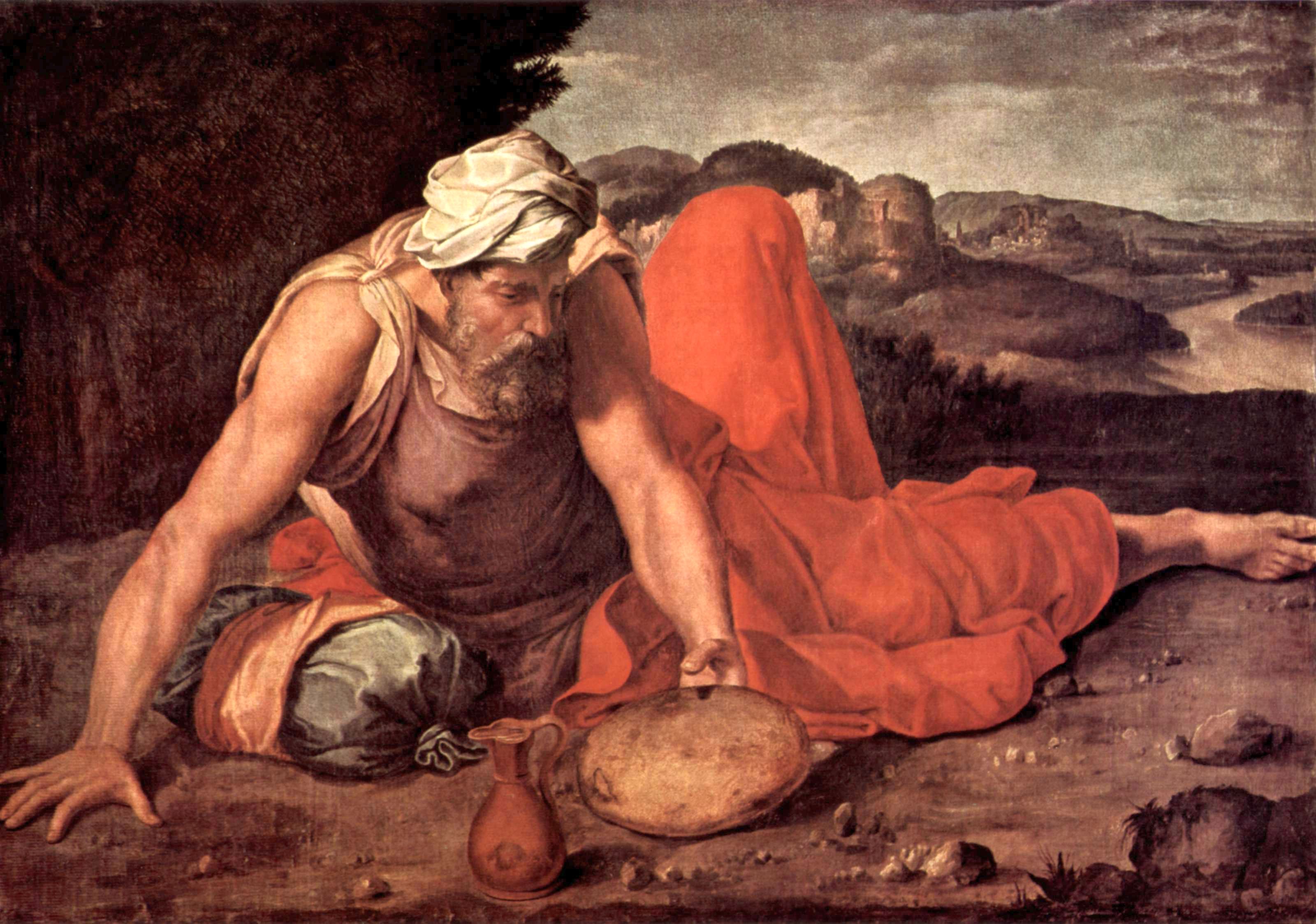
The first reading caught my attention, it being the account of Elias being fed by an angel (III Kings, xix, 4-9):

In those days: Elijah went forward, one day's journey into the desert. And when he was there, and sat under a juniper tree, he requested for his soul that he might die, and said: It is enough for me, Lord, take away my soul: for I am no better than my fathers. And he cast himself down, and slept in the shadow of the juniper tree: and behold an angel of the Lord touched him, and said to him: Arise and eat. He looked, and behold there was at his head a hearth cake, and a vessel of water: and he ate and drank, and he fell asleep again. And the angel of the Lord came again the second time, and touched him, and said to him: Arise, eat: for thou hast yet a great way to go. And he arose, and ate, and drank, and walked in the strength of that food forty days and forty nights, unto the mount of God, Horeb.

Exhausted and dismayed by having to flee from Jezebel's wrath, when he had thought himself victorious in the battle against heresy by calling down fire upon his right sacrifice, and slaying the false prophets of Baal, Elias had fled despairing into the desert, and was like to die. Then came an angel...

Now for those lost, seeking faith and hope confusedly, cast down by thoughts of an evil life no better than one's fathers, those lost and disheartened, it is indeed vital to heed God's messengers (for a priest is as the angel of the Lord) and receive with all thankfulness the Holy Eucharist - and not heedlessly, falling back into spiritual torpor, but partaking with intelligence of its riches.

Solely by profiting by this, the Sacrament Most Comfortable, our only true strength, in the strength of this Food alone may we walk the forty days and forty nights of this present life, through the desert wilderness fraught with serpents and danger (not to mention the alluring mirage of Egypt's fleshpots to deviate our course), unto our final goal, the Mountain of God. We must treat our Eucharist as Viaticum, as our Waybread: for assuredly It alone can give us the strength to walk to heaven, along the Way Which is Christ, Who is our Truth, ani in this His Body is our Life.

Too often to-day we look not up heavenwards whence cometh our help, but keep our eyes downcast upon this miserable mutable earth! As the Apostle tells us (Heb. xii, 22-24):

But you are come to mount Sion, and to the city of the living God, the heavenly Jerusalem, and to the company of many thousands of angels, and to the church of the firstborn, who are written in the heavens, and to God the judge of all, and to the spirits of the just made perfect, and to Jesus the mediator of the new testament, and to the sprinkling of blood which speaketh better than that of Abel.

First Mass of Bl Mary of the Cross

It is 100 years since Bl Mary of the Cross (MacKillop) went to her everlasting reward. In honour of Bl Mary, and in fond regard for two of her daughters in holy religion, Sr Kieran and Sr Bridget - two indefatigable, staunch and very elderly Irish "black Joeys", or Sisters of St Joseph of diocesan rite, that I know from some years back in Hobart, each of whom had even then been seventy-odd years in Tasmania serving the Lord and His people - I would like to retail some interesting details about Australia's sole beata.

(I especially salute Sr Kieran - even in retirement, I have no doubt about stating that, had the Holy Father commanded, she would have gladly taken over running both the Vatican and the Pentagon, and done a sterling job of both. She, just like dear Sr Bridget, had stedfastly rejected any suggestions that she change from her large, starched, traditional habit - "Never heard such a stupid idea!" as she would say; one wonders who would have had the courage to broach the idea with her in the first place...)

Regarding Mother Mary, the modern Josephites don't like admitting three things:
  • that their foundress took the title "of the Cross" - it is rather a solecism, and a secularist-tending uncatholic Freudian slip, to dump this and call her Mary MacKillop everywhere and always;
  • that she wore a voluminous religious habit (they prefer, again for uncatholic motives, to bring forward a photograph of a young woman in sober secular attire - an image quite possibly not of Mary but of a relative - and base representations upon it);
  • that she used the discipline - famously, until but a decade or so ago, one labelled as hers was on display at her shrine and burial place in North Sydney, but the sisters have magicked it away on the grounds that they can't prove its hers (compare this with their sleight-of-hand change of her image).
These same less-than-perfect spiritual daughters of Mother Mary notoriously persuaded a certain recently-deceased Polish Supreme Pontiff to celebrate the beatification Mass with all manner of liturgical nonsense, such as elderly frumpy sisters serving at the altar in lay dress (!), a fake Aboriginal "smoking ceremony", and a very peculiar arrangement whereby large numbers of vessels - I cannot call them ciboria - were not placed on the altar, but held in the hands of those nearby...

Here, however, are three more things that the Josephites would not to-day be so keen on:
  • Bl Mary of the Cross all her life long attended the Traditional Latin Mass, and signalled her death in Sydney to a priest-friend of hers in Adelaide by appearing to him at the side of the altar while he was offering the Sacrifice;
  • the very first Mass of Bl Mary celebrated was a Traditional Latin Mass: for directly the Holy Father pronounced the words of her beatification, Fr Terence Mary (who'd been listening in on the radio) processed into the Maternal Heart chapel at Lewisham to sing High Mass in her honour;
  • and the beata herself has confirmed her preference for the Mass she knew - it has been confirmed to me, that a priest saw her appear at the side of the altar as he celebrated a Traditional Latin Mass: she smiled and walked away through the wall...
It is sad but true that the Josephites, and many another nineteenth century order, have survived just long enough to see their foundress raised to the honours of the altar, but, having fallen away from their observances and loyal Catholicism, are about to die out for lack of vocationsm - whereas, if they had read the signs of the times less facilely and more wisely (not falling into line with the world and losing their raison d'être, but being truly countercultural by keeping committed to orthodox beliefs that alone offer an antidote to modern ills) they could have remained flourishing, as other religious orders have.

It is as the parable of the wise and foolish virgins: five kept awake and trimmed their lamps, but the other five slumbered and slept; their lamps of faith burning out, they ran off to seek from those who sell (the purveyors of spiritual trash), abandoning their vigil and missing their goal.

Get Thee to a Nunnery

It's the feast of Blessed Mary Mackillop, foundress of the Sisters of St Joseph, who combined the active and contemplative lives in her life as a religous, she who is Australia's only saint-in-the-making - and appropriately enough I've been hard at work transcribing (for the benefit of a friend in need) yet another little-known Votive Mass from a curious manuscript in my possession....

This is (excuse the bad Italian - I speak only Propagandese dialect) what's known around Rome as the "Missa senda to a conventa", a formulary obviously of benefit to seminarians who have not yet quite been able to quiet their hearts, despite the earlier use of the Missa contra amicas. (I have previously discussed the great natural and supernatural benefit of a mass exodus from the world to convents and monasteries.)

Missa senda to a conventa


Introit (St John viii, 10b. 11b; Ps xxxix, 5)

Woman, where are they that accused thee? Hath no man condemned thee? Neither will I condemn thee. Go, and now sin no more.

Ps. Blessed is the man whose trust is in the name of the Lord; and who hath not had regard to vanities, and lying follies.

Glory be…

Non dicitur Gloria in excelsis.

Oratio (Cf. Missale Parisiense 1738, Orationes ad diversa, Pro conversione peccatoris & pro sacris Deo Virginibus)

Deus, misericors et clemens, exaudi preces quas pro sorore nostra, gementes in conspectu tuo effundimus: da famulæ tuæ excellentiam virginitatis intelligere, intellectam diligere, dilectam fideliter conservare: ut converta, ubi abundat delictum, superabundet gratia. Per…

(Merciful and clement God, graciously hear our prayers for our sister, which we pour forth weeping before Thy face: give unto Thy handmaid to know the excellence of virginity, to love that knowledge, faithfully to preserve that love: that converted, where sin abounded, grace may more abound. Through…)

Epistle

Lesson from the Book of Judges (xii, 34-39a)

In those days: When Jephte returned into Maspha to his house, his only daughter met him with timbrels and with dances: for he had no other children. And when he saw her, he rent his garments, and said: Alas! my daughter, thou hast deceived me, and thou thyself art deceived: for I have opened my mouth to the Lord, and I can do no other thing. And she answered him: My father, if thou hast opened thy mouth to the Lord, do unto me whatsoever thou hast promised, since the victory hath been granted to thee, and revenge of thy enemies. And she said to her father: Grant me only this which I desire: Let me go, that I may go about the mountains for two months, and may bewail my virginity with my companions. And he answered her: Go. And he sent her away for two months. And when she was gone with her comrades and companions, she mourned her virginity in the mountains. And the two months being expired, she returned to her father, and he did to her as he had vowed, and she knew no man.

Gradual (St John iv, 17b. 18b. 27a)

Thou hast said well, I have no husband. He whom thou now hast, is not thy husband. This thou hast said truly.

V/. And immediately his disciples came; and they wondered that he talked with the woman.

Alleluia (St John ii, 4)

Alleluia, alleluia. V/. Woman, what is that to me and to thee? Alleluia.

Gospel

Continuation of the Holy Gospel according to Matthew. (xix, 25-29)

At that time: When they had heard this, the disciples wondered very much, saying: Who then can be saved? And Jesus beholding, said to them: With men this is impossible: but with God all things are possible. Then Peter answering, said to him: Behold we have left all things, and have followed thee: what therefore shall we have? And Jesus said to them: Amen, I say to you, that you, who have followed me, in the regeneration, when the Son of man shall sit on the seat of his majesty, you also shall sit on twelve seats judging the twelve tribes of Israel. And every one that hath left house, or brethren, or sisters, or father, or mother, or wife, or children, or lands for my name's sake, shall receive an hundredfold, and shall possess life everlasting.

Offertory (St John xx, 13a)

Woman, why weepest thou?

Secret (Cf. M. P. 1738, Orr. ad diversa, Pro Viduis)

Deus, cujus solius est separare, vota nostra pro famula tua clementer exaudi; ut a pedica connubii liberata, in lege Christi permanere, et tibi uni amore casto semper studeat adhærere. Per eumdem…

(God, Whose alone it is to separate, clemently hear our hopes for Thy handmaid: that delivered from the shackle of marriage, she may study to abide in the law of Christ, and ever to adhere unto Thee with one chaste love. Through the same…)

Communion (St Luke xx, 32)

Last of all the woman died also.

Postcommunion (M.P. 1738, Orr. ad diversa, Pro conversione peccatoris)

Domine Jesu Christe, Pastor bone, qui proprio corpore pascis oves, quas tuo sanguine redemisti: ovem tuam errantem require misericors; et ad ovile reportatam, pascuis redde dignam sempiternis. Qui vivis…

(Lord Jesus Christ, the Good Shepherd, Who feedest Thy sheep with Thine own Body, whom by Thy Blood Thou hast redeemed: mercifully seek Thy straying sheep; and, once brought back to the sheepfold, make worthy of everlasting pastures. Who livest…)


For those who wonder about the choice of Epistle - according to some of the Fathers, Jephte fulfilled his vow by consecrating his daughter to the Lord as a holy virgin set apart; which is a nicer interpretation than the usual one: