Showing posts with label Eucharist. Show all posts

Wednesday, December 16, 2009

Invalid Forms

There are rites that would be valid, if celebrated by valid ministers. There are also invalid rites, unable to impart the Sacrament intended - or in some cases because they are not intended to impart the Sacrament!

I've been rereading an old favourite of mine, Neale & Littledale's The liturgies of SS. Mark, James, Clement, Chrysostom, and Basil, and the Church of Malabar ([187-?]): in its first appendix are given the words of institution, the Consecration, or at least what passes for such, in almost all extant liturgies (over eighty of them). Unfortunately, as the book notes, several of the Ethiopian and Syrian Jacobite anaphoræ are not sufficient; here they are, numbered as in the volume mentioned:

* 24. Dionysius Bar-Salibi (Syro-Jacobite).

And when He had prepared Himself for the saving Passion, the bread which He took, He blessed, brake, and named it His holy Body for life everlasting to those who receive it. And the cup, which He mingled with wine and with water, He blessed, and consecrated, and perfected it (into) His precious Blood for life everlasting to those who receive it. And when He had delivered this to His holy Apostles, He commanded them, saying, Thus do for My commemoration until I come.

[An invalid formula.]

I assume that it is invalid because the Verba Domini are phrased in the third person, not the first. The priest, acting in the person of Christ, must say, "This is My Body...", not "This is His Body", which would be merely indicative, not performative.


* 46. James of Serug or Batnæ (Ethiopic).

Thou didst take bread in Thy holy hands, that Thou mightest give it to Thy holy disciples. Thou Who didst then bless, Who art with glory, bless now this bread. Thou Who didst then break, Who art with blessing, break now this bread. And again, Thou didst mix the cup of wine with water, that Thou mightest give it to the pure Apostles. Thou who didst consecrate then, consecrate now this cup. Thou Who didst hand then, hand now this cup. Thou Who didst unite then, unite now this bread to this cup. Let it be Thy Flesh and Thy Blood.

[This is one of the invalid forms, as there is no recitation of the words of institution.]

If anything, this is what is technically called a Logos epiclesis, or invocation of the Person of the Eternal Word to descend and consecrate the elements.


* 49. John Bar-Susan (Syro-Jacobite).

And before the voluntary passion of the Word God, He took in His divine hands simple bread and wine that (was) mingled moderately with water, blessed, and consecrated, and brake, and handed it to the band of the twelve, saying : Take, use (it) ; and when of these ye eat and drink, believe that they are My Body and Blood, which I give for the salvation of tlie world, and they shall be to you, and through you to the whole world, for the commemoration of My Burial aud Resurrection, until that I come.

[An invalid formula.]

I assume this is considered invalid because it most promiscuously, impertinently and presumptuously mixes together the formulæ for consecrating each species, and says "believe that they are" not "they are". But would "These are My Body and My Blood" work?


61. Matthew the Shepherd (Syro-Jacobite).

Priest. And when He willed to give a New Testament, by which the Old should be abolished. He took leavened bread, in which the mystery of life was concealed, and earnestly looking to Thee, Father, He gave thanks. He blessed. He sanctified, He brake, and gave to them that were lying at His supper, saying : Take, eat of it : This is My Flesh, which for all the faithful that adhere to Me is divided, that it may be eaten for the expiation of transgressions, the remission of sins, and eternal life.

People. Amen.

Deacon [!]. In like manner also. He took the Chalice of Life, which He had temperately mingled with the fruit of the vine and water, and gave thanks, blessed, sanctified, and gave also to them that were initiated in His mystery, and exhorted them that all should communicate of it, and declared that in it should be salvation to them that drink it, when they use it in a pure conscience, to the expiation of transgressions, the remission of sins, and eternal life.

People. Amen.

Priest. He adjoined also an admonition and declaration, saying: As often as ye shall be partakers of the Mysteries, ye shall celebrate the memory of My Death and Kesurrection until I come.

People. [As in 18.) We make memory, Lord, of Thy Death, we confess Thy Eesurrection, and we look for Thy Second Advent : we beseech from Thee mercy and grace : we pray for the redemption of our sins : let Thy mercies be upon us all.

[Observe that, valid, though much corrupted, in the first part of the Institution, this formula is invalid in the second.]

Pretty obviously, it just won't do for the priest to consecrate the host, and then let the deacon tackle consecrating the chalice... when all he does (which to be fair, is all he can do) is to describe what benefits it would bring if it were consecrated.


* 69. Our Lord Jesus Christ. II. (Ethiopic.)

In that night in which they delivered Him up, He took bread in His holy and blessed hands, which are without stain, He gave thanks, blessed, and brake, and handed to His disciples, saying : Take, eat ; this bread is My Body, which is broken for you for the remission of sins ; and when ye do this, make commemoration of Me. And similarly the Cup of wine, Thy mixing, giving thanks, blessing, and consecrating, and Thou gavest to them ; verily this is Thy Blood, which was poured out for our sins.

[The latter part of this formula is invalid, and there is no consecration of the Cup.]

Again, for validity, the Verba have to be in the first person: to correct this, adding "saying" before "verily", and changing "Thy" to "My" would work. Strictly speaking, the Mass is only half-completed, and as Christ is present in His Body alone (though by concomitance His whole Person is therefore there), there is no sacrifice, which is made present in the separate consecration of each species, thus mystically re-presenting the separation of His Body and Blood on the Cross. This would truly be a mere Communion service in one kind only.


71. S. Peter. II. [Syro Jacobite.)

Priest. Who, when He willed to taste death, and was accomplishing the Pascha in the evening, He took bread into His hands, He blessed, He sanctified and brake, and gave to the company of the holy Apostles, and said, Take and eat, for the remission of sins and life eternal.

People. Amen.

Priest. In like manner, mingling the Chalice of wine and water, He blessed, sanctified, and said to them, Take, and drink ye all of it, for the remission of sins and life eternal.

People. Amen.

Priest. This He commanded and admonished them, That as often as ye shall accomplish these mysteries, ye shall commemorate My Death and Resurrection until I come.

People. [As in 18.) We make memory, Lord, of Thy Death, we confess Thy Eesurrection, and we look for Thy Second Advent : we beseech from Thee mercy and grace : we pray for the redemption of our sins : let Thy mercies be upon us all.

[This is one of the liturgies which is invalid from the omission of the words, This is My Body, This is My Blood. It is one of the shortest of all the Syro-Jacobite offices and perhaps the composer ignorantly thought that the Invocation of the Holy Ghost, which is singularly plain and expressive, might, by itself, avail for the transmutation of the Elements. He might also wish to express his dissent from the Latin practice of entirely omitting the Invocation. Some copies of this Liturgy have the words inserted by a later hand.]


80. Thomas of Heraclea (Syro-Jacobite).

Priest. Verily and certainly He took on Himself the form of a servant, that in that form He might accomplish the things that were to be for our salvation, and the life that was to be given us. He took bread and wine : He blessed, He sanctified, He brake, and gave to His Apostles, saying : Take, use, and thus do. And when ye shall receive these things, believe and be certain that ye eat My Body and drink My Blood, doing it in remembrance of My Death, until I shall come.

People. (As in 18.) We make memory, Lord, of Thy Death, we confess Thy Eesurrection, and we look for Thy Second Advent : we beseech from Thee mercy and grace : we pray for the redemption of our sins : let Thy mercies be upon us all.

[This is one of the invalid formulæ : the words inserted in the second clause, according to the judgment of the best ritualists, scarcely avail to make good their omission in the first.]

See my comments on no. 49 above...

Any thoughts?

Saturday, August 8, 2009

In the Strength of that Food


Vernacular Mass at St Francis continues to be unexpectedly bearable and pleasant - a devout priest at the altar, and decent music too (Panis angelicus during Communion).

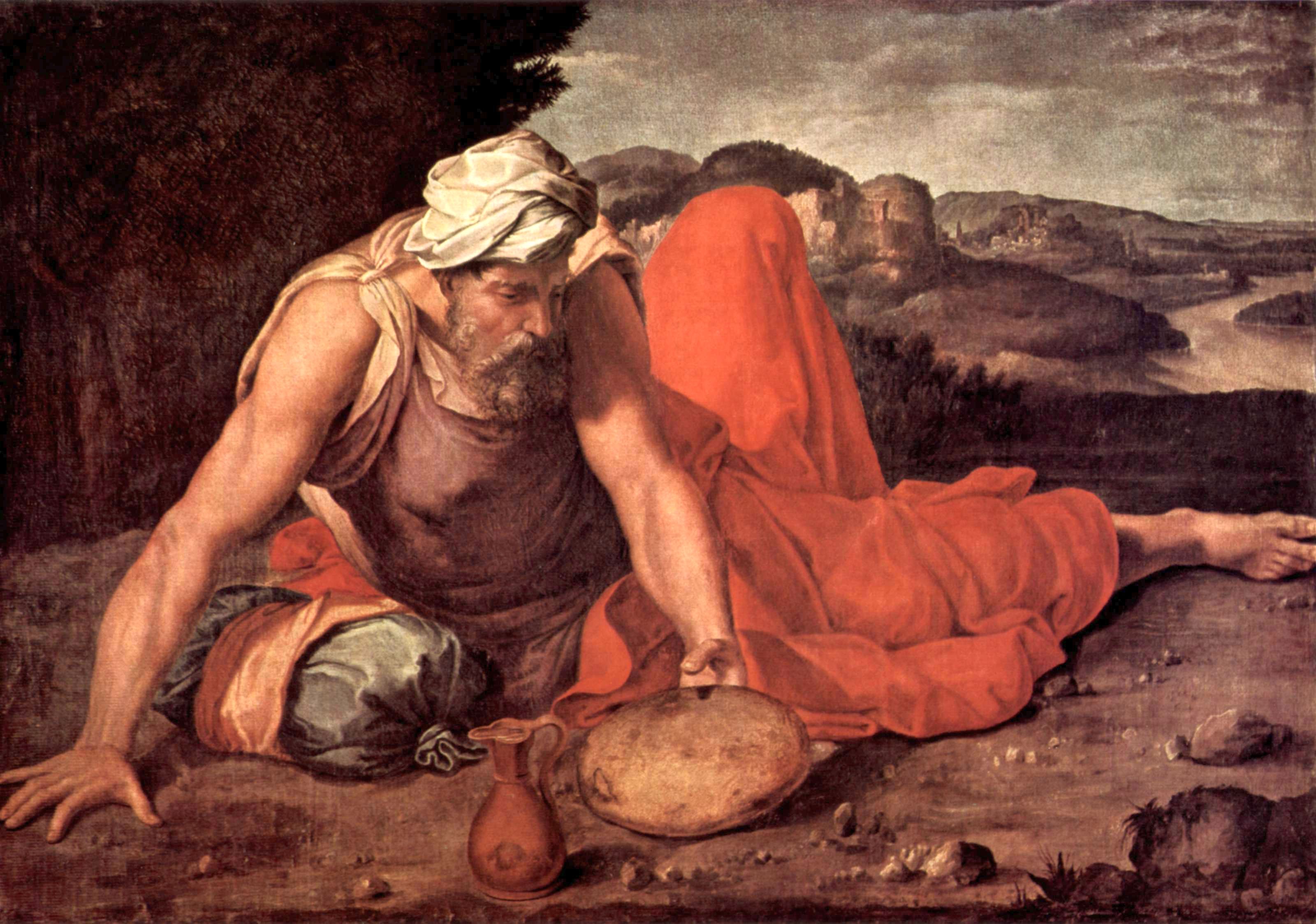
The first reading caught my attention, it being the account of Elias being fed by an angel (III Kings, xix, 4-9):

In those days: Elijah went forward, one day's journey into the desert. And when he was there, and sat under a juniper tree, he requested for his soul that he might die, and said: It is enough for me, Lord, take away my soul: for I am no better than my fathers. And he cast himself down, and slept in the shadow of the juniper tree: and behold an angel of the Lord touched him, and said to him: Arise and eat. He looked, and behold there was at his head a hearth cake, and a vessel of water: and he ate and drank, and he fell asleep again. And the angel of the Lord came again the second time, and touched him, and said to him: Arise, eat: for thou hast yet a great way to go. And he arose, and ate, and drank, and walked in the strength of that food forty days and forty nights, unto the mount of God, Horeb.

Exhausted and dismayed by having to flee from Jezebel's wrath, when he had thought himself victorious in the battle against heresy by calling down fire upon his right sacrifice, and slaying the false prophets of Baal, Elias had fled despairing into the desert, and was like to die. Then came an angel...

Now for those lost, seeking faith and hope confusedly, cast down by thoughts of an evil life no better than one's fathers, those lost and disheartened, it is indeed vital to heed God's messengers (for a priest is as the angel of the Lord) and receive with all thankfulness the Holy Eucharist - and not heedlessly, falling back into spiritual torpor, but partaking with intelligence of its riches.

Solely by profiting by this, the Sacrament Most Comfortable, our only true strength, in the strength of this Food alone may we walk the forty days and forty nights of this present life, through the desert wilderness fraught with serpents and danger (not to mention the alluring mirage of Egypt's fleshpots to deviate our course), unto our final goal, the Mountain of God. We must treat our Eucharist as Viaticum, as our Waybread: for assuredly It alone can give us the strength to walk to heaven, along the Way Which is Christ, Who is our Truth, ani in this His Body is our Life.

Too often to-day we look not up heavenwards whence cometh our help, but keep our eyes downcast upon this miserable mutable earth! As the Apostle tells us (Heb. xii, 22-24):

But you are come to mount Sion, and to the city of the living God, the heavenly Jerusalem, and to the company of many thousands of angels, and to the church of the firstborn, who are written in the heavens, and to God the judge of all, and to the spirits of the just made perfect, and to Jesus the mediator of the new testament, and to the sprinkling of blood which speaketh better than that of Abel.

Friday, February 6, 2009

The Interim Rite

angBe alert, not alarmed - my contacts with the T.A.C. here in Launceston have issued in an invitation to attend their Sunday service.  Well, I had thought this to be Morning Prayer, which according to their website was what they had on the second Sunday of the month - but a recent email informed me that instead it is "the Interim Rite [of Mass] with English Missal additions"... which puts me in a quandary, since I seem to have invited myself to it: I asked the advice of a knowledgeable priest, who gave me some wise advice about what would be appropriate; and his advice concorded with what I had thought acceptable in conscience.

It seems to me, as advised, that if I come along to their service, take a back seat and pray for the happy day to come when all are gathered into the one fold of the Redeemer, while out of courtesy standing, sitting and kneeling as the others do, but avoiding making any responses which would imply agreement with anything that I wouldn't honestly believe, it would be acceptable to attend - for the purpose of learning how the T.A.C. in its local instantiation worships, and, afterward, to meet with their people.

Now, many years back my then parish priest, now Bishop of Lismore, Geoffrey Jarrett, shewed me as a curiosity his old copy of the English Missal, which is basically the Roman Missal in a Cranmeresque English translation, with a few bits and pieces of the Book of Common Prayer interspersed, but so that frankly most bits of it were immersed in a Papal sea; most amusingly, it provides three Eucharistic Prayers - the latter two being the Roman Canon itself, in English and in Latin - and also a proper service for the feast of a certain "King Charles the Martyr", with a Latin Sequence!  This was the text he had used as an Anglican minister prior to his conversion in 1965.

The "Interim Rite" is a clever rearrangement of two prayers in the 1662 B.C.P., following a suggestion made by the Anglican liturgical scholar Walter Howard Frere back in 1911.  First, some background: the 1549 editio princeps of the Book of Common Prayer had a Canon, partly new, partly a cunning recompilation of parts of the Roman Canon, which was sufficiently ambiguous as to admit of both a Catholic and a (very conservative and "high") Protestant acceptation, in simple terms - the devil being most definitely in the details! - but this Canon was broken up in the 1552 and all subsequent B.C.P.'s into three prayers, redistributed throughout the Anglican Eucharistic rite: as Dix cogently argued, this reflects all too accurately Cranmer's further descent into heresy toward a Zwinglian view of the Sacrament.  
  • The first part of the Canon, being a long intercession, was stripped of its list of saints and intercession for the dead, these elements being reduced to a mere thankful remembrance of the faithful departed (so much for the communio sanctorum), and placed earlier on in the rite, becoming the "Prayer for the Church Militant", so as to dissociate the Eucharist from any idea of being offered up for determinate ends as a sacrifice of impetration.
  • The second part, being an epiclesis and the words of institution, had its epiclesis rephrased from "with thy Holy Spirit and word, vouchsafe to bl+ess and sanc+tify these thy gifts and creatures of bread and wine, that they may be unto us the Body and Blood of thy most dearly beloved Son Jesus Christ" to "grant that we receiving these thy creatures of bread and wine... may be partakers of his most blessed Body and Blood", and directly after it the distribution of the elements so prayed over was ordained, so that no time elapse during which the elements might be the object of oblation or adoration.
  • The third part, being an anamnesis with oblation, a petition for fruitful reception, a self-oblation, mention of angelic intercession and doxology, was stript of its anamnesis and oblation, as of the mention of angelic intercession, and, with its petition for fruitful reception watered down, was moved until after the distribution of the elements for communion, and likewise prefixed by the Lord's Prayer (also moved, lest the petition "Give us this day our daily bread" be applied to the Eucharist - very Zwinglian, in its utter denial that the bread had aught to do with the Body) and made the alternative "Prayer of Oblation" to a postcommunion prayer - in Dix's damning words, substituting the oblation of the sons of men for the Oblation of the Son of Man.
Frere's suggestion for an "Interim Rite" was intended as a move back from this nightmare Zwinglian ordo - which somehow had acquired a range of higher interpretations among Anglicans, ranging from receptionism (Hooker's new heresy) up through dynamic virtualism (the spiritual presence of the Lord in the elements in some manner extraordinarily difficult to understand) toward, after the Oxford movement, approaches to the real presence that amounted to transsubstantiation in all but name - by rearranging prayers so as to approach what High Anglicans have always regarded as their liturgical utopia of 1549 (utopia, "no-place", indeed!).  He proposed a simple transposition, to return the Prayer of Oblation to its former place after the Prayer of Consecration, and then to have the Lord's Prayer prayed before the distribution of the elements for communion.

In the absence of any larger liturgical reform (under discussion in 1911, but frustrated by Parliamentary opposition in 1928 and 1929, and not restarted until the 1960's - when as all know all hell broke loose), Frere thought this would move liturgical matters in a more catholic direction.  That said, since the later nineteenth century the more advanced, daring, or just plain crazy Ritualists among the High Church had been adopting just about every Roman custom, prayer and rubric they could lay their hands on, with the result that in Anglo-Catholic parishes the Eucharistic service was basically the Tridentine Mass in English: hence the English Missal and many slightly less brave alternatives thereto.  So "the Interim Rite with English Missal additions" is a representative form of Anglican advanced catholicizing and Romanizing liturgical practice as of the period immediately before Vatican II - in an odd way, the closest thing to the 1962 Missal!

Here is the Interim Rite as Frere proposed it, with the 1549 anamnesis in square brackets:


The Interim Rite (Frere, 1911)
Prayer of Consecration (1662 BCP)
ALMIGHTY God, our heavenly Father, who of thy tender mercy didst give thine only Son Jesus Christ to suffer death upon the Cross for our redemption; who made there (by his one* oblation of himself once offered) a full, perfect, and sufficient sacrifice, oblation, and satisfaction, for the sins of the whole world; and did institute, and in his holy Gospel command us to continue, a perpetual memory of that his precious death, until his coming again; Hear us, O merciful Father, we most humbly beseech thee; and grant that we receiving these thy creatures of bread and wine, according to thy Son our Saviour Jesus Christ's holy institution, in remembrance of his death and passion, may be partakers of his most blessed Body and Blood: who, in the same night that he was betrayed, took Bread; and, when he had given thanks, he brake it, and gave it to his disciples, saying, Take, eat, this is my Body which is given for you: Do this in remembrance of me. Likewise after supper he took the Cup; and, when he had given thanks, he gave it to them, saying, Drink ye all of this; for this is my Blood of the New Testament, which is shed for you and for many for the remission of sins: Do this, as oft as ye shall drink it, in remembrance of me. Amen
Prayer of Oblation (BCP 1662)

[1549
includes: Wherefore,] O LORD and heavenly Father, [1549 includes: according to the institution of thy dearly beloved Son, our Saviour Jesus Christ,] we thy humble servants [1549 includes: do celebrate, and make here before thy divine Majesty, with these thy holy gifts, the memorial which thy Son hath willed us to make, having in remembrance his blessed passion, mighty resurrection, and glorious ascension, rendering unto thee most hearty thans, for the innumerable benefits procured unto us by the same,] entirely desire [1549: desiring] thy fatherly goodness mercifully to accept this our sacrifice of praise and thanksgiving; most humbly beseeching thee to grant, that by the merits and death of thy Son Jesus Christ, and through faith in his blood, we and all thy whole Church may obtain remission of our sins, and all other benefits of his passion. And here we offer and present unto thee, O Lord, ourselves, our souls and bodies, to be a reasonable, holy, and lively sacrifice unto thee; humbly beseeching thee, that all we, who are partakers of this holy Communion, may be fulfilled with thy grace and heavenly benediction. And although we be unworthy, through our manifold sins, to offer unto thee any sacrifice, yet we beseech thee to accept this our bounden duty and service; not weighing our merits, but pardoning our offences, through Jesus Christ our Lord; by whom, and with whom, in the unity of the Holy Ghost, all honour and glory be unto thee, O Father Almighty, world without end. Amen.

[* Some printings of the 1549 B.C.P. read "own" instead of "one" - the difference is significant.]

And this is my critique of it, using Bishop Elliott's categories of real presence, sacrifice and communion - considering these in the abstract, without thereby wishing to declare the prayers sufficient to express Catholic doctrine, and leaving aside the issue of Anglican orders:
  1. the Cranmerian revised epiclesis as quoted above still stands, and its words "that we receiving these... creatures of bread and wine... may be partakers of [Christ's] Body and Blood", are incompatible with Catholic doctrine unless interpreted in a manner that does violence to its words, since it states that when the elements are received, they are still in their proper natural substances - perhaps the T.A.C. version either changes these words back to their 1549 version, or so modifies and surrounds them in its rite with fuller expressions, that they can be made to express the correct belief;
  2. as to the Eucharist as a sacrifice, certainly the Eucharist is a "sacrifice of praise and thanksgiving" - but while a Catholic would read "this our sacrifice" as referring to the Eucharist, a Protestant could instead read "this our sacrifice of praise and thanksgiving" as being merely our verbal sacrifice of praise and thanksgiving, which we offer up at the Lord's Supper as merely our own unworthy self-oblation; similarly, the Catholic doctrine is that the Mass is also a sacrifice of propitiation and impetration, offered up in expiation of the outrage of sin and to obtain all blessings spiritual and temporal - which could be what is shortly expressed in the words "that by the merits and death of thy Son Jesus Christ, and through faith in his blood, we and all thy whole Church may obtain remission of our sins, and all other benefits of his passion"; or these words could be interpreted in the Protestant sense of looking to the Cross, not as manifested in power in the Eucharist, but as a once only offering at Calvary in no way made present in the Eucharist (what masterful ambiguity!) - so again, it will depend on whatever ancillary prayers are added in from the English Missal to determine the doctrine being expressed;
  3. the communion aspect is probably the most acceptable - since it prays that all who partake of "this holy Communion" may share in Christ's Body and Blood, and thereby be filled with all grace and blessing (and of course, if the additional parts from the English Missal used to supplement these two Prayers include translations of the relevant prayers preparatory to communion, so much the better).
I shall be interested to observe whether these preliminary surveys of the Interim Rite with added prayers is what I shall witness on Sunday.

Wednesday, December 31, 2008

Splitting the Difference

When Luther infamously rejected the Roman Canon as "reeking of oblation", retaining alone the Verba Testamenti (the words of Our Lord instituting this Sacrament) found "[captive] like the Ark in the Temple of Dagon", he little kenned that the Canon is among the oldest surviving Eucharistic Prayers, being attested to in substantially the same form by St Ambrose in his authenticated late fourth century De Sacramentis, and most probably being of earlier origin, as for example the phrase quod tibi obtulit summus sacerdos tuus Melchisedech is objected to in the Quæstiones Veteris et Novæ Testamenti (circa 370) on the grounds that Melchisedech is not called "high priest" in Scripture, but rather "priest of God most High" - and this implies that the offending phrase is a mistranslation of the Greek τὴν προσφορὰν Μελχισεδὲκ τοῦ ἱερέυς σοῦ τοῦ ὑψίστου.

The mediævals of course expressed the highest praise for the most sacred mysteries of the Canon of the Mass, without, however, always understanding much of it - for instance, Paul the Deacon wrote of the Supplices te rogamus that it was not so much as to be comprehended as to be feared!  In the meanwhile, they supplied from Gallican and other sources many proleptic prayers to be used during the Offertory, to the extent that these almost formed a doublet of the Canon, and indeed were known collectively as the Little Canon or Canon minor.

To return to Luther, in his Formula missæ he made the radical but surprisingly 'traditional' suggestion that the consecratory words of the Lord ought be transferred from their silent recitation in the midst of the Canon to a public chanting in the midst of the Preface - I say this is 'traditional', for it actually well corresponds, surprisingly enough, to the consecratory Prefaces of the Roman Rite, such as those for ordinations.  I say this is in a manner 'traditional', further, because there is good evidence from early sources, including in Italy, that the Sanctus is a later addition to the Eucharistic Prayer, being perhaps Syrian in origin, and so the no longer extant original of the Canon may well have passed from praise of God in what is now the opening of the Preface straight into the consecratory and oblatory passages of the Canon, thus constituting what's called a two-step prayer, rather than the somewhat later three-step Eucharistic Prayers (such as those of the Byzantine Rite), with their successive thanksgiving series, Verba and epiclesis, each tidily attributed to Each of the Divine Persons in due order.  

(En passant, the fact that the epiclesis occurs in different places in different rites, sometimes explicitly calling upon the Spirit to consecrate the elements, sometimes doing so inchoately or not mentioning the Holy Ghost, as famously in the Roman Canon itself, shews that this is a later explicitation of the liturgical and sacramental action, and not an original and absolutely necessary element thereof - Our Lord certainly blessed the bread and wine He transsubstantiated, but didn't invoke the Holy Ghost by name to do so: the words He spoke as the Word Incarnate effected what they signified.)

By emplacing the Verba in the midst of the Preface, the Sanctus could then follow, and the elevation of the Sacrament - which Luther considered a happy and salutary custom - would be carried out directly before the Benedictus, thus as much as he felt possible conserving the accepted shape of the liturgy.  Now, it goes without saying that I hardly approve of such highhanded mucking about with the liturgical order laid down by Holy Church, inspired by the Holy Ghost, but I feel called to speculate a little about this...

Some few Lutheran Agendæ kept a modified and invariable Secret as an epicletic prayer, but in general, as I understand it because it to them smacked of Calvinist practice whereby the Reformed sectaries pretended that prayer to the Holy Spirit obtained that the elements be set aside as mere instruments and tokens, Lutherans dropped any prayer asking for the Sacrament to be effected, considering that the Verba alone sufficed (as indeed they do, after all).  However, Luther in his Deutsche messe introduced what became very popular and almost standard: to sing the Preface and Sanctus, then (in inverted order) the Lord's Prayer before the Verba, so rendering, in popular acceptation at least, the Our Father an epicletic, even consecratory prayer begging God to "Give us this day our daily bread" - in a sense reducing the Eucharist to Holy Communion only.  

He did I recall recommend the Pax Domini be kept, recognizing it quite shrewdly for what liturgiologists have established it originally was, a pre-communion blessing, and likewise kept the Agnus Dei: Lutherans have maintained both of these.  He also allowed for what has fallen out of use among them irregardlessly, the precommunion private prayer Domine Jesu Christe, Fili Dei vivi.

So, why this great long curious winding detailing of orthodox and heterodox liturgy?  (For even more of the same, consult my posting about Swedish Lutheran liturgical history.)  Well, seeing as there is the Anglican Use Book of Divine Worship, what would be proposed for, so to speak, Uniate Lutherans?  I make bold to suggest that recovery of the Suscipe sancta Trinitas as a sort but complete formula of anamnesis and oblation for the living and the dead would supply the missing element to Lutheran formulas!  Here is the suggested schema:
  • Epicletic Secret Prayer (Oratio super oblata), fixed - as for example derived, oddly enough, from the Secret of the orations pro rege:
Munera, Domine, quæsumus, [hæc tua] sanctifica: ut [...] nobis Unigeniti tui corpus et sanguis fiant [...].  Qui tecum vivit...

(Hallow, Lord, we beg, these Thy gifts: that they may become for us the Body and Blood of Thine Onlybegotten.  Who with Thee liveth...)
  • Sursum corda and Preface, with the Verba inserted (Qui pridie or somesuch), but then continuing on with the usual conclusion describing the angels' worship;
  • Sanctus and Benedictus, with the Elevation between, and...
  • Prayer Suscipe sancta Trinitas - I am thinking of the very short but complete Dominican Rite variant (the Roman or another would do as well*), which oddly enough is identical to that of the Use of Hereford, and expands upon the Pauline statement that the use of the Sacrament makes manifest the saving death of the Lord until He come (I Cor. xi, 26):
Suscipe sancta Trinitas hanc oblationem, quam tibi offero in memoriam Passionis Domini nostri Jesu Christi: et præsta ut in conspectu tuo tibi placens ascendat; et meam et omnium fidelium salutem operetur æternam.
(Receive, holy Trinity, this offering, which I offer thee in memory of the Passion of Our Lord Jesus Christ: and grant that it may arise pleasingly in Thy sight unto Thee; and may it work my eternal salvation and that of all the faithful.)
  • Doxology Per ipsum, sung aloud;
  • The Lord's Prayer, concluding, as the Lutherans like, with its Doxology;
  • Pax Domini and Agnus Dei;
  • Preparatory prayer(s) (Domine Jesu Christe, qui dixisti and) Domine Jesu Christe, Fili Dei vivi.
Given the addition in particular of the Suscipe sancta Trinitas*, the previous intercessions offered earlier in the service would be linked to the supreme oblation of the Holy Sacrifice made present in the Consecration.

******

* If one wishes to continue to play the happy if dangerous game of liturgical recomposition beloved of various Vatican II types, to which yours truly is obviously not entirely immune if only as a parlour game, perhaps instead the Byzantine formula would suit:
Μεμνημένοι τοίνυν τῆς σωτηρίου ταύτης ἐντολῆς καὶ πάντων τῶν ὑπὲρ ἡμῶν γεγενημένων, τοῦ Σταυροῦ, τοῦ Τάφου, τῆς τριημέρου Ἀναστάσεως, τῆς εἰς οὐρανοὺς Ἀναβάσεως, τῆς ἐκ δεξιῶν Καθέδρας, τῆς δευτέρας καὶ ἐνδόξου πάλιν Παρουσίας, Τὰ Σὰ ἐκ τῶν Σῶν Σοὶ προσφέρομεν κατὰ πάντα καὶ διὰ πάντα.

(Therefore, remembering this command of our Saviour, and all that He had endured for us: the Cross, the Grave, the Resurrection on the third day, the Ascension into Heaven, the Session at the Right Hand [of the Father], and the Second and glorious Coming again, Thine own of Thine own we offer unto Thee, on account of all and through all [that Thou hast done for us].)

Controversial, but hopefully interesting? - at least to readers of Sentire cum Ecclesia, I hope!

Sunday, May 11, 2008

Liturgical Anniversary

I was baptized, confirmed, and houselled on Pentecost Sunday, 1987; after a most lukewarm time as a teenager, I came back to the practice of my faith on Pentecost Sunday 1994: I treat this solemnity, therefore, as my anniversary - this year, the 21st - of incorporation into Christ through His Church.

Although I daily grieve the Holy Spirit (cf. Eph. iv, 30), by His free gift of grace I continue to turn again to the Lord, and through Confession come again to Communion, the Holy Eucharist: Ave in æternum, sanctissima Caro Christi, mihi ante omnia et super omnia summa dulcedo. The Eucharist gives us spiritual life: "As the living Father hath sent me, and I live by the Father; so he that eateth me, the same also shall live by me" (St John vi, 58). I think I could not go without it. Soon I will go off to Mass.