Friday, September 4, 2009

St Moses


(Moses in Western art is always portrayed with horns,
following Jerome's literal translation of
Exodus xxxiv, 29, 30 and 35 - "his face was horned":
wherever the verb qaran otherwise appears,
it means "to have horns",
but as a noun in post-biblical literature it can mean "ray of light";
St Paul wrote of how Moses' face shone after meeting with the Lord,
in II Corinthians iii, 7 and 13,
following the Septuagint paraphrase "his face was glorified".)

Fairly obviously, of all the saints remembered on this day, Moses, par excellence "the man of God" (Ps 89, superscription) is the one of signal importance in the whole history of salvation. Since his deeds at the Lord's command are so well-known, I'll not go over them here; rather, here is the encomium of Moses found in Ecclesiasticus xlv, 1-6:

Moses was beloved of God, and men: * whose memory is in benediction.
He made him like the saints in glory, † and magnified him in the fear of his enemies, * and with his words he made prodigies to cease.
He glorified him in the sight of kings, † and gave him commandments in the sight of his people, * and shewed him his glory.
He sanctified him in his faith, and meekness, * and chose him out of all flesh.
For he heard him, and his voice, * and brought him into a cloud.
And he gave him commandments before his face, * and a law of life and instruction,
That he might teach Jacob his covenant, * and Israel his judgments.

The great lesson of Moses, as of all true saints, is found in his meekness and humility. As the Baptist later declared, He must increase, I must decrease.

Moses even in his death was a prophet, for he died in sight of, yet outside the Promised Land, revealing how the Law he taught would not of itself suffice to save. "Did Moses not give you the law, and yet none of you keepeth the law?" (St John vii, 19) It required a new Prophet like himself to arise, to bring the people into their rest (and Him Joshua foreshadowed). "For the law was given by Moses; grace and truth came by Jesus Christ." (St John i, 17) "We have found him of whom Moses in the law, and the prophets did write, Jesus the son of Joseph of Nazareth." (St John i, 45b) "There is one that accuseth you, Moses, in whom you trust. For if you did believe Moses, you would perhaps believe me also; for he wrote of me." (St John v, 45b-46)

Moses, after long centuries of waiting in the Limbo of the Fathers, was, with Elijah (who like him had fasted forty days and forty nights that he might behold God face to face on the mountain), brought to bear witness to the Transfiguration of Christ, our God Incarnate, and to speak with Him (St Matthew xvii, 3; St Mark ix, 3) of the exodus, of the passing-over, that He was to accomplish in Jerusalem (St Luke ix, 30f), thus fulfilling the Old Testament figure of the Passover, and opening the gates of heaven to Moses, Elijah, the righteous of the Old Testament, and all men to come who should believe.

Moses led the people through the Red Sea waters, trusting in the power of God to save them and drown their rabid foes; and this again was a secret showing forth of what was to come: the waters of baptism - "all in Moses were baptized, in the cloud, and in the sea" (I Cor. x, 2) - whereby we are delivered from spiritual darkness and captivity. Likewise, by his stretching forth his arms in prayer (cf. Ex. xvii, 8-16), he foreshadowed the power of the Cross in overcoming all enemies of the chosen people of God. Likewise (cf. I Cor. x, 3f), the spring of water opened in the desert (Ex. xvii, 1-7), and the manna sent down from heaven, foreshadowed the Holy Eucharist, the true bread from heaven (cf. St John vi, 32), the true drink, which feeds us, not only for a time like the water and manna of old, but unto everlasting life.

It interests me to note parenthetically that, while in English we call him Moses, his name in the Hebrew is rendered something like Moshe, but was processed into Greek as Μωϋσῆς and thence into Latin as Moyses. In all these languages, it sounds really strange - because it is an Egyptian name, given him by Pharoah's daughter. Very interestingly, many Egyptians had names ending with a similar pair of syllables: Thutmoses, Rameses, etc.; but in these cases, the first part is the name of a pagan deity, Thoth, Ra, or whatnot, and therefore the full name meant "son of", "begotten of", "provided by" the god. It may be that Moses had such a theophoric name, but got rid of the embarrassingly pagan first half!

The Mutterology

Some Dominicans told me that of old time, the custom in their Melbourne priory was to have the Martyrology read out in the refectory during the meal; the clerical students deputed to this task termed it the Mutterology, as their Latin was perhaps faced by many a tonguetwister! They still joke about the saint(s) who died at "Too dirty in Umbria" [Tuderti, locative of Tuder, now Todi].

While in the old rite the 4th of September is a feria, there are a slew of saints whose anniversaries occur. From to-day's (1962) Martyrology (which I didn't get around to reading at Prime yester-day, hence my interest):

  • St Moses the Prophet and Lawgiver of Israel;
  • St Candida, said to have been first-fruits of Naples for Christ (and baptized by St Peter)*;
  • St Marcellus, bishop of Treves and martyr*;
  • SS Rufinus, Silvanus and Vitalicus, child-martyrs of Ancyra in Galatia*;
  • SS Magnus, Castus and Maximus, martyrs*;
  • St Marcellus, martyred at Chalons in the reign of the Emperor Antoninus by being buried up to his waist and left to die;
  • St Thamel (previously a pagan priest) and companions, martyrs*;
  • SS Theodore, Oceanus, Ammian and Julian, martyred by having their feet chopped off and their bodies thrown into a fire;
  • Pope St Boniface I, Confessor (died 422);
  • St Marinus, anchorite and deacon at Rimini, who converted many to the Faith of Christ (4th or 5th century);
  • St Rosalia, Virgin, a 12th century native of Palermo, and of royal descent, who abandoned the pomps and comforts of court and fled rather to the mountains to live as a hermitess;
  • St Rose of Viterbo, Virgin, whose relics were translated this day.

The modern Martyrology, observing many of these saints on different days, and omitting some so far as I can see (the ones marked with asterisks *), adds these other saints and beati, of local cultus only:

  • St Caletrix, 6th century bishop of Carnuti in Neustria (where?);
  • St Ida, widow of Duke Egbert, at Heresfeld in Saxony (died 825);
  • St Fredald, bishop and martyr, at Mimatus in Aquitaine (9th century);
  • St Irmgard, Countess of Süchteln, at Cologne (died circa 1089);
  • Bl Catherine Mattei, Virgin and Dominican sister of penitence (died 1547);
  • Bl Scipio Jerome Brigéat de Lambert, priest and martyr, starved to death in a prison hulk during the French Revolution in 1794;
  • Bl Marie of St Cecilia Bélanger, Virgin, religious sister of the Congregation of Jesus and Mary (died 1929);
  • BB Jose Paschal Carda Saporta and Francis Sendra Ivars, priests, and Bernard Bieda Grau, Capuchin, martyred in various parts of Spain during the Spanish Civil War.

Sancta Maria et omnes Sancti intercedant pro nobis ad Dominum...

(May Holy Mary and all the Saints intercede for us with the Lord....)

...ut nos mereamur ab eo adjuvari et salvari, qui vivit et regnat in sæcula sæculorum. Amen.

(...that we may deserve to be helped and saved by Him, Who liveth and reigneth world without end. Amen.)

Thursday, September 3, 2009

Ecclesiasticus Chapter XIV

Holy Church appoints to-day her book, the Church's wisdom, that is, Ecclesiasticus, to be read at Matins; and it is the fourteenth chapter thereof with which the lessons are concerned, beginning with verses 1 to 5:

Blessed is the man that hath not slipped by a word out of his mouth and is not pricked with the remorse of sin. Happy is he that hath had no sadness of his mind, and who is not fallen from his hope. ... He that is evil to himself, to whom will he be good? ... (Ecclus xiv, 1-2, 5a)

The second lesson (verses 6 to 10) concerns the self-hatred of the envious and covetous; to-day, by reason of the occurrence of the feast of St Pius X, it is combined with the third lesson (verses 11 t0 17):

My son, if thou have any thing, do good to thyself, and offer to God worthy offerings. Remember that death is not slow, and that the covenant of hell hath been shewn to thee: for the covenant of this world shall surely die [that is, the decree that dying we shall die binds all men]. Do good to thy friend before thou die: and according to thy ability, stretching out thy hand, give to the poor. Defraud not thyself of the good day: and let not the part of a good gift overpass thee. Shalt thou leave to others to divide by lot thy sorrows and labours? Give and take, and justify thy soul. Before thy death work justice: for in hell there is no finding food.

In other words, all too soon we shall die, and whatsoever we have not done, never shall we do. Now is the time to act, and do good while it is yet day, for the night comes when none can work. Death is certain; when we are weighed in the balance, "Every work that is corruptible shall fail in the end: and the worker thereof shall go with it [to corruption]. And every good work shall be justified: and the worker thereof shall be honoured therein." (Ecclus xiv, 20f)

Here we have expressed already in the Old Testament the doctrine of the Apostle:

For other foundation no man can lay, which is laid: which is Christ Jesus. Now, if any man build upon this foundation, gold, silver, precious stones, wood, hay, stubble: every man's work shall be manifest. For the day of the Lord shall declare it, because it shall be revealed in fire. And the fire shall try every man's work, of what sort it is. If any man's work abide, which he hath built thereupon , he shall receive a reward. If any man's work burn, he shall suffer loss: but he himself shall be saved, yet so as by fire. (I Cor. iii, 11-15)

Whatsoever good we do, if it is truly founded upon Christ, and built conformably upon Him, it will be good; but unless the Lord builds the house, the builders labour in vain (Ps 126:1). Thus saith the Spirit: "Blessed are the dead who die in the Lord... for their works follow them." (Apoc. xiv, 13b & d)

Redeem the time!

St Pius X

Oh, I almost forgot: to-day (according to the 1962 books and those who follow them) is the feast of Pope St Pius X: may he intercede for the Church, that she be one in faith, all in good order, and for all people, that we may follow after his example and teachings, and so join him in heaven. God grant it!

Dogma and the Transcendentals

I think someone said that each person tends to be attracted more to one of the transcendentals - the good, the true, the beautiful (accepting for the moment that the beautiful is a transcendental) - than to the others. I suppose in my case it would be the true that captivates me. The beautiful also; the good, less so: hence my sins tend to be about missing the good or going after goods in the wrong way. The true in a sense corresponds with faith, one of the theological virtues; the beautiful, with hope I suppose; and the good with charity.

Alas, love is the virtue I lack. (For this cause, and because of the replacement role it plays in modernist misbelief - filling in for lack of belief in doctrine - I cannot abide talk of social justice. Catholic schooling has permanently inoculated me against it, for ever. Of course, I do try and give alms and such, but I no longer believe the secularist aCatholic claim that it is the trendy left that really help, rather than infantilize, the poor...)

With this in mind, it can be seen how I heartily agree with this statement of Newman's:

“From the age of fifteen, dogma has been the fundamental principle of my religion: I know no other religion; I cannot enter into the idea of any other sort of religion; religion, as a mere sentiment, is to me a dream and a mockery.”

For this cause, I hate and detest sentimentality, doubt, and the rejection of reason - nothing gets me riled up worse than fools saying "Why don't we just all love Jesus and not worry about these silly doctrines any more?". I am firmly of the opinion that many after the Council delighted in rejecting as much of the Faith as possible, dumbing everything down - evacuating our most holy religion of content. Some people would rather believe nothing - it's more convenient. Stupidity is alive and well in most Catholic churches! I don't mean by this anything against those of low intellect - they are creatures of God - but by this I reprobate those who wallow in ignorance and delight in their own lack of understanding, in a mad kind of pride.

Similarly, while some just "lurrrve" sentimental songs of dubious orthodoxy, such as the lyrics of Marty Haugen or John Bell, I cannot stand their puerile sound and uncatholic message. Compare such unhealthy "fast food" music to the more difficult to appreciate and sing, but holier treasures and more beautiful far that is the prodigious inheritance of sacred music down the ages. Trust our own Philistine and narcissistic age to dump most of this. It is the same with the awful solemnity of the Sacred Liturgy - too many think Mass ought be (aging) hippies gathered with a guitar round a trestle table. Mass like that is an abomination! "O worship the Lord in the beauty of holiness" should be the words to heed.

So I do value the beautiful, but not to the extent of running into effete æsthetic excess. Particularly in Australia, the beautiful is often mocked by lazy lax liberals as being "gay" - and of course there is that perversion of beauty around, but abusus non tollit usus. "Bells and smells" cannot be the end of it - as is said of some immoral Anglicans, their holiness ends when the vestments are packed away. (A friend of mine and a female friend of his were horribly scandalized by some High Church types, who invited them to a fancy dress party that turned out to be low and vile - at which those dirty buggers were tricked out in church vestments. I use the term buggers advisedly.)

Liturgy must never be camp; neither must it be feminized as the Novus Ordo too often is, with the only man present in the sanctuary an emasculated old priest, surrounded by women, with a congregation largely of the same. The Mass should be masculine in the true sense of imaging sacrifice, for Christ the Bridegroom gave Himself sacrificially for His Bride the Church, and His priests and their ministers sacramentally represent this truth. If Mass does express this, both men and women will feel comfortable with it. Liturgy, if feminized or effete, repels normal folk of both sexes.

Ave atque Vale, Tolkien

Here are my posts about Tolkien:
  • Subcreation (my brief explanation of Tolkien's insight that, when we write stories, we are are in humble yet real sense reflecting the creative power of the Creator);
  • Day is Ended (my eulogy of Tolkien, from his first inspiration for Middle-earth, a line from an Old English poem, to a late work, "Bilbo's Last Song" - picturing that elderly hobbit's farewell to Middle-Earth, which may be read as Tolkien's own farewell to this world ere he passed over to the Undying Lands).
I commend these to readers' attention - and particularly the last, in remembrance of his passing. Ora pro eo.

Tolkieniana

Having been enjoying reading over things elvish and otherwise at Singulare Ingenium, and being only able to potter around to-day while I slowly get over a nasty cold, I thought I'd make a little catalogue of my books by and about the late great J.R.R. Tolkien, whose anniversary of death was yesterday (he died in 1973 - God rest his soul evermore).

The very first book of Tolkien's that I read must have been The Hobbit, which I surely read whilst at primary school; but strangely I never owned a copy until recently, when I picked one up secondhand: I had aways just borrowed one from whatever library was handy. I bought a second copy while in W.A., since most of my books were back in Tasmania.

Next, my well-beloved, terribly worn-out boxed set of The Lord of the Rings, given me as a birthday present when I was in Grade 3 (and devoured over the long Christmas holidays that year, while I was laid up with a severe dog bite to my right leg), and which I've read over cover-to-cover (especially the Appendices - what does that say about me?!) three or four times at least as I grew older, until their increasingly fragile condition made me buy a new set for reading from (especially as I was in W.A. at the time, without most of my books).

Finally, after reading LOTR, while still a young 'un, the family doctor lent me his hardback copy of The Silmarillion, but I found this rather different from what I expected, and only came to appreciate it much later, once I was all grown up. Again, I only bought a secondhand copy of it in 2001, and a second copy while over in Western Australia.

Here is my little list of Tolkien's books:

  • J.R.R. Tolkien; Pauline Baynes, illus. Bilbo's Last Song (hardback), London: Random House, 2002.
  • J.R.R. Tolkien; Christina Scull & Wayne G. Hammond, edd. Farmer Giles of Ham (paperback), London: Harper Collins, 1999.
  • J.R.R. Tolkien, trans.; Christopher Tolkien, ed. Sir Gawain and the Green Night, Pearl, and Sir Orfeo (paperback), London: George Allen & Unwin, 1983. [secondhand]
  • J.R.R. Tolkien, trans. Sir Gawain and the Green Night, Pearl, and Sir Orfeo (paperback), New York: Ballantine, 1980. [secondhand - acquired while I was in W.A.]
  • J.R.R. Tolkien, The Hobbit (paperback), London: George Allen & Unwin, 1978. [2 copies, both secondhand]
  • J.R.R. Tolkien, The Lord of the Rings (3 volume paperback boxed set), London: George Allen & Unwin, 1982.
  • J.R.R. Tolkien, The Lord of the Rings (3 volumes, paperback), London: Harper Collins, 2001. [Two of these I bought secondhand.]
  • J.R.R. Tolkien; music by Donald Swann, The Road Goes Ever On (hardback, with CD), London: Harper Collins, 2002. [Includes "Lúthien Tinúviel" and "Bilbo's Last Song".]
  • J.R.R. Tolkien; Christopher Tolkien, ed. The Silmarillion (paperback), London: George Allen & Unwin, 1979 [1st copy] & 1984 [2nd copy]. [both secondhand]
  • J.R.R. Tolkien, Tree and Leaf, including Mythopoeia and The Homecoming of Beorhtnoth (paperback), London: Harper Collins, 2001. [Contains On Fairy Stories and Leaf by Niggle.]
  • J.R.R. Tolkien, Unfinished Tales (paperback), London: George Allen & Unwin, 1985.

And here is my list of Tolkieniana, books about Tolkien and his œuvre:

  • Humphrey Carpenter, J.R.R. Tolkien: A Biography (paperback), London: George Allen & Unwin, 1978. [secondhand]
  • Patrick Curry, Defending Middle Earth: Tolkien: Myth & Modernity (paperback), London: Harper Collins, 1998.
  • David Day, The Hobbit Companion (hardback), Milsons Point: Random House Australia, 2002.
  • Colin Duriez, The Tolkien and Middle-Earth Handbook (paperback), Pymble, Harper Collins, 1992. [secondhand]
  • Jude Fisher, The Lord of the Rings: The Return of the King: Visual Companion (hardback), London: Harper Collins, 2003. [A present from a Dominican friend.]
  • Daniel Grotta, The* Biography of J.R.R. Tolkien, Architect of Middle-Earth (paperback), Philadelphia: Running Press, 1978. [secondhand] [*How immodest!]
  • Wayne G. Hammond & Christina Scull, The Lord of the Rings: A Reader's Companion (paperback), London: Harper Collins, 2005.
  • Randel Helms, Tolkien and the Silmarils (hardback), London: Thames and Hudson, 1981. [secondhand]
  • Paul Kocher, Master of Middle-Earth: The Achievement of J.R.R. Tolkien (paperback), London: Pimlico, 2002.
  • Joseph Pearce, Tolkien: Man and Myth (hardback), London: Harper Collins, 1999.
  • Joseph Pearce, ed. Tolkien: A Celebration: Collected Writings on a Literary Legacy (paperback), London: Harper Collins, 1998.
  • Tom Shippey, J.R.R. Tolkien: Author of the Century (paperback), London: Harper Collins, 2001.
  • Michael N. Stanton, Hobbits, Elves and Wizards: Exploring the Wonders and Worlds of J.R.R. Tolkien's The Lord of the Rings (paperback), New York: Palgrave Macmillan, 2002.

Some of these books are at the embarrassing hippie-devotee end of the spectrum, but most others are solid, sympathetic and Catholic.

(I also have the DVD's of the recent films made of LOTR.)

I really must get a copy of Tolkien's letters, as edited by Humphrey Carpenter, which I've read through before but ought read again; I am surprised to find I don't have a copy of The Adventures of Tom Bombadil nor of Smith of Wootton Major (both of which I first eagerly read long years past, while at primary school); and I wouldn't mind some of the History of Middle Earth series that Christopher Tolkien has brought out, particularly the parts detailing his philosophical speculations.

[UPDATE: I've just bought these desiderata online, except for the last-named!]

And finally there is my own signal contribution to Tolkien studies - a cassette tape of my lecture to the Newman Society of the University of Tasmania, given 28th July 2002! I may one day get around to transcribing this brilliant jewel of erudite exposition...

Still Ill

Another day off work! - I may not see my colleagues till after the holidays at this rate. I began antibiotics to-day, since my doctor told me that if I were still unwell, I most probably have not a viral infection, but a bacterial...

Yuck.

Wednesday, September 2, 2009

My God, My Mercy

I have a little prayer book entituled My God, My Mercy (quoting Psalm 68:18b - Deus meus, misericordia mea); this line one strikes each Wednesday at None in the Breviary, and to-day (being sick at home) I had the sudden inspiration (after a very spiritually dismal time) of reading the full Office again, which has at least restored my spirits while being insufficient penance for my sins, double-mindedness and backslidings.


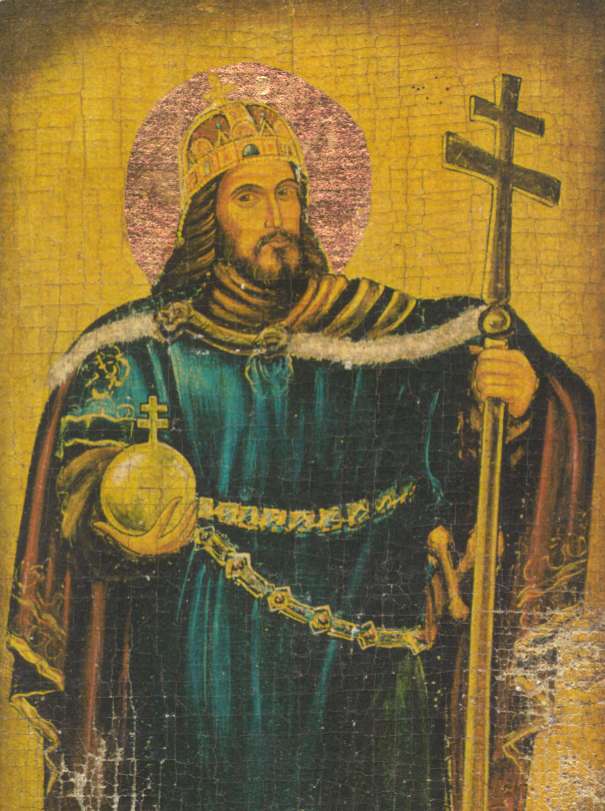
(By special grant of the Holy See,
St Stephen and all his successors down to
Bl Charles, last Emperor of Austria and King of Hungary,
had the right to have the Cross carried before them.)

St Stephen the Confessor, King and Apostle of Hungary! What a figure, the flower of Magyar piety and chivalry, the Duke who led his nation to Christ, promoted the Church everywhere for the salvation of his people, received the crown of Hungary from the Pope himself, and, ever-devoted to the Holy Mother of God, whom he had declared Patroness of Hungary, was taken up to heaven at her intercession on the very day of her Assumption, called in Hungary the Day of the Great Lady. As his collect prays, may the Almighty grant St Stephen to be a potent fighter for the Church from heaven, who on earth was her zealous propagator.

(Note that his feast is kept some days earlier, on the 20th of August, in the new Calendar, and is a public holiday in Hungary - it is the anniversay of the translation of his relics to Buda.)


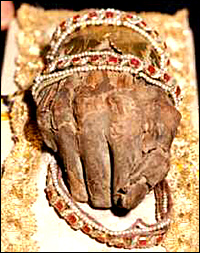
(The Holy Right Hand, principal relic of St Stephen:
with this hand he ministered to the sick and poor,
and it was preserved as a signal sign of his charity
while the rest of his body crumbled into dust.)

I liked, too, reading and praying the Wednesday psalms, some of them especially familiar to me nowadays by their continual reappearance in the Little Office, but some of them old friends not seen for some time: Pss 44, 45, 47, 48, 49 and 50 at Matins (a very happy sequence on which I've blogged before); Pss 96, 64, 100, 145 and the Canticle of Judith (xvi, 15-21) at Lauds; at Prime and the Little Hours, Pss 25, 51, 52, 53, 54, 55, 56, 57, 58, 59. (Vespers will be from the second half of the Gradual Psalms, including the beautiful Ps 131, Memento Domine David, and Compline uses Pss 33 and 60.) There's nothing quite like a Psalm.

I took the time also to read the Martyrology: such saints! What am I in comparison; what am I called to be...

As always, one reads the Martyrology for the next day, as a kind of holy advance notification: to-morrow brings (for Traddies) Pope St Pius X (may he pray for the Church, to drive away all Modernism, to redouble worthy reception of the Eucharist, and to restore peace and good order between the Society of his name and the Holy See, for the salvation of souls - to the glory of God).

But also commemorated are St Phœbe, known to St Paul; many holy martyrs and virgin-martyrs (many tortured and put to the sword, one plunged into molten lead, another cast into a fiery furnace, many monks of Lerins and their Abbot St Aigulf who were slain by the Saracens, and one, St Basilissa, a nine year old girl, who by her stedfast witness converted the Roman magistrate who ordered her put to torment and death); holy bishops and confessors; a hermit (St Simeon Stylites the younger); and the ordination of St Gregory the Great to the Supreme Pontificate, that his rays of sanctity might the more surely irradiate the Globe from the City - in the Novus Ordo, this is his feast day.

Tuesday, September 1, 2009

Book of Divine Worship, Rite One

As all men know, there now exists an Anglican Use of the Roman Rite, whose liturgical texts are collected in The Book of Divine Worship (Newman House Press, 2003). This volume contains the Holy Eucharist, Rites One and Two, the second being a modern-English version and the first being in Cramnerian English, more or less. Rite One is noteworthy for having the Roman Canon in what is called an "Old English Translation" (sometimes attributed to Coverdale, but apparently not actually by him).

What is more noteworthy is that it contains several very obvious omissions: it leaves out entirely the "Through the same Christ our Lord" at the end of the Communicantes (while still including this phrase after the Hanc igitur, the Supplices te and the Memento etiam, and the Nobis quoque, where it adds "Jesus"). More annoyingly and most inconsistently, it omits the Amen after each - except after the Supplices te! - but these were only included in the Missal in 1475 anyway.

It also omits any translation of the two opening words Te igitur (Thee, therefore) of the Roman Canon; and renders et beati Joseph ejusdem Virginis sponsi (inserted by Bl John XXIII) as "of Joseph her spouse" (following the old ICEL paraphrase); similarly, it omits tuorum (thy) in relation to the Apostles and Martyrs (although "the" is possibly a misprint for "thy" here); and curiously, perhaps for better effect, slightly reorders the great concluding doxology Per ipsum, putting "in the unity of the Holy Ghost" and "all hono[u]r and glory be unto thee" before "O Father Almighty" - and rendering est as "be" (subjunctive), not the indicative "is".

Because of the more tyrranical hold of the Novus Ordo mindset in the eighties and nineties, when the B.D.W. was prepared, the words of consecration are those of the modern Ordinary Form of the Roman Rite, rather than a direct translation from the traditional Canon:

Take this, all of you and eat it: this is my body which will be given up for you.

(In the Traditional Rite, I mean, the Extraordinary Form, the words before the colon are not part of the formula, and the words after "body" are not present, being inserted - arguably to emphasise the sacrifice of the Mass! - in 1969; similarly, the particle enim ought really be translated "for" and inserted before "this".)

Take this, all of you, and drink from it: this is the cup of my blood, the blood of the new and everlasting covenant. It will be shed for you and for all so that sins may be forgiven. Do this in memory of men.

(Here we have the notorious "for all", which makes Traddies have a fit of scruples and doubts - famously, the Vatican has now decreed, some years ago already, that this must be changed to "for many" in all translations, in continuity with all tradtion. Similarly, enim is omitted, mysterium fidei is moved to later, "Take this... drink from it" is included as part of the consecratory words, and the original Hæc quotiescumque feceritis in mei memoria facietis is replaced by the Novus Ordo Hoc facite in meam commemorationem. - a change that was allegedly made, leaving aside conspiracy theories, in order to give a more literal quotation from Scripture, though research has shewn that the older and more venerable a text, the less likely, perversely enough, it is to be literal in quoting Holy Writ.)

"Therefore we proclaim the mystery of faith" (at least adjusting the weak "Let us" of old ICEL) and those annoying Memorial acclamations are next inserted, again because the B.D.W. was put together in times less enlightened than the pontificate of Benedict XVI! Of course, mysterium fidei was moved here, and some made-up responses inserted, by some liturgical do-gooder in the course of the liturgical reform. I can't wait to see it all dumped; and as liturgists have said, these acclamations would - if kept - fit far better after the anamnesis anyway...

I understand that were this Book compiled now, it wouldn't have thus bowed to the Novus Ordo; perhaps we can expect a second revised edition sometime?

Overall, though, it is a good translation, and may be interestingly compared with the new ICEL version of the Roman Canon (and indeed of the whole Mass) soon to be put into place throughout the Anglosphere. For a start, here are the new ICEL words of consecration:

TAKE THIS, ALL OF YOU, AND EAT OF IT: FOR THIS IS MY BODY WHICH WILL BE GIVEN UP FOR YOU.

TAKE THIS, ALL OF YOU, AND DRINK FROM IT: FOR THIS IS THE CHALICE OF MY BLOOD, THE BLOOD OF THE NEW AND ETERNAL COVENANT; WHICH WILL BE POURED OUT FOR YOU AND FOR MANY FOR THE FORGIVENESS OF SINS. DO THIS IN MEMORY OF ME.

Note the use of "for" to express enim, and of "many" to translate multis (you wouldn't think it would take forty years to get these two right, would you?).

Sent Home Again

It seems almost ridiculous, but again I went to work and again my colleagues insisted I was too sick and ought go home... so I've done so, and will soon go to the doctor.

My father, too, who is in decline owing to Parkinsons, is not coping very well: prayers please!

Order Our Days in Thy Peace

After a troubled night's sleep in some ways, I woke with these words of the Hanc igitur in my mind and on my lips as a prayer:

Diesque nostros in tua pace disponas,
atque ab æterna damnatione nos eripi,
et in electorum tuorum jubeas grege numerari.
Per Christum Dominum nostrum. Amen.

Grant us your your peace in this life,
save us from final damnation,
and count us among those you have chosen.
Through Christ our Lord. Amen.
[old ICEL]

Order our days in your peace,
and command that we be delivered from eternal damnation
and counted among the flock of those you have chosen.
Through Christ our Lord. Amen.
[new ICEL]

Order thou our days in thy peace,
and bid us to be delivered from eternal damnation,
and to be numbered in the fold of thine elect.
Through Christ our Lord. Amen.
[BDW, Anglican Use]

An obviously excellent and very pertinent prayer! I thank the Lord for His inspiration...