Showing posts with label faith. Show all posts

Monday, October 22, 2012

Victory... Our Faith

Unfortunately, in recent times the drift from God and from the spiritual and supernatural view of life has seriously weakened this country. It is true that a rise in church membership has been reported during the past few years, but in the light of other evidence, one is forced to question how significant such mere statistics may be. One looks in vain for any corresponding increase of religion's beneficial influence upon the nation's life. Indeed, the trend in public and private morality has been downward; there is an alarming disregard in practice for God's teaching and for God's law. 
Is there any need to instance the growing evils in family life, the lustful self-indulgence which leads from birth prevention and divorce, from broken homes to the broken lives of youthful delinquents? Need we adduce in evidence the appalling circulation of indecent literature, and the low moral level of so much of the public entertainment in these days?
...
At its best, our civilization was the fine flowering of the Christian Faith. Now that the West has fallen from its former greatness, let us recognize that it is because so many have fallen away from the Faith, or have denatured it by dilution and compromise. 
We have fallen down before idols of flesh and of gold. It is not the True Faith which has failed us; it is we who have failed the Faith. A weak and vacillating Christianity, a partial, truncated Christianity, paying lip service to God and to the Spirit, but devoted in practice to man and matter, can never triumph in the battle with total, determined materialism.
— extracts from the 1954 Annual Statement of the Bishops of the United States.

While looking for something else, I came across this long-forgotten pamphlet, entitled Victory... Our Faith... 'The Battle Is Joined'... Enemy is Atheistic Materialism. The American bishops of sixty years ago had not yet been emasculated and completely befuddled by nonsense (one wishes they had not wasted so much time abroad in the years then still to come); they recognized the profound danger to souls of what is diametrically opposed to our Holy Faith: "...atheistic materialism,... Godless humanism... is [if not denial, then ignorance] of God... and His law... an excessive preoccupation with creatures... [which] reveals itself as secularism in politics and government, as avarice in business and in the professions, and as paganism in the personal lives and relations of all too many men and women."

They reëcho the words of the Didache about the Two Ways, that most ancient form of Christian catechesis:
The way of matter and of the flesh is the way of death; the way of God and of the spirit is the way of life. If we would have life, we must renew and reaffirm our Faith in God and in His Christ; we must cling again to that Christian moral code... 
... In the sign of the Cross, Christ conquers the paganism which had enslaved mankind... Jesus Christ restored meaning and purpose and love to human life; He warmed and illumined our life where before it had been cold and dark. He rescued man from the wild wandering and the black despair of the atheistic materialism of that day. In this day of the new paganism, we Christians can again triumph in the sign of the same Cross of Christ. 
Christ is the Prophet and the Teacher, in Whose doctrines are the truths which inspire and satisfy... Christ is the Priest, the Mediator. His is the great Atonement. By His Sacrifice, we are redeemed from our sins. ... And Christ is King, the Lord... He is the Lawgiver, laying down the code of conduct that binds the consciences of men. He is the Judge, merciful and just, Who rewards the good and punishes the evil. He is the Ruler... From Him alone do earthly magistrates receive their power of governance. ... Worship and obedience, order and discipline... - these He exacts... but in return He gives... His Father's love and His Father's home, rich largess of grace and abiding peace of soul. ... 
This is why we repeat without ceasing that God and His Christ afford the answer to all our problems, and provide the solution to all our difficulties. Those who have never known the Christian religion, or who have not known it in its fulness as taught by the Catholic Church [even within the Church*], should turn to it now, and examine its credentials. It is the answer to their quest.
*If only we taught the Faith, not presented a weak, pathetic travesty of it that acts only as a vaccine against belief. If only the Church here were not so smug and unconcerned about its failures over the past two generations to pass on the Faith, pretending that all shall be well, while matters have reached the point at which the real teachings of the Church appear strange and even alien to ill-instructed Catholics. I must repeat those terrible words of self-accusation that the American bishops uttered sixty-odd years ago: 
It is not the True Faith which has failed us; it is we who have failed the Faith. A weak and vacillating Christianity, a partial, truncated Christianity, paying lip service to God and to the Spirit, but devoted in practice to man and matter [i.e. obsessed with prating of social justice, while knowing too little of either to avoid falling into simplistic, materialist traps], can never triumph in the battle with total, determined materialism.
Alas, this is all too accurate a picture of the Australian Church today, which is far further down that road of indifferentism and practical apostasy, fallen asleep without even realizing it, afflicted with sloth and accidie, that revulsion at holy things which is the special curse of those who grow bored and impatient with their religion. So often the Church here brings to mind that horrifying sentence of Our Lord passed on Laodicea, one of the complacent churches of Asia Minor back in the days of the writing of the Apocalypse: I would you were either hot or cold; but since you are so tepid and lukewarm – I will vomit you out of My mouth. (Rev. iii. 15-16) Lord, have mercy!

Domine, salva nos, perimus. 
Credo, Domine, adjuva incredulitatem meam.
Domine, adauge nobis fidem.

Lord, save us, we are perishing.
I believe, Lord, help my unbelief.
Lord, increase our faith.

Thursday, December 8, 2011

Faith and Faithfulness

We may be unfaithful, but he is always faithful, for he cannot disown his own self.
— II Tim. ii, 13 (Jerusalem Bible)

I always give thanks for the unmerited gift of faith; I always wish I were a good deal more faithful!  I often reflect that "the devils believe, and tremble"(James ii, 19); for "faith without works is dead", as the next verse of that Epistle reminds me.  It always seems a mystery to me that "the good which I will, I do not; but the evil which I will not, that I do." (Rom. vii, 19)  Indeed, with the Apostle, I say "Unhappy man that I am, who shall deliver me from the body of this death?"(Rom. vii, 24) But with him I do go on at once proclaim that my deliverance is "The grace of God, by Jesus Christ our Lord." (Rom. vii, 25)

Thanks be to God, God is so good as not only to give us the gift of divine faith by the Holy Ghost, but forgives us when we fail to be faithful – He always remains faithful, for He is God.

At this Advent season, I do turn in trust and faith to Christ, begging Him come into my life and rule: Veni, Domine Jesu.

Tuesday, November 22, 2011

Aspirations for the Year of Faith

Recently, the Pope decreed that a Year of Faith be held, to begin on the 11th of October 2012, and to end on the last Sunday before Advent 2013.  This is excellent and most necessary: for "the just man liveth by faith" (Rom. i, 17).  Christ commands us "Have ye faith in God" (St Mark xi, 22) – and He bids us have a salutary fear lest we lose hold of our Most Holy Faith, by posing to each of us the question, "When the Son of Man cometh, thinkest thou that He will find faith on earth?" (St Luke xviii, 8)

"Faith is the assurance of things hoped for, the conviction of things not seen." (Heb. xi, 1) Divine and supernatural faith is an intellectual virtue infused into our souls at baptism, enabling us to believe in truths beyond the unaided mind of man, such as the Triune nature of God.  As we read in the Epistle to the Hebrews a little further on, "without faith it is impossible to please God" and indeed "he that cometh to God must believe that He exists, and is a Rewarder to them that seek Him" (xi, 6).  For this reason, the truths necessary to salvation are summarized as belief in God (frequently extended to include belief in God as Trinity and in the Incarnation of the Second Person thereof, not to mention His Resurrection) and as belief in a future state wherein God will reward the good and punish the bad; as the Apostles' Creed puts it, Credo in Deum... venturus est judicare ("I believe in God... He shall come to judge...").  Faith in these two points may be declared in aspirations taken from Holy Writ:

Credo Filium Dei esse Jesum Christum. (Acts viii, 37b)
(I believe that Jesus Christ is the Son of God.)

Credo videre bona Domini in terra viventium. (Ps 26, 13)
(I believe that I shall see the good things of the Lord in the land of the living.)

Of course, the latter point – belief in God as the Rewarder of each according to his just deserts – implies acceptance of moral responsibility for one's actions: as the Beloved Disciple teaches, "this is His commandment: that we believe in the name of His Son Jesus Christ; and that we love each other, as He has commanded us." (I John iii, 23)  To believe in Christ is to acknowledge Him as the Incarnate Son of God, implying adhesion to Trinitarian belief; to love as He commanded is to keep the Commandments, the Ten summed up in the Two and the New.

But, without neglecting the greatest of the theological virtues, the focus of the Year of Faith is upon faith, faith believing in hope, working through love.  The temptation of a doubting disbelieving age, a proud Pelagian age, is to discard faith and speak only of a sentimentalized love far removed from supernatural charity; this is to be roundly opposed, as Our Lord Himself reminded us, as quoted above, lest being without faith we be lost forever.  Whatever people may wish to believe, we are not told by Truth, "Love will save you" but "He who believes and is baptized, the same shall be saved; but he that believeth not, shall be condemned" (St Mark xvi, 16).

The Sacred Liturgy places before us each year (EF: 13th Sunday after Pentecost; OF: 30th Sunday per annum) this prayer for all three theological virtues, and the grace to obey the commandments and so obtain what God promises:

Omnipotens sempiterne Deus, da nobis fidei, spei et caritatis augmentum, et ut mereamur assequi quod promittis, fac nos amare quod præcipis. Per...

Almighty ever-living God, increase our faith, hope and charity, and make us love what you command, so that we may merit what you promise. Through...

It is a precious thing to make an Act of Faith, a declaration of one's belief, in whatsoever words answer to its object and content, as Benedict XIV long ago encouraged all the faithful to do, that they strengthen their grasp of and persevere in the Faith once delivered to the Saints.  I learnt, and still repeat, the short Act "O my God, I believe in Thee, and in all that Thy Holy Church teacheth, for Thou hast said it, and Thy word is true." — for God, being all-perfect, can neither deceive nor be deceived; and He has disseminated knowledge of His saving truth through all the world.  Longer, more explicit declarations of one's faith in the Trinity and in Christ our Redeemer become more and more Creed-like; while, after Communion, the Adoro te devote is a most appropriate Act of Faith, as consideration of its words will demonstrate.

Of course, to recite and to pray with attention, devotion and care the words of one of the very Creeds themselves is to make such an Act indeed: at Mass, we sing or say Credo in unum Deum, praying the Nicene (well, strictly speaking the Nicæno-Constantinopolitan) or "Mass" Creed, and would that we confidently know the words and meaning thereof in Latin and English at the least; in one's devotions, and in older forms of the Office, the Apostles' Creed, Credo in Deum, the ancient Baptismal Creed of the Roman Church, is customarily used, and again, to meditate on and turn over its words in the heart is to make a good act of faith.  On Trinity Sunday at Prime, and more often according to one's piety, the Athanasian Creed, Quicumque vult, is right and proper to be prayed.  And the Tridentine Profession of Faith, or Paul VI's Credo of the People of God, are more extensive declarations of belief worthy of meditation.

Especially when undergoing trials and temptations, to keep hold on the anchor of faith is vital, just as St Thérèse of Lisieux endured a terrible temptation toward atheism and self-murder during her descent through illness toward death.  As a wise Dominican said, if we lose our faith, so to speak, the last thing we should do is stop saying our prayers and going to Mass – that is when we most need to lay hold of things divine, to cry mercy, acknowledging our utter destitution, when all seems black.

But to end with some suitable aspirations for the coming Year of Faith, and indeed for all our lives as we, please God, "walk by faith and not by sight", one can raise heart and mind to the Lord, crying out:

Credo, Domine! (St John ix, 38a)
(I believe, Lord!)

[Domine,] Adauge nobis fidem! (St Luke xvii, 5b)
([Lord,] increase our faith!)

Credo, Domine; adjuva incredulitatem meam. (St Mark ix, 23b)
(Lord, I believe; help my unbelief.)

Credo Domine, sed credam firmius. (Pope Clement XI)
(I believe, Lord, but may I believe more firmly.)

O Lord, preserve to us the Faith.

Thursday, September 3, 2009

Dogma and the Transcendentals

I think someone said that each person tends to be attracted more to one of the transcendentals - the good, the true, the beautiful (accepting for the moment that the beautiful is a transcendental) - than to the others. I suppose in my case it would be the true that captivates me. The beautiful also; the good, less so: hence my sins tend to be about missing the good or going after goods in the wrong way. The true in a sense corresponds with faith, one of the theological virtues; the beautiful, with hope I suppose; and the good with charity.

Alas, love is the virtue I lack. (For this cause, and because of the replacement role it plays in modernist misbelief - filling in for lack of belief in doctrine - I cannot abide talk of social justice. Catholic schooling has permanently inoculated me against it, for ever. Of course, I do try and give alms and such, but I no longer believe the secularist aCatholic claim that it is the trendy left that really help, rather than infantilize, the poor...)

With this in mind, it can be seen how I heartily agree with this statement of Newman's:

“From the age of fifteen, dogma has been the fundamental principle of my religion: I know no other religion; I cannot enter into the idea of any other sort of religion; religion, as a mere sentiment, is to me a dream and a mockery.”

For this cause, I hate and detest sentimentality, doubt, and the rejection of reason - nothing gets me riled up worse than fools saying "Why don't we just all love Jesus and not worry about these silly doctrines any more?". I am firmly of the opinion that many after the Council delighted in rejecting as much of the Faith as possible, dumbing everything down - evacuating our most holy religion of content. Some people would rather believe nothing - it's more convenient. Stupidity is alive and well in most Catholic churches! I don't mean by this anything against those of low intellect - they are creatures of God - but by this I reprobate those who wallow in ignorance and delight in their own lack of understanding, in a mad kind of pride.

Similarly, while some just "lurrrve" sentimental songs of dubious orthodoxy, such as the lyrics of Marty Haugen or John Bell, I cannot stand their puerile sound and uncatholic message. Compare such unhealthy "fast food" music to the more difficult to appreciate and sing, but holier treasures and more beautiful far that is the prodigious inheritance of sacred music down the ages. Trust our own Philistine and narcissistic age to dump most of this. It is the same with the awful solemnity of the Sacred Liturgy - too many think Mass ought be (aging) hippies gathered with a guitar round a trestle table. Mass like that is an abomination! "O worship the Lord in the beauty of holiness" should be the words to heed.

So I do value the beautiful, but not to the extent of running into effete æsthetic excess. Particularly in Australia, the beautiful is often mocked by lazy lax liberals as being "gay" - and of course there is that perversion of beauty around, but abusus non tollit usus. "Bells and smells" cannot be the end of it - as is said of some immoral Anglicans, their holiness ends when the vestments are packed away. (A friend of mine and a female friend of his were horribly scandalized by some High Church types, who invited them to a fancy dress party that turned out to be low and vile - at which those dirty buggers were tricked out in church vestments. I use the term buggers advisedly.)

Liturgy must never be camp; neither must it be feminized as the Novus Ordo too often is, with the only man present in the sanctuary an emasculated old priest, surrounded by women, with a congregation largely of the same. The Mass should be masculine in the true sense of imaging sacrifice, for Christ the Bridegroom gave Himself sacrificially for His Bride the Church, and His priests and their ministers sacramentally represent this truth. If Mass does express this, both men and women will feel comfortable with it. Liturgy, if feminized or effete, repels normal folk of both sexes.

Sunday, July 5, 2009

Enemies of the Human Race

Reading about the martyrs of the Roman persecutions helped me better to understand the central charge against them - that Christians were "enemies of the human race", foes of the common good, haters of and hated by all men: for they refused to sacrifice to the gods by whose favour the Pax Romana endured, and thus were thankless atheists; they refused the commands of the Emperors, and thus were stiff-necked, obstinate, disobedient rebels and traitors; they were members of a sinister secret society, by its cloak of darkness gravely suspect of plotting against the State, and containing a whole illegitimate rival hierarchy; and they held to beliefs and practices subversive of public morals (contemporaries found them odious and shocking, thinking they worshipped a condemned criminal or even an ass, partook of cannibal feasts, and even committed incest).  The Empire was the world, and the Christians were a fifth column within it.

At least the stiff-necked and obstinate Jews, against whose revolts the Empire had to fight on several occasions, were adherents of an ancient religion, the proper cult of their fathers and their nation, and their peculiar religion was recognized, even permitted unusual privileges by the laws - but Christians, seemingly holding perverted Jewish beliefs blasphemous to the Jews themselves, were every one a traitor to their own individual ancestral religions, having spurned their native gods and turned to a new and disturbingly exclusive deity, whose worship had not been permitted by the Senate (part of whose purview was the detection and punishment of strange and vile religious cults that undermined public order).


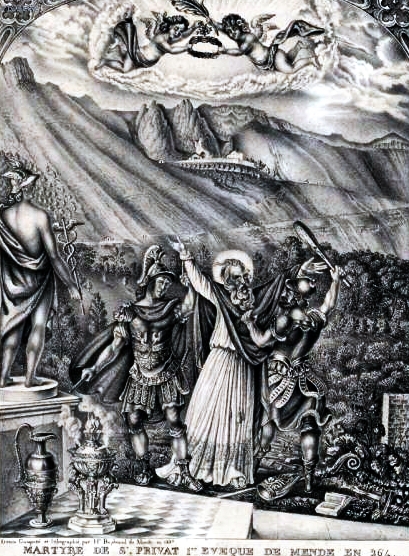
(Refusing to sacrifice to the Roman gods as the Emperor commands for the good of the State, the Christian bishop is done to death as an enemy of the world, an ingrate atheist, a dangerous innovator, a spreader of unlawful superstition and a rebel rabble-rouser.)

As the West sloughs off more and more vestiges of Christianity, as secularism bites or rather disbelief spreads, what is found is a return to paganism - for as Chesterton pointed out, those who believe nothing will believe anything.  Ever seen the pages of astrology, fortune telling, numerology, tarot card reading, and worse in women's magazines?  What of ghosts, witches and mediums on television - the last being on non-fiction programmes!  It's a wonder animal sacrifice isn't back in vogue.  Pagans could read fine philosophy, albeit vitiated by horrendous moral deviations not excluding infanticide - sound familiar?  But their morality was expediency...

Note how every other religion (even, ahem, one that seems to have more than its fair share of aggressive members, yet is forever being declared in its pure form "a religion of peace" - which ought be Christianity's title), in a suitably watered down version acceptable to bourgeois sensibilities, is accorded unquestioning respect: visit some odd New Age shop and see a vast kitsch collection of Buddhas, angels, crystals and more... a veritable idol shop.   But one thing you will not find: a crucifix.  The world cannot abide the Crucified.

Christianity to-day, above all the Catholic Church, faces more and more the same accusations that it faced in the beginning: of practising an irrational, immoral, exclusive, world-hating religion, completely inappropriate for our enlightened age, discriminating against decent citizens: it's a wonder it's allowed at all, as it is its inappropriate and politically incorrect views deserve to be banned from being propagated or followed.  Note that "politically incorrect" means precisely "not appropriate for the City, the Polis" - that is, our civil society.

St Peter writes of the pagans' uncomprehending hatred of Christians in his First Epistle (iv, 1-4):

Christ therefore having suffered in the flesh, be you also armed with the same thought: for he that hath suffered in the flesh, hath ceased from sins: that now he may live the rest of his time in the flesh, not after the desires of men, but according to the will of God.  For the time past is sufficient to have fulfilled the will of the Gentiles, for them who have walked in riotousness, lusts, excess of wine, revellings, banquetings, and unlawful worshipping of idols.  Wherein they think it strange, that you run not with them into the same confusion of riotousness, speaking evil of you.

To our cost, too many Christians have behaved anything but as becomes saints - the filthy crimes revealed to the world's eyes have deeply scandalized many both inside the Church, and those who, outside in darkness, might otherwise have been curious to seek after Truth, but now have recoiled in horror.  We have been a stumbling block to many.  The scandals besetting the Church, especially in lands with a strong Irish background, have been pleasing to none but Satan, the Deceiver.  They have also revealed how compromised many in sacred orders have been, and how the innocent have suffered, the guilty prospered.  All this seems to confirm the common external diagnosis: that Christianity is a wicked false religion, imposing guilt and slavish obedience on its dupes, while those in positions of power use it for their fell ends and personal gain.

What eventually overcame three hundred years and ten great Persecutions?  The blood of the martyrs, which is the seed of the Church as Tertullian noted: the witness of sanctity, of unheard of generosity (such as the Christians who laboured to help plague victims and died trying - why? for they weren't even coreligionists or relations!), and the fact that ordinary folk were willing to suffer and die horribly for their belief.  No pagan cult could claim such power to make the weak strong.  The Holy Spirit was indeed active in His Saints, as these noble athletes ran in the footsteps of Christ Who in His Passion had preceded them: and in their witness God was glorified, and the world converted.

Persecution does seem, perversely enough, to crystallize the real issue - to be really Christ's, or not - and thus strangely to bring not death but life to the Church: as someone said, believers would be more fervent "if they were burning priests on Bourke Street" (the main road leading through the city up to Parliament House in Melbourne).  A friend of mine, speaking of what he considers to be the impending return to the times of persecution, such is the falling away, cheerfully said, "Of course we'll all be martyrs!"  The martyrs confessed themselves all unworthy of the gratuitous gift that was theirs - to fight the good fight, keep the faith, and for the sake of temporary suffering win eternal glory in Christ Jesus our Lord.  I rather agree with the blogger who said, "She thought she could be a martyr, if they killed her quick".  We must all seriously ask ourselves whether we bear witness to the Lord, or keep cowed, frightened and silent; as the roadside poster said, "If you were tried for being a Christian, would there be enough evidence to convict you?"  

Only if one can be convicted of Christianity can one's witness hope to convert others - to the greater glory of God.


Te martyrum candidatus laudat exercitus.
(The white-robed army of martyrs praise Thee.)

Tuesday, April 29, 2008

St Peter of Verona, M.O.P.

In the modern rite, which I must needs attend if I am to hear Mass, St Catherine of SIena is celebrated (in the old, her feast day is tomorrow). Yesterday's feast of St Peter Chanel pushed aside not only St Paul of the Cross (EF only) but St Louis Mary de Monfort (in both forms of the Roman Rite). Too many saints to fit in!

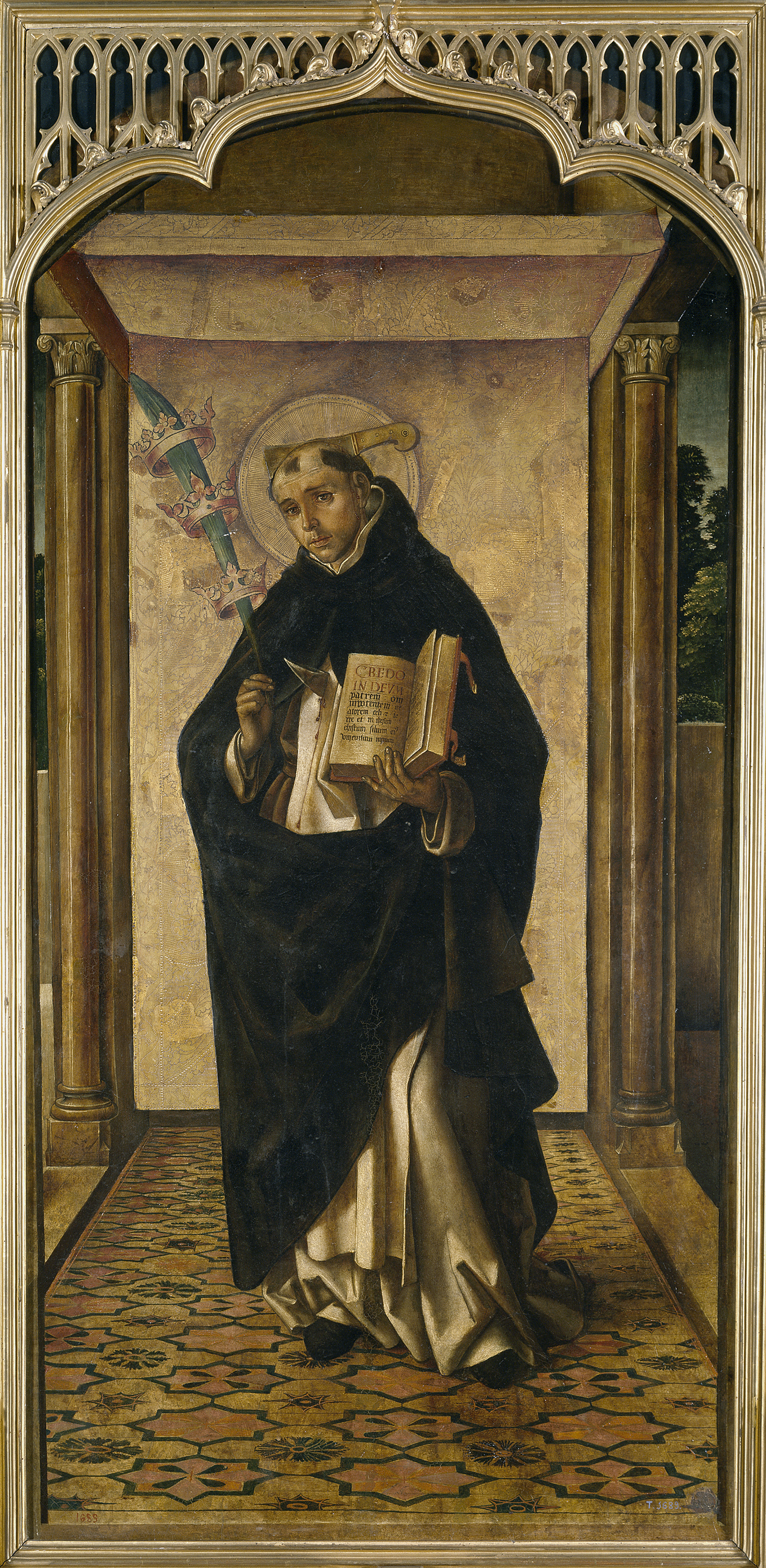
In the old rite, and especially in the Dominican Rite, today is the feast of St Peter Martyr, a Dominican slain by heretics outside Milan on Easter Saturday, 6th April 1252, and canonized within a year, the fastest of all modern canonizations; his murderer repented, and became a Dominican lay brother - which must have occasioned some unusual reflections each year as the feast approached! - and himself died in the odour of sanctity, being ever since venerated in some places as Blessed Carino.

For various reasons I consider St Peter a patron saint of mine: he was an intrepid preacher of the Faith, even unto death. In his earliest youth he, the child of Manichaean parents, rebuked their faithlessness by his refusal to disavow the Apostles' Creed, which he had learnt at school; and, as he lay dying, his skull split open by the nefarious blow from a billhook, he wrote one last time Credo in his own blood.

St Vincent Ferrer, his later confrere, also an indefatigable herald of the Gospel, tells us to treasure and pray often the Apostles' Creed with great devotion and full attention, giving heartfelt assent to its saving truths; but we must beware, lest our wicked lives give the lie to our pious utterances, for "The diamond is easily lost in the dunghill, and the precious pearl of faith is in great danger of being lost in a conscience defiled with the filth of sin." As my old P.P. (now Bishop of Lismore) said, the root of most all heresies is moral turpitude.

The Missale Romanum includes proper orations only, but the Dominican Missal has this proper, borrowing some parts from various commons:

******

Mass of St Peter of Verona, Dominican Priest and Martyr (T.P.)

Introit (Ps. 63:3,2)

Protexisti me, Deus, a conventu malignantium, alleluja: a multitudine operantium iniquitatem, alleluja, alleluja. Ps. Exaudi Deus orationem meam cum deprecor:a timore inimici eripe animam meam. Gloria Patri.

Collect

Præsta, quæsumus, omnipotens Deus, ut beati Petri martyris tui fidem congrua devotione sectemur, qui pro ejusdem fidei dilatatione, martyrii palmam meruit obtinere. Per…

Epistle (II Timothy ii, 4-10)

Carissime: Nemo militans Deo implicat se negotiis sæcularibus; ut ei placeat, cui se probavit. Nam et qui certat in agone, non coronatur nisi legitime certaverit. Laborantem agricolam oportet primum de fructibus percipere. Intellige quæ dico: Dabit enim tibi Dominus in omnibus intellectum. Memor esto Dominum Jesum Christum resurrexisse a mortuis ex semine David, secundum Evangelium meum, in quo laboro usque ad vincula, quasi male operans: sed verbum Dei non est alligatum. Ideo omnia sustineo propter electos, ut et ipsi salutem consequantur, quæ est in Christo Jesu, cum gloria cælesti.

Paschal Alleluia (before Ascensiontide)

Alleluja, alleluja. V/. Felix ex fructu triplici, quem sub patre mirifico ex virtute multiplici legit sancto Dominico. Alleluja. V/. Surrexit pastor bonus, qui posuit animam suam pro ovibus suis, et pro suo grege mori dignatus est. Alleluja.

Gospel (St Luke ix, 23-26)

In illo tempore: Dixit Jesus discipulis suis: Si quis vult post me venire, abneget semetipsum, et tollat crucem suam quotidie, et sequatur me. Qui enim voluerit animam suam salvam facere, perdet illam: nam qui perdiderit animam suam propter me, salvam faciet illam. Quid enim proficit homo, si lucretur universum mundum, se autem ipsum perdat, et detrimentum sui faciat? Nam qui me erubuerit, et meos sermones, hunc Filius hominis erubescet cum venerit in majestate sua, et Patris, et sanctorum angelorum.

Offertory (Ps 20:4,5)

Posuisti, Domine, in capite ejus coronam de lapide pretioso: vitam petiit a te, et tribuisti ei. Alleluja.

Secret

Preces, quas tibi, Domine, offerimus, intercedente beato Petro martyre tuo, clementer intende; et pugiles fidei sub tua protectione custodi. Per…

Communion (St John xv, 5)

Ego sum vitis vera, et vos palmites: qui manet in me, et ego in eo, hic fert fructum multum. Alleluja.

Postcommunion

Fideles tuos, Domine, custodiant sacramenta, quæ sumpsimus; et intercedente beato Petro martyre tuo, contra omnes adversos tueantur incursus. Per…

Saturday, January 12, 2008

In a Convent Parlour

Having returned from an audience at Carmel with the Prioress, at her suggestion I looked up the former Cardinal Ratzinger's 1991 address on "Conscience and Truth", given at a Workshop for Bishops in Dallas, Texas.


Mother remarked on making use of Benedict's recent encyclical Spe Salvi for reflection and prayer, and on how a meditative reading of it is so necessary.  When I mentioned how over the past year I've very slowly read most of my way through his book Jesus of Nazareth, she agreed that it was not a book to read at a sitting, but deserving of contemplation, and told how it is one of the texts read during meals at the monastery.


She also alerted me to the importance placed on hope, in connexion with faith and prayer, within the Carmelite tradition, and further referred me to an address of Benedict XVI on the occasion in 2007 of his visiting the Cistercian monastery of Heiligenkreuz in Austria.  As a parting gift from the Carmel I received some holy cards bearing two quotations focussing on faith, prayer and hope, from a Sunday homily of his, given at Naples late last year, plus a last from a General Audience (16th August 2006):


It is essential to strengthen HOPE
which is based on FAITH
and expressed in unflagging prayer.
It is PRAYER
that keeps
the torch of faith alight.

The power that changes
the world
and transforms it into
the kingdom of God,
in silence
and without fanfare,
is faith -
and prayer is the
expression of faith.

Only openness
to the mystery of GOD
Who is LOVE
can quench
the thirst for truth
and happiness
in our hearts.
 

Please join in praying to the Lord for the Carmel of Launceston, that the younger sisters may persevere, the older sisters, especially those aged and infirm (Sr Monica and Sr Paul Joseph), be strengthened, and more vocations bless this house of prayer abundantly, wherein the "still, small Voice" (III Kings xix, 12) is attended to with great love and fidelity, to the edification of all: "Speak, Lord, Thy servant heareth" (I Kings iii, 10).


Our Lady of Mount Carmel, pray for us.
St Elijah, pray for us.
St Teresa of Jesus, pray for us.
St John of the Cross, pray for us.
All Carmelite Saints, pray for us.