Showing posts with label death. Show all posts

Sunday, January 28, 2018

Septuagesima Thoughts on the Two Ways

Septuagesima brings us face to face with death. The Introit is Circumdedérunt me gémitus mortis (The sorrows of death surrounded me); the ancient chant Media vita (In the midst of life we are in death) is oft sung during the pre-Lenten season; at Matins, the readings begin at Genesis chapter one, and soon enough bring us face to face with the Fall of Man, when, having eaten of the forbidden fruit, death came to mankind, and estrangement from God, which makes death evil.

At the end of Lauds, until the 1950s, after Fidelium animæ the Lord's prayer was said silently, then the versicle Dominus det nobis was sung, followed by the Marian anthem of the season. The 1693 Lyons Breviary adds two words, post mortem, to the second half of this versicle, thus:
V. Dóminus det nobis suam pacem.
R. Et post mortem vitam ætérnam. Amen.
(V. May the Lord grant us his peace.
(R. And, after death, life eternal. Amen.)
This seemed to me a devout addition suitable to use in prayer, since it balances the length of each phrase... but often I have mixed up the words, and said by mistake, Et post vitam mortem ætérnam (And, after life, death eternal)! That is not a prayer to make, lest it be answered!

But more seriously, these are in fact the options we face in this vale of tears:
1. Post mortem, vitam ætérnam (After death, life eternal);
2. Post vitam, mortem ætérnam (After life, death eternal).
Here we have the age-old presentation of the Two Ways, the Way of Life and the Way of Death: either (1) following the narrow path, “denying ungodliness and worldly desires, we should live soberly, and justly, and godly in this world, looking for the blessed hope and coming of the glory of the great God and our Saviour Jesus Christ,” (Titus ii, 12f), or (2), taking the broad road, “many walk, of whom I have told you often (and now tell you weeping), that they are enemies of the cross of Christ; whose end is destruction; whose God is their belly; and whose glory is in their shame; who mind earthly things.” (Phil. iii, 18f).

As Our Lord taught so clearly, “If any man will come after me, let him deny himself, and take up his cross, and follow me. For he that will save his life, shall lose it: and he that shall lose his life for my sake, shall find it. For what doth it profit a man, if he gain the whole world, and suffer the loss of his own soul?” (St Matthew xvi, 24-26). We can either deny ourselves and bear our appointed cross and follow Christ to Calvary, praying for final perseverance, trusting in his grace to save us and bring us to glory, or live vainly, heedless of and hating God, and hateful to him and others and ourselves, and after death perish everlastingly.

Ultimately we must be among the martyrs, the true witnesses to the Crucified at the cost of their own lives, whether literally or in intention – or among the reprobate, who madly purchase worthless transient pleasures at the infinite cost of everlasting damnation. Be sheep or goats, choose!

Monday, November 19, 2012

Birthday and Funeral

The nineteenth of November is my birthday; this year, I will keep it by driving to Hobart for the funeral and burial of my old friend Ben.  Having heard that he truly had that which we pray for, a "good death", I am glad to go and mourn in hope, praying that his soul may rest in peace.

Of your charity, please spare a prayer for Ben, an Ave or a Salve or a Requiem; please pray too for Jane his widow, and for their family.  Ben I met late in his life, a long, a good life: as it is, I have known him and Jane for the better part of twenty years, and what a privilege it has been.

The parting of friends is a painful thing.  I think oft of Tolkien's portrayal of this, and of "Bilbo's Last Song", surely J.R.R.'s parting song ere he left this world to pass over to the Father.

Donald Swann's setting of Bilbo's Last Song.

My family and I celebrated my birthday a day early, on Sunday.  Every year passes more quickly; my father lived to 84, my friend Ben to 88; as for myself, today I reach the number of (to misquote the Apostle) forty stripes minus two.  It is strange but sobering to reflect that more than half my life is already over, and with little or nothing to shew for it.

St Philip Neri used to lament his hitherto slack life (!) after recovering from illness, and would say, Now I purpose to set my life in order, now I purpose to make a new start, now, a sinner, to strive for holiness – may I be granted grace to do the same, so numbering my days as to gain true wisdom.

Tempus fugit! All things pass, and all too quickly: let us redeem the time, for we know not how short the time is that may remain.  Remember, O Christian, the Four Last Things: death, judgement, hell, and heaven.  Remember thy last end, and thou shalt never sin. 

Wednesday, November 14, 2012

Requiem æternam dona ei, Domine

Of your charity, pray for the repose of the soul of Ben Gard, who died this morning after a short battle with cancer. Ben was a great man and a good Catholic: he fought for King and Empire in Burma and Malaya, and lived a long and rich life, which he always tackled with true English pluck. I was privileged to get to know him while at University, and have always valued his friendship and generosity. We pray he may hear those words of his Lord and Master, "Well done, thou faithful servant." Please also remember Jane his loving wife, their children and grandchildren at this sad time.

Requiem æternam dona ei, Domine, 
et lux perpetua luceat ei: 
requiescat in pace. 
Amen.

Monday, July 25, 2011

R.I.P. Sr Paul Joseph, O.C.D.

Died, in the 48th year of her Carmelite profession and the 95th of her age, Sister Paul Joseph of Mary the Mother of God, on Sunday the 24th of July 2011: on whose soul may the Lord have mercy.

Well done, thou good and faithful servant!

Sister's Requiem Mass will be held on Thursday at the Chapel of the Immaculate Heart of Mary at the Carmel of Launceston, followed by interment in the crypt of the monastery.

Sr Paul Joseph was the last of the dedicated extern sisters of the Carmel here in Tasmania.  Because of her status as "mediatrix between nuns and men" as I liked to joke, my family were privileged to often talk with her over the years.  She had a wry sense of humour and a shrewd grasp of all matters.  I recall once asking her when the nuns prayed: she ran through all the times of divine service at Carmel, then paused, and questioned me, "Do you plan to come to all of them?"

I recall her telling me of how she first tried her vocation as a Carmelite in Melbourne, but such were the rigors of that Carmel back then that she was taken from there in an ambulance!  She re-entered Carmel in Adelaide, and from there came to Tasmania, so far as I understand.

As her health failed, she moved from her extern quarters into the enclosure, and latterly was in medical care; she died a holy death early on Sunday.

Of your charity, pray for her eternal repose, and ask her to intercede that more vocations come to Carmel.

Wednesday, July 14, 2010

Illumina oculos meos, ne unquam obdormiam in morte

הָאִירָה עֵינַי, פֶּן-אִישַׁן הַמָּוֶת.

Φώτισον τοὺς ὀφθαλμούς μου μήποτε ὑπνώσω εἰς θάνατον.

Illumina oculos meos, ne umquam obdormiam in morte.

(Give light to mine eyes, lest I ever sleep in death.)
—Psalm 12:4b

Lord, "give light to mine eyes, lest I ever" (ne umquam) - or rather, "that I never" (ut numquam), never ever "sleep in death".  Umquam...  What does this mean?  It cannot be taken in the direct literal sense - for mortal man can hardly expect never to suffer death, let alone presume to remain alive for ever by sole reason of having light to see by!  Aquinas does, however, give a note about the literal meaning:
This literally corresponds to David fleeing from the presence of Saul, of whom he often had to beware, lest at some time he might fall into his hands and be killed. Similarly, as long as a man is conscientious in resisting sin he does not fall into death, but when he sleeps he is killed. Thus in 2 Kings (II Sam. iv,5), When Isboseth hath fallen asleep, and the handmaid was cleansing the wheat, he was killed; and Eph. 5 (v, 14), Rise thou that sleepest.
Based upon this, but questing to understand how being enlightened may preserve one from death forever, one must seek for a deeper level of signification.

Evidently one must interpret the light as not material but spiritual illumination; and "to sleep in death" must mean "to be deprived of spiritual life by reason of sin", cut off from true awareness, deprived of the state of grace by mortal sin.  Horror of horrors, it may mean to sleep in death forever, "to fall into the second death of eternal hell".

Contrariwise, if we are ever enlightened and never lost in darkness, we need not fear the second death: fear not him who slays the body, but him who slays the soul; thus, after the death which to the Christian is but to fall asleep, we will enter not into endless death but into eternal life and light.

Only if one is enlightened by God's beneficient light, with one's intellect illuminated and one's will inspired, can one avoid falling into the disastrous nightmare that is to sleep in sin.  For sleep is a time when one is unaware, unconscious, when one's reason is not in control; one's mind drifts in dreams; therefore, sleep is an apt image of sin, when one is not in charge, but enthralled to phantoms; and to sleep in death is not merely to slumber, but to be trapped in deadly sin – perhaps for ever.

Neale notes what Thomas says of Psalm 12 relative to this verse: "Christ always lightens our eyes that we should not sleep in death".

The full verse, in the Prayer Book Version (approved since the Anglican Use Book of Divine Worship was approved), reads as follows:


Consider, and hear me, O Lord my God: lighten mine eyes, that I sleep not in death. 

—Ps 13:3 (Hebrew numbering)

God indeed considers us with His all-pitying Eye of compassion, and therefore in saying "Consider", we remind ourselves of this and comfort ourselves that God will indeed hear us, He, the Lord our God.

How are eyes enlightened by God through Christ?  To ask is to answer: by Christ's Incarnation, as the Light to enlighten the Gentiles, according to Simeon's prophecy.  It is the eyes of the inner man that Christ enlightens, He, the true Light that enlighteneth every man born into this world: He illuminates the understanding and the affections, turning them from darkness to His wonderful light.

As Cassiodorus says of this, "Eyes we must here interpret as those of the heart, which sleep in death when the light of faith is buried, and they are closed through pleasure of the flesh".  By our faith, that infused supernatural intellectual virtue, we may apprehend the things of God, and come nigh unto Him, all by His grace; as is notorious, immorality destroys faith: heresy arises from moral turpitude.

If by Divine illumination we are kept awake, we may keep watch with Christ and rest with him in peace, as the Church sings at Compline-time.  We may avoid the shameful sleep of sin, and instead sleep with wakeful hearts turned Godward.  Sleep is an image of death; dying we shall die, but how we die, in what state we die, makes all the difference: to enter into eternal death, or into eternal life?  That is the question!

By God's grace we are saved, through faith.

Long ago, a prayer was composed as a thanksgiving after Mass; here is one paragraph:
O lux vera! quæ illuminas omnem hominem venientem in hunc mundum, illumina oculos meos, ne umquam obdormiam in morte.
O true Light! Who enlightenest every man coming into this world, enlighten mine eyes, lest I ever sleep in death.
The Greek Liturgy turns this verse into poetry that Neale englished thus: "Lighten mine eyes, O Saviour, or sleep in death shall I".  As a metrical psalm paraphrases it, "Lest sleep of death enfold me, / Enlighten Thou mine eyes."

Illumina oculos meos, ne umquam obdormiam in morte.

Sunday, September 27, 2009

The Black Death

I've just finished reading a book I would recommend to all: John Hatcher's The Black Death: The Intimate Story of a Village in Crisis, 1345-1350 (London: Phoenix, 2009).

It is a very sympathetic account, written as if by a near-contemporary, of what the village of Walsham in Suffolk faced as the Black Death approached, then raged, and then passed. I found it excellent particularly in its depiction of the religious beliefs and practices of the priests and people, their liturgical and devotional life, and how they dealt with the unanswerable question of why a just and merciful God would permit so terrible a plague to befall them, and with their guilt over how in fear of death they shrank back from ministering to their loved ones in the chaos of the plague.

Apart from three minor slips that I with my interest in liturgy detected (e.g. the author has a priest wearing a chasuble under a cope - I think he meant to write "stole"), the detail is very believable, and tells an important tale. All Catholics would appreciate the characters, particularly the good parish priest, Master John (whom the author gave many of the qualities of the ideal clergyman as delineated by Chaucer and others).

Hatcher also mentions the very interesting and very controversial advice that bishops tendered to their flocks on the eve of the pestilence: that if a priest could not be found to come to the dying victims, they could make confession even to a layman or laywoman! (See this translation of the letter of the Bishop of Bath and Wells, 10th January 1349.) Note that this was intended as a substitute for the sacrament of penance: the dying person, by admitting their sins and having contrition, would, if perfectly contrite, obtain full forgiveness of the Lord, and the process of having to do so would aid them in this. It was not a question of those not priests absolving of course.

Who knows when the next really terrible pandemic will strike? Would we lax irreligious moderns cope any better than, or even as well as, those mediæval villagers? Media vita in morte sumus...

Thursday, September 3, 2009

Ecclesiasticus Chapter XIV

Holy Church appoints to-day her book, the Church's wisdom, that is, Ecclesiasticus, to be read at Matins; and it is the fourteenth chapter thereof with which the lessons are concerned, beginning with verses 1 to 5:

Blessed is the man that hath not slipped by a word out of his mouth and is not pricked with the remorse of sin. Happy is he that hath had no sadness of his mind, and who is not fallen from his hope. ... He that is evil to himself, to whom will he be good? ... (Ecclus xiv, 1-2, 5a)

The second lesson (verses 6 to 10) concerns the self-hatred of the envious and covetous; to-day, by reason of the occurrence of the feast of St Pius X, it is combined with the third lesson (verses 11 t0 17):

My son, if thou have any thing, do good to thyself, and offer to God worthy offerings. Remember that death is not slow, and that the covenant of hell hath been shewn to thee: for the covenant of this world shall surely die [that is, the decree that dying we shall die binds all men]. Do good to thy friend before thou die: and according to thy ability, stretching out thy hand, give to the poor. Defraud not thyself of the good day: and let not the part of a good gift overpass thee. Shalt thou leave to others to divide by lot thy sorrows and labours? Give and take, and justify thy soul. Before thy death work justice: for in hell there is no finding food.

In other words, all too soon we shall die, and whatsoever we have not done, never shall we do. Now is the time to act, and do good while it is yet day, for the night comes when none can work. Death is certain; when we are weighed in the balance, "Every work that is corruptible shall fail in the end: and the worker thereof shall go with it [to corruption]. And every good work shall be justified: and the worker thereof shall be honoured therein." (Ecclus xiv, 20f)

Here we have expressed already in the Old Testament the doctrine of the Apostle:

For other foundation no man can lay, which is laid: which is Christ Jesus. Now, if any man build upon this foundation, gold, silver, precious stones, wood, hay, stubble: every man's work shall be manifest. For the day of the Lord shall declare it, because it shall be revealed in fire. And the fire shall try every man's work, of what sort it is. If any man's work abide, which he hath built thereupon , he shall receive a reward. If any man's work burn, he shall suffer loss: but he himself shall be saved, yet so as by fire. (I Cor. iii, 11-15)

Whatsoever good we do, if it is truly founded upon Christ, and built conformably upon Him, it will be good; but unless the Lord builds the house, the builders labour in vain (Ps 126:1). Thus saith the Spirit: "Blessed are the dead who die in the Lord... for their works follow them." (Apoc. xiv, 13b & d)

Redeem the time!

Tuesday, February 24, 2009

Fr Ckuj R.I.P.

I was saddened to learn, via a correspondent, of the unexpected death of Fr Adrian Ckuj (pronounced "skwee"), aged only 40, in Rome, still only at the beginning of what he promised to achieve for Christ and His flock as a brilliant and holy priest: but God in His inscrutable providence has taken him, we pray, to Himself.  My condolences go especially to his brother, Fr Simon Ckuj (also known to me from my time in Melbourne), and his family.  

May his memory be eternal!

Thursday, January 29, 2009

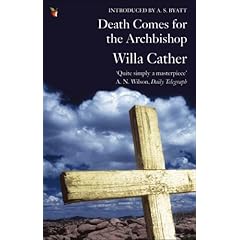
Death Comes for the Archbishop

No, this isn't a news flash, or a devout prayer that Such-and-such receive his reward very soon...  (For such, BTW, one sings the Media vita, or has a Requiem sung.)

Rather, I've just taken delivery of a favourite book of mine, which I've read over and again, but one of which I've never actually owned a copy: Death Comes for the Archbishop, by Willa Cather (originally published 1927).  It's an evocative, elegaic work about two French priests come to the South-West of the United States to reawaken its slumbering Catholicism and erect new dioceses among the Indians, Spanish/Mexicans and Americans there.  I thoroughly recommend it to all.

While I'm not so interested in reading most of her œuvre, I think I may buy a copy of Shadows on the Rock, set in 17th century Quebec...

Sunday, August 24, 2008

Death

Today's Gospel being the account of the raising to life of the only son of the widow of Naim, Fr Rowe took this as a cue to preach on death - for, just as that youth was struck down in the prime of life, at some unknown day and hour we too shall die: but, unlike him, it is most unlikely we shall be miraculously resuscitated.

Therefore, we ought focus on death, our ineluctable fate.

Fr observed that the sight of a hearse or coffin or funeral or burial ought move us to pray for the deceased.  Just as it is a corporal work of mercy to bury the dead, so it is a spiritual work of mercy to pray for the dead: thus we should assist at funerals when possible.

To better instruct us, he detailed parts of the funeral liturgy and their significance.

At the news of death, and at the time of a funeral, the church bell rings out the solemn death knell: by which the faithful are bidden to pray for the holy souls in Purgatory, and to assemble for the obsequies.

The priest and people go to meet the body, and it is borne to church, with Psalms 129 and 50 - the De profundis and Miserere - chanted.  While priest and people will be in black, the colour of mourning, we ought not bewail like the pagans who have no hope (cf. I Thess. iv, 13b), nor indulge in melodramatic ululations, nor perpetuate suchlike follies.  The early Christians rather rejoiced at the passage of their brethren into eternal life, but, given the manifold dangers of the world, and our awareness of the less-than-perfect lives of even believers to-day, the Church calls us to a moderate and rational grief, mingled with prayer for deliverance from Purgatory for the departed soul.

Before the body is carried the crucifix and candles, representing unto us that Christ's all-meritorious death is our only hope of salvation, and reminding us that once the faithful had perforce furtively to bury the Christian dead by torchlight in the catacombs, whilst furious persecution raged against ours, the only true religion.

Several times in the funeral rites, the corpse is aspersed and thurified: this signifies that prayer for the dead tempers the fires of purgatory and pleases the Almighty (as well as reminding us that the Christian departed was baptized and therefore made holy and fit for heaven, tho' required to live justly, soberly and piously). 

 The body of a layman is placed with the head altarward, for God shall judge his soul; but that of a priest is laid with head toward the congregation, for the priest shall be judged not only by the Lord, but, as it were, by his flock, for he must answer for all his ministrations toward them.*  

[*UPDATE: Did I get this mixed up in my hazy memory?  A correspondent tells me the bodies actually go the other way round!  Whoops.]

Since, as once with the only son of the widow of Naim, in olden days bodies were brought into church exposed on a bier, a black pall is cast over the body so as not to affright the people in church, even though nowadays a closed coffin is employed.

The Holy Sacrifice of the Mass is next offered up for the eternal repose of the faithful departed, in presence of the corpse - or, if need be, a catafalque representing the body is erected.  (This was done for the memorial Mass of a friend of mine, Brett O'Meara - God rest his soul - who died on the 12th of May 2003.  I attended his actual funeral in country Victoria, but, since he had preference for the Latin Mass, arrangements were made to have a second memorial Mass, a Missa cantata, in Melbourne at the end of May that year.)

After Mass, the coffin is carried forth for burial, with the chanting of the Benedictus, and final prayers at the graveside.  The body is buried into the earth, since the earth has it were rights over the body, being made from the earth as Genesis avers, and as we are reminded each Ash Wednesday.  The priest and all present pour handfuls of earth onto the coffin.  Pagans being enamoured of cremation, the early Christians had a horror of it - hence burial in the earth.

Die we must: pray for a good and happy death, asking the prayers of St Joseph, patron thereof.

Saturday, July 12, 2008

How Sweet to Die a Carmelite

Of your charity, please pray for Peter (late of Bunbury) who is trying his vocation with the Carmelite Monks of Wyoming (having departed thence just under a month ago). Now, to live a Carmelite is hard - but, as the proverb continues, to die a Carmelite how sweet it is!

For proof of this sentiment, I quote from the annual Auxiliary Newsletter from the Carmel of Launceston, as penned by Mother Stephanie Mary of Divine Providence, the Prioress (which my Mum has just sent me to read):

Sister Mary Monica, who was one of our foundation sisters and had been ill for some time went to God in a very beautiful and peaceful death on March 10th [2008]. We were all with her in prayer as she left this world at the moving words "Go forth Christian soul...". Her last weeks in our infirmary were marked by her peaceful surrender to God and her gratitude for all the sisterly care and love given her over those last weeks. How grateful we are to her for her great contribution to our community of nearly 60 years. Some of you may have known her earlier when she held the office of prioress several times. Please pray for her now. I am confident she is now praying for us all from heaven. Her funeral Mass on March 13th was really lovely and Father Terry Southerwood [Dean of Northern Tasmania] preached a beautiful homily.

I'm not ashamed that this simple yet uplifting account almost moves me to tears. Heaven! Thou shouldst be the only hoped-for sight!

Please pray also for holy perseverance for Sr Elijah Mary of Mount Carmel, OCD, who took her first vows at the Launceston Carmel on the 8th of September (Our Lady's Birthday) last year.

A lovely Carmelite custom, to which I've been privy on occasion, is that at the Easter Vigil, after all renew their baptismal promises, the nuns then renew their vows: I quite clearly recall hearing one of them saying "I, Mother Mary of the Holy Ghost..." and so on.

(The Carmel of the Immaculate Heart in Launceston, Tasmania, was blessed and opened on the 7th of June 1975, some 33 years ago, having relocated from the nearby country town of Longford, where it had originally been founded on the 15th of June 1948, from Adelaide in South Australia: so this is their diamond jubilee year. Sr Mary of the Holy Ghost, one of the foundation sisters, is still alive and active, Deo gratias.)

Sunday, January 27, 2008

...and he died

Last night, fairly desultorily looking through the readings for Septuagesima week that I didn't read, having used the Liturgy of the Hours instead, I recalled a striking sermon -which I'd thought was Newman's, but can't track down now - regarding Genesis 5, part of which was appointed for Saturday at Matins:

5:1 This is the book of the generation of Adam. In the day that God created man, he made him to the likeness of God. 2 He created them male and female; and blessed them: and called their name Adam, in the day when they were created. 3 And Adam lived a hundred and thirty years, and begot a son to his own image and likeness, and called his name Seth. 4 And the days of Adam, after he begot Seth, were eight hundred years: and he begot sons and daughters. 5 And all the time that Adam lived came to nine hundred and thirty years, and he died.

6 Seth also lived a hundred and five years, and begot Enos. 7 And Seth lived after he begot Enos, eight hundred and seven years, and begot sons and daughters. 8 And all the days of Seth were nine hundred and twelve years, and he died. 9 And Enos lived ninety years, and begot Cainan. 10 After whose birth he lived eight hundred and fifteen years, and begot sons and daughters.

11 And all the days of Enos were nine hundred and five years, and he died. 12 And Cainan lived seventy years, and begot Malaleel. 13 And Cainan lived after he begot Malaleel, eight hundred and forty years, and begot sons and daughters. 14 And all the days of Cainan were nine hundred and ten years, and he died. 15 And Malaleel lived sixty-five years, and begot Jared.

16 And Malaleel lived after he begot Jared, eight hundred and thirty years, and begot sons and daughters. 17 And all the days of Malaleel were eight hundred and ninety-five years, and he died. 18 And Jared lived a hundred and sixty-two years, and begot Henoch. 19 And Jared lived after he begot Henoch, eight hundred years, and begot sons and daughters. 20 And all the days of Jared were nine hundred and sixty-two years, and he died.

21 And Henoch lived sixty-five years, and begot Mathusala. 22 And Henoch walked with God: and lived after he begot Mathusala, three hundred years, and begot sons and daughters. 23 And all the days of Henoch were three hundred and sixty-five years. 24 And he walked with God, and was seen no more: because God took him. 25 And Mathusala lived a hundred and eighty-seven years, and begot Lamech.

26 And Mathusala lived after he begot Lamech, seven hundred and eighty-two years, and begot sons and daughters. 27 And all the days of Mathusala were nine hundred and sixty-nine years, and he died. 28 And Lamech lived a hundred and eighty-two years, and begot a son. 29 And he called his name Noe, saying: This same shall comfort us from the works and labours of our hands on the earth, which the Lord hath cursed. 30 And Lamech lived after he begot Noe, five hundred and ninety-five years, and begot sons and daughters.

31 And all the days of Lamech came to seven hundred and seventy-seven years, and he died. ...

Each of the antediluvian patriarchs is enumerated, and each formulaic entry ends, after giving their tale of long years: "...and he died."

Septuagesima week recalls the Creation, the Fall, and the terrible effects of the Fall on fallen man: suffering, breakdown of harmony, the first murder, and death, "the wages of sin".

Death is common to all.