Showing posts with label Book of Divine Worship. Show all posts

Sunday, April 21, 2013

Liturgical Ethos of the Ordinariate

The Mater et caput of all the Personal Ordinariates is surely that of Our Lady of Walsingham for England and Wales (and Scotland): its Ordinary, Monsignor Keith Newton, has recently issued Guidelines for the Celebration of the Holy Eucharist in the Personal Ordinariate of Our Lady of Walsingham, which, inasmuch as they well promote the liturgical ethos of the groups of Anglicans that have come into full communion with the Catholic Church, may with profit be studied and emulated, not just in the other two Ordinariates, mutatis mutandis, but throughout the wider Latin Rite of the Universal Church.

Some of the more notable points in the Introduction and Norms of these Guidelines are:

1. Without excluding liturgical celebrations according to the Roman Rite, the Customary of Our Lady of Walsingham and the Book of Divine Worship [Rite One only – cf. 2.] are the current liturgical texts, for the Office and for Holy Mass, proper to the Personal Ordinariate of Our Lady of Walsingham, as indicated by the faculty given (cf. AC III). 
3. Liturgical celebrations should always take into account the desire of the Apostolic Constitution Anglicanorum coetibus, for the maintenance of the traditions of the Anglican Communion within the Catholic Church (cf. AC III). This should be evident in all aspects of liturgical celebration, whether according to the Book of Divine Worship or the Ordinary Form of the Roman Rite, not least in the choice of sacred music and vesture. 
5. Where the dynamic of the building allows it, the ancient practice of ad orientem celebration is commended. 
6. Where versus populum celebration of the sacred liturgy is necessary, the placing of a standing crucifix with the corpus turned towards the celebrant, in the centre of the altar, is commended. 
9. Where it is possible, Sundays, solemnities, and some feasts (e.g. Candlemas, Ash Wednesday, Annunciation, Visitation, Transfiguration, Holy Cross, Blessed John Henry Newman, All Souls) should be celebrated in a more solemn form, with the use of incense and music. 
10. The Roman Canon (Eucharistic Prayer I) is highly commended for use, not simply on Sundays or solemnities. This prayer is a particular sign of continuity with the Uses in force in the Church in England before the Reformation.

Whether, at Mass, either the Ordinary Form of the Roman Rite, or the Book of Divine Worship is used, the Anglican Patrimony, that treasure to be preserved and indeed shared with the wider Church (as Benedict XVI put it), ought be evident in the liturgical ethos and atmosphere, in all aspects, "not least in the choice of sacred music and vesture": and by "vesture" I daresay the use of beautiful and dignified vestments, not cheap polyester ponchos, but those of a higher quality, as favoured by Benedict XVI of happy memory, is suggested, as also the use of cassock and surplice by servers, not sacklike albs for all and sundry.

Furthermore, on all Sundays, solemnities and some feasts, incense and music ought be employed where possible. The eastward position is recommended to be used, if the physical layout of the church building allow it; however, as happens, if this is not possible (here in Australia, the church of the Ordinariate parish in Melbourne has an altar that has been moved forward, so that it is impossible to say Mass ad orientem), then the so-called Benedictine arrangement ought be used.  The use of the Roman Canon is highly encouraged, not merely on Sundays and solemnities, but on all occasions.

Quite frankly, if only ordinary Masses across the wider Roman Rite were conducted in such a manner! There would indeed be a hermeneutic of continuity employed. The Roman canon, incense, music, celebration ad orientem... this would gladden the hearts of the New Liturgical Movement.

The Guidelines then detail recommendations about Sacred Music:

15. The use of sacred music is integral to the celebration of the sacred liturgy. As such priority should be given to the liturgical texts as found in the liturgical books (cf. GIRM §48) and to the use of plainchant (cf. GIRM §41). 
16. The priest or deacon should sing those parts of the rite indicated by the rubrics to a varying degree dependent on the solemnity of the occasion. 
17. Well-chosen hymns have a particular role in Anglican liturgical patrimony and in recent years have almost displaced the singing of the Propers. The Anglican Use Gradual, successor to the English Gradual, is a simple tool for the recovery of the singing of the Propers and is highly commended. 
18. The sung proclamation of the gospel is commended when the prayers of the Mass are sung and especially at celebrations of particular solemnity. 
19. It is desirable that the faithful know how to sing together at least some parts of the Ordinary of the Mass in Latin, especially the Profession of Faith and the Lord’s Prayer, as a sign of our unity with the wider Church (cf. GIRM §41). 
20. Each Ordinariate Group should be well-versed with the plainchant setting of the Ordinary of the Mass found in the English translation of the Third Typical Edition of the Roman Missal. Where this is employed in celebrations according to the Book of Divine Worship, the Greek/Latin is used. 
21. Mass VIII (Missa de Angelis) in Latin, Credo I and Credo III, and the Lord’s Prayer set by John Merbecke are highly commended for use. In celebrations according to the Book of Divine Worship where a congregational setting of the Ordinary of the Mass is used, John Merbecke’s setting and the Anglican Folk Mass by Martin Shaw are highly commended. 
22. Certain plainchant hymns, proses, and anthems in English should be known by the faithful of the Personal Ordinariate (e.g. the seasonal Office Hymns, Advent and Lent Prose). It is good that the seasonal Marian antiphons are known in Latin as well as to vernacular, metrical settings (e.g. Joy to thee, O Queen of Heaven).

Aside from a few references particular to the Anglican Patrimony, if only the standard of sacred music aimed at here were the norm throughout the Western Church! Note particularly the encouragement of the singing of the Gospel at sung Mass (once the norm, now exceedingly rare), the singing of the Ordinary of the Mass in Latin as well as English, and the use of sung Propers.

As for the readings from Scripture, only the Revised Standard Version (Catholic, 2nd edition) is permitted for use at Mass (n. 23) – but, when members of the Ordinariate worship with a congregation made up mainly of diocesan Catholics, for "pastoral reasons" the Jerusalem Bible may be used, lest a change cause wonderment. (As an aside, be it noted that, sometime in the next decade, the Lectionary will be brought out in a new version, employing the English Standard Version.)

When the Book of Divine Worship – the preferred form of the Eucharistic Liturgy in the Ordinariate – is to be used for Mass, further rules apply:

27. The Propers are taken from the Third Typical Edition of the Roman Missal if they are to be used. If they are to be sung, the equivalent texts (together with the accompanying chant) from the Graduale Romanum, Graduale Simplex, or the Anglican Use Gradual are used. 
28. The Collect for the celebration of the Holy Eucharist may be taken from either the Book of Divine Worship or the Third Typical Edition of the Roman Missal in English. If the latter is used, it should not be adapted (i.e. by the adopting the conventions of ‘traditional language’). 
29. The Traditional [BCP] Psalter as found in the Customary of Our Lady of Walsingham and the Psalter as found in the RSV Lectionary may be used for the psalm in the celebration of the Holy Eucharist and the Liturgy of the Hours. 
30. The Psalter as found in the Book of Divine Worship [being the Episcopalian revision of the original BCP Psalter] is not permitted for use. 
31. Penitential Rite B [after the Intercession and before the Preparation of the Offerings] is to be preferred. 
32. The Preparation of the Offerings is taken from the Third Typical Edition of the Roman Missal. 
33. The Prayer over the Offerings is taken from the Third Typical Edition of the Roman Missal. 
34. The Roman Canon as found in the Book of Divine Worship is used with the following words of consecration inserted in place of those found in the Book of Divine Worship: 
Who, the day before he suffered, took bread into his holy and venerable hands, and with eyes lifted up to heaven, unto thee, God, his almighty Father, giving thanks to thee, he blessed, broke and gave it to his disciples, saying: 
TAKE THIS ALL OF YOU, AND EAT OF IT, FOR THIS IS MY BODY,
WHICH WILL BE GIVEN UP FOR YOU. 
Likewise, after supper taking also this goodly chalice into his holy and venerable hands, again giving thanks to thee, he blessed, and gave it to his disciples, saying: 
TAKE THIS, ALL OF YOU, AND DRINK FROM IT, FOR THIS IS THE CHALICE OF MY BLOOD,
THE BLOOD OF THE NEW
AND ETERNAL COVENANT,
WHICH WILL BE POURED OUT FOR YOU AND FOR MANY
FOR THE FORGIVENESS OF SINS. DO THIS IN MEMORY OF ME. 
35. The response to ‘Therefore we proclaim the mystery of faith’, is one of the acclamations taken from the Third Typical Edition of the Roman Missal.

These modifications fall into two categories: firstly, updating the Book of Divine Worship to conform to the latest edition of the Roman Missal (in other words, removing the obsolete ICEL paraphrases and inserting the far more acceptable new ICEL translations – the sudden change from Cranmerian prose to ICEL vernacular and back again for the Offertory and Consecration was one of the most jarring aspects of the Book of Divine Worship); and secondly giving directions for the use of the sung Propers, even in Latin – so Graduals and the like may be sung.

Finally, the Guidelines provide very pertinent directions about "The Distribution of Holy Communion" in conformity with the restoration of Catholic tradition (as exemplified by the practice of Benedict XVI) and the maintenance of the orthodox Anglican Patrimony:

36. In keeping with the Anglican tradition, it is highly commended that Holy Communion be distributed at a communion rail (or in a similar manner) to kneeling communicants. 
37. Where Holy Communion is received in the hand, due reverence and the patristic and Anglican practice of ‘making a throne’ and taking the Sacred Host to the mouth are highly commended, as is the practice of receiving Holy Communion directly on the tongue. 
38. In keeping with the Anglican tradition, it is highly commended that the chalice is always retained by the Minister of Holy Communion, whether Ordinary or Extraordinary, and not passed into the hands of the communicant. Holy Communion under both kinds is part of the patrimony and remains normal practice in the Personal Ordinariate.

Anglicans of whatever variety have always knelt for communion, and when I have occasionally glanced into Anglican churches I have very often noted the altar rail and kneeler still in place for regular use, whether the locals be High or Low in their churchmanship. The near-universal rejection of kneeling in favour of standing is a Catholic innovation of the last fifty years, after centuries of kneeling. As to reception on the hand, it seems more reverent to convey the Host to one's mouth in that manner, by bearing It gently to the mouth upon the "throne" of the hands, rather than to seize It with the fingers as if It were a potato crisp! But of course to receive directly upon the tongue is also most commended, as the normative Catholic practice even today, whatever of widespread contrary custom.

(I would guess that the employment of extraordinary ministers of holy communion is not so common in the Ordinariate, and that any such are male servers, vested in cassock and surplice, as is most fitting.)

In sum, these Guidelines are a marvellous programme for noble and dignified Eucharistic worship (and also when the Divine Office is celebrated, though I have omitted to comment on that in this post). Aside from the particular use of elements proper to the Anglican Patrimony (the Customary, the Anglican Use Gradual, the Book of Divine Worship), if these Guidelines were widely disseminated and employed, how greatly would worship, liturgy and true piety profit throughout the wider Church!

Imagine, for a moment, how this would look in a parish, and not one part of the Ordinariate, but where these sane principles were embraced by priest and people as a timely reminder of the true Catholic ethos, "which I have loved long since and lost a while":

  • worship ad orientem (n. 5);
  • incense and sacred music used on all Sundays and solemnities, and on many feasts (n. 9);
  • the Roman Canon employed not merely on Sundays and solemnities, but more often (n. 10);
  • "silence and due reverence before the tabernacle, and in the Church before and after liturgical worship" (n. 11);
  • "public and sung celebration of the Liturgy of the Hours" (n. 12) – e.g. Vespers, which ought to be celebrated in all parish churches at least on Sundays;
  • "The celebration of the Sacrament of Reconciliation... before Mass... as a means of bringing the sacrament to the renewed awareness of the faithful" (n. 13);
  • priority given to singing the liturgical texts and to plainchant (n. 15), to the singing by the priest or deacon of their parts of the Mass (n. 16) – e.g. the Preface and even the Gospel (n. 18) – to the singing of the Propers (n. 17), and to the singing by all of well-known settings of the Mass in both English and Latin (nn. 19-21);
  • Holy Communion distributed to kneeling communicants at the altar rail, where they may receive either on the tongue or in the hand in a reverent manner; and the administration of the chalice in a like and seemly manner (nn. 36-38).

These remind me of the famous "six points" of Anglo-Catholic or ritualist worship: the mixed chalice, wafer bread (unleavened hosts), lights (candles),  Eucharistic vestments, the eastward position, incense – the first four of these are and have always been universal Roman Catholic practices, but the last two have sadly dropped away, and ought be restored.

I pray that we have here, not one last fruit "out of season" of the Pontificate of Benedict XVI, but the first blossoming of the ongoing rediscovery and repristination of divine worship which is the fundamental duty of the whole Church.

My only regret is that Monsignor Newton did not see fit to employ that famously witty Anglican sense of humour, and give us thirty-nine of these Guidelines!

Tuesday, November 6, 2012

Ordinariate Mattins and Evensong

Some notes of mine about the order for Mattins and Evensong found in the Customary:


The use of a Sentence of Scripture and Penitential Rite at the start of the Hour is allowed before Evensong only; the Penitential Rite consists of an Exhortation, a Confession and an Absolution (non-sacramental, of course): the Exhortation derives from Evensong, not Mattins, in the 1979 US BCP (this same passage was reused in the Book of Divine Worship); the particular form of the Confession also follows the US BCP and BDW in omitting the 1662 phrases "And there is no health in us", "O God", and "miserable offenders", as well as making slight changes in the use of personal pronouns from the more archaic "them which" and "them that", and also reading "Jesus" not "Jesu". Finally, the Absolution follows the BDW in adding "May" to make the subjunctive sense clear, and changing from the 1979 US BCP by reading "us" and "our", not "you" and "your": 
  
Dearly beloved, we have come together in the presence of Almighty God our heavenly Father, to render thanks for the great benefits that we have received at his hands, to set forth his most worthy praise, to hear his holy Word, and to ask, for ourselves and on behalf of others, those things that are necessary for our life and our salvation. And so that we may prepare ourselves in heart and mind to worship him, let us kneel in silence, and with penitent and obedient hearts confess our sins, that we may obtain forgiveness by his infinite goodness and mercy.

or

Let us humbly confess our sins unto Almighty God.


Almighty and most merciful Father,
we have erred and strayed from thy ways like lost sheep,
we have followed too much the devices and desires of our own hearts,
we have offended against thy holy laws,
we have left undone those things which we ought to have done,
and we have done those things which we ought not to have done.
But thou, O Lord, have mercy upon us,
spare thou those who confess their faults,
restore thou those who are penitent,
according to thy promises declared unto mankind in Christ Jesus our Lord;
and grant, O most merciful Father, for his sake,
that we may hereafter live a godly, righteous, and sober life,
to the glory of thy holy Name. Amen.


May the Almighty and merciful Lord grant us absolution and remission of all our sins, true repentance, amendment of life, and the grace and consolation of his Holy Spirit. Amen. 

At Evening Prayer, the first versicle “O Lord, open…” is omitted (just as in the 1979 US BCP), unless traditional musical settings are used; and the same applies to the use of the 1662 versicle “Praise ye the Lord” at both Morning and Evening Prayer – following the US BCP and BDW, "Alleluia" is proposed for use instead (in this imitating the Roman Rite).
  
The Morning Prayer Invitatories are all but one (the first) based on those in the 1979 US BCP, as also used in the BDW, but updating the language ever so slightly, as by using "draws" not "draweth", etc. The  Invitatory Psalms suggested are either the traditional Ps 95 (not the US cento version), or one of Pss 24, 67, 100 (the last also in the BDW), or of course the Easter Anthems at their proper season.

As a parallel to the Invitatory, at Evensong there is an option to insert a Lucernarium: Ps 141:1-4b, 8 or Ps 134 or two hymn versions of the Phos hilaron may sung while candles are lit, and incense burned.  This seems a trifle contrived, I must say.

As is traditional in Anglican practice, an Office hymn may be sung either after the Invitatory Psalm (at Mattins) or before the "Mag." (at Evensong).

The Psalmody follows in the usual manner; and, next, the two Lessons, with a Canticle after each.

Oddly, no direction is given as how to announce the title of the Lessons.  Unlike in the 1662, allied BCP's, and the BDW, there is no provision to say at the close of each, "Here endeth the (First/Second) Lesson" but instead only "The Word of the Lord" with the usual Roman response may be used.

At Mattins, the appointed Canticles are: after the first Lesson, Benedicite or Benedictus es (ferial), or Te Deum (festal); and after the second, the Benedictus (daily) – however, the Customary gives three other canticles as optional alternatives to use after the first Lesson on Ash Wednesday (Deducant oculi, Jer 14:17-21), Good Friday (Domine audivi, Hab 3:2-4, 13a, 15-19) and Holy Saturday (Ego dixi, Is 38:10-14, 17-20, which may also be used on All Souls and in the Office for the Dead).

Similarly, at Evensong, the daily Canticles are the age-old "Mag. and Nunc" (or, if the latter is to be used at Compline, one of the modern Roman Vespers New Testament Canticles is to be substituted therefor).

After the Apostles' Creed, "The Lord be with you" (to be omitted if the person presiding is not a clergyman), "Let us pray", the threefold Kyrie (in English) and Lord's Prayer all follow. After the "Our Father" come the Suffrages, in three forms – the first set (A1) is the traditional English from the 1662 BCP; the second (A2) derives from the 1979 US BCP (via the BDW); the third (B), is also US in origin, at Mattins being the Te Deum’s third part, but at Evensong is Byzantine in origin.

The Collect of the Day is followed by the traditional Second and Third Collects; after these, the end of the service may include hymns or anthems, a sermon, Benediction of the Blessed Sacrament (at Evensong), and/or "Further Prayers" – among which are given: the General Thanksgiving (in traditional 1662 form), a Prayer for the Pope (an understandable insertion, with a text derived from the old Missale Romanum), a Prayer for the Clergy and People (1662 form, but with “Curates” changed to “Clergy”), a Prayer for the Queen and Royal Family (moved from before the prayer for the clergy to avoid any hint of Erastianism; again, not in the 1662 form, but with a text taken from the old Roman Missal's oratio pro Rege); and the famous Prayer of St Chrysostom (1662, derived from the Byzantine Divine Liturgy).

The whole service ends either with "The grace..." (1662) or with a more Roman conclusion: "The Lord be with you… Let us bless the Lord…" and either "The Lord bless us…" at Morning Prayer (derived from modern Roman Lauds and Vespers) or "May the souls of the faithful…" at Evening Prayer (from the traditional Roman Office).

Friday, September 24, 2010

Morning Prayer: Judith

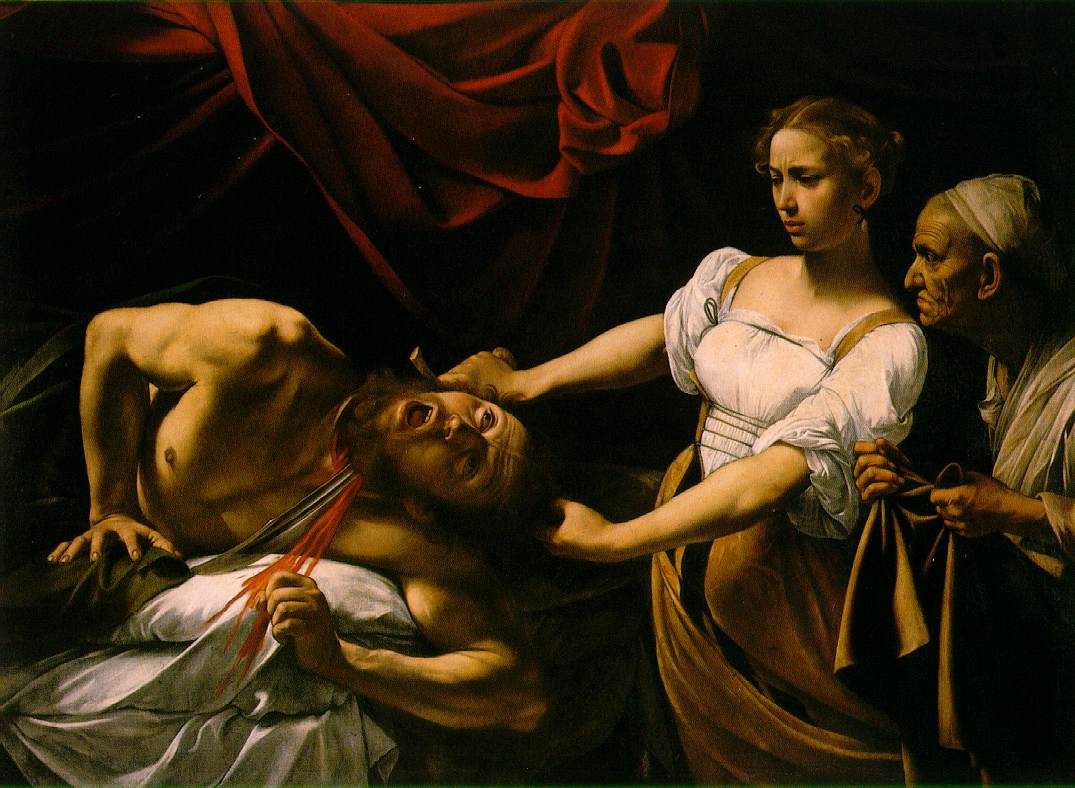
Thinking to pray with and for those Anglicans and Catholics (in both senses) who, God willing, will decide to enter the Ordinariates soon to be set up, I read Morning Prayer from my copy of the Book of Divine Worship, which is the already-existing first draft of the Anglican Use.  In its lectionary, I noted that there are alternative readings for this, the week of the Sunday closest to the 21st of September: either from Esther, or Judith.  Going on a hunch, remembering that to-day the 24th is kept in memory of Our Lady of Ransom, I chose Judith as an apt type of Our Lady: for in hewing off Holofernes' head, she foreshadowed Holy Mary treading Satan underfoot, as the Protoëvangelium long ago first predicted.

How to deal with unwelcome brutes

Herewith, the first lesson: Judith 13:1-20 (the whole chapter), which is the climax of the book, as herein shrewd Judith, having rendered Holofernes dead drunk, now strikes him dead with his own sword, and returns in triumph to her people, the Israelites beseiged at Bethulia, whereupon she wins their highest praise for saving them all (I quote from the R.S.V., which is what I use with the B.D.W., as closest to the K.J.V. and also being approved for Catholic use):
When evening came, his [Holofernes'] slaves quickly withdrew, and Bagoas closed the tent from outside and shut out the attendants from his master's presence; and they went to bed, for they all were weary because the banquet had lasted long. So Judith was left alone in the tent, with Holofernes stretched out on his bed, for he was overcome with wine. 
Now Judith had told her maid to stand outside the bedchamber and to wait for her to come out, as she did every day; for she said she would be going out for her prayers. And she had said the same thing to Bagoas. So every one went out, and no one, either small or great, was left in the bedchamber. Then Judith, standing beside his bed, said in her heart, "O Lord God of all might, look in this hour upon the work of my hands for the exaltation of Jerusalem. For now is the time to help thy inheritance, and to carry out my undertaking for the destruction of the enemies who have risen up against us." 
She went up to the post at the end of the bed, above Holofernes' head, and took down his sword that hung there. She came close to his bed and took hold of the hair of his head, and said, "Give me strength this day, O Lord God of Israel!" And she struck his neck twice with all her might, and severed it from his body. Then she tumbled his body off the bed and pulled down the canopy from the posts; after a moment she went out, and gave Holofernes' head to her maid, who placed it in her food bag.
Then the two of them went out together, as they were accustomed to go for prayer; and they passed through the camp and circled around the valley and went up the mountain to Bethulia and came to its gates. Judith called out from afar to the watchmen at the gates, "Open, open the gate! God, our God, is still with us, to show his power in Israel, and his strength against our enemies, even as he has done this day!"
When the men of her city heard her voice, they hurried down to the city gate and called together the elders of the city. They all ran together, both small and great, for it was unbelievable that she had returned; they opened the gate and admitted them, and they kindled a fire for light, and gathered around them. Then she said to them with a loud voice, "Praise God, O praise him! Praise God, who has not withdrawn his mercy from the house of Israel, but has destroyed our enemies by my hand this very night!"
Then she took the head out of the bag and showed it to them, and said, "See, here is the head of Holofernes, the commander of the Assyrian army, and here is the canopy beneath which he lay in his drunken stupor. The Lord has struck him down by the hand of a woman. As the Lord lives, who has protected me in the way I went, it was my face that tricked him to his destruction, and yet he committed no act of sin with me, to defile and shame me."
All the people were greatly astonished, and bowed down and worshiped God, and said with one accord, "Blessed art thou, our God, who hast brought into contempt this day the enemies of thy people."
And Uzziah said to her, "O daughter, you are blessed by the Most High God above all women on earth; and blessed be the Lord God, who created the heavens and the earth, who has guided you to strike the head of the leader of our enemies. Your hope will never depart from the hearts of men, as they remember the power of God. May God grant this to be a perpetual honor to you, and may he visit you with blessings, because you did not spare your own life when our nation was brought low, but have avenged our ruin, walking in the straight path before our God." And all the people said, "So be it, so be it!"
(Comparing the K.J.V. rendering, I find the R.S.V. to be just that, a revision; the only interesting textual difference is in verse 11, where the K.J.V. has "Jerusalem", not "Israel".  Two other differences are merely interesting: instead of the common word "sword", "fauchion" - more commonly, "falchion" - which is a curved broadsword, similar to a scimitar; and Uzziah is instead called Ozias.

(By comparison, the Douay has more phrasal differences, albeit none of any great consequence, encompassing the same tale in 26 verses.)

May the Anglicans coming into full communion with the Church, the new Jerusalem, likewise prove not to have been shamed by their dallying with Holofernes (or Henry VIII) - but rather to have taken up the sword of the spirit, the word of God, and with it confounded the enemy who entrapped them, before hieing themselves back to the camp of the true Israel.  Amen, amen.

Monday, December 28, 2009

A Basic Difference in Attitude

In my experience, all but the most way-out and scarcely Catholic priests wouldn't dream of interpolating extra prayers into the Mass, or materially changing its structure by omitting items holus-bolus; the most they do is change a word here or there, which is annoying but hardly earth-shattering... and of course this only applies to the Ordinary Form - anyone offering the Traditional Mass wouldn't dare make changes (apart perhaps from following older rubricks, such as singing Benedicamus Domino not Ite missa est in Advent).  The only 'mainstream' addition I can think of is the happy one – an innovation due to the piety of an English bishop shortly after the Council – of having the people say a Hail Mary at the end of the bidding prayers, before the collect that concludes them.

Compare and contrast this with what prevails among our separated brethren of the Anglican sort: some very estranged indeed, some not to be separated for much longer...

Among Anglo-Catholics, it appears a sort of liturgical anarchy reigns.  Whatever of the official liturgical books, at the least these are tricked out with all manner of pomp and ceremony, and supplemented with all manner of extra prayers: some from modern and some from olden Roman books, some from mediæval Uses, and some from who knows where.  It is common, and in fact a clichéd joke, for folk to say "we're strictly Prayer Book Anglicans" when the sights and words of their liturgies would suggest otherwise!

(Don't get me wrong: as one bishop put it, Anglicans believe in salvation by good taste alone!  The High tend to be very careful about worshipping the Lord in the beauty of holiness, and in this are a blessed relief for Catholics too often experiencing philistine and minimalist worship.  Take the use of good music, of the eastward position at the altar, of incense - apart from Traditional Latin Mass circles and rare Reform of the Reform liturgies, and to a lesser extent some cathedrals, Catholics these days tend to be deprived of all three.  One could say they've the form and we've the substance...)

But back to my topic, via a concrete example: I have never heard of a Catholic priest using the old Offertory prayers at the modern form of Mass; at most, I've seen priests mix the chalice first, rather than after offering the host, or even offering both host and chalice together, which are strictly incorrect but actually quite well-precedented little changes; but I have seen with my own eyes an Anglican service, where both the Tridentine and the Novus Ordo Offertory prayers were used, sandwiched in between the BCP Prayer for the Church Militant and the Preface leading into an "Interim Rite" Prayer of Consecration and Oblation.

Do-it-yourself liturgy on such a scale (and I don't say it's unorthodox, rather the contrary, given that it is done to catholicize the rite) is to Catholic eyes rather surprising to say the least.  More seriously, it has to be said that it appears rather like a continual reinvention of the wheel.

As is well-known, Forward in Faith Anglicans in the C. of E. (who may or may not cross the Tiber in who knows what numbers come February the 22nd) tend to use the modern Roman Rite of Mass: it must be for them that Anglicanorum cœtibus mentions that the use of the Roman Rite is not excluded in the forthcoming Ordinariates.

Then there is the Anglican Use of the Catholic Church, Mark I - the Book of Divine Worship – which even those involved in drawing it up have described openly as not what they would have wanted, presumably because it follows the 1979 U.S. B.C.P. rather than the more classically Anglican 1928 U.S. B.C.P., and also because it has large inserts from the Novus Ordo (above all, the modern Roman three-year lectionary, and the modern "Preparation of the Gifts"), rather than following the Ritualist tradition of taking as much as possible from the older Roman liturgy done into hieratic English.

The Anglican Use Mark II, which is supposedly under final development, would I assume be a mixture of the best of the classic B.C.P.'s (the last of which was the Canadian book of 1962) and enrichments from the Roman Rite, largely if not wholly from its pre-Conciliar form, and even taking elements from the Sarum Rite.

But whatever options are given, Rome will intend that liturgical anarchy cease, and that the rites so thoughtfully provided be used as appointed.

Options already semi-officially available via the B.D.W. are the use of the so-called "Minor Propers", which are in fact the Introit, Gradual, Alleluia or Tract, Offertory and Communion – the classical Roman Rite's liturgical chants, done into English.  They are provided for by the innocuous rubricks at the start of the Rite of the Holy Eucharist, between its readings, at its offertory and at communion: "Here may be sung a Psalm, Hymn or Anthem".  This is elastic enough to permit of the use of a modern Responsorial Psalm or of a Sarum Sequence...

Personally, I would prefer that an Anglican Use be "Anglican", not just a strange hybrid of all the nicest bits of B.C.P. and Roman Missal (old and new) thrown together.  Here would be my very tentative suggestion, taking as its base the most Catholic of the family of B.C.P. rites – the Scottish – and supplementing it where necessary, but nearly always from Anglican sources:


  • Psalm, Hymn or Anthem / Introit Psalm with Glory Be
  • ["The Lord be with you..., Let us pray" & Threefold Kyrie (Nonjurors' 1718)]
  • [Lord's Prayer]
  • Collect for Purity
  • Decalogue / Summary of the Law, with Responses; &/or Kyrie eleison
  • [Collect for Grace and Strength to keep the Commandments (Scottish & U.S.)]
  • "The Lord be with you..." & "Let us pray"
  • Collect of the Day
  • [Lesson (for those who use three lessons at Mass, following more modern Lectionaries)]
  • Epistle with Title and Conclusion
  • Psalm, Hymn or Anthem
  • Gospel with Title and Responses
  • Creed
  • Notices & Sermon & Exhortation (if used)
  • Bidding Prayer (used here because the Prayer for the Church is used after the Consecration, as the form of intercession during the Eucharistic Prayer; the 1928 U.S. Bidding Prayer is admirable)
  • "Let us present our offerings to the Lord..." (Scottish)
  • Offertory Sentence / Psalm, Hymn or Anthem
  • [Mixing the chalice with wine and water; washing hands – nihil dicens]
  • "Blessed be thou..." (the Scottish Offertory prayer – see below, †)
  • [Would the Orate fratres and Secret be necessary importations from the Roman Rite?]
  • Sursum corda &c.
  • Preface
  • SanctusBenedictus
  • Prayer of Consecration (with a pre-consecratory Epiclesis, praying that the elements "become the Body and Blood", as in the 1764 Scottish formula)
  • Prayer of Memorial and Oblation (incl. "which we now offer unto thee" - Scottish & American, but removing the post-consecratory epiclesis)
  • Prayer for the Church (incl. "to accept our oblations and to receive these our prayers which we offer", so expressing the Sacrifice as impetratory; inserting the name of the Pope; and commemorating the Saints by name)
  • "As our Saviour Christ... we are bold to say:"
  • Lord's Prayer with Doxology
  • The Peace of the Lord be with you...
  • Invitation, General Confession, Declaration of Absolution (non-Sacramental, so changing "you" to "us", etc.), Comfortable Words [this could be put before the Offertory as in most other Anglican forms, and as the B.D.W. already does]
  • Prayer of Humble Access
  • Agnus Dei
  • [Ecce Agnus Dei &c.? - Roman but apparently much used; perhaps the 1549 "Christ our Paschal Lamb..." could be used also; the B.D.W. deleted the 1979 U.S. B.C.P. "Take them in remembrance..." formula presumably as altogether too Zwinglian]
  • Psalm, Hymn or Anthem
  • "The Body / Blood of Our Lord Jesus Christ..."
  • ["Having now received..." / versicles (optional Scottish forms)]
  • Prayer of Thanksgiving
  • Gloria in excelsis (in most modern Anglican forms moved back to its original place, but quite decent here as a thanksgiving; the B.D.W. has it at the start, but I don't think this would be absolutely necessary)
  • [Collect before the Blessing (vide infra, *)]
  • "The Peace..."
  • [Dismissal?]

This liturgy would almost wholly use elements common to the Anglican Prayer Book tradition, while being made perfectly orthodox, by reason of careful bolstering of its epiclesis and its expression of the offering of the Sacrifice for all ends.

My personal view is that, if one wants the Traditional Latin Mass, have a Traditional Latin Mass; if one wants the Novus Ordo, do it but do it properly; and if one wants an Anglican Use Mass, have one that is proud of itself, not a mish-mash of a few Anglican bits floating in a Roman sea.

(I would of course have no objections to, say, the Sarum Rite being revived, whether in Latin or done into decent English, but such a multiplicity of rites for a relatively small group of incomers, however welcome, may seem excessive.)

******

* Note that the South African 1954 B.C.P. (and its forerunners earlier in the century) proposed a very full-blooded reference to the Eucharistic Sacrifice, being transparently based on the Placeat sancta Trinitas, to use before the Blessing; apparently it excited quite some controversy among the Protestants:

LOOK with favour, most Holy Trinity, on this our act of worship and service; and may this sacrifice set forth before thine eyes be acceptable to thy Divine Majesty, and avail for us and all for whom we have offered it; who livest and reignest, one God, world without end. Amen.

What a nice prayer to use at the end of an Anglican Use Mass!

(As it is, I often use this as a private prayer at the end of the Masses I attend.)

******

† The Scottish offertory prayer, based on King David's prayer at the people's giving gifts for the building of the Temple (I Chronicles xxix, 10b-12a,14b), deserves to be better known; it is certainly more splendid than that tired pair of anæmic berakhoth used in the Novus Ordo ("Blessed are you, Lord God of all creation..."):

BLESSED be thou, O Lord God, for ever and ever. Thine, O Lord, is the greatness, and the glory, and the victory, and the majesty: for all that is in the heaven and in the earth is thine: thine is the kingdom, O Lord, and thou art exalted as head above all: both riches and honour come of thee, and of thine own do we give unto thee. Amen.

This prayer is intended to be recited when the host and mixed chalice are readied: the priest "shall then offer up, and place the bread and wine prepared for the Sacrament upon the Lord's Table" – custom was to hold the paten and chalice a little above the altar, and at the final phrase to lift them up a little, as a gesture of oblation.

******

While writing of ideal liturgies, the Nonjurors' 1718 Communion Office included the following prayer at the end of the offertory directly before the Sursum corda, being abridged from St Basil's Liturgy; while too exotically oriental and too long to really fit in a Western rite, it is noteworthy for what it says about their understanding of what the priestly ministry is:

O ALMIGHTY God, who hast created us, and placed us in this ministry by the power of thy Holy Spirit; may it please thee, O Lord, as we are ministers of the New Testament, and dispensers of thy holy mysteries, to receive us who are approaching thy Holy Altar, according to the multitude of thy mercies, that we may be worthy to offer unto thee this reasonable and unbloody Sacrifice for our Sins and the Sins of the People. Receive it, O God, as a sweet smelling savour, and send down the grace of thy Holy Spirit upon us. And as thou didst accept this worship and service from thy Holy Apostles: so of thy goodness, O Lord, vouchsafe to receive these Offerings from the hands of us sinners, that being made worthy to minister at thy Holy Altar without blame, we may have the reward of good and faithful servants at that great and terrible day of account and just retribution; through our Lord Jesus Christ thy Son, who, with Thee and the Holy Ghost, liveth and reigneth ever one God, world without end. Amen.

Could not this serve as a suitable prayer of preparation before Mass for a priest?

Wednesday, December 2, 2009

Spare A Thought

Spare a thought for the nuns at the Carmel here in Launceston: come December the 1st, they move to their summer timetable, and arise half an hour earlier, at 4.55 am. Deo gratias!

It certainly makes my coming to weekday Mass for Advent at Carmel pale in comparison - especially since I've now missed the start of Mass (at 7.30 am) for three days running, and have shamefully to sneak in late - the first day during the sung Gloria, yester-day during the first reading, and to-day during the sermon! At this rate I'll soon never get to Mass at all, quod Deus avertat.

I must say, I find it a real discipline to take up the Breviary again as part of my Advent preparation: all these Psalms... I was quite pleased to be almost over with Matins before Mass. It must be said, Matins is the real kicker: the Day Hours are doable, though one has to be consistent about observing the veritas horarum lest they all get left to be said at night.

Writing this put me in mind of something to consider, for I keep a small notebook recording Masses heard, Confessions made, and Hours prayed (obviously I turn my mind to God on other occasions also, but liturgical prayer makes up the bulk of my devotional practices).

I find that this year so far, out of just over 11 months, I've read the full Breviary Office on 131 days, the Day Hours only on 70, and some part of the Hours on 14; while I used the Little Office instead for 76 days, plus 15 when I attempted only part of it; up until Advent, for a change, I prayed Mattins and Evensong from my copy of the Book of Divine Worship for 20 days straight; shamefully, 8 days here and there went by without much prayer at all.

To think that for years and years - well over a decade - I was absolutely punctilious about saying the Divine Office; now see how much of a chopper and a changer I've become...

Saturday, November 21, 2009

An Anglican Canon?

The current Anglican Use Book of Divine Worship includes all the major B.C.P. prayers for the Holy Communion, except the Prayer of Consecration and the Prayer of Oblation. With a second edition, suitably based on older B.C.P.'s and the English Missal, apparently in preparation at the Vatican, it is interesting to speculate on whether an Anglican Canon will be included, or whether, as in the B.D.W., only the Roman Canon (and the other three post-conciliar Eucharistic Prayers) will be included. I exclude discussion of the enormous number of modern Eucharistic Prayers throughout the Anglican Communion - their name is legion - since most of them are frankly too low in their doctrine, and hardly any have much intercession included. I have previously blogged on this, and have just left the following comments on Fr Hunwicke's blog:

...for any Anglican Canon to be inserted in the upcoming Roman Rite Anglican Use Missal (B.D.W. 2.0) - so far as I can see, the only way to do so would be to follow the Scottish 1764 Communion Office, and have the Prayer of Consecration immediately followed by the Prayer of Memorial and Oblation, with the Prayer for the Church tacked on at the end, rather than read at or before the Offertory. (Rome would also require, as it has for all new Eucharistic Prayers, that the Epiclesis be put back before the Consecration, as in other Anglican traditions than the Scottish and its daughter the American.) But would not having these three prayers in sequence make for a very long Canon?

...the Scottish rearrangement (which derives from the 1718 Nonjurors' liturgy) is... :

  1. Prayer of Consecration;
  2. Prayer of Memorial and Oblation;
  3. Prayer for the Church.

By putting the Prayer for the Church last, and including the words "accept our Oblation", it makes it clear that the Eucharist is an impetratory sacrifice, not merely one of praise and thanksgiving: it is offered up for determinate ends.

As St Cyril of Jerusalem says,

"Then when the spiritual sacrifice, the bloodless act of worship is complete, we beseech God, on the ground of that sacrifice of propitiation, for the common peace of the churches; for the stability of the world; for kings; for our soldiers and allies; for the sick and afflicted; in fact, we pray for all who need help, and for them we offer this sacrifice. Next, we remember those who have fallen asleep before us; first the Patriarchs, Apostles, Martyrs; that by their prayers and intercessions God may receive our supplication. After that we pray for the holy Fathers and bishops who have already fallen asleep; and, in short, for all the departed, believing that it will be the greatest advantage for the souls of those for whom this supplication is offered when the holy and awful sacrifice is set before God. We offer up Christ, sacrificed for our sins, propitiating our compassionate God on their behalf, and on our own."
[Mystagogical Catecheses 5, 7-10]

The Prayer for the Church, in its more catholic recensions (1549, as returned to and reworked by the Nonjurors and the Scots, praying for the dead and fulsomely commemorating the Saints), fits this description admirably. As Bishop Thomas Brett (1667-1744) wrote:

"The Reason of the Thing also pleads for putting the Prayer for all estates and Conditions of Men after the Consecration, for as it is one general End of Sacrifice, and of this Eucharistick Sacrifice in particular, to render our Prayers more effectual...it is certainly most proper, that the Sacrifice or Oblation should first be offered, and that Prayer should be made whilst it lies upon the altar, and is already dedicated to God."

It will be observed that this order is in fact the common pattern of the post-Conciliar Roman Eucharistic Prayers:

  • Proemium;
  • Epiclesis;
  • Consecration;
  • Anamnesis/Memorial;
  • Oblation;
  • Prayer for Communicants;
  • Intercesssion for the Living and the Dead with Commemoration of the Saints;
  • Doxology.

Note that, in regard to the Epiclesis, Rome has been clear that in the Roman Rite, for the avoidance of all confusion, it must be placed before the Consecration, so 1549 must be followed, not the Nonjurors, the Scots and the Americans.

So much for what I've written already; here is an example of the text of such an "Anglican Canon" - this is from the Scottish B.C.P. of 1929, except for the restoration of the most express and orthodox 1764 Epiclesis, moved back to before the Consecration (where it was found until that year), and so to fit the sense, changing "For" back to "Who" and deleting "he", and the petition for the Queen and Government moved to after that for the Church and clergy, to avoid Erastianism (I have also restored the words "to accept our Oblations" from the 1764, and inserted the Pope to signify Catholic communion):

ALL glory and thanksgiving be to thee, Almighty God, our heavenly Father, for that thou of thy tender mercy didst give thine only Son Jesus Christ to suffer death upon the cross for our redemption; who, by his own oblation of himself once offered, made a full, perfect, and sufficient sacrifice, oblation, and satisfaction, for the sins of the whole world; and did institute, and in his holy Gospel command us to continue, a perpetual memorial of that his precious death and sacrifice until his coming again.
And we most humbly beseech thee, O merciful Father to hear us, and of thy almighty goodness vouchsafe to bless and sanctify, with thy word and Holy Spirit, these thy gifts and creatures of bread and wine, that they may become the body and blood of thy most dearly beloved Son.
Who in the night that he was betrayed, took bread; and when he had given thanks, he brake it, and gave it to his disciples, saying, Take, eat, this is my Body, which is given for you: Do this in remembrance of me. Likewise after supper he took the cup; and when he had given thanks, he gave it to them, saying, Drink ye all of this, for this is my Blood of the new testament, which is shed for you and for many for the remission of sins: Do this as oft as ye shall drink it in remembrance of me.
Wherefore, O Lord, and heavenly Father, according to the institution of thy dearly beloved Son our Saviour Jesus Christ, we thy humble servants do celebrate and make here before thy Divine Majesty, with these thy holy gifts, which we now offer unto thee, the memorial thy Son hath commanded us to make; having in remembrance his blessed passion, and precious death, his mighty resurrection, and glorious ascension; rendering unto thee most hearty thanks for the innumerable benefits procured unto us by the same, and looking for his coming again with power and great glory.
And we earnestly desire thy fatherly goodness, mercifully to accept this our sacrifice of praise and thanksgiving, most humbly beseeching thee to grant, that by the merits and death of thy Son Jesus Christ, and through faith in his blood, we and all thy whole Church may obtain remission of our sins, and all other benefits of his passion.
And here we humbly offer and present unto thee, O Lord, ourselves, our souls and bodies, to be a reasonable, holy, and living sacrifice unto thee, beseeching thee that all we who shall be partakers of this Holy Communion may worthily receive the most precious Body and Blood of thy Son Jesus Christ, and be fulfilled with thy grace and heavenly benediction, and made one body with him, that he may dwell in us and we in him.
And although we be unworthy, through our manifold sins, to offer unto thee any sacrifice; yet we beseech thee to accept this our bounden duty and service, not weighing our merits, but pardoning our offences, through Jesus Christ our Lord; by whom, and with whom, in the unity of the Holy Ghost, all honour and glory be unto thee, O Father Almighty, world without end.
Amen.

Let us pray for the whole state of Christ's Church.

ALMIGHTY and Everliving God, who by thy holy Apostle hast taught us to make intercessions and to give thanks for all men: We humbly pray thee most mercifully to accept our Oblations, and to receive these our supplications which we offer unto thy Divine Majesty; beseeching thee to inspire continually the universal Church with the spirit of truth, unity, and concord; and grant that all they that do confess thy holy Name may agree in the truth of thy holy word, and live in unity and godly love.
Give grace, O heavenly Father, to all Bishops, Priests, and Deacons, [and especially to thy servants N. our Pope and N. our Bishop,] that they may both by their life and doctrine set forth thy true and living word, and rightly and duly administer thy holy Sacraments: and to all thy people give thy heavenly grace, and especially to this Congregation here present, that they may hear and receive thy holy word, truly serving thee in holiness and righteousness all the days of their life.
We beseech thee also to save and defend all Kings, Princes, and Governors, and especially thy servant Elizabeth our Queen, and all who are put in authority under her, that we may be godly and quietly governed.
We most humbly beseech thee of thy goodness, O Lord, to comfort and succour all those who in this transitory life are in trouble, sorrow, need, sickness, or any other adversity.
We commend to thy gracious keeping, O Lord, all thy servants departed this life in thy faith and fear, beseeching thee to grant them everlasting light and peace.
And we yield unto thee most high praise and hearty thanks, for the wonderful grace and virtue declared in all thy Saints, who have been the choice vessels of thy grace, and the lights of the world in their several generations: and chiefly in the Blessed Virgin Mary, Mother of thy Son Jesus Christ our Lord and God, and in the Holy Patriarchs, Prophets, Apostles, and Martyrs, beseeching thee to give us grace to follow the example of their stedfastness in thy faith, and obedience to thy holy commandments, that * at the day of the general resurrection, we, and all they who are of the mystical body of thy Son, may be set on his right hand, and hear his most joyful voice, Come ye blessed of my Father, inherit the kingdom prepared for you from the foundation of the world.
Grant this, O Father, for Jesus Christ's sake, our only Mediator and Advocate.
Amen.

[*Add ", strengthened by their fellowship, and aided by their prayers" - from the Scottish 1929 B.C.P., Prayers and Thanksgivings, Prayer 51.]
Does this appear a sufficiently orthodox Catholic Eucharistic Prayer, or not?

Friday, November 20, 2009

A Converted Prayer

The forerunner of Anglicanorum cœtibus, and its upcoming parallel document specifically for the T.A.C., was the Pastoral Provision of 1980. To obtain quick approval of some elements of Anglican liturgy for the incoming American groups back then, selections from the 1979 U.S. B.C.P. were hastily assembled, and somehow got past the elder Marini et al. Much has changed since then, and we may hope for something more like the English Missal, with the nice bits of the various older and more classical B.C.P.'s inserted therein, to be made available as the Anglican Use of the Roman Rite.

In the meanwhile, here is one of these converted (I was going to say rebaptized) prayers now declared a part of official Catholic worship by reason of its placement at the end of the Anglicna Use Burial Service, Rite I - it is an abbreviation of a prayer of about twice the length by Jeremy Taylor, seventeenth century Anglican Divine, in his Holy Dying - which I think expresses well the urgency of all moves toward full corporate unity:

O God, whose days are without end, and whose mercies cannot be numbered: Make us, we beseech thee, deeply sensible of the shortness and uncertainty of life; and let thy Holy Spirit lead us “in holiness and righteousness all our days” (St Luke i, 75); that, when we shall have served thee in our generation, we may be gathered unto our fathers, having the testimony of a good conscience; in the communion of the Catholic Church; in the confidence of a certain faith; in the comfort of a reasonable, religious, and holy hope; in favour with thee our God; and in perfect charity with the world. All which we ask through Jesus Christ our Lord. Amen.

Tuesday, November 17, 2009

Anglicanorum Cœtibus - II

I find the terribly uncharitable comments posted on the Rorate Cæli blogsite really quite scandalous - surely the mean and extreme remarks found there will frighten off many potential converts? - but I found the following comment, from one P.K.T.P., very interesting:

"...the TAC choirmaster here [where?] tells me that it was announced publicly today by the dean of his cathedral.

"The news is this: the apostolic constitution was not Rome's response to the TAC's petition of October, 2007; rather, it is a general response to all the requests of differing Anglican groups to reunite with the See of St. Peter. There will now be a SECOND document issued from the C.D.F., this one to address the situation of the TAC specifically. This is coming soon, very soon, well before Christmas.

"I have no idea what is in this new document to come, but we can have some fun speculating about it. I imagine that it will grant some general dispensations for TAC priests and it might make arrangements for ordinariates, especially for the less populous TAC national churches."

Recall that other sources indicate that the Vatican will also approve before Christmas a form of liturgy for the incoming Anglicans, upgraded from the present Anglican Use of the Roman Rite given in the Book of Divine Worship, and most probably drawing upon the English Missal (that is, the Roman Missal done over into Cranmerian prose, with the nice bits of the Book of Common Prayer interwoven).

It seems Father Christmas, otherwise known as Papa Benny, has been busy at work preparing gifts for good boys and girls... I wonder what else he has hidden under the camauro?

Saturday, November 14, 2009

A Lesson

After Confession this morning, I read Mattins from my B.D.W. (hoping by this quixotic devotion to express my prayerful support for corporate reunion of Anglicans), and was struck by the end of the first Lesson:

The Mattathias cried out in the city with a loud voice, saying: "Let every one who is zealous for the law and supports the covenant come out with me!" And he and his sons fled to the hills and left all that they had in the city.
I Maccabees 2:27-28

Surely this may be applied to those wetting their toes on Tiber's banks, having finally spurned the glamours and witchery of that false strumpet, the C of E? For in the days of the Maccabees, Israel had capitulated to the pressure of the pagan world, changing from faith in God to worship of demons, and from adhesion to the Law to the crass expediency that marked Gentile morals. All that was left to do was to fight and flee to a place of refuge...

And I recall what happens a bit further into the tale of the Maccabean revolt, in chapter eight of the first book of the Maccabees:

Now Judas [Maccabeus] heard of the fame of the Romans, that they were very strong and were well-disposed toward all who made an alliance with them, that the pledged friendship to those who came to them...

So Judas chose Eupolemus the son of John, son of Accos, and Jason the son of Eleazar, and sent them to Rome to establish friendship and alliance, and to free themselves from the yoke; for they saw that the kingdom of the Greeks was completely enslaving Israel. They went to Rome, a very long journey...
I Maccabees 8:1, 17-18a


It is and has been a very long journey to Rome: please God, journey's end is now at last in sight.

To escape the slavery of modernism - that is, complete surrender to the world - and to cast off its yoke, paradoxically it remains for Anglicans to seek Gospel liberty in the embrace of the Roman Pontiff: who, far from being the tyrant of Protestant legend or of the scoffing mob's derision, is as Christ's faithful Vicar, the true heir of SS Peter and Paul, attending to preaching the Good News to all, ever concerned for all the churches, and striving to guarantee the Lord's promises of a light burden, Christian service in perfect freedom, the tranquillity of order, and a peace that the world cannot deliver.

Wednesday, November 11, 2009

T.A.C. B.C.P.?

Dominic, who is a T.A.C. member in Canada, commented on my post about the T.AC. at prayer; he wrote about my observation of the local T.A.C. liturgy that:

This is indeed curious. I'm a TAC member in the Anglican Catholic Church of Canada. If you can find the 1962 [Canadian] BCP online you will see what we use. The parish I attend just uses the BCP as is with chanted Introit and Gradual psalms (Willan's Plainsong Psalter settings and pointing). We too meet in a rented hall, but have somewhat more elaborate furniture to set up -altar rails, altar riser and footpace, etc etc - and we kneel to receive in both kinds, the priest uses the full version of the words to be said at the distribution repeating the whole thing over and over as he goes down the row. After the Sermon is the Preparation as the people sing a hymn, then that over, the priest turns to the people, announces his intentions and asks the people to remember those sickor what have you, then turns to back to face the altar and begins "Let us pray for Christ's holy catholic Church..etc" at which we kneel, and remain kneeling for the entire thing until we pray the prayer of Humble Access immediately followed by the Agnus Dei. We sit while the priest makes his communion, then he turns from the altar holding the paten in his hand and one of the hosts above it and says the "Ecce agnus Dei..." at which we go forward.

It is a bit spartan, but it is just a plain-jane Prayer Book Communion with no interpolations additions or deletions. It is my hope that the revised rites used in Ordinariate parishes will take what is good and necessary from the Tridentine forms.

When I read of the hybridisation of some anglo catholic ritual, such as the use of the Novus Ordo, it makes me cringe. Here in Canada, at least, we are Prayer Book worshippers. Mattins and Evensong too are straight up BCP in my experience. I think any movement towards contemporary English and such will be resisted by the laity.

I thank Dominic for letting me know how the T.A.C. in Canada worships: "all things decently and in order" would seem to be their motto. (I note that the T.A.C. in the U.S.A. has the appalling motto "We're formal, and we're friendly" - !!!)

Now, to make some commentary on the Canadian '62 B.C.P. (shades of my preferred rite, the Roman '62 (or earlier...)) and its projected reordering to entirely conform it to Catholic truth - I make no reference to ritual actions, since Anglo-Catholics usually do the ceremonial extremely well:

******

The rite begins with the singing of an Introit, then an initial Lord's Prayer and Collect for Purity, followed by either the Decalogue or Our Lord's Summary of the Law (with response), and a threefold Kyrie may be added. All this, while very Anglican, seems entirely fitting and nowise contrary to Catholic faith. [Where's the Gloria in excelsis? See far below!]

(Even in the proposed 1928 English Prayer Book, provision was made for "a Devotion", which was the Roman Introibo with Psalm Judica me and all the rest; Anglo-Catholics would unblushingly add the Roman Confiteor with all the saints invoked therein, and go up to kiss the altar!)

Next, in English, Dominus vobiscum, Oremus, and the Collect of the day (plus any others appointed). The Collects, mainly good translations of the mediæval ones, are fine; obviously prayers for Catholic feasts such as the Immaculate Conception would have to be inserted, but they are all in the English Missal already, used by generations of Anglo-Catholics.

I note one thing that will have to be changed: before the Collect of the day, a Collect for the Queen may be read: it seems rather impertinently Erastian to read it first (though I suspect it is first simply for convenience, to avoid turning back and forth through the book), so it ought be moved to second place, and the fateful words "and Governor" (sc. of the Church of England) would have to be removed, as also probably "the whole Church", which smacks of the notion that Princes have authority over the Church. But obviously to pray for Her Majesty, Sovereign Liege Lady of Canada as of Australia and her other realms, is excellent and commendable piety toward she whom God hath pleased to set in power over us.

The Canadian B.C.P. then has the Epistle and Gospel (more or less as in the traditional Roman Missal, but slightly reordered, as in the Sarum Rite), with a Psalm or Hymn in between as desired - which is code for the Gradual and Alleluia, etc. Again, no worries here. Whereas in the 1980's Roman liturgists inflicted the Novus Ordo Lectionary on the U.S. Book of Divine Worship for Anglican Use Catholics, at the most this would now be made optional, not compulsory.

The Creed follows, then ecclesiastical announcements (e.g. what feast and fast days are coming up, not banal parish notices), and a sermon. Anglo-Catholic sermons are generally of admirable quality!

Offertory sentences are then provided to be read at the altar by the celebrant: several speaking of sacrifice, and various texts for the seasons of the Church year. Rubrics direct the collection to be taken up and presented (very Anglican this: solemnly offering up the monies given by the parish at the altar!), and also the bread and wine for the service may be brought up to the celebrant, if not with him already.

First important note: the Catholic Church will require that only unleavened bread be used, and that water must be mingled with the wine (with or without a prayer to accompany this action), as is the practice of all the Western Rites.

A formula (cf. I Chronicles 29:10,11,14) is provided as an offertory prayer for the bread and wine, which is frankly nobler and more pleasant than the Novus Ordo "Blessed are you..." boring bits:

BLESSED be thou, LORD God of Israel, for ever and ever.
All that is in the heaven and in the earth is thine.
All things come of thee, and of thine own have we given thee.

However, here Catholic Rome would require some interpolations be made:
  • the priest must wash his hands (with or without the usual psalm, Lavabo) as a gesture of purification;
  • he must pray the In spiritu humilitatis, directing his intention to offer sacrifice;
  • he will pray Orate fratres, and the people respond Suscipiat, involving all in the offering up of the great oblation;
  • there will be a proper Secret (Prayer over the Oblations), matching with the Collect of the day, as throughout the Roman Rite.
If, as I think is likely given the present temper of Rome and the T.A.C., the adoption of the full Tridentine Offertory prayers is desired, so be it: I'd not object! (Many Anglo-Catholics would sotto voce insert all that anyway already: "We're strictly B.C.P." can mean many things...)

The Bidding and the general Intercession is next made - note that this is after, not before the Offertory. Perhaps this (and the Penitential Rite following) could be moved before the Offertory, but the order here is not materially important; the Eastern Rites have similar arrangements.

In the Intercession, improvements must be made:
  • the prayer for the nations and the Queen and all in authority moved to after the petitions for the church and clergy and people, to avoid the impression of Erastianism;
  • the Pope prayed for by name;
  • the dead explicitly prayed for;
  • the saints, especially St Mary the Virgin, explicitly commemorated.
(All this is as is done in the Book of Divine Worship.)

Next comes the Penitential Rite: Invitation, General Confession and Absolution (non-sacramental of course!), plus the Comfortable Words. All this is excellent; however, to avoid all confusion, the words "you" and "your" in the Absolution ought be changed to "us" and "our", as was done in the B.D.W.

The Preface dialogue and the Preface, with Sanctus, plus what must be made mandatory, the Benedictus, follows. Again, no trouble here.

THE CANON

Then the big issue - will Rome fix up the Anglican Prayer of Consecration? or substitute the Roman Canon? Having discussed this issue at some length, I believe that the Anglican text is fatally ambiguous, even if carefully amended. See my posts:

The Book of Divine Worship supplies instead the Roman Canon in traditional language (foolishly, inserting ICEL's poor version of the words of consecration, now being revised at last, and also those annoying Memorial Acclamations). I suspect Rome to-day will simply insert the Canon, without such silly overzealous 'corrections'.

So long "Blessing and glory and thanksgiving be unto thee Almighty God, our heavenly Father..."; hello, "Most merciful Father, we humbly pray thee, through Jesus Christ thy Son our Lord...": the Canadian formula, though beautiful, may have to be sacrificed.

-----

Whatever of the Consecration in the Canadian '62 B.C.P., some rearrangement of its prayers before communion is necessary: currently, it postpones the Agnus Dei till communion time, and the Lord's Prayer till afterward, but here the Lord's Prayer must be put first, then the Pax Domini (already there) and the Agnus Dei next, with a rubric ordering the fraction of the Host (this is how the B.D.W. reorders things - note that the Roman embolism after the Lord's Prayer and the Prayer for peace are not inserted even there).

The Prayer of Humble Access, that moving and heartfelt devotion, precedes the actual communion. Here the Ecce Agnus Dei and Domine, non sum dignus should be interpolated - as it appears from Dominic's comment is already done.

Obviously, fitting hymns and anthems can be sung at the distribution of Communion. I would think, however, that the words "The Body of our Lord Jesus Christ, which was given for thee, preserve thy body and soul unto everlasting life... The Blood of our Lord Jesus Christ, which was shed for thee, preserve thy body and soul unto everlasting life" are more than sufficient.

While susceptible of a Catholic interpretation, the additional sentences "Take and eat this in remembrance that Christ died for thee, and feed on him in thy heart by faith with thanksgiving" and "Drink this in remembrance that Christ's Blood was shed for thee, and be thankful" are of notoriously Protestantizing origin, appearing in Edward VI's ultra-low B.C.P., and are perhaps best gracefully retired. That said, the Apostle himself says more or less the same about the Eucharist! Maybe just amending "by faith with thanksgiving" (Zwinglian?) to "with faith and thanksgiving" would square the circle.

As in all Anglican services, but most bizarrely and improperly to Catholic sensibilities, provision is made in the Canadian '62 for a second consecration of one (!!!) or both species, amounting to a second Sacrifice! This was inserted when needed because Reservation of the Sacrament was not permitted. Obviously this strange practice of supplementary consecration will not be permitted, because Reservation will be.

There is a single quite beautiful Postcommunion prayer provided, which by its appearance in the B.D.W. is surely Catholic and orthodox. (I suspect that the proper Roman postcommunion is sometimes or always added to or substituted for this already.) Oddly to Catholics, but quite logically, the Gloria in excelsis is thereupon sung in thanksgiving for Holy Communion: while modern Anglican books nearly all move this back to its original place, it seems unobjectionable and quite beautiful in fact.

Finally, the liturgy concludes with the Anglican formula of blessing: "The peace of God...". To this may opportunely be added the Ite missa est, as I guess is often done anyway.

The only remaining items to note are that a rubric for reservation needs to be added, and the present rubric about reverent consumption of any leftover elements be amended to reflect this; and of course the wicked and heretical Black Rubric - "...It is here declared, that thereby no Adoration is intended, or ought to be done, either unto the Sacramental Bread or Wine there bodily received, or unto any Corporal Presence of Christ's natural Flesh and Blood..." - must be utterly denounced and abolished.

******

So, in short, the celebration of the Holy Eucharist according to the Canadian B.C.P. of 1962 could easily be tweaked and supplemented to make it fully Catholic: for that is a holy pastime undertaken by Anglicans since the days of the Oxford Movement!

I look forward to worshipping God after this manner, once the T.A.C. is in Holy Church united. Oremus ut unum sint!