It is truly right and just, our duty and our salvation, always and everywhere to give you thanks, Lord, holy Father, almighty and eternal God, through Christ our Lord. For he revealed his glory in the presence of chosen witnesses and filled with the greatest splendor that bodily form which he shares with all humanity, that the scandal of the Cross might be removed from the hearts of his disciples and that he might show how in the Body of the whole Church is to be fulfilled what so wonderfully shone forth first in its Head. And so, with the Powers of heaven, we worship you constantly on earth, and before your majesty without end we acclaim:
Showing posts with label Preface. Show all posts
Showing posts with label Preface. Show all posts
Saturday, August 6, 2011


Thursday, June 11, 2009
Reading for Corpus Christi
Over at St Bede's Studio one can read a pleasant translation of the Preface of the Blessed Sacrament pro aliquibus locis, the consideration of which reveals a wealth of theological insight into the Sacrifice of the Mass and our share of its fruits through Holy Communion. According to various decisions of the Ecclesia Dei Commission - detailed in earlier posts on the same blog - this and other prefaces can be used at the Usus Antiquior: and in this case it would be excellent to do so. Anyone objecting should pause and consider that the Preface for the Dead and that for St Joseph, the Preface of Christus Rex and the Preface of the Sacred Heart were introduced in 1919, 1925 and 1929 respectively; so why not a few more, as was quite reasonably being done in an ongoing process of organic development prior to the great liturgical rupture?
******
Now, for the supremely lyric and beautiful, because gloriously true and powerful, decrees of Trent on the Mass:
HOLY ECUMENICAL AND GENERAL COUNCIL OF TRENT.
TWENTY-SECOND SESSION
which is the sixth under the Supreme Pontiff, Pius IV,
celebrated on the seventeenth day of September, 1562.
Doctrine concerning the Sacrifice of the Mass.
That the ancient, complete and in every way perfect faith and teaching regarding the great mystery of the Eucharist in the Catholic Church may be retained, and with the removal of errors and heresies may be preserved in its purity, the holy, ecumenical and general Council of Trent, lawfuly assembled in the Holy Ghost, the same legates of the Apostolic See presiding, instructed by the light of the Holy Ghost, teaches, declares, and orders to be preached to the faithful the following concerning it, since it is the true and only sacrifice.
Chapter I:
The Institution of the Most Holy Sacrifice of the Mass.
Since under the former Testament, according to the testimony of the Apostle Paul, there was no perfection because of the weakness of the Levitical priesthood, there was need, God the Father of mercies so ordaining, that another priest should rise according to the order of Melchisedech,[1] our Lord Jesus Christ, who might perfect and lead to perfection as many as were to be sanctified. He, therefore, our God and Lord, though he was by his death about to offer Himself once upon the altar of the cross to God the Father that He might there accomplish an eternal redemption, nevertheless, that His priesthood might not come to an end with his death,[2] at the last supper, on the night He was betrayed, that He might leave to His beloved spouse the Church a visible sacrifice, such as the nature of man requires, whereby that bloody sacrifice once to be accomplished on the cross might be represented, the memory thereof remain even unto the end of the world, and its salutary effects applied to the remission of those sins which we daily commit, declaring Himself constituted a priest forever according to the order of Melchisedech,[3] offered up to God the Father His own body and blood under the form of bread and wine, and under the forms of those same things gave to the Apostles, whom He then made priests of the New Testament, that they might partake, commanding them and their successors in the priesthood by these words to do likewise: Do this in commemoration of me,[4] as the Catholic Church has always understood and taught. For having celebrated the ancient Passover which the multitude of the children of Israel sacrificed in memory of their departure from Egypt,[5] He instituted a new Passover, namely, Himself, to be immolated under visible signs by the Church through the priests in memory of His own passage from this world to the Father, when by the shedding of His blood He redeemed and delivered us from the power of darkness and translated us into his kingdom.[6] And this is indeed that clean oblation which cannot be defiled by any unworthiness or malice on the part of those who offer it; which the Lord foretold by Malachias was to be great among the Gentiles,[7] and which the Apostle Paul has clearly indicated when he says, that they who are defiled by partaking of the table of devils cannot be partakers of the table of the Lord,[8] understanding by table in each case the altar. It is, finally, that [sacrifice] which was prefigured by various types of sacrifices during the period of nature and of the law,[9] which, namely, comprises all the good things signified by them, as being the consummation and perfection of them all.
Chapter II:
The Sacrifice of the Mass is Propitiatory
both for the Living and the Dead.
And inasmuch as in this divine sacrifice which is celebrated in the mass is contained and immolated in an unbloody manner the same Christ who once offered Himself in a bloody manner on the altar of the cross, the holy council teaches that this is truly propitiatory and has this effect, that if we, contrite and penitent, with sincere heart and upright faith, with fear and reverence, draw nigh to God, we obtain mercy and find grace in seasonable aid.[10] For, appeased by this sacrifice, the Lord grants the grace and gift of penitence and pardons even the gravest crimes and sins. For the victim is one and the same, the same now offering by the ministry of priests who then offered Himself on the cross, the manner alone of offering being different. The fruits of that bloody sacrifice, it is well understood, are received most abundantly through this unbloody one, so far is that latter from derogating in any way from the former. Wherefore, according to the tradition of the Apostles,[11] it is rightly offered not only for the sins, punishments, satisfactions and other necessities of the faithful who are living, but also for those departed in Christ but not yet fully purified.
Chapter III:
Masses in Honour of the Saints.
And though the Church has been accustomed to celebrate at times certain masses in honour and memory of the saints, she does not teach that sacrifice is offered to them but to God alone who crowned them;[12] whence, the priest does not say: “To thee, Peter or Paul, I offer sacrifice,”[13] but, giving thanks to God for their victories, he implores their favour that “they may vouchsafe to intercede for us in heaven whose memory we celebrate on earth”[14].
Chapter IV:
The Canon of the Mass.
And since it is becoming that holy things be administered in a holy manner, and of all things this sacrifice is the most holy, the Catholic Church, to the end that it might be worthily and reverently offered and received, instituted many centuries ago the holy canon,[15] which is so free from error that it contains nothing that does not in the highest degree savour of a certain holiness and piety and raise up to God the minds of those who offer. For it consists partly of the very words of the Lord, partly of the traditions of the Apostles, and also of pious regulations of holy pontiffs.
Chapter V:
The Ceremonies and Rites of the Mass.
And since the nature of man is such that he cannot without external means be raised easily to meditation on divine things, holy mother Church has instituted certain rites, namely, that some things in the mass be pronounced in a low tone and others in a louder tone. She has likewise, in accordance with apostolic discipline and tradition, made use of ceremonies,[16] such as mystical blessings, lights, incense, vestments, and many other things of this kind, whereby both the majesty of so great a sacrifice might be emphasised and the minds of the faithful excited by those visible signs of religion and piety to the contemplation of those most sublime things which are hidden in this sacrifice.
[Chapters VI to IX and the Canons on the Sacrifice of the Mass omitted.]
[1] Heb. 7:11.
[2] Ibid., 7:24.
[3] Ps. 109:4.
[4] Luke 22:19; I Cor. 11:24f.
[5] Ex. 13.
[6] Col. 1:13.
[7] Mal. 1:11.
[8] Cf. I Cor. 10:21.
[9] Gen. 4:4; 12:8, etc.
[10] Heb. 4:16.
[11] Cf. Sess. XXII, can. 3, and Sess. XXV, decr. on Purgatory.
[12] Cf. Sess. XXII, can. 5, and Sess. XXV, Invocation of the Saints.
[13] St Aug., De civitate Dei, VIII, c.27.
[14] Or. Suscipe sancta Trinitas.
[15] C.6, X, De celebr. miss., III, 41 (Innoc. III).
[16] Cf. Sess. XXII, can. 7.
Thursday, January 29, 2009
St Francis de Sales
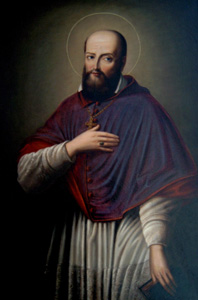
I've tried, and failed, I'll admit, to read St Francis de Sales' Introduction to the Devout Life - oddly, since I find Fr Faber's perfervid prose fine, and ditto for St Louis de Montfort, somehow the Baroque style of de Sales doesn't sit well with me: too much sugar?
In any case, far be it from me to do anything but laud the great works of St Francis de Sales, who (as his hagiographic lesson says) by the help of God converted 72,000 Calvinist and other heretics to the Catholic Faith by his indefatigable preaching of the Divine Word and writing - "By his writings recording heavenly doctrine he enlightened the Church" - and so he was declared by Bl Pius IX a Doctor of the Church.
His Collect, composed by Pope Alexander VII:
Deus, qui ad animarum salutem beatum Franciscum Confessorem tuum atque Pontificem omnibus omnia factum esse voluisti: concede propitius; ut caritatis tuæ dulcedine perfusi, ejus dirigentibus monitis ac suffragantibus meritis, æterna gaudia consequamur. Per...(God, Who for the salvation of souls willed blessed Francis Thy Confessor and Pontiff to be made all things to all men [cf. I Cor. ix, 22]: graciously grant, that imbued with the sweetness of Thy love, by his directing admonitions and assisting merits, we may attain eternal joys. Through...)
One of my missals provides the proper Mass of St Francis de Sales for his daughters, the nuns of the Order of the Visitation. The Epistle is Ephesians iii, 7-21, and the Offertory, Apoc. ii, 19: "I know thy works and thy faith, and thy charity, and thy ministry, and thy patience, and thy last works, which are more than the former." There is even a proper Preface:
Vere dignum... per Christum Dominum nostrum.Qui Ecclesiæ suæ beatum Franciscum Pastorem juxta cor suum suscitavit, ut scriptis, sermonibus et exemplis pietatem corroboraret et aspera converteret in vias planas. Quique illum suæ lenitatis spiritu tam mirabiliter adimplevit, ut non solum indurata peccatorum corda ad pœnitentiam flecteret, sed et rebelles tot hæreticorum mentes ad fidei catholicæ unitatem revocaret.Et ideo...(Truly worthy... through Christ our Lord.(Who raised up for His Church blessed Francis as a Shepherd after His own Heart [cf. Jer. iii, 15], to strengthen piety by his writings, sermons and examples and to convert rough places into level paths [cf. Is. xl, 4]. Who also so marvellously filled him with a spirit of gentleness [cf. Gal. vi, 1], that not only did he bend the hard hearts of sinners to penitence, but recalled the rebel minds of many heretics to the unity of the Catholic Faith.(And therefore...)
May he pray for us before the Face of God in heaven, that still to-day he may fulfil his God-given mission of grace, as an ambassador for Christ calling all of us to unity of Faith and right conduct, that the Lord may deign to work again such wonders through him that the sinner may repent and the heretic believe aright.
(It is a little-known fact that the Oratorians lay claim to St Francis de Sales, since it is thought that he met, if not St Philip Neri himself, then his close disciples, and at one stage sought to establish an Oratory in his area of operations prior to his becoming a bishop.)
Wednesday, January 7, 2009
Unpacking
My boxes having arrived from W.A., I now have some unpacking to do...
I also want to unpack the Epiphany Preface; and will consider it in its three constituent parts.
Vere dignum et justum est, æquum et salutare,nos tibi semper et ubique gratias agere,Domine, sancte Pater, omnipotens æterne Deus:(Truly it is worthy and just, right and salutary,[for*] us always and everywhere to give thanks unto Thee,Lord, Holy Father, Almighty Eternal God:)
Here we have the first part, the protocol of the Preface, the same (but for those of Easter and of the Apostles) in all Prefaces, which reminds us of what reason and religion alike instruct us, that unto God ought be rendered all honour and glory at all times and in every place, giving thanks in all things and for all things to God the Father of lights, from Whom cometh down every good and perfect gift; for so to pray is our duty and a most fruitful one. The use of duplication and reduplication to give majestic sound is notable: four descriptive terms, then two, then God Himself named with six titles. [* The Ambrosian Rite uses the expression Vere quia &c., For it is truly right....]
Quia,cum Unigenitus tuus in substantia nostræ mortalitatis apparuit,nova nos immortalitatis suæ luce reparavit.(For,when Thine Onlybegotten appeared in the substance of our mortality,He repaired us by the new light of His immortality.)
The short body of the Preface - pregnant with meaning - is our proclamation before the Lord as to our especial reason for giving Him thanks before the priest alone embarks upon the silent consummation of the most sacred mysteries within the Canon of the Mass (præfari, to speak before). God's Very Son deigned to shew Himself Incarnate, partaking of our own flesh and blood, so by this unparalleled illumination making manifest and displaying before our astonished eyes a truth previously unguessable; and being immortal and impassible in His Divinity, by enduring all for us in a nature that is our own He carried out an inconceivable transaction, that in due process of time gave us, all undeserving, access to a share in that immortality, translating us from the kingdom of darkness into His own marvellous light. Glory to Him for ever!
But here is the alternative, Ordinary Form passage:
Quia ipsum in Christo salutis nostræ mysteriumhodie ad lumen gentium revelasti,et cum [-] in substantia nostræ mortalitatis apparuit,nova nos immortalitatis ejus gloria reparasti.(For Thee Thyself in Christ the mystery of our salvationto-day revealed as a light to the nations,and when He appeared in the substance of our mortality,Thou didst repair us by the new glory of His immortality.)
Curiously enough, the Novus Ordo Epiphany Preface expands on the Traditional text of the Epiphany Preface by including a new 'couplet' and changing a few words (suæ luce to ejus gloria, and reparavit to reparasti), giving a focus somewhat more directly on God the Father: Who Himself deigned to unveil the mystery of salvation, formerly hidden from all ages, and made it appear in Christ, the Light of the Gentiles; and Who Himself restored us by Christ's immortal glory.
Et ideo cum Angelis et Archangelis,cum Thronis et Dominationibus,cumque omni militia cælestis exercitus,hymnum gloriæ tuæ canimus,sine fine dicentes:(And therefore with Angels and Archangels,with Thrones and Dominations,and with all the companies of the heavenly host,we sing a hymn of Thy glory,saying without ceasing:)
The last part, the eschatocol of the Preface, comes in four forms, of which this, Et ideo, is the most common; but where it is preceded by (Per) Christum Dominum nostrum, the matching form Per quem is used; while the Pentecost Preface ends with Sed et, and the Trinity Preface with Quam laudant. (It must be noted that the All Saints Preface pro aliquibus locis has a variant form of the Per quem, and the quasi-Preface formerly used at the blessing of palms on Palm Sunday has a variant of the Et ideo.) Four choirs of the celestial armies are named, then the whole in its array, making a resounding and emotional climax before we join in their continual cry, Sanctus, Sanctus Sanctus!
This the Epiphany Preface is noteworthy finally because the sentiments expressed in it, being quite general, could indeed have been used equally well at Christmastide or indeed at other times in the Christian Year - this is a quality of the older Roman Rite, that its prayers and euchological texts by their very brevity and profundity repay careful unpacking and consideration, and that their wealthy of meaning makes them appropriate not merely at their assigned time and season, but in wider spheres also.
Wednesday, June 25, 2008
Why St John?
Guéranger answers my question of why Rome holds St John the Baptist as one of her principal patrons: the Cathedral of Rome, though originally dedicated to Our Saviour, came very many centuries ago to be known mainly as St John Lateran - and, although the Evangelist is also associated with it, this name refers in the first place to the Baptist. This is the more remarkable when one considers that neither St Peter's on the Vatican Hill, nor St Paul's Outside the Walls were designated the seat of the Bishop of Rome, despite the fact that these two Princes of the Apostles died for Christ at Rome.
Formerly, as at Christmas, there were three Masses on his feast, at midnight, dawn and Terce; moreover, the Leonine Sacramentary has two more Masses ad Fontem for neophytes, since once baptism was solemnly conferred on this day, as otherwise only at Epiphany, Easter and Pentecost.
It seemed to me a pity not to have a proper Preface at Mass for St John; here is that from the 1738 Paris Missal:
VD... Deus:
Qui nos de Præcursoris Unigeniti tui nativitate gaudere fecisti. Ipse enim fuit lucerna ardens et lucens: ipse est Elias venturus: ipse et quo inter natos mulierum nullus major, affirmante Unigenito tuo servatore nostro;
Per quem...
Oh, and I am not so opposed to the NO as to despise its Preface for St John the Baptist, except for its eschatocol (the part at the end about our joining with the carolling angels), which for this Preface is a bit anemic; as should be better known, it is permissible to use some of the modern Prefaces with the TLM, and this is no bad thing, whatever conspiratologists may imagine; consider the elegant Latin of the NO Preface:
VD... per XDN:
In cujus Præcursore beato Joanne
tuum magnificentiam collaudamus,
quem inter natos mulierum honore præcipuo consecrasti.
Qui cum nascendo multa gaudia præstitisset,
et nondum editus exsultasset ad humanæ salutis adventum,
ipse solus omnium prophetarum
Agnum redemptionis ostendit.
Sed et sanctificandis etiam aquæ fluentis
ipsum baptismatis lavit auctorem,
et meruit fuso sanguine supremum illi testimonium exhibere.
* Et ideo, cum cælorum Virtutibus, in terris te jugiter prædicamus, majestati tuæ sine fine clamantes:
* What I mean above is, the eschatocol Et ideo... above should be replaced with the fuller EF formula:
Et ideo, cum angelis et archangelis, cum thronis et dominationibus, cumque omni militia cælestis exercitus, hymnum gloriæ tuæ canimus, sine fine dicentes:
Formerly, as at Christmas, there were three Masses on his feast, at midnight, dawn and Terce; moreover, the Leonine Sacramentary has two more Masses ad Fontem for neophytes, since once baptism was solemnly conferred on this day, as otherwise only at Epiphany, Easter and Pentecost.
It seemed to me a pity not to have a proper Preface at Mass for St John; here is that from the 1738 Paris Missal:
VD... Deus:
Qui nos de Præcursoris Unigeniti tui nativitate gaudere fecisti. Ipse enim fuit lucerna ardens et lucens: ipse est Elias venturus: ipse et quo inter natos mulierum nullus major, affirmante Unigenito tuo servatore nostro;
Per quem...
Oh, and I am not so opposed to the NO as to despise its Preface for St John the Baptist, except for its eschatocol (the part at the end about our joining with the carolling angels), which for this Preface is a bit anemic; as should be better known, it is permissible to use some of the modern Prefaces with the TLM, and this is no bad thing, whatever conspiratologists may imagine; consider the elegant Latin of the NO Preface:
VD... per XDN:
In cujus Præcursore beato Joanne
tuum magnificentiam collaudamus,
quem inter natos mulierum honore præcipuo consecrasti.
Qui cum nascendo multa gaudia præstitisset,
et nondum editus exsultasset ad humanæ salutis adventum,
ipse solus omnium prophetarum
Agnum redemptionis ostendit.
Sed et sanctificandis etiam aquæ fluentis
ipsum baptismatis lavit auctorem,
et meruit fuso sanguine supremum illi testimonium exhibere.
* Et ideo, cum cælorum Virtutibus, in terris te jugiter prædicamus, majestati tuæ sine fine clamantes:
* What I mean above is, the eschatocol Et ideo... above should be replaced with the fuller EF formula:
Et ideo, cum angelis et archangelis, cum thronis et dominationibus, cumque omni militia cælestis exercitus, hymnum gloriæ tuæ canimus, sine fine dicentes:
Monday, May 26, 2008
Some Liturgical Devotions to St Philip Neri
This is the Vesper hymn from the traditional Ambrosian Rite for St Philip Neri:
Sacrum Philippum canticum
Terræque et astra concinant:
Implevit hic virtutibus
Terras, et astra civibus.
Rectæ magister semitæ,
Dux gentis, ara pauperum,
Ardens lucerna in Israel;
Sic ille Romæ splenduit.
Inter sepulchra martyrum
Orat, latetque pervigil:
Ex his sepulchris prodiens
Vitam resumit cœlicam.
Romanæ honorem purpuræ,
Quo plus meretur, respuit;
Et major ostro et infulis
Virtute sola fulgurat.
Illapsa flamma pectori
Divini amoris æstuat,
Et corde claudi nescia
Costas refractas dividit.
Ad astra jam cor altius
Vulnus per illud evolat;
Et fusa late in proximos
Divina flagrat caritas.
Hæc caritatis vulnera
Plagas coæquant martyrum:
Hic cordis ignis æstuans
Flammas adæquat Seraphim.
Ergo rogamus supplices,
Philippe, summo Numini
Tu nostra pande pectora,
Tuis ut urat ignibus.
Deo Patri sit gloria
Ejusque soli Filio
Cum Spiritu Paraclito
In sempiterna sæcula. Amen.
According to the Oratorian Proper, the 1st Nocturn readings are from Ecclesiasticus 51:11-30 [RSV] (Vulg. 51:15-38), the 2nd Nocturn readings are those of the Breviary previous to its last preconciliar reform, and the readings for the 3rd Nocturn are as follows:
Lectio VII.
Lectio sancti Evangelii secundum Lucam.
In illo tempore; dixit Jesus discipulis suis: Sint lumbi vestri præcincti, et lucernæ ardentes in manibus vestris. Et reliqua.
Homilia sancti Ambrosii Episcopi.
Lib. 7. In Lucam. [Expositio Evangelii secundum Lucam VII, 131-132]
Beati servi illi, quos cum venerit Dominus invenerit vigilantes. In superioribus vigilare nos voluit, per omnia expectantes momenta Domini Salvatoris adventum; ne dum aliquis remittit, et negligit, et de die in diem opera sua differt, judicii futuri die, vel propria morte præventus meritum suæ commendationis amittat; et illa quidem in omnes præcepti forma generalis. (Quod si dixerit servus ille in corde suo, moram facit Dominus meus venire). Verum series sequentis exempli dispensatoribus, hoc est Sacerdotibus, videtur esse proposita, quo sciant sibi gravem in futurum pœnam esse subeundam, si sæcularibus intenti deliciis, familiam Domini, plebemque commissam sibi gubernare neglexerint. Ille autem servus, qui cognovit voluntatem Domini sui, et non præparavit, et non fecit secundum voluntatem ejus, vapulabit multis.
(A reading of the holy Gospel according to Luke.
At that time, Jesus said to his disciples: Let your loins be girt, and lamps burning in your hands. And the rest.
A homily of St Ambrose the Bishop.
Blessed are those servants, whom the Lord when he cometh, shall find watching. Above, he wished us to expect at all times the Coming of our Saviour , lest when someone relax and neglect his tasks, putting them off from day to day, he be prevented by the day of the future Judgement or his own death and lose the merit of his worth. And, surely, that is the general form of a precept for all. But if that servant shall say in his heart: My lord is long a coming… is indeed the link with the following example for stewards , that is, it seems to be set before Priests, whereby they may know that they will suffer severe punishment in the future, if, intent on worldly pleasures, they have neglected to govern the Lord’s Household and the people entrusted to them. And that servant who knew the will of his lord, and prepared not himself, and did not according to his will, shall be beaten with many stripes. )
Lectio VIII.
Sed quia exiguus est profectus, et parva meritorum gratia, supplicii metu ab errore revocari, majorque prærogativa caritatis et amoris est Dominus ad promerendam sui gratiam studia nostra acuit, et acquirenda cupiditate divinitatis inflammat dicens: Ignem veni mittere in terram. Non utique illum ignem consumptorem bonorum, sed bonæ voluntatis auctorem, qui aurea Dominicæ domus vasa meliorat, fœnum vero consumit, et stipulam, et sæcularia omnia mundi voluptate concreta; perituræque opus carnis exurit; ille ignis divinus, qui flammigerabat in ossibus Prophetarum, sicut Sanctus dixit: Quia factus est sicut ignis ardens flammigerans in ossibus meis. Est enim ignis Domini, de quo dictum est: Ignis ante eum ardebit.
(But because the profit is slight and the grace of merits little, in being recalled from error by the fear of punishment, and the prerogative of charity and love is greater, therefore the Lord sharpens our zeal to express his grace and inflames us with the desire for divinity, saying, I am come to send fire on the earth, surely not that fire which destroys the good, but the author of good will, which refines the golden vessels of the Lord’s House, but consumes hay and halm. And worldly things, stiffened by the pleasure of this age and the work of the perishable flesh are burned by that divine fire which blazed in the bones of the prophets, as a Saint says: But it was as burning fire flaming in my bones. For there is a fire of the Lord of which it is said, Fire shall go before him.)
Lectio IX.
Sint autem lumbi vestri præcincti, et lucernæ ardentes; et ideo, quia nox est dies hujus vitæ, lucerna est necessaria. Hunc ignem in se etiam Amaon, et Cleophas a Domino missum esse testatur, dicentes: Nonne cor nostrum ardens erat in via, cum aperiret nobis Scripturas? Evidenter itaque docuerunt, qualis istius ignis sit operatio, qui secreta cordis illuminat . Et ideo fortasse Dominus in igne venturus est, ut resurrectionis tempore vitia universa consumat, suique conspectu desideria compleat singulorum; meritorumque, et mysteriorum lumen accendat.
(Let therefore your loins be girt, and lamps burning. And, therefore, because the night is the day of this life, a lamp is needful. Do not also Ammos and Cleophas bear witness that this fire was sent to them from the Lord, saying, Was not our heart burning… on the way, when he opened to us the scriptures? Thus, they clearly taught what is the operation of that fire which illumines the secrets of the heart. Thus, perchance, the Lord is to come in fire, so that at the time of the Resurrection, he may consume all offences, and by his appearance fulfil the desires of individuals and of the deserving, and kindle the light of mysteries.)
Here is the traditional Oratorian Preface for St Philip, with my poor translation:
Vere dignum, et justum est, æquum et salutare nos tibi semper et ubique gratias agere, Domine sancte, Pater omnipotens, æterne Deus.
Qui beatum Philippum gratiæ tuæ muneribus, amoris igne æstuare fecisti: qua ineffabili charitate inflammatus, novam ad animarum lucrum Congregationem instituit, et quæ aliis dedit salutis monita, operum exhibitione complevit.
Quæsumus clementiam tuam ut illius nos festivitate (commemoratione) lætifices, exemplo piæ conversationis exerceas, verbo prædicationis erudias, grataque tibi supplicatione tuearis.
Et ideo cum Angelis et Archangelis cum Thronis et Dominationibus cumque omni militia cœlestis exercitus, hymnum gloriæ tuæ canimus, sine fine dicentes:
(Truly it is worthy and just, right and salutary for us always and everywhere to give thanks unto thee, holy Lord, Father almighty, eternal God.
Who hast made blessed Philip by the gifts of thy grace to burn with the fire of love: enkindled by that ineffable charity, he instituted a new Congregation for the gain of souls, and those salutary precepts he gave others, he accomplished by the example of his deeds.
We beseech therefore thy clemency, that thou mayest give us joy by his feast (commemoration), exercise us by the example of his pious conduct, instruct us by the word of his preaching, and protect us by his thankful supplication unto thee.
And therefore with Angels and Archangels, with Thrones and Dominations, and with every army of the host of heaven, we sing a hymn to thy glory, saying without end:)
Finally, here are the traditional and the modern responsories for Matins/Office of Readings for the saint, together with references to their sources; I have dared to add three compositions of my own at the end, for private devotion only:
I. THE EIGHT TRADITIONAL RESPONSORIES
First Nocturn – Responsories referring to the Marvellous Dilation of St Philip’s Heart by the Fire of Divine Love of the Holy Ghost
Resp. 1
R. Repletus Spiritus sancto beatus Philippus ascensiones suas disposuit in corde suo; * Et totis visceribus diligebat Dominum. V. Dedit ei Spiritus Domini sapientiam, et prudentiam multam nimis, et latitudinem cordis. * Et totis visceribus diligebat Dominum.
“repletus Spiritus sancto Petrus” – Acts 4:8
“Paulus, repletus Spiritus sancto” – Acts 13:9
“ascensiones in corde suo disposuit” – Ps 83(84):6
“qui totis visceribus diligebat Christum Regem” – Aña ad Magn., Vespers of St Martin of Tours
“Dedit quoque Deus sapientiam Salomoni et prudentiam multam nimis, et latitudinem cordis” – 3(1) Kings 4:29a
Resp. 2
R. Spiritus sanctus a throno procedens, illius cor penetravit * Novo sanctificationis signo. V. Advenit ignis divinus confringens, urens, et illuminans; et tribuit ei charismatum dona. * Novo sanctificationis signo.
“R. Spiritus sanctus, procedens a throno, Apostolorum pectora invisibiliter penetravit novo sanctificationis signo: * Ut in ore eorum omnium genera nascerentur linguarum, alleluja. V. Advenit ignis divinus, non comburens, sed illuminans et tribuit eis charismatum dona. * Ut in ore…” – Matins of Pentecost (Feria II in Oct. Pent., R. ii)
Resp. 3
Amore vulneratus languebat jugiter dicens: * Quis me separabit a caritate. V. Certus sum enim, quia neque mors, neque vita, poterit me separare a caritate Dei, quoniam ipse in me manet, et ego in eo. * Quis me separabit a caritate. Gloria Patri… * Quis me separabit a caritate.
“Caritate Dei vulneratus languebat jugiter” – Lesson 5, Matins of St Philip Neri
«Vulneratus caritatis sum ego» – saying of St Philip Neri
Cf. “quia amore langueo” – Cant 2:5c & 5:8c
Cf. “Vulnerasti cor meum… vulnerasti cor meum…” – Cant 4:9
“Quis ergo nos separabit a caritate” – Rom 8:35a
“Certus sum enim quia neque mors, neque vita” – Rom 8:38a
“poterit nos separare a caritate Dei” – Rom 8: 39b
“in illo manet, et ipse in eo” – 1 Jn 3:24a
“quoniam in eo manemus, et ipse in nobis” – 1 Jn 4:13a
“quoniam… Deus in eo manet, et ipse in Deo” – 1 Jn 4:15b
“in me manet, et ego in illo” – Jn 6:57b
“qui manet in me et ego in eo” – Jn 15:5
Second Nocturn – Responsories referring to the Death of St Philip
Resp. 4
R. Oculis et manibus in cælum semper intentus: * Invictum ab oratione spiritum non relaxabat. V. Clamans clamabat ad Dominum: Quando veniam, et apparebo ante faciem Dei? * Invictum ab oratione spiritum non relaxabat.
“Oculis ac manibus in cælum semper intentus, invictum ab oratione spiritum non relaxabat.” – V. of R. ii, Matins of St Martin of Tours
“R. Oculis ac manibus in cælum semper intentus, * Invictum ab oratione spiritum non relaxabat.” – R. of R. iv., Matins of St Martin of Tours
“Oculis ac manibus in cælum semper intentus, invictum ab oratione spiritum non relaxabat, alleluja. ” – Aña 4, Lauds & Vespers of St Martin of Tours
“clamabat ad Dominum, dicens” – Judith 9:1b
“quando veniam, et apparebo ante faciem Dei?” – Ps 41(42):3b
Resp. 5
R. Obitum suum longe ante præscivit, dixitque fratribus: * Cupio dissolvi, et esse cum Christo. V. Interiora mea intra me efferbuerunt absque ulla requie. * Cupio dissolvi, et esse cum Christo.
“Beatus Martinus obitum suum longe ante præscivit, dixitque fratribus, * Dissolutionem sui corporis imminere, quia judicabat se jam resolvi.” – R. of R. v., Matins of St Martin of Tours
“desiderium habens dissolvi, et esse cum Christo” – Phil 1:23b
“interiora mea efferbuerunt absque ulla requie” – Job 30:27a
Resp. 6
R. [Hodie] Philippus migravit a sæculo gemma sacerdotum. * Per quem in cælo viventem tanta miracula coruscant. V. O virum ineffabilem, nec labore victum, nec morte vincendum. * Per quem in cælo viventem tanta miracula coruscant. Gloria Patri… * Per quem in cælo viventem tanta miracula coruscant.
“Martinus episcopus migravit a sæculo: vivit in Christo gemma sacerdotum.” – V. of R. viii, Matins of St Martin of Tours
“O ineffabilem virum, per quem nobis tanta miracula coruscant!” – Aña 6, Matins of St Martin of Tours
“O virum ineffabilem, nec labore victum, nec morte vincendum, qui nec mori timuit, nec vivere recusavit!” – Aña 3, Lauds & Vespers of St Martin of Tours
Third Nocturn – Responsories referring to St Philip’s Desires for His Congregation of the Oratory
Resp. 7
R. Domus mea domus orationis vocabitur: * In eas omnis qui petit accipit, qui quærit invenit, et pulsanti aperietur. V. Lætificabo eos in domo orationis. * In eas omnis qui petit accipit, qui quærit invenit, et pulsanti aperietur.
“domus mea domus orationis vocabitur” – Is 56:7d
“Omnis enim qui petit, accipit: et qui quærit, invenit: et pulsanti aperietur.” – Mt 7:8 & Lk 11:10
“lætificabo eos in domo orationis” – Is 56:7b
Resp. 8
R. Obsecro itaque, filii, orationes fieri, postulationes, gratiarum actiones pro omnibus: * Et diligite decorem domus Dei. V. Manete in vocatione; attendite lectioni, et doctrinæ; conversationem inter gentes habete bonam. * Et diligite decorem domus Dei. Gloria Patri… * Et diligite decorem domus Dei.
“Obsecro igitur primum omnium fieri obsecrationes, orationes, postulationes, gratiarum actiones, pro omnibus hominibus ” – 1 Tim 2:1
“Domine, dilexi decorem domus tuæ” – Ps 25:8a
“Obsecro itaque vos ego vinctus in Domino, ut digne ambuletis vocatione, qua vocati estis” – Eph 4:1
“manete in vocatione” – not a Scriptural quotation, but quoted by St Gaspar del Bufalo (1836)
“attende lectioni, exhortationi, et doctrinæ”- 1 Tim 4:13b
“conversationem vestram inter gentes habentes bonam” – 1 Pet 2:12a
II. Responsories for Office of Readings of St Philip Neri
Resp. 1 (shortened form of Matins Resp. 8)
R. Obsecro itaque, filii, manete in vocatione, attendite lectioni et doctrinæ. * Conversationem inter gentes habete bonam. V. Et diligite decorem domus Dei. * Conversationem inter gentes habete bonam.
“Obsecro itaque vos ego vinctus in Domino, ut digne ambuletis vocatione, qua vocati estis” – Eph 4:1
“manete in vocatione” – not a Scriptural quotation, but quoted by St Gaspar del Bufalo (1836)
“attende lectioni, exhortationi, et doctrinæ”- 1 Tim 4:13b
“conversationem vestram inter gentes habentes bonam” – 1 Pet 2:12a
“Domine, dilexi decorem domus tuæ” – Ps 25:8a
Resp. 2 (seems suitable to be Matins Resp. 9)
R. Fratres, gaudete, perfecti estote, exhortamini invicem, idem sapite, pacem habete; * Et Deus dilectionis et pacis erit vobiscum (T.P. alleluja). V. Deus autem spei repleat vos omni gaudio et pace in credendo. * Et Deus dilectionis et pacis erit vobiscum (T.P. alleluja).
De cætero, fratres, gaudete, perfecti estote, exhortamini, idem sapite, pacem habete, et Deus pacis et dilectionis erit vobiscum. — 2 Cor. 13,11
Deus autem spei repleat vos omni gaudio et pace in credendo. — Rom 15,13a
III. Three More Proposed Responsories (Relating to St Philip’s Life), as if for use in the Monastic Rite (which needs 12 Responsories for Feasts)
Resp. 1
R/. Dominus Jesus invenit Philíppum. * Et dicit ei: Sequere me.
V/. Et vocavit Philíppum, unum de amicis suis. * Et dicit ei: Sequere me.
Et vocavit Philippum, unum de amicis suis — 1 Mach 6,14a
[Jesus] invenit Philippum. Et dicit ei Jesus: Sequere me. — Jo 1,43b
Resp. 2
R/. Philíppus ascendens in Civitatem, prædicabant illis Christum. Intendebant autem turbæ his quæ a Philíppo dicebantur, unanimiter audientes, et videntes signa quæ faciebat. * Factum est ergo gaudium magnum in Civitate.
V/. Cum vero credidissent Philíppo evangelizanti de regno Dei, adhærebant Philíppo. Videntes etiam signa et virtutes maximas fieri, stupentes admirabantur. * Factum est ergo gaudium magnum in Civitate.
Philippus autem descendens in civitatem Samariæ, prædicabant illis Christum. Intendebant autem turbæ his quæ a Philippo dicebantur, unanimiter audientes, et videntes signa quæ faciebat. Factum est ergo gaudium magnum in illa civitate.
Cum vero credidissent Philippo evangelizanti de regno Dei…
…adhærebat Philippo. Videns etiam signa et virtutes maximas fieri, stupens admirabatur. — Act 8:5,6,8,12a,13b
Resp. 3
R/. Omnibus omnia factus sum, ut omnes facerem salvos. * Repletus sum consolatione; superabundo gaudio.
V/. Puto autem quod et ego Spiritum Dei habeo. * Repletus sum consolatione; superabundo gaudio.
Omnibus omnia factus sum, ut omnes facerem salvos. — 1 Cor 9,22b
Repletus sum consolatione; superabundo gaudio. — 2 Cor 7,4b
Puto autem quod et ego Spiritum Dei habeo. — 1 Cor 7,40b
Sacrum Philippum canticum
Terræque et astra concinant:
Implevit hic virtutibus
Terras, et astra civibus.
Rectæ magister semitæ,
Dux gentis, ara pauperum,
Ardens lucerna in Israel;
Sic ille Romæ splenduit.
Inter sepulchra martyrum
Orat, latetque pervigil:
Ex his sepulchris prodiens
Vitam resumit cœlicam.
Romanæ honorem purpuræ,
Quo plus meretur, respuit;
Et major ostro et infulis
Virtute sola fulgurat.
Illapsa flamma pectori
Divini amoris æstuat,
Et corde claudi nescia
Costas refractas dividit.
Ad astra jam cor altius
Vulnus per illud evolat;
Et fusa late in proximos
Divina flagrat caritas.
Hæc caritatis vulnera
Plagas coæquant martyrum:
Hic cordis ignis æstuans
Flammas adæquat Seraphim.
Ergo rogamus supplices,
Philippe, summo Numini
Tu nostra pande pectora,
Tuis ut urat ignibus.
Deo Patri sit gloria
Ejusque soli Filio
Cum Spiritu Paraclito
In sempiterna sæcula. Amen.
According to the Oratorian Proper, the 1st Nocturn readings are from Ecclesiasticus 51:11-30 [RSV] (Vulg. 51:15-38), the 2nd Nocturn readings are those of the Breviary previous to its last preconciliar reform, and the readings for the 3rd Nocturn are as follows:
Lectio VII.
Lectio sancti Evangelii secundum Lucam.
In illo tempore; dixit Jesus discipulis suis: Sint lumbi vestri præcincti, et lucernæ ardentes in manibus vestris. Et reliqua.
Homilia sancti Ambrosii Episcopi.
Lib. 7. In Lucam. [Expositio Evangelii secundum Lucam VII, 131-132]
Beati servi illi, quos cum venerit Dominus invenerit vigilantes. In superioribus vigilare nos voluit, per omnia expectantes momenta Domini Salvatoris adventum; ne dum aliquis remittit, et negligit, et de die in diem opera sua differt, judicii futuri die, vel propria morte præventus meritum suæ commendationis amittat; et illa quidem in omnes præcepti forma generalis. (Quod si dixerit servus ille in corde suo, moram facit Dominus meus venire). Verum series sequentis exempli dispensatoribus, hoc est Sacerdotibus, videtur esse proposita, quo sciant sibi gravem in futurum pœnam esse subeundam, si sæcularibus intenti deliciis, familiam Domini, plebemque commissam sibi gubernare neglexerint. Ille autem servus, qui cognovit voluntatem Domini sui, et non præparavit, et non fecit secundum voluntatem ejus, vapulabit multis.
(A reading of the holy Gospel according to Luke.
At that time, Jesus said to his disciples: Let your loins be girt, and lamps burning in your hands. And the rest.
A homily of St Ambrose the Bishop.
Blessed are those servants, whom the Lord when he cometh, shall find watching. Above, he wished us to expect at all times the Coming of our Saviour , lest when someone relax and neglect his tasks, putting them off from day to day, he be prevented by the day of the future Judgement or his own death and lose the merit of his worth. And, surely, that is the general form of a precept for all. But if that servant shall say in his heart: My lord is long a coming… is indeed the link with the following example for stewards , that is, it seems to be set before Priests, whereby they may know that they will suffer severe punishment in the future, if, intent on worldly pleasures, they have neglected to govern the Lord’s Household and the people entrusted to them. And that servant who knew the will of his lord, and prepared not himself, and did not according to his will, shall be beaten with many stripes. )
Lectio VIII.
Sed quia exiguus est profectus, et parva meritorum gratia, supplicii metu ab errore revocari, majorque prærogativa caritatis et amoris est Dominus ad promerendam sui gratiam studia nostra acuit, et acquirenda cupiditate divinitatis inflammat dicens: Ignem veni mittere in terram. Non utique illum ignem consumptorem bonorum, sed bonæ voluntatis auctorem, qui aurea Dominicæ domus vasa meliorat, fœnum vero consumit, et stipulam, et sæcularia omnia mundi voluptate concreta; perituræque opus carnis exurit; ille ignis divinus, qui flammigerabat in ossibus Prophetarum, sicut Sanctus dixit: Quia factus est sicut ignis ardens flammigerans in ossibus meis. Est enim ignis Domini, de quo dictum est: Ignis ante eum ardebit.
(But because the profit is slight and the grace of merits little, in being recalled from error by the fear of punishment, and the prerogative of charity and love is greater, therefore the Lord sharpens our zeal to express his grace and inflames us with the desire for divinity, saying, I am come to send fire on the earth, surely not that fire which destroys the good, but the author of good will, which refines the golden vessels of the Lord’s House, but consumes hay and halm. And worldly things, stiffened by the pleasure of this age and the work of the perishable flesh are burned by that divine fire which blazed in the bones of the prophets, as a Saint says: But it was as burning fire flaming in my bones. For there is a fire of the Lord of which it is said, Fire shall go before him.)
Lectio IX.
Sint autem lumbi vestri præcincti, et lucernæ ardentes; et ideo, quia nox est dies hujus vitæ, lucerna est necessaria. Hunc ignem in se etiam Amaon, et Cleophas a Domino missum esse testatur, dicentes: Nonne cor nostrum ardens erat in via, cum aperiret nobis Scripturas? Evidenter itaque docuerunt, qualis istius ignis sit operatio, qui secreta cordis illuminat . Et ideo fortasse Dominus in igne venturus est, ut resurrectionis tempore vitia universa consumat, suique conspectu desideria compleat singulorum; meritorumque, et mysteriorum lumen accendat.
(Let therefore your loins be girt, and lamps burning. And, therefore, because the night is the day of this life, a lamp is needful. Do not also Ammos and Cleophas bear witness that this fire was sent to them from the Lord, saying, Was not our heart burning… on the way, when he opened to us the scriptures? Thus, they clearly taught what is the operation of that fire which illumines the secrets of the heart. Thus, perchance, the Lord is to come in fire, so that at the time of the Resurrection, he may consume all offences, and by his appearance fulfil the desires of individuals and of the deserving, and kindle the light of mysteries.)
Here is the traditional Oratorian Preface for St Philip, with my poor translation:
Vere dignum, et justum est, æquum et salutare nos tibi semper et ubique gratias agere, Domine sancte, Pater omnipotens, æterne Deus.
Qui beatum Philippum gratiæ tuæ muneribus, amoris igne æstuare fecisti: qua ineffabili charitate inflammatus, novam ad animarum lucrum Congregationem instituit, et quæ aliis dedit salutis monita, operum exhibitione complevit.
Quæsumus clementiam tuam ut illius nos festivitate (commemoratione) lætifices, exemplo piæ conversationis exerceas, verbo prædicationis erudias, grataque tibi supplicatione tuearis.
Et ideo cum Angelis et Archangelis cum Thronis et Dominationibus cumque omni militia cœlestis exercitus, hymnum gloriæ tuæ canimus, sine fine dicentes:
(Truly it is worthy and just, right and salutary for us always and everywhere to give thanks unto thee, holy Lord, Father almighty, eternal God.
Who hast made blessed Philip by the gifts of thy grace to burn with the fire of love: enkindled by that ineffable charity, he instituted a new Congregation for the gain of souls, and those salutary precepts he gave others, he accomplished by the example of his deeds.
We beseech therefore thy clemency, that thou mayest give us joy by his feast (commemoration), exercise us by the example of his pious conduct, instruct us by the word of his preaching, and protect us by his thankful supplication unto thee.
And therefore with Angels and Archangels, with Thrones and Dominations, and with every army of the host of heaven, we sing a hymn to thy glory, saying without end:)
Finally, here are the traditional and the modern responsories for Matins/Office of Readings for the saint, together with references to their sources; I have dared to add three compositions of my own at the end, for private devotion only:
I. THE EIGHT TRADITIONAL RESPONSORIES
First Nocturn – Responsories referring to the Marvellous Dilation of St Philip’s Heart by the Fire of Divine Love of the Holy Ghost
Resp. 1
R. Repletus Spiritus sancto beatus Philippus ascensiones suas disposuit in corde suo; * Et totis visceribus diligebat Dominum. V. Dedit ei Spiritus Domini sapientiam, et prudentiam multam nimis, et latitudinem cordis. * Et totis visceribus diligebat Dominum.
“repletus Spiritus sancto Petrus” – Acts 4:8
“Paulus, repletus Spiritus sancto” – Acts 13:9
“ascensiones in corde suo disposuit” – Ps 83(84):6
“qui totis visceribus diligebat Christum Regem” – Aña ad Magn., Vespers of St Martin of Tours
“Dedit quoque Deus sapientiam Salomoni et prudentiam multam nimis, et latitudinem cordis” – 3(1) Kings 4:29a
Resp. 2
R. Spiritus sanctus a throno procedens, illius cor penetravit * Novo sanctificationis signo. V. Advenit ignis divinus confringens, urens, et illuminans; et tribuit ei charismatum dona. * Novo sanctificationis signo.
“R. Spiritus sanctus, procedens a throno, Apostolorum pectora invisibiliter penetravit novo sanctificationis signo: * Ut in ore eorum omnium genera nascerentur linguarum, alleluja. V. Advenit ignis divinus, non comburens, sed illuminans et tribuit eis charismatum dona. * Ut in ore…” – Matins of Pentecost (Feria II in Oct. Pent., R. ii)
Resp. 3
Amore vulneratus languebat jugiter dicens: * Quis me separabit a caritate. V. Certus sum enim, quia neque mors, neque vita, poterit me separare a caritate Dei, quoniam ipse in me manet, et ego in eo. * Quis me separabit a caritate. Gloria Patri… * Quis me separabit a caritate.
“Caritate Dei vulneratus languebat jugiter” – Lesson 5, Matins of St Philip Neri
«Vulneratus caritatis sum ego» – saying of St Philip Neri
Cf. “quia amore langueo” – Cant 2:5c & 5:8c
Cf. “Vulnerasti cor meum… vulnerasti cor meum…” – Cant 4:9
“Quis ergo nos separabit a caritate” – Rom 8:35a
“Certus sum enim quia neque mors, neque vita” – Rom 8:38a
“poterit nos separare a caritate Dei” – Rom 8: 39b
“in illo manet, et ipse in eo” – 1 Jn 3:24a
“quoniam in eo manemus, et ipse in nobis” – 1 Jn 4:13a
“quoniam… Deus in eo manet, et ipse in Deo” – 1 Jn 4:15b
“in me manet, et ego in illo” – Jn 6:57b
“qui manet in me et ego in eo” – Jn 15:5
Second Nocturn – Responsories referring to the Death of St Philip
Resp. 4
R. Oculis et manibus in cælum semper intentus: * Invictum ab oratione spiritum non relaxabat. V. Clamans clamabat ad Dominum: Quando veniam, et apparebo ante faciem Dei? * Invictum ab oratione spiritum non relaxabat.
“Oculis ac manibus in cælum semper intentus, invictum ab oratione spiritum non relaxabat.” – V. of R. ii, Matins of St Martin of Tours
“R. Oculis ac manibus in cælum semper intentus, * Invictum ab oratione spiritum non relaxabat.” – R. of R. iv., Matins of St Martin of Tours
“Oculis ac manibus in cælum semper intentus, invictum ab oratione spiritum non relaxabat, alleluja. ” – Aña 4, Lauds & Vespers of St Martin of Tours
“clamabat ad Dominum, dicens” – Judith 9:1b
“quando veniam, et apparebo ante faciem Dei?” – Ps 41(42):3b
Resp. 5
R. Obitum suum longe ante præscivit, dixitque fratribus: * Cupio dissolvi, et esse cum Christo. V. Interiora mea intra me efferbuerunt absque ulla requie. * Cupio dissolvi, et esse cum Christo.
“Beatus Martinus obitum suum longe ante præscivit, dixitque fratribus, * Dissolutionem sui corporis imminere, quia judicabat se jam resolvi.” – R. of R. v., Matins of St Martin of Tours
“desiderium habens dissolvi, et esse cum Christo” – Phil 1:23b
“interiora mea efferbuerunt absque ulla requie” – Job 30:27a
Resp. 6
R. [Hodie] Philippus migravit a sæculo gemma sacerdotum. * Per quem in cælo viventem tanta miracula coruscant. V. O virum ineffabilem, nec labore victum, nec morte vincendum. * Per quem in cælo viventem tanta miracula coruscant. Gloria Patri… * Per quem in cælo viventem tanta miracula coruscant.
“Martinus episcopus migravit a sæculo: vivit in Christo gemma sacerdotum.” – V. of R. viii, Matins of St Martin of Tours
“O ineffabilem virum, per quem nobis tanta miracula coruscant!” – Aña 6, Matins of St Martin of Tours
“O virum ineffabilem, nec labore victum, nec morte vincendum, qui nec mori timuit, nec vivere recusavit!” – Aña 3, Lauds & Vespers of St Martin of Tours
Third Nocturn – Responsories referring to St Philip’s Desires for His Congregation of the Oratory
Resp. 7
R. Domus mea domus orationis vocabitur: * In eas omnis qui petit accipit, qui quærit invenit, et pulsanti aperietur. V. Lætificabo eos in domo orationis. * In eas omnis qui petit accipit, qui quærit invenit, et pulsanti aperietur.
“domus mea domus orationis vocabitur” – Is 56:7d
“Omnis enim qui petit, accipit: et qui quærit, invenit: et pulsanti aperietur.” – Mt 7:8 & Lk 11:10
“lætificabo eos in domo orationis” – Is 56:7b
Resp. 8
R. Obsecro itaque, filii, orationes fieri, postulationes, gratiarum actiones pro omnibus: * Et diligite decorem domus Dei. V. Manete in vocatione; attendite lectioni, et doctrinæ; conversationem inter gentes habete bonam. * Et diligite decorem domus Dei. Gloria Patri… * Et diligite decorem domus Dei.
“Obsecro igitur primum omnium fieri obsecrationes, orationes, postulationes, gratiarum actiones, pro omnibus hominibus ” – 1 Tim 2:1
“Domine, dilexi decorem domus tuæ” – Ps 25:8a
“Obsecro itaque vos ego vinctus in Domino, ut digne ambuletis vocatione, qua vocati estis” – Eph 4:1
“manete in vocatione” – not a Scriptural quotation, but quoted by St Gaspar del Bufalo (1836)
“attende lectioni, exhortationi, et doctrinæ”- 1 Tim 4:13b
“conversationem vestram inter gentes habentes bonam” – 1 Pet 2:12a
II. Responsories for Office of Readings of St Philip Neri
Resp. 1 (shortened form of Matins Resp. 8)
R. Obsecro itaque, filii, manete in vocatione, attendite lectioni et doctrinæ. * Conversationem inter gentes habete bonam. V. Et diligite decorem domus Dei. * Conversationem inter gentes habete bonam.
“Obsecro itaque vos ego vinctus in Domino, ut digne ambuletis vocatione, qua vocati estis” – Eph 4:1
“manete in vocatione” – not a Scriptural quotation, but quoted by St Gaspar del Bufalo (1836)
“attende lectioni, exhortationi, et doctrinæ”- 1 Tim 4:13b
“conversationem vestram inter gentes habentes bonam” – 1 Pet 2:12a
“Domine, dilexi decorem domus tuæ” – Ps 25:8a
Resp. 2 (seems suitable to be Matins Resp. 9)
R. Fratres, gaudete, perfecti estote, exhortamini invicem, idem sapite, pacem habete; * Et Deus dilectionis et pacis erit vobiscum (T.P. alleluja). V. Deus autem spei repleat vos omni gaudio et pace in credendo. * Et Deus dilectionis et pacis erit vobiscum (T.P. alleluja).
De cætero, fratres, gaudete, perfecti estote, exhortamini, idem sapite, pacem habete, et Deus pacis et dilectionis erit vobiscum. — 2 Cor. 13,11
Deus autem spei repleat vos omni gaudio et pace in credendo. — Rom 15,13a
III. Three More Proposed Responsories (Relating to St Philip’s Life), as if for use in the Monastic Rite (which needs 12 Responsories for Feasts)
Resp. 1
R/. Dominus Jesus invenit Philíppum. * Et dicit ei: Sequere me.
V/. Et vocavit Philíppum, unum de amicis suis. * Et dicit ei: Sequere me.
Et vocavit Philippum, unum de amicis suis — 1 Mach 6,14a
[Jesus] invenit Philippum. Et dicit ei Jesus: Sequere me. — Jo 1,43b
Resp. 2
R/. Philíppus ascendens in Civitatem, prædicabant illis Christum. Intendebant autem turbæ his quæ a Philíppo dicebantur, unanimiter audientes, et videntes signa quæ faciebat. * Factum est ergo gaudium magnum in Civitate.
V/. Cum vero credidissent Philíppo evangelizanti de regno Dei, adhærebant Philíppo. Videntes etiam signa et virtutes maximas fieri, stupentes admirabantur. * Factum est ergo gaudium magnum in Civitate.
Philippus autem descendens in civitatem Samariæ, prædicabant illis Christum. Intendebant autem turbæ his quæ a Philippo dicebantur, unanimiter audientes, et videntes signa quæ faciebat. Factum est ergo gaudium magnum in illa civitate.
Cum vero credidissent Philippo evangelizanti de regno Dei…
…adhærebat Philippo. Videns etiam signa et virtutes maximas fieri, stupens admirabatur. — Act 8:5,6,8,12a,13b
Resp. 3
R/. Omnibus omnia factus sum, ut omnes facerem salvos. * Repletus sum consolatione; superabundo gaudio.
V/. Puto autem quod et ego Spiritum Dei habeo. * Repletus sum consolatione; superabundo gaudio.
Omnibus omnia factus sum, ut omnes facerem salvos. — 1 Cor 9,22b
Repletus sum consolatione; superabundo gaudio. — 2 Cor 7,4b
Puto autem quod et ego Spiritum Dei habeo. — 1 Cor 7,40b
Wednesday, April 2, 2008
St Joseph!
At the Pro., the late-breaking news - to which the inimitable Fr Z alerted me - that St Joseph was meant to be transferred to before Holy Week in the old as well as the new form of Mass, was not well-received, Fr Rowe pointing out that five days' warning, on the strength of a blog, however well-known, was hardly the sort of canonical let alone rubrical direction that must be obeyed, especially as he had already published the schedule of Masses based on a very reliable Ordo anyway. (For the same reason, we will be singing Mass of St Patrick at 5:30pm tomorrow.)
Hence we sang Mass of St Joseph today at 6:30pm. I was delighted to join in singing with the Victoria Singers, and letting my voice blend in rather than perforce sing everything by myself! We simply psalm-toned the propers, and did Mass I for the Ordinary (except for the Gloria from Mass VIII) and Credo III; for fillers, we added in the Regina cæli before Mass (to honour his spouse), the O filii et filiæ (in yet another slightly different arrangement) at the Offertory (for Eastertide), and - since it was an evening Mass - Te lucis ante terminum (!) at Communion. For a recessional, we sang "Joseph, the scriptures love to trace / the glories of thy kingly line".
Fr Rowe preached on fidelity to God's will, after noting how peculiarly fitting it was to feast St Joseph today, after his dear Spouse the Blessed Virgin Mother yesterday. The Preface for St Joseph is a worthy companion to Our Lady's Preface, from which it manifestly derives:
 Vere dignum... Et te in festivitate beati Joseph debitis magnificare præconiis, benedicere et prædicare. Qui et 'vir justus', a te Deiparæ Virgini sponsus est datus [cf. S. Matt. i, 18-19]: et 'fidelis servus et prudens, super Familiam tuam est constitutus' [cf. S. Luc. xii, 42]: ut Unigenitum tuum, Sancti Spiritus obumbratione conceptum, paterna vice custodiret, Jesum Christum Dominum nostrum. Per quem...
(Truly worthy... And on the Feast of Blessed Joseph with due praises to magnify, bless and preach [or, proclaim] Thee. Who was both a 'just man', a husband given by Thee to the Virgin Theotokos [cf. St Matthew i, 18-19]; and 'a faithful and wise servant, set over Thy Family' [cf. St Luke xii, 42]: that Thy Onlybegotten, conceived by the overshadowing of the Holy Ghost, he might watch over with fatherly care, Jesus Christ our Lord. Through Whom...)
After Mass, Fr and I had a meal and some beers with Peter, who as I mentioned earlier is applying to join the Carmelite Monks in Wyoming: best of luck, Pete, with getting the visa at the consulate tomorrow! Godspeed.
Hence we sang Mass of St Joseph today at 6:30pm. I was delighted to join in singing with the Victoria Singers, and letting my voice blend in rather than perforce sing everything by myself! We simply psalm-toned the propers, and did Mass I for the Ordinary (except for the Gloria from Mass VIII) and Credo III; for fillers, we added in the Regina cæli before Mass (to honour his spouse), the O filii et filiæ (in yet another slightly different arrangement) at the Offertory (for Eastertide), and - since it was an evening Mass - Te lucis ante terminum (!) at Communion. For a recessional, we sang "Joseph, the scriptures love to trace / the glories of thy kingly line".
Fr Rowe preached on fidelity to God's will, after noting how peculiarly fitting it was to feast St Joseph today, after his dear Spouse the Blessed Virgin Mother yesterday. The Preface for St Joseph is a worthy companion to Our Lady's Preface, from which it manifestly derives:
 Vere dignum... Et te in festivitate beati Joseph debitis magnificare præconiis, benedicere et prædicare. Qui et 'vir justus', a te Deiparæ Virgini sponsus est datus [cf. S. Matt. i, 18-19]: et 'fidelis servus et prudens, super Familiam tuam est constitutus' [cf. S. Luc. xii, 42]: ut Unigenitum tuum, Sancti Spiritus obumbratione conceptum, paterna vice custodiret, Jesum Christum Dominum nostrum. Per quem...
(Truly worthy... And on the Feast of Blessed Joseph with due praises to magnify, bless and preach [or, proclaim] Thee. Who was both a 'just man', a husband given by Thee to the Virgin Theotokos [cf. St Matthew i, 18-19]; and 'a faithful and wise servant, set over Thy Family' [cf. St Luke xii, 42]: that Thy Onlybegotten, conceived by the overshadowing of the Holy Ghost, he might watch over with fatherly care, Jesus Christ our Lord. Through Whom...)
After Mass, Fr and I had a meal and some beers with Peter, who as I mentioned earlier is applying to join the Carmelite Monks in Wyoming: best of luck, Pete, with getting the visa at the consulate tomorrow! Godspeed.
Subscribe to:
Posts (Atom)




