Showing posts with label Homily. Show all posts

Sunday, March 17, 2013

What a Preacher!

Listen to our humble Pope as he leads us to meditate on the mercy of God:

Tuesday, December 25, 2012

Our Participation in Angelic Worship

"God... by the Incarnation brought together the heavenly and earthly realm" (Solemn Blessing of Christmas).

Fr Paul, O.P., the visiting priest at the Launceston Carmel and an old friend of mine, preached at the Dawn Mass on sacred music as our share in angelic worship. He noted that the Gospel of the Midnight Mass ended with a great throng of the heavenly host singing Gloria in excelsis (St Luke ii, 14), while the Dawn Gospel began by speaking of what the shepherds next did, the angels having gone back to heaven (ibid., verse 15): it thus appears that the celestial choirs were engaged in chanting hymns of adoration all the night long.  Indeed, ceaseless is their worship; many a Preface makes reference to this fact: how appropriate, therefore, to take us this liturgical hint and contemplate it in the new light of Christmas morn.

God the Word having taken on our mortal flesh, heaven is joined to earth; so, too, we men of earth may lift our voices in company with the angels, and join – here and now in foretaste, in all liturgical worship and, above all, at Mass; one day, please God, in endless fulfilment in the kingdom of heaven – in their unending praise of the Most High and Thrice-Holy.  They sing, fundamentally, in adoration of God as He Is, Triune, a Communion of infinite Love, Three Persons in One God evermore; they sing in praise of His mighty work of Creation; they sing, having beheld the Christmas Mystery and its completion at Easter, of God's still more prodigious work whereby the Almighty united heaven to earth for the salvation of mankind, that on earth there may be pax hominibus bonæ voluntatis.  In the words of the eschatocol of the first, the traditional Christmas Preface:
And so, with Angels and Archangels, with Thrones and Dominions, and with all the hosts and Powers of heaven, we sing the hymn of [God's] glory, as without end we acclaim...
Inter alia, I was amused that Fr Paul mentioned Pope Telesphorus as the Supreme Pontiff to whom is attributed the command to sing Gloria in excelsis at Christmas.  For I recall only one other priest who ever mentioned Telesphorus – it was my old parish priest Fr Jarrett, now a bishop, who, when years ago I, yes, too pedantically, queried why there had been no Gloria at Mass that Sunday, replied, firmly tongue in cheek (having been momentarily forgetful at Mass, and begun the Collect directly the choir finished the Kyrie that day), that I ought really recall that Pope Telesphorus had died on that day, and therefore Holy Mother Church sings no Gloria on his anniversary!

The Gloria in excelsis, the Angelic Hymn or Greater Doxology, begins of course by making our own the song of the angels recorded in Holy Writ, and then adds many phrases drawn from Sacred Scripture and Tradition.  At Mass at Carmel (as always when it is sung, and likewise the Kyrie, Sanctus and Agnus Dei) the Gloria had been chanted in the age-old Latin; Fr Paul reminded us that it is good and proper to value highly and rediscover the Church's patrimony of sacred music, especially in this Year of Faith, for Vatican II, fifty years ago, by no means called for a neglect of what it itself named and lauded as a great treasure; he reminded us that the Supreme Pontiff now gloriously reigning, no less than the Zeitgeist active among younger Catholics, seeks to cultivate and reconnect with these immemorial harmonies as a most fitting mode wherein to praise God, Who inspires all beauty.

Most of both Masses at Midnight and Dawn – certainly the Collect, the Preface, and so forth, but also the Gospel itself – were chanted by priest and people, thus singing to the Lord, in consonance with our morning homily.  Hearing the Nativity Gospels sung made one listen more carefully to each phrase; the texts' solemnity impressed on the mind by their ceremonial presentation as itself a ritual act, a principal part of Divine service. Worship is a lifting of the whole person to God by His grace, and this necessarily involves our minds, our hearts, our voices, our bodies and all that is ours, for we are both flesh and spirit in complex unity.

At the end of Mass, the Solemn Blessing reminded us that "God... by the Incarnation brought together the heavenly and earthly realm".  Last night, driving home after Midnight Mass, I spontaneously sang over the words of the recessional hymn, "O little town of Bethlehem", with its quiet assurance of salvation for those who receive the Christ Child in faith and truth:

O little town of Bethlehem, how still we see thee lie!
Above thy deep and dreamless sleep the silent stars go by.
Yet in thy dark streets shineth the everlasting Light;
The hopes and fears of all the years are met in thee tonight. 
For Christ is born of Mary, and gathered all above,
While mortals sleep, the angels keep their watch of wondering love.
O morning stars together, proclaim the holy birth,
And praises sing to God the King, and peace to men on earth! 
How silently, how silently, the wondrous Gift is giv’n;
So God imparts to human hearts the blessings of His Heav’n.
No ear may hear His coming, but in this world of sin,
Where meek souls will receive Him still, the dear Christ enters in. 
O holy Child of Bethlehem, descend to us, we pray;
Cast out our sin, and enter in, be born in us today.
We hear the Christmas angels the great glad tidings tell;
O come to us, abide with us, our Lord Emmanuel!

Tuesday, December 6, 2011

Semi-Pelagian Sermon

An unusual sermon at Carmel this morning: referring to the parable of the lost sheep, the preacher most unfortunately said "Well, none of us have gone astray, so how does this apply to us?"  What pride, what hubris!  Surely every Christian feels himself a lost sheep.

He went on to surmise that perhaps this parable could mean for us "good sheep" that we might have hidden talents or gifts we need to discover for ourselves and celebrate - what dreadful self-satisfied feel-good humanism!  This struck me as Semi-Pelagian at best.

I bet a Lutheran would have been horrified at such smug self-righteousness, and rightly so.

Why are Catholics in particular so addicted to congratulating themselves on their own mediocrity?

Tuesday, October 5, 2010

A Time to be Born and a Time to Die

From the Homilies on Ecclesiastes of St Gregory of Nyssa:

Ecclesiastes says: There is a time to be born and a time to die. Right from the beginning he fittingly compressed this necessary etymological relation, bringing together death and procreation. For death necessarily follows upon birth and every birth ends in destruction.
There is a time, he says, to be born and a time to die. May we also receive the grace to be born at the right time and die at the opportune moment. For no one could assert that Ecclesiastes is here presenting this procreation as involuntary and death as spontaneous, as if such were the ordinary process of virtue. Neither the act of giving birth takes place by the will of the woman, nor is death subject to the free choice of those who must die. What does not depend on us cannot be reckoned as virtue or vice by anyone. Hence, it is necessary to inquire about what is the birth that happens at a right time and what is the death that comes at an opportune moment.
I believe that a birth is right and not out of its time when – as Isaiah says – someone has conceived out of the fear of God and through the travails of the soul in birth generates his own salvation. For we are in a certain sense our own parents, when through the good disposition of our soul and complete freedom of our will we form and generate and bring ourselves to the light.
We do this by the fact that we bring God into ourselves, having become children of God, children of virtue, and children of the Most High. On the other hand, we bring ourselves into the world out of due time and form ourselves in an imperfect and immature manner when there has not been formed in us the image of Christ, to use the words of the Apostle. For it is necessary that the man of God be without reproach and perfect.
If the manner in which we are born at the right time is evident, equally clear to all is the way we die at the opportune moment and the way every moment was in the eyes of Saint Paul opportune for a good death. For he cries out in his writing, pronouncing in a certain way an oath when he says: For your sake we are being slain all the day long. And we bear within our very selves the sentence of death.
Furthermore, the manner in which Paul dies each day is not obscure; he never lives in sin; he always mortifies the members of the flesh and ever bears within him the mortification of the body of Christ, for he is always crucified with Christ and never lives for himself but ever has Christ living in him. This in my opinion was the favourable death which was leading to true life.
In fact, he says: I will put to death and give life; in order that he may persuade others that it is really a gift of God to be dead to sin and to be alive in the Spirit. The divine word – precisely because he has put to death – promises to give life.

— St Gregory of Nyssa, In Eccl. 6 (PG 44:701-703); from Word in Season VIII.

(The Liturgy of the Hours appoints this passage for Tuesday of Week 7 in O.T., omitting the last sentence.) 

Wednesday, February 3, 2010

Another Year Over

I kept Candlemas at Carmel yester-day morning, again - as last year - assembling with the priest and laity in the large parlour, with the nuns assembled in due order behind the screen: they processed out through their convent to their wing of the chapel, while we made our way - all alike with blest candles burning bright - through the outer passageway into the public part of the chapel, thus coming together for the celebration of the Mass.

The celebrant was a devout Irish Carmelite, who preached a very interesting sermon, putting forward the symbolism of this feast: it is illuminated by and lies between two candles — the Christmas light, and the Paschal candle — the former for the Incarnation, the latter for the Passion and Resurrection of Christ our Lord and God.  The Eternal Son took on our nature, that in His own Incarnate Person He might offer perfect worship to God His Father — and by His Passion and Cross, won for us the grace, as sons in the Son, to offer perfect worship to the Father, "in spirit and truth".  We do this, of course, above all when we offer the Sacrifice of the Mass...

Thus we begin on earth that office of adoration which shall be our eternal occupation in heaven.

(Some foretaste of this, I felt, was the gentle unhurried pace of the celebration – Mass took almost an hour – the slow reading of the lessons by the nuns and the Gospel by the priest, his meditative sermon, his focussed recitation of the prayers throughout, and our singing of the timeless Gregorian chant of the Kyrie, Sanctus, and Agnus Dei.)

To shew in a lively fashion that ceaseless praise is our most high calling, Mass ended with the Blessed Sacrament being exposed in the monstrance for ongoing Adoration...

Blessed be God for ever!

Sunday, December 27, 2009

The Holy Family

"And Jesus advanced in wisdom and age and grace with God and men."  (St Luke ii, 42)

This morning — which in the Ordinary Form of the Mass is the feast of the Holy Family (in the Breviary, it is the Sunday in the Octave of Christmas), and which had the Gospel of the Finding of Our Lord in the Temple — Fr Peter, our Dominican visiting priest at Carmel, preached on the necessity of family to Christ, that in His humanity He grow up and develop: for as all men, the Son of Man could not grow up isolated and alone, but was formed as to His human nature as a member of society, needing parents, relations, friends and acquaintances;  for "no man is an island" - man is a social animal.

Our Lady was not merely Mother of Christ, but a Mother to Christ; and it was needful for St Joseph to be a true foster-father to Our Lord, not merely a breadwinner for the Holy Family, but a true father figure, teaching his putative Son how to live as a man by his example.  This is because Christ was true Man as well as true God, and therefore according to His human nature truly and not in similitude learned and grew up through experiential knowledge, as all men do.  Hence "He was subject to them" (St Luke ii, 51).

The Holy Family had gone up to Jerusalem for the feast, as usual — just as we go to Sunday Mass as usual.  But then, consternation!  They looked for Him "everywhere": note the poignant choice of word.  Yet they found Him about His Father's affairs, in His Father's house, and were not able then to quite grasp the situation (St Luke ii, 49-50).  Our Lord's answers more than satisfied the doctors of the Law as He sat with them the Temple; but His answer did not at once explain matters, not to Our Lady, not till she took it to her heart (St Luke ii, 51), turning it over and pondering on it.

Faith is like this — it is not an entire explanation to us, not this side of the Beatific Vision; it is what we lay hold of, "the assurance of things hoped for, the proof of things not seen" (Heb. xi, 1), but what we struggle to understand; difficulties, "doubts" in the improper sense, are a part of our life of faith, in the darkness of our earthbound understanding of matters above: the lack of clarity is because the light is in a sense too strong, rather than not strong enough.  But we must not be discouraged, and rather hold on to our faith.  "It is as a lamp shining in a dark place..." (cf. St James i, 19 - writing of the Scriptures).

(This seems to me somewhat of the gist of the homily.)

Saturday, December 26, 2009

On the Feast of Stephen

To-day is the feast of my confirmation patron, and, despite mortal flesh wanting to rest after the exertions (religious and culinary) of Christmas, I rose from bed for early Mass at Carmel for to honour St Stephen, since I always feel bad if through sloth I miss the Liturgy for his feast.

Fr Peter was Thomistic in his approach: Is it not incongruous to think on blood and gore the day after Christmas, when surely the whole Octave should be about the Christ-Child?  No, said he, on the contrary this feast of the First Martyr is all about Christ and His Life: for in death the martyr does not reject life, but offers it, as Christ did His whole life long, to the glory of God.  He pointed out to the nuns that they "with all their spare time" (titters from within the screen) ought take time to read at one sitting the whole history of St Stephen in Acts chapters six and seven, reflecting on how perfectly it mirrors Our Saviour's trial and passion: the betrayal, the false charges, the false witnesses, the true testimony of the accused, and the murderous anger of the judges at the mention of the truth about the Son of Man standing at the Right of God.  Both pray for their enemies as they die; only the manner of death is different, but this is not material.

So, too, with and for us: we all should live such lives in Christ as true Christians that with St Paul - converted by Stephen's prayers from a murderous enemy to the great Apostle - we may rightly say, I live, now not I, but Christ Who lives in me.  In such a case, our death (be it one of martyrdom, or one due to cancer, old age, or car accident, or any cause whatsoever) will be not a giving up of life but the entire holocaust of ourselves into the hands of God, an offering of our life to the Father, offered up in intercession for the benefit of others.

Friday, December 25, 2009

Merry Christmas One and All

...the white stars fairly blaze / At midnight in the cold and frosty sky...

(Banjo Paterson, The Man from Snowy River)

These lines came into my head as I beheld the heavens, when I came home from Midnight Mass: Orion to the north, the Southern Cross and Pointers to the south, and the great band of the Milky Way overhead.  "The heavens are telling the glory of God..."

Mass at Carmel was a beautiful celebration of Christ's Birth, the modern rite at its best.  Fr Peter Lucas, O.P., a wise Dominican well-known to me, and an excellent preacher, gave us a firm message, taking as his text the Epistle (Titus ii, 11-15a), and the Apostle's words therein concerning Jesus Christ, that He "gave Himself for us".  Christ is the Gift, in memory of Whom all gifts are to be given and received - so what if things be commercial, so long as He be honoured therein.  Now, with any present, we accept it, unwrap it (not leaving it on the shelf), marvel at it, and - if it be clothing - put it on.  How much the more so with Christ: here and now, we must accept Him and all He is, the Incarnate Son of God; we must not leave off at this, leaving Him alone, but go on to take Him to ourselves; we must in sober truth marvel at Him, Who He is and why He is come - this is prayer - ; and we must "put on Christ", living henceforth a Christian life.

Light, light the darkness cannot overcome, this holy night lit up with light, the Eternal Light come down, Light from Light, true God from true God; beholding our God made visible, we are caught up in love of the God we cannot see - so sings Holy Church in the Christmas Preface.  We sang Adeste fideles - "O come, all ye faithful" - that hymn of adoration of Christ, written for Benediction; we sang "O little town of Bethlehem", singing of the coming of the everlasting Light, while mortals sleep and angels sing:

Gloria in excelsis Deo, et in terra pax hominibus bonæ voluntatis.

A wonderful Christmas, to you all, dear readers, whoever you be: God bless you, in Christ.

Sunday, December 20, 2009

The Feast of Gifts

Happily, the celebrant for Mass at Carmel this morning was Fr Kene, whom I was pleased to see arriving drest properly as a priest, with a clerical suit and Roman collar - which is rather unusual a sight in the Archdiocese of Hobart, alas! Since the three Nigerian priests came to help supplement our shortage of clergy here in Tasmania, it is has become obvious how much better-trained they are, as their excellent homilies abundantly prove - quite naturally Fr Kene refers to "Holy Mother Church", not a phrase one hears too often.

It was good to see he was to say Mass for another reason: one of the other priests often comes late for the 7.30 am Mass (poor Father isn't a morning person), and moreover sits in the sanctuary during the readings looking disgruntled, even angry, at having to come serve the liturgy for the nuns and congregation there - how petulant and childish, you'd think he'd take stock of himself and do better, such is really unbecoming a man of the cloth. (In his defence, this other priest can preach very well when he has a mind to, when his prayerfulness comes through.) I must say, having lived on the Mainland, and having got to know many priests and people, church circles here can display can an embarrassingly self-satisfied mediocrity, a sort of insularity and provincialism that one would have hoped Tasmanians would strive to overcome, and I speak as one myself.

But enough bellyaching from me: no doubt I've many a beam to remove from my own eye first, and am certainly no saint, far from it!

In any case, Fr Kene preached a thought-provoking sermon, pointing out that Christmas, now just around the corner, is the feast of giving gifts, on God's part and ours. John iii, 16 (my mother's favourite words of Scripture) says it all: God so loved the world, He gave His only Son, that all who receive Him should not perish, but have everlasting life. Christ brought innumerable gifts, when He came to do His Father's will, offering Himself once for all, emptying Himself, assuming the form of a servant (cf. Philippians ii): but two gifts in particular that He brings are joyful obedience to God's will, and a peace such as the world cannot give.

In like part, the Blessed Virgin, immediately upon conceiving Christ, did not hug herself, but ran to the aid of her kinswoman Elizabeth, bringing not just gifts for the baby, but above all herself, doing God's will by serving her cousin in need, and bringing her the gift of peace - just as her unborn Son, having come into the world to do God's will, then worked the first of His miracles, by baptizing, as it were, the unborn Baptist, sanctifying him still in the womb, granting him peace with God.

So too, we in our several stations ought imitate Christ and His Mother by giving godly and Christian gifts consonant with God's will and imparting true peace at Christmas, above all by emptying ourselves in service to others.

I reflected that I must strive to be a bringer of peace this Christmas - too often I am argumentative and difficult. Mea culpa!

Sunday, November 15, 2009

Hope not Fear

Θλῖψις, thlipsis - "distress" (hardship, suffering, trouble, being hard-pressed): what a great word, rolling tripping off the tongue... it pops up in the readings at ordinary Mass this Sunday, the penultimate of the Church's Year of grace.

"Deliver us from all anxiety," as the priest prays at the altar!

The world will come to an end, we know not when; but this knowledge, combined with our apprehension of all the stupidities, cruelties, tragedies and violence in this and every age, ought not drive us to despair: for God the Lord holds all of man's broken history in His hand, and - being so powerful as to draw good even out of evil - is silently, secretly directing all things toward their fulfilment in Christ. Of ourselves, we would indeed succumb to despair if we were without faith (as Vatican II in one of its wiser passages affirms); but because as believers we are in Christ, we know that in Him is our only hope, a hope unshakeable - we must not be as the pagans who have no hope, and so wallow in every form of distraction to dull their sense of futility and ineluctable doom. Therefore, we ought live godly, sober and righteous lives, serving God above all and loving our neighbour for His sake, "alert not alarmed", keeping watch and vigil, not in dread but in the joyful expectation of the return of Christ in glory and power almighty.

(Some thoughts based upon Fr Greg's sermon this morning at Carmel.)

******

The music at Carmel was much as it always is: a (rather slow) hymn to start and end with; the Ordinary sung in Gregorian chant (but the Creed said by all); the nuns' singing the Responsorial Psalm, Alleluia verse, and Communion verse to some simple tone (Gelineau?); the Memorial Acclamation (that unfortunate innovation), "Great" Amen and Lord's Prayer sung also, and the rest of the liturgy said.

As is the custom, the chant for the Ordinary was taken from different Masses: the opening Kyrie and Gloria were short and syllabic settings, presumably for ease of singing and to avoid too much delay - as the nuns sing very slowly - while the Sanctus and Agnus Dei were more melismatic, being shorter texts able to be sung out with more complexity:
  • Kyrie from Mass XVI (for ferias);
  • Gloria from Mass XV (Dominator Deus, for simple feasts);
  • Sanctus from Mass IX (Cum jubilo, for feasts of Our Lady);
  • Agnus Dei from Mass IX also;
  • O sacrum convivium, in a simplified chant setting (I must get a copy!), sung after Communion - it made an excellent spur for meditation on the ineffable benefits of receiving Our Lord.
(These settings of the chants of the Mass I learnt first by ear through attendance at Mass at Carmel - only later, having to sing from a book at a Traditional Latin Mass, did I discover which Masses they came from.)
******

Yesterday was the feast of All Saints of Carmel, and to-morrow, All Carmelite Souls (transferred from to-day); next Saturday will be the Feast of the Presentation of Our Lady, and is Pro Orantibus day, when we all should pray for cloistered contemplatives. From the modern Carmelite Missal:

I will bring them to my holy mountain, and make them joyful in my house of prayer; for my house is a house of prayer for all the peoples. (Is 56:7a,c)

Lord, may the patronage of the Blessed Virgin Mary, our Mother, and the prayers of all the Saints of Carmel help us to walk steadfastly in their footsteps, and by our prayers and good works ever further the cause of your Church. Through...

Lord, you are the glory of those who serve you. Look lovingly on our departed brothers and sisters, united in following Christ and his Mother by the waters of baptism and the bonds of Carmel. In your mercy grant them everlasting sight of you, their Creator and Redeemer. Through...

Saturday, August 29, 2009

Grace

I was struck by the neat antithesis of the Epistle (St James i, 17-18, 21-22, 27) and Gospel (St Mark vii, 1-8, 14-15, 21-23) at to-night's Vigil Mass, best summed up in the word of the Lord spoken to Hosea: "Destruction is thy own, O Israel: thy help is only in me." (Osee xiii, 9)

As St James attests, every good and perfect gift cometh down from above, from God, Who, being Pure Act, suffers no alteration nor shadow of change (cf. i, 17); by His own will we are begotten as His children by His Word of truth (i, 18). But rather than just hearing without heeding the word planted in us and paying it only lip service, we ought pray it be engrafted into our hearts at our free assent and coöperation inspired by grace, to bring forth the fruits of good works, lest we deceive ourselves and hope for salvation in vain (cf. i, 21f). By His grace, we ought keep to religion pure and undefiled - helping widows and orphans (the set types of the piteously needy) and keeping uncontaminated by the world (i, 27).

I was irresistibly reminded of one of the BCP Collects after the Offertory, clearly based on this text:

Grant, we beseech thee, Almighty God, that the words, which we have heard this day with our outward ears, may through thy grace be so grafted inwardly in our hearts, that they may bring forth in us the fruit of good living, to the honour and praise of thy Name; through Jesus Christ our Lord. Amen.

Opposed to the recognition that all grace is from above is the low human tendency to pretend our vile acts are good: to rationalize away our sins and offences, in mad self-deception, sinning against the Holy Ghost by cutting ourselves off from seeing the truth that alone can set us free. Well did St Augustine daily pray (as was mentioned at Mass), "Lord, that I may know Thee; Lord, that I may know myself"! The Pharisees, as St Mark's Gospel describes them, were hypocrites - feigning to set themselves apart as pure (their name means "separated") yet, relying not on God but on human traditions, washed themselves again and again while neglecting charity. Lady Macbeth was similarly concerned with achieving a merely forensic purity, while having a heart icecold and dead.

Fr Allan mentioned at the outset of his sermon two comic characters - Arthur Daley, that rogue, and Sir Humprey Appleby, that smooth conniver. We ought admit our faults and failings, that we all of us have something of them in us, and beg for the grace to open our eyes to this, that we fail not in charity nor in true purity: for out of the heart comes much lying perversity that merits only damnation.

Destruction is thy own, O Israel: thy help is only in me. (Osee xiii, 9)

Thursday, July 16, 2009

Happy Feast of Our Lady of Mount Carmel

Flos Carmeli,
vitis florigera,
splendor cæli,
Virgo puerpera,
singularis.

Mater mitis,
sed viri nescia,
Carmelitis
da privilegia,
stella maris.

A year ago today I was serving Pontifical Mass for the feast of the Blessed Virgin Mary of Mount Carmel, a feast dear to me because of the wonderful life and witness of her spiritual daughters, the Discalced Carmelite Nuns of her Carmel here in Launceston.

Here is Bishop Jarrett's homily for the occasion.

Sunday, May 31, 2009

Psallite Sapienter in Christchurch

Fr Clement was kind enough to thank me for singing at his Pentecost Missa cantata this morning, referring to the motto of this blog: "Sing wisely".   I replied that I was sorry to have instead inflicted a dose of psallite insaniter upon the congregation - for, apart from a very competent organist, I alone was the choir this morning! For the record, I psalm-toned the propers (more or less) a capella, sang the Sequence, the Missa de Angelis and Credo III all accompanied on the organ (the people, about 30 being present, joining in), and beforehand we had the Pentecost Vesper hymn Veni Creator, while at the Offertory I sang the Ave maris stella and Regina caeli, and for Communion the Adoro te and the Ave verum (the last being accompanied). For a recessional there was a very nice setting of the Veni Creator in English, but one wholly unknown to me.  (I should add that Br Paul, Fr Clement's fellow Son of the Most Holy Redeemer, was the M.C. at the Mass.)

Fr's preaching was very clear and very helpful, starting from the observation that in the Old Testament the Feast of Pentecost, fifty days after the Passover commemorating the Exodus from Egypt, commemorated the giving of the Law to Moses on Mt Sinai. But the Old Law, being a list of rules without the grace to keep them, was a ministry of death as the Apostle says; for the law came by Moses, but grace and truth through Jesus Christ (St John i). It was for Christ to establish the New Law, written in our hearts by the Holy Ghost, Who gives us the grace to keep the commandments with love, not with servile fear as of old. Hence Augustine could boldly say, Ama, et fac quod vis - "Love, and do what you will": because if we truly love God then we will only ever freely choose to do good, virtuous things. 

To serve the Lord out of fear alone may seem a secure way, but in fact it is very insecure, and oft leads to slips into sin and finally hypocrisy: for we did not receive a Spirit of timidity, as St Paul says, and to turn from love to fear is to lapse into Old Testament ways, when things were tough and even cruel. Fr Clement very importantly noted that such a lapse into Old Testament law-keeping in fear is probably the spiritual reason behind such terrible abuses of children as have been revealed to have taken place in Ireland in the early to mid-twentieth century: the fault was not liberalism or moralism (they didn't even have the dialogue Mass then, after all!) but what would be termed rigorism and Jansenism, issuing in cruelty and hypocrisy that covered up shameful deeds completely at odds with the sweet yoke and light burden of Jesus Christ.

Saturday, May 30, 2009

Church of the Good Shepherd, Tekapo

My Aotearoa peregrination continued to-day, with a wonderful morning at the Hermitage, Mt Cook - looking out from my table at breakfast straight toward Mt Cook, shining white in the brilliant sun and clear sky, only 12 km away and still 3km higher above sea level than my vantage point (at 720m). Unfortunately the glacier tours have just finished for the season, and I didn't think I should linger longer than late morning, though I could have taken a few hours' walk to see the nearest of them...


Instead, I motored off down Lake Pukaki, to strike another strange New Zealand fog patch (I could only see a couple of roadside guideposts ahead of the car) that lasted from before the lake outlet to the crossing of the Pukaki-Tekapo canal, whereupon the cloudless sky and bright sunshine returned as abruptly as it had departed. At Lake Tekapo itself, I stopped at the Anglican-owned Church of the Good Shepherd, where Anglican and Presbyterian services are held, as well as the Catholic Mass; the church thus having the seal of approval, as it were, I did what heedless tourists rarely do and prayed there (Prime, Terce and Sext). I must say the scenery around is utterly magnificent - long ranges of snowcovered mountains up both sides of the lake and south of it also.


Driving on, I took the inland scenic route (what a superfluous term in N.Z., where everywhere has a million-dollar view), after coming through Burke's Pass and Fairlie (where travellers to Mt Cook in the olden days alighted from their train and took the two-day horsedrawn coach trip to the original Hermitage - tourism started there 125 years ago, and in fact my visit to Mt Cook coincided with their anniversary celebrations). The weather to-day, to repeat myself, was magnificent; on the road through to Geraldine I had a late lunch at a very picturesque spot, with again great snowy mountain ranges forming the backdrop to rolling hills and rich farmland. Then, on and on across the fertile Canterbury plains, not turning off to the ski fields at Mt Hutt but continuing on to Christchurch, twisting down and up again through the Rakaia gorge, praying I'd arrive in time...


And I did, arriving (thanks to a quick prayer to Our Lady for guidance) back at Bl Sacrament Cathedral just after the start of the dialogue Mass, enabling me to join in with the Confiteor as soon as I arranged the hassock on the floor and knelt down. I would estimate the congregation as numbering about 55. This being a Sunday Mass, Fr Rizzo celebrated (assisted by two servers) at the high altar, which looked beautiful, being properly dressed with crucifix, candles, altar cards, missal and the rest: it seemed so right. The Counter-reformation style of the basilica almost made me imagine I was in Rome of the late 16th C. - especially when, after the Gospel, Fr Rizzo went up a concealed staircase to the pulpit on the Epistle side, looking for all the world a contemporary of St Philip Neri as he preached there in his biretta!


His sermon (which I paraphrase, with my own explications) concerned Divine Revelation, beginning in Paradise with God the Father initially revealing His merciful love to our first parents, created as they were in His image and likeness, in the state of original justice that wonderfully figured forth a facet of His justice. But the sin that Satan lured them into so damaged them and all the human race that God perforce cast them forth, revealing thereby His justice, the justice they no longer represented in their fallen state. Down the long ages He revealed to man what He desired: sacrifice. This was his command, this was his covenant with Abraham, and with Moses. Man's sacrifices being, however, unable in principle to achieve that atonement which they represented, in due time God the Son took on our mortal nature, revealed Himself to men and walked among them, being seen on earth, testifying to His divinity and authority by miracles - and He established the New and Eternal Covenant, which perfectly teaches mercy and justice in His Sacrifice that takes our sins away; and having won our redemption, He is pleased to apply it to us by perpetuating its presence and fruits in the Mass, which is one sacrifice with Calvary. But Divine Revelation was not yet complete, not till the death of the last Apostle: for it was expedient that Christ should die, rise again and then return to heaven, since He promised to send the Holy Ghost the Paraclete, Third Person of the Trinity, to establish the Church, lead the Apostles into all truth, enable them to complete the process of Revealation by their writing (of the Scriptures) and their preaching (which oral teaching became Tradition), and Who would so strengthen our intellects that we could grasp the truths thus presented to us of God's plan of our salvation, and so inflame our hearts that we would wish willingly to live out our faith in hope and charity. Truth does not change - a changing truth is no true at all, but a falsehood, a lie. The expression of the truths of our Faith may, of course, vary from generation to generation, but it is the responsibility of the unchanging Catholic Church, guided by the Holy Spirit whose Soul He Is, to guard against any heretical mispresentations of doctrine and morals, since, being indefectible and infallible, she can never fall into grievous error. Fr ended his sermon by noting that the pretended "gift of tongues" that beguile some are quite other than that recorded in the Acts of the Apostles at Pentecost - for then the gift of tongues was for understanding, giving the Apostles and their hearers the wonderful benefit of transmitting and receiving the Good News of salvation in Christ; whereas in many contemporary settings what is called the gift of tongues seems rather to be an emotional high than an intellectual enlightenment; for Catholics, faith and reason go together, the mind illumined by the Holy Ghost being able to grasp our Holy Faith, and communication of such supernatural truths is the hoped-for goal, whereas artless (or artful?) glossolalia seems to provide no such benefit. As he justly remarked, it is poor to speak of being "slain in the Spirit" - for if we have supernatural life, the life of grace, we live in the Spirit!
Mass, having begun at 5.30pm, ended at 6.30 pm with the Regina caeli.

Sunday, May 24, 2009

F.Ss.R in Christchurch

Wasting time over breakfast &c. nearly led me to be late for Mass, but in the event my map-reading bore fruit, and I arrived right on the stroke of 10 am at the Oratory of Our Lady of Perpetual Succour in Rutland Street, St Albans. (I later learnt the amusing coincidence from the celebrant that he had been a member of the Plymouth Brethren prior to his conversion, and that the present chapel used to belong to the same sect.) The congregation of about 25 were singing "O purest of creatures" as an entrance hymn; Low Mass with two servers followed.

Fr Clement Mary, F.Ss.R., is a Scotsman, and read Mass with excellent diction and pronunciation, since his accent better fits the continental vowels - I hope one day to hear Mark, the Scots blogger now soon to join the F.S.S.P., likewise praying at God's altar. It was not a dialogue Mass (the servers alone responded); before preaching, Fr read the Epistle and Gospel in English (for the Epistle and Sermon, he wore a biretta, having laid aside the maniple as usual, and read the Gospel bareheaded; before the sermon, we all said a Hail Mary); there was a Third Confiteor; and the Leonine Prayers were read kneeling after Mass. The final hymn was the Redemptorist favourite, "Mary from thy sacred image" - a fine old Dutch copy of the Icon of Perpetual Succour hung as an altarpiece.

Mass, as I had surmised, was of the Sunday after Ascension; it was noteworthy how to-day's Epistle is full of the best advice on the moral life (Luther rudely noted that "whoever arranged the readings from the Epistles was 'a friend of works'"), and very neatly divides up into the Little Chapters to be read at Terce, Sext and None this day.

The sermon itself reminded me in the best way of Fr Rowe's clear doctrinal preaching, adducing many useful examples from the saints: as the Dove of the Holy Ghost visibly appearing at the ear of Popes St Gregory the Great and Gregory VII, indicating their gracing with the Gift of Wisdom; and the illapse of the Spirit's ball of fire into the heart of St Philip Neri, permanently expanding his heart, fulfilling beyond measure his fervent prayers to be made a fit instrument of the Holy Ghost, to the extent that he trembled with joy and Divine love, needing to beg God to abate His consolations, lest he die. We ought have the greatest of devotion to the Third Person of the Most Blessed Trinity, Equal to the Father and the Son: if we be in the state of grace, Love dwells in our souls, is the Soul of our soul, and thus (as St Teresa of Avila avers) we have no reason to seek after transient things and vain, seeing as nothing outside can compare with our heart's Treasure: we each of us are, like St Ignatius of Antioch, to be surnamed Theophorus, "God-bearer" - hence, grieve not the Spirit! He it is Who perfects our knowledge and love of Christ, and is the Sanctifier and Lifegiver. Thus the Blessed Virgin and the Apostles prayed, and only when He came was the work of saving souls made active and fruitful: all had been prepared by Our Lord, but it was expedient that He return to heaven, that the Holy Ghost come and fulfil all things.

Fr Clement was very pleasant to speak with at the parish cup of tea afterward, and explained that, several of their singers being away, it would be appreciated if I bolstered the choir for their sung Mass for Pentecost! (The Propers will be recto tono, it seems; but he wants me to sing the Sequence; the Ordinary will be good ol' de Angelis and I expect Credo III.) Veni, Sancte Spiritus! As Pentecost is very dear to me, this is a wonderful thing to be asked to assist in.

Saturday, May 23, 2009

Let us journey to the Father

Having heard early Mass at Carmel (one can never tell if one's Communion will be viaticum - flying always reminds me of the Last Things), I was blessed to hear a good sermon: as Our Lord says, Whatsoever you ask of the Father in My Name, He will grant - we usually take this with ifs and buts and turn the quotation into a pretext for a disputation on Providence, etc.: instead, hear and heed this, and put it into effect by praying to the Father in Christ's Name, for indeed we have a marvellous God Who promises to hear and answer our petitions.  

At the end of Mass, the celebrant somewhat oddly, but rather pointedly, told us to continue our journey to the Father: and this is our hope, in Christ Jesus our Lord.

Monday, December 29, 2008

The Lengthy Matins of Christmas

On average, the psalmody at Matins extends for 115 verses (and only 87 on Sundays).  Unfortunately, however, the very devout and well-chosen selection of psalms for Christmas Matins extends for 170 verses, including the notoriously long Ps 88 (Misericordias Domini in æternum cantabo), and these psalms are repeated each day of the Octave, except for the three feasts!  (St Stephen's Matins are of One Martyr, and are particularly short, having only 90 verses; those of St John Evangelist and of the Holy Innocents, again from their matching Commons, have a more or less normal 119 and 111 verses respectively.)

I daresay after I've served Mass I'll be on my knees in the chapel for a while, getting through Matins and Lauds, and probably Prime as well.  No rest for the wicked!

UPDATE

I had to rush to get to Carmel in time to tog up and serve Mass...  Fr preached a very devout sermon on the text Simeon took the Child Jesus into his arms (cf. St Luke ii, 28), pointing out what a joy it must have been for this aged priest to hold in his arms the Promised Messiah, and with what tender rapture Our Lady and St Joseph must have cradled the Divine Infant: parents know this inexpressible joy of cradling their own children, their own gifts from God; but how surpassing wonderful to hold the very Word made flesh, made a helpless infant for us - Nobis natus, nobis datus.  Now, Holy Mass is the Divine Sacrifice of Calvary made present, but every Mass is also Christmas, our Jesus coming to us in the Sacrament of the Altar: so the privilege of holy Simeon is extended to us!  We ought pray for suffering families and for children who have not the love of parents, who lack the embrace of love that all human beings truly need, and beg the Lord at Communion time for the grace of a tender devoted love issuing in selfless service.

After Mass (about 40 minutes with sermon), another 40 minutes for Matins, Lauds and Prime!  I sat rather than knelt, I must admit.  (And St Thomas of Canterbury gets but a commemoration at Lauds.)

After Mass and Office - a coffee and the paper at the local café.  

God's in His heaven, all's right with the world.

Wednesday, December 24, 2008

24th December: Mass in the Morning

Serving Mass at Carmel again this Christmas brings back happy memories - for I've done so for many years, on and off.  Fr is obviously a recollected priest, given that he not only recited the vesting prayers before Mass, and at Mass joins his hands juxta rubricas (something most priests, being lazy, don't bother with), but conjoins his thumb and forefinger from the Consecration to the ablutions (as Fr Mannes does).  If this is the Novus Ordo, I must say I don't mind it...   

I enquired after Mass, would he like me to bring wine as well as water for the ablutions?  Yes, he replied.  This all reminds me of what was said of the more conservative clergy when the 1549 B.C.P. was brought in: that they kept as much of the old ceremonial as they dared, and celebrated at side altars "Holy Communion of Our Lady" or "of the Apostles" just as if they were still offering up their accustomed Votives.  (BTW, "Our Lady" is, or rather ought be, a  title for the Blessed Virgin perfectly acceptable even to Anglicans, since the Book of Common Prayer, in its table of "Lessons Proper for Holy-Days", refers to the "Annunciation of our Lady" - let Protestants take note!)


In any event, Fr preached inter alia on the sense of eager expectation that Advent ought have enkindled in our hearts, that we might arise and awake early as the Prophet tells us in the lessons from Isaias read in the Office, and be as it were bursting with longing for Christmas and the Christ Child to come - he adduced how little children love getting up early, especially at Christmas, not always to the delight of their parents (amusement), and caused more titters from the sisters when he praised them for doing the same so joyfully! - for we needs must have that childlike sense of wonder and awe at even the natural order, at the rising sun at dawn, at each new day, given to us gratis, that helps feed our even greater amaze at beholding things supernatural, above all God's great Gift of Himself incarnate for us at Christmas.

Sunday, December 14, 2008

Sermon for Gaudete

Gibbons' motet "This is the record of John" is a favourite of mine, and tells the first half of to-day's Gospel; Terra had this version of it embedded on her blog, and I think I'll do the same:


Here's the text of the anthem, based on St John i, 19-23:

This is the record of John, when the Jews sent priests and Levites from Jerusalem to ask him, Who art thou? And he confessed and denied not, and said plainly, I am not the Christ.
And they asked him, What art thou then? Art thou Elias? And he said, I am not. Art thou the prophet? And he answered, No.
Then said they unto him, What art thou? that we may give an answer unto them that sent us. What sayest thou of thyself? And he said, I am the voice of him that crieth in the wilderness, Make straight the way of the Lord.

And this is the text of the continuation of the Gospel as used at Mass:

At that time: 
The Jews sent from Jerusalem priests and Levites to John, to ask him: Who art thou?  And he confessed, and did not deny: and he confessed: I am not the Christ.  And they asked him: What then? Art thou Elias? And he said: I am not. Art thou the prophet? And he answered: No.  They said therefore unto him: Who art thou, that we may give an answer to them that sent us? What sayest thou of thyself?  He said: I am the voice of one crying out in the wilderness, make straight the way of the Lord, as said the prophet Isaias.  And they that were sent, were of the Pharisees.  And they asked him, and said to him: Why then dost thou baptize, if thou be not Christ, nor Elias, nor the prophet?  John answered them, saying: I baptize with water; but there hath stood one in the midst of you, whom you know not.  The same is he that shall come after me, who is preferred before me: the latchet of whose shoe I am not worthy to loose.  These things were done in Bethania, beyond the Jordan, where John was baptizing.

(St John i, 19-28)

As Fr Rowe pointed out in his homily this day, we can draw valuable lessons from this Gospel passage.  St John the Baptist is asked, "Who art thou?" (St John i, 19b) - we ought ask ourselves the same question.  Do we always tell the truth?  Do we know how wicked it is to lie, and how strictly that sin must be punished?  Do we tell the truth about ourselves - to ourselves?

We are each one of us a Christian, with an immortal soul and a mortal body.  But do we pamper the latter, which shall sink into the grave, and neglect the former, which shall either reign with Christ or suffer with Satan evermore?  Do we live as becomes Christians, or are we as much enslaved to the spirit of the world as those unhappy souls around us?  For without adherence to the law of Christ, His most sweet yoke, His most sacred reign, all is restless and disordered, whether in society at large or in our divided hearts.  Do we recognize ourselves as sinners, and do we therefore do penance and make a good confession, especially here and now in this holy season of Advent?  Do we prepare our hearts to meet Christ at Christmas? yea, do we at this time and at this moment welcome Christ into our hearts; or is there "no room at the inn" (cf. St Luke ii, 7)?  

Do we possess any of the three degrees of humility that John the Baptist demonstrated?  That is - do we avoid pridefully exaggerating our true worth, as when the Baptist declared "I am not the Christ" (St John i, 20), though the Jews were at that time in expectation of the long-promised Messiah, and would almost believed him to be the One who was to come? and do we furthermore desire to be less esteemed than we could be, as John did when he said he was not Elias (St John i, 21), even though Our Lord later testified that the Baptist had indeed come in the spirit and power of Elias (St Luke i, 17)? and do we even accept humiliations and reverses when valued very little, as when John accepted being criticised for baptizing persons (St John i, 25): are we not rather indignant when our perceived self-worth is discounted?  

And what of Christ - can it be said of us what the Baptist told that delegation of the Jews, "there hath stood One in the midst of you, Whom you know not" (St John i, 26b)?  Do we know Our Lord - in His doctrine and in His teachings, in His Church and in His Sacraments, in the very Sacrament of the Altar?  Are we faithful sons of Holy Church, eager to feed our souls on sound doctrine, or contrariwise enemies thereof by our scoffing disbelief?

Appropriately sober warnings for this Advent Sunday!

Tuesday, December 9, 2008

Holy Hour, Mass, and Dinner

The Brethren of the Oratory met for their devotions this evening, followed by sung Mass of the Immaculate Conception.  For a change, yours truly was one of the acolytes (along with Aaron; Peter was M.C. and Troy, thurifer - all adults), which meant I had a good spot in the sanctuary - though my knees were aching, and by Communion time all I could do was accept this as penance, looking at the Corpus on the altar Crucifix and thanking Our Lord for suffering so much more...

******

We again had a visiting priest celebrate Mass for us, although Fr Rowe preached the sermon (he had said the lunchtime Low Mass, and ran both Holy Hours).   His theme was that just over 150 years ago this happy dogma of the Immaculate Conception was decreed, for the glory of Our Lady, the rebuke of the world, and the strengthening of cowardly Catholics.  

The Blessed Virgin's glories all redound to her Son, on Whose account she is the Immaculate Conception - for the Trinity could not ally Itself to aught of sin; the Word could not take flesh in a sin-stained womb, nor could He Who was to deliver us from Satan's bondage take manhood from a fallen woman; the angels could not hail as their Queen one who was not as unstained as they are, nor could she assume the rank once held by Lucifer if she had ever been under his fell dominion.  

The smugly ignorant misbelieving world, scoffing at holy things, things that could alone save it from utter destruction if only it knew, must needs be boldly faced with the truth that all generations had held inchoately by calling her blessed, calling her the Panagia, the All-Holy, the sinless Virgin.  

The quailing Catholic, uncertain and afraid, must be given strength to stand firm in the fight against the enemies of our most holy Faith, and given the banner of her who is like to the morning rising, fair as the moon, beautiful as the sun, splendid as an army in battle array: and the cry of victory must be, 

O Mary conceived without sin, 
pray for us who have recourse to thee.  

Far from making her more distant from or distainful of us poor sinstained men, her freedom from sin makes Our Lady yet more cognizant of its great sadness, and of the depth of our need to be won from it, that we may be made holy and perfect in love, for this is the will of God - our sanctification.  She delights to hear her children's cries for help, and with her puissant humility she finds in the Lord a ready ear and an all-embracing Divine charity that rains down saving graces upon our dry and weary earth.  As the Memorare reminds us, no one who has sought her patronage has ever been left unaided.

******

While I was in the sanctuary, Andrew, Greg, and Fadi sang the chant: we had Mass IX (cum jubilo) - whose Sanctus and Agnus Dei are very familiar to me from their use at the Launceston Carmel - and Credo I, plus the Gregorian Propers, which are good to hear.  I was glad to join in the singing of the Ordinary at least!  A little bit of organ sounded, the Communion was sung with the Magnificat, and at the end of the liturgy we processed out to "Mary Immaculate, star of the morning", that fine hymn, sung to "Liebster Immanuel":

Mary Immaculate, star of the morning,
Chosen before the creation began,
Chosen to bring, for thy bridal adorning,
Woe to the serpent and rescue to man.

Here, in an orbit of shadow and sadness,
Veiling thy splendour, thy course thou hast run;
Now thou art throned in all glory and gladness,
Crowned by the hand of thy Saviour and Son.

Sinners, we worship thy sinless perfection;
Fallen and weak for thy pity we plead;
Grant us the shield of thy sovereign protection,
Measure thine aid by the depth of our need.

Frail is our nature, and strict our probation,
watchful the foe that would lure us to wrong;
succour our souls in the hour of temptation,
Mary Immaculate, tender and strong.

See how the wiles of the serpent assail us,
see how we waver and flinch in the fight;
let thine immaculate merit avail us,
make of our weakness a proof of thy might.

Bend from thy throne at the voice of our crying,
Bend to this earth which thy footsteps have trod;
Stretch out thine arms to us, living and dying,
Mary Immaculate, Mother of God.
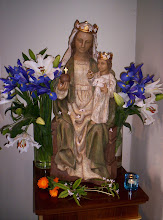
After packing up, there was just time for Vespers in thanksgiving.

******

Fr Rowe had his fellow priest and six of us (various of the servers and singers) to dinner, which was a prodigious affair; since it was Our Lady's feast, and in consideration of the other priest present, we had Leffe beer and a large bottle of Chimay as well.

An amazing thing to see this evening: I was shewn an Agnus Dei (that sacramental consisting of a waxen medallion) blessed by Pope Benedict XIII, in 1725!  It stonkered me to think that this seemingly fragile item has survived for nearly three hundred years, and was made and prayed over in Rome before Australia ever was.

Of your charity, please pray for priests: they need our prayers, their ministry is a high and graced calling, but also very much a straiter road and one bestrewn with crosses.

Sacerdotes tui induantur justitiam.
Et sancti tui exsultent.