Showing posts with label sacred music. Show all posts

Tuesday, April 2, 2013

The Experience of High Mass

I've been reading again, on and off, about the Anaphora of Addai and Mari (the most ancient and most frequently used Eucharistic Prayer of the Assyrian Church of the East, and which famously lacks an Institution Narrative; a certain ex-Cardinal, now ex-Pope, politely explained that the Words of Consecration were not present explicitly and ad litteram but "in a dispersed euchological... manner" – I defer to his theological acumen), and the theories of some liturgiologists about the development of the Roman Canon, accepting for the sake of argument both that Addai and Mari is orthodox and valid (as the Roman Church has pronounced, back in 2001, when Bl John Paul II approved the decision of the CDF about this), and that it preserves evidence of the evolution of the Eucharistic Prayer, whereby the oldest forms developed without initially having the Verba Domini present as a coherent Institution Narrative: as I say, this is evidently controversial, but, per impossibile or at least per improbabile, it is an interesting thought experiment (Gedänkenexperiment) to posit an unrecorded stage in the development of the Roman Canon, earlier even than the evidence adduced by St Ambrose in the late fourth century (when he records the central portion of an earlier version of the Canon, from what is now the Quam oblationem, through the Qui pridie and Simili modo, to the Unde et memores and a shorter combination of the Supplices and Supra quæ), which would have – like Addai and Mari – omitted Qui pridie, Simili modo and Unde et memores.

Pursuing this thought, and recalling that the section of the Roman Canon from Quam oblationem to Supplices inclusive – that is, from the equivalent of a consecratory epiclesis, through the Institution Narrative, anamnesis, oblation, prayer for acceptance and equivalent of a communion epiclesis – may be termed the "Canon within the Canon", as the modern rubrics require the celebrant and all concelebrants to recite it together (the rest of the Canon consisting of intercessions for the living and the dead, with commemoration of the Saints, and a concluding doxology, to say nothing of the Preface and Sanctus), it is at least curious to imagine what this section would look like if, as in Addai and Mari, it still appeared sans Verba and sans anamnesis:

Be pleased, O God, we pray, to bless, acknowledge, and approve this offering in every respect; make it spiritual and acceptable, so that it may become for us the Body and Blood of your most beloved Son, our Lord Jesus Christ.
Be pleased to look upon these offerings with a serene and kindly countenance, and to accept them, as once you were pleased to accept the gifts of your servant Abel the just, the sacrifice of Abraham, our father in faith, and the offering of your high priest Melchizedek, a holy sacrifice, a spotless victim.
In humble prayer we ask you, almighty God: command that these gifts be borne by the hands of your holy Angel to your altar on high in the sight of your divine majesty, so that all of us, who through this participation at the altar receive the most holy Body and Blood of your Son, may be filled with every grace and heavenly blessing. Through Christ our Lord. Amen.

Ironically, the Anaphora of Addai and Mari is if anything more explicit in affirming its intention to do as Christ commanded, offering up His Body and Blood, celebrating the Mystery of His Passion, Death and Resurrection, and calling down the Holy Spirit to render fruitful the oblation for the communicants, than this entirely hypothetical and indeed anachronistic reconstruction of the central parts of an earlier Roman Canon (since the equivalent paragraphs as reported by St Ambrose are shorter and simpler), as that ancient Eastern Anaphora includes such words as:

O my Lord, in thy manifold and ineffable mercies, make a good and gracious remembrance for all the upright and just fathers who were pleasing before thee, in the commemoration of the body and blood of thy Christ, which we offer to thee upon the pure and holy altar, as thou hast taught us... 
that all the inhabitants of the world may know thee ... and we also, O my Lord, thy unworthy, frail and miserable servants who are gathered and stand before thee, and have received by tradition the example which is from thee, rejoicing and glorifying and exalting and commemorating and celebrating this great and awesome mystery of the passion and death and resurrection of our Lord Jesus Christ... 
And let thy Holy Spirit come, O my Lord, and rest upon this offering of thy servants, and bless it and sanctify it that it my be to us, O my Lord, for the pardon of sins, and for the forgiveness of shortcomings, and for the great hope of the resurrection from the dead, and for new life in the kingdom of heaven with all who have been pleasing before thee...

******

But whatever of this, in plain truth, until the reforms of the 1960's, the Words of Consecration (following now the plain and obvious teaching of the Church, rather than rather confusing reinterpretations thereof) were not heard by anyone except the priest and perhaps those listening in at his side (as M.C. at our monthly Missa cantata, I can overhear the celebrant quite easily – according to the rubric, he ought read the Canon is such a quiet voice that he can hear himself, but no one else can, which is quite a difficult rule to fulfil evidently), and the experience of well over a thousand years was the same for all in attendance: the Consecration was accomplished in awe-filled silence.

The Canon was not originally said secretly, sotto voce: that roughly seventh century record of Roman ceremonial, the Ordo Romanus Primus, indicates that it was chanted in the same tone as the Preface, as is logical. However, in the Gallican Church the Institution Narrative, aptly enough called the Mysterium (and regarded as so holy it has only been found recorded in one surviving manuscript), was recited inaudibly, and evidently this practice spread, either from the non-Roman to the Roman West – or from the East, since the Emperor Justinian tried in vain to prevent the Anaphora at the Divine Liturgy being recited in a low voice (rather than chanted, presumably, as all the audible parts were and are).

I recall that Dix claimed this practice of praying the Eucharistic Prayer softly rather than in a loud voice developed first in Syria and environs, and spread from Jerusalem and Antioch throughout the Church – partly for reasons of brevity (a long prayer, such as the Anaphora of St Basil, which was originally used on all Sundays in the Byzantine Rite, takes a long time to say, let alone chant), partly because the choral parts were growing in complexity and length (tempting the priest to "get on with" saying the prayer, while the choir continue singing a not yet polyphonic but certainly elaborate setting of the Sanctus, for instance), and also partly out of a sense of devotional awe and dread.

The Eucharistic Sacrifice was emphasised as the mysterium tremendum et fascinans, the awe-inspiring appearance and Epiphany of Christ in His very Flesh and Blood in the Sacrament of the altar, worthy of worship, worthy of every reverence: the proleptic chants of the Cherubikon, as sung in the Byzantine Rite, amply demonstrate this attitude of holy fear and love. In the East, the actual words of consecration (according to the more typically Western theory) are still chanted aloud, from within the iconostasis; in the West, they were not, but instead the innovation of the Elevation of the Host (and, later, of the Chalice) was introduced in the twelfth century – the two by-then-sundered portions of Christendom thus in their respective fashions half-veiled, half-revealed the Eucharist made present at the consummation of the Divine Mysteries.

******

Put simply, the Western Mass (leaving aside the Byzantine East and the rest for the moment) divides into the choral and chanted parts, perceptible to the ear (the Introit, Kyrie, Gloria, Collect, Epistle, Gradual, Alleluia or Tract, Gospel, Creed, Preface, Sanctus, Lord's Prayer, Pax, Agnus Dei, Communion, Postcommunion and Ite missa est); and the sacred Action itself, for the most part effected in silence, spoken in secret by the cultic priest.

The parts said in a low voice may themselves be divided into two groups: the first – the Secret, Canon and Embolism (Libera nos) – are the immemorial constituents of the Mass, while the second – the prayers at the foot of the altar, the blessing of the deacon at the Gospel, the offertory prayers, the various prayers before, during and after Communion (some of which, as famously the Domine non sum dignus, came to be said aloud, but not chanted as the older chanted parts were), and the Placeat, blessing and Last Gospel (again, some of these came to be said aloud) – were gradually added over the course of the Middle Ages. (Local forms of the Roman Rite, such as the Dominican, codified in the thirteen rather than the sixteenth century, have shorter and simpler collections of such prayers.)

In the Ambrosian Mass (as said at Milan, both in its older and in its reformed version), the Secret and the Embolism are chanted aloud – the latter is chanted aloud on Good Friday even according to the  traditional Roman Rite. It appears that the Secret and Embolism were probably chanted aloud (as was the Canon too, originally), but motives of reverence and brevity led to their secret recital in the Roman Mass.

When able to join the congregation at High Mass, rather than – as too many do – read along furiously in my hand missal, ignoring the music (good or bad), I prefer to participate in the Sacred Liturgy precisely as Holy Church surely intends: by listening to all that is chanted aloud, and – when sacred silence descends – by praying as I am able. As the mediæval English canonist Lyndwood so wisely wrote, the Canon is silent Ne impediatur populus orare, Lest the people be impeded from praying. (Of course, when serving as M.C., as next Sunday, I have perforce to be busy about directing the celebrant and servers – one attendee, ex-army, congratulated me on my sergeant major manner, which may or may not be the ideal!)

While attending to all that is chanted, I also tend to look to the words of the Secret in my missal, and of course I know from long experience the words of the Canon and Embolism (and much else), and by the gesture and posture of the priest and ministers I know exactly what is going on at each stage. Sometimes, though, as was done in the early Middle Ages, I will pray psalms rather than pray along with the Canon: the psalms of preparation for Mass, as found in old Missals, are eminently suitable for this.

Consider the Mass as falling into two parts (as is the traditional division): the Mass of the Catechumens, during which nearly all is aloud (obviously the Introit masks the preparatory devotions of the sanctuary party); and the Mass of the Faithful, during which far less is, relative to that which is accomplished in mystery, in the pregnant silence.

The fore-Mass contains psalm chants selected with an eye to the liturgy of the day (the Introit, Gradual, Alleluia or Tract), cries for mercy (the Kyrie), songs of prayer and praise and faith (the Gloria Patri of the Introit, the Gloria in excelsis, the Creed), the Collect – the first and only time the celebrant prays aloud until the Mass proper begins, assuming it to be High Mass – which sums up the orientation of the feast, and the two lessons, the Epistle and Gospel (chanted by subdeacon and deacon respectively). Christ appears to us in the solemn proclamation of His Gospel; His salvific teaching is imparted to us by His minister, His priest, in the homily or sermon. Therefore, while Mass is fundamentally oriented toward divine worship, the Mass of the Catechumens has a partially didactic quality also.

When the Mass-Sacrifice begins at the Offertory, the chant of the Offertory ought, in a sense, occupy us, rather than the proper liturgical role of the priest (saying his private prayers as he arrays the elements, prepares himself and censes the oblations and altar, ere he too is censed) or his assistants. True, knowledge of the ritual and its forms of prayer informs the spirit of worship, facilitating actual participation; but I would argue that, just as one may well join in singing a hymn in the modern Mass during the preparation of the gifts, while the priest and ministers prepare according to the simpler rules and words appointed, so too in the older form of the Mass it is fitting to attend to the Offertory chant (and motet) rather than too closely to monitor the activities in the sanctuary.

I well recall two devout Italian ladies, who at Mass (OF) sat side by side, hand missals open – and reading in a low but still audible voice every single word the priest said, even at the Consecration! That to me seemed rather odd.

Instead, when the priest concludes the offertory, and in that marvellous chant tells us "Up hearts" (Sursum corda), to which we reply "We have them toward the Lord" (Habemus ad Dominum), then is the time to hearken to his words of praise, as he gives thanks to God for His marvellous works in the Preface, mingling our praise with that of the angels: then we join in the liturgy of heaven, singing the Sanctus.

Silence descends: the bell rings; the priest bows low; he genuflects, then elevates the Sacred Host – to Which incense is offered in adoration. Benedictus qui venit in nomine Domini. Now is the time to worship and pray! As I mentioned in my perhaps less than immediately apposite prolegomena above, the fact that the Roman Canon is all but silent, and the words of consecration themselves are never heard, instead focusses attention on the "Do this" of the Lord's command at the Last Supper: the Mass is no mere verbal sacrifice, but a sacred action.

After the Canon, the Lord's Prayer is sung; soon enough, the priest gives us (as Luther of all people rightly noted) a pre-communion blessing, in the words Pax Domini sit semper vobiscum; and again we plead for mercy with the Lamb of God now present, once slain yet ever alive, as our Christian Sacrifice present on our altar, as the choir sings the Agnus Dei. Thus fortified, we proceed to receive Him in Holy Communion.

Again, the communion chant is for us, to assist us in our devotion; while the priest's chanting of the Postcommunion (only his fourth prayer aloud, counting the Preface and Pater noster as well as the Collect) leads us in the sentiments that we ought have after receiving Our Lord in the Sacrament. The deacon dismisses us with those concise and mysterious words Ite missa est. All else following is added devotion.

This, I think, is a sane and sensible way to hear and participate in Holy Mass. (At Low Mass, some modifications must be made in this method; while in the Ordinary Form, as is unfortunately evident, the banality of much of the music, and the perhaps overly didactic atmosphere engendered by the relatively larger amount of text proclaimed aloud, can sometimes distract – that said, I find that an unpleasantly sloppy Mass ratchets up in tone once the Liturgy of the Word is over, and the more stable, less easily mucked-with Liturgy of the Eucharist begins.)

Tuesday, December 25, 2012

Our Participation in Angelic Worship

"God... by the Incarnation brought together the heavenly and earthly realm" (Solemn Blessing of Christmas).

Fr Paul, O.P., the visiting priest at the Launceston Carmel and an old friend of mine, preached at the Dawn Mass on sacred music as our share in angelic worship. He noted that the Gospel of the Midnight Mass ended with a great throng of the heavenly host singing Gloria in excelsis (St Luke ii, 14), while the Dawn Gospel began by speaking of what the shepherds next did, the angels having gone back to heaven (ibid., verse 15): it thus appears that the celestial choirs were engaged in chanting hymns of adoration all the night long.  Indeed, ceaseless is their worship; many a Preface makes reference to this fact: how appropriate, therefore, to take us this liturgical hint and contemplate it in the new light of Christmas morn.

God the Word having taken on our mortal flesh, heaven is joined to earth; so, too, we men of earth may lift our voices in company with the angels, and join – here and now in foretaste, in all liturgical worship and, above all, at Mass; one day, please God, in endless fulfilment in the kingdom of heaven – in their unending praise of the Most High and Thrice-Holy.  They sing, fundamentally, in adoration of God as He Is, Triune, a Communion of infinite Love, Three Persons in One God evermore; they sing in praise of His mighty work of Creation; they sing, having beheld the Christmas Mystery and its completion at Easter, of God's still more prodigious work whereby the Almighty united heaven to earth for the salvation of mankind, that on earth there may be pax hominibus bonæ voluntatis.  In the words of the eschatocol of the first, the traditional Christmas Preface:
And so, with Angels and Archangels, with Thrones and Dominions, and with all the hosts and Powers of heaven, we sing the hymn of [God's] glory, as without end we acclaim...
Inter alia, I was amused that Fr Paul mentioned Pope Telesphorus as the Supreme Pontiff to whom is attributed the command to sing Gloria in excelsis at Christmas.  For I recall only one other priest who ever mentioned Telesphorus – it was my old parish priest Fr Jarrett, now a bishop, who, when years ago I, yes, too pedantically, queried why there had been no Gloria at Mass that Sunday, replied, firmly tongue in cheek (having been momentarily forgetful at Mass, and begun the Collect directly the choir finished the Kyrie that day), that I ought really recall that Pope Telesphorus had died on that day, and therefore Holy Mother Church sings no Gloria on his anniversary!

The Gloria in excelsis, the Angelic Hymn or Greater Doxology, begins of course by making our own the song of the angels recorded in Holy Writ, and then adds many phrases drawn from Sacred Scripture and Tradition.  At Mass at Carmel (as always when it is sung, and likewise the Kyrie, Sanctus and Agnus Dei) the Gloria had been chanted in the age-old Latin; Fr Paul reminded us that it is good and proper to value highly and rediscover the Church's patrimony of sacred music, especially in this Year of Faith, for Vatican II, fifty years ago, by no means called for a neglect of what it itself named and lauded as a great treasure; he reminded us that the Supreme Pontiff now gloriously reigning, no less than the Zeitgeist active among younger Catholics, seeks to cultivate and reconnect with these immemorial harmonies as a most fitting mode wherein to praise God, Who inspires all beauty.

Most of both Masses at Midnight and Dawn – certainly the Collect, the Preface, and so forth, but also the Gospel itself – were chanted by priest and people, thus singing to the Lord, in consonance with our morning homily.  Hearing the Nativity Gospels sung made one listen more carefully to each phrase; the texts' solemnity impressed on the mind by their ceremonial presentation as itself a ritual act, a principal part of Divine service. Worship is a lifting of the whole person to God by His grace, and this necessarily involves our minds, our hearts, our voices, our bodies and all that is ours, for we are both flesh and spirit in complex unity.

At the end of Mass, the Solemn Blessing reminded us that "God... by the Incarnation brought together the heavenly and earthly realm".  Last night, driving home after Midnight Mass, I spontaneously sang over the words of the recessional hymn, "O little town of Bethlehem", with its quiet assurance of salvation for those who receive the Christ Child in faith and truth:

O little town of Bethlehem, how still we see thee lie!
Above thy deep and dreamless sleep the silent stars go by.
Yet in thy dark streets shineth the everlasting Light;
The hopes and fears of all the years are met in thee tonight. 
For Christ is born of Mary, and gathered all above,
While mortals sleep, the angels keep their watch of wondering love.
O morning stars together, proclaim the holy birth,
And praises sing to God the King, and peace to men on earth! 
How silently, how silently, the wondrous Gift is giv’n;
So God imparts to human hearts the blessings of His Heav’n.
No ear may hear His coming, but in this world of sin,
Where meek souls will receive Him still, the dear Christ enters in. 
O holy Child of Bethlehem, descend to us, we pray;
Cast out our sin, and enter in, be born in us today.
We hear the Christmas angels the great glad tidings tell;
O come to us, abide with us, our Lord Emmanuel!

Monday, January 16, 2012

Papa Marcelli

To-day, at Lauds (according to the Dominican Breviary) there is a memorial of St Marcellus I, Pope and Martyr (reigned May 308 to 309); and of course this brings to mind the even shorter reign of Pope Marcellus II (9th April to 1st May 1555); and in turn Palestrina's famous Missa Papæ Marcelli, composed to honour his memory, whose polyphonic magnificence, according to legend, averted the danger that the Council of Trent might prohibit polyphony and all other figured music for Church use – a charming parable but not exactly true (the polyphonic preces composed by de Kerle, and sung daily for success of the Council during its sessions, were if anything more directly influential in this).  My aunt once attended a performance of it in Scotland, which very amusingly ended with a trumpet flourish, and cries of Viva Papa Marcelle!

For those who delight in such, I append the first of Jacobus de Kerle's Preces speciales (texts selected by Pedro de Soto, O.P.):


PRIMVM RESPONSORIVM PRO CONCILIO

R. Suscipiant, Domine, montes Ecclesiæ tuæ, pastores et doctores nostri, pacem populo tuo et colles isti justitiam: * Salvos fac eos filios pauperum Apostolorum tuorum † et humilia calumniatorum hæreticum: ‡ ut unanimes uno ore honorificemus te, Deum et Patrem Domini nostri Jesu Christi.
V. Illustra faciem tuam, Domine, super servos tuos; accende corda eorum in ædificationem corporis tui. * Salvos fac eos filios pauperum Apostolorum tuorum.
V. Da illis non quærere, quæ sua sunt, sed quæ Jesu Christi Filii tui; præcinge eos virtute ad bellum adversus Satanam, † et humilia calumniatorum hæreticum.
V. Aufer ab eis, Domine, elationem omnem, presumptionem et sapientiam carnis, contentiones et æmulationes, dissensiones et invidias; da illis protectionem salutis tuæ, ‡ ut unanimes uno ore honorificemus te, Deum et Patrem Domini nostri Jesu Christi.
V. Gloria Patri, et Filio, et Spiritui Sancto.
R. Suscipiant, Domine, montes Ecclesiæ tuæ, pastores et doctores nostri, pacem populo tuo et colles isti justitiam: * Salvos fac eos filios pauperum Apostolorum tuorum † et humilia calumniatorum hæreticum: ‡ ut unanimes uno ore honorificemus te, Deum et Patrem Domini nostri Jesu Christi.


Preces
Kyrie, eleison.  Christe, eleison.  Kyrie, eleison.
Pater noster… (secreto usque ad)
V. Et ne nos inducas in tentationem.
R. Sed libera nos a malo.
V. Salvos fac servos tuos.
R. Deus meus, sperantes in te.
V. Redde eis lætitiam salutaris tui.
R. Spiritu principali confirma eos.
V. Nihil proficiat inimicus in eis.
R. Et filius iniquitatis non apponat nocere eis.
V. In nomine tuo salva eos.
R. Et in virtute tua tuere eos.
V. Dominus vobiscum.
R. Et cum spiritu tuo.
Oremus.
Orationes.
Omnipotens sempiterne Deus, cujus virtute universa fundantur, qui facis mirabilia magna solus, prætende super famulos tuos Patres Concilii spiritum gratiæ salutaris, et ut in veritate te quærant, in sanctitate inveniant, et nobis, quibus præsunt, verbo et exemplo prosint, perpetuum eis rorem tuæ benedictionis infunde.
Ecclesiæ, Domine, preces placatus admitte, ut destructis adversitatibus et erroribus universis, secura tibi serviat libertate.  Per Dominum nostrum Jesum Christum Filium tuum, qui tecum vivit et regnat in unitate Spiritus Sancti, Deus, per omnia sæcula sæculorum.  R.  Amen.

Friday, January 21, 2011

Gossec - Dies Iræ

On the train from Wellington up to Tongariro National Park, I whiled away the time by listening to my latest acquisition, a CD (how quaint) of François-Joseph Gossec's setting of the Requiem Mass (1760).  It has a grandiose quality...

Herewith, the opening of the Dies iræ:

Saturday, October 17, 2009

Dufay Mass, and a Motet


(Kyrie from Dufay's Missa "Se la face ay pale")

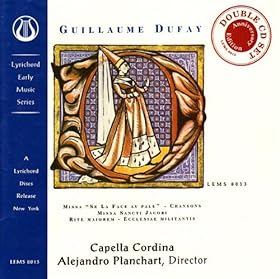
I have a CD of a vintage recording (directed by Planchart) of Guillaume Dufay's Mass "Se la face ay pale" - Jennifer told me the performance is a bit dated, but I rather like it. Anyhow, I've just ordered a CD of a different performance (directed by Binkley), which as a bonus comes with the chants, prayers and readings of the Nuptial Mass.

Why a Nuptial Mass? Because Dufay's famous Mass setting is the first cantus firmus Mass based on a secular chanson - Se la face ay pale is a rather predictable late mediæval love-song about suffering pangs of love for a puissant lady, complete with a play on words ("love", "bitter" and "sea" all sound much the same in French), which Dufay set to music in the 1430's - and it is thought this Mass was first sung at a royal or ducal wedding about 1450. With the passage of time, what would have fallen under the condemnation of Trent against sacred music making profane allusions is now quite acceptable!

Here is the text (the first part), with a rather clumsy translation:

Se la face ay pale,
la cause est aimer,
c'est la principale
et tant m'est amer aimer
qu'en l'amer me voudroye voir.

Or scet bien de voir,
la belle a qui suis
que nul bien avoir
sans elle ne puis.

If [my] face is pale,
the cause is love,
that is the principal,
and so bitter it is to love
that I want to throw myself into the sea [!].

Now she knows well,
the lady whom I serve,
that without her
I cannot be happy.

See what I mean about a rather ordinary collection of clichés? But the Mass is very beautiful.

******

As all men know, it is de rigueur to sing Ave Maria at a wedding: and I think this sentiment Catholic and orthodox, howsoever modern liturgists may complain, since after all the Orthodox sing a Megalynarion to the Mother of God just after the very Consecration at every Liturgy, and it seems strange at a wedding to make no plea whatsoever to Our Lady, who is our "most gracious advocate", as well as in her marriage to St Joseph a most holy model for all.


(Raphael's Marriage of the Virgin)

You'd think that at the Reform of the Liturgy some effort would have been made to add some reference in the marriage rites to Holy Mary and her most chaste spouse. But no: in fact, to add insult to injury, the modern recension of the Nuptial Blessing (to which two 1960's compositions have been added, as alternatives) dumps the reference to Rachel, Rebecca and Sarah, and the former final blessing, invoking the God of Abraham, Isaac and Jacob, has been entirely removed from the Novus Ordo. So much for a return to the sources: out with Abraham and Sarah, Isaac and Rebecca, Jacob and Rachel.

The Introit, too, alluding to Tobias and Sarah, has been left out of the new Gradual. Only reference to our first parents Adam and Eve, and to Christ's mystical marriage to the Church, seem to have survived. Predictably, given the vast selection of readings that bemused couples must choose from, the readings from Tobit, or what St Paul says to the Ephesians, are left aside in favour of I Corinthians xiii, used shamelessly at both weddings and funerals (even dreadful Diana's).

Now, while singing Ave Maria is all very well, the Bach-Gounod, let alone the Schubert settings are so hackneyed and dripping with sugary sentiment as to be a bit vulgar. Better is a restrained, tasteful polyphonic setting. But I am amused to learn that my favourite Ave Maria, while attributed to Victoria, is in fact almost certainly a late forgery, which first appears in print in the 19th century, and has no manuscript evidence for it at all! At least it is good counterpoint, clear and devout, not too difficult for four voices to sing successfully.

Sunday, August 2, 2009

Mexican Baroque

To and from Hobart I passed the time in the Mexican Baroque, with the following CD's - one of which at least comes highly recommended by a certain august prelate who shall remain nameless...

  • Chanticleer singing "Mexican Baroque: Music from New Spain" (2564 69765-2), with responsory, psalm and polychoral Mass by Ignacio de Jerusalem (c.1710-1769), plus villancicos and Lamentations by Manuel de Zumaya or Sumaya (c.1678-1755);
  • Chanticleer's peerless recording of highlights from Jerusalem's 1764 "Matins for the Virgin of Guadalupe" (0630-19340-2), with a responsory by Giacomo Rust (1741-1786) and two villancicos by Sumaya;
  • "Vespers of St Ignatius" (K617027) by the Jesuit Domenico Zipoli (1688-1726);
  • "Vespers of the Assumption" (K617026) - an improbable if pleasing mixture of sacred vocal and instrumental music by Sumaya, Juan de Araujo, and their French Baroque contemporary Marc-Antoine Charpentier.
If nothing else, one must have a copy of Matins for the Virgin of Guadalupe - everything on it is marvellous, and every day when I read Matins of Our Lady I have Jerusalem's magnificent setting of Quem terra, pontus, sidera (gift of Venantius Fortunatus to the Western Church) echoing in my ears...

Saturday, December 13, 2008

Misericordias Domini

On our way into town for Mass this afternoon (giving him a lift in my car again), I had Mike read None, which involved the really fatiguingly long Psalm 88, which all too-aptly begins Misericordias Domini in æternum cantabo...

After he finished, I teased him about what it says in the Imitatio about being "So drowsy at sacred vigils, so alert for idle gossip" or somesuch - but no sooner was I in church for the liturgy than I was just about prostrated with tiredness, and barely got through Low Mass, kneeling bowed forward, hanging over the pew in front!  Rather than fight to keep awake for the ensuing Holy Hour with Stations of the Infant Jesus (a Redemptorist devotion), I staggered back to the car, put the seat back and tried to rest - the hour went by very fast, and though I returned to the Pro. I was too late even for Benediction; at least I read Vespers.

We then all went for dinner at Fr's place, which was again a grand affair - Belgian beer (Orval), plus good fish and chips.  Before the food materialized, we had a chance to check out some curious books on the shelves or otherwise in the house, such as Ellard's The Mass of the Future (1948), and a Premonstratensian Breviary (with its  interesting peculiar texts at Prime and Compline)...

Mass, BTW, had been of Our Lady of Guadalupe - taken wholly from the Common of Marian Feasts, except for the Gospel of the Annunciation.  (Last year, I posted about Our Lady of Guadalupe, her Traditional Proper Mass, and her rather unfortunate modern Collect.)  Unusually, Fr Rowe preached a sermon - just a short one.  To commemorate this day (which in the Breviary is a feria) I have just put on a favourite CD: Chanticleer singing Matins for the Virgin of Guadalupe, by Ignacio de Jerusalem (1764).  Apparently in New Spain, it was all the rage to attend, not opera, but Matins... how nice to imagine the Viceroy at the Cathedral in Mexico City tapping his foot to the tunes as the service progressed.  If you like Baroque sacred music, well, the CD is Teldec 0630-19340-2.

This CD includes the three following historical lessons narrating the apparition of Our Lady of Guadalupe, apparently from her proper Office:

Mexici, in colle Tepeyancensi, anno millesimo quingentesimo trigesimo primo Dei para Virgo Maria Ioanni Didaco neophyto, uti pie traditur, sese videndam præbuit, eique ad antisititem Joannem de Zumárraga mandatum dedit, quod et instanter iteravit, de æde sibmet inibi construenda.

Episcopus vero signum expetiit.  Mox neophytum patruo morituro sacramenta longinquius ab apparitionis loco quærentem, tertio visu dignatur alma Mater, de patrui sanitate serenat, rosasque extra tempus obortas, in ejus pallio compositas, ad episcopum deferri jubet.

Cujus in conspectu rosis effusus, Mariæ imago, ipsi pallio impressa, uti traditur, mirum in modum præsentibus apparuit.  Quæ in sacello episcopali primum asservata, dein ad exstructam ædem in colle Tepeyacensi translata, denique in magnifico templo excepta est, quo turmatim plebes Mexicanæ magis magisque convenire cœperunt, venerationis gratia et frequentiæ miraculorum.

Sunday, November 23, 2008

What I'm listening to

At the moment, the car CD player bears a recording of M.-A. Charpentier's Messe pour le Port Royal; I particularly like his tune for the Veni Creator Spiritus, which is what I use when singing my hymn to St Cecilia...

Apart from this, I usually listen to ABC News Radio.

(Until recently, I'd had a CD of Telemann in the CD player, but it's just been superseded by this item of Charpentier, who's my favourite composer given my liking for sacred music.)