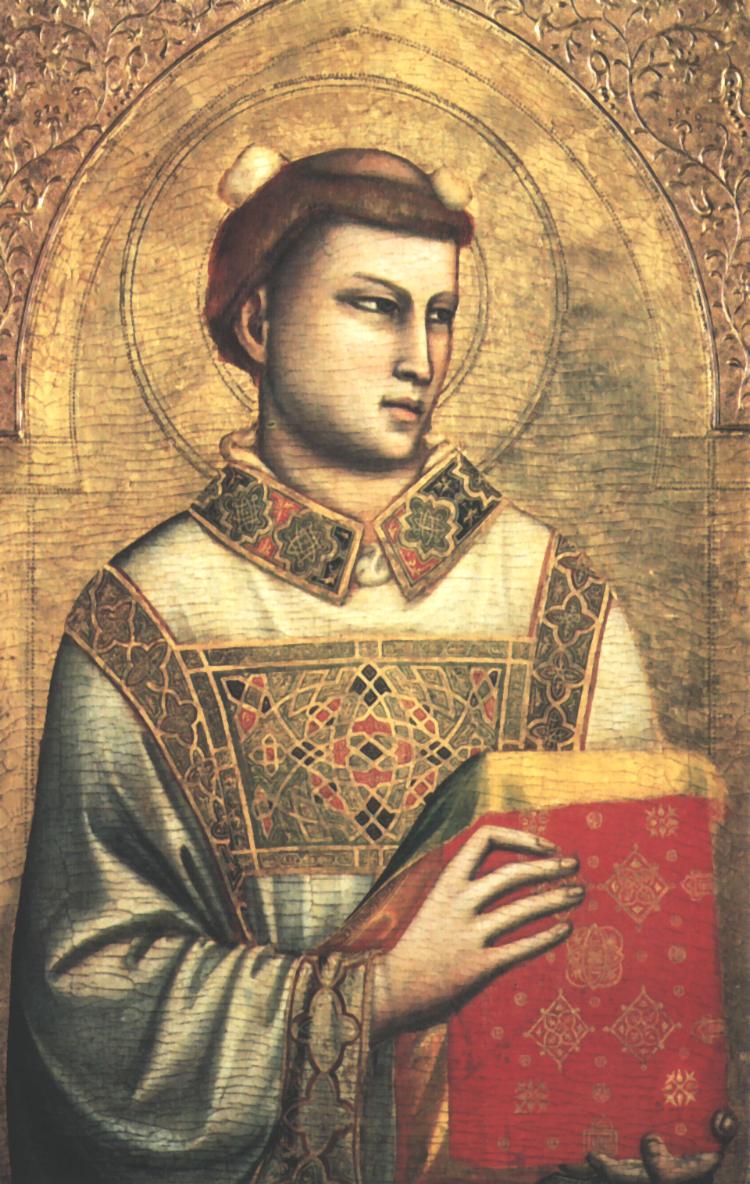
Showing posts with label St Stephen. Show all posts

Thursday, December 26, 2013

The Gap

The Protomartyr in his own person and passion illustrates the gap between proclamation of the saving kerygma and the response of faith in its hearers. Those of the Sanhedrin of old stopped their ears and rushed upon St Stephen, stoning him to death rather than allowing their stony hearts to be converted by the word of salvation so irrefutably preached to them by him; but by an illumination (vouchsafed, we may understand, at the First Martyr's prayers), nay, by the voice of the Word Himself, Saul was later converted on the road to Damascus, closing the gap in his life, faith at last being enkindled where murderous hate had reigned.

All down through history, the response of men has ever been the same: lest they hear, and repent, and be converted, and saved, so perverse is fallen nature, instead outrages have been inflicted by sinners upon God's saints. But every Diocletian has been defeated; and as the Apostate unwillingly confessed, "Thou hast conquered, O Galilean". Fr Paul remarked on all this at Mass this morning – I blend what I remember of his words with ideas of mine own engendered thereby.

He further observed that, when Christ shall come as Judge, to him every knee must bend – either in worship, or in servitude (for even the devils fear and tremble, yet for them there is no salvation). God's Kingdom will come, whether we will or nill; let the Holy Spirit descend and purify us, that we may be worthy of that Kingdom, and not cast out into the infernal darkness, where there is wailing and gnashing of teeth.

God grant that Holy Church never cease to proclaim His Gospel, and may her members pray for the fruitful reception of that Good News by all, that (by the inspiration of the Holy Spirit) more and more may know and believe, love and obey Jesus Christ, that willingly with the saints they may adore the Lord – lest they instead hate and resist, chafing against the bit and in danger of condemnation.

Saturday, December 26, 2009

Feast of Deacons


St Stephen, as well as the First of Martyrs, was the First Deacon; hence his feast is the Feast of Deacons.

O quam gloriosus est beatus Stepanus Martyr et Levita, qui ante Apostolos regna cælestia possidere meruit et ad Patris dexteram Filium videre!
(O how glorious is blessed Stephen the Martyr and Deacon, who ahead of the Apostles deserved to possesss the kingdom of heaven and to see the Son at the Father's right!)
Tu principatum tenes in choro Martyrum similis Angelo: qui pro te lapidantibus Deum deprecatus es, beate Stephane, intercede pro nobis ad Dominum.
(Thou holdest the first place in the choir of Martyrs like an Angel: thou who didst beseech God for those who stoned thee, blessed Stephen, intercede for us with the Lord.)
— Magnificat anthems from the Dominican Rite


May I take this opportunity belatedly to congratulate my friend Rev Br Paul Rowse, O.P., who was ordained deacon earlier this month?  He knows that my finances prevented me from attending his ordination (and that of his colleague, now Fr Vincent), just as I missed his solemn profession, despite being specially invited, mea culpa: I take this opportunity to declare I will make every effort to make his priestly ordination sometime next year...

I assume that these two newly ordained friars will have been very busy over Christmas, and may well to-day be enjoying a dies non (Dominican jargon for a day when the Prior dispenses the community from the choral office, on account of their tiredness; this usually happens thrice a year, after Christmas, after Easter and after St Dominic's Day).  "Sleep on, and take your rest!"  ;-)

In the meanwhile, I pray that he, like Stephen, may be full of the Holy Ghost and wisdom, full of grace and fortitude, endowed with the grace of preaching for the salvation of souls and the glory of God, holding fast to the mystery of faith.

He will be amused, no doubt, to recall that Scripture and the Liturgy compare deacons to angels, as servants of the Lord, ministering at the Holy Table, and His messengers, preaching the Word...

Since as a strange sort of volunteer I also hold a running brief for promoting the patrimony of those Anglicans coming into union with the Church, here is the BCP final Collect from "The Ordering of Deacons", changed to the singular:

ALMIGHTY God, giver of all good things, who of thy great goodness hast vouchsafed to accept and take this thy servant unto the Office of Deacon in thy Church; Make him, we beseech thee, O Lord, to be modest, humble, and constant in his Ministration, to have a ready will to observe all spiritual Discipline; that he, having always the testimony of a good conscience, and continuing ever stable and strong in thy Son Christ, may so well behave himself in this inferior Office, that he may be found worthy to be called unto the higher Ministries in thy Church; through the same thy Son our Saviour Jesus Christ, to whom be glory and honour, world without end. Amen.

On the Feast of Stephen

To-day is the feast of my confirmation patron, and, despite mortal flesh wanting to rest after the exertions (religious and culinary) of Christmas, I rose from bed for early Mass at Carmel for to honour St Stephen, since I always feel bad if through sloth I miss the Liturgy for his feast.

Fr Peter was Thomistic in his approach: Is it not incongruous to think on blood and gore the day after Christmas, when surely the whole Octave should be about the Christ-Child?  No, said he, on the contrary this feast of the First Martyr is all about Christ and His Life: for in death the martyr does not reject life, but offers it, as Christ did His whole life long, to the glory of God.  He pointed out to the nuns that they "with all their spare time" (titters from within the screen) ought take time to read at one sitting the whole history of St Stephen in Acts chapters six and seven, reflecting on how perfectly it mirrors Our Saviour's trial and passion: the betrayal, the false charges, the false witnesses, the true testimony of the accused, and the murderous anger of the judges at the mention of the truth about the Son of Man standing at the Right of God.  Both pray for their enemies as they die; only the manner of death is different, but this is not material.

So, too, with and for us: we all should live such lives in Christ as true Christians that with St Paul - converted by Stephen's prayers from a murderous enemy to the great Apostle - we may rightly say, I live, now not I, but Christ Who lives in me.  In such a case, our death (be it one of martyrdom, or one due to cancer, old age, or car accident, or any cause whatsoever) will be not a giving up of life but the entire holocaust of ourselves into the hands of God, an offering of our life to the Father, offered up in intercession for the benefit of others.

Tuesday, August 4, 2009

Invention of St Stephen

Don't you love suppressed feasts? While I'm nowadays adhering to the Little Office of Our Lady, in the '62 Breviary yesterday (Monday) was a feria - but had previously been the feast of the Discovery of the Relics of St Stephen, who happens to be my confirmation patron.

A holy priest, Lucian, of the bishopric of Jerusalem, received a vision in 415: it was Gamaliel, communicating to him the burial place of himself, and with him his son, Abibas, and also Nicodemus and St Stephen, bidding him summon Bishop John, that the relics of all these be uncovered for the glory of God and the comfort of the Church. The buried bodies of the saints again saw the light of day, the wonders they worked and the veneration they inspired presaging their coming glorification at the General Resurrection, on the 26th of December that year (hence the date of the main feast of St Stephen); the feast of the Invention of the Relics of St Stephen (and of St Gamaliel and St Nicodemus) was later fixed on the 3rd of August, probably in memory of the dedication of a church in his honour.

These sacred relics were very soon dispersed throughout the Church of God: St Augustine records the triumphal reception of portions of St Stephen's relics in North Africa, where, as at Jerusalem, it pleased the Lord to work miracles through them, and of many St Augustine himself was eye-witness: public cures abounded - at Hippo alone, seventy miracles were attested, including three raised from the dead, and the same happened elsewhere. It is interesting that what the Fathers beheld proven beyond doubt is scoffed at by the mistrustful blind guides of our present age.

To Rome relics of St Stephen came also - God willing, come September I shall visit them, where they are buried beside St Lawrence the great Martyr-Deacon of Rome, at his basilica without the Walls.

I refer interested readers to an earlier posting of mine (for St Stephen's Day, 2007), giving Collects, Sequences, Antiphons and such in his honour. The Collect for the Discovery is as follows:

Da nobis, quæsumus, Domine, imitari quod colimus: ut discamus et inimicos diligere; quia ejus inventionem celebramus, qui novit etiam pro persecutoribus exorare Dominum nostrum Jesum Christum Filium tuum: Qui tecum vivit et regnat...

(Grant us, we beseech Thee, O Lord, to imitate what we worship: that we may learn to love even our enemies: for we celebrate his finding, who thought to pray even for his persecutors to Our Lord Jesus CHrist Thy Son, Who with Thee liveth and reigneth...)

Friday, June 26, 2009

True Brotherhood

Six months to Boxing Day... exactly half a year before the feast of St Stephen, Protomartyr, first of that white-robed army of those who bore witness to Our Lord usque ad mortem, in sincerest imitation of Him Who is the True and Faithful Witness, Who shed His Blood to save us all.
Fittingly, to-day is the feast of SS John and Paul, themselves holy Martyrs of Christ; last year on this feast I blogged a deal about them, but this year I wish to focus on their Collect, and also in passing to rejoice that I will, God willing, be in Rome come September staying not far at all from their church, the ancient basilica of Santi Giovanni e Paolo al Celio ("on the Caelian Hill"), where these brothers repose awaiting the Last Trump. (Very pleasingly, given the benefits I have received from the Passionist Fathers in their ministry in Hobart, it turns out that it is their Congregation that has charge of the basilica, and indeed their founder, St Paul of the Cross, is also buried therein.) There is a link to St Stephen, too: for another church on the Caelian is that of San Stefano Rotondo.
As to their Collect:
Quaesumus, omnipotens Deus, ut nos geminata laetitia hodierna festivitatis excipiat, quae de beatorum Joannis et Pauli glorificatione procedit, quos eadem fides et passio vere fecit esse germanos. Per...
(We beg, almighty God, that we obtain the twofold joy of today's feast, which proceeds from the glorification of blessed John and Paul, who were made true brothers by their joint faith and suffering. Through...)

Friday, January 2, 2009

Former Octave Day of St Stephen

Perhaps it brought boredom to clerics having to read their Office all over again, but I must say I wish the duplication of feasts hadn't been suppressed in 1960 or thereabouts: it seems to me that the great saints of the New Testament are well worth having more than one look at each year.

Consider how sensible it was to have the Octave Day of Christmas on the 1st of January, then the successive Octave Days of St Stephen, St John Evangelist and the Holy Innocents filling up the time until the 5th of January, kept as Vigil of the Epiphany, and then the Epiphany itself.  Now we have instead ferial days of Christmastide.  Hmmm.

In any case, it's a chance for me to further fete St Stephen, my confirmation patron, in my private prayers at least.

******

In other news, it's been quite unseasonably cold ever since I returned to Tasmania, and the wind-chill factor has made it chillier - for instance, yesterday we went off on a pleasant enough daytrip round the North-East, through Scottsdale and Lilydale (stopping off at Piper's Brook winery, now owned by Kreglinger Wine Estates), but the temperature didn't even crest 19°C; to-day I'm driving down to Hobart (one always drives down to Hobart and up to Launceston), yet the State's capital will reach only 16°C - and this is supposed to be summer!  I hadn't packed for this sort of weather...  Brrr!

Monday, December 29, 2008

The Lengthy Matins of Christmas

On average, the psalmody at Matins extends for 115 verses (and only 87 on Sundays).  Unfortunately, however, the very devout and well-chosen selection of psalms for Christmas Matins extends for 170 verses, including the notoriously long Ps 88 (Misericordias Domini in æternum cantabo), and these psalms are repeated each day of the Octave, except for the three feasts!  (St Stephen's Matins are of One Martyr, and are particularly short, having only 90 verses; those of St John Evangelist and of the Holy Innocents, again from their matching Commons, have a more or less normal 119 and 111 verses respectively.)

I daresay after I've served Mass I'll be on my knees in the chapel for a while, getting through Matins and Lauds, and probably Prime as well.  No rest for the wicked!

UPDATE

I had to rush to get to Carmel in time to tog up and serve Mass...  Fr preached a very devout sermon on the text Simeon took the Child Jesus into his arms (cf. St Luke ii, 28), pointing out what a joy it must have been for this aged priest to hold in his arms the Promised Messiah, and with what tender rapture Our Lady and St Joseph must have cradled the Divine Infant: parents know this inexpressible joy of cradling their own children, their own gifts from God; but how surpassing wonderful to hold the very Word made flesh, made a helpless infant for us - Nobis natus, nobis datus.  Now, Holy Mass is the Divine Sacrifice of Calvary made present, but every Mass is also Christmas, our Jesus coming to us in the Sacrament of the Altar: so the privilege of holy Simeon is extended to us!  We ought pray for suffering families and for children who have not the love of parents, who lack the embrace of love that all human beings truly need, and beg the Lord at Communion time for the grace of a tender devoted love issuing in selfless service.

After Mass (about 40 minutes with sermon), another 40 minutes for Matins, Lauds and Prime!  I sat rather than knelt, I must admit.  (And St Thomas of Canterbury gets but a commemoration at Lauds.)

After Mass and Office - a coffee and the paper at the local café.  

God's in His heaven, all's right with the world.

Friday, December 26, 2008

On the Feast of Stephen - II

Boxing Day has been a late start for me - not feeling quite at rights, I slept in, extending my uneasy sleep...

Having thus missed serving Mass at Carmel, I went later late and heard half a Mass at Church of the Apostles, arriving late, at the Orate fratres; so I read the readings &c. from my missal.

St Stephen is my confirmation patron, being the first of martyrs; last year I blogged about him; this year I've read the instruction for his feast given in Nelsons' Festivals and Fasts (I have an 1841 reprint of this 1703 manual by a devout High Churchman, married to a Recusant).  If you wish to consult same, look at pages 66-77 here.; I append an extract, to give the feel of the beautiful English in which it is written, let alone to shew its general piety and usefulness:

Text not available

In other business, the Boxing Day Cricket Test continues; hopefully our man Ponting (a fellow Launcestonian) can captain Australia to victory over the South Africans; else it will be our first at-home series defeat in 15 years.  And while lunching on Christmas leftovers we watched the start of the famous Sydney to Hobart yacht race, that perennial fixture of the end of December.  (The local paper is running a series on the tragedy of the 1998 Sydney to Hobart, when a storm struck the fleet in Bass Strait, sinking many yachts, requiring many rescues, and leading to six deaths.)

Perhaps I'll go see The Day the Earth Stood Still this arvo; I'm interested to compare it to the original film.

I suppose I should start on the day's Office, too...

And, last but not least, as to-day is the Feast of Deacons, festal greetings to Rev Br Vincent Magat, O.P.!

Wednesday, December 26, 2007

On the Feast of Stephen

I feel better after second breakfast!  Getting up early to serve Mass at Carmel was good tho' I hadn't had much sleep; Mass is always a blessing, especially with the fine sermon I heard and the way Fr says Mass with solemnity; and having said Matins, Lauds and Prime I've broken the back of today's Office; so having come back from church I had a snack.

I took the name of St Stephen the Protomartyr at my confirmation, and am glad to keep his feast.  The sermon in his honour by St Fulgentius of Ruspe (another favourite saint) is excellent, and extracts appear in both the traditional Breviary and the modern Office; I read it over again at (first) breakfast, early in the morning before leaving for Mass.  

The Church in her liturgies loves to praise and meditate on St Stephen; his twin collects (one for today, one for his former Octave Day, on the 2nd of January) are profitable:

Da nobis, quæsumus, Domine, imitari quod colimus: ut discamus et inimicos diligere; quia ejus natalicia celebramus, qui novit etiam pro persecutoribus exorare Dominum nostrum Jesum Christum Filium tuum: Qui tecum vivit et regnat in sæcula sæculorum.  R/.  Amen.

(Grant us, we beseech Thee, O Lord, to imitate what we worship: that we may learn to love even our enemies: for we celebrate his [heavenly] birthday, who thought to pray even for his persecutors to Our Lord Jesus CHrist Thy Son, Who with Thee liveth and reigneth world without end.  R/.  Amen.)

Omnipotens sempiterne Deus, qui primitias Martyrum in beati Levitæ Stephani sanguine dedicasti: tribue, quæsumus; ut pro nobis intercessor exsistat, qui pro suis etiam persecutoribus exoravit Dominum nostrum Jesum Christum Filium tuum: Qui tecum vivit et regnat in sæcula sæculorum.  R/.  Amen.

(Almighty everlasting God, Who hast consecrated the firstfruits of Thy Martyrs in the blood of blessed Stephen the Deacon; grant, we beseech Thee, that he may pray for us, even as he also prayed for his persecutors, to our Lord Jesus Christ Thy Son, Who with Thee liveth and reigneth world without end.  R/.  Amen.)

Also, there is a excellent medieval sequence in his honour by Adam of St Victor, turned into a hymn (which omits all the last part, marked * below) much later:

Heri mundus exsultavit 
et exsultans celebravit 
Christi natalitia;
heri chorus angelorum 
prosecutus est cælorum 
regem cum lætitia.

Protomartyr et levita, 
clarus fide, clarus vita, 
clarus et miraculis, 
sub hac luce triumphavit 
et triumphans insultavit 
Stephanus incredulis.  

Fremunt ergo tamquam feræ, 
quia victi defecere, 
lucis adversarii; 
falsos testes statuunt 
et linguas exacuunt 
viperarum filii.  

Agonista, nulli cede, 
certa certus de mercede, 
persevera, Stephane!  
insta falsis testibus, 
confuta sermonibus 
synagogam Satanæ!  

Testis tuus est in cælis, 
testis verax et fidelis, 
testis innocentiæ; 
nomen habes coronati, 
te tormenta decet pati 
pro corona gloriæ.  

Pro corona non marcenti 
perfer brevis vim tormenti, 
te manet victoria; 
tibi fiet mors natalis, 
tibi pœna terminalis 
dat vitæ primordia.  

Plenus Sancto Spiritu 
penetrat intuitu 
Stephanus cælestia; 
videns Dei gloriam 
crescit ad victoriam, 
suspirat ad præmia.  

En, a dextris Dei stantem 
Jesum, pro te dimicantem, 
Stephane, considera; 
tibi cælos reserari, 
tibi Christum revelari, 
clama voce libera.  

Se commendat Salvatori, 
pro quo dulce ducit mori 
sub ipsis lapidibus, 
Saulus servat omnium 
vestes lapidantium 
lapidans in omnibus.  

Ne peccatum statuatur, 
his, a quibus lapidatur, 
genu ponit et precatur 
condolens insaniæ; 
in Christo sic obdormivit, 
qui Christo sic obœdivit 
et cum Christo semper vivit, 
martyrum primitiæ.  


* Quod sex suscitaverit 
mortuos in Africa, 
Augustinus asserit, 
fama refert publica.

Hujus Dei gratia
revelato corpore
mundo datur pluvia 
siccitatis tempore.  

Solo fugat hic odore 
morbos et dæmonia, 
laude dignus et honore 
jugique memoria.  

Martyr, cujus est jucundum 
nomen in Ecclesia, 
languescentem fove mundum 
cælesti fragrantia.

(* The last part of the Sequence refers to the miracles worked by his relics in North Africa as St Augustine reports them, and to the finding of his body near Jerusalem in 415; the feast of their finding was formerly kept on the 3rd of August.)

In the Mozarabic Rite his Mass has as first reading the account of Naboth's vineyard, and how that just and innocent man was stoned (III Kings xxi, 1-29).  

The Dominican Breviary had fine special antiphons (interpreting their respective psalms in the light of his history) for his Matins, and for the Magnificat at 1st and 2nd Vespers, which I append, together with the 9th responsory, not in the Roman books:

In primis Vesperis ad Mem.  
Aña.  Tu principium tenes in choro Martyrum, similis Angelo, qui pro te lapidantibus Deum deprecatus es: beate Stephane, intercede pro nobis ad Dominum.

Ad Matutinum.
Aña j.  Beatus Stephanus jugi legis Dei meditatione roboratus, tanquam lignum fructiferum secus salutarium aquarum plantatum decursus, fructum martyrii in tempore suo dedit primus.  (Cf. Ps 1:1a, 2b, 3)

Aña ij.  Constitutus a Deo prædicator præceptorum ejus, in timore sancto illi servire studuit: officioque fideliter peracto, in montem sanctum ejus ascendere dignus fuit.  (Cf. Ps 2:6, 11)

Aña iij.  In tribulatione lapidum se prementium positus, millia populi se circumdantis non timuit: quia susceptorem suum Jesum, ut eum salvum faceret, exurgere in cœlo vidit.  (Cf. Ps 3:6)

Aña iv.  Lumine vultus tui, Domine, insignitus Protomartyr Stephanus sacrificium justitiæ seipsum tibi sacrificavit ideoque in lætitia cordis in pace obdormiens requiescit.  (Cf. Ps 4:7a, 6a, 7b, 9)

Aña v.  Benedictionis tuæ, Domine, munere justificatus et scuto tuæ protectionis in passione munitus nominis sui coronam Stephanus a te percipere meruit.  (Cf. Ps 5:14, 15)

Aña vj.  O quam admirabile est nomen tuum, Domine Deus noster, pro quo beatus Stephanus passus gloria et honore a te est coronatus et super cœlos dono tuæ magnificentiæ exaltatus.  (Cf. Ps 8:1, 2, 6)

Aña vij.  In Domino Deo suo confisus fortis athleta Stephanus lapidum fortiter sustinuit utus et idcirco ad montem virtutum transmigravit victoriosus.  (Cf. Ps 10:1)

Aña viij.  Sine macula beatus Stephanus ingressus est, Domine, in tabernaculum tuum et quia operatus est justitiam requiescit in monte sancto tuo.  (Cf. Ps 14:1, 2)

Aña ix.  Domine, virtus et lætitia rectorum, quoniam prævenisti dilectum tibi Stephanum dono gratuite benedictionis te primum secutus est morte gloriose passionis unde cum corona martyrum dedisti ei vitam in sæculum sæculi.  (Cf. Ps 20:1a, 3, 4, 6)

R/. ix.  Sancte Dei pretiose Protomartyr Stephane, qui virtute charitatis circumfultus undique, Dominum pro inimico exorasti populo: * Funde preces ✝ Pro devoto tibi nunc collegio.  V/.  Ut tuo propitiatus interventu, Dominus nos purgatos a peccatis jungat cœli civibus. * Funde preces.  Gloria Patri et Filio et Spiritui Sancto. ✝ Pro devoto tibi nunc collegio.

In secundis Vesperis.
Magn. Aña.  O quam gloriosus est beatus Stephanus Martyr, et Levita, qui ante Apostolos regna cœlestia possidere meruit et ad Patris dexteram Filium videre!

Once upon a time, St Stephen's day was kept as the feast of deacons.  I extend a special feastday greeting and congratulations to one of the world's newest deacons, a friend of mine, Rev. Mannes Tellis, O.P., just ordained on the 22nd of December.

St Stephen's day was also kept as the feast of All Martyrs.  Likewise, St John the Evangelist's day – tomorrow – was regarded in medieval days as the feast of priests.  

Nowadays, many keep Childermas (the feast of the Holy Innocents, two days hence) as a day to commemorate victims of abortion.  While I do not think they can properly be regarded as martyrs, it is certainly right to pray and work for an end to this wicked crime (demographic suicide, in the decadent, corrupted West), while always recalling, as Paul VI predicted, that the introduction of unnatural birth prevention, far from curtailing such horrors, has lead to a great increase in women being forced into abortion, by irresponsible and callous men, and that such women deserve prayers and support much more than condemnation – for too often they themselves most loathe themselves for what they were forced into, and suffer terribly.