Showing posts with label heraldry. Show all posts

Wednesday, June 15, 2011

Dormitionist Coat of Arms

Alongside its three mottoes – Requies (Rest); Dormire, Requiescere, Somniare ("To sleep, to rest, to dream", or, more poetically, "To sleep, perchance to dream"); and Dormire est orare – the Order of the Dormition of the Blessed Virgin Mary, that most retiring religious Order of Canons Regular contemplatives, is also blessed with   heraldic bearings most fitly representing its proper charism.  

Informally, these arms may be referred to as "black and blue and surrounded by spinning stars", but, as this seems somewhat unseemly in the vernacular, the correct blazon in the language of heraldry is instead "Party per pale sable and azure, a circle of seven mullets argent".  It will be at once evident how apt this is: for the black stands for sleep, the blue for Our Lady, and therefore the two together represent her in her Dormition, under which title she is primary patroness of this, her Order.

As for the seven stars, the three upper mark the Three Days' Sleep-in-Death of Our Lord in the Holy Sepulchre, while the four lower represent the four days St Lazarus (secondary patron of the Order) spent in the tomb; or again, all seven stars in a circle represent both the Seven Sleepers of Ephesus, secondary co-patrons of the Order, and also that all seven days of the week, the Friday, Saturday and Sunday Our Lord spent in the Tomb, and the Monday through to Thursday that it is posited Lazarus spent entombed, ought be consecrated to sleep: hence the term seven-sleeper, Siebenschläfer, for a zealous Dormitionist.

Again, as sable is related to Saturn, azure to Jupiter and argent to the Moon, there may be found in these arms an allusion to the myth of Endymion, at the behest of Selene lulled to endless sleep by Zeus or Jove; and sleep, as all men know, is somewhat related to a melancholy temperament, as represented by the influence of Saturn.  (It was, after all, common in mediæval times and the Renaissance to produce armorial bearings with such planetary and astrological significance.)

Sometimes – but by no means always – this shield may be accompanied by one or other of the Order's mottoes; and, especially in Baroque woodwork (as in the choir of Dormitionist churches), there may be carven supporters of the shield: to dexter and sinister, a bear and a cat, dormant (with head resting on fore-paws).

Sunday, February 20, 2011

Arms and the Man

To become armigerous, one applies to the relevant authority... it appears from checking the website of the College of Arms that some qualifications are required of one before daring to apply; having a university degree is mentioned, but I think something more - a mark of character, of public service, of distinction - would be asked; plus a fee of £4,400 or so.  Hmmm.

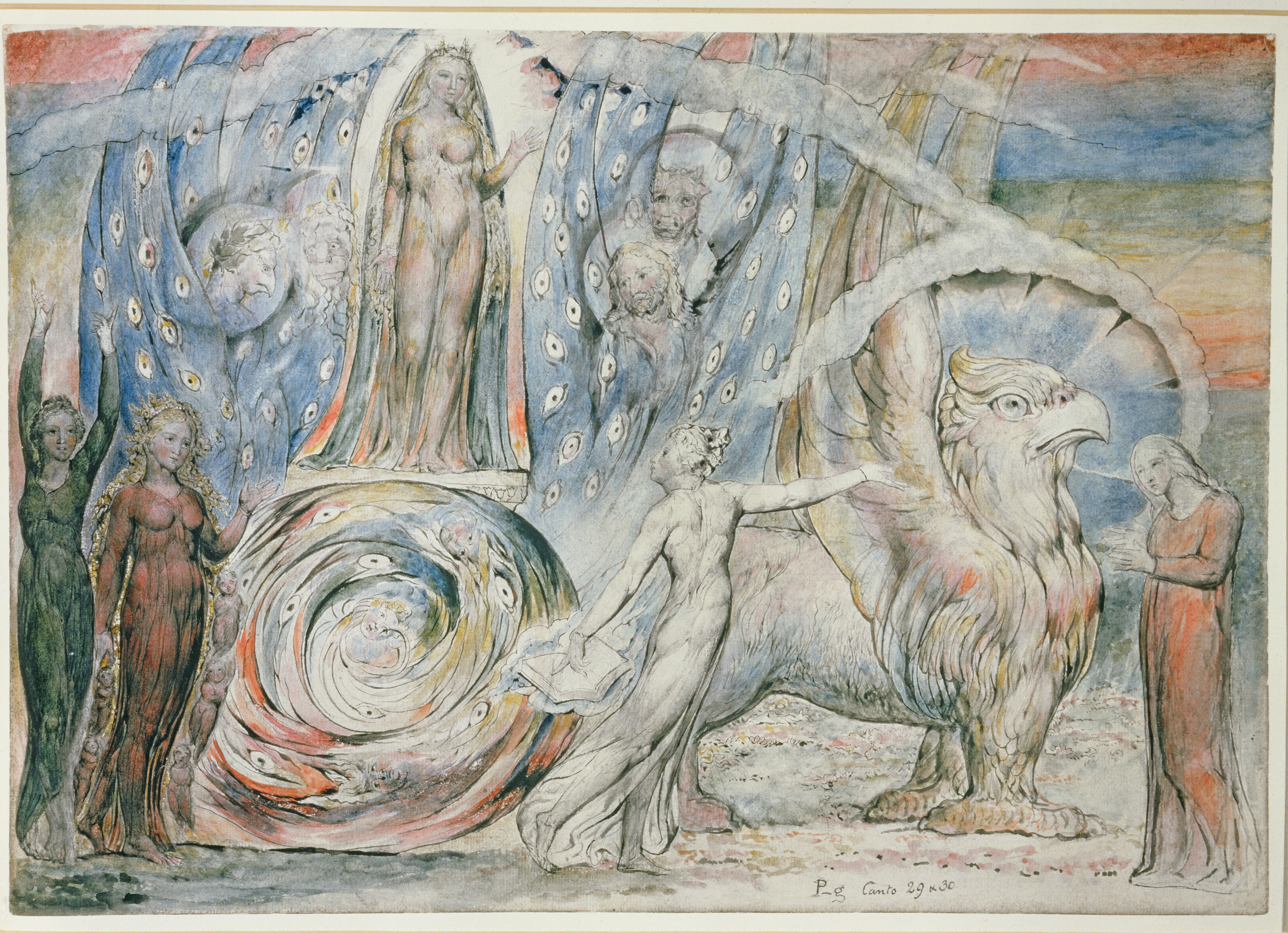
Strictly as a private and unofficial blazon, I would propose what has been my settled idea since I was young, and first read Dante: for I was struck by his image (Purgatorio, Canto XXIX, ll. 109ff) of the griffin, with foreparts like an eagle, of gold imperishable, and hindparts as a lion, dappled white and blood-red – this fabulous beast representing Christ in His Divinity and sacred Humanity: the eagle, king of the birds, standing for the king of heaven, shining golden and eternal; the lion, king of beasts, representing the king of men, doomed for man to die, His Flesh wounded, pouring forth Blood, His Flesh and Blood our sacrifice and spiritual feast.

Interestingly, in mediæval times it was more common to represent Christ in the guise of a hippogriff than of a griffin; for the issue of a griffin and a mare (horses normally being the food of griffins, according to legend) was considered more miraculous even than that of an eagle and a lion – hence the proverbial "to mate griffins with horses", meaning something impossible.

(While I prefer this creature's name spelt "gryphon", in heraldry it is "griffin", or in French "griffon".) 

Dante, having summited Mount Purgatory, beholds a mystic Pageant (variously illustrated here):
...un carro, in su due rote, trïunfale,
ch’al collo d’un grifon tirato venne.
Esso tendeva in sù l’una e l’altra ale
tra la mezzana e le tre e tre liste,
sì ch’a nulla, fendendo, facea male.
Tanto salivan che non eran viste;
le membra d’oro avea quant’ era uccello,
e bianche l’altre, di vermiglio miste.


A chariot triumphal on two wheels,
Which by a Griffin's neck came drawn along;
And upward he extended both his wings
Between the middle list and three and three, * 
So that he injured none by cleaving it.
So high they rose that they were lost to sight;
His limbs were gold, so far as he was bird,
And white the others with vermilion mingled.
— Dante, Purgatorio, Canto XXIX, lines 108-114.

[* The "middle... three and three" are the seven bands of light trailing behind each of the seven candles that led the procession.]


Now, bearing the theophoric Christian name of Joshua, thus testifying that "God is my salvation", and revering the Holy Name of Jesus, the equivalent in Greek of the Hebrew original of Joshua, and keeping the Lord before my eyes, I find in Dante's griffin a charge suitable for a shield – which shield, out of suitable Marian and Ecclesial piety, ought be blue, for as Our Lady brought forth Christ both God and Man, so our Holy Mother the Church brought forth every Christian, remaining human and yet thus right marvellously divinized by adoption and grace.

Hence, I would adopt, if permitted, arms with a blue background, upon which walks a griffin with extended wings, its fore-parts gold and its hind-parts dappled red and white.  In heraldic language, as near as I can achieve it (I don't know the technical term for "hind-parts"), this would be emblazoned or worded thus:

Azure, a griffin passant segreant Or, the hind-parts vairy of gules and argent.

(By the rule of tincture, a colour may not lie upon a colour, but this rule does not apply to furs, and vair seemed to me the closest to the sort of fur I imagined the griffin would have – tufts of red and white.)

The motto, of course, would be Psallite sapienter.

After all, in the Psalms, everywhere we read of Christ, His Divinity, His Humanity, His saving works, His rule over all; and in Psalm 46:8, the full verse reads Quoniam rex omnis terræ Deus: psallite sapienter – "For the king of all the earth is God: psalm ye wisely".  Christ born of Mary is our King, and God, and Sacrifice.

If anyone would kindly draw me these proposed arms, please email me.