Showing posts with label Requiem. Show all posts

Saturday, November 7, 2015

Cistercian Elevation Chants

UPDATE: I have made a more accurate transcription of all three elevation chants.

The Cistercian Rite retained down to the liturgical changes of the 1960's the mediæval practice of singing an elevation motet after the elevation of the Host; and presumably all EF Masses in the Cistercian Rite still retain this laudable and pious custom. At Mass, after the chanted Sanctus, but before the Benedictus, the O salutaris Hostia is sung after the elevation; however, if it be Mass in honour of the Blessed Virgin, the Sanctus and Benedictus are sung first, and then the Ave verum after the elevation. The Cistercian version of the Ave verum includes a slight change in wording (fudit aquam cum, not fluxit aquam et), an additional last phrase (Tu nobis miserere, set to the same notes as fili Mariæ) and a few minor variants in the assignment of notes to syllables (for in exa- and …li Mari…).

At Requiem Masses, the Sanctus and Benedictus are sung first, then the Pie Jesu after the elevation. This last chant is particularly interesting, as it is clearly based on a variant tune for the last lines of the Sequence Dies iræ, which is not sung in the Cistercian liturgy. The invocation Pie Jesu Domine, dona eis requiem is sung thrice, then sempiternam (from the Agnus Dei melody) is appended, with a final Amen. 

Herewith, the Cistercian O salutaris Hostia (whose melody is a slightly more elaborate variant of the Roman), Ave verum, and Pie Jesu:


At present, I like to silently pray these three in succession after the Elevation, during the silent Canon of the Mass.

Monday, November 7, 2011

Mass in Hebrew, Greek, Latin – and English

The Roman Mass is of course always offered in the three sacred languages (cf. St John xix, 20) of Hebrew, Greek and Latin, at least in the Extraordinary Form thereof – for Amen, Alleluia, Sabaoth and Hosanna are of course Hebrew words, as Kyrie and Christe eleison are Greek, and the rest is Latin.

In my own parish, the weekday Mass, in the Ordinary Form, is offered in these tongues together with English: for daily the Kyrie is chanted in Greek, and the Sanctus and Agnus Dei in Latin, while of course those four Hebrew words Amen, AlleluiaSabaoth and Hosanna occur during the liturgy, the latter two within the Sanctus, while the Alleluia is sung, and many times we say Amen.

Since to-day is a public holiday here in northern Tasmania ("Recreation Day", whatever that means), I attended the 9am parish Mass.  Our priest likes music, and, seeing as to-day is a feria, he offered a Mass for the dead in purple vestments: "The Lord's my shepherd" was the opening hymn, while a version of the commendation said at funerals, set to a hymn-tune, was used as the closing hymn.  As is done always, the Kyrie, Sanctus and Agnus Dei were chanted, as was the Alleluia (bearing in mind that this is sung even at Requiems in the modern Mass, as is done in the Byzantine Rite also).  [I cannot now recall if he sang the doxology to the Eucharistic Prayer, but he usually does so.]

For this Requiem Mass, the 1st Preface of the Dead was used, together with Eucharistic Prayer III and its specially enlarged intercessions for  the departed as may be used at Masses for the dead; the orations were those "For Several Deceased Persons or for All the Dead", as follows:

Collect 
O God, who willed that your only Begotten Son, 
having conquered death, 
should pass over into the realm of heaven, 
grant, we pray, to your departed servants (N. and N.) 
that, with the mortality of this life overcome, 
they may gaze eternally on you, 
their Creator and Redeemer. 
Through our Lord Jesus Christ, your Son, 
who lives and reigns with you in the unity of the Holy Spirit, 
one God, for ever and ever.

Prayer over the Offerings 
Look with favour, we pray, O Lord, 
on the sacrificial offerings 
we present to you for the souls of your servants 
and, just as you bestowed on them 
the dignity of the Christian faith, 
grant them also its reward. 
Through Christ our Lord. 

Preface I for the Dead
It is truly right and just, our duty and our salvation, 
always and everywhere to give you thanks, 
Lord, holy Father, almighty and eternal God, 
through Christ our Lord. 
In him the hope of blessed resurrection has dawned, 
that those saddened by the certainty of dying 
might be consoled by the promise of immortality to come. 
Indeed for your faithful, Lord, 
life is changed not ended, 
and, when this earthly dwelling turns to dust, 
an eternal dwelling is made ready for them in heaven. 
And so, with Angels and Archangels, 
with Thrones and Dominions, 
and with all the hosts and Powers of heaven, 
we sing the hymn of your glory, 
as without end we acclaim: 

Eucharistic Prayer III, in Masses for the Dead
...
Remember your servant[s] N. 
whom you have called (today) 
from this world to yourself. 
Grant that he (she) [they] who was [were] united with your Son in a death like his, 
may also be one with him in his Resurrection, 
when from the earth 
he will raise up in the flesh those who have died, 
and transform our lowly body 
after the pattern of his own glorious body. 
To our departed brothers and sisters, too, 
and to all who were pleasing to you 
at their passing from this life, 
give kind admittance to your kingdom. 
There we hope to enjoy for ever the fullness of your glory, 
when you will wipe away every tear from our eyes. 
For seeing you, our God, as you are, 
we shall be like you for all the ages 
through Christ our Lord, 
through whom you bestow on the world all that is good.
Through him...

Prayer after Communion 
Through these sacrificial gifts, 
which we have received, O Lord, 
bestow on your departed servants your great mercy, 
and, to those you have endowed with the grace of Baptism, 
grant also the fullness of eternal joy. 
Through Christ our Lord. 

Note especially the mention of offering the Sacrifice for the souls of the departed in the Prayer over the Offerings – reference to the "souls" of the departed was often dropped in the reform of the Missal, but survives in certain of the prayers for use at Masses for the Dead.

For the Prayer of the Faithful or General Intercessions, Father took the intercessions from Lauds in the Office for the Dead, as also may be done.

After Mass and thanksgiving, I had a chat with Fr Allan, and he mentioned something sad that several priests have told of: a parishioner, quite devout, has just died – but the children, doubtless unchurched, didn't even want a Mass for her funeral, just some inoffensive private ceremony not even at the church; thus their shame and embarrassment at not being churchgoers, their rejection through laziness or sin of the practice of the Faith, deprives their Catholic mother of a proper Requiem, a terrible injustice.  Father of course indicated that, like those other priests I've heard the like from, he would be offering a Mass for the repose of her soul, lest she be deprived of the suffrages of Holy Church through the fault of her children.

(I of course do not quote kindly Father in referring to the unchurched persons in such a manner, but I think it quite true to do so.  Even an unbeliever ought have respect to the wishes of the departed, methinks.  It reminds me of the dreadful crime of Simone de Beauvoir in not letting her dying mother be told of her terminal illness, and refusing to allow her a priest when her mother would have surely wanted one.)

Thursday, September 17, 2009

Requiem at the Altar of St Gregory

From San Gregorio I set out at half seven this morning, to serve a Requiem (for Robert Peckham) at SSma Trinità. Fr Brendan was there as planned, and very fittingly we had the Low Mass at the side altar of St Gregory, with its marvellous altarpiece of that holy Pope, enlightened by the Dove of the Holy Ghost, beholding the deliverance of souls from purgatory at his prayers and offering of the Mass. Requiescat in pace.
Mass done, Fr very kindly invited me, and the visiting American priest, plus one of the regular servers at the church (an American student at the Angelicum) to go for coffee at a bar nearby. It was very interesting to talk with them, especially with Fr Brendan, who it turns out knows a number of priests and laymen of my acquaintance - even Mark, that former blogger in Edinburgh. We had a very interesting discussion afterward all about Biblical theology (how to steer between the Scylla and Charybdis of fundamentalism and heterodoxy), while strolling the local streets. He also revealed that, like Fr Mannes my old mate, he is a great Star Wars devotee!

Thursday, September 10, 2009

Requiem Mass with Organ and Soloist

Ssma Trinità dei Pellegrini is a lovely church, and, being a pilgrim and a Traddie, I feel it is my church in Rome: it owes its foundation to St Philip Neri too.

Last night, I found the Mass was a Requiem, marking the anniversary of some deceased fellow: Requiescat in pace. But there was music, and such music! An organist was playing some great music before Mass, and continued during the prayers at the foot of the altar. Come the Sequence, a strong and talented tenor sang out the thrilling chant of Dies Irae; and at the Offertory, he sang a rather Baroque motet accompanied by the organ. The organ played again - after the Elevation of the chalice! During communion, there was another accompanied solo motet, and after Mass ended, to my utter stupefaction, the soloist sang the Salve Regina, accompanied by organ, in what I recognized was a setting by Marc-Antoine Charpentier.

This was a very grand Roman affair, a Low Mass accompanied by sacred music, the organ being more shall we say Counter-Reformation in style, while the motets were Baroque. I don't wish to appear unkind, but it was, however, quite contra rubricas, since at a Requiem the organ may at most play only to help sustain the chant.

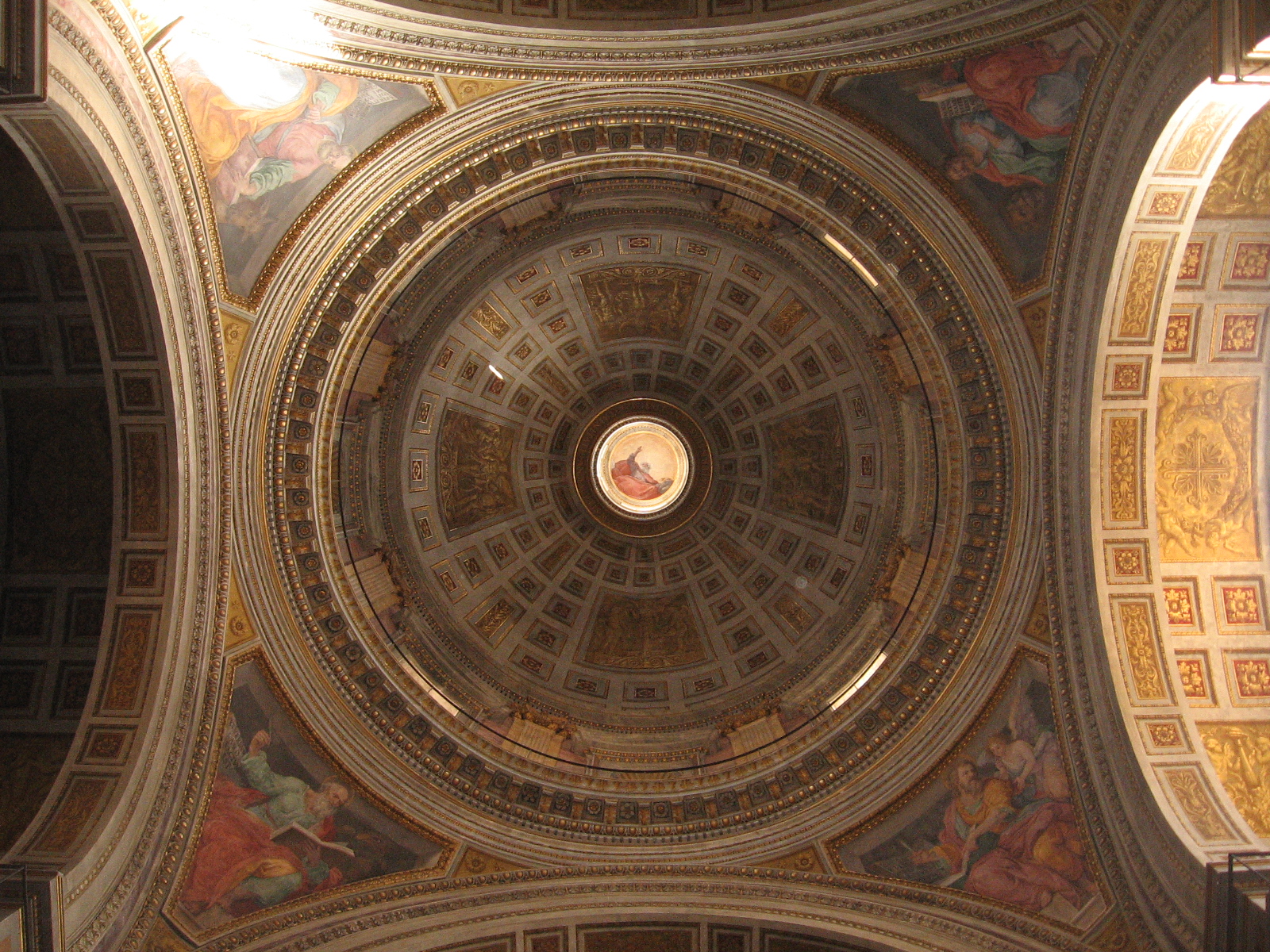
Gazing toward the high altar, one is captivated by the altarpiece, the original needless to say, a huge painting of the Holy Trinity by Guido Reni. High above is written Deo Trino Uni (To God the Three and One), and high, high, exceedingly high up, in the lantern of the dome, is a painting of God the Father Almighty blessing us from on high. You have to crane your neck back till it hurts to see it. What a sight - Pater noster, qui es in caelis...


Benedictione perpetua benedicat nos Pater aeternus. Amen.

Wow!

Monday, November 3, 2008

Two Masses for All Souls

While I would have preferred to have won the trifecta, as it were, and heard all three Requiem Masses to-day, getting to two was pretty good really.

As is my settled custom, I said Lauds before work, and had the chance to pray the Little Hours at odd moments through the day, so that once I arrived at the Pro. I had but Matins, Vespers and Compline left - I have adopted, as the only workable solution, saying Matins out of order - and so I used the half-hour or so before the 5.30pm Mass to knock over Matins (tho' I had to wait till the Offertory to read Lesson ix &c.).  It was good to hear Mass, and plead the Holy Sacrifice.  My prayer at the Elevation was Pie Jesu Domine, dona eis requiem (Sweet Jesus Lord, grant them rest).

After this Mass (which used the texts of the third Mass, BTW, since those of the first were reserved by rubric for the sung Mass, and at the morning Mass those of the second were used), there was time for a pause and to assemble with Rosemary, Catherine and Jeff as we awaited Justin to lead us in the Gregorian chant.  He having arrived, we had a quick quarter-hour practice, and then...

The sung Mass of Requiem for All the Faithful Departed began at 6.30pm.  The complete Proper and Ordinary were sung to their proper Gregorian music, as was the Libera me at the Absolution over the catafalque afterward.  

There is something so very great about the wonderful alternation in the chant between evocations of eternal rest, and of the fearful prospect of Judgement and Hellfire: the Introit, Gradual, Agnus Dei and Communion being among those emphasising the former (and by their simple melody the Kyrie and Sanctus stylistically belong with these), the Tract portrays both, while the Offertory, the Libera me and above all its brother the dread, pounding, magnificent Sequence depict the latter!  What triple hammer-strokes ring out in the Dies iræ!

The use of the simple or ferial tone for the Dominus vobiscum, Collect, Sursum corda, Preface and Pater noster also added to the sombre atmosphere surrounding this solemn Commemoration of the Dead, as did the black vestments.  At the end of Mass, we sang Newman's hymn for the Holy Souls; and I prayed Placebo, or Vespers of the Dead.

Fr Rowe preached very well on the Christian duty to visit the consecrated ground of cemeteries especially at this time of year, both as a moral tonic to fortify us in the true perception of temporal affairs as but passing things compared with our eternal destiny, and to act as a spur to heartfelt prayer for the souls of the faithful departed; for whom, during this octave, we may gain a plenary indulgence by devoutly visiting such burial places, and reciting fit prayers under the usual conditions.  A Christian grave (as his home and his very person, by the frequent use of the sign thereof) ought be adorned with the Cross or crucifix, signifying that we place our only hope in life and in death in the merits of Christ crucified.  While it is religious and decent to erect a fitting funerary monument, all vain pomp ought be eschewed, and the monies therefor better spent on charitable alms for the poor and Mass stipends for the dead.  A better and more lasting monument, better than all workmanship in the world, is to leave behind the testimony of a good life spent in good works for the betterment of oneself, one's family, and all mankind, which witness is the earthly shadow of, please God, the eternal merits stored up in life and due to be eternally rewarded by the Lord in heaven.  Again, it is most laudable to decorate the graves of loved ones with flowers, which themselves bespeak at once the frail brevity of life and its passing beauty (for life is as a mist that appears and then vanishes - cf. James iv, 15), the sadness of this transient state (lachrymæ rerum!), and the need to be in one's life "the good odour of Christ" (II Cor. ii,15).

******

It being also Rosemary's birthday, half a dozen of us joined her for dinner at a nearby restaurant afterward: ad multos annos.

Friday, April 25, 2008

ANZAC Day

ANZAC Day... The long Parade of ever-thinning out, ever-older returned servicemen... The marching bands, some in Scottish kilts with bagpipes, playing "Waltzing Matilda"... The Last Post... The Ode... The old hymns they sing every time... You used to see the very last of the WWI Diggers being driven by slowly in special cars, but I think all have died*, and the WWII veterans are in their eighties now; the Vietnam Vets are middle-aged and older; Australian troops fighting in Iraq and Afghanistan must not be forgotten. Lest we forget.

* No - I was wrong: there is one still living: Jack Ross, 109, of Ballarat.

I had planned to get up long before dawn, and drive into town to go to the Dawn Service at King's Park, but a combination of factors forced a change of plan. We have Mass for St Mark's Day at 9am at the Pro., and I hope the road closures for the Parade won't block me from getting in and parking close by! After Mass, I'll go to the Parade and the late morning Service down by the foreshore.

Fr Rowe told me that he had the option (! - in the old rite! yes: by special decree of the Sacred Congregation of Rites, 23rd June 1961) to say a Requiem today rather than the festal Mass, and in the new rite in Australia (and N.Z. I suppose) the feast of St Mark is moved to tomorrow, so that a Requiem with proper texts and prayers can be fitted in today, in memory of all those fallen in war, "who gave their tomorrow so we could have our today". As I use the modern Office, today I'll do the Office of the Dead, and keep St Mark for tomorrow.

As for the Litanies, I can only assume Fr plans to say them privately.

I append some pictures sent me that were taken by Fr Bernard, when he came with me to the ANZAC Day Parade in Melbourne, back in 2006; it took 4 hours for all the marchers to pass by...