How good it is to have books with long titles; at my right sits The Missal Compiled by lawful authority from the Missale Romanum A New Edition agreeable with the Vatican Typical Edition With a supplement containing the Additional Masses used in English-speaking countries and those for the greater feasts of the Principal Religious Orders (London: Burns, Oates & Washbourne, 1928). This handsome little hardback volume (151 by 86 by 35 mm – that's a shade under 6 by 3⅜ by 1⅜ inches) contains a very large collection of Masses, some of them rare and notable (such as the old Mass Egredimini of the Sacred Heart, and another equivalent proper, Gaudeamus, but celebrating the "Most Divine" Heart), spread across nearly twelve hundred pages.
The prefatory material (an introduction by Adrian Fortescue, usage guide, contents pages, Table of Moveable Feasts, Kalendar, prayers before and after both Mass and Holy Communion, the Litanies of the Saints, &c.) amounts to only sixty pages or so – but then comes the Ordinary of the Mass, and after that all the usual Temporal and Sanctoral, Commons and Votives, a few pages of blessings, twenty-four pages of diocesan calendars, then Commons pro aliquibus locis (including the amusingly-titled Commons "of Many Virgins Martyrs", "of Many Virgins not Martyrs", "of Many Martyrs not Virgins" and "of Many Holy Women neither Martyrs nor Virgins"), a great number of Masses said in the different dioceses of England & Wales, Scotland, Ireland, Australia, New Zealand, then Benedictine and Jesuit calendars and yet many more Masses for those and other religious orders.
This handy collection, dating as it does from 1928, piqued my interest because it contains proper Prefaces (most of them conceded for use fairly recently, I understand) for the following feasts of Our Lord, Our Lady, and important Saints celebrated by the respective Orders named below:
- Preface of the Eucharistic Heart of Jesus (Redemptorist);
- Preface of Our Lady of Mount Carmel (Carmelite) ;
- Preface of St Augustine (Augustinian);
- Preface of St Benedict (Benedictine);
- Preface of St Dominic (Dominican);
- Preface of St Elias (Carmelite) ;
- Preface of St Francis (Franciscan);
- Preface of St Francis de Sales (Visitandine);
- Preface of St John of the Cross (Carmelite);
- Preface of the Seven Holy Founders of the Servites (Servite);
- Preface of St Teresa of Avila (Carmelite);
- "Parisian" Preface of All Saints & Patrons, used for St Vincent de Paul (Vincentian);
- Preface of Reparation for Insults Offered to the Most Holy Sacrament of the Eucharist (related to but distinct from the Neo-Gallican Parisian Preface, and indeed Mass, thereof).
I posted the Preface of St Augustine – which, to be honest, strikes me as a bit long-winded and pedestrian – the other day; to-day I have been thinking on the Preface of St Benedict, and the light it shines on the littleness of all things here below:
Vere dignum et justum est, æquum et salutare, nos tibi semper et ubique gratias agere, Domine sancte, Pater omnipotens, æterne Deus. Qui beatissimum confessorem tuum Benedictum, ducem et magistrum cælitus edoctum, innumerabili multitudini filiorum statuisti. Quem et omnium justorum spiritu repletum, et extra se raptum, luminis tui splendore collustrasti. Ut in ipsa luce visionis intimæ mentis laxato sinu, quam angusta essent omnia inferiora deprehenderet. Per Christum Dominum nostrum. Quapropter profusis gaudiis totus in orbe terrarum monachorum cœtus exsultat. Sed et supernæ virtutes atque angelicæ potestates hymnum gloriæ tuæ concinunt sine fine dicentes:
Sanctus...
It is truly meet and just, right and wholesome, for us ever and everywhere to give thanks unto thee, O Lord holy, Father almighty, God eternal. Who didst appoint Benedict thy most blessed Confessor, taught from heaven, to be leader and master to a numberless multitude of sons. Whom also, filled with the spirit of all the just, and rapt out of himself, thou didst illumine with the splendour of thy light. That in the very light of that close vision, his mind being unfettered, he might see how truly little are all things below: through Christ our Lord. Wherefore with freest joys doth the whole choir of monks throughout the world exult. But the hosts above, and the angelic powers also join in singing the hymn of thy glory, saying without ceasing:
Holy...
The protocol of the Preface is the usual Vere dignum; the eschatocol is that of Pentecost, with the charming difference that instead of declaring that mundus, the world, exults, instead the priest sings that monachorum cœtibus, the company of monks, corporately rejoices.
St Benedict, by a natural play on words, is called a "most blessed" confessor – that is, turning to the original signification of the term, one who, while not a martyr, endured obloquy and confessed the Faith even when persecuted (for not all were happy to have him as their abbot). He is justly named as leader and master or teacher, himself taught by Heaven, having first learned to be wisely unwise in earthly matters (scienter nescius et sapienter indoctus – S. Greg. Magn., Dial., II, Pro.) and instead to seek the one thing necessary by betaking himself to the eremitic life, ere he founded monasteries and composed his Rule, enlightened from above: and thus the Almighty has established him and set him up as the father in God of a numberless multitude of sons (as once he promised Abraham), the monks Benedictine who have been as lights in the world ever since.

Several quotations from Book II of the
Dialogues of Pope St Gregory the Great complete the body of the Preface. Peter the Deacon, Gregory's interlocutor as portrayed in the
Dialogues, says of St Benedict that he was filled with the spirit of all the just (Book II, Chapter 8); but, more notably, the Preface briefly summarizes and quotes from the famous vision St Benedict beheld one night before Matins, as told in Chapter 35 of Book II of those
Dialogues.
For St Benedict, praying at the window of his chamber, suddenly beheld a glittering light brighter than that of day shining forth with splendour in the darkness: and "During this vision a marvellously strange thing followed, for, as he himself afterward reported, the whole world, gathered together, as it were, under one beam of the sun, was presented before his eyes".
When Peter the Deacon interrupts, as it were, the account of this vision to query how anyone could behold the whole world, Pope Gregory wisely answers that:
All creatures are, as it were, nothing [angusta est omnis creatura] to that soul that beholds the Creator. For though it sees but a glimpse of that light which is in the Creator, yet all things that are created seem very small [breve ei sit omne quod creatum est].
By means of that supernatural light, the capacity of the inward soul is enlarged [quia ipsa luce visionis intimæ mentis laxatur sinus], and is so extended in God, that it is far above the world. The soul of one who sees in this manner, is also above itself [super semetipsam]; for being rapt up in the light of God, it is inwardly in itself enlarged above itself [cumque in Dei lumine rapitur super se conspicit]. When it is so exalted and looks downward, it comprehends how little all creation is [exaltata comprehendit quam breve sit]. ...
The man of God, therefore, who saw the fiery globe... could, no doubt, not see those things but in the light of God [in Dei lumine]. What marvel is it, then, that he who saw the world gathered together before him – rapt up in the light of his soul [qui sublevatus in mentis lumine] – was at that time out of the world [extra mundum fuit]? ...
The soul of the beholder was more enlarged, rapt in God [qui in Deo raptus], so that it might see without difficulty that which is under God. Therefore, in that light which appeared to his outward eyes, the inward light which was in his soul ravished the mind of the beholder to supernatural things [lux interior in mente fuit, quæ videntis animum, quia ad superiora rapuit] and showed him how small all earthly things are [ei quam angusta essent omnia inferiora monstravit].
Thus it is clear that, when the Preface sings in praise to God that, when St Benedict was "rapt out of himself, thou didst illumine [him] with the splendour of thy light. That in the very light of that close vision, his mind being unfettered, he might see how truly little are all things below" (extra se raptum, luminis tui splendore collustrasti. Ut in ipsa luce visionis intimæ mentis laxato sinu, quam angusta essent omnia inferiora deprehenderet) – this refers to and indeed quotes directly from the account of that vision of the splendour of divine light enlightening the Holy Patriarch of Monks, rapt out of himself in ecstasy, in Dialogues, II, 35: "in the very light of that intimate vision, the capacity of the mind enlarged" [(quia) ipsa luce visionis intimæ mentis laxat(ur) sinu(s)], he was shown "how small all earthly things are" [quam angusta essent omnia inferiora (monstravit)].
Of course, this marvellous vision, and all other graces gracing St Benedict, we confess to come "Through Christ our Lord".
This Preface of St Benedict points out the "one thing necessary", upon which contemplatives of all people ought ever fix their gaze: the Godward glance in comparison to which all terrestrial matters are revealed as transient, "for the world as we know it is passing away". This Preface, I would argue, is profoundly apposite, since monks ought ever be reminded not to love the world, nor the things of the world: theirs of all vocations should be the most eschatologically oriented: they should ever be intent on things above, where Christ is, at the right hand of God, and live lives hidden in Him; they ought "behold the Man, the Orient is His Name" and look East to Christ and the coming of His Kingdom, not turn back to the West, that is, to the paltry affairs of mortal, sinful man.
While ever extending hospitality to all, receiving those who visit as if they were Christ Himself, and like Moses when Israel battled Amalek ever lifting up holy hearts and hands to God in heaven, invoking Divine aid for all enduring the spiritual warfare of this miserable and naughty world, they should as it were have but the left eye on mundane things, and the right eye, the eye of the heart and soul and mind, on the things that are eternal.
The wonderful vision of St Benedict – the whole world seen in the coruscating light of God – makes me think of the title of an old book on astronomy: In the Centre of Immensities; which may be understood in a spiritual manner. It may be going a bit too far, however, given the somewhat offensive quality of the phrase, to think of the science fiction novel The Mote in God's Eye!
But whatever of that, there are several very famous images of the Earth from space that are somewhat analogous to this supernatural insight, insofar as anything natural can be analogous to things above.

I think of the image of Earthrise, snapped by the Apollo 8 crew on Christmas Eve 1968 as they rounded the Moon, which is considered one of the most notable photographs ever taken, and whose import for those here below ought be profitably linked to the near-contemporaneous reading of Genesis 1:1-10 by the three astronauts of Apollo 8 when they broadcast to the world from lunar orbit.
What a sight on Christmas Eve – when the Word by Whom all was made was born for us in true human nature and dwelt among us, sanctifying all things, the Uncreated having taken to Himself creaturehood as the Firstborn of all creation, He Who made the Sun, the Earth, the Moon, the stars...

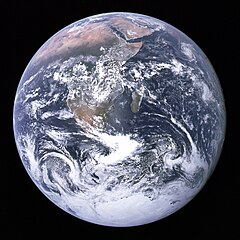
Likewise, I recall that other famous image called "The Blue Marble" – Earth photographed from Apollo 17 on its journey out to the Moon on the Vigil of the Immaculate Conception in 1972. How significant that date! For that feast celebrates the greatest and humblest of all creatures at the moment of her coming to be: not Gaia, but the Blessed Virgin, in due season alone accounted worthy to be the true Mother of God Incarnate of her flesh.
However, far from (as in popular usage) merely helping to engender "global consciousness" (no doubt laudable insofar as it goes) or environmental concern (also praiseworthy in due measure), with all their attendant temptations to so magnify tree and flower, sea and air, as to be entrapped in their beauty and drawn away from the Divine, this image and the other ought instead make us comprehend how our created world is as but a tiny thing the size as it were of a hazelnut, as was revealed to Dame Julian of Norwich long ago: indeed, her vision was not merely of the Earth, but of the whole Universe, "all that is made" – she "marvelled how it might last, for it seemed it might suddenly have sunk into nothing because of its littleness", but was reassured "It lasts and ever shall, because God loves it."

The vision of St Benedict doubtless was of all that is, not merely of the Earth – for by the world is oft meant the cosmos in older works; but nonetheless its sphericity and tininess may be compared to yet a far more distant image of our world, that referred to as "The Pale Blue Dot", showing the Earth as the merest mote caught in a sunbeam, imaged from six billion kilometres away by the space probe Voyager 1 in 1990 as it departed our solar system forever.
That image reminds me of something Tolkein wrote – he perceived as it were his soul as a speck of dust illuminated by a ray, and that ray seemed as it were to be his guardian angel, and the Light shining forth that ray and lighting up that speck to be the Origin and End of both and their Creator.
All these three images of Earth have become modern "icons", to use a significant term: but icons too often of merely mundane concerns – for, while obviously it is important to apprehend the true value and beauty and rareness of our planet, and prudently to care for it (as man was put in the garden so to do in the beginning), the message that modern man misses in his obsession with even the best of created things is precisely what ought be most obvious – that Earth is but a speak of dust compared to boundless space, and that is an apt illustration of how truly little all things are here below, while above lies infinity, and the Infinite God.
May I dedicate this reflection to a good and devout priest, Fr Mark Withoos, late of the Roman Curia, whom I understand to have decided to enter the Benedictine foundation at Norcia in Italy, seeking the pearl of great price, God alone – may the Lord bless and ratify his calling in heaven, at the prayers of Our Lady, St Benedict and all the saints.


.JPG/241px-Benedikt_(St._Benedikt,_M%C3%BCnchen).JPG)