Showing posts with label Postcommunion. Show all posts

Saturday, January 3, 2015

Belated Christmas Present: a Postcommunion addressed to the Holy Spirit

While looking for the various Office and Masses in honour of St James conceded to Spain (the feast of the Translation of his body to Compostela, on the 30th of December; the feast of his Apparition as Santiago Matamoros on the 23rd of May; the Vigil, on the 24th of July, of his feast; and his feast itself, on the 25th of July, with an Octave ending on the 1st of August) – as I am planning to walk the Camino in four years' time, and am beginning to make remote preparations, spiritual and temporal – I made a most amazing discovery: amongst those Masses for use in the Spanish realms, in a special Votive Mass for pregnant women and those undergoing the pangs of childbirth, the Collect, Secret and Postcommunion are addressed to the Father, the Son and the Holy Spirit respectively.

Now, there are plenty of orations addressed to God the Son (though of course most are addressed to God the Father), but this was the first I have ever come across, appointed for use in a Roman Rite liturgical book, addressed to God the Holy Ghost. Fellow students of the sacred liturgy, this is a belated Christmas gift to you.

Years ago, I read Jungmann's The Place of Christ in Liturgical Prayer, which confirmed that liturgical prayers, apart from some in the Armenian Rite, are hardly ever addressed to God the Holy Spirit. Now, the Third Person of the Trinity is certainly invoked in hymns and antiphons (such as the Veni Creator Spiritus and the Veni Sancte Spiritus of the Roman West, or the troparion O heavenly King of the Byzantine East), but prayers in the strict sense are nearly always addressed to either the First or, less often, the Second Person of the eternal Triune Godhead.

The Postcommunion that I came across is found in a book available online, entitled Missæ quæ in Hispania specialiter celebrantur, pro celebrantium commoditate congestæ (Barcinone [Barcelona], 1833), on page 83, where it is part of Alia Missa ad honorem gloriosæ Virginis pro Mulieribus prægnantibus, aut alias in partu laborantibus (Another [Votive] Mass in honour of the glorious Virgin for pregnant women, or for other women labouring in childbirth):
Beatissime Spiritus, per quem condita sunt universa: suppliciter tuas exaudire digneris famulas, pro quibus has tuæ porrigimus pietati preces: ut quemadmodum tuo felici, et sancto juvamine optant liberari; ita suffragiis beatissimæ Matris Dei, lumen gratiæ tuæ, in earum celeri expeditione infundere digneris. Qui cum Deo Patre, et eodem Filio vivis, et regnas Deus per omnia sæcula sæculorum. 
(Most blessed Spirit, through whom all was created: deign graciously to hear thy handmaids, for whom we suppliantly offer these prayers to thy piety: that in whatsoever way they hope to be delivered by thy happy and holy aid, even so, at the suffrages of the most blessed Mother of God, deign to pour forth with speedy expedition the light of thy grace into them. Who with God the Father, and the same Son, livest and reignest God, through all ages of ages.)
This prayer is rather too prolix and complex compared to the classic prayers of the Roman liturgy, but it is still most worthy of note.

In particular, I had often wondered (in that artless way of mine) as to how the closing doxology of a prayer to the Holy Ghost would be phrased – would it end "In whose unity the Father and the Son live and reign, God, world without end", or how? In the event, it appears that the ending used is all but identical to that used for prayers ad Filium, simply adding et (eodem) Filio and removing in unitate Spiritus Sancti.

In any case, I had best reiterate my long-term plan to walk from Roncesvalles to Santiago de Compostela in 2019 (hopefully, during Eastertide). Why then? Because I ought have amassed enough leave from work by then, and when three friends of mine walked that same pilgrim path in 1997, they set off in Easter Week and arrived in time for Pentecost, which seems a good plan to me also.

Tuesday, January 3, 2012

The Most Holy Name

By mistake, I read the ferial Office yester-day, when I should have said the Office of the Holy Name of Jesus (according to my Dominican Diurnal and Breviary); so, instead of reading the ferial Office to-day, I'm saying the Office of the Holy Name.  "Office for Office", after all, is the principle.  In addition, to-day, the 3rd, is the Optional Memorial of the Most Holy Name in the Ordinary Form, so Lauds in my Diurnal coincided with the Mass I attended.

I was struck by how the very long-winded and indeed rather bizarre orations in the Extraordinary Form (though not in the Dominican Rite – alas, I live far from a friar) have been replaced by, frankly, rather better ones in the Ordinary.  For example, the Postcommunion in the 1962 Missal is:

Omnípotens ætérne Deus, qui creásti et redemísti nos, réspice propítius vota nostra: et sacrifícium salutáris hóstiæ, quod in honórem nóminis Fílii tui, Dómini nostri Jesu Christi, majestáti tuæ obtúlimus, plácido et benígno vultu suscípere dignéris; ut grátia tua nobis infúsa, sub glorióso nómine Jesu, ætérnæ prædestinatiónis titulo gaudeámus nómina nostra scripta esse in cælis. Per eumdem...
(Almighty eternal God, Who hast created and redeemed us, graciously regard our desires, and deign to receive with a placid and benign countenance the sacrifice of the saving Victim, which we have offered to Thy majesty, in honour of the Name of Thy Son, our Lord Jesus Christ; that, Thy grace infused into us, we may rejoice that our names are written in heaven, under the glorious Name of Jesus, a pledge of eternal predestination. Through the same...)

Is this not a terribly overlong prayer, hardly fitting the expected concision of the Roman Mass?

This, I believe, has been abbreviated to advantage, to become the Prayer after Communion in the current Missal, which I append in the Latin and in the new English translation:

Hostia sumpta, Domine, quam Christi nomen honorantes tuæ obtulimus majestati, gratiam tuam, quaesumus, nobis infundat uberrime, ut et nostra in caelis esse scripta nomina gaudeamus. Per Christum Dominum nostrum.
May the sacrificial gifts offered to your majesty, O Lord, to honour Christ's Name and which we have now received, fill us, we pray, with your abundant grace, so that we may come to rejoice that our names, too, are written in heaven. Through Christ our Lord.

I have underlined the words common to the new and old forms of this prayer, demonstrating how the one derives from the other, the necessary grammatical changes being made.  The new is definitely a tighter, more effective composition, whereas the older was too diffuse.

Sunday, November 13, 2011

Hobart Missa Cantata: the Postcommunion

To-day I’ve been down to Hobart and back, for to M.C. at our monthly Traditional Latin Mass, the one and only permitted in the Archdiocese (whatever a certain Supreme Pontiff may have decreed).

(This began as a comment on David Schütz's blog, but I've decided to save time and cross-post it here on my own.)

In any case, not to belly-ache but to celebrate, I was indeed uniquely privileged to stand at the priest’s side throughout the Liturgy (but for the prayers at the foot of the altar, the Consecration and my own Communion, naturally), and doing so made me suddenly aware (as I pointed it out for Father in the Missal) that the Postcommunion of to-day, the 23rd Sunday after Pentecost in the Extraordinary Form is – that of this selfsame Sunday in the Ordinary Form, the 33rd Sunday per annum!

It is actually quite rare to find any prayer or chant occurring in both forms of the Roman Rite on the same day, so my curiosity was piqued.

The first thing to note is an important change of address made by the revisers: in the traditional Missal, the Postcommunion is as follows:


Súmpsimus, Dómine, sacri dona mystérii, humíliter deprecántes, ut, quæ in tui commemoratiónem nos * fácere præcépisti, in nostræ profíciant infirmitátis auxílium. Qui vivis et regnas cum Deo Patre…


I have highlighted the words subsequently changed, and inserted an asterisk where two new words were inserted in the reform – obviously, the prayer was redirected, so as to address God the Father rather than God the Son (and if I recall correctly that was itself a change made centuries earlier, from the initial almost total address of all such orations to the Father, to also addressing the Son if the prayer seemed to better suit it):


Súmpsimus, Dómine, sacri dona mystérii, humíliter deprecántes, ut, quæ in sui commemoratiónem nos *Fílius tuus* fácere praecépit, in nostræ profíciant caritátis augméntum. Per Christum…


The other interesting, and, I am afraid, all too predictable modification was that made to the intention of the prayer: no longer do we pray for aid for our weakness, but for an increase of charity. Now, both intentions are good and orthodox, but unfortunately the semi-Pelagian feel of “Gaudium et Spes” (to quote the current Pope when commenting when yet a priest on the Council documents!) has here made itself manifest: we do not confess our weakness, but perhaps too complacently ask for a boost to our lovingkindness.

In other news from today’s Mass, the choir was without its usual director, and the threat of having only a Low Mass was upon us – but, perhaps high-handedly and selfishly preferring a  Missa cantata (mea culpa), I reminded Simon, as locum tenens of the choir director, that as a bare minimum the Propers could simply be monotoned, advised him to sing the most familiar setting of the Ordinary (Missa VIII – de Angelis – and Credo III), and suggested that any other Latin ditties he knew could be sung to fill in the time at Offertory and Communion, so the good old Salve and Adoro te devote saved the day.

Before Mass and afterward, I reminded him that such was the practice over in Perth, W.A.,  whenever Fr Rowe wanted a sung Mass at the drop of a hat on a weekday (it brings back memories of a week's retreat, at which myself as the one chorister, and Aaron as the one server, had to provide him with a sung Mass between us daily).

We even sang “Faith of our Fathers” as a fitting recessional. Best of all (as we Catholics say) Mass was a bit faster than usual, taking just an hour.


Deo gratias et Mariæ!

Thursday, July 8, 2010

The Martyrs of Gorkum


Deus, qui beatorum martyrum tuorum Joannis et sociorum ejus, gloriosum pro fide tua certamen æternitatis laurea decorasti: concede propitius, ut eorum meritis et imitatione certantes in terris, cum ipsis coronari mereamur in cælis.  Per eumdem...
O God, Who adorned with the laurel of immortality the glorious battle of Thy blessed martyrs John and his companions for the Faith: graciously grant, that by their merits and exampledoing battle on earth, with them we may deserve to be crowned in heaven.  Through the same...
— Collect, St John of Cologne and Companions, MM (Dominican Rite)


It is only and ever through the Prince of Martyrs, the Faithful Witness, the Firstborn from the dead, by Whose Blood we are washed from our sins, Christ Jesus our Lord, that we may fight the good fight of the Faith.  By His grace we are compassed about by a great cloud of witnesses, who have now run the race before us, and by faith conquered; as they triumphed over pain and death in Him, so we may hope to finish the course.

To-morrow, Friday the 9th of July, marks the 438th anniversary of the martyrdom of St John of Cologne and eighteen companions, captured in and around Gorkum, most cruelly tortured, abused and finally hanged by Dutch Calvinists in the town of Brielle, which has been ever since a place of pilgrimage in honour of their witness unto death to our most holy Faith: for they refused to renounce their belief in the Blessed Sacrament and the Papal supremacy, and for this they were hanged out of devilish fanatical hatred.

Hæresum surgunt nova monstra, "New monstrosities of heresies arose", begins the hymn at Matins of this feast.  What good ever came of the blasphemies of Calvin, his hellish perversion of Christianity into a religion of fear, not of love?  Only the white-robed army of martyrs sent to heaven by the bloodstained hands of its sectaries!  Whose was the "total depravity"?  His and theirs who refused belief in sacramental regeneration, and made God into a monster worse than sinful men, a deceiving distortion of the Lord into what the ancient heretic, Marcion, misrepresented as the vengeful deity of the Old Testament.

Of the witnesses for Jesus who stood against such wicked folly, the larger part of this saintly company were Franciscans, nine priests and two lay brothers, but also four secular priests, two Norbertines, an Augustinian, and the Dominican, John, mentioned above - who, having heard of the incarceration of the first fifteen, hastened to bring them the sacraments and was himself captured, tormented and slain with the rest.  Greater love hath no man...


"Behold how they are numbered among the children of God, and their lot is among the saints."
– Wisdom v, 5 (Communion)

The Postcommunion for this feast in the Dominican Missal addresses Our Lord thus:

Deus, virtutis auctor ac largitor, per sanctorum martyrum tuorum fidem et constantiam concede, ut nos ad sacrum convivium accedentes, eodem accendamur ardore, quo ipsi pro veritate corporis et sanguinis tui, vitam tibi in holocaustum obtulere.  Qui vivis et regnas...
O God, the author and giver of strength, for the sake of Thy holy martyrs' faith and steadfastness, bestow on us who draw near this hallowed banquet the same enkindling flame wherewith they gave their life as a holocaust to Thee, for the truth of Thy Body and Blood: Who livest and reignest...

Saturday, June 19, 2010

Sacri Corporis et Sanguinis Pretiosi

I was forcibly struck by the words of the prayer after Communion this evening, at the Vigil Mass for the 12th Sunday of Ordinary Time (honestly, I had to look up which it was – I rather like not knowing where the poor Church is, lost in Boring Time):

Sacri Corporis et Sanguinis pretiosi alimonia renovati, quæsumus, Domine, clementiam tuam, ut quod gerimus devotione frequenti, certa redemptione capiamus.  Per...

This stems from the Veronese or Leonine Sacramentary, where it appears in the 19th Mass formulary, with one word different (libamine not alimonia), and placed after renovati, and three in a different order (frequenti devotione gerimus) – minute variations only.  The opening phrase, be it noted, is unusual, in that "sacred" is not the usual adjective applied to Christ's Body – rather, "(most) holy" would be the expected.

Strangely, the great Fr Z doesn't seem to offer a translation of this postcommunion, but luckily the good fathers of the Birmingham Oratory do (I correct "Thy" to "the" before "Sacred"):

Renewed by the nourishment of the Sacred Body and Precious Blood, we beseech Thy mercy, O Lord, that what we do here with constant devotion, may win for us our eternal redemption.  Through...

Of course, the lame-duck ICEL version we'll be well rid of by next year impertinently mistranslates this, rewriting it as a completely different prayer; still, its rendering is by no means their worst paraphrase, since at least it still has some meat to it:

Lord, you give us the body and blood of your Son to renew your life within us. In your mercy, assure our redemption and bring us to the eternal life we celebrate in this eucharist. 

We are indeed renewed, renovated, repristinated, made new in the deep sense of being conformed to the New Adam, Christ, by the nourishment of His Sacred Body and Precious Blood; though sons of the Old Adam in his fallenness, like him weighed down and made old by sin, the sacred Food and Drink, the Flesh and Blood that saves, renews us as Christians.  

Mirabile dictu, this Sacrament was instituted ut sumatur, that It be consumed: what a marvel that we should tremble at!  God gives His very Body most sacred, His Blood beyond all price, to be our nourishment.  Had He not directly commanded us to thus eat and drink, never would anyone dare imagine such a thing.

Having thus been fed by such sacred and precious Gifts, thus assured of God's mercy, we confidently beg that Mercy.  What we do here constantly – as Dix put it so well in his magnum opus, what we ever do in memory of Christ, celebrating His Sacrifice and Sacrament – we pray may win eternal redemption for us: His Death once for all on Calvary, we hope to grasp ahold of, that that great act of Redeeming Love may prove for us eternal in its effect.

In reflecting on this, I was mindful of Neale's great englishing of that ancient hymn Sancti venite (at least as old as the 7th century, and traditionally attributed to St Sechnall or Secundius, nephew of St Patrick, who are together said to have heard the angels singing thus at Mass):


Draw nigh and take the body of the Lord;
And drink the holy blood for you outpoured.
Saved by that body and that holy blood,
With souls refreshed, we render thanks to God.

Wednesday, May 26, 2010

Festa di Pippo Buono

To keep the feast of San Philippo Neri, Pippo Buono (Phil Black, "Good Pip", as we would say in English) – joy!  And a joy it was to go to Mass this evening to honour the saint and worship God Who made him.  I had abundant lights at Communion, reminding me that from one so overwhelmingly blessed as to receive the Lord, what great things ought be expected.  

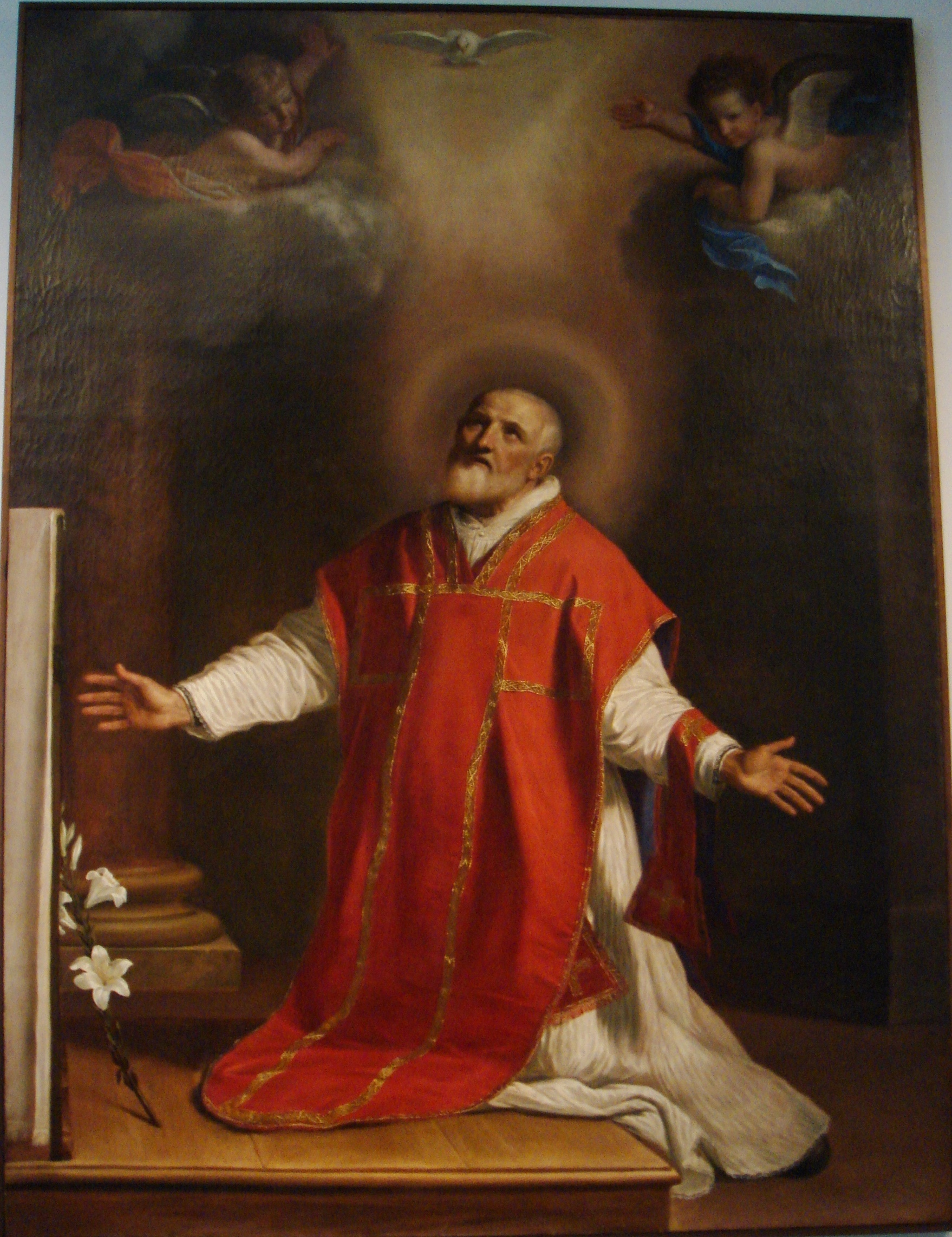
St Philip, with the lily of purity afore him, is shewn at the footpace of the altar in Mass-vestments of red, signifying his priestly focus upon the Mass and his entire devotion to the Holy Ghost, seen (flanked by angels) illapsing upon him

St. Philip, inflamed with the love of God and a desire of praising him worthily, after offering him all the affections of his soul, and the homages of all his creatures, seeing in their poverty and inability nothing equal to his infinite greatness, comforted himself in finding in the Mass a means of glorifying him by a victim worthy of himself.  This he offered to him with inexpressible joy, devotion, and humility, to praise and honor his holy name, to be a sacrifice of perfect thanksgiving for his infinite benefits, of expiation for sin, and of impetration to obtain all graces.  Hence in this sacrifice he satiated the ardent desires of his zeal, and found such an excess of overflowing love and sweetness in the closest union of his soul with his divine Redeemer.
(Taken from Vol. V of “The Lives or the Fathers, Martyrs and Other Principal Saints” by the Rev. Alban Butler, the 1864 edition published by D. & J. Sadlier, & Company)


******

The Postcommunion of this feast is entirely apposite: 

Cælestibus, Domine, pasti deliciis, quæsumus, ut * beati Philippi [confessoris tui, meritis et] imitatione * semper eadem, per quæ veraciter vivimus, appetamus.  Per...
(Fed, Lord, with celestial delicacies, we beseech that * by the imitation [and merits] of blessed Philip [thy confessor] * we may ever desire the same, by which we truly live.  Through...)

Interestingly enough, St Philip himself often prayed this prayer!  For, saving only the insertion of the words "by the imitation [and merits] of blessed Philip [Thy confessor]", which I have enchased with asterisks, it is the Postcommunion of the 6th Sunday after Epiphany – nowadays used in the Ordinary Form for the 6th Sunday in Ordinary Time.  This prayer is thus very ancient and expresses the doctrine of Holy Church with sureness.  At how many altars, for well over twelve hundred years, has this been prayed!

How greatly St Philip's heart dilated at these words of truth... how ought my heart likewise expand.  For in receiving Our Lord in Holy Communion, we partake of the true Manna by which we may expect life without end, beginning even now in this world.  I recall the famed and mysterious Mass of St Philip, celebrated in private as he grew older, that he might without embarrassment give full vent to his mystic love of Christ – a Mass lasting 3 hours, his Communion taking up most of the time; the saint could be heard to whisper in awe when drinking from the chalice, "It's real Blood".

The words in square brackets are omitted in the Novus Ordo, which is usually allergic to the mention of merit, presumably as "unecumenical", meaning, not pleasing to Protestants (thank God the editorial committee didn't remove reference to the saints' merits from the Canon), and which, in the interests of brevity, omits reference to non-martyrs as confessors, especially as the category of "confessor", however ancient, no longer exists as a separate Common.

Tuesday, December 22, 2009

Profound Postcommunion

My ears pricked up while Fr Allan read the prayer after Communion at Mass to-day for the 22nd of December: unusually for the ICEL translation, it included the word "merit" - and in toto was a most noteworthy collect:

Lord,
strengthen us by the sacrament we have received. [Probably we are to understand this as a subordinate clause causally linked to the next, so read it as "Lord, strengthen us by the sacrament we have received, that thereby you may..."]
Help us to go out to meet our Saviour
[This clause gives an Advent flavour by alluding to the parable of the wise and foolish virgins waiting for the Bridegroom to arrive for the wedding feast: which is an image of our Christian life of expectation and keeping watch for Christ's Coming]
and to merit eternal life [gulp! that's a rather scary thought - but of course we do this "in Christ", Whose members we are by baptism, and Whose grace makes our actions supernaturally meritorious for the sake of His Passion]
with lives that witness to our faith.
We ask this in the name of Jesus the Lord. [Or, rather, "Through Christ our Lord," the proper short ending, much more truly significant, since all this we ask, and all this we know can only be granted, through Him our Mediator and Redeemer.]

So much for the ICEL version; in default of having the upcoming new and faithful translation to hand (it's due for implementation in 2011 I now understand), here is the Latin:

Roboret nos, Domine, tui sacramenti perceptio, ut venienti Salvatori mereamur cum dignis operibus obviare, et beatitudinis praemia promereri. Per Christum Dominum nostrum.

May the reception of thy sacrament strengthen us, Lord, that [yes, the first clause was a subordinate one of causation] with worthy works [not "lives that witness to our faith" as ICEL Protestantizes it] we may be deserving to meet the coming Saviour, and to merit the reward of beatitude. Through Christ our Lord.

Two separate verbs for deserving and meriting are used: mereamur and promereri. The concept is clearly crucial in this prayer; happily for once ICEL broke its usual rule and actually translated the word "merit".

Note how crappy and patronizing the ICEL paraphrase is: not only is Our Saviour not referred to as "coming" - a pretty stupid omission - but "the reward of blessedness", a beautiful and theologically significant phrase, is replaced with the easier-for-simpletons paraphrase, "eternal life". The causal link between the sacrament and our ensuing actions is removed, and "worthy works" is replaced most misleadingly with "lives that witness to our faith". Bleh!

But to give that body its due, here it actually did manage to convey something of the prayer.

What a great pity that English-speaking Catholics have been given an anemic and positively misleading translation of the Mass for so long. Arguably this is a greater wrong than ever was inflicted: for in the past when Mass was only in Latin, the translations in the hand missals that the laity took to Mass were scrupulously literal. Look at how people nowadays have no idea of the doctrines of merit and of grace - the latter word, so vital in theology, hardly appears at all in the English Mass, and yet it's there in the Latin. O, I forgot, ICEL renders it as "love" - a treacly mess in which we drown.

Sunday, February 22, 2009

Quinquagesima / 7th Sunday per annum

Well, in the Church's Year of Salvation it's Quinquagesima; and in the Novus Ordo, the 7th Sunday of Ordinary Time, Year B.  Sigh.

Fr Kene (yay!) was again our celebrant for the Sunday Mass at Carmel; unlike the other priests, he seems to enjoy coming to say Mass for the sisters, likes the Gregorian chant they sing, even having us use the Confiteor so the sisters can chant the Kyrie as well as the Gloria (plus the Sanctus and Agnus Dei further on), and even tries singing the Collect and Preface (as to-day) so as to fit in with the generally more sacral style of Mass at Carmel.  Again, though, what a sad comment on the Novus Ordo that one has to go to the monastery for Mass done without banal mediocrity much in evidence!

Given the readings for this Sunday (the Gospel from St Matthew v, 38-48 being that of the healing of the paralytic), he preached on how the Lord will extend to us His healing hand if we but pray; and how He so prizes our souls, that He wills to grant spiritual healing even over the physical healing extended to the bodies of the sick: we should therefore supplicate Him to heal our aversion to prayer and to liturgy (yes, he actually said that!), and all other wounds of our souls.  Furthermore, Fr Kene observed that too often "the crowd" impedes our approach to Christ, setting up obstacles and distracting us from our highest good, which is to come nigh unto the Lord, the Divine Physician.

The sisters had evidently prepared short, sharp and arresting petitions for the Prayer of the Faithful: for the ministers of the sacrament of Penance; for those enduring atheistic tyranny; for devotion to Our Lady the Refuge of Sinners; for the bushfires and for preservation therefrom; for all the dead.  That's what such petitions ought be, not longwinded mini-sermons more about propagandizing the congregation than begging God for mercy.

As usual, the ICEL paraphrases of the orations at Mass were hardly even that: but years past I obtained (largely from Fr Z's WDTPRS) literal renderings thereof, which, together with the Latin originals, I printed out onto small inserts put into my modern missal; while I only took my Breviary to Mass this morning, I did take the relevant insert with me inside its front cover, and was struck by how bad and misleading those stupid ICEL prayers are - look to just the Collect (originally that of the 6th after Epiphany) and Prayer after Communion (that of the 5th after Epiphany, with two words different):
Præsta, quæsumus, omnipotens Deus, ut, semper rationabilia meditantes, quæ tibi sunt placita, et dictis exsequamur et factis.  Per...

(Grant, we beg, Almighty God, that we, meditating always on rational things, may fulfil those things which are pleasing to you by both words and deeds.  Through...)

ICEL: Father [no, "Almighty God" - how hilarious that late-1960's committee members rendered the address to the Deity by a term that the feminists would have already hated!], keep before us the wisdom and love you have revealed in your Son [they have taken semper rationabilia meditantes, and changed it into a reference to God's revelation in Christ - which is good, but in no way a translation].  Help us [so much for "grant, we beg"!] to be like him in word and deed [yes, to do what pleases God is to live as Christ did on earth, but that's not at all what the original actually said], for he lives and reigns... [having so rewritten the collect, they now conclude it with Qui tecum vivit... not Per Dominum...]

Præsta, quæsumus, omnipotens Deus, ut illius capiamus effectum, cujus per hæc mysteria pignus accepimus.  Per...

(Grant, we implore you, Almighty God, that we may obtain the effect of that of which we have received a pledge by means of these [sacramental] mysteries.  Through...)

ICEL: Almighty God [they got this bit right for a change], help us to live the example of love [this seems to be their kindergarten version of pignus, a pledge or foretoken] we celebrate [no, what "we have received"] in this eucharist [what a dumbing down from "mysteries"], that we may come to its fulfilment [an elucidation of "effect"] in your presence [a fair enough expansion and explicitation, though not in the original].  We ask this... [again, a rubbish paraphrase: "through Christ" implies both that we ask and that God grants all through the One Mediator, Jesus our Lord]
I think my fisk of these poor attempts at prayer shews just what a crock ICEL sold us; to think that such crap has been inflicted on Roman Catholics these forty years.

******

The Breviary has a commemoration at Lauds of the Chair of St Peter (and of his fellow Prince of the Apostles, St Paul, under one conclusion - for these are the Christian Romulus and Remus): I recall with thanksgiving and prayer that this day, the 22nd of February, eight years ago, I was in Lismore for the episcopal ordination of my former parish priest, Geoffrey Jarrett - ad multos annos!

Oremus pro Antistite Lismorensis Godefrido:

Stet et pascat in fortitudine tua, Domine, in sublimitate nominis tui.  [Cf. Micheas v, 4]

(Let us pray for Geoffrey, Bishop of Lismore*:

(May he stand and shepherd in Thy strength, Lord, in the sublimity of Thy Name.)

[* Literally, "Lismorensine High-Priest"!]

Monday, December 22, 2008

Torrens in Austro

The Wills are currently entertaining some guests, including myself, and kindly gave me a chance to update my blog, now that I've been fortified with a vol-au-vent and some cups of tea!

In reverse order:
  • This morning I had the privilege of serving two private Masses: Fr Rowe's, and Fr Mannes' - the latter being assisted at this his first Roman Rite Low Mass by Fr Rowe as chaplain. A select group ('stable' group?) attended. I was doubly privileged in that Fr Mannes offered Mass for my intentions, as I'd handed him a stipend for his first Latin Mass, a repetition on this feria of the Mass of the 4th Sunday of Advent. The Epistle (I Cor. iv, 1-5), proclaiming that "Let a man so account of us as of the ministers of Christ and the dispensers of the mysteries of God. Here now it is required among the dispensers that a man be found faithful...", was most appropriate for the first Low Mass of a priest; and the Gospel (St Luke iii, 1-6), read to-day as yesterday and as the day before, detailing as it does the preaching ministry of St John Baptist, very apposite for a Friar Preacher! And it struck me that the Postcommunion Sumptis muneribus - about the greater and greater increase of the effect of our salvation being accomplished by frequentation of the sacred mysteries - was certainly being fulfilled.
  • Yesterday was marked (after I first served Fr Rowe's private Mass, and received a post-Mass blessing with a relic of St Monica) by Fr Mannes' first Ordinary Form Mass, which was quite a splendid affair, held at Holy Rosary Church before a large congregation. While an altar crucifix was overruled, in most ways otherwise it was a reform of the reform affair, with a choir of friends chanting the Introit Rorate cæli, the Kyrie, Sanctus, Agnus Dei and Communion, together with many other pleasant items - such as "O come, O come, Emmanuel" at Offertory, and at Communion, Pange lingua in alternating chant and polyphony, followed by polyphonic Alma Redemptoris Mater and the ineffable Sicut cervus of Palestrina: having made my communion, I was almost in ecstasy hearing this! Curiously, there were an awful lot of kneeling communions, including those of several priests and deacons in choir - let bishops and friars take note. (The auxiliary of Adelaide was at a prie-dieu in the sanctuary, and Dominicans, Franciscans and secular priests concelebrated.) Before I forget, Rev Br Vincent preached a very fine and intellectual homily, which I cannot now recall in extenso, and the other deacon assisting Fr Mannes sang the Gospel. I noticed Fr Mannes kept his fingers conjoined from Consecration to the ablutions, and observed a number of traditional and Dominican usages... About the only drawback was the lack of ad orientem celebration (which is still too brave a statement for Australia), together with the embarrassment of lady readers - one of whom suddenly appeared at the lectern to ask us all to "read the communion antiphon", a gauche intervention that she noticeably regretted when the choir struck up soon after.
  • In preparation for the ordination to come, I served Fr Rowe's Ember Saturday Low Mass earlier in the afternoon on Saturday, he agreeing in consideration of the occasion to read all six lessons. The actual grand joint ordination took place at the Cathedral here in Adelaide, His Grace Philip Wilson officiating. Again, the liturgy was very high church by general Australian standards (though His Grace unfortunately - unlike Fr Mannes - doesn't sing at all), but reminded me of how much the Novus Ordo can resemble learning to drive in a manual car: too much bumping and grinding of the gears! For instance, a fine hymn to a very Anglican tune opened the liturgy (and a versified Magnificat to the tune of "Jerusalem" closed it), and Missa Orbis factor provided the Kyrie - but alas la(d)y readers, none too skilled in reading, irrupted into the sanctuary, providing a strange contrast to the Gospel chanted by a deacon; and a friend of mine sang the Responsorial Psalm very well, a piece which is usually annoying after all, but then very wierdly sang the Alleluia verse to a modern tune but in Latin - why? Wilson more or less got the ordination alright, though he misnamed Br Vincent as "James" shortly after diaconizing him, and almost stuffed up the laying on of hands for Rev Br Mannes prior to the prayer of consecration - we twitted him at the afterparty, was he really ordained? The music, provided by the same choir of friends mentioned above, was very pleasant, and I was very glad to hear Ronan's setting of Tu es sacerdos being sung! After the one-and-a-half hours of the liturgy passed by, we all received Fr Mannes' first blessing, Deo gratias.
And lack of time precludes me more than alluding to the good time that was had by all at the various post-liturgy functions that were held over this weekend, or to the good folk who kindly put me up and/or put up with me (such as Roman and Terra), or to my enjoyment of this return visit to the beautiful city of Adelaide, or to my nearly missing my plane from Perth to Adelaide because I was sitting quietly in the departure lounge trying to finish Lauds, didn't know the flight was boarding since the P.A. system wasn't working!

As I'm in the capital of South Australia, on the river Torrens, the following Psalm 125 seems highly applicable:

In convertendo Dominus captivitatem Sion,
facti sumus sicut consolati.
Tunc repletum est gaudio os nostrum,
et lingua nostra exsultatione.
Tunc dicent inter gentes:
Magnificavit Dominus facere cum eis.
Magnificavit Dominus facere nobiscum;
facti sumus lætantes.
Converte, Domine, captivitatem nostram,
sicut torrens in austro.
Qui seminant in lacrimis,
in exsultatione metent.
Euntes ibant et flebant,
mittentes semina sua.
Venientes autem venient cum exsultatione,
portantes manipulos suos.

When the Lord brought back the captivity of Sion,
we became like men comforted.
Then was our mouth filled with gladness;
and our tongue with joy.
Then shall they say among the Gentiles:
The Lord hath done great things for them.
The Lord hath done great things for us:
we are become joyful.
Turn again our captivity, O Lord,
as a stream ["torrens"] in the south.
They that sow in tears
shall reap in joy.
Going they went and wept,
casting their seeds.
But coming they shall come with joyfulness,
carrying their sheaves ["maniples"?!].

Friday, December 19, 2008

Ember Friday in Advent

Well, I've served Mass and made my Communion; time to throw the last bits into my bags and get ready to fly...

This being Ember Friday in Advent, the Introit was very appropriately Prope es tu, Domine (Near art thou, Lord...), the Gospel was of the Visitation, and the Postcommunion as follows, a very significant prayer I thought:

Tui nos, Dómine, sacraménti libátio sancta restáuret: et a vetustáte purgátos, in mystérii salutáris fáciat transíre. Per...

May the holy receiving of Thy sacrament, O Lord, restore us: and purged of the old, make us to pass over into the saving mysteries.  Through...

Sunday, December 7, 2008

Amare Cælestia

I have deliberately intituled this post with the above phrase, rather than the (in)famous words  terrena despicere, because the whole point of the Postcommunion of this, the second Sunday of Advent, which will be repeated all week, even at Mass of the Immaculate Conception, is that we must "love what is heavenly".  Now, if to do so we must "despise terrene things", well, fine!  As that golden book, the Imitatio Christi, reminds us, For transient and earthly things, men will labour without rest, yet for eternal and celestial reward, we scarce lift a foot from the ground.  O woe to such blindness, of which I am a chief example!

To-day's noble Postcommunion reminds us that Communion is not an end in Itself.  So often at (ordinary) Mass, it seems as if those present only bother to remain till they can get "It", and then chafe to be away - there seems perhaps a lack of recollection about What they have just encountered, and what it ought effect: as I once saw, when a dear old lady in hospital, being brought Holy Communion, turned off her bedside radio, received the Host very rapidly administered, and just as quickly popped the radio back on!

No, being not merely a most intimate entertainment of our Sovereign Guest, Communion has a purpose - to transform us into Christ, for in no other way will we ever leave this earth fitted for heaven.  

After all, let us reverse the sentiment of this prayer: who would wish us to love earthly concerns, and despise heavenly matters?  Satan, of course: that he may have us for his prisoners both on earth and eternally in hell, in torment without end.  No thank you!

It seems fair to say that the Crucified despised earthly things, having not where to lay His head, and ending up on the infamous gibbet; and most certainly He loved heavenly things, and not for Himself alone, but yearned that we too, poor sinners, might have the taste of them.  So as to wean us from the ultimately fruitless pleasures of earth, which would else drag us down to the Pit, He gave us the chiefest delight of heaven: Himself, in form of bread.  Awesome Mystery!  Sacrament unbelievable, were it not for the warrant of His Word!  Just as bread is the staff of life, so His Flesh is in truth what we pray it may subjectively appear to us - as the sum of all delights, the foretaste on earth of the ineffable ecstasy of the Vision of the Trinity above.


Therefore we pray the Postcommunion:

Repleti cibo spiritualis alimoniæ, supplices te, Domine, deprecamur: ut hujus participatione mysterii, doceas nos terrena despicere et amare cælestia.  Per...

(Replenished by the food of spiritual nourishment, bending low Thee, Lord, we entreat: that by sharing in this Mystery, Thou mayst teach us to despise the earthly and to love the heavenly.  Through...)

Thursday, January 3, 2008

The Holy Name

While I kept the Feast of the Most Holy Name of JESUS yesterday, since I was praying the 1962 Breviary (altho' I didn't get round to it till late at night after a very busy day!), in the modern Roman Rite the same feast (as an optional memorial) falls today, rather than attaching to the Sunday between the 2nd and the 5th inst., or failing that, on the 2nd; and the modern Martyrology declares:


Sanctissimi Nominis Jesu, in quo solo omne flectatur genu, cælestium, terrestrium et infernorum, ad gloriam divinæ majestatis.

(Of the Most Holy Name of Jesus, at which alone every knee shall bend, of celestials, of terrestrials and of infernals*, to the glory of the divine majesty.  [Cf. Phil. ii, 10-11.])

[*i.e. "of those who are in heaven, on earth, and in hell" – my little joke.]


This reminds me: one of the many things I like about the modern Divine Office is the inclusion of New Testament canticles at Vespers; and I liked to genuflect at the words Ut in nomine Jesu omne genu flectatur, cælestium, terrestrium, et infernorum, which appear each Saturday in the cancticle from Philippians ii, 6-11; I based this on the rubric requiring this genuflection at the same words when read on Palm Sunday (and on the feasts of the Holy Cross) as part of the Epistle at the Traditional Mass.


I also try to maintain the formerly universal Catholic custom of bowing the head at the name of Jesus.  It is a sad sign of secularization that this salutary practice has become so rare.


Today's a good day (especially since I hardly celebrated the Feast yesterday) to pray the Litanies of the Most Holy Name; also a good day to delight in the moving Office hymns – Jesu Rex admirabilis (at Matins), Jesu decus angelicum (at Lauds), and Jesu dulcis memoria (at Vespers)  – proper to the (Traditional version) of the feast, drawn from the Jubilus Rhythmicus (wrongly) attributed to St Bernard.


Certain versicles in the Office, widely used elsewhere in the Church's Liturgy, have great appeal also:


V/.   Sit nomen Domini benedictum.
R/.  Ex hoc nunc et usque in sæculum.  (Ps 112:2)

V/.  Adjutorium nostrum in nomine Domini.
R/.  Qui fecit cælum et terram.  (Ps 123:8)

V/.  Magnificate Dominum mecum.
R/.  Et exaltemus nomen ejus in idipsum.  (Ps 33:4)

Domine, Dominus noster, quam admirabile est nomen tuum in universa terra!  (Ps 8:2)

Ego autem in Domino gaudebo, et exsultabo in Deo Jesu meo.  (Hab.  iii, 18)


The last sentence - the 3rd antiphon at Vespers – is unique in that it is the actual Vulgate rendering of "But I will rejoice in the Lord, and exalt in God my Saviour": for that is the import of the Name Jesus.


This also reminds me of the pious customs for those at Sunday or festal Vespers to bow their heads (and doff their birettas...) at the half-verses Sanctum et terribile nomen ejus and Sit nomen Domini benedictum in Psalms 110 and 112, and even at et sanctum nomen ejus in the Magnificat.


Yesterday's Postcommunion at Mass in the extraordinary form is quite unusual:


Omnipotens æterne Deus, qui creasti et redemisti nos, respice propitius vota nostra: et sacrificium salutaris hostiæ, quod in honorem nominis Filii tui, Domini nostri Jesu Christi, majestati tuæ obtulimus, placido et benigno vultu suscipere digneris; ut gratia tua nobis infusa, sub glorioso nomine Jesu, æternæ prædestinationis titulo gaudeamus nomina nostra scripta esse in cælis.  Per eumdem Dominum...

(Almighty eternal God, Who hast created and redeemed us, graciously regard our prayers: and deign to receive with a placid and benign countenance the sacrifice of the saving Victim which we have offered unto Thy Majesty, in honour of the Name of Thy Son, our Lord Jesus Christ; that Thy grace being poured forth into us,  we may rejoice at our names to be written in heaven under the glorious Name of Jesus as a title of eternal predestination.  Thro' the same...)


"For there is no other name under heaven given to men, whereby we must be saved."  (Acts iv, 12.)