Showing posts with label fisk. Show all posts

Thursday, March 12, 2009

Pertinent Excerpts from the Pope's Letter

The remission of the excommunication of the four Bishops consecrated in 1988 by Archbishop Lefebvre without a mandate of the Holy See has for many reasons caused, both within and beyond the Catholic Church, a discussion more heated than any we have seen for a long time. Many Bishops felt perplexed by an event which came about unexpectedly and was difficult to view positively in the light of the issues and tasks facing the Church today. Even though many Bishops and members of the faithful were disposed in principle to take a positive view of the Pope’s concern for reconciliation, the question remained whether such a gesture was fitting in view of the genuinely urgent demands of the life of faith in our time. Some groups, on the other hand, openly accused the Pope of wanting to turn back the clock to before the Council: as a result, an avalanche of protests was unleashed, whose bitterness laid bare wounds deeper than those of the present moment.  [His Holiness puts his finger on the true issue: the filth-ridden torrent of bile spewed forth in response to his paternal concession proves the existence of a most serious infection in the Mystical Body, riddled as it were with hideous buboes and pus-ridden sores, themselves the result of deep and dangerous injuries sustained by the Church, left denied and untreated for too long.]
******
An unforeseen mishap for me [how candid!] was the fact that the Williamson case came on top of the remission of the excommunication. The discreet gesture of mercy towards four Bishops ordained validly but not legitimately suddenly appeared as something completely different: as the repudiation of reconciliation between Christians and Jews, and thus as the reversal of what the Council had laid down in this regard to guide the Church’s path. A gesture of reconciliation with an ecclesial group engaged in a process of separation thus turned into its very antithesis: an apparent step backwards with regard to all the steps of reconciliation between Christians and Jews taken since the Council – steps which my own work as a theologian had sought from the beginning to take part in and support. That this overlapping of two opposed processes took place and momentarily upset peace between Christians and Jews, as well as peace within the Church, is something which I can only deeply deplore. I have been told that consulting the information available on the internet would have made it possible to perceive the problem early on. I have learned the lesson that in the future in the Holy See we will have to pay greater attention to that source of news.  [Fr Z for Prefect of the Sacred Congregation for the Internet!]  I was saddened by the fact that even Catholics who, after all, might have had a better knowledge of the situation, thought they had to attack me with open hostility.  [To think that this is the Pope himself speaking in the first person - what a scandal that he must admit to the open hostility shewn him by bad Catholics!]
******
The Church’s teaching authority cannot be frozen in the year 1962 – this must be quite clear to the Society. But some of those who put themselves forward as great defenders of the Council also need to be reminded that Vatican II embraces the entire doctrinal history of the Church. [As Bp Jarrett once said on this topic, "I believe in all 21 Ecumenical Councils."] Anyone who wishes to be obedient to the Council has to accept the faith professed over the centuries, and cannot sever the roots from which the tree draws its life.  [In other words, continuity not rupture is the only rational hermeneutic to be applied to the Council: else we fall into a like error to Pol Pot, who committed genocide in his attempt to return Cambodia to Year Zero.]
******
In our days, when in vast areas of the world the faith is in danger of dying out like a flame which no longer has fuel [When the Son of Man comes, will He find faith on earth?], the overriding priority is to make God present in this world and to show men and women the way to God. Not just any god, but the God who spoke on Sinai; to that God whose face we recognize in a love which presses "to the end" (cf. Jn 13:1) – in Jesus Christ, crucified and risen. The real problem at this moment of our history is that God is disappearing from the human horizon, and, with the dimming of the light which comes from God, humanity is losing its bearings, with increasingly evident destructive effects.  [Insert the endless list of human follies, wickednesses, tragedies and crimes...]

Leading men and women to God, to the God who speaks in the Bible: this is the supreme and fundamental priority of the Church and of the Successor of Peter at the present time. A logical consequence of this is that we must have at heart the unity of all believers. Their disunity, their disagreement among themselves, calls into question the credibility of their talk of God.  [Hence heresy and schism are the worst of scandals, since they afford easy rationalizations for the scoffing world to remain impenitent and unbelieving, mocking Catholic and Christian disunity.]
******
That the quiet gesture of extending a hand gave rise to a huge uproar, and thus became exactly the opposite of a gesture of reconciliation, is a fact which we must accept. [What a source of horror and sorrow!] But I ask now: Was it, and is it, truly wrong in this case to meet half-way the brother who "has something against you" (cf. Mt 5:23ff.) and to seek reconciliation? Should not civil society also try to forestall forms of extremism and to incorporate their eventual adherents – to the extent possible – in the great currents shaping social life, and thus avoid their being segregated, with all its consequences? Can it be completely mistaken to work to break down obstinacy and narrowness, and to make space for what is positive and retrievable for the whole? I myself saw, in the years after 1988, how the return of communities which had been separated from Rome changed their interior attitudes; I saw how returning to the bigger and broader Church enabled them to move beyond one-sided positions and broke down rigidity so that positive energies could emerge for the whole. Can we be totally indifferent about a community which has 491 priests, 215 seminarians, 6 seminaries, 88 schools, 2 university-level institutes, 117 religious brothers, 164 religious sisters and thousands of lay faithful? Should we casually let them drift farther from the Church? I think for example of the 491 priests. We cannot know how mixed their motives may be. All the same, I do not think that they would have chosen the priesthood if, alongside various distorted and unhealthy elements, they did not have a love for Christ and a desire to proclaim him and, with him, the living God. Can we simply exclude them, as representatives of a radical fringe, from our pursuit of reconciliation and unity? What would then become of them? [This reminds me of the way the Anglican Communion has shewn the door to those now taking refuge in the Traditional Anglican Communion, and also in a local way to the Anglican Bishop of Tasmania speaking matter-of-factly about "acceptable losses", implying that the Anglicans he drives out of their churches by his Low Church mania are somehow undeserving of any pastoral care.  I know Catholics who would write off Traditionalists, and I mean unschismatic ones such as myself, in just the same way.]

Certainly, for some time now, and once again on this specific occasion, we have heard from some representatives of that community many unpleasant things – arrogance and presumptuousness, an obsession with one-sided positions, etc. Yet to tell the truth, I must add that I have also received a number of touching testimonials of gratitude which clearly showed an openness of heart. But should not the great Church also allow herself to be generous in the knowledge of her great breadth, in the knowledge of the promise made to her? Should not we, as good educators, also be capable of overlooking various faults and making every effort to open up broader vistas? And should we not admit that some unpleasant things have also emerged in Church circles? At times one gets the impression that our society needs to have at least one group to which no tolerance may be shown; which one can easily attack and hate. And should someone dare to approach them – in this case the Pope – he too loses any right to tolerance; he too can be treated hatefully, without misgiving or restraint. [What a damning diagnosis: it is so sadly true that "Scratch a liberal, find a fascist," and that "Where orthodoxy is reduced to a tolerated position, soon enough it will no longer even be tolerated".]
******
Dear Brothers, during the days when I first had the idea of writing this letter, by chance, during a visit to the Roman Seminary, I had to interpret and comment on Galatians 5:13-15. I was surprised at the directness with which that passage speaks to us about the present moment: "Do not use your freedom as an opportunity for the flesh, but through love be servants of one another. For the whole law is fulfilled in one word: ‘You shall love your neighbour as yourself’. But if you bite and devour one another, take heed that you are not consumed by one another." I am always tempted to see these words as another of the rhetorical excesses which we occasionally find in Saint Paul. To some extent that may also be the case. But sad to say, this "biting and devouring" also exists in the Church today, as expression of a poorly understood freedom. [A Lutheran pastor of my acquaintance tells me that Catholics are shockers in ecumenical circles, since - even as official representatives of the Church - they criticise and deride the hierarchy in the worst of uncharitable ways, causing great scandal; likewise, he told me of how a Catholic lady he knows through his work in hospital chaplaincy (herself both ignorant of the faith - he's read more Catholic theology than she seems to even be aware of - and shockingly vocal in her dissent) put him onto the appalling a-Catholic website active here in Australia, which he looked at in amazement for its complete lack of charity combined with vile vituperation in no way consonant with the Gospel.] Should we be surprised that we too are no better than the Galatians? That at the very least we are threatened by the same temptations? That we must always learn anew the proper use of freedom? And that we must always learn anew the supreme priority, which is love?
It's Lent: we all need to repent.  God grant us the grace to do so.  And let us sing in filial devotion to Christ's good Vicar, "God bless our Pope, the great, the good!"

Monday, February 23, 2009

Papal Monarchy

Warning: I'm riled up and this won't be one of my usual pious reflections.

There was a rather obviously propagandistic article in The Australian to-day, describing His Holiness Pope Benedict as cut off from the world, making unpopular decisions, and acting as if he were a monarch... to which last I say, well, he is!  (Indeed, in the Vatican City he is indeed a monarch, just as he was King of the Papal States until they were stolen from him in 1870.)  Viva il Papa Re!

Strange to say - how offensive and risible in the eyes of the scoffing world - the Catholic Church is not (thank Christ) a democracy: if it were, it would be like the Anglicans who, in the latest chapter of the history of Protestant variations (as Bossuet put it long ago), now decide questions of faith and morality by majority vote.  No; under Christ, as the Church confesses (to those who do not so confess, anathema sit, as Vatican I declared), the Successor of St Peter is Supreme Pontiff, judging all, and to be judged by none: for he (all unworthy) is the Lord's Vicar until He come again.  In other words - how offensive to "progressive" types - the Pope is in fact still what he has always been: a monarch, the single leader (monon archon) of the Church.

This to many modern Catholics would seem a monstrously outdated thing to say, but in point of fact a cursory look at what a monarchy is shews it to be true.  Now, the Pope is obviously not an absolute ruler like Louis XIV or some modern dictator (whatever the fantasies of supposed liberals, who in my experience tyrannize over anyone they can while loudly proclaiming their victimhood, like some latterday Uriah Heep), but he is like an early mediæval "unconstitutional" monarch, such as a French King or Holy Roman Emperor, certainly the Sovereign but by no means in control of his "loyal" feudatories, having only very limited and partial governance of his state in any modern sense: any modern Government levies far more taxes, makes far more and far more rigidly applied laws, and has far more control over each one of its citizens than any mediæval ruler did or had.  The Pope is monarch of the Church in this sense.

Should not the Pope act in all meekness and charity, in consort with the College of Bishops, as the Servant of the Servants of God?  Of course - but is he to sit in the Vatican inactive, passive, smilingly presiding over the complete and abject falling away of the Church from adhesion to Christ?  No, of course not!  He must act, reading the signs of the times: which means, not giving into the Zeitgeist (which is not the Holy Ghost, but a far different unholy spirit), and to the contrary most unpopularly acting in opposition to it.  And his consequent unpopularity, inside as well as outside the Church, is the mark of his true teaching in loyalty to Christ: his unpopularity, inside as well as outside the Church, is the mark of his detractors' love of falsehood in disloyalty to the Lord (for they may imagine themselves better Christians, while being lovers of expediency and moral turpitude, but I fear He shall say to them as to all who refuse to follow the Narrow Way, "Amen, I say unto you, I never knew you").  Faith is a free choice, an act of the will consequent upon knowledge: the Pope is to strengthen his brethren by giving reasoned grounds for our constant belief against all foes: if so many fall away, this does not disprove the Deposit of Faith one whit, but rather demonstrates how misbelief is attractive to fallen minds and wills.

A sign of Catholic Faith is one's clear-eyed discernment of the big issues, and these days one is that to be a believer one must follow the leadership given by the Supreme Pastor of the faithful, even against what direction the madding crowd of baptized Catholics suggests, even against (I say in sorrow) what winking infidelity so many priests and prelates purvey.  Now, what proportion of the Church is loyal to its earthly leader - not to him personally (though he appears affable enough), but to him in his office?  It appalls me that the generality, dare I say, of bishops and priests are dumb dogs, if not intractable curs: they don't support and explain the directions given by the Pope, but all too often treat him as strange and alien - so much for the schismatic mindset.  All too many are loyal only to their own curious image of Vatican II (in other words, they are a strange sort of Conciliarists, which used to be called a heresy), rather than loyal to the Pope in his true role as enunciated by both Vatican Councils.   Ever since 1968 and before, too many have no love of the Vatican, but plenty of pretended loyalty to their convenient false interpretation of the Council - which permits them to believe and do whatsoever their passions demand.

How amusing that the greatest criticism of the Pope is for his lifting the excommunication of the four SSPX bishops - not so much, as has been gifted to all critics of this act, for the ostensible objection that one of them has gratuitously offensive views, but for the real underlying reason that Vatican II, or rather its "spirit" (call it forth, and ask its name!), is thereby being stript away from its supposed central place.  Myself, I believe in all 21 Ecumenical Councils; but confess that some, such as Lateran V and Vatican II, have been rather less successful than others - these I cite were not successful, respectively, in averting the Reformation and the secularist fallaway from the Church dating from the 1960's: "by their fruits ye shall know them".  Why do so many then express their ardent commitment to the Council over the Pope (that nasty old German)?  Not because it has been overall successful, but because their own spin on it has been markedly successful for them and their cohorts.

No, of what dreadful blunders is Benedict XVI accused?  Of not listening to the Fourth Estate: in amazed horror, The Australian reports that he's not even brought a daily press summary - to which I say, I'm glad.  Instead, he spends much of his day cloistered, reading and writing theology: they implicitly deprecate this, but for God's sake, literally, isn't that precisely what a Pope should do?  He's a churchman, and I should say a Church Father, not a modern politico surfing the opinion polls, bending in the wind, and spinning all stories to inflate his ego and our adulation of him.  Would that the clergy fulfil their teaching ministry by correctly informing the faithful and the unfaithful - preaching to the converted and the unconverted, rebuking, entreating, exhorting, in season and out of season, so disseminating the Word that saves by being ingrafted into the soul.  Yes, an eye to the press is useful - but to a preacher, above all to see what ought be said to propagate the Faith: and I think that the fault lies not with Pope Benedict but with his fellow bishops and their clergy, who seem to devote their energies not to seconding him in ways appropriate in their several stations, but to detracting from him and giving succour to enemies.

The same article I'm fisking rehashes the Regensburg Address, which any fool can see proved exactly the Pope's point - which of course at all costs much be denied, in this age when Islam and Judaism must be uncriticised, while Christianity ruthlessly mocked and attacked (these contradictions all undertaken in the name of free speech!) - that Islam is fundamentally nominalistic and unreasonable, all morality being a fiat of Allah, and furthermore it has an innate propensity to violence (hence the ensuing riots).  Bizarre, really, that endlessly Christianity is rejected for its Crusades, whereas the many bloodthirsty conquests of Islam are swept under the carpet.

Interestingly, the mainstream media (such as The Oz) unblushingly trumpets its favour toward the pack of rebels at St Mary's, South Brisbane (weep, O Holy Virgin, and beg God sway their hearts) - these are so free, so good, so brimming over with every secular virtue, loving "gays" and every fashionable minority group real or imagined: and absolutely defiant of their Archbishop, who received a bomb threat from obscure elements.  In my opinion, these squatters should be excommunicated, forcibly evicted, and charged with trespass.  "Because it is like the sin of witchcraft, to rebel: and like the crime of idolatry, to refuse to obey. " (I Kings xv, 23)  Oh what a pity the police in Queensland have lost their former (rather bad and deserved) reputation for dealing all too harshly with hippies, leftists, and commies!

I expect some bleeding heart will be all too predictably aghast at my last comment, over and above the rest of this little post: but did not Our Blessed Lord in righteous anger drive out those profaning His Father's House? and how did He not weep over cursed Jerusalem, doomed to destruction, yet rejecting the Holy One who came to save?

Sunday, February 22, 2009

Quinquagesima / 7th Sunday per annum

Well, in the Church's Year of Salvation it's Quinquagesima; and in the Novus Ordo, the 7th Sunday of Ordinary Time, Year B.  Sigh.

Fr Kene (yay!) was again our celebrant for the Sunday Mass at Carmel; unlike the other priests, he seems to enjoy coming to say Mass for the sisters, likes the Gregorian chant they sing, even having us use the Confiteor so the sisters can chant the Kyrie as well as the Gloria (plus the Sanctus and Agnus Dei further on), and even tries singing the Collect and Preface (as to-day) so as to fit in with the generally more sacral style of Mass at Carmel.  Again, though, what a sad comment on the Novus Ordo that one has to go to the monastery for Mass done without banal mediocrity much in evidence!

Given the readings for this Sunday (the Gospel from St Matthew v, 38-48 being that of the healing of the paralytic), he preached on how the Lord will extend to us His healing hand if we but pray; and how He so prizes our souls, that He wills to grant spiritual healing even over the physical healing extended to the bodies of the sick: we should therefore supplicate Him to heal our aversion to prayer and to liturgy (yes, he actually said that!), and all other wounds of our souls.  Furthermore, Fr Kene observed that too often "the crowd" impedes our approach to Christ, setting up obstacles and distracting us from our highest good, which is to come nigh unto the Lord, the Divine Physician.

The sisters had evidently prepared short, sharp and arresting petitions for the Prayer of the Faithful: for the ministers of the sacrament of Penance; for those enduring atheistic tyranny; for devotion to Our Lady the Refuge of Sinners; for the bushfires and for preservation therefrom; for all the dead.  That's what such petitions ought be, not longwinded mini-sermons more about propagandizing the congregation than begging God for mercy.

As usual, the ICEL paraphrases of the orations at Mass were hardly even that: but years past I obtained (largely from Fr Z's WDTPRS) literal renderings thereof, which, together with the Latin originals, I printed out onto small inserts put into my modern missal; while I only took my Breviary to Mass this morning, I did take the relevant insert with me inside its front cover, and was struck by how bad and misleading those stupid ICEL prayers are - look to just the Collect (originally that of the 6th after Epiphany) and Prayer after Communion (that of the 5th after Epiphany, with two words different):
Præsta, quæsumus, omnipotens Deus, ut, semper rationabilia meditantes, quæ tibi sunt placita, et dictis exsequamur et factis.  Per...

(Grant, we beg, Almighty God, that we, meditating always on rational things, may fulfil those things which are pleasing to you by both words and deeds.  Through...)

ICEL: Father [no, "Almighty God" - how hilarious that late-1960's committee members rendered the address to the Deity by a term that the feminists would have already hated!], keep before us the wisdom and love you have revealed in your Son [they have taken semper rationabilia meditantes, and changed it into a reference to God's revelation in Christ - which is good, but in no way a translation].  Help us [so much for "grant, we beg"!] to be like him in word and deed [yes, to do what pleases God is to live as Christ did on earth, but that's not at all what the original actually said], for he lives and reigns... [having so rewritten the collect, they now conclude it with Qui tecum vivit... not Per Dominum...]

Præsta, quæsumus, omnipotens Deus, ut illius capiamus effectum, cujus per hæc mysteria pignus accepimus.  Per...

(Grant, we implore you, Almighty God, that we may obtain the effect of that of which we have received a pledge by means of these [sacramental] mysteries.  Through...)

ICEL: Almighty God [they got this bit right for a change], help us to live the example of love [this seems to be their kindergarten version of pignus, a pledge or foretoken] we celebrate [no, what "we have received"] in this eucharist [what a dumbing down from "mysteries"], that we may come to its fulfilment [an elucidation of "effect"] in your presence [a fair enough expansion and explicitation, though not in the original].  We ask this... [again, a rubbish paraphrase: "through Christ" implies both that we ask and that God grants all through the One Mediator, Jesus our Lord]
I think my fisk of these poor attempts at prayer shews just what a crock ICEL sold us; to think that such crap has been inflicted on Roman Catholics these forty years.

******

The Breviary has a commemoration at Lauds of the Chair of St Peter (and of his fellow Prince of the Apostles, St Paul, under one conclusion - for these are the Christian Romulus and Remus): I recall with thanksgiving and prayer that this day, the 22nd of February, eight years ago, I was in Lismore for the episcopal ordination of my former parish priest, Geoffrey Jarrett - ad multos annos!

Oremus pro Antistite Lismorensis Godefrido:

Stet et pascat in fortitudine tua, Domine, in sublimitate nominis tui.  [Cf. Micheas v, 4]

(Let us pray for Geoffrey, Bishop of Lismore*:

(May he stand and shepherd in Thy strength, Lord, in the sublimity of Thy Name.)

[* Literally, "Lismorensine High-Priest"!]

Wednesday, October 29, 2008

Fisk: Interim Proper of the Mass of Our Lady of the Southern Cross

Upon requesting it, I have been kindly emailed the interim texts for the proper Mass of Our Lady of the Southern Cross, at present celebrated in the Diocese of Toowoomba in Queensland.  I anticipate there is nothing wrong with posting these here on my blog for the purpose of analysing and critiquing them...  Please be aware that I offer these thoughts without wishing to be uncharitable, but rather that my fisking may be constructive.

To be honest, I was looking forward to finding some nice devout prayers to say to Our Blessed Lady under this title, but have been disappointed.

1.  So, first, the opening prayer, which I prefer (following the newest Latin editions of the Missal as well as the older) to name the collect:

Blessed Virgin Mary of the Southern Cross
Interim Texts*

Opening Prayer

God of all peoples,
you inspire us by the courage of our pioneers
and enrich us by the ancient wisdom
of the Indigenous people who first inhabited this land.
Through the intercession of Mary of the Southern Cross
may the people of this Diocese
and all who live within our shores
be gathered together to form one people
working together for your kingdom, in harmony and peace.
We ask this through our Lord, Jesus Christ...

I must admit that I find this a very contrived, politically correct, awkward prayer.  No doubt God is indeed the God of all peoples (Deus gentium omnium), but the Roman Rite typically uses an address along the lines of "Almighty God", "Lord God", or somesuch: this business of using an adjectival genitive - "God of loving-kindness", "God of our sisters and brothers" - is sadly typical of many would-be contemporary euchologists; one suspects it is really about avoiding what amusingly enough ICEL invented: the constant use of "God our Father" and other "patriarchal" references to the First Person of the Trinity, which are actually quite rare in the Latin orations.  So much for the invocation!

Next, telling the Lord (as if He weren't aware, if it is in fact the case) that "you inspire us" by courageous pioneers and indigenous wisdom is in fact rather trite, and simply increases the feelgood aura of niceness that cloys this collect.  Do we really need to point out in prayer that the indigenous were the first inhabitants of Austalia?  After all, isn't that what the very word "indigenous" means?  So we do away with a relative clause for God (and use "you" rather than "who"), but next insert one to labour the point about our dear aboriginal friends...

Let us be honest, who exactly are really, actually enriched by indigenous wisdom?  Can this honestly be said to be true for the good Christians of Toowoomba?  The truth in rural Australia is often far otherwise.  And frankly what has this to do with a prayer honouring Our Lady of the Southern Cross?  No doubt all indigenous wisdom is inspired by the Lord to both benefit its possessors and act as a præparatio Evangelica, but it seems overdone and self-conscious to drone on about it, bespeaking a certain fashionable middleclass guilt.

And, harking back to the blessed early settlers and their courage, again, are they (rather than, say, the All-Holy Mother of God, all brave martyrs and the saints triumphant who have fought the good fight) really to be lauded and praised, as so amazingly significant Christian heroes for the Catholics of Toowoomba - in a collect for a Marian feast?

We finally arrive at a mention of Our Lady of the Southern Cross, and her intercession.  Now, the central problem is this: the title "of the Southern Cross" is pregnant with meaning, but the prayer expounds none of it.  Surely the title has at least a threefold signification, bringing to mine her dauntless stance at the foot of the Cross on Calvary, her coredemptive office there, standing as a sign to all Christians to take up their cross, have their share in Christ's sufferings, and fill up what is lacking therein for the sake of His Body, the Church (cf. Col. i, 24), and furthermore alluding to her patronage over Australia, the land of the Southern Cross, which for countless ages before Christ and the consequent advent of His Gospel here had hung as a mysterious sign of the coming redemption in the skies of the Great South Land?  But this collect is dumb as regards all this and whatever else it may signify, sadly.

What are we to pray for, through Holy Mary's intercession?  That all in the Diocese, and all in our nation girt by sea, shall work for the coming of the kingdom in justice and peace.  

O social justice!   What crimes have been committed in your name!  

Being gathered together to build a socialist utopia is Marxism, not Christianity: of course, this prayer doesn't pray for that, it is of course a worthy aim to advance God's kingdom on earth (as by extending the social reign of Christ the King, converting Australia and making it a confessional state by concordat with the Holy See - but I suspect this idea is not quite what the liturgical author intended).  However, in practice such a nothing statement is interpreted in relentlessly secular terms, reducing the Gospel to helping the poor (most laudable) but leaving the universal call to holiness aside (which is Americanism). Having been through Catholic schooling, I have long past had a gutful of social justice pestering, and like Goering it makes me wish to reach for a revolver.

Being "gathered together" reminds me of that dreadful modern misguided notion of patronizingly didacticizing the opening rites of Mass, into a meet-and-greet à la kindergarten show and tell.  And "working together" is such a jejune phrase in its current setting.

In short, I find the prayer sums up the worst of modern Catholic obsessions with secondary matters, to the exclusion of unpacking the tremendous symbolism of the title "of the Southern Cross" as applied to the Blessed Virgin: it is not a product of organic development from the traditional models of collect-writing in the one Roman Rite.

2.  Next, to the oratio super oblata:

Prayer over the Gifts

God of all the ages
receive the fruits of the earth that we bring as gift to you,
who first gifted us with this rich and diverse land,
so that, gathered from every people and nation,
we who receive them may become one body
alive in the one spirit, through Jesus Christ the Lord.

Here we are in the midst of the mindset that can seem to imply, as Bishop Elliott satirically opined, that the Eucharist is a cereal offering.  

The people will already most likely have heard the modern preparation of the gifts prayers recited ("Blessed are you, Lord, God of all creation.  Through your goodness we have this... to offer...  which earth has given... work of human hands..."), so why labour the point that bread and wine are now prepared upon the altar?  They are indeed the fruits of the earth, and thus ultimately come from God - "Thine own of thine own do we offer unto Thee".  

However, the purpose of what was for long ages called the secret prayer is not to point out the obvious, but to look forward to the consecration of these oblations (the Latin is things brought and offered, oblata; "gifts" is too banal in English) and to pray for the effects of the sacrifice to be effected in the consecration of the sacrament.  This offertory prayer doesn't know what it's for.  Indeed, without making explicit that the offerings will be changed into holy mysteries, the Sacrament of the Eucharist, it seems peculiar to pray that these fruits of the earth may mystically incorporate and spiritualize us.

Another annoyance reappears: again that potty adjectival genitive rears its head: perhaps "God of the new world order" would be the phrase with which to parody it.  Of course the Lord is ruler of all the ages; of course this land Australia is rich and diverse (as the national anthem insists), and its peoples have come across the seas to live herein, a sign in the natural order of our supernatural ingathering into the Ecclesia Christi, that we be one Body and one Spirit in Christ: but is this prayer for Australia Day?  No, it is for the feast (to be imprecise) of Our Lady of the Southern Cross; so surely she deserves a mention, as after all it was by her agency that Our Lord took flesh and dwelt amongst us, that we should, by His Sacrifice and Presence offered us in the Sacrament, become partakers of His Divinity.

3.  The Preface to be used is that of "The Blessed Virgin at prayer with the Apostles" from the Sacramentary of Masses for the BVM, which has Vatican approval, so I shall omit commentary upon it.  I think, however, that a great opportunity to write some sublime liturgical poetry was missed here; or, why was not the Preface for "The Blessed Virgin Mary at the Foot of the Cross" used?

4.  Now for the postcommunion:

Prayer after Communion

God of our joy,
through the communion we receive
unite us under the care of Mary of the Southern Cross,
as one people in Jesus Christ
who dwells with you forever and ever.

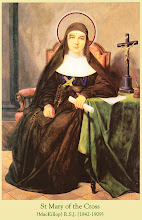
This prayer after receiving Holy Communion is I think quite decent: it is a happy turn of phrase to pray that we be united "under the care of Mary of the Southern Cross" - though I think it would sound less jarring if she were given a title such as Holy Mary or such (else it sound a bit too much as if it were referring to Blessed Mary (MacKillop) of the Cross, Australia's one and only beata) - and most certainly we would hope and pray that our reception of the Sacrament would make us to be one people in Christ.  

However, the issues plaguing these prayers (and their author?) glare forth in the first and last lines.  As I said above, the adjectival genitive when used of the Deity can sound absolutely ridiculous: "God of our joy" indeed!  (At least we are not subjected to "Joyful God" or "God of our happiness and laughter".)  And the theological, or rather ideological mindset that shrinks from Christ "living and reigning" with the Father is manifested by the strange use of "dwells" (the Johannine notion of abiding, no doubt), which is foreign to the Roman tradition: the short ending is by definition qui (tecum) vivit et regnat in sæcula sæculorum.

5.  At least the solemn blessing supplied (vide infra), which I suspect but cannot at this moment prove to come from that collection of Marian Masses (because of the un-Australian spelling of "Savior", if for no other reason), is perfectly orthodox and quite good:

Blessing

May you be filled with the grace of God the Father,
whose Word was conceived in the womb of the Blessed Virgin
to become the Savior of the human race. R/. Amen.

May your hearts rejoice at the salvation won by Christ,
Son of God, and Son of Mary, as he hung upon the cross. R/. Amen.

May the light and grace of the Holy Spirit
that filled Mary of Nazareth remain with you,
that you may await the Coming of Christ
vigilant in prayer and with songs of praise on your lips. R/. Amen.

May almighty God bless you,
the Father, and the Son, + and the Holy Spirit. R/. Amen.

So much for the euchological texts of this local Mass.

6.  The readings are taken from the Common of the Blessed Virgin Mary: they are Apocalypse 11:19 and 12:1-6,10 (in Eastertide: signum magnum apparuit in cælo, alluding to Our Lady and her connexion to the Southern Cross in the starry sky) or Isaiah 9:1-6, which can be construed as having an apposite application, although probably 7:10-14 would have been better; Galatians 4:4-7; and St John 19:25-27 (so at last the Cross, the Virgin's steadfast stance thereat, and Our Lord's gift of His Mother to us get a mention).  The responsorial psalm to be used was not mentioned in the email I received, but is probably the one paired with whichever of the first readings gets used.  

Update: having been able to check a lectionary (tho' annoyingly the page numbers didn't match, and the original references I was given gave only page numbers), and now having had further correspondence to clarify these details, it appears the responsorial psalm used is Ps 44:11-12,14-17 (R/. v. 11).  As for the Gospel Acclamation or Alleluia verse paired with the Gospel reading, it is "Blessed is Mary who stood by the cross of her son, believing that the promises of the Lord would be fulfilled."  (Cf. Jn 19:25; Lk 1:45.)

* The proper is an interim text approved for use by Bishop William Morris for use in the Diocese of Toowoomba.