Showing posts with label Easter Monday. Show all posts

Monday, April 21, 2025

SEDE VACANTE AUC MMDCCLXXVIII

Today, the 2778th anniversary of the foundation of the City of Rome, on Easter Monday, died Pope Francis; of your charity, pray for the repose of his soul:

Deus, qui inter summos Sacerdótes fámulum tuum Francíscum ineffábili tua dispositióne connumerári voluísti: præsta, quǽsumus; ut, qui unigéniti Fílii tui vices in terris gerébat, sanctórum tuórum Pontíficum consórtio perpétuo aggregétur. Per eúmdem Dóminum nostrum Jesum Christum, Fílium tuum, qui tecum vivit et regnat in unitáte Spíritus Sancti, Deus, per ómnia sǽcula sæculórum. Amen. 
(O God, who didst will in thine unspeakable disposition to number thy servant Francis amongst the high Priests: grant, we beg, that he, who ruled as vicar of thy Son on earth, may be aggregated to the fellowship of thy holy Pontiffs. Through the same our Lord Jesus Christ, thy Son, who with thee liveth and reigneth in the unity of the Holy Ghost, God, world without end. Amen.) 

Pray also that Christ the Lord may speedily grant his beloved Bride, the Catholic Church, a worthy Catholic to be his Vicar on earth, that the next Pope may rule wisely and well, for the salvation of souls and the greater glory of God:

Súpplici, Dómine, humilitáte depóscimus: ut sacrosánctæ Románæ Ecclésiæ concédat Pontíficem illum tua imménsa píetas; qui et pio in nos stúdio semper tibi plácitus, et tuo pópulo pro salúbri regímine sit assídue ad glóriam tui nóminis reveréndus. Per Dóminum nostrum Jesum Christum, Fílium tuum, qui tecum vivit et regnat in unitáte Spíritus Sancti, Deus, per ómnia sǽcula sæculórum. Amen. 

(In suppliant humility, O Lord, we pray earnestly, that thy boundless piety may grant to the most holy Roman Church that Pontiff, who may both by pious zeal for us ever be pleasing unto thee, and to the glory of thy name assiduously be respected by thy people on account of his beneficial rule. Through our Lord Jesus Christ, thy Son, who with thee liveth and reigneth in the unity of the Holy Ghost, God, world without end. Amen.)

Thursday, April 28, 2011

Pasquetta

The Italians call Easter Monday Pasquetta, or Little Easter; and it was celebrated beautifully at St Aloysius, with the last Pontifical Mass for the visit of Bishop Meeking from Christchurch. (There was still to come a Pontifical Low Mass on Easter Tuesday, but I attended an earlier Low Mass instead.)  As seems the usual length, Mass, beginning at 10:30am, took an hour and a half, and was followed by a parish picnic in the grounds of Maryvale: a very merry affair, with good wine and good company; some of us remained till after sunset past 6 o'clock.  Being invited for dinner that evening, I went and read the Hours back in church to use the time intervening profitably.  What can I say but that it was a very pleasant meal that followed, a chance to thank and enjoy the converse of priests and laymen, some of whom I hadn't seen for years, some of whom were new acquaintances.  It was midnight before Pasquetta ended for me as I returned to my accommodation for sleep.

Monday, April 13, 2009

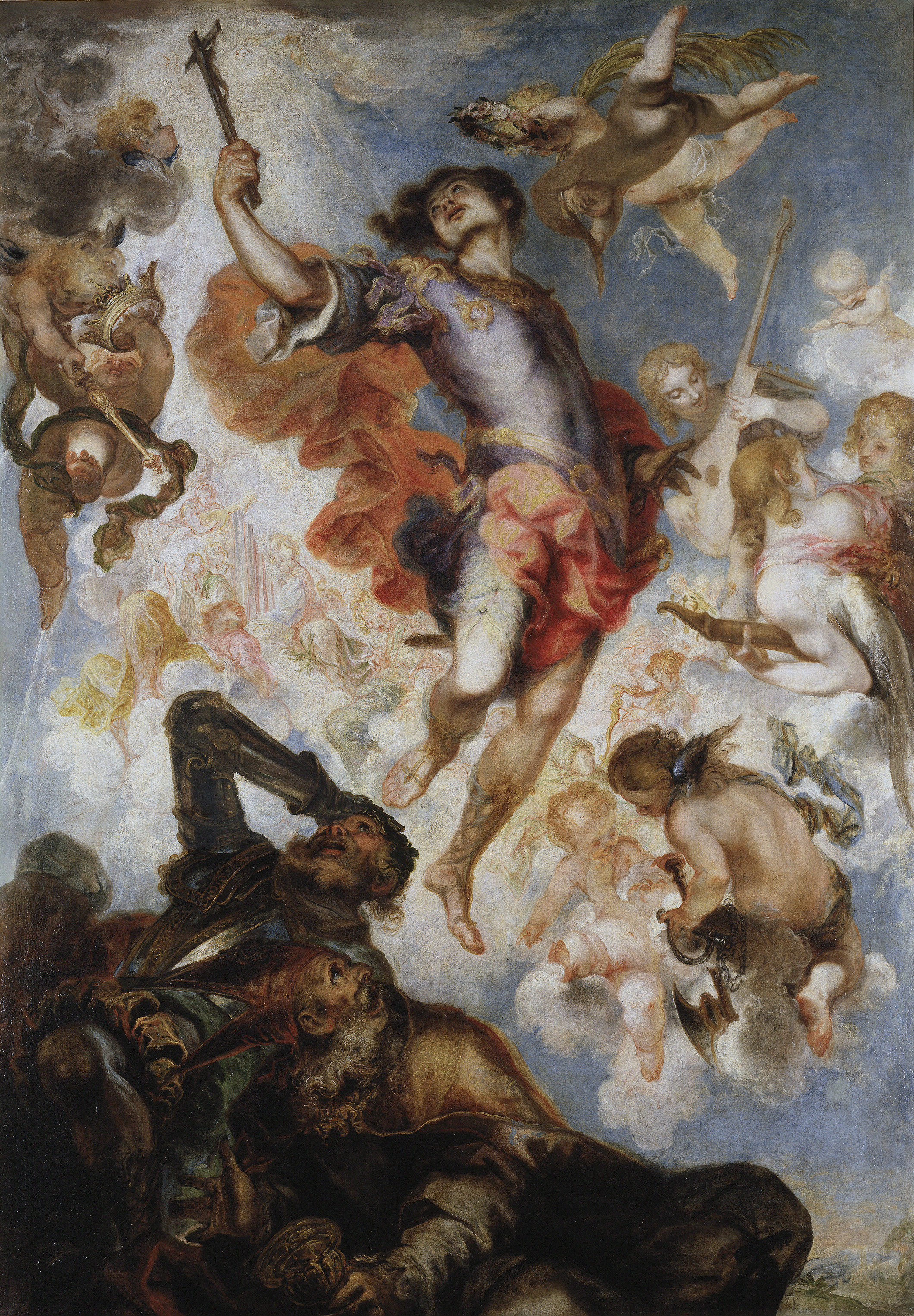
Easter Martyr: St Hermenegild

On the 13th of April 585, after refusing to receive the Easter Communion at the hands of an Arian bishop, the heir to the throne of Spain was murdered on the orders of his father, the King.

It is a classic tale of family feuding, and as in any whodunnit, cherchez la femme!  In this case, there were two ladies involved: the prince's evil step-mother, the unlovely Goiswintha, fomented King Leovigild's anger; the prince's saintly wife, Ingund (or Ingunthis) - daughter of the Frankish King Sisebert I of Austrasia - was a stedfast Catholic despite the attempted suasions of her step-mother-in-law: and she, together with St Leander, Bishop of Seville (whose brother, St Isidore, later succeeded to that same see), had wrought her husband's conversion from the Arian heresy.  For these were the days of Visigothic Spain, when a Teutonic military aristocracy ruled the Romanized Spanish; and the Visigoths, prior to their irruption into the rich provinces of the Roman Empire, had been converted by Arian missionaries, not Catholics.

St Hermenegild's younger brother, Reccared (like him, a child of the King's first wife, Theodosia, who had died), had attempted to reconcile father and son during their previous feuds; but now it was too late.  Hermenegild, reconciled instead to thoughts of winning through to heaven, bowed his neck to the sword. Being slain rather than deny the Faith by sacrilegiously communing with a heretic, he won the crown of the everlasting kingdom, and reigns with Christ evermore.


(Hermenegild, spurning the promise of an earthly crown, triumphantly wins the crown of martyrdom, to the joy of the angels; his father laments, and the Arian bishop cowers away.)

From the truth thy soul to turn,
Pleads a father's voice in vain;
Naught to thee were jewelled crown, 
Earthly pleasure, earthly gain. 

Angry threat and naked sword 
Daunted not thy courage high; 
Choosing glory with the Lord, 
Rather than a present joy. 

Now amidst the Saints in light,
Throned in bliss forevermore; — 
Oh! from thy exalted height, 
Hear the solemn prayer we pour. 

Honor, glory, majesty, 
To the Father and the Son, 
With the Holy Spirit be, 
While eternal ages run. Amen.

(Hymn at Lauds, Nullis te genitor, by Pope Urban VIII.)

King Leovigild died the next year; Hermenegild's younger brother, Reccared, who succeeded as King of Spain, himself became a Catholic in 587, and by May of 589, at the Fourth Council of Toledo, the whole Visigothic nation abjured Arianism, and the great St Leander of Seville preached a famous sermon on "the triumph of the Church at the Conversion of the Goths".  Amazingly, even the Arian clergy converted, and were confirmed in their ministries!  All this, it is piously believed, was obtained by the celestial intercession of the royal martyr, whose glorious merits and suffrages won sweet grace from God.  Truly, Hermenegild was an immense treasure (Ermen Gild), for whose life the Lord paid a rich wergild: the gift of Faith to a whole people.

Pope St Gregory the Great, who was a friend of St Leander, having known him during his exile from Spain prior to his return in triumph, sings the praises of St Hermenegild in his Dialogues (III, 31).  It has been argued that the prince, having rebelled against his father, was no worthy martyr; but as St Gregory of Tours states, whatever his sins, they were blotted out by his suffering and martyrdom, whereas, if he had but accepted the Arian bishop's offer of Holy Communion, he would have been restored to his princely estate and reconciled to the King, yet at the price of abandoning the Catholic Faith: this he would not abandon, as the pearl of great price, and it was for this that he died a true martyr.

As for the martyr's widow and infant son, they had taken refuge in the Byzantine Empire, where they prospered; and his great-grandson returned to Spain to reign as King Erwig (680-687).

Deus, qui beatum Hermenegildum Martyrem tuum, cælesti regno terrenum postponere docuisti: da, quæsumus, nobis; ejus exemplo caduca despicere, atque æterna sectari.  Per...

(God, Who didst teach blessed Hermenegild Thy Martyr to esteem earthly things less than the heavenly kingdom: grant, we beg, unto us, that by his example we may despise things perishable and rather seek after things eternal.  Through...)

[BTW, caducus is a great word: tottering, falling, fallen, frail, vain, perishable...]

Three Sermons

Fr Greg, the visiting Dominican at our local Carmel, has continued his masterly sermon series.  I cannot do them justice in extenso, but can summarize the burthen of his words.  

At the Easter Vigil, he impressed upon us what oft we neglect to note in the Gospel account: that the myrrhbearing women at the Tomb were amazed and terrified, not just by the Angel, but by the news of the Resurrection of Christ - for Easter, while joyous, should also amaze and alarm us.  After all, now that One has risen from the dead, our lives take on a totally different meaning: with eternal life now in prospect, we must needs reorder our affairs to take cognizance of this fact, and this will be no simple or painless task (as the lives of the Apostles, Martyrs, and all Christian Saints illustrates).  

On Easter morning, Fr's homily concerned the deepest truth of this Feast of feasts: that the Resurrection signifies the Father's Yes to Christ, His Yes to His Son's trust in Him, and therefore His Yes to all human hopes for deliverance, for life, for salvation.  Having had such an answer, what sure-founded joy is ours!

To-day, commenting on the Novus Ordo Gospel appointed, about the holy women seeing Our Lord, falling down before Him and clasping His sacred Feet, our preacher pointed out what he had once years before told me in pithy form: that the cure for all doubt and fear is worship and prayer.  (As he had put it, and as I ever remember it and repeat to others and pay heed to it, "If you lose your faith, the last thing you do is stop saying your prayers and stop going to Mass" - for that is precisely when you most need to pray and go to Mass!  True.)  

How do we have hope and trust and faith in Jesus Christ, in His salvation, in Him saving even us?  For we can feel unworthy of God's love - "As if that had anything to do with it," Fr commented forcefully: leaving unsaid what we ought ever recall,  that God's love is gratuitous and unmerited!  Or we may feel - in our Pelagian age - that we have no need of His salvation, which our goodness will deserve of itself, thank you very much, God perforce granting it, as too many suppose.  (O wretched deception and presumptuous heresy!  Salvation is unmeritable!)

We strengthen our faith and win against doubt and fear when we come to worship God at Mass, when we pray, when we contemplate Divine things.  The contemplative life is essential for our souls.  (I suspect the nuns well know the force of this: that's why they are in Carmel, for God's love and to save their souls, yea, and by intercession and example to help save men.)

As always, Fr Greg's homilies are deserving of praise, and I do wish he will one day publish them.  In the meanwhile, I will continue to note what I comprehend of them: but be mindful that "everything is received according to the mode of the receiver" - I do note them do with my emphases, in my language, with my editing, comments, revisions and excisions!  Poor Father...

Tuesday, March 25, 2008

Easter Joy

Today, after Confession, and praying Prime and some of Terce, I served the 12:10pm Mass for Fr Terence; strangely, only about four communicants presented themselves at the rails, but all was explained when I heard that the other two priests had said their Masses at 11am and 11:30 respectively! To prepare the better for his own Mass, Fr Terence had served the previous one. After the Sacrifice, I said the remainder of Terce, and Sext, as my thanksgiving. After lunch with our priests and some others, I finally got to None while in my car in the carwash...

Some Easter treasures from our Holy Mother the Church:

(1) the Paschal Vesper hymn (from Low Sunday onwards) Ad regias Agni dapes -

- which, in its modern recension in the Divine Office is the Ad cenam Agni providi, but, as used by the Dominicans and Benedictines is this Ad cenam Agni providi following, which has about half its verses (marked with the asterisk *) different to that in the modern books, let alone to the version in the Roman Breviary since Urban VIII:

Ad cenam Agni providi
* Et stolis albis candidi,
Post transitum Maris Rubri
Christo canamus principi.

Cujus corpus sanctissimum,
In ara crucis torridum:
*Cruore ejus roseo
*Gustando vivimus Deo.

Protecti Paschæ vespere
A devastante Angelo,
*Erepti de durissimo
*Pharaonis imperio.

Jam Pascha nostrum Christus est,
*Qui immolatus Agnus est:
Sinceritatis azyma
*Caro ejus oblatus est.

*O vere digna hostia,
Per quam fracta sunt tartara,
*Redempta plebs captivata,
*Reddita vitæ præmia!

Consurgit Christus tumulo,
Victor redit de barathro,
Tyrannum trudens vinculo,
*Et reserans paradisum.

*Quæsumus, Auctor omnium,
*In hoc paschali gaudio
*Ab omni mortis impetu
*Tuum defende populum.

*Gloria tibi, Domine,
*Qui surrexisti a mortuis,
*Cum Patre et Sancto Spiritu
In sempiterna sæcula. Amen.


(At the Lamb's high feast we sing
Praise to our victorious King,
Who hath washed us in the tide
Flowing from His pierced side.

(Praise we Him whose love divine
Gives the guests His Blood for wine,
Gives His Body for the feast,
Love the victim, love the priest.

(Where the Paschal blood poured,
Death's dark Angel sheathes his sword;
Israel's hosts triumphant go
Through the wave that drowns the foe.

(Christ, the Lamb whose Blood was shed,
Paschal victim, Paschal bread;
With sincerity and love
Eat we manna from above.

(Mighty Victim from the sky,
Powers of hell beneath Thee lie;
Death is conquered in the fight;
Thou hast brought us life and light.

(Now Thy banner Thou dost wave;
Vanquished Satan and the grave;
Angels join His praise to tell—
See o'erthrown the prince of hell.

(Paschal triumph, Paschal joy,
Only sin can this destroy;
From the death of sin set free,
Souls re-born, dear Lord, in Thee.

(Hymns of glory, songs of praise,
Father, unto Thee we raise;
Risen Lord, all praise to Thee,
Ever with the Spirit be.)


That great Pope, St Pius V, died while reciting the second-last verse: "We beseech Thee, O Author of all, in this [time of] Easter joy, from all motions of death to defend Thy people". I like to use this, and the fifth verse (but in the modern version - "O true, worthy Victim, by Whom Hell was smashed, a captive people redeemed, the prize of life returned!"), as my adoration at the Elevations in Paschaltide:

O vera, digna hostia,
Per quam franguntur tartara,
Captiva plebs redimitur,
Redduntur vitæ præmia!

Quæsumus, Auctor omnium,
In hoc paschali gaudio
Ab omni mortis impetu
Tuum defende populum.


(2) The passage from Colossians iii, 1-4, used as the Epistle at the Mass of the Easter Vigil, the first half of which, down to terram (vv. 1-2) is used at Prime daily:

Fratres:
Si consurrexistis cum Christo: quæ sursum sunt quærite, ubi Christus est in dextera Dei sedens:
quæ sursum sunt sapite, non quæ super terram.
Mortui enim estis, et vita vestra est abscondita cum Christo in Deo.
Cum Christus apparuerit, vita vestra: tunc et vos apparebitis cum ipso in gloria.


Brethren:
If you be risen with Christ, seek the things that are above; where Christ is sitting at the right hand of God:
Mind the things that are above, not the things that are upon the earth.
For you are dead; and your life is hid with Christ in God.
When Christ shall appear, who is your life, then you also shall appear with him in glory.


(3) The collects for Easter Monday and Easter Tuesday:

Deus, qui solemnitate paschali, mundo remedia contulisti: populum tuum, quæsumus, cælesti dono prosequere; ut et perfectam libertatem consequi mereamur, et ad vitam proficiat sempiternam. Per...

(O God, who in the Paschal solemnity hast given a remedy to the world: we beseech Thee, further Thy people by heavenly gift, that they may both deserve to obtain perfect freedom, and profit unto life everlasting. Through...)


- This remedy, this celestial gift, is saving baptism, bestowed at the solemn Paschal vigil, by which alone, set free from sin's slavery, we may be set free in Christ (woe if we fall away! cf. Gal. iv, 31 - v, 1) and attain in Him eternal life -

Deus, qui Ecclesiam tuam novo semper fœtu multiplicas: concede famulis tuis: ut sacramentum vivendo teneant, quod fide perceperunt. Per...

(O God, who dost ever multiply Thy Church with new offspring: grant unto Thy servants, that they may keep hold of for living the sacrament, which by faith they received. Through...)


- The Sacraments, including Baptism, are sacraments of faith, for without faith they profit us not; and likewise, if the sacraments not be relied on and kept hold of that we may live by their grace, they are likewise profitless and serve only to merit us punishments for our falling away and abandonment of them, as we run heedlessly from life into death.

(4) The marvellous Easter Preface:

Vere dignum et justum est, æquum et salutare, te quidem, Domine, omni tempore, sed in hoc potissimum die (vel in hoc potissimum) gloriosus prædicare, cum Pascha nostra immolatus est Christus. Ipse enim verus est agnus, qui abstulit peccata mundi; qui mortem nostram moriendo destruxit, et vitam resurgendo reparavit. Et ideo cum angelis et archangelis, cum thronis et dominationibus, cumque omni militia cælestis exercitus, hymnum gloriæ tuæ canimus, sine fine dicentes: Sanctus...

(It is truly meet and just, right and salutary, to praise Thee, O Lord, at all times, but more especially on this day [or at this time] when Christ out Pasch was sacrificed [cf. I Cor. v, 7]. For he is the true lamb that hath taken away the sins of the world [cf. St John i, 29]; who by dying destroyed our death, and by rising again hath restored our life. And therefore with angels and archangels, with thrones and dominations, and with all the heavenly host, we sing a hymn to Thy glory, saying without ceasing: Holy...)