Showing posts with label Fratres Oratorii. Show all posts

Monday, July 19, 2010

Significant Psalm Verses

I particularly like the psalms read on Monday in the Breviary.

(Yes, there are those who would refer with disdain to this arrangement of the psalmody as a sad excess of St Pius X's glorious reign, and regard as truly holy and Roman the pre-1912, immemorial arrangement alone...  There are also those who prefer the post-Conciliar four-week arrangement of the psalter; and of course the Anglican 30-day cycle is already, via the Anglican Use Book of Divine Worship, part of the Patrimony that Anglicanorum cœtibus recognizes as valuable for the wider Church.)

Monday features the following psalmody during the Day Hours: Pss 46 (including the famous words Psallite sapienter), 5, 28 and 116 at Lauds, pleasingly short; Pss 23 and 18 at Prime (both most suitable); Pss 26 and 27 at Terce; Ps 30 at Sext; Pss 31 and 32 at None; Pss 114, 115, 119, 120 and 121 at Vespers; and Pss 6 and 7 at Compline.

(I must say, though, I don't at all like having variable psalms at Compline: it was a bad mistake not to retain Pss 4, 30:1-6, 90 and 133 for Compline every day, and to that extent at least I agree with the many scholars and learned men who criticised the weekly redistribution of the psalms in the Divine Office made by order of Pope St Pius X.)

Here are some of the particular verses that struck me to-day...
  • mentita est iniquitas sibi - "inquity hath lied to herself" (Ps 26:12b)
How true it is: "O what a tangled web we weave / When first we study to deceive" – everyone likes to rationalize away one's sins, and indeed all who fall a prey to sin are to that extent deceived and deceiving.  Only God the Lord, all-pure, all-holy, can neither deceive nor be deceived: "Truth Himself speaks truly / Or there's nothing true" as wise Aquinas wrote.
  • Et refloruit caro mea... And my flesh flourished again... (Ps 27:7b)
What a wonderful thought: as it says somewhere, Their bones shall flourish as the grass...  God is good to His people.

These two verses following are always highlights of the Little Hours for me: they match up very well with the little chapter read at Compline in the Ambrosian Rite (see below), which I adopted – do any devotees remember? – for the Fratres Oratorii, that little essay at attempting something along the lines of the Oratorian spirit of prayer and meditation, while I was in Perth.
Expecta Dominum, viriliter age: et confortetur cor tuum, et sustine Dominum.  (Ps 26:14)
Expect the Lord, do manfully: and let thy heart be strengthened, and wait for the Lord.
(Last verse of the second portion of the psalmody at Terce on Mondays.)
Viriliter agite, et confortetur cor vestrum, omnes, qui speratis in Domino.  (Ps 30:25)
Do manfully, and let your heart be strengthened, all who hope in the Lord.
(Last verse of the psalmody at Sext on Mondays.)

Compare this with the "Epistolella" at Compline in the Ambrosian Rite:
Fratres: Vigilate, orate, state in fide: viriliter agite et confortamini in Domino: et omnia vestra in caritate faciant.  (Cf. I Cor. xvi, 13. 14.)
Brothers: Keep watch, pray, stand firm in the faith: act manfully and be strengthened in the Lord: and let all your works be done in charity.  
A programme indeed for Christian living...

Tuesday, December 9, 2008

Holy Hour, Mass, and Dinner

The Brethren of the Oratory met for their devotions this evening, followed by sung Mass of the Immaculate Conception.  For a change, yours truly was one of the acolytes (along with Aaron; Peter was M.C. and Troy, thurifer - all adults), which meant I had a good spot in the sanctuary - though my knees were aching, and by Communion time all I could do was accept this as penance, looking at the Corpus on the altar Crucifix and thanking Our Lord for suffering so much more...

******

We again had a visiting priest celebrate Mass for us, although Fr Rowe preached the sermon (he had said the lunchtime Low Mass, and ran both Holy Hours).   His theme was that just over 150 years ago this happy dogma of the Immaculate Conception was decreed, for the glory of Our Lady, the rebuke of the world, and the strengthening of cowardly Catholics.  

The Blessed Virgin's glories all redound to her Son, on Whose account she is the Immaculate Conception - for the Trinity could not ally Itself to aught of sin; the Word could not take flesh in a sin-stained womb, nor could He Who was to deliver us from Satan's bondage take manhood from a fallen woman; the angels could not hail as their Queen one who was not as unstained as they are, nor could she assume the rank once held by Lucifer if she had ever been under his fell dominion.  

The smugly ignorant misbelieving world, scoffing at holy things, things that could alone save it from utter destruction if only it knew, must needs be boldly faced with the truth that all generations had held inchoately by calling her blessed, calling her the Panagia, the All-Holy, the sinless Virgin.  

The quailing Catholic, uncertain and afraid, must be given strength to stand firm in the fight against the enemies of our most holy Faith, and given the banner of her who is like to the morning rising, fair as the moon, beautiful as the sun, splendid as an army in battle array: and the cry of victory must be, 

O Mary conceived without sin, 
pray for us who have recourse to thee.  

Far from making her more distant from or distainful of us poor sinstained men, her freedom from sin makes Our Lady yet more cognizant of its great sadness, and of the depth of our need to be won from it, that we may be made holy and perfect in love, for this is the will of God - our sanctification.  She delights to hear her children's cries for help, and with her puissant humility she finds in the Lord a ready ear and an all-embracing Divine charity that rains down saving graces upon our dry and weary earth.  As the Memorare reminds us, no one who has sought her patronage has ever been left unaided.

******

While I was in the sanctuary, Andrew, Greg, and Fadi sang the chant: we had Mass IX (cum jubilo) - whose Sanctus and Agnus Dei are very familiar to me from their use at the Launceston Carmel - and Credo I, plus the Gregorian Propers, which are good to hear.  I was glad to join in the singing of the Ordinary at least!  A little bit of organ sounded, the Communion was sung with the Magnificat, and at the end of the liturgy we processed out to "Mary Immaculate, star of the morning", that fine hymn, sung to "Liebster Immanuel":

Mary Immaculate, star of the morning,
Chosen before the creation began,
Chosen to bring, for thy bridal adorning,
Woe to the serpent and rescue to man.

Here, in an orbit of shadow and sadness,
Veiling thy splendour, thy course thou hast run;
Now thou art throned in all glory and gladness,
Crowned by the hand of thy Saviour and Son.

Sinners, we worship thy sinless perfection;
Fallen and weak for thy pity we plead;
Grant us the shield of thy sovereign protection,
Measure thine aid by the depth of our need.

Frail is our nature, and strict our probation,
watchful the foe that would lure us to wrong;
succour our souls in the hour of temptation,
Mary Immaculate, tender and strong.

See how the wiles of the serpent assail us,
see how we waver and flinch in the fight;
let thine immaculate merit avail us,
make of our weakness a proof of thy might.

Bend from thy throne at the voice of our crying,
Bend to this earth which thy footsteps have trod;
Stretch out thine arms to us, living and dying,
Mary Immaculate, Mother of God.

After packing up, there was just time for Vespers in thanksgiving.

******

Fr Rowe had his fellow priest and six of us (various of the servers and singers) to dinner, which was a prodigious affair; since it was Our Lady's feast, and in consideration of the other priest present, we had Leffe beer and a large bottle of Chimay as well.

An amazing thing to see this evening: I was shewn an Agnus Dei (that sacramental consisting of a waxen medallion) blessed by Pope Benedict XIII, in 1725!  It stonkered me to think that this seemingly fragile item has survived for nearly three hundred years, and was made and prayed over in Rome before Australia ever was.

Of your charity, please pray for priests: they need our prayers, their ministry is a high and graced calling, but also very much a straiter road and one bestrewn with crosses.

℣ Sacerdotes tui induantur justitiam.
℟ Et sancti tui exsultent.

Sunday, December 7, 2008

Fratres Oratorii - Sessio VIII

To-morrow, being Monday the 8th of December, the Feast of the Immaculate Conception, there will be two Masses at the Pro., each preceded by a Holy Hour: the Hour of Grace starting at 12 noon, followed by Low Mass at 1.10 pm; and Brethren of the Oratory at 5.30 pm, followed by Sung Mass at 6.30pm.  Fr will be busy...

This will be Sessio VIII of the Fratres Oratorii, our more-or-less monthly assembly for prayer after the model of our patron, St Philip Neri; given the day's solemnity, we will have Solemn Exposition (in the monstrance), and will sing the Litanies of our Lady, as well as her Advent anthem Alma Redemptoris Mater.  Our time of prayer will fall close to the first anniversary of the Brethren of the Oratory, which began on the 20th of November last year.

After the Missa cantata, some of us who are willing will go off for dinner at a certain Thai restaurant, which should be a pleasant way to celebrate Our Lady's feast indeed!

A Little Lectio

Terra advises us to begin Lectio divina by turning to the texts of the liturgy, and committing them to memory.  Perhaps I'll commit something to writing, then, at the least...

On this Sunday of Advent, as happens in the Office, the capituli ("little chapters") for use at the Hours are taken from to-day's magnificent Epistle, itself an extract from Romans xv, 4-13.  How appropriate, then, to take up these texts from the first and most celebrated writing of the Apostle, during this Year of St Paul!

******

1.  The first capitulum, which the liturgy highlights given its use at both Vespers, at Lauds and at Terce (which is meant to be celebrated directly before the High Mass), is the striking beginning of the pericope, Romans xv, 4:

Fratres: Quæcumque scripta sunt, ad nostram doctrinam scripta sunt: ut per patientiam,  et consolationem Scripturarum spem habeamus.

(Brethren: Whatsoever was written, for our doctrine was written: that through patience, and the consolation of the Scriptures we may have hope.)
There are some nice plays on words here: Jerome thrice uses derivatives of scribere, to write: I could have rendered "Scriptures" as "(Holy) Writ" above to make this clearer.  "Whatsoever", in other words, everything, all that has been written - in the Old Testament, that is, as the New was still in process of writing and had not yet been recognized by the Church; St Paul goes on to quote several passages from the Psalms and Isaias in succeeding verses - has been written down, not frivolously, but as teaching for us to learn (doctrina, "doctrine", comes from docere, to teach): and why?  That "...through the consolation of (Holy) Writ we may have hope". 

What is consolatio?  It is the noun derived from the deponent consolari, to comfort together (cum + solari); one could say, to sympathize or empathize, to suffer with, and in this case its meaning is better captured by noting the intervening word patientia (< pati, to suffer, to endure): the implication is, we as Christians must needs endure much, whether the sacrifices, sadnesses and difficulties of life common to all men, or the special sufferings (estrangement from friends, maltreatment by an unbelieving and hostile world, even martyrdom) proper to those who follow a Crucified Saviour.  The Scriptures, the "things written", teach us that "all who seek to lead a godly and pious life in Christ Jesus shall suffer persecution" (II Tim. iii, 12), by holding up before us holy Job of old, indeed, all the righteous and prophets who endured much down the ages:

Take, brethren, as an example of labour and patience, the prophets who spoke in the name of the Lord.  Behold, we call them blessed who have endured.  You have heard of the patience of Job...
(Jas v, 10f)

Lest, devastated by our miseries, we utterly despair, we are reminded that we can have hope, a twofold trust: one in the reward attached to perseverance in suffering, like Job stedfast on the dunghill, awaiting the salvation of God; the other, that engendered by the Word of God, making plain us how those who weep and mourn in this world shall be comforted in the coming Kingdom of God (St Matt. v, 5; and cf. all the Beatitudes).

The Anglicans long ago derived a splendid collect from this sentence of Scripture, which they read on this day:

Blessed Lord, who hast caused all holy Scriptures to be written for our learning; Grant that we may in such wise hear them, read, mark, learn, and inwardly digest them, that by patience and comfort of thy holy Word, we may embrace, and ever hold fast, the blessed hope of everlasting life, which thou hast given us in our Saviour Jesus Christ.  Amen.

Amen indeed!

******

2.  At Sext, the capitulum is taken from Romans xv, 5-6:

(And may the God of patience, and of solace, give unto ye to think the same towards one another, according to Jesus Christ: that with one soul with one mouth ye may honour God, and the Father of Our Lord Jesus Christ.)

God is the God of patience, He desires us to practise it, just as He is ever-patient with us; moreover, He is the God of solace also, of consolation (both deriving from solari, noted above), in that He gives us the strength to suffer and endure all things.  

But here St Paul prays a blessing on us, that this long-suffering and consoling Deity have us regard each other with the same thoughts, literally to savour (sapere) the same things - which is to say in better English, to be of the same mind.  And in what manner?  After the pattern of Christ, of course: there can be no other fitting way.  And thus to think - why?  That being of one mind, we may as with one mouth together glorify God, the Father of Christ.  For our chief end is to adore the Lord: "Ye shall [worship] the Lord on this mountain" (cf. Exodus iii, 12).  Is not our blessed destiny to know, love and serve God, and be happy with Him forever in heaven, ever worshipping before the throne of God and of the Lamb?  This praise will then be perfect and united; so let us practise here what shall occupy us hereafter, lest, unfitted for common praise, we seek our proper place - which would not then be in heaven!

Again, I'm reminded of an Anglican Collect, this time, "A Prayer for Unity", used on the Anniversary of the Accession of The Queen:

O God the Father of our Lord Jesus Christ, our only Saviour, the Prince of Peace: Give us grace seriously to lay to heart the great dangers we are in by our unhappy divisions. Take away all hatred and prejudice, and whatsoever else may hinder us from godly union and concord: that, as there is but one Body, and one Spirit, and one hope of our calling, one Lord, one faith, one baptism, one God and Father of us all; so we may henceforth be all of one heart, and of one soul, united in one holy bond of truth and peace, of faith and charity, and with one mind and one mouth glorify thee; through Jesus Christ our Lord. Amen.

Ut unum sint!

******

3.  Finally, at None (which I haven't prayed yet), the capitulum comes from the very end of the longer passage read at Mass: it is the parting blessing of the Apostle, as it were, from Romans xv, 13:

Deus autem spei repleat vos cum omni gaudio et pace in credendo: ut abundetis in spe, et in virtute Spiritus Sancti.

(And may the God of hope fill ye with all joy and peace in believing: that ye may abound in hope, and in the power of the Holy Ghost.)

This is a passage dear to me, since I associate it with St Philip Neri, that animate instrument of the Third Person of the Trinity, who was such a model of "all joy and peace in believing", who did indeed abound both in hope and in power, power to convert souls, and to that end even to work wonders.  

To-morrow afternoon we will meet together in the society of the Brethren of the Oratory, and I feel that among my other contemplations I may well turn to this text, to feed upon its promise - for surely St Paul, St Philip, and all the Saints together, with the peerless Immaculate Virgin, do impetrate God continually on our behalf for this exceeding precious grace and favour?  

Without it we would have no peace, no joy; but if what we know of sacred doctrine does impart to us hope and trust in God, surely we ought be running over with gladness and delight, with measureless longing for the Lord, and be strengthened with the power of His might, to the end that we may be saved.

Tuesday, November 11, 2008

Fratres Oratorii & Mass of St Andrew Avellino

Sessio VII of the Brethren of the Oratory went off well; we began with simple Exposition and then sang the Litanies of the Saints; during the time of quiet prayer before the Blessed Sacrament exposed in the ciborium, our confessarius, Fr Rowe, heard a number of confessions (including my own) after the model of good St Philip, after leading us in the 6pm Angelus; and we concluded with simple Benediction, the Salve, and Newman's hymn to St Philip.

I thought on a number of themes during the time of prayer, mainly suggested by the words of the prayers and hymns we were using; in particular, I was led to contemplate two points.  First, that pregnant verse of Wednesday Terce, Jacta super Dominum curam tuam, et ipse te enutriet; non dabit in æternum fluctuationem justo (Ps 54:23) - though I feel so let down by my selfish will, so apt to do disservice to my soul, I must ever run to God, ever repent, "cast my care upon the Lord", for He is the One who shall nourish me, and He will not give me to waver for ever.  

This is my trust in Him, who in baptism justified me, who in confession again and again reclaims and cleanses me: He has all my life long been kind to me, He has always lifted me up, I trust that in the future He shall remain always faithful, and that He will bring my tangled affairs to a happy conclusion.  It is in truth a great blessing not to be ever in this world, ever at risk, ever fluctuating between sinfulness and holiness; at length we shall be withdrawn from this dark vale, to flounder no more.  Since we shall fixed forever in the state in which we quit it, our care must be so to live now that we be found ready when the Master returns.  

I now recall that this is what my friend Herr Schütz has considered from a different angle, commenting upon Luther's dictum simul peccator et justus; as was observed long ago at the time of its issuance, this statement has both an orthodox and an heretical interpretation, and the Catholic view to be taken of it is best expressed by adding to it the words semper pænitens: so long as we are in this world, though justified by God first of all by holy baptism, and by all the consequent graces we receive (as in holy confession), we all of us fall into sins, and so must be ever penitent: as Augustine wrote against Pelagius, with St John all the just cry, "If we say that we have no sin, we deceive ourselves, and the truth is not in us" (I John i, 8); and so we must pray every day, "Forgive us our trespasses".

The second point that struck me - an illumination - was this, that our entire devotion to God the Holy Ghost is hidden in plain sight, for we are called and please God are Christians, and what is a christian, nay, what is Christ, but "an anointed": anointed not with earthy oil, but with the Holy Ghost.  We are His temples; pray God we not grieve Him and drive Him away by sin, but may He ever dwell within us.  (As an aside, some pious works speak of Him "nesting" in our souls, but is that an acceptable expression?  It seems somehow belittling and overly sentimental.)

******

Low Mass of St Andrew Avellino, on this, the very quadricentennial of his death on the 10th of November 1608, with commemoration of SS Tryphon, Respicius and Nympha, followed our Holy Hour.  (While there was no sermon, we did end with a hymn in honour of Christ the King: "Christ our Lord the Prince of ages".)

SS Tryphon and Respicius are holy martyrs of the Decian persecution; though tried by every exquisite torment that a perverted magistracy could devise, they kept faith with Christ and now reign with Him in exceeding great glory, manifested in the wide extension of their cult, marked out by so many miracles.  With them in glory we also celebrate St Nympha, virgin (and martyr) of Palermo, who came to be associated with them because her body was translated to their church in Rome; however, that church having fallen into ruin by 1604, the relics of all three were later brought elsewhere, as to the great hospital of the Holy Ghost in Saxia.  


As for St Andrew Avellino, that ornament of the strict Theatine clerks regular, from being an ecclesiastical lawyer, upon feeling the awful horror of telling a slight untruth in his avocation, he turned to seeking God alone, and took two most strict and fearsome vows, ones never to be made but by special divine inspiration, with prudent counsel and in a state of advanced holiness, viz. to ever annihilate his own will, and to seek with utmost strength to ever do that which is most perfect.  This twofold holocaust of himself he accomplished, as his Collect reminds us - for we must all of us seek perfection; God calls us to be saints, and assuredly only by becoming such shall we enter heaven, achieving our true apotheosis in that apex of glory:

Deus, qui in corde beati Andreæ Confessoris tui, per arduum quotidie in virtutibus proficiendi votum, admirabiles ad te ascensiones disposuisti: concede nobis ipsius meritis et intercessione ita ejusdem gratiæ participes fieri, ut, perfectiora semper exsequentes, ad gloriæ tuæ fastigium feliciter perducamur.  Per...

(God, Who in the heart of blessed Andrew Thy Confessor, by his arduous vow of daily increasing in virtues, didst direct [his] wondrous advancements upwards to Thee: grant unto us by his very merits and intercession so to be made sharers of the same grace, that, ever following after things more perfect, to the summit of Thy glory we may happily be brought.  Through...)

******

After Mass (and Vespers read privately in thanksgiving), a number of the brethren joined Fr for dinner, as a fitting end to our celebrations.

******

Sessio VIII of the Fratres Oratorii will be held at 5.30 pm on Monday the 8th of December, the Feast of the Immaculate Conception, with most likely sung Mass afterward.  (Given the day's solemnity, we will have Solemn Exposition, and will sing the Litanies of our Lady, as well as the Advent Marian anthem Alma Redemptoris Mater.)  This will mark the first anniversary of the Brethren of the Oratory, who first gathered for devotions on the 20th of November last year.

Sunday, November 9, 2008

Fratres Oratorii - Sessio VII

A reminder for to-morrow: Sessio VII of the Fratres Oratorii will be held at the Pro. on Monday the 10th of November at 5.30pm, to be followed by Low Mass at 6.30pm.

As is our custom, there will be exposition of the Blessed Sacrament (simple, in the ciborium), followed by the singing of the Litanies of the Saints, then silent prayer, to conclude with Benediction.

After Low Mass and thanksgiving, the fratres will join Fr Rowe for dinner and conversation.

Monday, October 20, 2008

Advance Warning: Fratres Oratorii - 10th November

Sessio VII of the Fratres Oratorii will be held at the Pro. on Monday the 10th of November at 5.30pm, to be followed by Low Mass at 6.30pm.

As is our custom, there will be exposition of the Blessed Sacrament (simple, in the ciborium), followed by the singing of the Litanies of the Saints, then silent prayer, to conclude with Benediction.

Sunday, June 22, 2008

Sunday Low Mass; Alert: Fratres Oratorii, Sessio VI

A great start to the day - a good sleep in, since I wasn't needed to sing at Mass!

I don't normally like missing the sung liturgy on Sunday, but once in a while it's okay, I find, and it was nice to attend the 11.15 am Low Mass.

Here is the glorious collect of the day, the 6th after Pentecost:

Deus virtútum, cujus est totum quod est óptimum: ínsere pectóribus nostris amórem tui nóminis,et præsta in nobis religiónis augmentum: ut quæ sunt bona, nútrias, ac pietátis stúdio, quæ sunt nutrita, custódias. Per...

Here is its Cranmerian version, infinitely better than any ICEL version of course:

LORD of all power and might, who art the author and giver of all good things; Graft in our hearts the love of thy Name, increase in us true religion, nourish us with all goodness, and of thy great mercy keep us in the same; through Jesus Christ our Lord. Amen.

Since Fr Rowe has headed off after lunch to Bunbury on his monthly supply there, we will have a Monday evening Mass this week, which I can attend after work.

Better still, on Tuesday, being the feast of St John the Baptist, there will be a second evening Mass (at 6.30 pm), and before it, at 5.30 pm, we will have Sessio VI of the on-again, off-again Brothers of the Oratory:

  • Solemn Exposition (as more congruent to the solemnity of the day)
  • Litanies of the Saints (invoking all the saints and angels, among them the great Precursor)
  • Half-an-hour of mental prayer
  • Solemn Benediction
  • Salve Regina
  • Hymn to St Philip

Monday, May 26, 2008

Rachmaninoff Vespers

We sang Mass of the 2nd Sunday after Pentecost as usual this morning, supplemented with a Procession in honour of the Blessed Sacrament at its end. In the afternoon - after getting the booklets ready for the Brothers of the Oratory tomorrow - I went with Fr Rowe, Rosemary and Peter to hear the Perth Collegium sing Rachmaninoff's Vespers (a.k.a. All-Night Vigil). Our mate Justin had a starring role thrust upon him, for at the last moment one of the other soloists was taken ill and Justin had to sing the other man's part as well as his own. The music was stunning, and the choir, not to mention Justin, acquitted themselves with aplomb. Afterward, we went out for Chinese (at the nearby Jade Flowers Chinese Restaurant, in Cambridge St, Wembley - I recommend it), together with and followed by some drinks and suchlike, and much good conversation. I even read the assembled brethren Dom Alban Butler's account of the death of St Philip Neri, to prepare us for tomorrow's feast, which ended with these stirring words:

St. Philip, inflamed with the love of God and a desire of praising him worthily, after offering him all the affections of his soul, and the homages of all his creatures, seeing in their poverty and inability nothing equal to his infinite greatness, comforted himself in finding in the Mass a means of glorifying him by a victim worthy of himself. This he offered to him with inexpressible joy, devotion, and humility, to praise and honor his holy name, to be a sacrifice of perfect thanksgiving for his infinite benefits, of expiation for sin, and of impetration to obtain all graces. Hence in this sacrifice he satiated the ardent desires of his zeal, and found such an excess of overflowing love and sweetness in the closest union of his soul with his divine Redeemer.

(from Vol. V of The Lives or the Fathers, Martyrs and Other Principal Saints by the Rev. Alban Butler, the 1864 edition published by D. & J. Sadlier, & Company)


To celebrate the day, I plan to read the Oratorians' 1st class Office of their Founder, kindly provided by one of their number. The Holy Hour for the Brethren of the Oratory (with Simple Exposition, Litany of St Philip, a half-hour of meditation, and Benediction to finish) will start at 5.30pm, to be followed by sung Mass at 6.30pm, and a gaudeamus afterward. Justin and I will sing the Propers, together with Mass V (Kyrie magnæ Deus potentiæ), the Veni Creator at offertory, Pange lingua at communion, and "Rejoice the Lord is King" for a recessional.

Thursday, April 24, 2008

Fratres Oratorii - Sessio IV

Prayer and adoration, followed up with fellowship and good cheer: after filling the Pro. with clouds of incense, and all persevering in mental and vocal prayer, some of the fratres - Fr Rowe, Justin, Pete and I - were able to catch up afterward for a rather good Thai meal with beer and wine, concluded with conversation (and some homemade Limoncello, plus tea and sweets) at the presbytery.

I realized in my prayer truths that I have neglected: that faith - that infused intellectual supernatural theological virtue - is so potent and divine as to unite us to God, that we live already foretasting heaven on earth if God be in our soul, and that the one thing necessary is to aspire toward union with God in foretaste of our union with Him forever in heaven. I must not cease to nourish my soul by mental prayer, else my spiritual life die of inanition.

And as a completely unexpected bonus, Justin called me over to the organ as we packed up after the hour of prayer, and played and got me to sing along with a Wesley hymn that is quite Catholic and evangelical in the best sense: "And can it be that I should gain / an interest in the Saviour's Blood?". What a pity Wesley didn't find his way to the Church; he would have then been most perfectly the Newman of his age. I for one find his hymns both orthodox and potent.

Casting my mind back over previous sessiones, I record the following hours spent in prayer:

* Sessio I - 6.30pm, Tuesday 20th November 2007;

* Sessio II - 6.30pm, Monday 10th December 2007;

* Sessio III - 6.30pm, Tuesday 29th January 2008;

* Sessio IV - 6.30pm, Wednesday 23rd April 2008.

Our next planned sessio, the fifth, is for the Feast of Our Patron, St Philip Neri, on Monday the 26th of May 2008: the hour of mental and vocal prayer will be held a hour earlier, at 5.30pm, to allow for sung Mass of St Philip at 6.30pm.

Once we complete the move to St Anne's, perhaps we can make the Oratory a more than monthly devotion...

Wednesday, April 23, 2008

Six Candles for St George

I thought I was going to be late for Mass, but arrived instead just before Fr gave Benediction; the sanctuary looked suitably mysterious, with twenty candles ablaze. Since George (happy feast day, mate!) had served the Holy Hour thus concluded, Fr Rowe popped out after the end thereof to ask if I would serve his Low Mass, and I gladly assented, quickly getting vested and putting out my hand missal on the gospel side of the footpace just before Mass...

That hand missal nearly occasioned a disaster; after giving me Holy Communion, Fr nearly tripped on it (now at the epistle side) when descending to the altar rails with the ciborium. However, he didn't seem worried afterward.

Why were the big six all alight? Well, since electrical work is going on in the school buildings next door, we had no power today, and Fr had George leave the altar candles alight, after snuffing out and removing the Exposition candelabrae, so as to be able to see! (It has been a rainy, cloudy morning.)

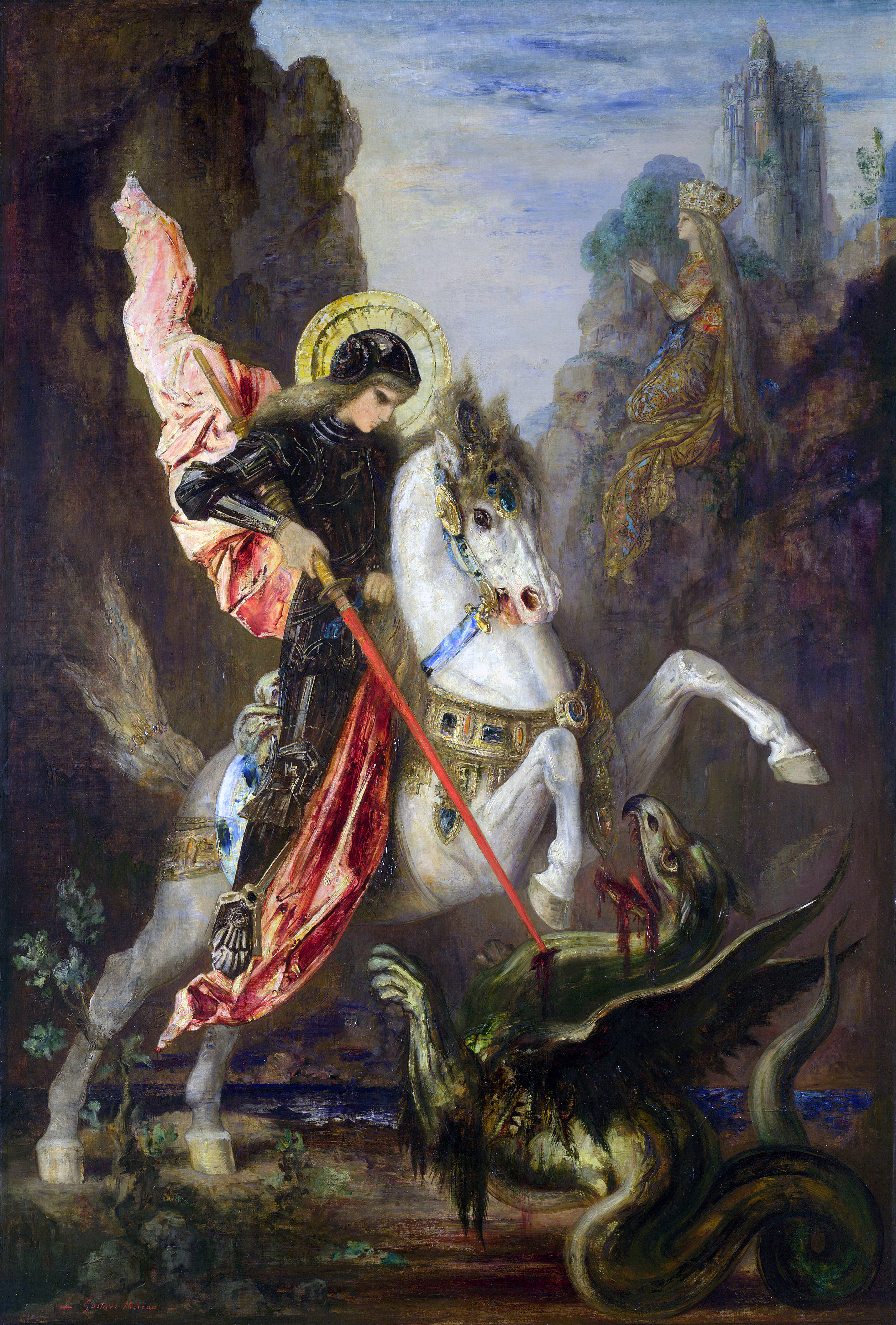
Why St George and the dragon? The tale as told is pretty obviously that of Perseus and Andromeda in Christian dress. But of course the iconography is symbolic: George, the military man who was martyred for Christ, fights the good fight of the Faith, and by the weapons of truth and grace, bearing the shield and armour and helmet of faith and purity, truly defeats sin, Satan, death and hell (who are the real actors behind the cruel Roman persecutor, their minion) and thus rescues the beautiful woman who is an image of the Bride of Christ, whether as the Church or as every Christian soul, that she may have eternal life with Christ Our Lord in heaven. He rides upon a white horse, just as does his Master, the Victorious Conqueror, the King of Kings and Lord of Lords, Who is called Faithful and True. It is another example of a true myth, which retells in allegory what really transpired when, in the eyes of the scoffing world, a fool died in torment for not obeying Caesar when the ruler of this world demanded obedience to 'the way things are' (which to the believer in Truth would have meant apostasy and idolatry). The legend thus compares to the similar tale of St Patrick casting out the snakes from Ireland, which obviously signifies his driving off that isle all pagan idolatry and wickedness.

Here are the collects from the 1962 and the 1969 Missals:

Deus, qui nos beati Georgii Martyris tui meritis et intercessione laetificas: concede propitius; ut, qui tua per eum beneficia poscimus, dono tuae gratiae consequamur. Per...

(O God, Who dost rejoice us by the merits and intercession of blessed George Thy Martyr, be pleased to grant that, as we implore through him Thy benefits, so we may follow [after him] by the gift of Thy grace. Through...)

Magnificantes, Domine, potentiam tuam, supplices exoramus, ut, sicut beatus Georgius dominicae fuit passionis imitator, ita sit fragilitatis nostrae promputs adjutor. Per...

(Magnifying, Lord, Thy power, bowing down we humbly pray that, as blessed George was made an imitator of the Lord's Passion, so he may be a prompt helper of our frailty. Through...)

The late Marquess of Bute, in a footnote to his translation of the Breviary, says: "This saint is one of the most popular in Christendom, but who he was, and indeed everything about him, except the fact of martyrdom, is enveloped in the greatest obscurity. The labours of the Bollandists tend to show that he was a soldier by profession, and that he is a martyr (otherwise anonymous) who was tortured to death for pulling down the edict of Diocletian against Christianity, at Nicomedia, in A.D. 303. He seems, says Alban Butler, to have been arrested on Good Friday, (April 16,) and after having been tortured for eight days, to have received his crown on the Friday following, April 23. He was the first victim of Diocletian's persecution."

My best wishes to all English Catholics on this 1st class feast/solemnity! I will not cry, however, without some pain, "God for England, Harry and St George!" - for yesterday was the lamented anniversary of the day when, in 1509, bad King Henry VIII ascended the throne of his Catholic forefathers, and soon enough brought heresy, schism and persecution into the realm once styled Our Lady's dowry.

Here's a nice apposite hymn, from that fine Anglo-Catholic production, The English Hymnal:

Lord God of Hosts, within Whose hand
Dominion rests on sea and land,
Before Whose word of life or death
The strength of nations is but breath:
O King, enthroned all thrones above,
Give strength unto the land we love.

Thou Breath of Life since time began,
Breathing upon the lips of man,
Hast taught each kindred race to raise
United word to sound Thy praise:
So, in this land, join, we beseech,
All hearts and lips in single speech.

To George our saint Thou gavest grace
Without one fear all foes to face,
And to confess by faithful death
That Word of Life which was his breath.
O help us, Helper of Saint George,
To fear not bonds that man can forge.

Arm us like him, who in Thy trust
Beat down the dragon in the dust;
So that we too may tread down sin
And with Thy saints a crown may win.
Help us, O God, that we may be
A land acceptable to Thee.

The Divine Office, in its Supplement for England and Wales, includes this hymn:

Leader now on earth no longer,
Soldier of th'eternal King,
Victor in the fight for heaven,
We thy loving praises sing.
Great Saint George, our patron, help us,
In the conflict be thou nigh;
Help us in that daily battle,
Where each one must win or die.

Praise him who in deadly battle
Never shrank from foeman's sword,
Proof against all earthly weapon,
Gave his life for Christ the Lord.
Great Saint George...

Who, when earthly war was over,
Fought, but not for earth's renown;
Fought, and won a nobler glory
Won the martyr's purple crown.
Great Saint George...

After Mass we repaired to the strangely named "Magic Apple" for morning tea cum early lunch. In about an hour I'm going to the bloodbank to make a donation.

And, of course, tonight is the April assembly of the Fratres Oratorii, founded late last year; this is only our fourth session, unfortunately, but hopefully we can be more regular in the future...

Tuesday, April 22, 2008

Brothers of the Oratory

Come all who seek to pray - the Brothers of the Oratory will meet tomorrow evening, on St George's Day, Wednesday the 23rd of April, at St John's Pro-Cathedral, Perth, from 6.30 to 7.30 pm.

We commence, as is our wont, with Exposition of Our Lord in the Blessed Sacrament. Next, we sing the Litanies of the Saints, to unite ourselves with all the Church down the ages, in communion with all the elect who ever worship the Lamb, joining our praise and prayer and worship with theirs, that God may hearken unto our united petitions and save us. Invoking the Holy Ghost, and, under Him, St Philip our Patron, we then embark together upon an half-hour of mental prayer, to be ended with prayers for each other and for perseverance in God's service. The devotions culminate in Benediction of the Blessed Sacrament; then we sing the Anthem of Our Lady, and a hymn to St Philip to conclude.

Those attending are welcome to gather afterward for conversation, dinner and a drink.

St Philip Neri, Patron of the Fratres Oratorii, pray for us.

Wednesday, January 30, 2008

Fratres Oratorii Sessio III

Rather like the on-again, off-again Council of Trent, the Brothers of the Oratory gathered on Tuesday evening just past to resume for the new year of grace, 2008.


Having had to attend an evening function instead, I at least caught up with the fratres afterwards, who by that stage were gathered having conversation, food and drink, in approximately that order of quantities!


I ended up driving one of them home, and getting back myself after midnight. It wasn't till nearly 2am that I turned the light out, having reread a bit more of The Lord of the Rings - just arrived at Bree!

Monday, January 28, 2008

Mass, Rosary - and Nocturnal Adoration

This evening's Low Mass was in honour of St Peter Nolasco, one of the founders of the Mercedarians, with commemoration of the second feast of St Agnes. (Confusingly enough, being back to saying the new Office, therein it was the feast of St Thomas Aquinas!) I managed to say my Rosary afterward, in thanksgiving - I say 'managed', because I haven't managed to get round to saying it for some time, because of lukewarmness.

Quite unexpectedly, after returning home and eating some of the Moroccan chicken dish left over from Sunday night, I received a phone call for one of my housemates: it seems owing to some unforeseen circumstance he couldn't make it to his time slot at adoration - I was asked, Could I step in for him? So it was I ended up at nocturnal adoration for 3/4 of an hour; finding myself still very lukewarm, I invoked the Lord as indeed the faithful God, with His Father and Their Spirit in the unity of the Trinity, and recalled St Paul's words to Timothy: "We may be unfaithful, but He is always faithful, for He cannot deny His Own Self" (II Tim. ii, 13). I used the time to make some mental prayer, plus say some Office and other vocal prayers, wishing I were more devout in presence of the Lord. What to pray but to pray with the prophet: Turn thou us and we shall be turned, save us and we shall be saved (cf. Lam. v, 21; Jer. xvii, 14; xxxi, 18).

The Brothers of the Oratory meet tomorrow at the Pro., 6.30-7.30pm, but - wouldn't you know it! - I have an important engagement elsewhere at just that time, and cannot come (tho' I should be able to join them for dinner and conversation later on). So tonight I used some of the prayers I would have prayed with them tomorrow...

Thursday, December 6, 2007

St Philip Neri, Patron of the Fratres Oratorii

Goethe informs us (if we can read German; I have the English, but not at hand nor on the Net) that it is good that there are many saints, so that every man may find one appropriate to his humour – and then goes on to explain why he, Enlightenment Lutheran that he was, likes St Philip Neri (though he rather spoils his account by explaining away miracles and making one or two crudely anti-Catholic comments).


Guided, I trust, by the Holy Ghost, to Whom I hope to offer a pleasing devotion for all His undeserved blessings toward such a backslider as I am, for many years I too have greatly esteemed good St Philip, himself the peculiar instrument of the Spirit (given his holy but often extraordinary behaviour).


For any liking to read of his life (always a good idea, to read about saints – for their example may be catching), here is Dom Alban Butler's beautifully eighteenth century take on it.  Snippets from the late great Louis Bouyer's The Roman Socrates are also on the Web. (The whole of Bacci's two volumes are available online here).


Many fine devotions concerning St Philip Neri are online, including sterling efforts by Newman – above all, the Litany to St Philip – and Faber (tho' the latter's hymns are frankly too treacly for my taste).  Here I simply give the traditional collect for his feast, to indicate what qualities of his have been highlighted since his raising to the honours of the altars, alongside SS Teresa of Avila, Ignatius Loyola, Francis Xavier and Isidore the Farmer, in 1622:


Deus, qui beatum Philippum, Confessorem tuum, sanctorum tuorum gloria sublimasti: concede propitius; ut cujus solemnitate [on other days: commemoratione] lætamur, ejus virtutum proficiamus exemplo.  Per Christum Dominum nostrum.  R/.  Amen.


Thus, as the Church seeks to inculcate in us, her children, by the collect she has composed for Philip's feastday, we ought "profit by the example of his virtues" if we are truly to "rejoice in his commemoration": for as God has been pleased to exalt him to the glory of holiness, so it is his will for all of us ("this is the will of God: your sanctification" – I Thess. iv, 3a).  


For this reason, to make some very little movement toward heaven by seeking to pray and so be strengthened for life's combat, some other men and myself at our usual place of worship have just started to come together each month or so as Fratres Oratorii (Brothers of the Oratory), after the example of St Philip and his sons the Oratorians, who gather for mental prayer and vocal prayer in common in the evenings.


God willing, the Fratres will pray together next on Monday the 10th of December at 6.30pm, at St John's Pro-Cathedral, Perth, Western Australia.  Our chaplain and confessarius, Fr Michael Rowe, will lead the Litanies of the Saints to begin (for we ought accustom ourselves to hold converse with saints and angels, with the Holy Mother of God, and above all, with God Three-in-One), and conclude the half-hour of mental prayer (during the which he will be available to hear confessions) with simple Benediction (with the ciborium).  Next year we hope to meet more regularly.  (Of course, any men interested would be most welcome.)