Showing posts with label Low Mass. Show all posts

Sunday, February 14, 2021

When Not to Say "Amen"

Especially at Low Mass, sometimes the overeager faithful reply Amen when they ought not.

The priest begins the prayers at the foot of the altar by making the sign of the Cross, saying In nomine Patris, et Filii, et Spiritus Sancti. Amen. No one, neither the server(s) nor the rest of the congregation, replies here - the priest himself says the Amen.

When the priest recites the Introit, he reads the Gloria Patri, ending with an Amen; however, as he immediately repeats the Introit antiphon, it is far less likely that an overzealous attendee would attempt to say Amen at that point.

It should be carefully noted, though, that when the priest recites the Gloria in excelsis, and, likewise, the Credo, in both cases he himself concludes each with an Amen, which is his to say, and is not the province of the faithful present at Mass, however heartily they concur – despite this, some mistakenly try to reply Amen, not realising that here there is no reply to give.

When the priest administers Communion to the faithful, he says to each Corpus Domini nostri Jesu Christi custodiat animam tuam in vitam æternam. Amen. Again, the individual communicant ought say nothing – as they are at that moment kneeling with their tongue extended, ready to receive the Host, by trying to saying Amen, they will only obstruct the administration of Communion.

It is always wise to be aware of the rubrics.

Sunday, August 17, 2014

Three Masses

Fr Christopher's flight from Melbourne was delayed by quite a long time – meaning that our scheduled 7:30 pm Mass for the Assumption began at 8:20 pm! It was very edifying to see the full congregation remain, waiting patiently, and keeping vigil in prayer: we said Our Lady's Rosary and Litany together. At length, our Missa cantata for the Holy Day was celebrated, with the first use of the Missa Regia as the Ordinary (save for Credo III), taking up a French tradition for solemnities.

On Saturday morning, a small party attended Father's private Low Mass of St Joachim, and then enjoyed a festive brunch.

To-day, Sunday, our Dominican visitor sang Mass of the 10th Sunday after Pentecost for a congregation of fifty or so, returning to our usual Sunday Ordinary – Mass XI, Orbis factor. In honour of Our Lady, feted this weekend, we sang "Hail Queen of heaven" after Mass, before repairing to the parish centre for coffee, cake and good cheer. It was a fitting end to our three days of Extraordinary Form Masses.

Friday, March 8, 2013

Sydney Long Weekend

Time to enjoy an extra day off, and to visit Sydney, and a friend... I will catch up with a former flatmate of mine from when I lived in Perth, Western Australia. Rather than brave the horrors of Mass in the diocese of Broken Bay, I plan to hear Low Mass at noon on Sunday at St Mary's Cathedral, it being a little difficult to make it to Lewisham for High Mass.

Please pray for a safe journey for all travellers; for in this life, we all of us are but pilgrims, and shall not pass this way again.

Tuesday, October 30, 2012

Low Mass – Votive of the Passion

As the Friday High Mass on pilgrimage had been a Votive of the Holy Cross, I suggested to Fr Rowe, when he readied himself to offer his Low Mass in the Christus Rex mobile chapel, that perhaps a Votive of the Five Wounds would be a suitable variant; but – most annoyingly – even a search of the Missæ pro aliquibus locis in the only available Missal failed to turn it up: so we settled for a Votive of the Passion (from which the Votive of the Five Wounds varies only in its orations in any case).  I was privileged to be Father's server, and took the opportunity to memorialize the occasion thanks to my iPhone's camera...

The Introit

The Gospel

The Secret

The Canon

After the Consecration

The Pre-Communion Prayers

The Last Gospel

The orations of the Votive Mass of the Passion are particularly mediæval in feel:
Lord Jesu Christ, who didst descend from the heavens to earth from the bosom of the Father, and shed thy precious Blood in remission of our sins: humbly we pray thee, that at the Day of Judgement, at thy right hand we may deserve to hear: Come, ye blessed: Who with the same Father and the Holy Ghost livest and reignest God, world without end. Amen. 
May the sacrifice offered unto thee, O Lord, by the interceding Passion of thy Onlybegotten Son, ever quicken and defend us: Who liveth and reigneth with thee in the unity of the Holy Ghost, God, world without end. Amen. 
Lord Jesu Christ, Son of the living God, who at the sixth hour didst ascend the gibbet of the Cross for the redemption of the world, and shed thy precious blood in remission of our sins: we humbly pray thee, that, after our death, thou grant us joyfully to enter the gates of paradise: Who livest and reignest with God the Father in the unity of the Holy Ghost, God, world without end. Amen.
It is interesting how the thoughts of the Collect are repeated in the Postcommunion; He Who came down from heaven, from the bosom of the Father, to redeem the world went up upon the infamous gibbet, there to shed His Blood, that great price of our salvation, that costly offering of His life which alone purchased the forgiveness of our sins; He we pray, that after death we may enter into the courts of the Lord with rejoicing, hearing on the Day of Doom that most joyful voice, Come, ye blessed. 

Fr Hunwicke points out that this Mass was very popular in late mediæval England, to the extent that Cranmer reused this phraseology at the conclusion of the intercession before the prayer of consecration in his 1549 recasting of the Mass: 
...that, at the day of the generall resurreccion, we and all they which bee of the misticall body of thy sonne, may altogether be set on his right hand, and heare that his most ioyfull voyce: Come unto me, O ye that be blessed of my father, and possesse the kingdom, whiche is prepared for you from the begynning of the worlde...

Wednesday, August 1, 2012

Rubrical Notes

For mystical reasons, sevenfold are the gestures of the celebrant at Low Mass according to the Roman Missal when reciting the Gloria in excelsis:
  1. at the opening exclamation, Gloria in excelsis Deo, the priest extends, raises and joins his hands, before devoutly bowing his head at Deo;
  2. at Adoramus te, he likewise bows his head in worship of the Almighty;
  3. at Gratias agimus tibi, he again bows his head in awefilled thanks;
  4. at Jesu Christe, he bows his head in honour of the Holy Name of Jesus;
  5. at suscipe deprecationem nostram, he humbly bows as a suppliant before Lord, that our prayer be accepted, our prayer for mercy;
  6. when he repeats Jesu Christe, he again bows in adoration;
  7. he makes the sign of the cross at the closing words in gloria Dei Patris. Amen.
(Dominican priests, be it noted, do not cross themselves at the end; for mystical reasons, that their gestures be sevenfold, it may be noted that instead they begin the Gloria at the middle of the altar, then move back to the Epistle side to continue it.  Dormitionists do likewise.)

But it must be asked, why is it that, at the twice-prayed words miserere nobis, the celebrant does not strike his breast?  Certainly at these same words during the Agnus Dei he does so.

It will please, therefore, those souls anxious for orthopraxy (an alas! uncommon yearning in these unrubrical days, when to say Mass aright is looked on as affectation or worse), who wonder at such seeming omissions, to know – as was not mentioned earlier, owing to an oversight – that when the grave Dormitionist fathers offer the Holy Sacrifice, observing their own proper rite, they do in fact strike their breast at each repetition of miserere nobis during this, the Major Doxology.

Furthermore, is not this Dormitionist peculiarity most fitting?  For is not this canticle the Angelic Hymn, its opening quoting the glad cry of the heavenly hosts above Bethlehem that happy morn long ago, and the words following, devoutly composed, making various references to Scripture, by some Greek of the Primitive Church, fortunately put into better Latin by none other than St Hilary, Bishop, Confessor and Doctor?  Yes, in veneration of the nine choirs of the Holy Angels, the Dormitionist at the altar performs nine significant gestures during this, their hymn.

It is a wonder that more mediæval Mass-plans for sundry dioceses and Orders did not command the same, given the predilection of the Middle Ages for such numerical symbolism.

******

It may also be noted that the Dormitionists observe to perform certain like gestures during the Lord's Prayer at Mass.  As is the custom at Milan, their priests bow their head at Sanctificetur nomen tuum, that even by their comportment they hallow God's ineffable name.  Likewise, following the practice at Hippo of old (as St Augustine reports), these Mass-saying penitential religious strike their breasts at Et dimitte nobis debita nostra.

(As they do not do so at all during their proper Agnus Dei, neither do they at the outset of Mass – having no Confiteor at that point – these men fulfil the expectations of God and nature by such a tunsio pectis, that speechless avowal of contrition, at two different points, not to mention during the Canon's Nobis quoque of course.)

As the rubrics direct, they say the Pater noster gazing in love and fear upon the Host, for Jesus Christ, truly present within the sacramental veil that conceals and yet reveals His Real Presence by its sacramental sign, is the visible consubstantial Image of the unseen God; and it is a devout custom of many to pause momentarily after the words Panem nostrum quotidianum da nobis hodie, that the words Jesum Christum may be added mentally, as an aspiration of the heart's longing.

However, as their closely-related religious brethren the Friars Preachers do not cross themselves at the end of the Gloria in excelsis, neither do the Canons Sleepers make the signum crucis at the end of the Pater noster (a practice attested in England, at least amongst some schismatics).

******

It would, of course, be ridiculous and unseemly to strike one's breast nine times at the Kyrie eleison.  Such an affected display of piety would seem hypocritical, and quite unworthy the sober austerity of the Roman liturgy.

"Mass should be frigid in its solemnity," as an old choir master of mine averred in outraged tones.

Wednesday, February 8, 2012

Low Mass as Seen by David

My good friend and fellow blogger, David Schütz (this has been cross-posted at his blog - so go there to see the comments!) , was kind enough to invite me to join him on Saturday morning, the 28th of January, during my recent visit to the Great See of Melbourne, for the usual Low Mass offered by Fr Dillon at St Philip’s, Blackburn. The twenty happy parishioners present testified to their esteem for their new parish priest. As matters transpired, I was drafted to serve the Mass.

Upon later reflection, I was curious to know more of how David enters into this distinct form of the Liturgy, given both his usual attendance at Ordinary Form Masses (daily at the Cathedral, on Sundays at St Philip’s or in his home parish at Boronia or wherever his work and family life takes him), and his unique background as a Catholic-minded Lutheran pastor prior to entering full communion with the Bishop of Rome.

David being agreeable, I sent him a list of questions (which are reproduced in bold below) to which he has in due course deigned to vouchsafe a response as appended (as the new translation would express it):

******


1. The service being in Latin would I suspect be at once notable and yet, to a well-educated Lutheran pastor, not at all difficult; indeed, I recall David asking me about the Gospel pericope 
and in doing so betraying that he had been reading along in Latin! Any further comments, David?


Actually, what I betrayed was my ignorance in matters of Latin. I couldn't work out the reference to a little "rex" – it was, of course, a misprint in the pew sheet for "grex". Silly me. Few Lutherans today are well educated in Latin, although Luther wished it to be retained for liturgies conducted "in the schools", and many of the Lutheran Agendas (ritual books) retained Latin for the parts of the Ordo of the Mass. But ecclesiastical Latin was offered as an "elective" in my Seminary training. I opted to do it as a part of my BA at Adelaide Uni, however. The reminder that the Western Rite is the Latin Rite (even in its Lutheran form) is quite pertinent.

2. Beginning at the beginning, would the fact of the liturgy being celebrated ad orientem actually seem more familiar, even nostalgic, to a former Lutheran than to the average Catholic today? And did the orientation of worship help engender feelings of solemnity, of reverence, and – not so Lutheran this – of the essentially sacrificial nature of the Mass?

This is a curious matter. It was only while I was in Seminary in the late 1980's that celebration "facing the people" entered into local Lutheran usage. Catholics should not underestimate the effect that their own liturgical practice has on their Protestant brethren and sistern [sic] around them. Up until then, the Lutheran Church of Australia (LCA) followed the time honoured practice of the Lutheran tradition, which was indeed ad orientem celebration. Lutherans put their own spin on this, dividing the liturgy up into "sacrificial" and "sacramental" aspects (aligning with the Law/Gospel paradigm). "Sacramental" aspects were those in which God imparted something to the congregation, such as a blessing or absolution. For this, the pastor faced the people. "Sacrificial" aspects were those parts addressed to God – prayers, for the most part - these were always said facing the altar, ie. ad orientem or away from the people. And good old medieval altars they were too, with full reredos behind them, making it impossible to celebrate "from behind". But in the 1980s, "free standing" altars came into vogue. At first, Lutherans used these just like the old-style east-wall altars. Then they started to go behind the altar to consecrate the elements for Holy Communion. Only later were liturgies occasionally (and even then only in some places) celebrated completely from "behind" the altar, facing the people, as is common in the Catholic Church today. For the most part, ad orientem remains the norm. It is curious though, that despite the rejection of the "Sacrifice of the Mass", the section of the Lutheran liturgy which corresponds to the Eucharist Prayer in the Catholic liturgy was traditionally conducted facing the altar (ie. away from the people, the usual "sacrificial" stance) – although in my parents' parish, the pastor turns away from the east-wall reredos altar and faces the people, holding the cup or the paten, in order to consecrate the elements. A bit odd, but more in keeping with strict Lutheran theology if not strict Lutheran tradition. The other thing to note is that there is always a crucifix on the Lutheran altar, and this is always facing the people. No need for the "Benedictine" arrangement.

3. Were the minutely specified and executed liturgical gestures of the priest, most carefully observing the ceremonial rubrics (and the attempts at doing the same by his bumbling server) something adding to or detracting from the Mass?

Certainly, for me, it was not a distraction. There were Lutheran manuals for ceremonial (I remember one by Lang, called "Ceremony and Celebration" which was my guidebook at Seminary) which was basically a Lutheran ceremonial based on the pre-Vatican II ritual, and included all relevant liturgical gestures. So I have been familiar with most of these for most of my adult life. But at the same time, I remember once attending an Australian Finnish congregation, where the pastor, apart from revolving on an 180 degree axis in accordance with the "sacrificial/sacramental" rule, never moved his arms from straight down at his side for the whole liturgy! I still make the sign of the cross at the end of the Gloria and the Creed as in the old liturgy, because this is what I learned as a Lutheran!


4. In contrast to the priest’s manifold posturings, his bowings and crossings, the congregation at a Low Mass simply kneel, but for standing at both Gospels and sitting during the Epistle and Offertory – which is very different to the standing, sitting and kneeling both at High Mass and at all modern Roman Rite Masses. How do you find this – more meditative, or constricting? Or just 
odd?


Yes, I find this very confusing. Lutherans always fully participated in their liturgies, both in singing or saying the responses and in terms of posture. So the postures were more like the modern Ordinary Form than the traditional Extraordinary Form. The exception was kneeling – which was only done for the general confession and absolution (corresponding to the prayers at the foot of the altar) – although some Lutherans practiced kneeling for the Sanctus (not widespread, but such a rubric made its way into the 1986 revised form of the LCA liturgy). Lutherans generally stand for the consecration of the elements at the liturgy.


5. I would expect that, mutatis mutandis, the prayers at the foot of the altar, the psalmodic dialogue and mutual confession of priest and server, would be recognizable to Lutheran eyes as 
similar to way their own traditional services began with a hymn and confession, even before the Introit – but the invocation of Our Lady and the Saints would of course mark this ritual as Roman. Am I right in saying that, to an ex-Lutheran, now mainly a Novus Ordo Mass-goer, the prayers at the foot of the altar have an unexpectedly familiar feel?


Yes, as I said above, the Lutheran orders all followed the Roman rite in this respect: Invocation, usually followed by the Opening Hymn, followed by General Confession and Absolution (kneeling), followed by the Introit (said by the Pastor) and Glory be (sung by the Congregation), followed by the Kyrie and Gloria in excelsis. The "Lord be with with you: and with your spirit" preceded the Collect as in the old mass. And certainly no invocation of Our Lady or the Saints in the confession of sins!

6. Similarly, am I right in saying that the use of Introit with Gloria Patri would seem more familiar to a Lutheran than to a modern-day Catholic?

Again, I have pre-empted this question. Yes, that was the way it was done – although the Antiphon was never repeated after the Gloria Patri. And although there were settings of the Introit available for singing, I have never attended a Lutheran mass where this was done. The Gloria Patri, however, was routinely sung. Most Lutherans (uneducated in the origin of this practice) regarded it as a part of the liturgy separate to the introit.

7. Any reactions to the Kyrie, the Gloria in excelsis (said at every saint’s day Mass in the older Mass) and the Collects (there being a second one for St Agnes at the Mass that Saturday)?

Well, there was only ever one Collect – and we followed more or less the traditional English Collects according to Cranmer – although in later years, there was a proliferation of "alternative collects".  Otherwise, the entrance rites were just the same as in the old Roman rite. The Gloria in excelsis was standard at all masses (except in Lent), since we rarely ever had week day services. In recent times, Lutherans in Australia have also begun the practice of omitting the Gloria in Advent also.

8. David, you being the Scripture expert, how do you perhaps differently perceive and appreciate the Epistle and Gospel (not to mention the Gradual and so forth) when read by the priest at the Latin Mass, as opposed to the less formal manner in which they are proclaimed by lay readers?

Traditionally, Lutherans followed the historical lectionary with only the Epistle and Gospel, although since the late 1800's, several different Old Testament lectionaries were added as well. The Roman "three-year lectionary" became common since the late 1970's, although this has largely been replaced by the modern "Revised Three-year Lectionary" common now in all Protestant Churches – which is something of an improvement, may I say, on the Roman version. Again, copying Rome, lay readers for the first two readings is now the norm, although in my childhood, the pastor read all three readings. There was no "responsorial psalm" between the Old Testament and Epistle readings. The psalm of the day, even now, is usually used in the place of the Introit. Where parishes have adopted the Roman usage (as in my wife's parish) the psalm is often sung responsorily. The LCA has many settings for these psalms produced as part of the Lutheran Worship Project (for which I was the major editor in the years immediately prior to my conversion). You can find these resources here. The musical settings are available as a separate booklet to be ordered from the LCA head office.

9. Dr Martin famously claimed that, from the Offertory onwards, “all stinks of oblation” – hence his cutting away the Minor Canon (the offertory prayers) and the Major Canon (all bar the Lord’s own Words) from the Mass as he himself, as a good Augustinian priest, had celebrated it daily for many years. David, given your unique background, and as a liturgist yourself, how do you regard the silent offertory and the prayers so robustly offering sacrifices of propitiation and expiation to the Lord?

Well, given that almost all these prayers were traditionally said silently, it does not surprise me that Lutherans in the 16th Century barely noticed their omission – especially when the practice was for the choir or congregation to sing an extended Sanctus during the consecration. This was the thing that most struck me when I attended my first Low Mass as a student in Adelaide. I am still always struck by the strong sacrificial language in the First Eucharistic Prayer (aka the Roman Canon), now restored for all to hear in the revised translation. As a Catholic, this strikes me as quite right (of course) although as a Lutheran, when I first heard the Roman Canon even in the old translation, this was very "in your face". I never quite understood how the Lutheran Church could regard the consecratory prayers as anything other than sacrificial (as they were said facing the altar and in prayer addressed to God), but Lutherans did always want to make a strong indication that the consecration was "sacramental" rather than "sacrificial" – which is by Dr Martin instructed the Words of Institution to be said aloud rather than silently. It was to be the "preached Sacrament" or the "visible Word".

10. The silent Canon is to contemporary Catholics one of the most surprising features of the Extraordinary Form Mass. Luther remodelled this part of the traditional service, by retaining only the Preface, the Sanctus and the Verba Domini, that central Institution Narrative whereby the Consecration is effected, and having it all prayed aloud. How do you relate to the age-old silence of the Roman Canon, into which the priest enters to offer sacrifice?

Again, I have anticipated this question. Reflecting more upon it, I see that there is correspondence here with the Eastern practice of visually hiding the consecration behind the iconastasis. Whereas the East veiled the consecration from sight, the Western practice was to "veil" it with silence. I think Joseph Ratzinger has written on this…


11. Dr Martin retained the Elevation, at least at first, regarding it as a visible preaching of Christ’s New and everlasting Testament, whereby all are called to eat the Bread containing His 
Flesh, Flesh given up for us sinners to save us. Adoring the Real Presence of Christ as both good Lutherans and good Catholics do, may I ask if any such “Lutheran patrimony” still strikes you at this holy moment?


Luther retained the elevation all his life – it was only in the 17th Century that the practice died out. I restored it in all liturgies that I celebrated. Luther taught that it was right and proper to adore Christ present in the Sacrament during the celebration. Lutherans still retain kneeling for the reception of the Sacrament. My wife and children have no problem at all with the adoration of the Blessed Sacrament, whether in their own parish or when they join me for mass or adoration. I am thrilled when attending EF masses to be able to kneel to receive Holy Communion.

12. Many moderns find it strange that the priest in the old rite says the Lord’s Prayer by himself, the server responding only with the last phrase thereof. I believe that Lutherans say the prayer all together, and that traditionally by them it is regarded as quasi-consecratory, by reason of its words “Give us this day our daily bread”, regarded almost as an epiclesis, and its repositioning in the Lutheran service to before the Words of Consecration. How do you relate both to the manner and the specifically Eucharistic connotation of the Pater noster?

Traditionally, when the Lord's Prayer is used before the consecration, it is said by the pastor alone, with the people joining in the doxology, thus retaining the sense that this is THE prayer of consecration. Luther taught that the Real Presence became present during the praying of the Lord's Prayer, and not only with the Verba. However, today it is indeed usually said by the congregation as a whole. This is not in accordance with Lutheran tradition, and is, I think, a matter of copying the modern Roman rite once again. The understanding that "Give us today our daily bread" refers to the Sacramental Bread is not well known in Lutheran circles.


13. Very sagely, Luther realized that the Pax Domini is actually a pre-communion blessing (as other liturgical rites make clear in their corresponding formulæ), a true imparting in prayer of 
the Lord’s peace to His people, that with glad hearts they may approach His Sacrament. (For this reason, it is my own private custom to make the sign of the cross at this point, when not serving.) The Pax in the modern Mass is rather turned into a merely natural meet-and-greet session, whereby bourgeois pleasantries are exchanged; does the Pax need, as at Low Mass, to be more consciously separated from banalities and perceived more as the divine bestowal of Shalom, 
God’s peace?


Although the practice of "passing the peace" has entered into modern Lutheran practice – again copying Rome – you are right that the "Pax" was understood as blessing. In traditional Lutheran rites, the response to the "Pax" is not "and with your spirit" but "Amen". Some Lutheran parishes – my wife's for instance – have the passing of the peace after the absolution at the beginning of the service.

14. Crying out Agnus Dei, begging mercy from Christ the Lamb of God Who alone takes sins away is, of course, very Catholic and very Lutheran, being simply Christian. But in the traditional liturgy, the attendant prayers and rites are rather more complex than in the Mass of Paul VI; and so far as I recall the Ecce Agnus Dei and Domine non sum dignus are not part of Lutheran divine service. Any specific observations?

You are right on all counts. The Agnus Dei has is a very cherished and solemn part of all Lutheran rites, with beautiful settings to go with it. Instead of the Ecce, there is an invitation to communion along the lines of "Come, for all things are now ready".

15. Kneeling for communion would, again, be more familiar to you qua Lutheran rather than qua Catholic – ?

Oh yes. A thousand times yes. There was never anything corresponding to the Anglican "black rubric" in the Lutheran Church!

16. The Last Gospel and the Leonine Prayers are unique to the old Mass; comments?

The Last Gospel was known in Luther's day, but he cut it out. The Leonine prayers are much later of course, and never had any place in the Lutheran rite.

17. I personally, when not serving, can find the dialogue of priest and server alone a bit irritating, being used to giving the responses, and having enough Latin to do so confidently. How do you find this?

I agree. I want to join in. Which is why I generally prefer the High or Solemn Mass to the Low Mass in the EF. I wish the "Dialogue Mass" – which was only just gaining ground when Vatican II came along - could have a place in today's celebration of the Low Mass. The people seem to want this.

18. Do you miss the Prayers of the Faithful, or for that matter any other parts of the modern Mass, such as the Memorial Acclamations?

No, not really. I am now used to occasions at weekday masses where the Prayers of the Faithful are omitted, and I am not a fan of the innovation of the Memorial Acclamations, which seem to interrupt the flow of the Canon.

19. I forgot to query Communion under one species only, which is very un-Lutheran! You?

I must confess that I still prefer a mass where I can receive under both kinds, but I accept the necessity for one kind communion in large groups. I am not a fan of the Lutheran practice of consecrating a whole flagon of wine for the Eucharist – the danger of profanation of the left over "wine" is too great.

20. Any other points come to mind?

I hope that this has answered most of your questions. My preference is still for the Ordinary Form of the liturgy – although I would wish for: more Latin than usual, ad orientem celebration, and kneeling to receive Holy Communion. I think Pope Ratzinger's idea of the Old and New forms mutually enriching each other would be a good thing, if it ever came to pass!

Sunday, November 20, 2011

The Dominican Offertory

A quick Mass is a good Mass – by which I mean, not a rushed Roman Low Mass, old or new, but that noble form of the pluriform Roman Rite, the Dominican Low Mass.  (I have only attended a Dominican High Mass once, back in the nineties, so I can't really comment on it too knowledgeably.  It is certainly more ceremonially complex than the Roman High Mass.)

One of the best features of the Dominican Mass is that the prayers at the foot of the altar, the offertory prayers, and the communion prayers are all shorter and less complicated than the Roman.  However, I will focus on the excellently arranged offertory prayers for the moment, and comment only on the Low Mass.

(To see the minutiæ of the rubrics, please refer to the handy online tutorial provided by the Dominican Province of St Joseph; as for the translations of the texts below, I took them from my copy of The Saint Dominic Missal, published 1959.)

Of course, the Dominican Offertory begins and ends as in all forms of the traditional Roman Rite: firstly Dominus vobiscum and Oremus, followed by the Offertory antiphon; lastly, the Secret.  It is the wisely devised set of prayers emplaced between these age-old parts of the Mass that testify to the genius of the Dominican Order, whose rite was fixed and stabilized in the 13th century.

Most surprisingly, the chalice in the Dominican Mass is already prepared before the Offertory!  This was in fact a common mediæval practice, surviving alone in the Dominican form of the Liturgy.  At a Low Mass, it is mixed at the very start; at a High Mass, during the Epistle.  In either case, the minister presenting the water says Benedicite (Bless), and the celebrant does so, saying In nomine Patris et Filii et Spiritus Sancti (In the name of the Father and of the Son and of the Holy Ghost), to which the minister responds Amen.  There is no long prayer equivalent to the Roman Per hujus vini et aquæ mysterium.

Therefore, having prepared the chalice previously, the Dominican priest, standing at the altar, having read the Offertory antiphon, next says in a low voice, Quid retribuam Domino pro omnibus quæ retribuit mihi? (What shall I render to the Lord for all that He has rendered to me?)  If it were High Mass, the deacon would then say Immola Deo sacrificium laudis et redde Altissimo vota tua. (Immolate to God the sacrifice of praise, and render to the Most High your vows.)

In both cases, these selected psalm texts succinctly express the reason the priest stands at the altar – to render the perfect sacrifice of praise to God for all His blessings poured out upon him and all creation.  The Holy Eucharist is after all the perfect sacrifice of thanksgiving.

Taking up the chalice, already containing wine mixed with water, with the host resting on the paten atop it, the priest then answers his own question by saying Calicem salutaris accipiam et nomen Domini invocabo. (I will take the chalice of salvation and will call upon the name of the Lord.)  Only by taking up the chalice and invoking the Lord's name can the priest proceed to return a perfect sacrifice of thanks to God.

It is interesting to note how Quid retribuam and Calicem salutaris are the words on the priest's lips at the very start of the offertory, whereas in the traditional Roman Mass they are said directly before the celebrant drinks Christ's Blood from the chalice.

The friar celebrant continues to elevate the chalice with the paten atop, elevating the bread and watered wine contained therein, as he offers up the sacrifice to the Holy Trinity, using a short formula, shorter than the Roman, which very curiously is identical to that used in the diocese of Hereford in the Middle Ages:

Suscipe, sancta Trinitas, hanc oblationem, quam tibi offero in memoriam passionis Domini nostri Jesu Christi: et præsta, ut in conspectu tuo tibi placens ascendat, et meam et omnium fidelium salutem operetur æternam.

(Receive, O holy Trinity, this offering, which I present to You in memory of the passion of our Lord Jesus Christ: and grant, that it may ascend to You worthily in Your sight, and may bring about my eternal salvation and that of all the faithful.)

Therefore, there is no separate oblation of each element, as in the Roman Rite with its prayers Suscipe sancte Pater and Offerimus tibi Domine; and the particular Dominican recension of the Suscipe sancta Trinitas – of which dozens of variants existed in mediæval times – focusses admirably, as might be expected from so scholastic an Order, on the Mass as making present the saving Passion of Christ, that the salvation of priest and all believers be wrought by this application of the power of His Sacrifice.

As is expected, next the priest goes to the epistle side of the altar and washes his fingers, praying the usual Lavabo, but only two verses (originally, only one), rather than the whole remainder of the psalm, as in the Roman Mass:

Lavabo inter innocentes manus meas, et circumdabo altare tuum Domine: ut audiam vocem laudis, et enarrem universa mirabilia tua. Domine, dilexi decorem domus tuæ, et locum habitationis gloriæ tuæ. 

(I will wash my hands among the innocent, and will compass Your altar, O Lord: that I may hear the voice of Your praise, and tell of all Your wondrous works. I have loved, O Lord, the beauty of Your house, and the place where Your glory dwells.)

Returning to the middle, he bows down and prays the In spiritu humilitatis, which, however, has a slightly divergent text from that of the general Roman Rite:

In spiritu humilitatis, et in animo contrito, suscipiamur, Domine, a te: et sic fiat sacrificium nostrum, ut a te suscipiatur hodie, et placeat tibi, Domine Deus.

(In a humble spirit, and with a contrite heart, may we be received by You, O Lord: and may our sacrifice be so [performed], that it be received by You this day, and be pleasing to You, O Lord God.)

Several other religious orders having their own proper rite of Mass were forced by Roman pressure to reword this text, but the Dominicans never did. Unlike the Roman practice, this prayer is not followed by the Veni sanctificator.

The Dominican priest then turns to the faithful present and says Orate, fratres, ut meum ac vestrum pariter in conspectu Domini sit acceptum sacrificium.  (Pray, brethren, that my sacrifice and yours may be pleasing in the sight of the Lord.)  There is no response to this – the brethren pray in their hearts in response, no doubt.

The only part of the Dominican offertory rite that seems an unnecessary duplication is that interposed between the Orate fratres and the Secret, albeit a common mediæval addition: the priest, after he has turned back to the altar, prays quietly Domine, exaudi orationem meam: et clamor meus ad te veniat. Oremus. (O Lord, hear my prayer: and let my cry come to You. Let us pray.)  This corresponds to the usual practice when Dominus vobiscum is not used in the Office, which suggests its origin was the transfer of such from Office to Mass; and this helps justify this apparently curious Dominican usage.

In sum, the Dominican Mass – and in particular, the offertory thereof – is to my mind plus simple et plus uni than the Roman.  Unlike Dom Claude de Vert, that early eighteenth century liturgist to whom I owe that phrase, my liturgy of predilection is not the Carthusian, but the Dominican.

If only I lived somewhat closer to a tradition-minded Blackfriar!  It's been weeks since I was at Fr Mannes' Low Mass...

Thursday, September 8, 2011

Tallarook Mass

On Sunday, being en route to Benalla in north-east Victoria to visit my great-aunt and great-uncle, both having recently celebrated their 90th birthday, it was very pleasant and convenient to stop off at the tiny stone church of St Joseph at Tallarook, a hamlet (population 258) about 100 km north of Melbourne, for a meditative Low Mass celebrated by Fr Terence.  

A rough count gave the congregation at about 35; Father informs me that he often gets more, up to 55, who come from all over the countryside around.  (Many of these used to drive all the way into Melbourne to hear Mass prior to this "chapel of ease" of St Aloysius being established!)

It was fitting it was a Low Mass, since down in Hobart, where I would otherwise have been for the first Sunday of the month, Fr Quinn was to say a Low Mass (incidentally relieving me of my duties as M.C.) since the choir was not able to sing this September.

I liked much the contrast between the sacred silence of Low Mass with its hallowed ritual, the two servers alone answering, and the chatty, informal style of Father's preaching, very much as I would imagine a mediæval Franciscan would employ.  I retain what he told us his father told him: "Always be kind."  God enable me to do so, overcoming my hard heart!  I pray for efficacious grace.

Sunday, January 9, 2011

Travel Journal: 9th January

Again, I just wanted to sleep in... I eventually headed downstairs to breakfast, and then off (via a rather expensive taxi) to Mass at Mother of Perpetual Succour Catholic Oratory, for the Feast of the Holy Family (which I have thus kept twice, whereas I missed the Epiphany entirely this year).  


Low Mass was offered up by the famous, redoubtable Fr Rizzo, F.S.S.P., who is manning the Christchurch Latin Mass scene until the Sons of the Most Holy Redeemer finally get their new men ordained and then send one out here (Fr Marshall having decided to join the Latin Mass apostolate in Melbourne).


As I recall has long been his practice, while Fr arranged the veiled chalice on the altar and went to open the missal before beginning Mass, he briefly instructed us as to the significance of this feast.  There were two servers, the usual notices, together with the Epistle and Gospel in English, read out before the sermon, and the Third Confiteor – thanks be, since I am used to this from Fr Rowe's Masses in Perth, and tend to say it secretly to myself out of habit if it is omitted, as it is in Melbourne, Hobart and Sydney.  

After Mass, there were the Leonine Prayers, then a special blessing of families from the Ritual, together with an aspersion with Epiphany water – for this, the ciborium was brought forth from the tabernacle, so the blessing was coram Sanctissimo, made more solemn by being before the Sacrament simply exposed – and thirdly the "Hail Queen of heaven" heartily sung out for a recessional.

Finally, after a brief retreat to the sacristy, Fr Rizzo returned to bless an engaged couple, using the approved formula from the Ritual.  All this took just an hour.

Worship done, I was glad to meet some of the parishioners, and renew my acquaintance with others: several recognized me from the Christus Rex Pilgrimage.  Fr Rizzo was personable as ever.  We all had a cup of tea and some cake in the adjoining house, and then I was invited to visit some live Kiwis...


Chris and Nancy, plus several of their children (Greg, Ruth and Hannah) very kindly took me back to their home at Rangiora, about 30 km outside of Christchurch, for lunch, and I ended up spending a very happy afternoon with them and several other visitors, including Br Paul, F.Ss.R., and Daniel, who's about to return to Ezechiel House in Sydney to complete his first year of studies with the F.S.S.P., ere he go to the U.S.A. for the remaining six years of seminary training.

Br Paul kindly dropped me off at my hotel at about six o'clock, and before dinner I took a long walk around the local Botanic Gardens.  Another beaut day.

Wednesday, January 5, 2011

Travel Journal: 5th January

Arising soon after six o'clock – why is early rising esteemed as, after cleanliness (let Englishmen take note!) next to godliness? – I motored over to early Mass at St Aloysius.  Now that the Latin Mass Community has the custody of the church, it's the Novus Ordo people who are the guests, so that they have to set up their trestyl tryst when they want their Mass: it was glorious to see the sanctuary uncluttered, the High Altar bedecked and daily in use for the great Sacrifice.

Low Mass at the High Altar was offered by Fr McDaniels, who is a fine priest and careful celebrant: it took just half an hour, as is right, with five communicants including the server.  Mass was of the feria – I had been hoping that perhaps the Vigil of the Epiphany would have still been kept (doesn't even the 1962 Missal include the Mass-texts of the old Vigils and so forth as options ad devotionem?) – but it was indeed wonderful to assist thereat.  What I wouldn't give to again live where I can be involved in a proper Latin Mass parish, I miss it so much.

(For the record, pace Fr Hunwicke, the celebrant indeed read in the Preface Domine, sancte Pater, omnipotens æterne Deus; and whatever of '62, as at the High Masses on the weekend, so to-day, the traditional bows to the crucifix at Oremus and the Holy Name were duly observed; for that matter, the celebrant at each High Mass was censed after the initial censing the altar, which I seem to recall was snipped out of the '62 for some piffling reason.)

Soon enough I'll head off, having breakfasted, for Healesville and the upper Yarra Valley: a decent country drive through vineyards, and hopefully a visit to an old friend of mine, Br Luke, now a Cistercian monk at Tarrawarra Abbey there.

Monday, November 1, 2010

Mass in the Horse-Float

Within the Chapel of Christ the King, within the Corboys' horse-float, late on Friday afternoon the 29th of October:

Fr Rowe descends to the foot of the altar for the beginning of Low Mass, a Votive of the Passion...


The Introit...


The Elevation of the Host...


Through + Him,
and with + Him,
and in + Him,
is unto Thee,
O God the Father + Almighty,
in the unity + of the Holy Ghost,
all honour and glory,
world without end.
Amen.

(I had perforce to depart at the end of the Canon in order to catch up with the pilgrim procession for the last leg of the day.  Glory be to God!)

¡Viva Cristo Rey!

Just arrived back from the Christus Rex Pilgrimage: stupendous!

All glory be to God.

The sacred ministers, keeping dry, discuss the expected arrival of the servers for the Missa multarum aquarum on Saturday.  Over the weekend, the environs received two inches of rain.

A marvellous spiritual recharge: an experience, in a very humble manner, of the Triduum, of Death and Resurrection, coming through suffering closer to the Lord - for, after beginning with great eagerness, and having assisted at our first Solemn High Mass, by Friday night, having through stupid pride pushed myself to walk all 35 km of the first day, I was so tired and miserable I could have crawled into a ditch; come Saturday, with its rain, and my exhaustion, I couldn't keep up past our mid-morning break, and took the bus for the weary pilgrims, joining the main party for our second Solemn High Mass in the pouring rain (the altar alone under shelter), a very Missa multarum aquarum, and then wisely resolving to join the two busloads' unable to proceed further in the wet and cold; yet, Sunday dawned and I arose and walked and prayed, and all ended gloriously.

His Lordship Bishop Elliott met us at the doors of Bendigo Cathedral, after we had sung in procession and consecrated ourselves to Christ the King: there then unfolded Pontifical Mass at the faldstool, with Palestrina's Missa brevis and sundry motets and organ voluntaries.  The occasion was magnificent, as was the hard-hitting sermon; I suspect the NLM may well cover it...

Sunday evening we feasted at the Queen's Arms Hotel, and, further refreshed, we kept All Saints' holy with our third Solemn High Mass, followed by brunch.  "O blest communion, fellowship divine!"

Other highlights: hearing most of Fr Rowe's Low Mass on Friday, and serving it on Sunday morning, on both occasions using the amazing portable chapel that the indefatigable Corboys have made out of a ute-drawn horse float!

Friday, September 10, 2010

Low Mass in Adelaide


Friday the 11th of September 2010, a bit after 6:30 pm at Holy Name, Stepney, in Adelaide, the City of Churches: Low Mass of St Nicholas of Tolentino, offered, not by the expected Fr McCaffery, F.S.S.P., but by another priest – an American, probably of the same Fraternity.  He prefaced Mass by explaining that the Sacrifice was to be offered up for the victims of Saturday’s earthquake in Christchurch, and by telling us that Fr Rizzo – well-known to me and the congregation, evidently – was safe but somewhat traumatized, sleeping in his car for fear of aftershocks, since he had been thrown against the wall while asleep in his bed by the force of the original tremor.  The Cathedral there is presently closed as a precaution, but Mass is being offered in the adjacent, undamaged hall.

In the manner I’ve observed of other Fraternity priests, past and present (certainly those in Melbourne do the same), Father began the prayers at the foot of the altar in a very low voice, which he maintained till he came to the Introit.  (I used the time profitably in saying the traditional psalms and so forth that comprise the accession office before Mass.)  Strangely, he used the same low voice for the Offertory antiphon and for the Agnus Dei, as also for the Last Gospel (although many priests do that).  The fact that the server brought a lit candle to the altar at the start of the Canon marks a rubrical observance maintained only by the Fraternity in my experience – Dominicans do so, but as part of their own proper Use.

The celebrant preached a short sermon in honour of St Nicholas of Tolentino, reminding us that he was known particularly for his penance, his humility, and his kindness.  What a high standard he sets for us all!  I prayed to gain somewhat of his kindness at the least.

Monday, March 8, 2010

Low Mass in Hobart

I shouldn't say it, but it was relaxing to sit back, as it were, and not sing, but participate in a Low Mass - which the congregration of 45 or more made a Dialogue Mass, loudly and confidently giving the responses.  (I am aware that some curmudgeons and intransigents condemn this, but I reject that uncatholic opinion.)

Because this monthly Traditional Latin Mass, since its inception over a decade ago, has been sung on all but perhaps a very few occasions (this is the first one I know about), the congregation participated as they have become accustomed to, sitting, standing and kneeling as at a Missa cantata, and joining in, right from the start, all reading Psalm 42 in alternation with the priest - even reciting the Creed along with him, and, as is tolerated, the Our Father!  (I refrained from the latter, until the Sed libera nos a malo.)

I am aware that there are mixed opinions about Dialogue Mass, but above all it was evident that the people were thoroughly intent upon praying the Divine Service, for the salvation of their souls and the glory of the Trinity, and that is what matters.

As is his custom, Fr Quinn said Mass slowly and reverently, preaching only a very short homily.  Mass took exactly one hour.

Sunday, February 28, 2010

Low Mass, O.P.

Mark tells me he hasn't yet been to a Dominican Rite Mass - well, I've only attended a Dominican High Mass once (think Sarum, with lots of processions to and from the altar, apparently checking to see if there is a chalice on the altar, and, if so, what's in it), and ditto for a Dominican Rite Missa cantata (bizarrely enough, I was the sole congregant, being the guest of honour; two brothers served and sang!) but I have often heard and even served Dominican Rite Low Mass, and I personally prefer it to the Use of Rome.

For a start, at the start, the service starts swiftly: the server carries in the Missal (as may be done, but is done rarely, in the Roman Rite), and lights the candles as part of the pre-Mass ritual while the priest readies things; immediately the chalice is mixed with a minimum of fuss, and then there is a quick and short mutual Confiteor, with a matching longer Misereatur – no Psalm 42 – that leads very soon to the Introit...

A number of rituals are simpler: for instance, the Dominican priest does not kiss the altar each time he says Dominus vobiscum – nor does he go to the centre of the altar to do so, but simply turns where he is. Yet other ceremonies are more ample: for instance, when the priest kisses the altar (for he does still do so at the start and end of Mass), he first makes the sign of the Cross on it with his thumb; and before and after the Gospel, all make a large sign of the Cross upon themselves, as well as the customary three small crosses beforehand.

Similarly, the Offertory rites are simple and direct: the mixed chalice, together with the host on the paten atop it, is elevated and offered up with a prayer to the Trinity that is identical to that used in the Rite of Hereford – while in the Roman Rite, a series of very devout but longwinded prayers are used, the Use of the Friars Preachers very quickly proceeds to the Secret and the Preface, leading into the Canon.  The Dominican Orate fratres is different to the Roman – and there is no response.

As for the Canon, the Blackfriars have some interesting differences of posture: at both Memento's, the priest joins his hands throughout; he bows deeply at the Hanc igitur (instead of extending his hands over the oblations, which is a much later innovation in the Roman Mass); after the Consecration, he recites the Unde et memores with arms partly extended in the form of a cross – which seems to be a derivation from the Ambrosian Rite that spread across Europe in the middle ages; and at the Supplices te, he bows low with arms crossed (cancellatis manibus), which again was the earlier Roman posture.

I particularly like the differences at the Per ipsum: after making a number of signs of the cross with the Host above, at the lip of, and within the chalice, before it, and at its base, the priest does not then elevate both Species – instead, replacing the Host on the corporal, he bows deeply before Them.  What gracious solemnity!

A nice little ceremony still remains in use in some Dominican provinces, including here in Australia: even at Low Mass, the Pax is offered – directly after the Agnus Dei, while the priest reads the longer commixture prayer, the server rises (genuflects), approaches the altar, uses the purificator to pick up the paten (which remains under the corporal, not being used to hold the Host, the remainder of Which the priest instead retains in his left hand after the commixture until he consumes It), and holds it up to the priest to kiss, which he does, saying, Pax tibi et Ecclesiæ sanctæ Dei – then the server replaces the paten, genuflects, and returns to his  place.

The private Communion prayers are again very short, and soon enough Mass concludes in the usual manner.

(Should I mention that I have once received under both species – much to my surprise! – at a Dominican Low Mass?  The priest turned to administer the chalice to me, and it seemed rude to refuse; he explained afterward that the Council had favoured a limited extension of Communion in both kinds, and that this was a Catholic sentiment he therefore followed upon occasion, when no possibility of scandal would arise.)

Finally, while the Last Gospel is read, the server snuffs the candles (a clever one managing to do so at apposite words about light and darkness!).

I do like this rite.

Tuesday, January 19, 2010

Catholic Ærobics

All this kneeling, sitting, and standing at Mass - a friend once called it "Catholic ærobics".

(The Eastern equivalent is the continual crossing of oneself and bowing - making the metanoia - at the Divine Liturgy; their continual standing is itself quite penitential, given the length of the service and the fact that no change of posture is really tolerated, apart from the Catholic practice of kneeling at the consecration, in imitation of the Western Rite; I am aware that the people may sit at certain parts such as the reading of the Epistle, particularly in Western lands where the churches are furnished with pews, but this is likewise not original.)

I got thinking about this topic last night...

Consider, firstly, the customary posture for the faithful at High Mass:


  • stand for the entrance of the priest and ministers;
  • kneel for the prayers at the foot of the altar;
  • stand when the priest ascends to the altar;
  • sit if the priest sits for the (Kyrie and) Gloria, given the length of the singing thereof;
  • stand for the Collect;
  • sit for the Epistle and following chants;
  • stand for the Gospel;
  • sit for the Homily;
  • stand for the Creed (kneeling at the Incarnatus est), remain standing for the salutation Dominus vobiscum and Oremus;
  • sit for the Offertory;
  • stand to be censed;
  • stand for the per omnia sæcula sæculorum, the ensuing Sursum corda dialogue and the Preface;
  • kneel for the Sanctus and Canon;
  • stand for the Pater noster, Embolism and Pax;
  • kneel at the Agnus Dei and remain kneeling until the tabernacle is closed after communion (standing only to go up to the altar rails for communion and to return therefrom), after which one may sit;
  • stand for the Dominus vobiscum, Postcommunion and Ite missa est;
  • kneel for the blessing;
  • stand for the Last Gospel (genuflecting at Et Verbum caro factum est) and for the priest's egress.

(While the above is what I am used to in Australia, Fortescue-O'Connell-Reid suggests instead that the faithful ought continue standing until the Consecration, for which they kneel, only to stand up again for the rest of the Canon!  Similarly, it provides that the people remain standing until Communion, saying nothing of kneeling at the Agnus Dei.  Clearly, the times for kneeling varied widely in the old rite, according to the custom of the place.)

Compare this to the far simpler arrangement for Low Mass (which, while technically overruled and conformed to the High Mass practice in 1960 or 1961, is still observed for Low Mass in most places, as Fortescue-O'Connell-Reid notes):

  • stand for the priest's progress to the altar;
  • kneel when he begins Mass with the sign of the cross;
  • sit for the Epistle (some if not many continue kneeling, but I always sit, following the custom I learnt);
  • stand for the Gospel;
  • sit for the Homily if there is one;
  • stand for the Creed if there is one (genuflecting in the usual place);
  • sit for the offertory onwards;
  • kneel at the Sanctus, and remain kneeling (but for going to and from the altar rails);
  • if desired, sit after the tabernacle is closed, during the ablutions (otherwise remain kneeling);
  • stand for the Last Gospel (genuflecting at the usual words);
  • stand as the priest leaves.

At the modern form of the Mass, these practices are modified, and the posture observed mainly parallels that at High Mass.

There are two exceptions: the priest, ministers and people no longer kneel for the preparatory, penitential prayers - except in Ireland - and neither do the faithful kneel for the blessing at the end of Mass - again, except in Ireland, where they still do, following what their bishops decreed.

While in the Ordinary Form of Mass there is no provision made for sitting during a long sung Kyrie or Gloria, by custom (as at the Cathedral in Melbourne, and elsewhere, such as the Oxford Oratory) the clergy and people still sit at this point: one can't stay standing forever...

Liturgical scholars sometimes assert that the salutation and Oremus at the start of the offertory in the Extraordinary Form is the remnant of the old intercessory prayers at this point; as these are restored (more or less happily) in the new Mass, quite sensibly all stand for them.

As I discussed in my last post, a small rubrickal change has been recently made in the new Mass: rather than standing for the Prayer over the 'Gifts' (Oblations), now all stand at the Orate fratres - which equates to the Oremus said elsewhere.

Another change in the modern rite compared to the older form - according to the rules observed in English-speaking countries - is that the congregation kneels after the Sanctus and Agnus Dei, rather than when they start.  If these are chanted, or sung to some simple modern tune, both are quite quickly over; however, if both are long-drawn-out settings, it would be sensible to kneel down, rather than stand stupidly while the choir sings on and on...

Observe that these last two rules apply only in some nations, because the universal rule in the Novus Ordo is to stand from the Orate fratres until the end of the whole Mass, excepting only to kneel at the Consecration itself (setting it off from the rest of the Eucharistic Prayer as the sacred moment of transsubstantiation and worship of Christ made present, be it noted), and to sit, if desired, during the silent pause (if any) after communion.

Clearly, the bishops of the U.S.A., of Australia, of England and Wales, and so forth, feeling that it would be cause for scandal among the faithful if they were suddenly told to stand rather than kneel at these accustomed times, obtained - as the current Roman Missal itself permits - permission from Rome for such local adaptations of the rubricks.  Indeed, the current General Instruction goes so far as to say that, where it is the custom of kneeling for the whole Eucharistic Prayer, such a practice may laudably be retained - which is Rome's way of saying it were wished this pious Catholic practice be kept!

As noted above, in Ireland all fall on their knees for the Penitential Rite, directly after the Sign of the Cross and the opening salutation, and likewise observe a kneeling posture for the blessing.  It would be nice, and more in continuity with the traditional practice, to do this at Mass not just in Ireland but elsewhere - I recall that in the aborted 1990's ICEL proposals for Mass in English, one suggested option was precisely to kneel for the penitential prayers (the Confiteor, Kyrie and suchlike) at least in Lent: who could disagree?  When in Italy just last week, noting how there was much more freedom of posture among the different people at Mass, I happily knelt for the blessing when attending the Ordinary Form in Florence: why not!

I still want to find out, though, why it is that the posture of the faithful, both in the old and new forms of Mass, is so divergent in Scotland...

Friday, September 11, 2009

San Pietro in Vaticano

I got to bed at midnight last night, having lain in bed resting my cobblestone-pained feet and legs, reading all about the Vatican Basilica, and slept very badly; I'd almost decided to sleep in when I received a text message from Australia, which resolved me to get up at about 5.20 am - for I had planned yester-day to go very early to St Peter's to-day.

Having travelled the metro, which was quite full considering the pre-dawn hour, I walked down to St Peter's Square, and was with the very first group to enter the Basilica this morning (letting the friendly South African ladies go first, as is right), right on seven o'clock. How glorious it had been to watch the morning twilight steal over the grand façade of this greatest church of Christendom: even while stepping across the border from Italy into the Vatican City on the edge of the piazza, I was forcibly struck that I was now on territory of Christ's Kingdom come on earth, in germ.

(I have had hard thoughts about the wicked and reprehensible conquest of Papal Rome by the ungodly House of Savoy, accursed and doomed, and its masonic, devilish, anticlerical supporters back in 1870: I do hope Vatican III will take up the important business of getting back the City, if not the whole States of the Church. Recall that in Rome down to the French occupation in 1799, no-one worked past lunchtime, and free gelati even was distributed to the populace, while criminals were pardoned within months of their imprisonment out of clemency and concern for their welfare: so much for Papal tyranny. Viva il Papa-Rè!)

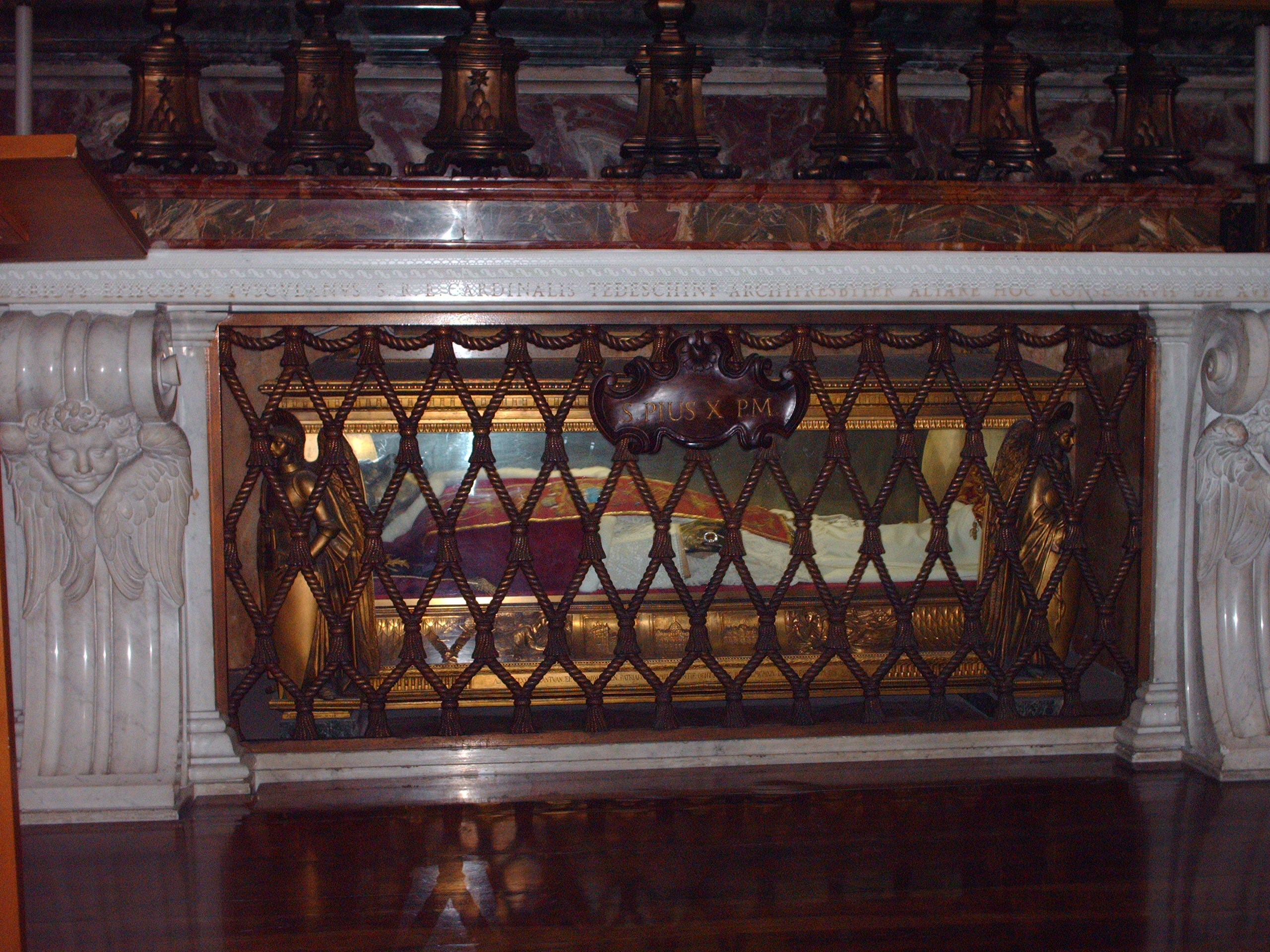
It had been my plan to hear and even serve Mass for the famed Fr "Where's" Withoos, whom I know from my Melbourne days, but in the event I went to the wrong altar - he offered the Sacrifice at St Sebastian's altar, whereas, following the advice of a commenter on a previous post, I had rushed round to St Pius X's altar, where I heard a friend of his say a Low Mass.


Three laymen including myself were in attendance: the priest was French, the server probably also (for he served in the French style, with bells rung at the Little Elevation, and once-twice-thrice at the celebrant's Domine non sum dignus). Again, as is the custom in Rome apparently, it was a dialogue Mass, and one even said the Gloria and Sanctus - I didn't, but bowed to local custom (!) and joined in saying the Agnus Dei responsorially, as the priest seemed to wish us do. Despite us all having said the Confiteor earlier, the pre-1962 third Confiteor was still used. After Mass, the Leonine Prayers were said in Latin.

It seemed best to go pray Matins and Lauds in the Bl Sacrament chapel; walking round, many other priests could be seen at Masses hither and thither, but all Novus Ordo so far as I could see. Weirdly, at one altar a Filipino priest in vestments stood celebrating, with two men in lay clothes standing close either side of him - I shudder to think what nonsense that involved.

(How typical for the poverty and minimalist spirit of the modern liturgy, to see most priests without servers, let alone any in other than lay clothes, when surely the sacristy is brimming over with necessary garments. I attended Benediction at St Peter's yester-day, and there wasn't even a server for the priest, or incense used!)

I stayed in the Basilica till ten in the morning, looking all round, noting down which saint reposed where, and what the monuments of the Popes and others. (Many sainted Popes are buried within the Vatican; under the altars of the Basilica, displayed for the veneration of the faithful, are relics of three Apostles, eleven Popes, two Eastern Doctors, several martyrs, among them St Josaphat, and St Petronilla, Virgin, disciple of St Peter.)

The sacristy and its museum was worth a look, with fantastic reliquaries: several of the True Cross, and others of many saints - including the head of St Luke the Evangelist! In the shop attached I found a handsome standing crucifix, something I've sought for some time, and a steal at €25. Just before leaving St Peter's I read Prime back at the altar of St Pius X.

Next, I had an important meeting at the Congregation for Divine Worship - after a most unsatisfactory sandwich, with which I at last broke my fast - and must now prepare some paperwork for the Ecclesia Dei Commission. I shan't have come 16,500 km without attempting to get satisfaction about the lack of permitted Trad Masses in Tasmania - one would think that in the eyes of a certain Ordinary the Pope's Motu proprio counts for nothing.

I popped into the Carmelite church on the Via della Conciliazione for Terce. Now, after some coffees and pastries I feel sustained, and ought think about my next move...

Thursday, September 10, 2009

Requiem Mass with Organ and Soloist

Ssma Trinità dei Pellegrini is a lovely church, and, being a pilgrim and a Traddie, I feel it is my church in Rome: it owes its foundation to St Philip Neri too.

Last night, I found the Mass was a Requiem, marking the anniversary of some deceased fellow: Requiescat in pace. But there was music, and such music! An organist was playing some great music before Mass, and continued during the prayers at the foot of the altar. Come the Sequence, a strong and talented tenor sang out the thrilling chant of Dies Irae; and at the Offertory, he sang a rather Baroque motet accompanied by the organ. The organ played again - after the Elevation of the chalice! During communion, there was another accompanied solo motet, and after Mass ended, to my utter stupefaction, the soloist sang the Salve Regina, accompanied by organ, in what I recognized was a setting by Marc-Antoine Charpentier.

This was a very grand Roman affair, a Low Mass accompanied by sacred music, the organ being more shall we say Counter-Reformation in style, while the motets were Baroque. I don't wish to appear unkind, but it was, however, quite contra rubricas, since at a Requiem the organ may at most play only to help sustain the chant.

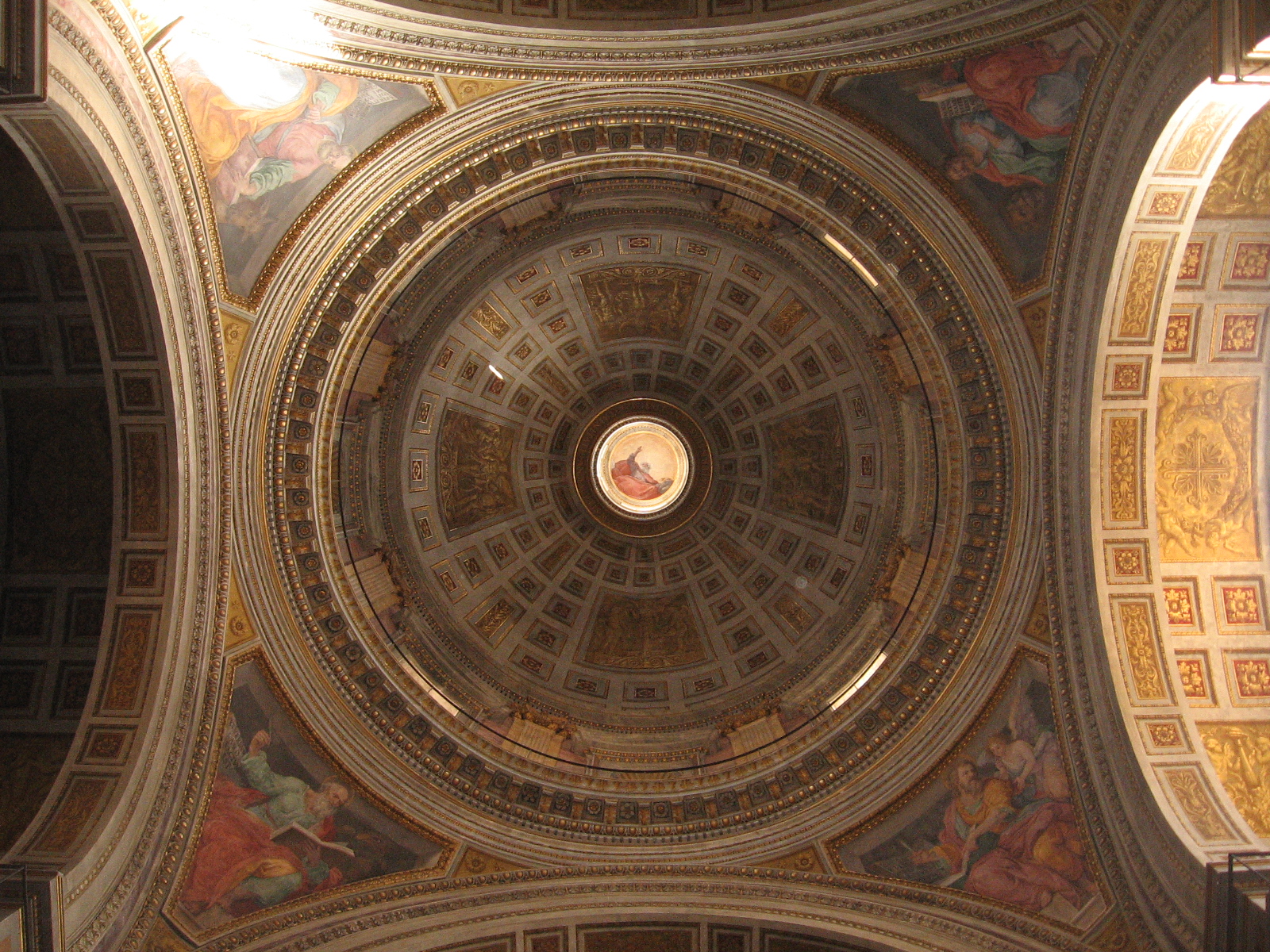
Gazing toward the high altar, one is captivated by the altarpiece, the original needless to say, a huge painting of the Holy Trinity by Guido Reni. High above is written Deo Trino Uni (To God the Three and One), and high, high, exceedingly high up, in the lantern of the dome, is a painting of God the Father Almighty blessing us from on high. You have to crane your neck back till it hurts to see it. What a sight - Pater noster, qui es in caelis...


Benedictione perpetua benedicat nos Pater aeternus. Amen.

Wow!

Wednesday, May 27, 2009

Hole and Corner Mass

I think Luther somewhere inveighs against "hole and corner Masses" - even though he elsewhere postulated, like a forerunner of modernism, that "real Christians" would gather in tiny groups in houses for informal, and somehow therefore more "authentic", true-to-the-Gospel, "evangelical" liturgies.
Early morning before today's trip to Milford Sound found me walking into St Bernard's Church, Te Anau, and checking the time for Mass, which was set for 9am. I returned in due time and waited, waited... I finally walked round to see if there were a presbytery, saw a light on, knocked firmly, waited, knocked again, and was let in by the sole congregant, who was attending Mass as offered by an nice old priest, Fr FitzGibbon, who is hunched over with arthritis or such. By the time I arrived, Fr was already into the Canon - yes, the Roman Canon - and I joined the two of them for Holy Mass. Apparently, weekday Mass when they have it is in the house, not the church; when I asked politely if they could put out a notice to advertise this, they told me that no one ever had come before.
I was struck by several things: evidently Fr reads Mass with attention, but out of some little local New Zealand ringbound publication that substitutes for a Missal (ICEL has been consulted about this copyright issue I believe); and the readings had evidently been taken from a small people's massbook. The necessary vessels and linen were all there, but of the very simplest... Again, I could not join in the very prayer of prayers, the Lord's Prayer, because of the modern N.Z. version being used.
Contrast this with my experience serving private Low Masses: there would be absolutely no question of not using a proper altar, nor of not using a proper Missal, etc., unless driven by necessity - in my opinion, the changeover period in the sixties habituated the clergy and people to ad hoc devices such as reading from photocopies rather than from proper liturgical books, and from this stemmed the vile pseudo-cult of the informal as somehow more meaningful and authentic; which is an aberrant notion that Luther seems to have revived.
(Note: I mean no disrespect to Fr FitzGibbon, who is obviously not in the best of health and so can only do what he can do; it is the general principle of liturgical minimalism that I am critiquing. Indeed, Fr stands for what is right in that he read the Roman Canon, which few modernistic priests ever do - they find it too long and overly sacrificial.)

Monday, May 25, 2009

F.S.S.P. Mass at Christchurch Cathedral

The Cathedral of the Bl Sacrament is a really beautiful building in high Counter-Reformation style - the supreme achievement of the N.Z. architect Francis Petre. Unfortunately, the interior decor (altar, sundry bits of carpet, etc.) are vintage 1970's, but the basilica itself being so spectacular it would be simple enough to improve its fittings and make them fitting to the overall style.

Take the Bl Sacrament Chapel: nasty carpet, secular chairs, a plain table for altar - but the tabernacle behind is quite fine. As I arrived, having walked over from my hotel, the server was putting the candlesticks and altarcards on the altar, and a crucifix above the tabernacle... soon enough Fr Rizzo came in to celebrate Mass, a dialogue Mass (no Third Confiteor, but still the pre-'62 custom of the people kneeling throughout except for standing for the Gospels and sitting for the Offertory).

To-day being the feast of that reforming Pope Gregory VII, who endured much in order to cleanse the filth from the lives of the clergy in his day, Fr Rizzo preached on the indefectibility and holiness of the Church, and the contrast between this and the foibles of her sinful members - as many have said, the great proof of her divine origin is that, despite the dreadful people that have had authority in her, she has lasted down the centuries and shall endure until the end of time. So too, in our own lives, being fallen men yet stamped with the seal of the Trinity in baptism, we sorrow at our human faults but trust in the Lord's grace which gives us hope for heaven.
As well as the Leonine Prayers, Fr led us in the Litany of Our Lady for the repose of the soul of one Br Lawrence, a Marist who died last night: Requiescat in pace. Amen.

After Mass, I had a quick word with Fr Rizzo in the sacristy: he's in fine form as always, ever so cheerful, sincere, unassuming and friendly - evidently his congregation love him. I hope to see him back here in Christchurch come Saturday evening, at his Vigil Mass. (Returning to my hotel for breakfast, I found Fr Rizzo on the front page of the newspaper! Apparently he had to conduct a funeral in very sad circumstances - the deceased having been involved in a murder-suicide, the estranged wife hoping for their son to attend, but the son himself being a fugitive on suspicion of crimes - and the police rather traumatized matters by appearing in great force at the very church and graveside, to the distress of the mourners.)