Showing posts with label Eucharistic Adoration. Show all posts

Friday, July 14, 2017

Eucharistic Adoration

My second-favourite time of the week is the hour I spend kneeling before the Blessed Sacrament exposed on Friday evening (my favourite time of the week, of course, is that spent at Holy Mass). Typically I have time to address God in prayer; to recite hymns, antiphons and prayers in honour of the Blessed Sacrament; to say some of the daily office in some form; to pray over the texts of the Mass (as a Missa sicca); to recite the Rosary; and (should the priest be present) to step aside to make my confession. My only regret is not having more than one hour a week for this: if only it were every day!

Eucharistic Adoration is held every Friday at St Francis, Riverside, Tasmania, from 7 am to 7 pm (save for the usual Friday morning Mass at 9 am), normally concluding with Benediction at 7 pm, but on First Fridays culminating in a Holy Hour from 7 till 8 pm. If even one reader should attend Adoration here or elsewhere, I will be delighted, and beg that they pray for me, a sinner.

Friday, January 6, 2012

Invenerunt Puerum cum Maria Matre ejus, et procidentes adoraverunt eum.


They found the Child with Mary His Mother, (genuflect)
and falling down they adored Him.
— St Matthew ii, 11.

Especially at Christmastide, most especially on the feast of the Epiphany, when I come before the Crib, I love to repeat these words as I kneel to adore the Saviour Whose image I see before me, offering not gold, frankincense nor myrrh, but my heart's oblation, as I find the Child with Mary His Mother, and adore Him with the Magi.

I apply these words when I genuflect before the tabernacle, where He reposes as once in the Manger, within the church, which is the true Bethlehem, verily the "House of Bread".  We must come into the Church to do so: Et intrantes domum, "And entering into the house...".

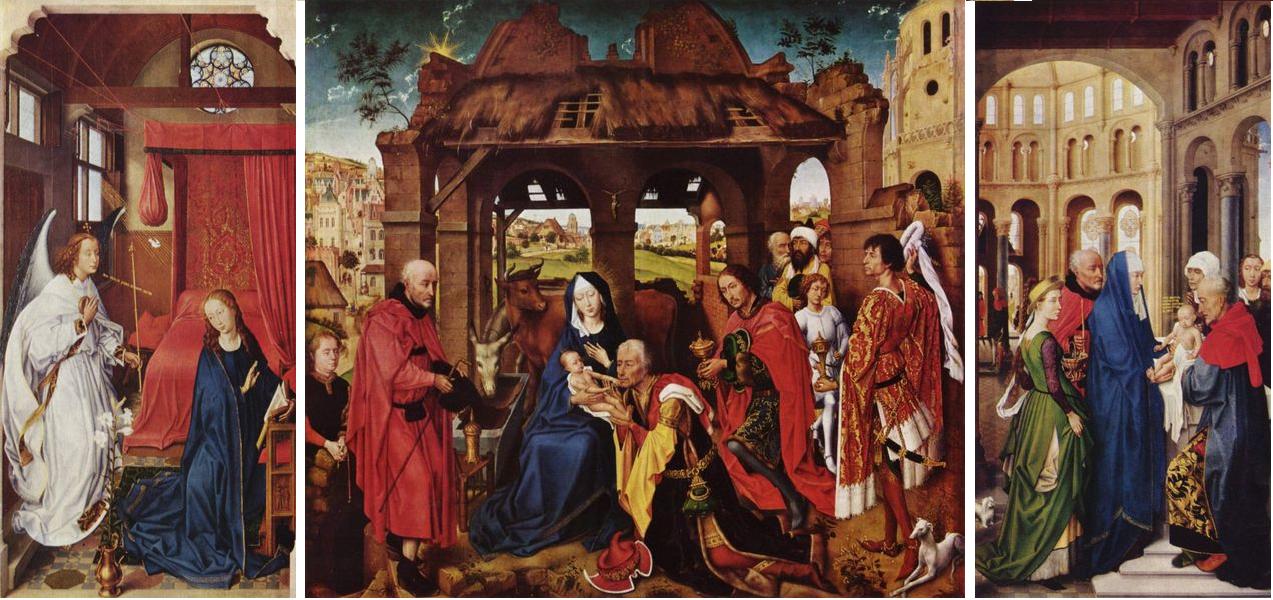
The above image, a triptych known as the Columba altarpiece, by Rogier van der Weyden (1399/1400-1464), I reproduce here because, in my parish church, a reproduction has been placed above the votive candle stand next to Our Lady of Perpetual Succour, and so I light a candle before her and this representation of the Annunciation, Nativity and Presentation of Our Lord, her Son.

Monday, December 28, 2009

Transeamus usque Bethlehem

Transeamus usque Bethlehem, et videamus hoc verbum, quod factum est, quod Dominus ostendit nobis.  Et venerunt festinantes : et invenerunt Mariam, et Joseph, et infantem positum in præsepio.
Let us pass over unto Bethlehem, and let us see this Word, which was made, which the Lord hath shewn unto us.  And they went hastening: and they found Mary, and Joseph, and the Child placed in the manger.
— St Luke ii, 15b-16

This post is a plea for solemn Eucharistic Adoration and Benediction during Christmastide, by which we may intensify as at this time (as is most appropriate) our desire for and spiritual communion with Christ, Who became Man for us, that He might give His Flesh for us, to be our Bread, so we could become partakers of the Divine Nature:

But as from the Highest Place Thou didst for us humble Thyself, submit now to my humility, and as Thou didst consent to lie in the cave and in the manger of dumb beasts, so now consent also to enter in to the manger of my dumb soul and into my defiled body.
— Byzantine Rite, Prayers of Preparation before Holy Communion, 3rd Prayer "by St John Chrysostom"
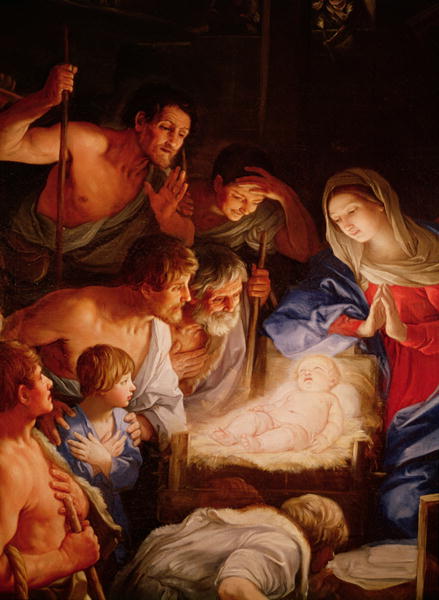
It ought ever be remembered that one of the English-speaking world's favourite carols, "O come, all ye faithful" was originally written by an eighteenth-century Englishman, a Catholic recusant, written in Latin (only done into English in the nineteenth century), and intended for singing, not at Mass (as was unheard of then) but at Benediction at the chapel of the one of the London embassies of Catholic countries.

This hymn, then, was sung in Latin ere ever it was sung in the vernacular.  Proving this, I have a copy of A Companion to the Altar, or Compact Pocket Missal, for all the Sundays, Festivals of Obligation & Devotion &c. &c. in the Year (2nd edition, London: 1796), which gives this hymn as follows in four stanzas  - I copy out the English only, from the left-hand column (the Latin is given on the right):

The Prose, ADESTE FIDELES, sung from Christmas to the Octave of the Epiphany.
Ye faithful souls rejoice and sing,
To Bethlehem your trophies bring:
Before the new-born Angels' King,
Come let us him adore.
Come, &c.

True God of God, true light of light,
Borne in womb of Virgin bright:
Begot, not made, true God of might,
Come let us him adore.
Come, &c.

Angelic Choirs with joy now sing,
Th' heav'nly Courts with echoes ring,
Glory on high to God our King,
Come let us him adore.
Come, &c.

Jesus, whose Life this day begun,
The Father's co-eternal Son,
Glory to him be ever sung:
Come let us him adore.
Come, &c.


Adeste fideles is therefore addressed to Catholic worshippers, and the triple refrain, Venite adoremus Dominum, is an exhortation to adore Our Lord in the Blessed Sacrament exposed in the monstrance on the altar.

Is not Bethlehem "the House of Bread"?  Let us go over to Bethlehem, that is, to the church - the House of Bread - and to the holy altar thereof, whose tabernacle is the holy of holies wherein God rests under the sacramental signs, to behold the Word made flesh for us, concealed in form of bread, nay, not so much veiled as revealed therein by the outward sign: for bread is the staff of life, and the True Bread come down from heaven, better than the ancient manna, feeds us unto life eternal.

After all, what is a cratch or manger but the feeding trough for lowly animals?  Christ laid therein shews forth His extreme kenotic self-giving sacrifice, making Himself food for us debased and fallen creatures.

The Lord has shewn this unto us, that His Onlybegotten Son, Christ, is incarnate for us, having taken our nature upon Him: and He is not far from us, but even in His sacred humanity He is present on our altars, as He has willed.  We can go to Bethlehem!

In our Bethlehem, we will find the Child, God's Eternal Son, reposing in great humility, not displaying His Divine Majesty but rather manifesting His great goodness and desire to nourish us.  And going to Bethlehem, to our church, we shall not find Christ alone - no pretended religion bereft of the communion of saints - but we shall find Him, and His Holy Mother Mary, our Mother also, and St Joseph, Patron of the Universal Church.

Consider now the stanzas of Adeste fideles: we who believe are called urgently to come to Bethlehem, to behold Him Who is born the King of Angels; for He is God from God, Light from Light, true God, begotten not created - as the Nicene Creed sings - and yet (taking flesh) carried in the Virgin's womb.

The shepherds, being called, left their flocks abiding "in tempest, storm and wind" (as another carol exaggerates), and humbly ran to the cradle; so we too should hasten our footsteps, praising.  Likewise come the Magi, wise men, led by the star to Him; they fall down and worship, offering gold, incense and myrrh; so therefore we should offer our hearts to the Christ-Child, God our Jesus, the Eternal Word born a tiny Babe and speechless.

For He is the Splendour Eternal of the Everlasting Father: veiled in the flesh we shall behold Him, God an Infant, wrapt in swaddling bands!  (We may add, in unparalleled humility sacramentally present under the form of bread.)  For us He is born poor and needy, cradled in a manger - in a feeding-trough - and so we ought wish to embrace Him in all piety, loving Him Who so greatly first loved us: what ought we not do for Him as some poor recompense?

The choirs of the angels now sing in jubilation, now sings all heaven, Glory to God in the highest!  (Such is the ceaseless worship of the Godhead by all angels and saints; such is their worship of Christ Incarnate, of Christ's Real Presence.)  Therefore to Thee, O Jesu, born for us this day, be all glory, Thou the Eternal Father's Word made flesh.

What an act of faith to sing this in presence of the Blessed Sacrament!


"O come let us adore Him, Christ the Lord."

Wednesday, December 23, 2009

O Emmanuel

When in past years I lived in Melbourne, and had the chance to pray daily before the tabernacle at St Dominic's, East Camberwell, I used to use Newman's formula for a short visit to the Blessed Sacrament, from his Meditations and Devotions, consisting of an Act of Faith in the Real Presence, and then one of the O Antiphons:

+ In the Name...

I place myself in the presence of Him, in whose Incarnate Presence I am before I place myself there.
I adore Thee, O my Saviour, present here as God and man, in soul and body, in true flesh and blood.
I acknowledge and confess that I kneel before that Sacred Humanity, which was conceived in Mary's womb, and lay in Mary's bosom; which grew up to man's estate, and by the Sea of Galilee called the Twelve, wrought miracles, and spoke words of wisdom and peace; which in due season hung on the cross, lay in the tomb, rose from the dead, and now reigns in heaven.
I praise, and bless, and give myself wholly to Him, who is the true Bread of my soul, and my everlasting joy.

Sunday: O Sapientia...
Monday: O Adonai...
Tuesday: O Radix Jesse...
Wednesday: O Clavis David...
Thursday: O Oriens...
Friday: O Rex Gentium...
Saturday: O Emmanuel...

These Advent anthems are ideal for worship of Christ in the Eucharist, since they capture the yearning for Him that we ought have before the Blessed Sacrament - since there we wish once more to receive Him in Holy Communion, to be in union with Him, and thereby make our spiritual communion with Him - just as the old farmer explained his method of prayer to the Curé of Ars: "I look at the Good God, and the Good God looks at me." That is true Eucharistic Adoration.

Each week I was glad as Saturday came round, since Saturday was the day to pray O Emmanuel, the greatest of these Advent anthems, since it names Our Lord as the Lord our God, come to save us.

(Please follow the link to the chant, the text and the sources of O Emmanuel.)

Friday, June 19, 2009

At Adoration

Stupidly I forgot last night that it was the eve of the Sacred Heart, and so read the wrong Vespers and Compline; oh well.  Because of my late-discovered mistake, I didn't organize myself to get to early Mass, the only Mass I could have attended to-day; but at least there was - unusually - Eucharistic Adoration at Church of the Apostles, the mother-church of Launceston, this afternoon from noon to six o'clock, and I made it along for the last 45 minutes.  It may seem tepid and lukewarm of me, but I simply knelt and read the Day Hours, Vespers, then Matins (which I'd had no time for earlier), just occasionally lifting up my eyes and heart to Our Lord in the Blessed Sacrament.

I would comment to all readers the sweetly devout and loving words of St Bonaventure that comprise the last three lessons of this feast, and also the moving sketch of the growth in devotion to the Sacred Heart down the ages that is given in the middle three lessons.

It was a pity that Adoration did not end with Benediction, and a greater pity that Father saw fit to repose the blessed Sacrament wearing a stole but no alb: it appeared lazy and irreverent.

Many years ago now I was a parishioner at Sacred Heart, New Town, and there learnt what is my customary petition to the Sacred Heart, the prayer that Fr (now Bp) Jarrett had put together and had printed on the back of holy cards of the handsome statue of the Sacred Heart he'd commissioned for the church from Oberammergau, whose plinth bore the inscription "Divine Love in a Human Heart" (from the Australian poet and hymnwriter James McAuley, another former parishioner):

Sacred Heart of Jesus, burning with love for us, inflame our hearts with love for Thee.

Sacred Heart of Jesus, I give myself to Thee, through Mary.

Jesus, gentle and humble of heart, make my heart like unto Thine.

May the Sacred Heart of Jesus be ever loved, praised and adored.

Sacred Heart of Jesus, bless and protect our families.

Sacred Heart of Jesus, our peace and reconciliation, have mercy on us.

Friday, May 23, 2008

Mass coram Sanctissimo

As is the custom at the Pro., after Adoration all afternoon, tonight our Corpus Christi Missa Cantata was sung before the Blessed Sacrament exposed, with Procession and Benediction (accompanied with the Pange lingua of course) immediately afterward. Quartessence gave us Byrd's Mass for four voices (but with Kyrie in plainchant, Credo III sung by all, and only the last invocation of the Agnus Dei in polyphony, so as not to hold up communion), together with the rest of the Gregorian Proper (but for psalm-toning the Gradual and Alleluia to save time by reason of the long Sequence), an Offertory Motet - Cantate Domino (Ps 95:1-3) by Hassler, quite my favourite - and two Communion Motets: Panis angelicus and O sacrum convivium. To conclude, we sang St Alphonsus' "O Bread of heaven" (see an earlier posting of this).

I had forgotten that this special day the Mass is said coram Sanctissimo, and was delighted to have this privilege. Again, after Lauds, Prime and Terce before work, Sext at lunch, and None after finishing up for the day, I was able to come to the church in time to be shriven, and then say Matins (out of order) and Vespers before Our Lord in the monstance upon the exposition throne, and to pray the Canon for Holy Communion (of which a version is linked to here) as part preparation for so great a Guest. As Fr Rowe said at the end of his sermon, Aquinas tells us that the effect of the Sacrament is the transformation of men into God, and as St Thérèse said, Our Lord does not descend from heaven to dwell in a golden ciborium, but rather to dwell in another heaven, the faithful heart. To make some thanksgiving, I used the Byzantine prayers after Holy Communion.

A friend and visitor to this blog, Peter from Bunbury, has come up for a while, and was at Mass; afterward, he and I had dinner with Fr Rowe and watched his DVD of The Lion, the Witch and the Wardrobe. Peter will not be with us much longer: he flies to the States on the 15th of June to join the Carmelite Monks in Wyoming.

Monday, January 28, 2008

Mass, Rosary - and Nocturnal Adoration

This evening's Low Mass was in honour of St Peter Nolasco, one of the founders of the Mercedarians, with commemoration of the second feast of St Agnes. (Confusingly enough, being back to saying the new Office, therein it was the feast of St Thomas Aquinas!) I managed to say my Rosary afterward, in thanksgiving - I say 'managed', because I haven't managed to get round to saying it for some time, because of lukewarmness.

Quite unexpectedly, after returning home and eating some of the Moroccan chicken dish left over from Sunday night, I received a phone call for one of my housemates: it seems owing to some unforeseen circumstance he couldn't make it to his time slot at adoration - I was asked, Could I step in for him? So it was I ended up at nocturnal adoration for 3/4 of an hour; finding myself still very lukewarm, I invoked the Lord as indeed the faithful God, with His Father and Their Spirit in the unity of the Trinity, and recalled St Paul's words to Timothy: "We may be unfaithful, but He is always faithful, for He cannot deny His Own Self" (II Tim. ii, 13). I used the time to make some mental prayer, plus say some Office and other vocal prayers, wishing I were more devout in presence of the Lord. What to pray but to pray with the prophet: Turn thou us and we shall be turned, save us and we shall be saved (cf. Lam. v, 21; Jer. xvii, 14; xxxi, 18).

The Brothers of the Oratory meet tomorrow at the Pro., 6.30-7.30pm, but - wouldn't you know it! - I have an important engagement elsewhere at just that time, and cannot come (tho' I should be able to join them for dinner and conversation later on). So tonight I used some of the prayers I would have prayed with them tomorrow...

Monday, January 21, 2008

Addo & Recco

My housemates have been talking about addo and recco - now, is it just me, or are these terms little-known outside of fervent Catholic youth circles in Perth?


For the record, both are typical bits of understated Aussie slang:

"addo" is (Eucharistic) adoration;

"recco" is reconciliation, or confession.


Apparently in the last ten years it's become the done thing to organize "addo and recco", referred to as such, for Catholic youth camps, conferences, etc.


Maybe these words can now take on a wider use. :-)