Showing posts with label Ave Maria. Show all posts

Friday, December 7, 2012

Three Hail Mary's

The devotion of the three Hail Mary's – said morning and evening to honour the Immaculata, for the grace to avoid mortal sin – is an excellent and Catholic custom, especially propagated by St Leonard of Port Maurice.

According to the wise counsel of St Alphonso, after each Ave, say, "By thy pure and immaculate conception, O Mary, make my body pure and my soul holy." (Per tuam puram et immaculatam conceptionem, O Maria, redde purum corpus meum et sanctam animal meam.)

I like to also add, in honour of Mary Immaculate, the prayer of the Miraculous Medal: "O Mary conceived without sin, pray for us who have recourse to thee."

Ave Maria purissima!

Saturday, October 17, 2009

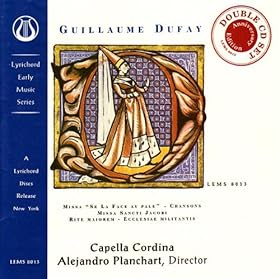
Dufay Mass, and a Motet


(Kyrie from Dufay's Missa "Se la face ay pale")

I have a CD of a vintage recording (directed by Planchart) of Guillaume Dufay's Mass "Se la face ay pale" - Jennifer told me the performance is a bit dated, but I rather like it. Anyhow, I've just ordered a CD of a different performance (directed by Binkley), which as a bonus comes with the chants, prayers and readings of the Nuptial Mass.

Why a Nuptial Mass? Because Dufay's famous Mass setting is the first cantus firmus Mass based on a secular chanson - Se la face ay pale is a rather predictable late mediæval love-song about suffering pangs of love for a puissant lady, complete with a play on words ("love", "bitter" and "sea" all sound much the same in French), which Dufay set to music in the 1430's - and it is thought this Mass was first sung at a royal or ducal wedding about 1450. With the passage of time, what would have fallen under the condemnation of Trent against sacred music making profane allusions is now quite acceptable!

Here is the text (the first part), with a rather clumsy translation:

Se la face ay pale,
la cause est aimer,
c'est la principale
et tant m'est amer aimer
qu'en l'amer me voudroye voir.

Or scet bien de voir,
la belle a qui suis
que nul bien avoir
sans elle ne puis.

If [my] face is pale,
the cause is love,
that is the principal,
and so bitter it is to love
that I want to throw myself into the sea [!].

Now she knows well,
the lady whom I serve,
that without her
I cannot be happy.

See what I mean about a rather ordinary collection of clichés? But the Mass is very beautiful.

******

As all men know, it is de rigueur to sing Ave Maria at a wedding: and I think this sentiment Catholic and orthodox, howsoever modern liturgists may complain, since after all the Orthodox sing a Megalynarion to the Mother of God just after the very Consecration at every Liturgy, and it seems strange at a wedding to make no plea whatsoever to Our Lady, who is our "most gracious advocate", as well as in her marriage to St Joseph a most holy model for all.


(Raphael's Marriage of the Virgin)

You'd think that at the Reform of the Liturgy some effort would have been made to add some reference in the marriage rites to Holy Mary and her most chaste spouse. But no: in fact, to add insult to injury, the modern recension of the Nuptial Blessing (to which two 1960's compositions have been added, as alternatives) dumps the reference to Rachel, Rebecca and Sarah, and the former final blessing, invoking the God of Abraham, Isaac and Jacob, has been entirely removed from the Novus Ordo. So much for a return to the sources: out with Abraham and Sarah, Isaac and Rebecca, Jacob and Rachel.

The Introit, too, alluding to Tobias and Sarah, has been left out of the new Gradual. Only reference to our first parents Adam and Eve, and to Christ's mystical marriage to the Church, seem to have survived. Predictably, given the vast selection of readings that bemused couples must choose from, the readings from Tobit, or what St Paul says to the Ephesians, are left aside in favour of I Corinthians xiii, used shamelessly at both weddings and funerals (even dreadful Diana's).

Now, while singing Ave Maria is all very well, the Bach-Gounod, let alone the Schubert settings are so hackneyed and dripping with sugary sentiment as to be a bit vulgar. Better is a restrained, tasteful polyphonic setting. But I am amused to learn that my favourite Ave Maria, while attributed to Victoria, is in fact almost certainly a late forgery, which first appears in print in the 19th century, and has no manuscript evidence for it at all! At least it is good counterpoint, clear and devout, not too difficult for four voices to sing successfully.

Saturday, January 10, 2009

Mediatrix of All Graces

After confession this morning I recited Matins and Lauds, and in so doing was reminded, it being the prayer to-day, of the Marian Collect Deus qui salutis æternæ on which I blogged earlier:

Deus, qui salutis æternæ, beatæ Mariæ virginitate fœcunda, humano generi præmia præstitisti: tribue, quæsumus; ut ipsam pro nobis intercedere sentiamus, per quam meruimus auctorem vitæ suscipere, Dominum nostrum Jesum Christum Filium tuum: Qui tecum vivit...

(God, Who didst grant unto the human race the reward of eternal salvation through the fruitful virginity of blessed Mary, grant, we beg, that we may feel her to intercede for us, through whom we have deserved to receive the Author of life, Our Lord Jesus Christ: Who with Thee liveth...)

This prayer is used on the Octave Day of Christmas, marking it out as a Marian feast - the Novus Ordo has aptly renamed it the Solemnity of Mary Mother of God - as well as the recapitulation of the Christmas mystery and the remembrance of Our Lord's Circumcision.  But it is also used on the ferias of Christmastide from the 2nd to the 5th of January; and for Saturdays when Our Lady's Office and Mass is said from the Saturday after the Octave of Christmas until the Saturday before the Purification of Our Lady (which again is now styled the Presentation of Our Lord) inclusive; last but not least, it is the oration appended to the Alma Redemptoris Mater after Compline every day from the 24th of December (Christmas Eve) until the 1st of February (Eve of the Purification) inclusive, for a total of 40 days, a tithe of the year.

What of this Collect?  It teaches the doctrine that Our Lady is the Mediatrix of All Graces.

What this doctrine?  That, as from all eternity God freely and almightily chose to bring into the world His Son Incarnate - the very Source of all grace - from the Virgin's spotless womb, she is therefore the Porta cæli, the Gate of heaven, and so is the Mediatrix of Grace, which is nothing other than to call her by her right name Mother of God; and further, as a corollary, it is entirely reasonable and religious to acknowledge that God, Who does nothing by caprice, but all things in harmony, has not changed, but likewise wills to grant all graces at her maternal intercession with her Son and God, our one Redeemer and Mediator between God and man (I Tim. ii, 5): for at the Annunciation, Our Lady stood in the place of all mankind when she graciously consented to God's plan for restoring lost creation, and in this place she stands still, just as she stood stedfast beneath the Cross, and stedfast prayed in the Upper Room for the coming of the Promised Paraclete to vivify and sanctify the nascent Church.

Does this make of her a goddess or sorceress?  By no means!  She waves not her hands as if to work lying wonders on her own like some pagan pretender, but she as every Christian most humbly supplicates that the Divine Will may be done, as in heaven, so on earth, as her Son hath taught is to be ever our rule of prayer (St Matthew vi, 9f).  This is her actual intercessory coöperation with the granting of every grace.  For surely every man knows that the saints in heaven are ever worshipping the Lord and in their undying charity a-praying for us!

Indeed, if we one and all are co-redeemers with Christ as the Apostle teaches (cf. Col. i, 24), and if one and all are to cease not from petition, supplication and intercession, are we not even here on earth mediators in the One Mediator (cf. I Tim. ii, 1-5)?  And much the more so are God's elect and chosen angels and saints; and supremely so is she who alone is Virgin Mother of the Word made flesh.  For as St Gregory the Great said, God has determined from all eternity to grant graces in response to prayer.  

Our Lord God delights to work through secondary causes, as the great chain of causality in His Creation all about us shews; likewise with things spiritual - as instanced by His care of us at the hands of ministering angels, and at the hands of our lawful pastors, and through His Revelation mediated to us "whether by letter or by word of mouth" (II Thess. ii, 15) - that is, via Scripture and Tradition - and through His Sacraments which are real contacts with the grace won for us on Calvary by His bleeding, dying Son.  It is the same with the united ceaseless intercession of all the saints, and by simple logic the preëminent prayer of the Mother of Our Lord, her special and uniquely maternal solicitude for us all, seeing that we were all given her as children in the order of grace by Christ from the Cross, in the person of St John (St John xix, 26f).


Does not Catholic piety, the sensus fidelium, the feeling of the faithful, confirm this?  Is she not styled Mother of Perpetual Succour, and a thousand other titles illustrating her office?  In every anguish and distress, every faithful Christian turns at once and says an Ave: 

Hail Mary, full of grace, the Lord is with thee.  Blessed art thou amongst women and blessed is the fruit of thy womb, Jesus.  Holy Mary, Mother of God, pray for us sinners, now and at the hour of our death.  Amen.

Thursday, January 1, 2009

Maria Mater Dei

To-day is the Octave Day of Christmas; the oldest sources relate that in Rome this was once held as a fast-day in detestation of idol-worship, but was soon solemnized as the eighth day of the Yuletide solemnities.  The Office for this day apparently stems from the Christmas Office as celebrated, not at St Peter's, but at St Mary Major's; as it has a more Marian orientation, while still celebrating the inexpressible joys of Our Saviour's birth, in the modern Roman Rite it has been renamed the Solemnity of Mary Mother of God, thus happily taking over the thought of the feast thereof held on the 11th October from 1931 until the postconciliar reforms.  Viewing this celebration from another angle, being the eighth day after His Birth it is also called the Feast of the Circumcision (St Luke ii, 21 - the very short Gospel read at to-day's traditional Mass), recalling how Our Lord, was born of a woman, born a subject of the Law, to redeem those subject to the Law and enable us to receive the adoption of sons (Galatians iv, 4-5).

(Icon of the Mother of God, Health of the Roman People, in the Borghese chapel at St Mary Major, Rome.)

 St Elizabeth acknowledged her "the Mother of my Lord" (St Luke i, 43); how wonderful is this great title of the Blessed Virgin - to be Mater Dei, to be Theotokos! 

No more intimate relationship to God can be conceived.  In Suarez' immortal phrase, "She touched the hem of the Divinity". 

Hail, Mary,
full of grace,
the Lord is with thee.
(St Luke i, 28)

Blessed art thou amongst women,
and blessed is the fruit of thy womb, Jesus.
(St Luke i, 42)

Holy Mary,
Mother of God,
pray for us sinners,
now and at the hour of our death.
Amen.

The Traditional Collect of this splendid feast is also that used with the Marian anthem Alma Redemptoris Mater from Christmas until the Presentation of the Lord:

Deus, qui salutis æternæ, beatæ Mariæ virginitate fœcunda, humano generi præmia præstitisti: tribue, quæsumus; ut ipsam pro nobis intercedere sentiamus, per quam meruimus auctorem vitæ suscipere, Dominum nostrum Jesum Christum Filium tuum: Qui tecum vivit...

(God, Who didst grant unto the human race the reward of eternal salvation through the fruitful virginity of blessed Mary, grant, we beg, that we may feel her to intercede for us, through whom we have deserved to receive the Author of life, Our Lord Jesus Christ: Who with Thee liveth...)

(More about New Year, to-day's feast(s) and so forth can be found at my post for the 1st of January 2008.)

Sunday, November 30, 2008

How Many Ave's for Australia?

I've heard one and a half Masses to-day...

I had thought the ladies' choir was to sing, but as usual their choirmistress hadn't turned up (she's always ill, poor thing; Fr needs to get new people for these posts, as those supposedly in command never seem to make it to Mass), and it looked as if there was to be no 9.15 am Missa cantata - but yours truly came to the rescue, albeit doing a rather botched job of it as usual.  By this time I sing awry without shame.  

After starting our processional hymn too low, wavering through the Introit on my own, and then giving a completely incorrect intonation for the Kyrie, luckily one of the ladies was good enough to take over - why she and the others don't lead and direct themselves, I don't know, they certainly have the voices for it; I must encourage them before I leave these shores - and the rest of Mass went off smoothly, and I even executed the rest of the Proper (still alone) without trouble, using Rossini's psalm-tone settings since the real Gregorian is too hard for me by myself as a rank amateur without any musical training.  

For the record, we sang "O come, O come, Emmanuel" for processional (first three verses) and recessional (last four), Missa de Angelis (sine Gloria of course), and our old standbys, Ave maris stella for Offertory and Adoro te devote at Communion.  As is our custom at the Pro., Benedicamus Domino was sung at the finish of the liturgy, not Ite missa est as the '62 prescribes even during Advent.  If I'd had time to get organized before Mass, I would have had us all sing something more appropriate for Advent, such as Alma Redemptoris Mater and Cónditor alme siderum, I mean Creator alme siderum, as "motets"; and (with a bit of practice) Rorate cæli desuper.

(BTW, remember what Fr Z taught on-blog: never pronounce Conditor (Creator) as Condítor, but always as Cónditor - because Condítor means "Pickler", being derived from condire, whereas Cónditor comes from cóndĕre.  To sing "O loving Pickler of the stars" would be insane.)

Before the last-minute pre-Mass rush (as we had perforce to wait to consult Fr as he was hearing confessions), I'd already done Lauds and part of Prime, which I finished during the parish notices after the Gospel, before the sermon.  My thanksgiving had to consist of the Adoro te, plus Terce after Mass.  We all then milled about outside the church before going for a coffee; it was good to meet a new parishioner, Ambrose, who's from Melbourne and has been lucky enough to have Fr Paul Newton, a sterling priest and a friend of mine, for his parish priest and spiritual director.

After coffee and a sandwich, I decided to pop back into the Pro. during the 11.15 am Low Mass for to say my prayers, and took the vacant spot, the same one I'd had at the 9:15 Mass actually while "directing" the choir pro tempore - the organ console seat, and the tiny kneeler wedged into the back lefthand corner between the console, pipes and wall!  Having arrived during the sermon (which was good, but which I'd already heard) I simply opened up to Matins, and read this followed by Sext, which took until the Last Gospel - of course, I looked up and adored at the Elevation and the Ecce Agnus Dei.  Having joined in singing the first three verses of "O come, O come, Emmanuel" again (this time on-note), I said a few prayers (those of St Thomas Aquinas and St Bonaventure, etc.), and caught up with some other friends before heading home.

During Fr's comments at sermon time, he told of his attendance at the recent FSSP ordinations in Canberra, and reminded us that Fr Sumich FSSP was ordained yesterday in New Zealand, and by our morning Mass here would have already have offered his first Mass.  Apparently Fr Sumich is a missionary in Nigeria, about to return as priest to a very poor but very populous and fervent parish.  Ad multos annos!

Nigerian Catholics put us all to shame: to atone for "the sins of Nigeria" they have the devotion of gathering in good numbers in church, at 6 am, to pray 2000 Hail Mary's in reparation, which takes them 9 hours straight, without pause, until 3 pm, when the Holy Sacrifice is offered up.  

How many Ave's should we be saying to atone for Australia's sins?

Monday, September 8, 2008

Our Lady's Birthday

Of your charity, please salute Our Lady today on this the feast of her birth, nine months after the feast of her Immaculate Conception:

Ave, Maria, gratia plena, Dominus tecum, benedicta tu in mulieribus, et benedictus fructus ventris tui, Jesus.

And after the Angelic salutation, to which St Elizabeth's blessing of Our Lady is attached, please, when praying to Holy Mary, remember me, a sinner in need of prayers:

Sancta Maria, Mater Dei, ora pro nobis peccatoribus, nunc et in hora mortis nostræ.  Amen.

Wednesday, June 11, 2008

Ten Hail Mary's

After work, I stopped off at the Redemptorist Monastery for confession; and was kept waiting for 20 minutes! I'm afraid I made a complaint... Anyhow, the confessor gave me ten Ave's for (unrelated) sins, and the extra waiting gave me a chance to finish off a lot of Office.

And how amazing, that by the voice of the priest my sins should be absolved on earth, and so in heaven; and that the frightful endless punishment due to my sins should be remitted; and that my act of satisfaction should be something in the eyes of the world so slight, but in power and consequence so mighty - the imploring the prayers of Blessed Mary, Mother of God and Virgin. For as God was pleased to bring into the world His Son, our Saviour, as God and Man through her and at her consent, so He is pleased to distribute the graces of His Son's Passion through her, who is full of grace, the throne of grace.

Hail, Mary,
full of grace,
the Lord is with thee.

Blessed art thou among women,
and blessed is the fruit of thy womb,
Jesus.

Holy Mary,
Mother of God,
pray for us sinners,
now
and at the hour of our death.

Amen.

After being laved in the Lamb's Blood, I went and donated some of mine - this evening was my 28th blood donation via the Australian Red Cross. If He poured out every drop for me, that I might have supernatural life and not death, ought I not spare some of mine to help the natural lives of my fellows? It is one of my few good deeds, and I write this not to brag (which would be silly anyway, since it's hardly a big ask to give blood) but to persuade others to donate too, since this would help supply the continual need for clean blood and blood products. (Apparently, in other, more benighted countries, donors are paid to give blood - which seems almost immoral to me and obviously productive of dangers to the blood supply from desperate and/or unscrupulous persons, who shouldn't donate but do so to get cash.) Here in Australia, blood donation has always been unpaid and voluntary; I encourage all to donate who can.

Oh, and today is the feast of St Barnabas the Apostle, the "son of consolation". God, of course, is the God of all consolation (cf. II Cor. i, 3-4: which is the ferial capitulum at Vespers every night except Saturday, a very blessing of God at the beginning of the second half of the Hour), our great Consolation; His Son (cf. I St John ii, 1), and His Spirit (cf. St John xiv, 16), our Advocates, Comforters, and Counsellors. Gloria Trinitati!